Inducing Script Structure from Crowdsourced Event Descriptions
via Semi-Supervised Clustering
Lilian D. A. Wanzare Alessandra Zarcone Stefan Thater Manfred Pinkal
Universit¨at des Saarlandes Saarland, 66123, Germany
{wanzare,zarcone,stth,pinkal}coli.uni-saarland.de
Abstract
We present a semi-supervised clustering approach to induce script structure from crowdsourced descriptions of event se-quences by grouping event descriptions into paraphrase sets (representing event types) and inducing their temporal order. Our model exploits semantic and posi-tional similarity and allows for flexible event order, thus overcoming the rigidity of previous approaches. We incorporate crowdsourced alignments as prior knowl-edge and show that exploiting a small number of alignments results in a substan-tial improvement in cluster quality over state-of-the-art models and provides an ap-propriate basis for the induction of tempo-ral order. We also show a coverage study to demonstrate the scalability of our ap-proach.
1 Introduction
During their daily social interactions, people make seamless use of knowledge about standardized
event sequences (scripts) describing types of
ev-eryday activities, orscenarios, such asGOING TO
THE RESTAURANT or BAKING A CAKE (Schank
and Abelson, 1977; Barr and Feigenbaum, 1981). Script knowledge is often triggered by the broader discourse context and guides expectations in text understanding and makes missing events and ref-erents in a discourse accessible. For example, if we hear someone say “I baked a cake on Sunday. I decorated it with buttercream icing!”, our script knowledge allows us to infer that the speaker must have mixed the ingredients, turned on the oven, etc., even if these events are not explicitly men-tioned. Script knowledge is relevant for the com-putational modeling of various kinds of
cogni-tive abilities and has the potential to support NLP tasks such as anaphora resolution (Rahman and Ng, 2011), discourse relation detection, semantic role labeling, temporal order analysis, and appli-cations such as text understanding (Cullingford, 1977; Mueller, 2004), information extraction (Rau et al., 1989), question answering (Hajishirzi and Mueller, 2012).
Several methods for the automatic acquisition of script knowledge have been proposed. Semi-nal work by Chambers and Jurafsky (2008; 2009) provided methods for the unsupervised wide-coverage extraction of script knowledge from
large text corpora. However, texts typically
only mention small parts of a script, banking on the reader’s ability to infer missing script-related events. The task is therefore challenging, and the results are quite noisy.
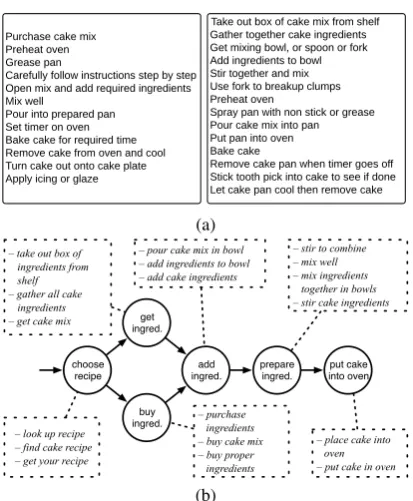
The work presented in this paper follows the ap-proach proposed in Regneri et al. (2010) (hence-forth “RKP”) who crowdsourced scenario de-scriptions by asking people how they typically carry out a particular activity. The collected event sequence descriptions provide generic
de-scriptions of a given scenario (e.g. BAKING A
CAKE) in concise telegram style (Fig. 1a). Based
on these crowdsourced event sequence descrip-tions or ESDs, RKP extracted high-quality script knowledge for a variety of different scenarios, in the form of temporal script graphs (Fig. 1b). Tem-poral script graphs are partially ordered structures whose nodes are sets of alternative descriptions denoting the same event type, and whose edges ex-press temporal precedence.
While RKP employ Multiple Sequence
Align-ment (MSA) (Durbin et al., 1998), we use a
semi-supervised clustering approach for script struc-ture induction. The choice of MSA was motivated by the effect of positional information on the tection of scenario-specific paraphrases: event
Purchase cake mix Preheat oven Grease pan
Carefully follow instructions step by step Open mix and add required ingredients Mix well
Pour into prepared pan Set timer on oven Bake cake for required time Remove cake from oven and cool Turn cake out onto cake plate Apply icing or glaze
Take out box of cake mix from shelf Gather together cake ingredients Get mixing bowl, or spoon or fork Add ingredients to bowl Stir together and mix Use fork to breakup clumps Preheat oven
Spray pan with non stick or grease Pour cake mix into pan Put pan into oven Bake cake
Remove cake pan when timer goes off Stick tooth pick into cake to see if done Let cake pan cool then remove cake
(a) choose recipe buy ingred. add ingred. prepare ingred. put cake into oven get ingred.
– look up recipe
– find cake recipe
– get your recipe
– take out box of ingredients from shelf
– gather all cake ingredients
– get cake mix
– purchase ingredients
– buy cake mix
– buy proper ingredients
– place cake into oven
– put cake in oven
– stir to combine
– mix well – mix ingredients
together in bowls – stir cake ingredients
– pour cake mix in bowl
– add ingredients to bowl – add cake ingredients
[image:2.595.78.285.58.309.2](b)
Figure 1: Example ESDs (a) and induced script
structure (b) for the BAKING A CAKE scenario
from Wanzare et al. (2016)
scriptions occurring in similar positions in ESDs tend to denote the same event type. However, MSA makes far too strong an assumption about the temporal ordering information in the ESDs. It does not allow for crossing edges and thus must assume a fixed and invariable order, while the or-dering of events in a script is to some degree
flex-ible (e.g., one canpreheat the ovenbefore or after
mixing ingredients). We propose clustering as an alternative method to overcome the rigidity of the MSA approach, and use a distance measure based on both semantic similarity and positional similar-ity information, making our clustering algorithm sensitive to ordering information, while allowing for order variation in the scripts.
Clustering accuracy depends on the reliabil-ity of similarreliabil-ity estimates, but scenario-specific paraphrase relations are often based on scenario-specific functional equivalence, which cannot be easily determined using semantic similarity, even if complemented with positional information. For
example in the FLYING IN AN AIRPLANE
sce-nario, it is challenging for any semantic
simi-larity measure to predict that walk up the ramp
and board plane refer to the same event, as the broader discourse context would suggest. To ad-dress this issue, we propose a semi-supervised ap-proach, capitalizing on previous work by Klein et
al. (2002). Semi-supervised approaches to cluster-ing have shown that performance can be enhanced by incorporating prior knowledge in the form of a small number of instance-level constraints. We automatically identify event descriptions that are
likely to cause alignment problems (called
out-liers), crowdsource alignments for these items and incorporate them as instance-level relational seeds into the clustering process.
Lastly, a main concern with the approach in RKP is scalability: temporal script graphs are cre-ated scenario-wise in a bottom-up fashion. They represent only fragments of the rich amount of script knowledge people use in everyday commu-nication. In this paper we address this concern with the first assessment of the coverage of exist-ing script resources, and an estimate of the con-crete costs for their extension.
2 Data
We will now introduce the resources used in our study, namely the datasets of ESDs, the gold stan-dards and the crowdsourced alignments between event descriptions.
Datasets and gold standards. Three large
crowdsourced collections of activity descriptions in terms of ESDs are available: the OMICS cor-pus (Gupta and Kochenderfer, 2004), the SMILE corpus (Regneri et al., 2010) and DeScript corpus (Wanzare et al., 2016). Sections 3-4 of this paper focus on a subset of ESDs for 14 scenarios from SMILE and OMICS, with on average 29.9 ESDs per scenario. In RKP, in the follow-up studies by Frermann et al. (2014) and Modi and Titov (2014) as well as in the present study, 4 of these scenarios were used as development set and 10 as test set.
RKP provided two gold standard datasets for
this subset: theRKP paraphrase datasetcontains
judgments for 60 event description pairs per
sce-nario, the RKP temporal order dataset contains
60 event description pairs that are separately an-notated in both directions, for a total of 120 dat-apoints per scenario. In order to directly evalu-ate our models for clustering quality, we also
cre-ated a clustering gold standard for the RKP test
event1. Every ESD was fully aligned with
ev-ery other ESD in the same scenario. Based on the alignments, we derived gold clusters by group-ing the event descriptions into gold paraphrase sets (17 clusters per scenario on average, ranging from 10 to 23).
In addition, we used a subset of 10 scenarios with 25 ESDs each from DeScript, for which Wan-zare et al. (2016) provided gold clusters, to evalu-ate our models and to demonstrevalu-ate that our method is independent of the specific choice of scenarios.
Crowdsourced alignments. To provide seed
data for the semi-supervised clustering algorithm, we crowdsourced alignments between event de-scriptions, following the procedure in Wanzare et al. (2016). First, we identified challenging cases
of event descriptions (called outliers), which we
expected to be particularly informative and help improve clustering accuracy. To this purpose, an (unsupervised) clustering system (Affinity Propa-gation, see below) was run with varying parameter settings. Those event descriptions whose nearest neighbors changed clusters across different runs of the system were then identified as outliers (see Wanzare et al. (2016) for more details). A comple-mentary type of seed data was obtained by select-ing event descriptions that did not change cluster
membership at all (calledstable cases).
In a second step, groups of selected descriptions (outliers and stable cases) in their original ESD were presented to workers in a Mechanical Turk experiment, paired with a target ESD. The work-ers were asked to select a description in the tar-get ESD denoting the same script event (e.g. for
BAKING A CAKE:pour into prepared pan→pour
cake mix into pan). We aimed at collecting two sets of high-quality seeds based on outliers and stable cases, respectively, each summing up to 3% of the links required for a total alignment between all pairs of scenario-specific ESDs (6% links in to-tal). To guarantee high quality, we accepted only items where three (out of up to four) annotators agree. We checked the annotators’ reliability by comparing their aligments for stable cases against the gold standard and rejected the work on 3% of the annotators.
We collected alignments for 20 scenarios: for
the test scenarios of the SMILE+OMICS dataset,
and for those in the clustering gold standard of
De-1This annotation was rather costly, so each scenario was
aligned by one annotator only.
Script. For the latter, a collection of alignment data was already available, but considerably dif-fered in size between scenarios and was in general to small for our purposes.
3 Model
We first present a semi-supervised clustering method to induce script events from ESDs using crowdsourced alignments as seeds (Section 3.1). In Section 3.2, we describe how we calculate the underlying distance matrix based on semantic and positional similarity information. In Section 3.3, we describe the induction of temporal order for the script events, which turns the set of script events into a temporal script graph (TSG).
3.1 Semi-supervised Clustering
We use the crowdsourced alignments between event descriptions as instance-level relational
seeds for clustering, more specifically asmust-link
constraints, requiring that the linked items should go into one cluster. We incorporate the constraints into the clustering process following the method in Klein et al. (2002): that is adapting the input dis-tance matrix in a pre-processing step, rather than directly integrating the constraints into the cluster-ing algorithm. This makes it possible to try dif-ferent adaptation strategies, independently of the specific clustering algorithm, and the adapted ma-trices can be straightforwardly combined with the clustering algorithm of choice. Klein et al. (2002) handle must-link constraints by modifying the
in-put matrix D in the following way: if two
in-stances i and j are linked by a must-link
con-straint, then the corresponding entry Di,j is set
to zero, which forcesi andj to be grouped into
the same cluster by the underlying clustering algo-rithm. In addition, distance scores for instances in
the neighborhood ofiorjare affected: if the
dis-tance is reduced for one pair of insdis-tances, triangle-inequality may be violated. An all-pairs-shortest-path algorithm propagates must-link constraints to
other instances inDthat restores triangle
inequal-ity.
We use a modified version of this approach. First, as the crowdsourced information may not be completely reliable, the clustering algorithm should be able to override it. We thus do not set
Di,j to zero but rather to a small constant value
d, that is the smallest non-identity distance value
inherent transitivity of paraphrase judgments to
derive additional constraints: if (i, j) and (j, k)
are must links, we assume the pair (i, k) to be a
must link as well, and set the distance tod. After
the additional constraints are derived, the all-pairs-shortest-path algorithm is applied to the input ma-trix as in Klein et al. (2002).
We experimented with various state-of-art clus-tering algorithms including Spectral Clusclus-tering and Affinity Propagation (AP). The results pre-sented in section 4 are based on AP, which proved to be most stable and provided the best results. Determining the number of event-clusters.
AP uses a parameterp, which influences the
clus-ter granularity without declus-termining the exact num-ber of clusters beforehand. There is considerable variation between the optimal number of clusters between scenarios, depending on how many event types are required to describe the respective activ-ity patterns (see Section 2). We use an unsuper-vised method for estimating scenario-specific
set-tings of p, using the mean Silhouette Coefficient
(Rousseeuw, 1987). This measure balances op-timal inter-cluster tightness and intra-cluster dis-tance, making sure that the elements of each clus-ter are as similar as possible to each other, and as dissimilar as possible to the elements of all other clusters. We run the unsupervised AP algorithm
for each scenario with different settings ofp and
select the number resulting in the highest total
Sil-houette Coefficient as the optimal value forp.
3.2 Similarity Features
We now describe how we combine semantic and positional similarity information to obtain the dis-tance measure that captures the similarities be-tween event descriptions.
3.2.1 Semantic Similarity
We inspect different models for word-level sim-ilarity, as well as methods of deriving phrase-level semantic similarity from word-phrase-level similar-ity. We use pre-trained Word2Vec (w2v) word vectors (Mikolov et al., 2013) and vector repre-sentations (rNN) by Tilk et al. (2016) to obtain word-level similarity information. The rNN vec-tors are obtained from a neural network trained on large amounts of automatically role-labeled text and capture different aspects of word-level simi-larity than the w2v representations. We also exper-imented with WordNet/Lin similarity (Lin, 1998),
but an ablation test (see below) showed that it was not useful.
To derive phrase-level similarity from word-level similarity, we employ the following three dif-ferent empirically informed methods:
Centroid-based similarity. This method
de-rives a phrase-level vector for an event description by taking the centroid over the word vectors of all content words in the event description. Similarity is computed using cosine.
Alignment-based similarity. Following RKP,
we compute a similarity score for a pair of event descriptions by a linear combination of (a) the similarity of the head verbs of the two event de-scriptions and (b) the total score of the align-ments between all noun phrases in the two descrip-tions, as computed by the Hungarian algorithm (Papadimitriou and Steiglitz, 1982).
Vocabulary similarity. We use the approach
in Fernando and Stevenson (2008) to detect paraphrases and calculate semantic similarities
between two event descriptionsp1andp2 as:
simvocab(~p1, ~p2) = ~p1W ~p2
T
|~p1| |~p2| (1)
where W is an n × n matrix that holds the
similarities between all the words (vocabulary)
in the two event descriptions being compared, n
being the length of the vocabulary, and−→p1 and−→p2
are binary vectors representing the presence or absence of the words in the vocabulary.
Combining these three methods with the three word-level similarity measures we obtained a total
of 8 different features2.
3.2.2 Positional Similarity Feature
In addition to the semantic similarity features de-scribed above, we also used information about the position in which an event description occurs in an ESD. The basic idea here is that similar event descriptions tend to occur in similar (relative) po-sitions in the ESDs. We set:
simpos(n1, n2) = 1−abs
n
1
T1 −
n2
T2
(2)
wheren1andn2are the positions of the two event
description andT1andT2represent the total
num-ber of event descriptions in the respective ESDs.
2Thecentroidmethod can not be combined with Lin
3.2.3 Combination
We linearly combine our 9 similarity features into a single similarity score, where the weights of the individual features are determined using logistic regression trained (10-fold cross validation) on the paraphrases from the 4 scenarios in the RKP de-velopment set (see Section 2). We run an ablation test by considering all possible subsets of features and using the 10 scenarios in the RKP test set, and found that the combination of the following five features performed best:
• centroid-based, alignment-based and
vocabu-lary similarity with w2v vectors
• centroid-based similarity with rNN vectors
• position similarity
3.3 Temporal Script Graphs
After clustering the event descriptions of a given scenario into sets representing the scenario-specific event-types, we build a Temporal Script Graph (TSG) by determining the prototypical or-der between them. The nodes of the graph are the event types (clusters); an edge from a
clus-ter E to a cluster E0 indicates that E typically
precedes E0. We induce the edges as follows.
We say that an ESD supports E → E0 if there
are event descriptions e ∈ E ande0 ∈ E0 such
thateprecedes e0 in the ESD. In a first step, we
add an edge E → E0 to the graph if there are
more ESDs that supportE → E0 than E0 → E.
In a second step, we compute transitive closure,
i.e. we infer an edge E → E0 in cases where
there are clusters E, E0, E00 such that E → E00
and E00 → E0. Finally, we form “arbitrary
or-der” equivalence classes from those pairs of event clusters which have an equal number of supporting ESDs in either direction and are not yet connected by a directed temporal precedence edge.
This is an extension of the concept of a temporal script graph used in RKP, in order to allow for the flexible event order assumed by our approach. For
example, the event descrpitions preheat the oven
andmixing ingredientsfrom theBAKING A CAKE
scenario are likely to occur in different clusters, which are members of the same equivalence class, expressing that the event descriptions are not para-phrases, but may occur in any order.
4 Evaluation
4.1 Experimental Setup
We applied different versions of our clustering
al-gorithm to the SMILE+OMICS dataset. In
partic-ular, we explored the influence of positional sim-ilarity, of the number of seeds (from 0 to 3%), as well as the proportion of the two seed types (out-lier vs. stable). As a baseline, we ran the unsu-pervised clustering algorithm based on semantic similarity only. We evaluated the models on the tasks of event-type induction, paraphrase detec-tion, and temporal order predicdetec-tion, using the re-spective gold standard datasets (see Section 2).
Cluster quality. First, we evaluated the quality
of the induced event types (i.e. sets of event
de-scriptions) against the SMILE+OMICS gold
clus-ters. We used the B-Cubed metric (Bagga and Baldwin, 1998), which is calculated by averaging per-element precision and recall scores. Amig´o et al. (2009) showed B-Cubed to be the metric that appropriately captures all aspects of measur-ing cluster quality.
Paraphrase detection. For direct comparison
with previous work, we tested our model on RKP’s binary paraphrase detection task. The model clas-sifies two event descriptions as paraphrases if they end up in the same cluster. We computed standard precision, recall and F-score by checking our clas-sification against the RKP paraphrase dataset.
Temporal order prediction. We tested the
qual-ity of the temporal-order relation of the induced TSG structures using the RKP temporal order dataset as follows. For a pair of event descriptions
(e, e0), we assume that (1)e precedese0, but not
the other way round, ife∈E ande0 ∈E0 for two
different clustersEandE0such thatE →E0. (2)
eprecedese0andvice versa (that is, both event
or-derings are possible), ife∈Eande0 ∈E0, andE
andE0 are different clusters, but part of the same
equivalence set. In all other cases (i.e. ifeande0
are members of the same cluster), we assume that precedence does not hold. We computed standard precision, recall and F-score by checking our clas-sification against the RKP temporal order dataset.
4.2 Results
Clustering Paraphrasing Temporal Ordering
Model B-Cubed Precision Recall F-score Precision Recall F-score
Regneri et al. (2010) – 0.645 0.833 0.716 0.658 0.786 0.706
Modi and Titov (2014) – – – 0.645 0.839 0.843 0.841
Frermann et al. (2014) – 0.743 0.658 0.689 0.85 0.717 0.776
Baseline: USC 0.525 0.738 0.593 0.646 0.736 0.712 0.722
USC+Position 0.531 0.76 0.623 0.675 0.789 0.766 0.775
SSC+Outlier 0.635 0.781 0.751 0.756 0.858 0.791 0.822
SSC+Mixed 0.655 0.796 0.756 0.764 0.865 0.784 0.822
Table 1: Results on the clustering, paraphrasing and temporal ordering tasks for state-of-the-art models, our unsupervised (USC) and semi-supervised clustering approaches (SSC)
three of our model variants: unsupervised cluster-ing with both semantic and positional information (USC+Position), semi-supervised clustering with positional information and only outlier constraints (3%, SSC+Outlier) and with the best-performing ratio of constraint types (SSC+Mixed, with 2% outliers and 1% stable cases). Row 4 shows the re-sults for our unsupervised clustering baseline with semantic similarity only (USC).
For comparison against previous work, we added the results on the paraphrase and tempo-ral ordering tasks of the MSA model by RKP, the Hierarchical Bayesian model by Frermann et al. (2014) and the Event Embedding model by Modi and Titov (2014) (for details about the latter, see Section 6).
On all three tasks, our best-performing model is SSC with mixed seed data (SSC+Mixed). Our best model outperforms the unsupervised model in RKP by 4.8 points (F-score) on the paraphras-ing and by 11.6 points on the temporal orderparaphras-ing task. Interestingly, the performance gain is ex-clusively due to an increase of precision in both tasks (15.1 and 20.7 points, respectively). Our system comes close, but does not beat Modi and Titov (2014) on their unsupervised state-of-the-art model for temporal ordering, but outperforms it on the paraphrase task by almost 12 points F-score. The use of both positional information and mixed seed data in the distance measure has substantial effects on the quality of the results, improving on the unsupervised clustering baseline and reaching state-of-the-art results.
4.3 Discussion
The largest and most consistent performance gain of our model is due to use of crowdsourced align-ment information.
undress
take off all your clothes, take off clothes, take clothes off, remove clothes, get undressed, disrobe, peeloff dresses, remove the clothes, place clothes in hanger, take off close, remove clothing, undress, i take off my clothes
soap body
scrub soap over your body, wash the rest of the body, repeat soaping body, wash the body, wet entire body, wash body with soap, soap body with soap or gel, put bath soap on body, scrub the body parts, apply soap, clean body with them,wash body with soap
soap body, add soap to cloth as needed, i soap up,
adjust temp.
adjust temperature to your liking, wait for hot water, set handle to correct temperature, check the temperature,
adjust the position of shower, feel for good temperature, adjust water temperature, adjust for desired temperature
dress
put clothes back on, get dressed,apply clothes, put clothes on,put on clothes, dress in clean clothing
Figure 2: Example clusters output by our model forTAKING A SHOWER.
Fig. 2 shows example clusters with script-specific paraphrases captured by our best model
for the TAKING A SHOWER scenario. The model
was able to capture a wide variety of lexical
real-izations of undress, including peel off clothes,
disrobe, remove clothes etc., and similarly for
dress, where we getget dressed, apply clothes, put on clothes, while these ended up in different
clusters in the baseline model (e.g. get dressed
was clustered together withshampoo haircluster).
There are still some incorrect classifications (in-dicated with italics in Fig. 2); note that these are often near misses rather than blatant errors.
the undress cluster, as it appears in the ini-tial segment of its ESD. Positional information sometimes also caused wrong clustering
deci-sions: place cloth in hanger typically occurs
di-rectly afterundressing, and thus ended up in
theundresscluster.
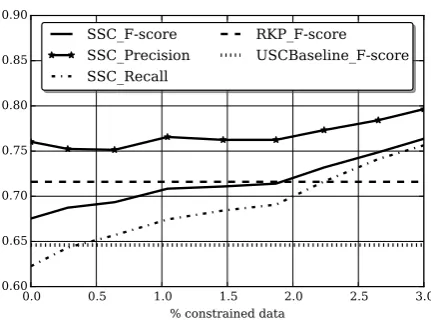
As described above, we collected alignments for outliers and for stable cases and tried sev-eral outlier-to-stable ratios. Outliers were much more effective than stable cases, as they improved recall by adjusting cluster boundaries to include scenario-specific functional paraphrases that were semantically dissimilar. Interestingly, adding a small number of stable cases leads to a slight im-provement, but adding more stable cases leads to a performance drop, and using only stable cases does not improve the unsupervised baseline at all. Fig. 3 shows how the model improves as more constraints are added.
We tried to reduce the amount of manual anno-tation in several ways. The decision to derive ad-ditional must-links using transitivity paid off: score consistently improves by about 1 point F-score. To further increase the set of seeds, we ex-perimented with propagating the links to nearest neighbors of aligned event descriptions, but did not see an improvement. Also, we tried to use alignments obtained by majority vote, which how-ever led to a performance drop, showing that using high quality seeds is crucial.
To make sure that our results are not dependent on the selection of a specific scenario set, we eval-uated our model also on the DeScript gold clusters. The results were comparable: B-Cubed improved from 0.551 (RKP: 0.525) to 0.662 (RKP: 0.655). As the DeScript corpus provides 100 ESDs per scenario, we were also able to test whether an in-creased number of input ESDs also improves clus-tering performance. We observed no effect with 50 ESDs compared to our model using 25 ESDs, and only a slight (less than 1 point) improvement with the full 100 ESDs dataset.
A leading motivation to use clustering instead of MSA was the opportunity to model flexible event order in script structures. Our expectations were confirmed by the evaluation results. A closer look at the induces TSGs (as shown by the example TSG in Fig. 4), suggests that our system makes extensive use of the option of flexible event order-ing.
0.0 0.5 1.0 1.5 2.0 2.5 3.0
% constrained data 0.60
0.65 0.70 0.75 0.80 0.85 0.90
SSC_F-score SSC_Precision SSC_Recall
[image:7.595.308.524.72.232.2]RKP_F-score USCBaseline_F-score
Figure 3: Paraphrase detection results for RKP, for our Unsupervised baseline (USC) and for our best Semi-supervised model (SSC+Mixed)
enter bathroom⇒(turn on shower↔undress)
⇒(adjust temp.↔turn off water)⇒get in shower
⇒(soap body↔close curtains)⇒shampoo hair
⇒(wash hair↔wash body↔shave)⇒rinse
⇒exit shower⇒dry off⇒dress
Figure 4: Example TSG forTAKING A SHOWER.
The arrows stand for default temporal precedence, the parentheses enclose equivalence classes ex-pressing arbitrary temporal order.
5 Costs and Coverage
We have demonstrated that semi-supervised clus-tering enables the extraction of script knowledge with substantially higher quality than existing methods. But how does the method scale? Can we expect to obtain a script knowledge database with sufficiently wide coverage at reasonable costs?
The process of script extraction requires crowd-sourced data in terms of (1) ESDs and (2) seed
alignments. To complete 3%+3% high-quality
alignments for the 10 DeScript scenarios via Me-chanical Turk (that is, 3% stable cases and 3% out-liers), workers spent a total of 37.5 hours, with an average of 3.75 hrs per scenario, ranging from
2.5 (GOING GROCERY SHOPPING) to 7.52 hrs
(BAKING A CAKE)3. It took on average 2.78 hrs
to collect 25 scenario-specific ESDs, that is 6.53 hrs of data acquisition time per scenario.
The costs per scenario are moderate. But how many scenarios must be modeled to achieve
suf-3We used the DeScript scenarios as reference because
Jessica needs milk.Jessica wakes up and wants to eat breakfast. She grabs the cereal and pours some into a bowl. She looks in the fridge for milk. There is no milk in the fridge so she can’t eat her breakfast. She goes to the store to buy some milk comes home and eats breakfast.
MAKE BREAKFAST: C
GOING GROCERY SHOPPING: P
Figure 5: Example ROC-story with scenario an-notation.
ficient coverage for the analysis of script knowl-edge in natural-language texts? Answering this question is not trivial, as scenarios vary consid-erably in granularity and it is not trivial that the type of script knowledge we model can capture all kinds of event structures, even in narrative texts. In order to provide a rough estimate of coverage for the currently existing script material, we car-ried out a simple annotation study on the recently published ROC-stories database (Mostafazadeh et al., 2016a). The database consists of 50,000 short narrative texts, collected via Mechanical Turk. Workers were asked to write a 5-sentence length story about an everyday commonsense event, and they were encouraged to write about “anything they have in mind” to guarantee wide distribution across topics.
For our annotation study, we merged the avail-able datasets containing crowdsourced ESD col-lections (i.e. OMICS, SMILE, and DeScript),
ex-cluding two extremely general scenarios (GO OUT
-SIDE,CHILDHOOD), which gives us a total of 226
different scenarios.
We randomly selected 500 of the ROC-stories and asked annotators to determine for each story which scenario (if any) was centrally addressed and which scenarios were just referred to or par-tially addressed with at least one event mention, and to label them with “C” and “P”, respectively. See an example story with its annotation in Fig. 5. Each story was annotated by three students of computational linguistics. To facilitate annotation, the stories were presented alongside ten scenar-ios whose ESDs showed strongest lexical overlap with the story (calculated as tf-idf). However, an-notators were expected to consider the full
sce-nario list4. The three annotations were merged
us-4We are aware that this setup may bias participants toward
finding a scenario from our collection, leading to an increase
ing majority vote. Cases without a clear majority vote containing one single “C” assignment were inspected and adjudicated by the authors of the pa-per.
26.4% of the stories were judged to centrally
re-fer to one of the scenarios5. Although this
per-centage cannot be directly translated to coverage values, it indicates that the extraction method pre-sented in this paper has the strong potential to provide a script knowledge resource with reason-able costs, which can substantially contribute to the task of text understanding.
6 Related Work
Following the seminal work of Chambers and Jurafsky (2008) and (2009) on the induction of
script-like narrative schemas from large,
unla-beled corpora of news articles, a series of mod-els have been presented for improving the induc-tion method or explore alternative data sources for script learning. Gordon (2010) mined common-sense knowledge from stories describing events in day-to-day life. Jans et al. (2012) studied differ-ent ways of selecting evdiffer-ent chains and used skip-grams for computing event statistics. Pichotta and Mooney (2014) employed richer event representa-tions, exploiting the interactions between multiple arguments to extract event sequences from a large corpus. Rahimtoroghi et al. (2016) learned contin-gency relations between events from a corpus of blog posts. All these approaches aim at high re-call, resulting in a large amount of wide-coverage, but noisy schemas.
Abend et al. (2015) proposed an edge-factored model to determine the temporal order of events in cooking recipes, but their model is limited to sce-narios with an underlying linear order of events. Bosselut et al. (2016) induce prototypical event structure in an unsupervised way from a large col-lection of photo albums with time-stamped images and captions. This method is however limited by the availability of albums for “special” events such asWEDDINGorBARBECUE, in contrast to
every-day, trivial activites such as MAKING COFFEE or
in recall. However, they had the option to label stories where they felt a scenario was only partially addressed in a differ-ent way, thus setting these cases apart from those where the scenario was centrally addressed.
5While we take the judgment about the “C” class to be
GOING TO THE DENTIST. Mostafazadeh et al.
(2016b) presented the ROC-stories, a dataset of c.a. 50.000 crowdsourced short commonsense ev-eryday story. They propose to use it for the evalu-ation of script knowledge models, and it may also turn out to be a valuable resource for script learn-ing, although to our knowledge this has not yet been attempted.
Closest to our approach is the work by RKP and subsequent work by Frermann et al. (2014) and Modi and Titov (2014). All these employ
the same SMILE+OMICS dataset for evaluation,
which we also used to allow for a direct compar-ison. Frermann et al. (2014) present a Bayesian generative model for joint learning of event types and ordering constraints. Their model promis-ingly shows that flexible event order in scripts can be suitably modelled. Modi and Titov (2014) fo-cussed mainly on event ordering between script-related predicates, using distributed representa-tions of predicates and arguments induced by a sta-tistical model. They obtained paraphrase sets as a by-product, namely by creating an event timeline and grouping together event mentions correspond-ing to the same interval.
7 Conclusions
This paper presents a clustering-based approach to inducing script structure from crowdsourced de-scriptions of scenarios. We use semi-supervised clustering to group individual event descriptions into paraphrase sets representing event types, and induce a temporal order among them. Crowd-sourced alignments between event descriptions proved highly effective as seed data. On a para-phrase task, our approach outperforms all previous proposals, while still performing very well on the task of temporal order prediction. A study on the ROC-stories suggests that a model of script knowl-edge created with our method can cover a large fraction of event structures occurring in topically unrestricted narrative text, thus demonstrating the scalability of our approach.
Acknowledgments
This research was funded by the German Research Foundation (DFG) as part of SFB 1102 ‘Informa-tion Density and Linguistic Encoding’.
References
Omri Abend, Shay B. Cohen, and Mark Steedman. 2015. Lexical event ordering with an edge-factored model. In Proceedings of the 2015 Conference of the North American Chapter of the Association for Computational Linguistics: Human Language Technologies, pages 1161–1171, Denver, Colorado, May–June. Association for Computational Linguis-tics.
Enrique Amig´o, Julio Gonzalo, Javier Artiles, and Fe-lisa Verdejo. 2009. A comparison of extrinsic clustering evaluation metrics based on formal con-straints. Information retrieval, 12(4):461–486. Amit Bagga and Breck Baldwin. 1998. Algorithms
for scoring coreference chains. InThe First Interna-tional Conference on Language Resources and Eval-uation Workshop on Linguistics Coreference, pages 563–566.
Avron Barr and Edward A. Feigenbaum. 1981. Frames and scripts. In The Handbook of Artificial Intelli-gence, volume 3, pages 216–222. Addison-Wesley, California.
Antoine Bosselut, Jianfu Chen, David Warren, Han-naneh Hajishirzi, and Yejin Choi. 2016. Learning prototypical event structure from photo albums. In Proceedings of the 54th Annual Meeting of the As-sociation for Computational Linguistics (Volume 1: Long Papers), pages 1769–1779, Berlin, Germany, August. Association for Computational Linguistics. Nathanael Chambers and Dan Jurafsky. 2008. Unsu-pervised learning of narrative event chains. In Pro-ceedings of ACL-08: HLT, pages 789–797, Colum-bus, Ohio, June. Association for Computational Lin-guistics.
Nathanael Chambers and Dan Jurafsky. 2009. Unsu-pervised learning of narrative schemas and their par-ticipants. InProceedings of the Joint Conference of the 47th Annual Meeting of the ACL and the 4th In-ternational Joint Conference on Natural Language Processing of the AFNLP, pages 602–610, Suntec, Singapore, August. Association for Computational Linguistics.
Richard E. Cullingford. 1977. Script Applica-tion: Computer Understanding of Newspaper Sto-ries. Ph.D. thesis, Yale University.
Richard Durbin, Sean Eddy, Anders Krogh, and Graeme Mitchison. 1998. Biological sequence analysis: probabilistic models of proteins and nu-cleic acids. Cambridge University Press, Cam-bridge, UK.
Lea Frermann, Ivan Titov, and Manfred Pinkal. 2014. A hierarchical bayesian model for unsupervised in-duction of script knowledge. InProceedings of the 14th Conference of the European Chapter of the Association for Computational Linguistics, pages 49–57, Gothenburg, Sweden, April. Association for Computational Linguistics.
Andrew S. Gordon. 2010. Mining commonsense knowledge from personal stories in internet we-blogs. InProceedings of the First Workshop on Au-tomated Knowledge Base Construction, Grenoble, France.
Rakesh Gupta and Mykel J. Kochenderfer. 2004. Common sense data acquisition for indoor mobile robots. In Proceedings of the 19th National Con-ference on Artificial intelligence, pages 605–610. AAAI Press.
Hannaneh Hajishirzi and Erik T. Mueller. 2012. Ques-tion answering in natural language narratives using symbolic probabilistic reasoning. InProceedings of the Twenty-Fifth International Florida Artificial In-telligence Research Society Conference, pages 38– 43.
Bram Jans, Steven Bethard, Ivan Vuli´c, and Marie-Francine Moens. 2012. Skip N-grams and ranking functions for predicting script events. In Proceed-ings of the 13th Conference of the European Chap-ter of the Association for Computational Linguistics, pages 336–344, Avignon, France, April. Association for Computational Linguistics.
Dan Klein, Sepandar D. Kamvar, and Christopher D. Manning. 2002. From instance-level constraints to space-level constraints: Making the most of prior knowledge in data clustering. InProceedings of the Nineteenth International Conference on Machine Learning, pages 307–314.
Dekang Lin. 1998. An information-theoretic defini-tion of similarity. InIn Proceedings of the 15th In-ternational Conference on Machine Learning, pages 296–304.
Tomas Mikolov, Kai Chen, Greg S. Corrado, and Jef-frey Dean. 2013. Efficient estimation of word rep-resentations in vector space. InProceedings of the International Conference on Learning Representa-tions.
Ashutosh Modi and Ivan Titov. 2014. Inducing neu-ral models of script knowledge. In Proceedings of the Eighteenth Conference on Computational Nat-ural Language Learning, pages 49–57, Ann Arbor, Michigan, June. Association for Computational Lin-guistics.
Nasrin Mostafazadeh, Nathanael Chambers, Xiaodong He, Devi Parikh, Dhruv Batra, Lucy Vanderwende, Pushmeet Kohli, and James Allen. 2016a. A cor-pus and cloze evaluation for deeper understanding of commonsense stories. In Proceedings of the
2016 Conference of the North American Chapter of the Association for Computational Linguistics: Hu-man Language Technologies, pages 839–849, San Diego, California, June. Association for Computa-tional Linguistics.
Nasrin Mostafazadeh, Lucy Vanderwende, Wen-tau Yih, Pushmeet Kohli, and James Allen. 2016b. Story cloze evaluator: Vector space representation evaluation by predicting what happens next. In Pro-ceedings of the 1st Workshop on Evaluating Vector Space Representations for NLP, pages 24–29. Erik T. Mueller. 2004. Understanding script-based
sto-ries using commonsense reasoning. Cognitive Sys-tems Research, 5(4):307–340.
Christos H. Papadimitriou and Kenneth Steiglitz. 1982. Combinatorial Optimization: Algorithm und Complexity. Dover Publications, Mineola, NY. Karl Pichotta and Raymond Mooney. 2014.
Statisti-cal script learning with multi-argument events. In Proceedings of the 14th Conference of the Euro-pean Chapter of the Association for Computational Linguistics, pages 220–229, Gothenburg, Sweden, April. Association for Computational Linguistics. Elahe Rahimtoroghi, Ernesto Hernandez, and Marilyn
Walker. 2016. Learning fine-grained knowledge about contingent relations between everyday events. In Proceedings of the 17th Annual Meeting of the Special Interest Group on Discourse and Dialogue, pages 350–359.
Altaf Rahman and Vincent Ng. 2011. Narrowing the modeling gap: a cluster-ranking approach to coref-erence resolution. Journal of Artificial Intelligence Research, 40:469–521.
Lisa F. Rau, Paul S. Jacobs, and Uri Zernik. 1989. In-formation extraction and text summarization using linguistic knowledge acquisition. Information Pro-cessing & Management, 25(4):419–428.
Michaela Regneri, Alexander Koller, and Manfred Pinkal. 2010. Learning script knowledge with web experiments. In Proceedings of the 48th Annual Meeting of the Association for Computational Lin-guistics, pages 979–988, Uppsala, Sweden, July. As-sociation for Computational Linguistics.
Peter J. Rousseeuw. 1987. Silhouettes: A graphical aid to the interpretation and validation of cluster analy-sis. Journal of Computational and Applied Mathe-matics, 20:53 – 65.
Roger C. Schank and Robert P. Abelson. 1977.Scripts, Plans, Goals, and Understanding: An Inquiry into Human Knowledge Structures. Erlbaum, Hillsdale, NJ.
in Natural Language Processing, pages 171–182, Austin, Texas, November. Association for Compu-tational Linguistics.