21
Understanding the Polarity of Events in the Biomedical Literature:
Deep Learning vs. Linguistically-informed Methods
Enrique Noriega-Atala, Zhengzhong Liang,
John A. Bachman†, Clayton T. Morrison, Mihai Surdeanu University of Arizona, Tucson, Arizona, USA
†Harvard Medical School, Boston, Massachusetts, USA
{enoriega,zhengzhongliang,claytonm,msurdeanu}@email.arizona.edu john [email protected]
Abstract
An important task in the machine reading of biochemical events expressed in biomed-ical texts is correctly reading the polarity, i.e., attributing whether the biochemical event is a promotion or an inhibition. Here we present a novel dataset for studying polar-ity attribution accuracy. We use this dataset to train and evaluate several deep learning models for polarity identification, and com-pare these to a linguistically-informed model. The best performing deep learning architec-ture achieves 0.968 average F1 performance in a five-fold cross-validation study, a consid-erable improvement over the linguistically in-formed model average F1 of 0.862.
1 Introduction
Recent advances in information extraction (IE) have resulted in high-precision, high-throughput systems tailored to the reading of biomedical sci-entific publications (Valenzuela-Esc´arcega et al., 2018; Peng et al., 2017; Quirk and Poon, 2016; Kim et al., 2013; Bj¨orne and Salakoski, 2013; Hakala et al., 2013;Bui et al., 2013, inter alia). This, in turn, has resulted in the use of machine reading systems as the foundation of more com-plex, higher-level inference applications in spe-cific domains such as cancer research ( Valenzuela-Esc´arcega et al.,2018).
However, the presence of noise in pipelined sys-tems that use IE as an initial component may seri-ously hinder the quality of downstream results. In particular, biomedical research literature is prone to noise caused by the mischaracterization of the
polarity (e.g., promotion vs. inhibition) of bio-chemical interactions. This is the focus of this work.
The identification of polarity in the biomedical domain is complicated by the fact that the lan-guage used is often hedged through multiple
nega-tions to stay closer to the complex biology under-neath. For example, consider the statement: The inactivation of Bad is sufficient to antagonize p38 MAPK.Under the (simplified but commonly used) representation of polarized interactions, a naive IE system would extract a negative interaction
be-tween the two proteins: Bad inhibits p38
MAPK, due to the presence of the negative pred-icateantagonize. However, a more careful read-ing of this text indicates that the better represen-tation for this extraction is a positive interaction: Bad promotes p38 MAPK,1 due to the
inter-action of two predicates with negative semantics,
inactivationandantagonize. This situation is ex-acerbated by the fact that statements in this domain may contain three and even four inter-related pred-icates that affect polarity (as observed in Section 8).
This paper analyzes the identification of polar-ity of biomedical interactions, from the perspec-tive of multiple possible methods. In particular, the contributions of this work are:
(1) We introduce a novel dataset that annotates
the polarity of biomedical interactions. The
dataset comes in multiple variants. A first vari-ant was derived using distant supervision (DS) (Mintz et al.,2009) by aligning a knowledge base (KB) of protein interactions (Perfetto et al.,2015) with the outputs of a machine reader ( Valenzuela-Esc´arcega et al., 2018). This dataset contains 52,779 promotion and 35,177 inhibition interac-tions. To account for the noise introduced through the DS process, we provide a second variant of this dataset consisting of a sample of the full dataset
1This representation is better but not perfect. The
correct representation should be: (decrease of Bad)
causes (decrease of p38 MAPK). However, the
that was manually curated by domain experts. We divide this sample into an Easy partition where the IE system initially agreed with the KB, and a Challenge partition where the IE system’s ex-tractions conflicted with the KB. These manually-curated partitions contain 62 and 67 data points, respectively.
(2) We compare several approaches for polarity identification, including a linguistically-informed method (Valenzuela-Esc´arcega et al., 2018), and
several deep learning (DL) approaches. The
DL methods incorporate: (a) multiple sequence models that capture the text before/after argu-ments/predicate, (b) attention models, and (c) explicit features from the linguistically-informed
method. Our analysis indicates that: (a) the
simpler DL methods perform better than the more complicated ones, (b) all DL approaches outperform the standalone linguistically-informed method, and (c) the difference between the two strategies grows larger with the complexity of the text.
2 Related work
The rate of scientific publishing has grown sub-stantially each year, reaching a level that exceeds the human capacity to read and process. For example, PubMed, a search engine of biomed-ical publications2 now indexes over 25 million
papers, 17 million of which were published be-tween 1990 and the present. Domain-agnostic approaches, such as open information extraction (OpenIE) (Angeli et al., 2015) can begin to miti-gate this by extracting information in the form of relation triples. However the widely varied lan-guage used by authors means that extractions can be difficult to aggregate and utilize.
On the other hand, there have been significant efforts to develop domain-specific information ex-traction approaches that are tailored to scientific publications. These approaches range from rule-based to machine learning-rule-based, and hybrid ap-proaches (Valenzuela-Esc´arcega et al.,2018;Peng et al., 2017; Quirk and Poon, 2016; Kim et al., 2013;Bj¨orne and Salakoski,2013;Hakala et al., 2013;Bui et al.,2013).
On top of the extractions produced by these methods, causal influence crucially relies on the
polarityof the influence interactions, i.e., whether
2http://www.ncbi.nlm.nih.gov/pubmed
one factorpromotesorinhibitsanother factor. Bi-ological models have been assembled from these interactions and used for domain-specific applica-tions (Gyori et al.,2017). Here we propose an ap-proach for automatically detecting this polarity.
Polarity detection has been explored in several other natural language processing tasks, perhaps most notably in sentiment analysis (e.g., Pang et al., 2008; Liu, 2012; Liu and Zhang, 2012), where the polarity of a text is measured on a spec-trum from negative to positive sentiment. Simi-larly, inWilson et al.(2005), the authors frame the problem of extracting opinion polarity explicitly as a sentiment analysis task. Our work is similar in spirit, but it focuses on the polarity of scientific statements. In (Lauscher et al.,2017), the authors investigate the polarity polarity of citations within the context of bibliometric analysis. In contrast, our work addresses the polarity of content, i.e., events extracted from the biomedical literature.
To summarize, our approach is inspired by this previous work, but it differs in two ways: first, we focus on statements in the biomedical domain, and, second, we extract polarity for specific, struc-tured events rather than unstrucstruc-tured texts.
3 Linguistically-informed polarity identification approach
In preliminary analyses, we observed that the ar-guments of biomedical events are generally cor-rectly identified, but the polarity of the interac-tions is often incorrect due to the complex lan-guage used (see, for example, the example in Sec-tion1). Based on this observation, all the methods introduced in this paper assume that anunlabeled
event is provided, e.g.,Bad interacts with
p38 MAPK, and the methods then label the event
with a polarity type, e.g.,Bad promotes p38
MAPK.
The first method analyzed, which extends the approach in Valenzuela-Esc´arcega et al. (2018), relies on linguistic cues. The approach takes the following steps:
1. First, it extracts the syntactic dependency path between the participants in the interac-tion.
2. Then, the path is expanded to include modi-fiers of the words along the above path. 3. Finally, the method counts the number of
Bach-Figure 1: Example of the linguistically-informed ap-proach. From the syntactic dependency tree, the approach extracts the shortest undirected path be-tween the participants in the interaction,Badandp38 MAPK:nsubj:xsubj> dobj>, where the>and < markers indicate the direction of a dependency
arc. Then, the path is extended with modifiers of the elements on the path: amod< nsubj:xsubj>
mark< dobj> compound<. (The complete path is highlighted and the negative words are underlined.) Lastly, the approach counts the number of polarity-carrying words along this path. An odd number indi-cates negative event polarity; otherwise the polarity is positive. In this example, the polarity is positive be-cause there is an even number of polarity words: inac-tivatedandantagonize.
man et al.,2018) from a defined lexicon. This lexicon contains 33 elements, such as “in-hibition” and “loss”. The event is labeled with negative polarity (inhibits) if the count of these words is odd. Otherwise, the polar-ity of the event is positive (promotes).
Figure 1 shows a walkthrough of this algorithm for the sentenceInactivated Bad is sufficient to an-tagonize p38 MAPK, which contains an event con-necting the two entitiesBadandp38 MAPK. Step 2 of this algorithm is crucial, as many polarity-carrying words, e.g., inactivated, do not appear along the syntactic dependency path between the event arguments, but rather modify terms on the path.
We extended the original algorithm in Valenzuela-Esc´arcega et al.(2018) as follows:
• We made the polarity lexicon
case-insensitive.
• We changed the algorithm to match the words in the polarity lexicon only if they occur as a full word or as a prefix, instead of any sub-string of a word. For example, in the text Re-duction of triglyceride synthesis without af-fectingALLN-inhibitableprotease, the orig-inal algorithm generates a false positive by matchinginhibitinALLN-inhibitable.
• We handle verb particles, which were ignored in the original algorithm. For example, in the text The Wip1 gene is overexpressed by
switching off p53, the polarity of the inter-action cannot be detected from the predicate alone (switching) without its attached particle (off).
• We adjusted the polarity lexicon, e.g., we removed target; and we added the suffix -KD(Bachman et al.,2018), which stands for
knockdown.
4 Deep learning polarity identification approaches
We propose several deep learning approaches for the classification of event polarity. In general, all proposed approaches use recurrent neural net-work (RNN) architectures, which incorporate both lexical and structural information into the learn-ing process by considerlearn-ing one or more sequences of words from the source sentence for the given event.
In each of the RNN model variants we inves-tigate, the input sentence is represented as a se-quence of word embeddings. Every wordwt trig-gers a recurrent state that generates a hidden vec-torht, which encodes information about the input word subsequence1..t. The output of the RNN is a sequence{ht}of hidden vectors, one for each of the input words.
The hidden vector sequence is then aggregated using one of a couple of different strategies (as described in the next two sub-sections), and then passed forward as the input to a multi-layer per-ceptron (MLP) that performs binary classification of the event’s polarity: positive or negative.
Because our approach applies to biochemical events, we use the result of the underlying IE method to encode the predicate of the event, or its trigger, as a feature in the MLP. That is, if the trigger belongs to the lexicon of positive-polarity terms, such aspromotesoractivates, the network uses this as evidence for positive po-larity. Conversely, if the trigger belongs to the negative-polarity lexicon, such asinhibits, the trig-ger is evidence of negative polarity. We use the same dictionary of polarity-carrying words as the linguistically-informed method.
[image:3.595.74.292.69.103.2]“Under basal conditions” “so that …”
LSTM LSTM
MLP Prediction
LSTM LSTM
“TSC2 negatively regulate” “the expression of mTOR”
[image:4.595.84.284.61.227.2]Rule trigger (i.e. Inhibits)
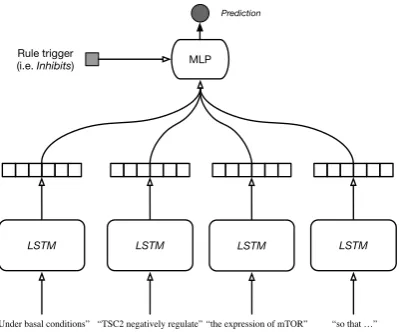
Figure 2: Four-segment LSTM architecture for polar-ity identification. The four segments model: the text before the left-most event argument, the text between the left-most argument and the event predicate, the text between the predicate and the right-most argument; and the text after the right-most argument. The outputs of the four LSTMs are integrated through a MLP, which also uses the polarity of the event trigger as an explicit feature.
We describe these approaches in the next two sub-sections.
4.1 Single-segment architecture
For this variant of the architecture, we consider the input sequence, consisting of the span of text that belongs to the event as a single unit, and take the last vector of the hidden sequence as input to the MLP, discarding the rest of the sequence’s hidden states. The output of the MLP directly labels the polarity of the event on top of this hidden state vector.
4.2 Four-segment architecture
The structure of the biochemical events modeled here have the following elements: controller (or cause), trigger (or predicate), and controlled (or theme). These elements are text-bounded and par-tition the source sentence into four regions: a window of text before the controller, up to three words, the textbetweenthe controller and the trig-ger, the textbetweenthe trigger and the controlled and the window of text after the controlled. If the trigger appears before or after both, controller and controlled (i.e.the phosphorylation of ERK by MEK), then the event text is considered as a single segment instead of two.
Each of the four sections of the source sentence is then fed to an independent LSTM using the same strategy as in Section4.1. Figure2illustrates
how the sentence Under basal conditions, TSC2 negatively regulates the expression of mTOR, so that ...is split and processed by this approach. The last vectors of the four hidden sequences are con-catenated and passed as input to MLP for polarity classification.
4.3 Additional enhancements
We implemented and tested the following en-hancements with both the single-segment and four-segment architectures from Sections4.1 and 4.2respectively.
Pre-trained word embeddings
We used Word2Vec (Mikolov et al.,2013) to pre-initialize the word embeddings. We pre-trained these embeddings over the open-access subset of
PubMed Central3. We used dimension 100 for
these vectors.
Character-level embeddings
To capture information present in the morpho-logical structure of a word, we extended our ap-proaches to usecharacter-level embeddings. Each wordwin an input sentence is enhanced by adding character-level embeddings to its word embedding ew.
Given the characters of wordw, each is mapped to an embedding ec. The resulting sequence of character embeddings {ect} is then passed
for-wards and backfor-wards through a bi-directional
GRU(Goldberg,2017). Then, the last hidden vec-tors of the forward and backward GRUs are con-catenated into the word’s characters embedding ewc.
The word embedding and the word’s charac-ters embedding are then concatenated into an en-hanced word embeddingew′ = [ew;ewc], which is passed as input for the current word of our polarity network architecture.
Attention mechanisms for aggregation
So far, in all proposed approaches the last element of a sequence has been used as input to the MLP for classification. By doing this, the remaining se-quence leading to the selected hidden vector is dis-carded with respect to classification. To account for this potential limitation, we implemented at-tention mechanisms (Bahdanau et al.,2014) to
ag-3https://www.ncbi.nlm.nih.gov/pmc/
gregate all the hidden vectors into the classifica-tion step of the network.
The attention mechanism functions as a weighted average of a sequence {ht} of vectors dictated byT
t αtht. The weight parameters{αt} are learnt jointly with the rest of the network pa-rameters. The scalar coefficient αt for the vec-tor ht is computed using the linear combination: at=Waht+ba, where the parametersWaandba are shared for all the observations passed through the network. The resulting sequence of coeffi-cients {at} is normalized with thesoftmax func-tion byαt = sof tmax({at}) to enforce that the weights sum up to 1.
The single-segment architecture is enhanced with this mechanism on top of the sequence of hidden vectors produced by the recurrent network. For the four-segment architecture, we tested an attention mechanism for the hidden vector se-quences of each segment of the sentence (shallow attention) and an additional approach that also cludes an attention mechanism to aggregate, in-stead of concatenate the four resulting sequence vectors before the MLP step (deep attention). This deep attention approach computes a weighted av-erage of the four sequences {si}, dictated by
4
i βisi. Similarly to the weights of the hidden vectors, each individual weight in {βi} is
com-puted by the linear combinationbt =Wbhi+b0,
where the parameters Wb and b0 are shared and
later normalized byβi=sof tmax({bi}). Bidirectional LSTMs
At any given index t of a source sentence, the LSTM network considers only the sequence 1..t of words to compute the hidden state vector of wt. Clearly, this formulation discards information from words to the right oft. To address this limi-tation, we modified our architecture to use a bidi-rectional LSTM (Graves et al.,2013) as a drop-in replacement of the vanilla LSTM wherever it is used. Similarly to the bidirectional GRU, the bidi-rectional LSTM contains two distinct LSTM net-works that process the input sentence left-to-right (forward) and right-to-left (backward). The last hidden vectors of both are concatenated and used for the next step in our architectures.
5 Dataset
To analyze the performance of the above ap-proaches, we assembled a dataset of sentences as-sociated with protein-protein interaction events,
as well as polarity labels. The dataset was con-structed through distant supervision (Mintz et al., 2009), by aligning events extracted from biomed-ical literature by Reach, a biomedbiomed-ical IE system (Valenzuela-Esc´arcega et al.,2018), with polarity labels from the SIGNOR database (Perfetto et al., 2015).
SIGNOR contains approximately 20,000 man-ually curated protein interactions, the majority of which are annotated with the polarity of the effect of the interaction on the downstream protein (ac-tivation or inhibition). These signed interactions were used to establish the true polarities for each pair of proteins in the database. A potential is-sue with this approach is that an interaction among proteins may have more than one possible polar-ity depending on the biological context: for ex-ample, protein A may activate protein B in cell type X, but inhibit protein B in cell type Y. To mitigate this, we filtered the relations in SIGNOR for those annotated with only a single, unambigu-ous polarity, under the assumption that for the rel-atively well-characterized interactions prioritized for curation in a pathway database, the assign-ment of a single polarity would be a good indicator of “ground truth” for the majority of texts. Pro-cessing the SIGNOR database in this way yielded 17,163 protein-protein interactions among with a single polarity, composed of the following interac-tion types: 13,302 interacinterac-tions with positive polar-ity, and 3,861 interactions with negative polarity.
We extracted protein-protein-interaction events from text by running the Reach IE system over all full-text articles in PubMed Central4, the
PubMed Central Author’s Manuscript collection5,
and MEDLINE6 abstracts (for articles not
cluded in the full-text datasets). We kept all in-formation about the events (e.g., triggers, partici-pants, overall interaction type), but discarded po-larity information. We assigned popo-larity labels by aligning these events with SIGNOR interac-tions that involved the same two proteins and the same overall interaction type, irrespective of sign (e.g., regulation of activity or regulation of phos-phorylation). From this dataset we removed: (a) duplicate sentences, and (b) sentences containing events where at least one of the participating
pro-4https://www.ncbi.nlm.nih.gov/pmc/tools/
openftlist/
5https://www.ncbi.nlm.nih.gov/pmc/about/
mscollection/
tein names could not be grounded to an entry in the UniProt protein database7. This process
pro-duced 68,935 polarity-labeled events (with sup-porting sentences). For 54,105 of these events, the original polarity detector in Reach agreed with the SIGNOR polarity label (a strong indication that these sentences are easier to classify). For 14,830 events, Reach’s polarity disagreed with SIGNOR (an indication that these sentences are more chal-lenging). We call this dataset theDS dataset(from distant supervision). Table1lists the distribution of labels for the DS dataset on both the Easy and Challenge partitions and overall.
Positive polarity Negative polarity
Easy 40,339 13,766
Challenge 7,262 7,568
Total 47,601 21,334
Table 1: Label distribution on theDSdataset.
The distant supervision process is potentially noisy (Yao et al.,2011). To control for this noise, we also created two smaller hand-curated datasets, as follows:
1. We randomly sampled 100 sentences from the sentences where Reach agreed with SIG-NOR, and 100 from the sentences where Reach disagreed with SIGNOR. Based on the intuition mentioned in the previous para-graph, we call these partitionsEasyand Chal-lenge.
2. Because the focus of this work is on polarity identificationgivena correct event, we elimi-nated the false positive events from both par-titions, i.e., events extracted by Reach that were not supported by the corresponding un-derlying sentence. Further, we removed sen-tences containing events where at least one of the participating protein names could not be grounded to UniProt. This reduced the size of the dataset to 62 Easy and 67 Challenge examples.
3. The remaining sentences were manually cu-rated by a domain expert. The expert cor-rected 2 polarity labels in the Easy partition, and 53 labels in the Challenge partition,
con-7https://www.uniprot.org
firming our expectation that the latter parti-tion is harder than the former.
To facilitate reproducibility, we will release all these datasets (and the software) upon acceptance.
6 Results
We performed a five-fold cross validation exper-iment on the DS dataset introduced in Section 5 to assess the performance of the linguistically-informed baseline (Section3) and of the various neural models previously described in Section4. Note that this dataset contains all the elements from both Easy and Challenge partitions. The data was split randomly and the experiment was repeated with five different random seeds and the numbers reported are the corresponding averages from all the trials. Table 2 reports these average scores as well as the standard deviations for all the approaches analyzed.
Tables 3 and 4 contain the results on the
manually-curated Easy and Challenge partitions, when the corresponding models were trained on the entire DS dataset.
The code and data used to generate these results
are available at this URL: https://github.
com/clulab/releases/tree/master/ naacl-essp2019-polarity.
7 Discussion
7.1 Discussion of the main results
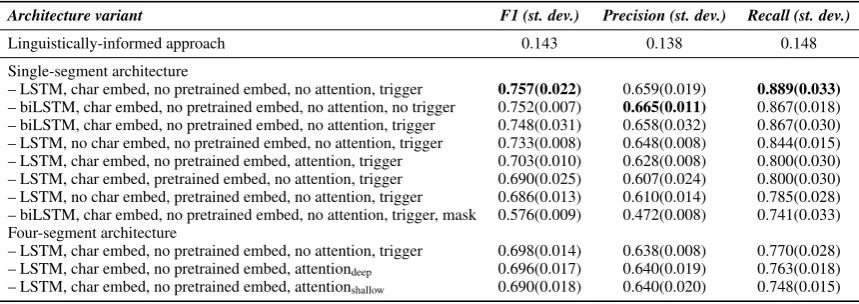
Table2shows that the linguistically-informed ap-proach performs reasonably well overall, with a F1 score of 0.862. This is encouraging, but also somewhat misleading. The DS dataset consists of mostly Easy examples, where Reach agreed with SIGNOR labels. As discussed in Section 5, the distribution of the examples in the DS dataset is 78.4/21.6% Easy/Challenge. Tables3and4show that the performance of the linguistically-informed approach, which is an improved version of the method in Reach, drops to 0.143 F1 when eval-uated solely on challenging sentences.
Architecture variant F1 (st. dev.) Precision (st. dev.) Recall (st. dev.)
Linguistically-informed approach 0.862 0.859 0.865 Single-segment architecture
– biLSTM, char embed, no pretrained embed, no attention, trigger 0.968(0.001) 0.967(0.001) 0.969(0.000)
– biLSTM, char embed, no pretrained embed, no attention, no trigger 0.968(0.001) 0.967(0.001) 0.968(0.000) – LSTM, char embed, no pretrained embed, no attention, trigger 0.966(0.001) 0.964(0.001) 0.967(0.001) – LSTM, no char embed, no pretrained embed, no attention, trigger 0.961(0.000) 0.959(0.001) 0.963(0.001) – LSTM, char embed, no pretrained embed, attention, trigger 0.954(0.001) 0.954(0.001) 0.955(0.002) – LSTM, char embed, pretrained embed, no attention, trigger 0.948(0.001) 0.944(0.002) 0.952(0.001) – LSTM, no char embed, pretrained embed, no attention, trigger 0.943(0.000) 0.938(0.001) 0.948(0.001) – biLSTM, char embed, no pretrained embed, no attention, trigger, mask 0.874(0.001) 0.852(0.010) 0.897(0.012) Four-segment architecture
– LSTM, char embed, no pretrained embed, no attention, trigger 0.956(0.000) 0.956(0.001) 0.956(0.000) – LSTM, char embed, no pretrained embed, attentiondeep 0.948(0.000) 0.949(0.001) 0.947(0.001)
[image:7.595.81.518.262.420.2]– LSTM, char embed, no pretrained embed, attentionshallow 0.948(0.000) 0.951(0.001) 0.945(0.001)
Table 2: Deep learning scores from a five-fold cross-validation experiment on the larger DS dataset. The “mask” option indicates that event participants have been masked (please see Section7.3for details).
Architecture variant F1 (st. dev.) Precision (st. dev.) Recall (st. dev.)
Linguistically-informed approach 0.989 0.979 1.0
Single-segment architecture
– biLSTM, char embed, no pretrained embed, no attention, no trigger 0.983(0.009) 0.978(0.000) 0.987(0.017) – biLSTM, char embed, no pretrained embed, no attention, trigger 0.980(0.011) 0.978(0.000) 0.983(0.021) – LSTM, no char embed, pretrained embed, no attention, trigger 0.974(0.005) 0.987(0.011) 0.961(0.009) – LSTM, char embed, no pretrained embed, no attention, trigger 0.972(0.006) 0.978(0.000) 0.965(0.011) – LSTM, no char embed, no pretrained embed, no attention, trigger 0.972(0.006) 0.978(0.000) 0.965(0.011) – LSTM, char embed, pretrained embed, no attention, trigger 0.971(0.005) 0.987(0.011) 0.957(0.000) – LSTM, char embed, no pretrained embed, attention, trigger 0.964(0.011) 0.987(0.011) 0.943(0.022) – biLSTM, char embed, no pretrained embed, no attention, trigger, mask 0.942(0.017) 0.964(0.017) 0.922(0.029) Four-segment architecture
– LSTM, char embed, no pretrained embed, no attention, trigger 0.974(0.006) 0.978(0.000) 0.970(0.011) – LSTM, char embed, no pretrained embed, attentionshallow 0.960(0.005) 0.973(0.008) 0.948(0.011)
– LSTM, char embed, no pretrained embed, attentiondeep 0.958(0.017) 0.965(0.010) 0.952(0.035)
Table 3: Performance of all approaches on theEasypartition. The “mask” option indicates that event participants have been masked (please see Section7.3for details).
Architecture variant F1 (st. dev.) Precision (st. dev.) Recall (st. dev.)
Linguistically-informed approach 0.143 0.138 0.148 Single-segment architecture
– LSTM, char embed, no pretrained embed, no attention, trigger 0.757(0.022) 0.659(0.019) 0.889(0.033)
– biLSTM, char embed, no pretrained embed, no attention, no trigger 0.752(0.007) 0.665(0.011) 0.867(0.018) – biLSTM, char embed, no pretrained embed, no attention, trigger 0.748(0.031) 0.658(0.032) 0.867(0.030) – LSTM, no char embed, no pretrained embed, no attention, trigger 0.733(0.008) 0.648(0.008) 0.844(0.015) – LSTM, char embed, no pretrained embed, attention, trigger 0.703(0.010) 0.628(0.008) 0.800(0.030) – LSTM, char embed, pretrained embed, no attention, trigger 0.690(0.025) 0.607(0.024) 0.800(0.030) – LSTM, no char embed, pretrained embed, no attention, trigger 0.686(0.013) 0.610(0.014) 0.785(0.028) – biLSTM, char embed, no pretrained embed, no attention, trigger, mask 0.576(0.009) 0.472(0.008) 0.741(0.033) Four-segment architecture
– LSTM, char embed, no pretrained embed, no attention, trigger 0.698(0.014) 0.638(0.008) 0.770(0.028) – LSTM, char embed, no pretrained embed, attentiondeep 0.696(0.017) 0.640(0.019) 0.763(0.018)
– LSTM, char embed, no pretrained embed, attentionshallow 0.690(0.018) 0.640(0.020) 0.748(0.015)
Table 4: Performance of all approaches on theChallengepartition. The “mask” option indicates that event partici-pants have been masked (please see Section7.3for details).
found around the dependency path representing the event. Taking into account the full, global in-formation in the sentence as a single segment re-sults in a simpler neural network with fewer pa-rameters, which may also explain why the four-segment architecture, which splits the sentence into subsequences according to the components
associated with the cause, predicate and theme, and runs each through distinct recurrent compo-nents in the architecture does not perform quite as well as the full, single-segment architecture.
[image:7.595.84.514.465.617.2]Number of negative
words per sentence Sample size PrecisionBest DL approachRecall F1 Linguistically-informed approachPrecision Recall F1
0 49,972 0.978 0.980 0.98 0.873 0.937 0.904 1 16,063 0.90 0.902 0.901 0.694 0.38 0.491 2 2,566 0.94 0.896 0.917 0.773 0.691 0.730 3 300 0.884 0.857 0.87 0.675 0.49 0.568 4 30 1.0 0.92 0.958 0.8 0.48 0.6
5 3 1.0 1.0 1.0 0.5 0.5 0.5
[image:8.595.100.497.64.169.2]6 1 1.0 1.0 1.0 1.0 1.0 1.0
Table 5: Polarity classification results stratified by the number of polarity-carrying words in the corresponding sentence.
Number of negative
words per sentence Sample size PrecisionBest DL approachRecall F1 Linguistically-informed approachPrecision Recall F1
0 49,972 0.882 0.934 0.907 0.873 0.937 0.904 1 16,063 0.643 0.627 0.761 0.694 0.38 0.491 2 2,566 0.789 0.734 0.761 0.773 0.691 0.730 3 300 0.744 0.689 0.716 0.675 0.49 0.568 4 30 0.941 0.64 0.761 0.8 0.48 0.6
5 3 1.0 1.0 1.0 0.5 0.5 0.5
6 1 1.0 1.0 1.0 1.0 1.0 1.0
Table 6: Polarity classification results stratified by the number of polarity-carrying words in the corresponding sentence with masked participants.
differential performance on the Easy and Chal-lengedata sets. In particular, on theEasydata set, the linguistically informed approach performs ex-ceptionally well, better than the highest perform-ing deep learnperform-ing model. The good performance of the linguistically-informed model is not surpris-ing here because, as discussed, the instances in the data set were those for which the linguistically-informed agreed with SIGNOR. But it is encour-aging that the best deep learning model manages to achieve this performance as well.
On the Challenge data set, however, the
linguistically-informed model performance dives to an F1 of 0.143. Again, this is not a surprise given that these data were ones that specifically disagreed with a version of the linguistic model. However, the performance of the best deep learn-ing model degrades just to 0.757 F1, demonstrat-ing the capacity of the model to maintain relatively good performance in the face of more challeng-ing data. We find this very encouragchalleng-ing, especially considering that the neural models were trained on the DS dataset, which contains distant-supervision noise. These results demonstrate that the neural models are able to generalize despite the presence of noise.
Somewhat surprisingly, no attention-based model outperformed the simpler bidirectional LSTM without attention. This highlights that the
simpler LSTM method is sufficient to model po-larity in this context, and that, possibly, the at-tention mechanisms are more likely to overfit on the distant-supervision noise present in this train-ing data.
[image:8.595.100.497.210.317.2]method drops in performance from 0.904 F1 in sentences with zero negative words to just 0.6 F1 in sentences with four negative words, whereas the best neural model drops from 0.98 to 0.958 F1 in the same subsets. This is further proof that the neural methods are able to aggregate multiple negative-polarity hints from the larger context sur-rounding the events.
7.3 Masking participants
To mitigate the potential of our method to over-fit to the entities present in the events analyzed, we implemented a variant of the previous analysis in which we replaced the words that belonged to a participant in a regulation event, both controller and controlled, with a predefined token that masks its identity but preserves its role in the event. For example, in the sentence PTEN Plays a Role in the Activation of the PI3K Signaling Pathway, the participants PTEN andPI3Kwill be replaced by
the termsCONTROLLERandCONTROLLED,
re-spectively.
Table6presents the results of this analysis. The table indicates that the performance of deep learn-ing models decreases in general. However, the same pattern observed when not masking the par-ticipants arises. That is, the deep learning ap-proach is not affected as much when the number of negative terms increases compared to the lin-guistic approach. Please note that this evaluation is more stringent and could be considered a lower-bound to what can be expected from a real world scenario. It also proves that the deep learning models do capture most their signal from the struc-ture of the sentence in which the event is extracted, and have a degree of resilience when facing partic-ipants that were not observed during training. Ta-bles2–4also show results for a model trained with masked participants in the corresponding scenario.
8 Conclusions
We have introduced a corpus for the development and assessment of approaches to assigning correct polarity to biochemical events. Using this cor-pus, we trained and evaluated a variety of deep learning architectures and compared them to a linguistically-informed model.
The best-performing deep learning architec-tures incorporate character embeddings with a bidirectional LSTM across the entire input sentence, achieving an average F1 of 0.972
in a five-fold cross-validation study. This
model was found to do just as well as the linguistically-informed model on examples that the linguistically-informed model does well on, but maintains much more robust performance in the face of more difficult cases.
We also explored a deep learning architecture that splits the input sentence into components that are generally meaningful for the task, but found that this did not reach the accuracy of the single-segment input model, suggesting that there is im-portant information spread across sentence com-ponents that should be jointly processed.
Additional work remains. Further work should be devoted to gain further F1 improvement, and the place to start is deeper analyses of the kinds of errors made by the best performing model. An-other issue is speed efficiency: the linguistically-informed model processes a sentence much faster than the deep learning models, so is better-adapted for high-throughput use cases. An area of fur-ther exploration is to consider the pattern observed in Table 5 and assess the tradeoffs of using the fast linguistically-informed model for simpler sen-tences (with no negative words) and then use the slower deep learning model for more complex sen-tences.
9 Acknowledgments
References
Gabor Angeli, Melvin Jose Johnson Premkumar, and Christopher D Manning. 2015. Leveraging linguis-tic structure for open domain information extraction. In Proceedings of the 53rd Annual Meeting of the Association for Computational Linguistics and the 7th International Joint Conference on Natural Lan-guage Processing (Volume 1: Long Papers), vol-ume 1, pages 344–354.
John A. Bachman, Benjamin M. Gyori, and Peter K. Sorger. 2018. Famplex: a resource for entity recog-nition and relationship resolution of human protein
families and complexes in biomedical text mining.
BMC Bioinformatics, 19(1):248.
Dzmitry Bahdanau, Kyunghyun Cho, and Yoshua Ben-gio. 2014. Neural machine translation by jointly learning to align and translate. arXiv preprint arXiv:1409.0473.
Jari Bj¨orne and Tapio Salakoski. 2013. Tees 2.1: Au-tomated annotation scheme learning in the bionlp 2013 shared task. In Proceedings of the BioNLP shared task 2013 workshop, pages 16–25.
Quoc-Chinh Bui, David Campos, Erik van Mulligen, and Jan Kors. 2013. A fast rule-based approach for biomedical event extraction. Inproceedings of the BioNLP shared task 2013 workshop, pages 104– 108.
Yoav Goldberg. 2017. Neural network methods for nat-ural language processing. Synthesis Lectures on Hu-man Language Technologies, 10(1):1–309.
Alex Graves, Navdeep Jaitly, and Abdel-rahman Mo-hamed. 2013. Hybrid speech recognition with deep bidirectional lstm. In2013 IEEE workshop on auto-matic speech recognition and understanding, pages 273–278. IEEE.
Benjamin M. Gyori, John A. Bachman, Kartik Subra-manian, Jeremy L. Muhlich, Lucian Galescu, and Peter K. Sorger. 2017. From word models to ex-ecutable models of signaling networks using
au-tomated assembly. Molecular Systems Biology,
13(11):954.
Kai Hakala, Sofie Van Landeghem, Tapio Salakoski, Yves Van de Peer, and Filip Ginter. 2013. Evex in st’13: Application of a large-scale text mining resource to event extraction and network construc-tion. In Proceedings of the BioNLP Shared Task 2013 Workshop, pages 26–34.
Jin-Dong Kim, Yue Wang, and Yamamoto Yasunori. 2013. The genia event extraction shared task, 2013 edition-overview. In Proceedings of the BioNLP Shared Task 2013 Workshop, pages 8–15.
Anne Lauscher, Goran Glavaˇs, Simone Paolo Ponzetto, and Kai Eckert. 2017. Investigating convolutional networks and domain-specific embeddings for se-mantic classification of citations. InProceedings of
the 6th International Workshop on Mining Scientific Publications, pages 24–28. ACM.
Bing Liu. 2012. Sentiment analysis and opinion min-ing. Synthesis lectures on human language tech-nologies, 5(1):1–167.
Bing Liu and Lei Zhang. 2012. A survey of opinion mining and sentiment analysis. InMining text data, pages 415–463. Springer.
Tomas Mikolov, Kai Chen, Greg Corrado, and Jeffrey Dean. 2013. Efficient estimation of word
represen-tations in vector space.CoRR, abs/1301.3781.
Mike Mintz, Steven Bills, Rion Snow, and Dan Juraf-sky. 2009. Distant supervision for relation extrac-tion without labeled data. In Proceedings of the Joint Conference of the 47th Annual Meeting of the ACL and the 4th International Joint Conference on Natural Language Processing of the AFNLP: Vol-ume 2-VolVol-ume 2, pages 1003–1011. Association for Computational Linguistics.
Bo Pang, Lillian Lee, et al. 2008. Opinion mining and sentiment analysis. Foundations and Trends©R in In-formation Retrieval, 2(1–2):1–135.
Nanyun Peng, Hoifung Poon, Chris Quirk, Kristina Toutanova, and Scott Yih. 2017. Cross-sentence
n-ary relation extraction with graph lstms.
Livia Perfetto, Leonardo Briganti, Alberto Calderone, Andrea Cerquone Perpetuini, Marta Iannuc-celli, Francesca Langone, Luana Licata, Milica Marinkovic, Anna Mattioni, Theodora Pavlidou, et al. 2015. Signor: a database of causal relation-ships between biological entities. Nucleic acids research, 44(D1):D548–D554.
Chris Quirk and Hoifung Poon. 2016. Distant super-vision for relation extraction beyond the sentence
boundary.
Marco A. Valenzuela-Esc´arcega, ¨Ozg¨un Babur, Gus Hahn-Powell, Dane Bell, Thomas Hicks, Enrique Noriega-Atala, Xia Wang, Mihai Surdeanu, Emek Demir, and Clayton T. Morrison. 2018. Large-scale automated machine reading discovers new
cancer-driving mechanisms.Database, 2018.
Theresa Wilson, Janyce Wiebe, and Paul Hoffmann. 2005. Recognizing contextual polarity in phrase-level sentiment analysis. InProceedings of Human Language Technology Conference and Conference on Empirical Methods in Natural Language Pro-cessing.