35
Opinion Mining with Deep Contextualized Embeddings
Wen-Bin Han
National Tsing Hua University HsinChu, 30013, Taiwan, R.O.C. [email protected]
Noriko Kando
National Institute of Informatics Tokyo, 101-8430, JAPAN
Abstract
Detecting opinion expression is a potential and essential task in opinion mining that can be ex-tended to advanced tasks. In this paper, we considered opinion expression detection as a sequence labeling task and exploited different deep contextualized embedders into the state-of-the-art architecture, composed of bidirec-tional long short-term memory (BiLSTM) and conditional random field (CRF). Our experi-mental results show that using different word embeddings can cause contrasting results, and the model can achieve remarkable scores with deep contextualized embeddings. Especially, using BERT embedder can significantly ex-ceed using ELMo embedder.
1 Introduction
One of the crucial tasks in sentiment analysis field is opinion mining, which right now becomes more and more popular for survey. The purpose of opin-ion mining is to detect the emotopin-ional expressopin-ion from a sentence or an entire document. To be more specific, those expressions usually contain human beings’ emotions, interests, even attitudes via nat-ural language.
Fine-grained opinion mining is not only funda-mental but also important because bountiful Nat-ural Language Processing (NLP) applications can benefit from it. For example, detecting opinion ex-pression can be extended to identify opinion en-tity, such asKatiyar and Cardie(2016);Miwa and Bansal(2016);Katiyar and Cardie(2017), recog-nize stance (Somasundaran and Wiebe,2010), and extract aspect (Xu et al.,2018;Wang et al.,2016). Opinion expression detection can be viewed as a linguistic sequence labeling problem. There-fore, recognizing opinionated span from a sen-tence can be designed as a token-level sequence tagging problem. In this case, standard BIO en-coding is usually applied in the same way in˙Irsoy
I hope you are going
O B_DSE O O O
to see more of an
O O B_ESE I_ESE I_ESE
effect from this event .
I_ESE O O O O
Table 1: An example with BIO labels for DSE and ESE.
and Cardie(2014); Choi et al.(2005). Thus, we used the dataset tagged with B, I, and O characters, which represent the beginning, inside, and outside respectively. The first token in each opinionated span is attached to B character, and then the rest of the span are assigned to I character. Table1is an example of BIO scheme.
Out of exactness, in this study, we chose the dataset MPQA 1.2 used inXie(2017);˙Irsoy and Cardie(2014). To estimate the generalization of our model, we also took another opinion-oriented dataset MOAT from the organization NTCIR7 (Seki et al.,2008).
we fed them into a robust neural network.
2 Related Work
Word Representation.In the past few years, dis-tributed word representations, also known as word embeddings, have been broadly applied to NLP tasks because adding pre-trained one can improve the performance by 1 to 2 point.
Many researches are done with GloVe (Pen-nington et al.,2014) or Word2Vec (Mikolov et al., 2013). However, one vector can not represent all the meanings of a word. For the sake of deep neu-ral networks, we can add contextual characteristic into word representation during converting. For instance, CoVe (McCann et al.,2017) learns con-textualized word vectors via encoders in transla-tion. ELMo (Peters et al.,2018) produces contex-tualized embeddings from language models com-puted on 2-layer BiLSTMs with character convo-lutions.Akbik et al.(2018) trained a character lan-guage model to produce contextual string embed-dings.
Different from the models mentioned above, BERT (Devlin et al., 2018) extends Rad-ford (2018), extracting features by Transformer (Vaswani et al.,2017), from uni-direction into bi-direction and outperforms impressively in many tasks. In this paper, we took BERT as our embed-der because it can generate contextual features. In contrast, ELMo is selected as our baseline embed-der.
According to Ruder and Howard (2018), pre-training on a large amount of unlabeled data do improve the model; thus, we used pre-trained BERT and ELMo model and then did fine-tuning with our data.
Neural Network. Recurrent Neural Network (RNN) (Jain and Medsker, 1999) handles vari-able length input and performs well on NLP tasks, in particular Long Short-Term Momory (LSTM) (Hochreiter and Schmidhuber,1997). At present, state-of-the-art approaches for sequence labeling typically use bidirectional LSTMs (BiLSTMs) (Schuster and Paliwal, 1997), and a conditional random field (CRF) decoding layer. BiLSTMs can capture not only the previous information but also the following information.
Recently, RNNs have been generally utilized in sequential modeling, such as˙Irsoy and Cardie (2014), which stacked 3-layer bidirectional vanilla RNNs and the model outperformed the variants of
CRF-based methods. Moreover, LSTM has multi-ple gates allowing the model to learn long-distance dependencies. For sequential labeling tasks, such as Name Entity Recognition (NER) and Part-of-speech (POS) tagging, BiLSTM can take both for-mer and latter contexts into consideration without length limitation and perform better (e.g.,Liu et al. (2015) resorted to LSTM with some linguistic fea-tures andKatiyar and Cardie(2016) applied deep BiLSTMs on detecting opinion entities and rela-tions).
So far, there have been many variants of LSTM-based neural network models proposed to improve the model and achieve competitive performance against traditional models. Miwa and Bansal (2016) made use of dependency tree and fed it into tree-structured BiLSTM. Simpler and more inge-nious, Katiyar and Cardie(2017) only employed attention-based BiLSTM for entity and relation without any manual features or dependency struc-ture information.
Conditional random fields (CRFs) (Lafferty et al.,2001) have also been quite successful for se-quence tasks. Thanks to CRF layer, the model can take advantage of sentence-level and neighbor tag information to predict current tag (Huang et al., 2015;Ma and Hovy,2016).
Some researches combined CNN with RNN to gain the benefits from each other. They extracted character-level features via CNN and handled sen-tences via RNN, such asChiu and Nichols(2016). BiLSTM-CNNs-CRF (Ma and Hovy, 2016) ob-tained features via CNN and stacks CRF on BiL-STM.Xie (2017) applied CNN with bi-direction Gated Recurrent Units (GRUs). Xu et al.(2018) applied CNN to extract features with dual embed-dings.
Our study compared BiLSTM-CNNs-CRF (2016) with the model using ELMo as embed-der (ELMo-BiLSTM-CRF) and then competed ELMo-BiLSTM-CRF with the one using BERT as embedder (BERT-BiLSTM-CRF). Afterwards, we compared the performance and the difference be-tween two embedders.
3 Model
The main focus of our research is to improve the performance by using the deep contextual-ized word representation and compare two kinds of word embedders. Therefore, rather than static word representations, we employed dynamic word embedders that create the word representation based on its context.
After transforming all tokens into continuous vector representations, we fed them into BiLSTM instead of feed-forward network because BiLSTM neural network is prevailing and dominant on NLP tasks and many opinion-related tasks are com-pleted with it.
After finishing each epoch, we updated the parameters simultaneously via back-propagation through time (BPTT) (Werbos, 1990). Last, after our comparisons, we chose the better model and added attention mechanism on BiLSTM layer to strengthen the performance.
In the following subsections, we decompose our neural network architectures and describe the components (layers) in detail. Hence, we intro-duce the neural layers in our models one-by-one from bottom to top. Before describing the mod-els, we first illustrate the annotation format of data, which is followed by the most important part, word embedders. Afterwards, the BiLSTM layers as well as CRF layer will be mentioned.
3.1 Data Scheme
Opinion expression detection can be viewed as a linguistic sequence labeling problem. In this case, BIO encoding is usually applied to identify the opinionated span in a sentence. Thus, in the dataset, each token is tagged with BIO.
3.2 Word Embedders
According to previous research, using pre-trained word embeddings in downstream tasks usually outperforms using randomly initialized vectors. Therefore, choosing a robust embedding way to transform tokens is influential in experiments. Nevertheless, although there have been abundant ways to convert words into dense distributions so far, we first did some experiments to discover how effective each approach is.
After observing the datasets, we found that opinion detection task concentrates more on se-mantics than syntax. Consequently, we used a deep neural network, BERT, to figure out this
problem because it is flexible enough to produce the representation of each token based on its con-text, even more the whole sentence.
Moreover, the BERT model is so overwhelming that it works impressively on plenty of tasks. In order to examine the performance on different em-bedding in opinion mining, we used BERT model as the word embedder in our experiments. Be-sides, it is necessary to compare the main model with a baseline. Therefore, we took another con-textualized embedding, ELMo, as word embed-ding, and regarded the results as our baseline.
3.3 Architecture
We stacked BiLSTM on top of embedders be-cause of the following reasons. First of all, in our research, BERT and ELMo are only used as word embedders instead of the whole architecture. Second, many RNN-based neural network models are proposed to figure out the sequence labeling tasks, and also achieved competitive performance against traditional models (Ma and Hovy, 2016; Huang et al.,2015). Last but not least, we would like to compare the performances between differ-ent contextualized embeddings so we must fix the other parts of architecture.
In addition, we also added CRF (Lafferty et al., 2001) layer because it can consider the correla-tions between labels in neighborhoods to predict current tag. Thanks to CRF layer, the model took full advantage of sentence-level tag informa-tion and enhanced itself to decode the best chain of labels for a given input sentence. In sum-mary, we combined BERT or ELMo embedders with BiLSTM and CRF layers (Bert-BiLSTM-CRF and ELMo-BiLSTM-(Bert-BiLSTM-CRF). Each model can efficiently benefit from the forward and back-ward input features through BiLSTM layer and sentence-level tag information via CRF layer.
3.4 Attention
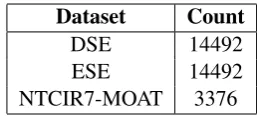
Dataset Count
DSE 14492
ESE 14492
[image:4.595.115.244.61.119.2]NTCIR7-MOAT 3376
Table 2: The number of sentences for each dataset.
4 Experiments
4.1 Data Sets
Due to the development of opinion mining, there are numerous existing datasets which are useful for us. For example, Multi-Perspective Question Answering (MPQA) offers the annotated dataset.
In this paper, we conducted the experiments on the processed dataset, MPQA 1.2, provided by ˙Irsoy and Cardie (2014). It includes two types of opinion expression proposed by Wiebe et al. (2005) - direct subjective expressions(DSEs) and expressive subjective expressions (ESEs). DSEs represent both subjective speech events and ex-plicitly mentioned private states, while ESEs con-sist of tokens that express emotion or sentiment in an indirect or implicit way. Table1is also an ex-ample of DSE and ESE.
In addition to MQPA 1.2, we have another dataset from MOAT task, which is also related to opinion expression and organized by NTCIR (Seki et al., 2008). Different datasets can confirm that our model is generalized enough. Table2depicts the number of sentences in each dataset.
In the research, we first used one tenth of the dataset as the development set, and the rest of the data are applied 10-fold in order to get a more bal-anced result.
4.2 Word Embeddings
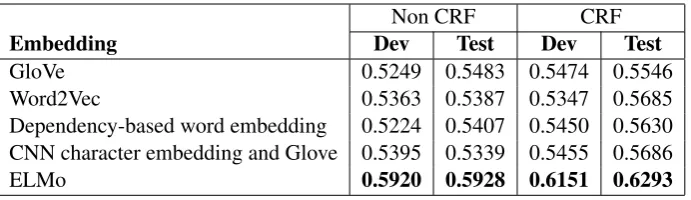
This experiment contains the details of the com-parison between ELMo and other embedding ways. Table3is the results from different notable embedding ways on DSEs, and the evaluation is token-based calculation.
we selected some pre-trained word embedding - Word2Vec (Mikolov et al., 2013), GloVe (Pen-nington et al.,2014), and dependency-based word embedding (Levy and Goldberg, 2014). Besides, we also tried BiLSTM-CNNs-CRF (Ma and Hovy, 2016), which extracted character features by CNN and concatenated GloVe.
All the architectures are identical except for the word representings and decoding ways. Each
combination is composed of one type of embed-dings and three BiLSTM layers with or without CRF layer.
According to the results, the model with CRF layer does defeat the model without CRF layer. It proves that adding CRF layer becomes more pow-erful. Moreover, all the scores are close except for ELMo one. BiLSTM-CNNs-CRF doesn’t ex-ceed the other models only with pre-trained word embedding. We assumed that opinion mining em-phasizes more semantics than syntax. Therefore, character features do not boost the model much.
Subsequently, we compared BiLSTM-CNNs-CRF with the one using ELMo embedder (ELMo-BiLSTM-CRF), and it turned out that ELMo-BiLSTM-CRF surpasses BiLSTM-CNNs-CRF substantially. Therefore, we took it as our baseline in this paper.
4.3 Parameter Settings
We made use of pre-trained BERT and ELMo models and did the fine-tuning during training pro-cedure guided by Devlin et al. (2018) in order to make the model learn the distribution of the dataset.
For ELMo model, we used ELMoForMany-Langs1provided by HIT-SCIR (Che et al.,2018; Fares et al.,2017) and took the average of the hid-den states from all the layers as token representa-tion.
For BERT model, we used ”BERT-Base, Mul-tilingual Cased” provided by Google 2 (Devlin et al.,2018). Most of the hyper-parameters are in-structed by the paper. Only the hidden state from the last layer is picked and regarded as token rep-resentation.
For the rest of shared properties, we stacked 3 layers of BiLSTM 3 based on ˙Irsoy and Cardie (2014). Learning rate is 0.00005 advised by (De-vlin et al.,2018). Dropout is set to 0.5 before fully connected layer. Optimizer uses Adam (Kingma and Ba,2014).
4.4 Evaluation
In the evaluation, we calculated precision, recall, and F1-score. However, in order to evaluate our model comprehensively, we measured our model not only by token basis but also span basis. This
1
https://github.com/HIT-SCIR/ELMoForManyLangs 2
https://github.com/google-research/bert
Non CRF CRF
Embedding Dev Test Dev Test
GloVe 0.5249 0.5483 0.5474 0.5546
Word2Vec 0.5363 0.5387 0.5347 0.5685
Dependency-based word embedding 0.5224 0.5407 0.5450 0.5630 CNN character embedding and Glove 0.5395 0.5339 0.5455 0.5686
[image:5.595.128.474.61.161.2]ELMo 0.5920 0.5928 0.6151 0.6293
Table 3: The results of applying a variety of embeddings on DSEs. ELMo embedder outperforms others signifi-cantly. Besides, stacking a CRF layer as decoder can increase the performance slightly.
Token basis Binary Overlap Proportional Overlap
Model Prec. Rec. F1 Prec. Rec. F1 Prec. Rec. F1
ELMo-BiLSTM-CRF 0.708 0.640 0.640 0.703 0.620 0.653 0.676 0.543 0.597 BERT-BiLSTM-CRF 0.735 0.753 0.720 0.738 0.766 0.750 0.702 0.705* 0.701 BERT-BiLSTM-Attn-CRF 0.740 0.761 0.723 0.744 0.768 0.752 0.710 0.705* 0.703
Table 4: Experimental evaluation of models for DSE.
Token basis Binary Overlap Proportional Overlap
Model Prec. Rec. F1 Prec. Rec. F1 Prec. Rec. F1
ELMo-BiLSTM-CRF 0.637 0.518 0.552 0.644 0.510 0.560 0.586 0.391 0.460 BERT-BiLSTM-CRF 0.672 0.608 0.631 0.686 0.634 0.654 0.625 0.527 0.564 BERT-BiLSTM-Attn-CRF 0.665 0.635 0.645 0.654 0.684 0.663 0.598 0.570 0.577
Table 5: Experimental evaluation of models for ESE.
Token basis Binary Overlap Proportional Overlap
Model Prec. Rec. F1 Prec. Rec. F1 Prec. Rec. F1
ELMo-BiLSTM-CRF 0.483 0.419 0.404 0.465 0.356 0.323 0.426 0.267 0.245 BERT-BiLSTM-CRF 0.468 0.428 0.430 0.426 0.432 0.415 0.387 0.354 0.359* BERT-BiLSTM-Attn-CRF 0.515 0.481 0.482 0.360 0.510 0.407 0.337 0.427 0.359*
Table 6: Experimental evaluation of models for NTCIR-MOAT7. * means the same scores.
is because it is difficult to define the boundaries of expressions, even for human annotators. To put it another way, for token-based evaluation, F1-score pays attention to whether the individual tag is predicted correctly or not. In contrast, span-based evaluation cares about the count of over-lap; hence, we used binary overlap along with pro-portional overlap. Binary overlap computes the number of matching overlaps between predicted sequence and ground-truth sequence. As long as predicted span overlaps ground-truth span, binary overlap views it as a correct prediction. To refine the evaluation, proportional overlap considers the length of overlap and imparts a partial correctness to each match, which is able to assess the model more accurate. We used these three evaluations to
measure our models.
5 Results and Discussion
5.1 Results
Table4,5, and6display the results of the data sets individually. The scores show that using BERT embedder does achieve better performance than using ELMo embedder by dramatic difference, which implies that BERT is promising in opinion mining tasks. More interestingly, adding attention mechanism on BiLSTM can increase the perfor-mance slightly.
5.2 Discussion
opinion-DSE S1 My public affairs keepers [could]B [n’t care less]I . ELMo-BiLSTM-CRF My public affairs keepers could n’t care less . Bert-BiLSTM-CRF My public affairs keepers [could]B [n’t care]I less . Bert-BiLSTM-Attn-CRF My public affairs keepers [could]B [n’t care less]I .
ESE S1 By comparison , the al Qaedans [look]B [pretty fat , if not happy]I . ELMo-BiLSTM-CRF By comparison , the al Qaedans look [pretty]B[fat]I, [if]B[not happy]I . Bert-BiLSTM-CRF [By]B comparison , the al Qaedans [look]B[pretty fat]I , [if]B[not happy]I . Bert-BiLSTM-Attn-CRF [By]B [comparison]I, the al Qaedans [look]B[pretty fat]I , [if]B[not happy]I .
ESE S2 Their restroom arrangements [are]B[pretty spartan]I . ELMo-BiLSTM-CRF Their restroom arrangements are [pretty]B [spartan]I . Bert-BiLSTM-CRF Their restroom arrangements are [pretty]B [spartan]I . Bert-BiLSTM-Attn-CRF Their restroom arrangements are [pretty]B [spartan]I .
ESE S3 We can see for ourselves , [sort]B [of]I. ELMo-BiLSTM-CRF We can see for ourselves , [sort]I of .
Bert-BiLSTM-CRF We can [see]I for [ourselves]I, [sort]B [of]I. Bert-BiLSTM-Attn-CRF We can see for ourselves [,]B[sort]I [of]I.
[image:6.595.72.532.61.323.2]MOAT S1 [He]B [considers them as Indonesian as he is .]I ELMo-BiLSTM-CRF He considers [them]I as [Indonesian]I as [he]I is . Bert-BiLSTM-CRF He considers them as [Indonesian]I as he is . Bert-BiLSTM-Attn-CRF [He]B [considers them as Indonesian as he is .]I
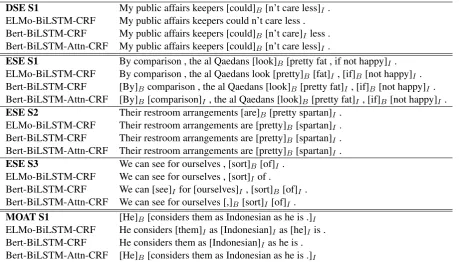
Table 7: Output from our models for each dataset.
ated expression, which may be some adjectives. However, detecting ESEs requires understanding more implicit semantics, but BERT-BiLSTM-CRF works well on ESEs.
Adding attention mechanism does not improve much probably because BERT layer has already incorporated multi-head attention mechanism and caught well-represented information.
Moreover, the training epochs for ELMo-BiLSTM-CRF is 4 times more than that of BERT-BiLSTM-CRF to converge. In other words, apply-ing BERT embedder can save much more time. To conclude, in our experiments, BERT embedder is much more efficient than other embeddings.
5.3 Error Analysis
In this section, we observed the predictions and analyzed the defect in our models. Table 7 is our several predictions from our model on each dataset. Many sentences are predicted approxi-mately or even same; however, in some sentences ELMo-BiLSTM-CRF has lower recall.
BERT-BiLSTM-CRF can predict well, but some failures are caused by the inconsistency in dataset. For example, whether definite articles (e.g. “the”) or punctuation should be included or not is one of the problems. Besides, the same verb, such as ’say’, in similar contexts is not always an-notated, either.
For ESEs, It is much more difficult to clearly identify implicit semantics because there are many fragmented predictions. Besides, although we have CRF layer to consider the entire sequence predictions, it still exists some wrong tagging, such as starting with I tag.
The opinionated spans in NTCIR7-MOAT data are usually too long, which is a little different from the other datasets. Besides, the number of sen-tences is not much; thus, the result does not meet the expectation.
Once the flaws in dataset are figured out, we can gain a better performance. Furthermore, adding another feature, such as GLoVe (Pennington et al., 2014) or linguistic characteristics, is also a way to enhance the model.
6 Conclusion
In this paper, we introduced contextualized em-beddings into opinion mining task. Experimen-tally, our models have significant promotion for changing embedder and prove that deep contextu-alized embeddings perform well in opinion mining task. Specifically, our comparison shows that us-ing BERT embedder dramatically surpasses usus-ing ELMo embedder.
Chiu and Nichols(2016);Xu et al.(2018). Even more, we can add contextual string embedding (Akbik et al.,2018) to support character-level fea-tures and apply it to advanced opinion mining tasks.
Acknowledgments
Thanks to the professor Noriko Kando to super-vise me for the research and my friend for giv-ing the advice for the paper. This work was supported by the International Internship Program of National Institute of Informatics, Japan, and JSPS KAKENHI Grant Numbers JP18H03338 and JP16H01756.
References
Alan Akbik, Duncan Blythe, and Roland Vollgraf. 2018. Contextual string embeddings for sequence labeling. InCOLING.
Wanxiang Che, Yijia Liu, Yuxuan Wang, Bo Zheng, and Ting Liu. 2018. Towards better UD parsing: Deep contextualized word embeddings, ensemble, and treebank concatenation. InProceedings of the CoNLL 2018 Shared Task: Multilingual Parsing
from Raw Text to Universal Dependencies, pages
55–64, Brussels, Belgium. Association for Compu-tational Linguistics.
Jason P. C. Chiu and Eric Nichols. 2016. Named entity recognition with bidirectional lstm-cnns. Transac-tions of the Association for Computational Linguis-tics, 4:357–370.
Yejin Choi, Claire Cardie, Ellen Riloff, and Siddharth Patwardhan. 2005. Identifying sources of opinions with conditional random fields and extraction pat-terns. InHLT/EMNLP.
Jacob Devlin, Ming-Wei Chang, Kenton Lee, and Kristina Toutanova. 2018. Bert: Pre-training of deep bidirectional transformers for language understand-ing. CoRR, abs/1810.04805.
Murhaf Fares, Andrey Kutuzov, Stephan Oepen, and Erik Velldal. 2017. Word vectors, reuse, and replica-bility: Towards a community repository of large-text resources. InProceedings of the 21st Nordic
Con-ference on Computational Linguistics, pages 271–
276, Gothenburg, Sweden. Association for Compu-tational Linguistics.
Sepp Hochreiter and J¨urgen Schmidhuber. 1997. Long short-term memory. Neural Comput., 9(8):1735– 1780.
Zhiheng Huang, Wei Xu, and Kai Yu. 2015. Bidirec-tional lstm-crf models for sequence tagging. CoRR, abs/1508.01991.
Ozan ˙Irsoy and Claire Cardie. 2014. Opinion mining with deep recurrent neural networks. InProceedings of the Conference on Empirical Methods in Natural
Language Processing, pages 720–728.
L. C. Jain and L. R. Medsker. 1999. Recurrent Neu-ral Networks: Design and Applications, 1st edition. CRC Press, Inc., Boca Raton, FL, USA.
Arzoo Katiyar and Claire Cardie. 2016. Investigating lstms for joint extraction of opinion entities and re-lations. InACL.
Arzoo Katiyar and Claire Cardie. 2017. Going out on a limb: Joint extraction of entity mentions and rela-tions without dependency trees. InACL.
Diederik P. Kingma and Jimmy Ba. 2014. Adam: A method for stochastic optimization. CoRR, abs/1412.6980.
John D. Lafferty, Andrew McCallum, and Fernando Pereira. 2001. Conditional random fields: Prob-abilistic models for segmenting and labeling se-quence data. InICML.
Omer Levy and Yoav Goldberg. 2014. Dependency-based word embeddings. InACL.
Pengfei Liu, Shafiq R. Joty, and Helen M. Meng. 2015. Fine-grained opinion mining with recurrent neural networks and word embeddings. InEMNLP.
Xuezhe Ma and Eduard H. Hovy. 2016. End-to-end sequence labeling via bi-directional lstm-cnns-crf.
CoRR, abs/1603.01354.
Bryan McCann, James Bradbury, Caiming Xiong, and Richard Socher. 2017. Learned in translation: Con-textualized word vectors. InNIPS.
Tomas Mikolov, Ilya Sutskever, Kai Chen, Gregory S. Corrado, and Jeffrey Dean. 2013. Distributed repre-sentations of words and phrases and their composi-tionality. InNIPS.
Makoto Miwa and Mohit Bansal. 2016. End-to-end re-lation extraction using lstms on sequences and tree structures.CoRR, abs/1601.00770.
Jeffrey Pennington, Richard Socher, and Christo-pher D. Manning. 2014. Glove: Global vectors for word representation. InEMNLP.
Matthew E. Peters, Mark Neumann, Mohit Iyyer, Matt Gardner, Christopher Clark, Kenton Lee, and Luke S. Zettlemoyer. 2018. Deep contextualized word representations. InNAACL 2018.
Alec Radford. 2018. Improving language understand-ing by generative pre-trainunderstand-ing.
Sebastian Ruder and Jeremy Howard. 2018. Universal language model fine-tuning for text classification. In
M. Schuster and K.K. Paliwal. 1997. Bidirectional recurrent neural networks. Trans. Sig. Proc., 45(11):2673–2681.
Yohei Seki, David Kirk Evans, Lun-Wei Ku, Le Sun, Hsin-Hsi Chen, and Noriko Kando. 2008. Overview of multilingual opinion analysis task at ntcir-7.
Pro-ceedings of The IEEE - PIEEE.
Swapna Somasundaran and Janyce Wiebe. 2010. Rec-ognizing stances in ideological on-line debates.
Ashish Vaswani, Noam Shazeer, Niki Parmar, Jakob Uszkoreit, Llion Jones, Aidan N. Gomez, Lukasz Kaiser, and Illia Polosukhin. 2017. Attention is all you need. InNIPS.
Xin Wang, Yuanchao Liu, Chengjie Sun, Ming Liu, and Xiaolong Wang. 2016. Extended dependency-based word embeddings for aspect extraction. InICONIP.
Janyce Wiebe, Theresa Wilson, and Claire Cardie. 2005. Annotating expressions of opinions and emo-tions in language. Language Resources and Evalu-ation, 39(2):165–210.
Xiaoxia Xie. 2017. Opinion expression detection via deep bidirectional c-grus. 2017 28th International Workshop on Database and Expert Systems
Appli-cations (DEXA), pages 118–122.