128
BAM: A combination of deep and shallow models for German Dialect
Identification.
Andrei M. Butnaru
Department of Computer Science, University of Bucharest 14 Academiei, Bucharest, Romania
Abstract
In this paper, we present a machine learning approach for the German Dialect Identifica-tion (GDI) Closed Shared Task of the DSL 2019 Challenge. The proposed approach com-bines deep and shallow models, by applying a voting scheme on the outputs resulted from a Character-level Convolutional Neural Net-works (Char-CNN), a Long Short-Term Mem-ory (LSTM) network, and a model based on String Kernels. The first model used is the Char-CNN model that merges multiple con-volutions computed with kernels of different sizes. The second model is the LSTM net-work which applies a global max pooling over the returned sequences over time. Both mod-els pass the activation maps to two fully-connected layers. The final model is based on String Kernels, computed on characterp -grams extracted from speech transcripts. The model combines two blended kernel functions, one is the presence bits kernel, and the other is the intersection kernel. The empirical re-sults obtained in the shared task prove that the approach can achieve good results. The sys-tem proposed in this paper obtained the fourth place with a macro-F1score of62.55%.
1 Introduction
Being at its third edition, the 2019 VarDial Evalu-ation Campaign (Zampieri et al., 2019) includes two shared tasks on dialect identification which proves that researchers are still interested in this challenging NLP task. For example, in the 2018 GDI Shared Task (Zampieri et al., 2018), a sys-tem (Jauhiainen et al., 2018) that uses a series of language models based on character n-grams achieves state-of-the-art with a macro-F1 score
near 69%, in a 4-way classification setting. For the 2019 GDI Shared Task, the organizers have in-cluded audio features together with speech tran-scripts, and also provided a word-level
normal-ization for each transcript. For solving this task, we propose a combination of deep and shallow models, by applying a voting scheme on the out-puts resulted from a Character-level Convolutional Neural Networks (Char-CNN), a Long Short-Term Memory (LSTM) network, and a model based on String Kernels. In the 2019 GDI Shared Task, the participants had to discriminate between four Ger-man dialects, in a 4-way classification setting. A number of6participants have submitted their re-sults, and the model proposed in this paper ob-tained4thplace with an accuracy of62.95%, and macro-F1score of62.55%.
The best scoring system that we submitted for the GDI Shared Task is an ensemble that com-bines both deep and shallow models. The sys-tem uses features from two deep models, Char-CNNs and LSTMs, and also from a shallow model that combines several kernels using multiple ker-nel learning. The Char-CNN model merges convo-lutions computed with kernels of different sizes to learn a first group of features. The LSTM network learns the second group of features by applying a global max pooling over the returned sequences over time. For the String Kernel model, we com-bined two kernel functions. The first kernel used is the p-grams presence bits kernel1 which takes into account only the presence ofp-grams instead of their frequencies. The second kernel is the his-togram intersection kernel2, which was first used in a text mining task by (Ionescu et al.,2014). This kernel functions proved useful in previous dialect identification shared tasks (Ionescu and Popescu,
2016; Ionescu and Butnaru, 2017; Butnaru and Ionescu,2018).
There are two steps in the learning process. In
1
Thep-grams presence bits kernel was computed using the code available at http://string-kernels.herokuapp.com.
2The intersection string kernel was computed using the
the first step, the deep models are trained indi-vidually using the Adam optimization algorithm (Kingma and Ba, 2015). In the second step, the string kernel model is learned by applying Kernel Ridge Regression (KRR) (Shawe-Taylor and Cris-tianini,2004). Finally, a voting schema is applied to obtain the final class for a test sample. Before deciding the final system, we tuned each model for the task. First of all, we tuned the string kernels model by trying outp-grams of various lengths, in-cluding blended variants of string kernels as well. Besides blended variants, we evaluated individ-ual kernels, and also various kernel combinations. Second of all, we tuned the Char-CNN model, by trying out various convolution lengths, number of filters and depths. Finally, we tuned the LSTM model by seeking the best number of output units. The paper is organized as follows. Work related to German dialect identification, models based on Character-Level Convolutional Neural Networks, Long Short-Term Memory Networks, and meth-ods based on string kernels is presented in Section
2. Section3presents Char-CNNs, LSTMs and the string kernel models used in this approach. In this section, we also present the ensemble model. De-tails about the German dialect identification exper-iments are provided in Section4. Finally, we draw the conclusion in Section5.
2 Related Work
2.1 German Dialect Identificaion
German dialect identification is not a widely re-searched task, but we can observe an increased interest in it within recent years. In 2010, a sys-tem for written dialect identification was proposed (Scherrer and Rambow,2010) , and it was based on an automatically generated Swiss German lex-icon that maps word forms with their geographi-cal extensions. During test time, they split a sen-tence into words and look up their geographical extension in the lexicon. Another method ( Hol-lenstein and Aepli,2015) was proposed for solv-ing the Swiss German dialect identification task based on trigrams. For each dialect, a language model was trained, and each test sentence was scored against every model. The predicted dialect is chosen based on the lowest perplexity. In 2016, a corpus (Samardˇzi´c et al.,2016) that can be used for GDI was presented, which was later used to evaluate the participants in the GDI Shared Task of the DSL 2017 Challenge. One of the
partici-pants in the previously mentioned shared task, de-fined a system (Ionescu and Butnaru,2017) that is based on multiple string kernels. The team used a Kernel Ridge Regression classifier trained on a kernel combination of a blended presence bits ker-nel based on3−6-grams, a blended intersection kernel based on3−6-grams, and a kernel based on LRD with3−5-grams. The winning team of the GDI Shared Task of the VarDial 2018 Workshop defined a system (Jauhiainen et al., 2018) that is based on language models defined on character4 -grams, and having on top the HeLI method.
2.2 String Kernels
In the past years, we can find that techniques that approach text at the character level proved re-markable performance levels in various text anal-ysis tasks (Lodhi et al., 2002; Sanderson and Guenter, 2006; Kate and Mooney, 2006; Es-calante et al., 2011; Popescu and Grozea, 2012;
Popescu and Ionescu,2013;Ionescu et al.,2014,
2016;Gim´enez-P´erez et al.,2017;Popescu et al.,
2017; Cozma et al., 2018; Ionescu and But-naru, 2018a). String kernels are a natural way of using character level information to gener-ate features that are helpful in solving various areas of tasks. They are a particular case of the more general convolution kernels (Haussler,
1999). Since the beginning of the 21st century, re-searchers applied string kernels on document cat-egorization (Lodhi et al., 2002), obtaining excel-lent results. String kernels were also success-fully used in authorship identification (Sanderson and Guenter, 2006; Popescu and Grozea, 2012). For example, the first ranked team of the PAN 2012 Traditional Authorship Attribution task, used a system (Popescu and Grozea, 2012) based on string kernels. In recent years, various blended string kernels reached state-of-the-art accuracy rates for native language identification (Ionescu et al., 2016; Ionescu and Popescu, 2017), Ara-bic dialect identification (Ionescu and Popescu,
2016; Ionescu and Butnaru, 2017; Butnaru and Ionescu, 2018), polarity classification ( Gim´enez-P´erez et al.,2017;Popescu et al.,2017), automatic essay scoring (Cozma et al., 2018), and cross-domain text classification (Ionescu and Butnaru,
2018a,b).
2.3 Character-Level CNN Networks
computer vision tasks (Krizhevsky et al., 2012;
Szegedy et al.,2015;Ren et al.,2015). Therefore, many researchers decided to apply CNNs in their primary area of interest. For example, in the NLP domain, Convolutional Neural Networks (LeCun et al.,1998;Krizhevsky et al.,2012) were success-fully applied on several NLP tasks such as part-of-speech tagging (Santos and Zadrozny, 2014), text categorization (Kim,2014;Zhang et al.,2015;
Johnson and Zhang, 2015), dialect identification (Belinkov and Glass, 2016; Ali, 2018), machine translation (Gehring et al., 2017) and language modeling (Kim et al.,2016;Dauphin et al.,2017). Word embeddings (Mikolov et al.,2013; Penning-ton et al.,2014) had a significant impact on NLP due to their ability to learn semantic and syntactic latent features. Because of this, researchers devel-oped many CNN-based methods that rely on word embeddings. Trying to eliminate the pre-trained word embeddings from the pipeline, some re-searchers have tried to build end-to-end models us-ing characters as input, in order to solve text clas-sification (Zhang et al.,2015;Belinkov and Glass,
2016), language modeling (Kim et al., 2016) or dialect identification (Butnaru and Ionescu,2019) tasks. Using characters as features can help the model learn unusual character sequences such as misspellings or take advantage of unseen words during test time. Working at the character-level can prove useful in solving the dialect identifica-tion task, since some state-of-the-art dialect identi-fication methods (Ionescu and Butnaru,2017; But-naru and Ionescu,2018) use character n-grams as features.
2.4 Long-Short Term Memory Networks
Recurrent Neural Networks (RNNs) (Elman,
1990) have the ability to process fixed length se-quences and learn short-term dependencies be-tween items from the sequence (Lin et al.,1996). A limitation of the RNN model is that it can-not learn long-distance correlations between items within a sequence (Hochreiter and Schmidhuber,
1997;Hochreiter et al., 2001). Long Short-Term Memory (LSTMs) (Hochreiter and Schmidhuber,
1997) have been proposed as a solution for the RNNs issue, introducing a memory cell inside the network. LSTMs have become more popular after being successfully applied in statistical machine translation (Sutskever et al., 2014). Besides this, researchers employed LSTMs in various areas,
from speech recognition (Graves et al., 2013a,b;
Amodei et al.,2016), to language modelling (Kim et al.,2016), and text classification (Zhang et al.,
2015).
2.5 Ensemble Learning
Ensemble learning combines a number of pre-viously trained classifiers to classify new data samples by applying a voting schema on their predictions. Ensemble methods have been suc-cessfully employed in various machine learning tasks, including feature selection (Saeys et al.,
2008), sentiment analysis (Xia et al.,2011;Wang et al., 2014), complex word identification ( Mal-masi et al.,2016), and dialect identification ( Mal-masi and Dras, 2015; Malmasi and Zampieri,
2017).
3 Method
The model presented in this paper combines the results obtained from three different learning algo-rithms: Kernel Ridge Regression over String Ker-nels, Character-level Convolutional Neural Net-works, and a Long Short-Term Memory Network. The intuition to use three different learning al-gorithms comes from the idea that each trained model can discover from the same input differ-ent discriminant features, thus combining them will increase the accuracy of each and any model. String Kernels uses a function to compute a sim-ilarity matrix that carries the correlation between all pairs of samples. Based on the similarity be-tween the samples ( that is held in the similarity matrix ) the KRR can learn a function that dis-criminates between them. Character-level Con-volutional Neural Networks can learn to discrim-inate between samples by discovering patterns at character-level. The intuition in using this method comes from the idea that the same words in differ-ent dialects can have small character differences. Besides small character differences, there can be connections between words within a text. Having this in mind we propose to employ an LSTM ne-towrk to learn patterns between words within texts from the same dialect.
3.1 String Kernels
Kernel functions (Shawe-Taylor and Cristianini,
the power to naturally handle input data that is not in the form of numerical vectors, for example strings. There are many kernel functions that can be applied on strings, with significant impact in domains such as computational biology and com-putational linguistics. String kernels embed the texts in a very large feature space, given by all the substrings of length p, and leave the job of selecting important (discriminative) features for the specific classification task to the learning al-gorithm, which assigns higher weights to the im-portant features (characterp-grams). Perhaps one of the most natural ways to measure the similar-ity of two strings is to count how many substrings of lengthpthe two strings have in common. This gives rise to thep-spectrum kernel. Formally, for two strings over an alphabet Σ, s, t ∈ Σ∗, the p-spectrum kernel is defined as:
kp(s, t) = X v∈Σp
numv(s)·numv(t),
where numv(s) is the number of occurrences of string vas a substring ins. The feature map de-fined by this kernel associates to each string a vec-tor of dimension|Σ|p containing the histogram of frequencies of all its substrings of length p (p-grams). A variant of this kernel can be obtained if the embedding feature map is modified to as-sociate to each string a vector of dimension|Σ|p containing the presence bits (instead of frequen-cies) of all its substrings of length p. Thus, the characterp-grams presence bits kernel is obtained:
k0p/1(s, t) = X v∈Σp
inv(s)·inv(t),
where inv(s)is1if stringvoccurs as a substring ins, and0otherwise.
In computer vision, the (histogram) intersec-tion kernel has successfully been used for object class recognition from images (Maji et al.,2008;
Vedaldi and Zisserman, 2010). Ionescu et al.
(2014) have used the intersection kernel as a ker-nel for strings, in the context of native language identification. The intersection string kernel is de-fined as follows:
k∩p(s, t) = X v∈Σp
min{numv(s),numv(t)}.
For thep-spectrum kernel, the frequency of a p-gram has a very significant contribution to the ker-nel, since it considers the product of such frequen-cies. On the other hand, the frequency of ap-gram
is completely disregarded in thep-grams presence bits kernel. The intersection kernel lies some-where in the middle between thep-grams presence bits kernel and thep-spectrum kernel, in the sense that the frequency of ap-gram has a moderate con-tribution to the intersection kernel. In other words, the intersection kernel assigns a high score to a p-gram only if it has a high frequency in both strings, since it considers the minimum of the two frequen-cies. The p-spectrum kernel assigns a high score even when thep-gram has a high frequency in only one of the two strings. Thus, the intersection ker-nel captures something more about the correlation between thep-gram frequencies in the two strings. Based on these comments, in the experiments we use only thep-grams presence bits kernel and the intersection string kernel.
Data normalization helps to improve machine learning performance for various applications. Since the value range of raw data can have large variations, classifier objective functions will not work properly without normalization. After nor-malization, each feature has an approximately equal contribution to the similarity between two samples. To obtain a normalized kernel matrix of pairwise similarities between samples, each com-ponent is divided by the square root of the product of the two corresponding diagonal components:
ˆ Kij =
Kij
p
Kii·Kjj .
To ensure a fair comparison among strings of dif-ferent lengths, normalized versions of thep-grams presence bits kernel and the intersection kernel were used in the experiments. Taking into ac-count p-grams of different lengths and summing up the corresponding kernels, new kernels, termed blended spectrum kernels, can be obtained. Vari-ous blended spectrum kernels were used in the ex-periments in order to find the best combination.
3.2 Character-Level CNN
Input
Conv. layer 3 kernel size
1024 filters
Conv. layer 4 kernel size
1024 filters
Conv. layer 5 kernel size
1024 filters
Global Max Pooling
Global Max Pooling
Global Max Pooling
Concatenation
Fully-Connected Layer
Fully-Connected Layer Alpha-Dropout
[image:5.595.75.291.58.446.2]Output
Figure 1: The architecture of the Character-level CNN model.
one-hot vector. For example, having the alpha-betΣ = {a, b, c}, the encoding for characterais [1,0,0], forbis[0,1,0], and forcis[0,0,1]. Each character from the input text is encoded, and only a fixed sizelof the input is kept. In the experiments presented in this paper, l was set to 270 charac-ters. The documents that are under the length were zero-padded. The alphabet was extracted from the dataset and it contains a total of 32 characters from which 26 are the lower case letters of the English alphabet, plus 6 Swiss-German diacritics (such as ˜a, ¨a, ˜o, ¨o, ¨u, ˜e). Characters that do not appear in the alphabet are encoded as a blank character.
As illustrated in Figure 1, the architecture is 5 layers deep. The first layer is composed of three different convolutional layers, each followed by a global max-pooling layer. The third layer concate-nates the features extracted from the global max-pooling layers, then passes the concatenation to
two fully-connected layers. The convolutional lay-ers are based on one-dimensional filtlay-ers, one with filter size 3, another one with filter size 4, and the last one with filter size 5. After the concatena-tion step, the activaconcatena-tion maps pass through a fully-connected layer having ReLU activation and af-ter that, through an alpha dropout layer with the drop probability of 0.1. The last fully-connected layer has a softmax activation, which provides the final output. All convolutional layers have 1024 filters, and the first fully-connected layer has 256 neurons. The network is trained with the Adam optimizer using categorical cross-entropy as loss function, and a learning rate of 0.001.
3.3 Long Short-Term Memory Network
Long Short-Term Memory networks (LSTMs) have the capacity to learn long-term dependencies from a sequence. When applied on text, LSTMs can discover connections between words within a sentence or a text. Those connections can help the learning algorithm to find patterns that can later be used to solve a specific task. For example, discov-ering such connections can be useful to say if a text belongs to one class or another. Based on this idea, this paper proposes an LSTM model that can learn to discriminate between different dialects.
The input for this model is the same as the input used for the Char-CNN model. Characters were chosen as input because of the idea that between dialects, there are subtle character differences that makes a word belong to one dialect or another. The other reason is that there might be connec-tions between substrings within the whole text of a specific dialect. The LSTM model defined for the GDI task is illustrated in Figure 2. The architec-ture consists of an LSTM layer, with the number of cells equal to 256, followed by a global max-pooling layer over the hidden state of each input character. The activation maps then pass through a fully-connected layer with 128 neurons, having ReLU activation. Finally, the predictions are com-puted by another fully-connected layer. The net-work is trained with the Adam optimizer using categorical cross-entropy as loss function, and a learning rate of 0.01.
3.4 Ensemble Model
Input
LSTM LSTM LSTM
Global Max Pooling
...
Fully-Connected Layer
Fully-Connected Layer
[image:6.595.75.289.58.354.2]Output
Figure 2: The architecture of the LSTM model.
method is employed. A voting schema is applied over the predictions from the Char-CNN, LSTM and String Kernel model. The vote from each model has equal weight. The class voted by the majority of the models is the final class for a sam-ple data. If there is a tie, the class is chosen be-tween the prediction of the Char-CNN model or the LSTM model, whichever prediction has the highest confidence among the outputs of the two models.
4 Experiments
4.1 Data Set
The 2019 GDI Shared Task data set (Zampieri et al., 2019) contains manually annotated tran-scripts of Swiss German speech, acoustic features for each transcript, and word-level normalization for each text. The task is to discriminate be-tween Swiss German dialects from four differ-ent areas: Basel (BS), Bern (BE), Lucerne (LU), Zurich (ZH). As the samples are almost evenly dis-tributed, an accuracy of 27.10%can be obtained with a majority class baseline on the test set. In our experiments, we used only the text transcripts to generate features.
4.2 Parameter and System Choices
The approach presented in this paper treats tran-scripts as strings. Because the approach works at the character level, there is no need to split the texts into words or to do any NLP-specific processing before computing the string kernels or feed the data to the deep networks. One thing to mention here is that for the deep networks the characters were mapped to one-hot encodings.
In order to tune the parameters and find the best system choices, the development set was used. Each model used in the ensemble was tuned. For tuning the parameters of the String Kernel method, we carried out a set of preliminary experiments to determine the optimal range ofp-grams for each string kernel. We fix the learning method to KRR and evaluated allp-grams in the range2−7. The best accuracy (63.99%) is obtained with4-grams. Having set the optimal number ofp-grams, we ex-perimented with different blended kernels to find out if combiningp-grams of different lengths will improve the accuracy. For both kernels, presence and intersection, the best accuracy was obtained by combining p-grams with the length in range 3−5.
After determining the optimal range ofp-grams for each kernel function, we conducted further ex-periments by combining the presence bits kernel with the intersection kernel. When multiple ker-nels are combined, the features are actually em-bedded in a higher-dimensional space. As a conse-quence, the search space of linear patterns grows, which helps the classifier to select a better discrim-inant function. The most natural way of combin-ing two or more kernels is to sum them up. The process of summing up kernels or kernel matrices is equivalent to feature vector concatenation. The results obtained by the individual kernels and also with the combined version are reported in Table 1. We can notice that even the individual kernels yield similar accuracy, when combined, the accu-racy increases by a small amount.
lay-Figure 3: Accuracy rates of the KRR based on the presence bits kernel withp-grams in the range2−7.
Model Accuracy
ˆ
k30/−15 66.05%
ˆ
k3∩−5 66.00%
ˆ k30/−15+ ˆk
∩
3−5 66.09%
Char−CN N 66.09%
LST M 65.39%
ˆ k30/−15+ ˆk
∩
3−5+Char−CN N+LST M 67.95%
Table 1: Accuracy rates of various models used in ex-periments. The results are obtained over the develop-ment set.
ers. From those experiments, we discovered that having 1024 filters on each convolutional layer, and one fully-connected layer having 256 neurons employs the best result (66.09%). In the exper-iments, the model was trained using Adam op-timizer having the learning rate set at 0.001 and with mini-batches of 64 samples. The network was trained for 25 epochs.
The last defined model was the LSTM model. For this model, we fixed the length of the hidden cell to be a number that is a power of two and close to the maximum length of a sample. Because the maximum length of a sample was set to 270 characters, we fixed the hidden cell number to be 256. The fully-connected layer was also fixed to 128 neurons from the beginning. For this model, we tuned the learning rate and the mini-batch size used for training. Through experiments, we fixed the learning rate to 0.01 and the mini-batch size to 32. This model was also trained using Adam opti-mizer. The best accuracy obtained with this model was65.39%and it was obtained after training the model for 25 iterations.
Applying a voting schema over the three
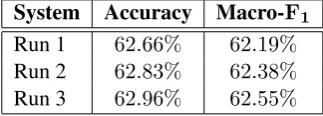
[image:7.595.79.508.72.255.2]mod-System Accuracy Macro-F1 Run 1 62.66% 62.19% Run 2 62.83% 62.38% Run 3 62.96% 62.55%
Table 2: Results on the test set of the 2019 GDI Shared Task (closed training) of the method described in this paper.
els, we observe an increase of almost2%over the best individual model.
4.3 Results
Table 2 presents our results for the German Di-alect Identification Closed Shared Task for the 2019 VarDial Evaluation Campaign. The only dif-ference between the three runs is the regulariza-tion parameter used in training the string kernel method. On the first run, the regularization pa-rameter was set to 10−3, on the second one it was set to 10−4, and on the last run it was set to10−5. Among the submitted systems, the best performance is obtained when the KRR regular-ization parameter, for the String Kernel model, is set to10−5. The String Kernel model used in the three runs was trained on both training and devel-opment set. The submitted systems were ranked by their macro-F1 scores and among the 6
partic-ipants, the best model that we submitted obtained the fourth place with a macro-F1score of62.55%.
[image:7.595.72.294.291.374.2] [image:7.595.335.497.292.350.2]distinguish-BE BS LU ZH Predicted label
BE
BS
LU
ZH
True label
737 201 170 83
65 954 105 75
426 150 533 67
53 235 127 762
Confusion Matrix
[image:8.595.76.288.65.254.2]0.0 0.1 0.2 0.3 0.4 0.5 0.6 0.7
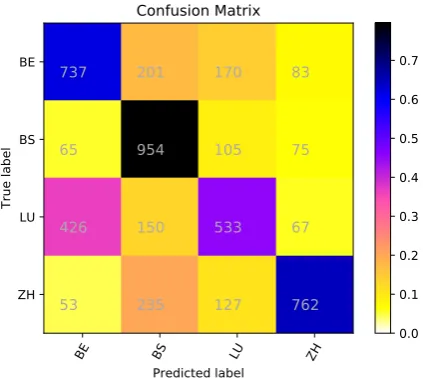
Figure 4: The confusion matrix of our best submission (run 3).
ing the Zurich dialect from the Basel dialect on one hand, and the Bern dialect from the Basel di-alect on the other hand. Overall, the results look good, as the main diagonal scores dominate the other matrix components.
5 Conclusion
In this paper, we presented an approach for the GDI Shared Task of the DSL 2019 Challenge (Zampieri et al., 2019). The approach is based on an ensemble model that combines using a voting scheme results from three different mod-els: Character-level Convolutional Neuronal Net-works, Long Short-Term Memory network, and a String Kernel model. The approach obtained the fourth place.
References
Mohamed Ali. 2018. Character level convolutional neural network for arabic dialect identification. In
Proceedings of VarDial, pages 122–127.
Dario Amodei, Sundaram Ananthanarayanan, Rishita Anubhai, Jingliang Bai, Eric Battenberg, Carl Case, Jared Casper, Bryan Catanzaro, Qiang Cheng, Guo-liang Chen, et al. 2016. Deep speech 2: End-to-end speech recognition in english and mandarin. In In-ternational conference on machine learning, pages 173–182.
Yonatan Belinkov and James Glass. 2016. A Character-level Convolutional Neural Network for Distinguishing Similar Languages and Dialects. In
Proceedings of VarDial, pages 145–152.
Andrei M. Butnaru and Radu Tudor Ionescu. 2018. UnibucKernel Reloaded: First Place in Arabic Di-alect Identification for the Second Year in a Row. In
Proceedings of VarDial, pages 77–87.
Andrei M Butnaru and Radu Tudor Ionescu. 2019. Mo-roco: The moldavian and romanian dialectal corpus.
arXiv preprint arXiv:1901.06543.
M˘ad˘alina Cozma, Andrei M. Butnaru, and Radu Tudor Ionescu. 2018. Automated essay scoring with string kernels and word embeddings. In Proceedings of ACL, pages 503–509.
Yann Dauphin, Angela Fan, Michael Auli, and David Grangier. 2017. Language Modeling with Gated Convolutional Networks. InProceedings of ICML, pages 933–941.
Jeffrey L Elman. 1990. Finding structure in time. Cog-nitive science, 14(2):179–211.
Hugo Jair Escalante, Thamar Solorio, and Manuel Montes-y-G´omez. 2011. Local Histograms of Char-acter N-grams for Authorship Attribution. In Pro-ceedings of ACL: HLT, volume 1, pages 288–298.
Jonas Gehring, Michael Auli, David Grangier, and Yann Dauphin. 2017. A Convolutional Encoder Model for Neural Machine Translation. In Proceed-ings of ACL, pages 123–135.
Rosa M. Gim´enez-P´erez, Marc Franco-Salvador, and Paolo Rosso. 2017. Single and Cross-domain Polar-ity Classification using String Kernels. In Proceed-ings of EACL, pages 558–563.
Alex Graves, Navdeep Jaitly, and Abdel-rahman Mo-hamed. 2013a. Hybrid speech recognition with deep bidirectional lstm. In2013 IEEE workshop on auto-matic speech recognition and understanding, pages 273–278. IEEE.
Alex Graves, Abdel-rahman Mohamed, and Geoffrey Hinton. 2013b. Speech recognition with deep recur-rent neural networks. In 2013 IEEE international conference on acoustics, speech and signal process-ing, pages 6645–6649. IEEE.
David Haussler. 1999. Convolution Kernels on Dis-crete Structures. Technical Report UCS-CRL-99-10, University of California at Santa Cruz, Santa Cruz, CA, USA.
Sepp Hochreiter, Yoshua Bengio, Paolo Frasconi, J¨urgen Schmidhuber, et al. 2001. Gradient flow in recurrent nets: the difficulty of learning long-term dependencies.
Sepp Hochreiter and J¨urgen Schmidhuber. 1997. Long short-term memory. Neural computation, 9(8):1735–1780.
Radu Tudor Ionescu and Andrei M. Butnaru. 2017. Learning to Identify Arabic and German Dialects us-ing Multiple Kernels. In Proceedings of VarDial, pages 200–209.
Radu Tudor Ionescu and Andrei M. Butnaru. 2018a. Improving the results of string kernels in sentiment analysis and Arabic dialect identification by adapt-ing them to your test set. InProceedings of EMNLP, pages 1084–1090.
Radu Tudor Ionescu and Andrei Madalin Butnaru. 2018b. Transductive learning with string kernels for cross-domain text classification. In Interna-tional Conference on Neural Information Process-ing, pages 484–496. Springer.
Radu Tudor Ionescu and Marius Popescu. 2016. UnibucKernel: An Approach for Arabic Dialect Identification based on Multiple String Kernels. In
Proceedings of VarDial, pages 135–144.
Radu Tudor Ionescu and Marius Popescu. 2017. Can string kernels pass the test of time in native language identification? In Proceedings of BEA-12, pages 224–234.
Radu Tudor Ionescu, Marius Popescu, and Aoife Cahill. 2014. Can characters reveal your native lan-guage? A language-independent approach to native language identification. InProceedings of EMNLP, pages 1363–1373.
Radu Tudor Ionescu, Marius Popescu, and Aoife Cahill. 2016. String kernels for native language identification: Insights from behind the curtains.
Computational Linguistics, 42(3):491–525.
Tommi Jauhiainen, Heidi Jauhiainen, and Krister Lind´en. 2018. Heli-based experiments in swiss ger-man dialect identification. In Proceedings of the Fifth Workshop on NLP for Similar Languages, Va-rieties and Dialects (VarDial 2018), pages 254–262.
Rie Johnson and Tong Zhang. 2015. Effective Use of Word Order for Text Categorization with Convolu-tional Neural Networks. InProceedings of NAACL, pages 103–112.
Rohit J. Kate and Raymond J. Mooney. 2006. Using String-kernels for Learning Semantic Parsers. In
Proceedings of ACL, pages 913–920, Stroudsburg, PA, USA. Association for Computational Linguis-tics.
Yoon Kim. 2014. Convolutional Neural Networks for Sentence Classification. InProceedings of EMNLP, pages 1746–1751.
Yoon Kim, Yacine Jernite, David Sontag, and Alexan-der M. Rush. 2016. Character-Aware Neural Lan-guage Models. In Proceedings of AAAI, pages 2741–2749.
Diederik P. Kingma and Jimmy Ba. 2015. Adam: A method for stochastic optimization. InProceedings of ICLR.
Alex Krizhevsky, Ilya Sutskever, and Geoffrey E. Hin-ton. 2012. ImageNet Classification with Deep Con-volutional Neural Networks. In Proceedings of NIPS, pages 1106–1114.
Yann LeCun, Leon Bottou, Yoshua Bengio, and Pat-trick Haffner. 1998. Gradient-based learning ap-plied to document recognition. Proceedings of the IEEE, 86(11):2278–2324.
Tsungnan Lin, Bill G Horne, Peter Tino, and C Lee Giles. 1996. Learning long-term dependencies in narx recurrent neural networks. IEEE Transactions on Neural Networks, 7(6):1329–1338.
Huma Lodhi, Craig Saunders, John Shawe-Taylor, Nello Cristianini, and Christopher J. C. H. Watkins. 2002. Text classification using string kernels. Jour-nal of Machine Learning Research, 2:419–444.
Subhransu Maji, Alexander C. Berg, and Jitendra Ma-lik. 2008. Classification using intersection kernel support vector machines is efficient. Proceedings of CVPR, pages 1–8.
Shervin Malmasi and Mark Dras. 2015. Language identification using classifier ensembles. In Pro-ceedings of the Joint Workshop on Language Tech-nology for Closely Related Languages, Varieties and Dialects, pages 35–43.
Shervin Malmasi, Mark Dras, and Marcos Zampieri. 2016. Ltg at semeval-2016 task 11: Complex word identification with classifier ensembles. In Proceed-ings of the 10th International Workshop on Semantic Evaluation (SemEval-2016), pages 996–1000.
Shervin Malmasi and Marcos Zampieri. 2017. Arabic Dialect Identification Using iVectors and ASR Tran-scripts. InProceedings of the VarDial, pages 178– 183.
Tomas Mikolov, Ilya Sutskever, Kai Chen, Gregory S. Corrado, and Jeffrey Dean. 2013. Distributed Rep-resentations of Words and Phrases and their Com-positionality. InProceedings of NIPS, pages 3111– 3119.
Jeffrey Pennington, Richard Socher, and Christo-pher D. Manning. 2014. GloVe: Global Vectors for Word Representation. In Proceedings of EMNLP, pages 1532–1543.
Marius Popescu and Cristian Grozea. 2012. Ker-nel methods and string kerKer-nels for authorship anal-ysis. In Proceedings of CLEF (Online Working Notes/Labs/Workshop).
Marius Popescu and Radu Tudor Ionescu. 2013. The Story of the Characters, the DNA and the Native Language. Proceedings of the Eighth Workshop on Innovative Use of NLP for Building Educational Ap-plications, pages 270–278.
Shaoqing Ren, Kaiming He, Ross Girshick, and Jian Sun. 2015. Faster R-CNN: Towards Real-Time Ob-ject Detection with Region Proposal Networks. In
Proceedings of NIPS, pages 91–99.
Yvan Saeys, Thomas Abeel, and Yves Van de Peer. 2008. Robust feature selection using ensemble fea-ture selection techniques. In Joint European Con-ference on Machine Learning and Knowledge Dis-covery in Databases, pages 313–325. Springer.
Tanja Samardˇzi´c, Yves Scherrer, and Elvira Glaser. 2016. ArchiMob–A corpus of spoken Swiss Ger-man. InProceedings of LREC, pages 4061–4066.
Conrad Sanderson and Simon Guenter. 2006. Short Text Authorship Attribution via Sequence Kernels, Markov Chains and Author Unmasking: An Investi-gation. InProceedings of EMNLP, pages 482–491, Sydney, Australia. Association for Computational Linguistics.
Cicero D. Santos and Bianca Zadrozny. 2014. Learning character-level representations for part-of-speech tagging. InProceedings of ICML, pages 1818–1826.
Yves Scherrer and Owen Rambow. 2010. Word-based dialect identification with georeferenced rules. In
Proceedings of the 2010 Conference on Empirical Methods in Natural Language Processing, pages 1151–1161. Association for Computational Linguis-tics.
John Shawe-Taylor and Nello Cristianini. 2004. Ker-nel Methods for Pattern Analysis. Cambridge Uni-versity Press.
Ilya Sutskever, Oriol Vinyals, and Quoc V Le. 2014. Sequence to sequence learning with neural net-works. InAdvances in neural information process-ing systems, pages 3104–3112.
Christian Szegedy, Wei Liu, Yangqing Jia, Pierre Sermanet, Scott Reed, Dragomir Anguelov, Du-mitru Erhan, Vincent Vanhoucke, and Andrew Ra-binovich. 2015. Going Deeper With Convolutions. InProceedings of CVPR.
Andrea Vedaldi and Andrew Zisserman. 2010. Effi-cient additive kernels via explicit feature maps. Pro-ceedings of CVPR, pages 3539–3546.
Gang Wang, Jianshan Sun, Jian Ma, Kaiquan Xu, and Jibao Gu. 2014. Sentiment classification: The con-tribution of ensemble learning. Decision support systems, 57:77–93.
Rui Xia, Chengqing Zong, and Shoushan Li. 2011. En-semble of feature sets and classification algorithms for sentiment classification. Information Sciences, 181(6):1138–1152.
Marcos Zampieri, Shervin Malmasi, Preslav Nakov, Ahmed Ali, Suwon Shon, James Glass, Yves Scher-rer, Tanja Samardˇzi´c, Nikola Ljubeˇsi´c, J¨org Tiede-mann, Chris van der Lee, Stefan Grondelaers, Nelleke Oostdijk, Antal van den Bosch, Ritesh Ku-mar, Bornini Lahiri, and Mayank Jain. 2018. Lan-guage Identification and Morphosyntactic Tagging: The Second VarDial Evaluation Campaign. In Pro-ceedings of VarDial, pages 1–17.
Marcos Zampieri, Shervin Malmasi, Yves Scherrer, Tanja Samardˇzi´c, Francis Tyers, Miikka Silfverberg, Natalia Klyueva, Tung-Le Pan, Chu-Ren Huang, Radu Tudor Ionescu, Andrei Butnaru, and Tommi Jauhiainen. 2019. A Report on the Third VarDial Evaluation Campaign. InProceedings of the Sixth Workshop on NLP for Similar Languages, Varieties and Dialects (VarDial). Association for Computa-tional Linguistics.