Can We Create a Tool for General Domain Event Analysis?
Siim Orasmaa
Institute of Computer Science, University of Tartu [email protected]
Heiki-Jaan Kaalep Institute of Computer Science,
University of Tartu [email protected]
Abstract
This study outlines a question about the possibility of creation of a tool for general domain event analysis. We provide rea-sons for assuming that a TimeML-based event modelling could be a suitable ba-sis for general domain event modelling. We revise and summarise Estonian ef-forts on TimeML analysis, both at auto-matic analysis and human analysis, and provide an overview of the current chal-lenges/limitations of applying a TimeML model in an extensive corpus annotation. We conclude with a discussion on reduc-ing complexity of the (TimeML-based) event model.
1 Introduction
It has been hypothesised in language comprehen-sion research that human understanding of natu-ral language involves a mental representation of events (situations) described in texts (Zwaan and Radvansky, 1998). As many texts can be inter-preted as stories/narratives that are decomposable into events, the hypothesis gains further support from research in communication (Fisher, 1984) and in computer science (Winston, 2011), which emphasises the importance of the capability of un-derstanding stories/narratives in natural language understanding. Following this, a creation of an automatic tool that analyses texts for events and their characteristics (e.g. participants and circum-stances of events) can be seen as a prerequisite for applications involving text understanding, such as automatic question answering and summarisation. Furthermore, considering the vast amount of infor-mation created in online news media on daily ba-sis, one can argue for a clear need of such tool, as it would help to provide a human intuitive overview (e.g. focusing on questions who did what, when and where?) on what is reported in online media (Vossen et al., 2014).
Since the Message Understanding Conferences (MUC) and the initiation of information
extrac-tion (IE) research, numerous works have attacked the problem from a domain-specific side, focus-ing on automatic analysis of specific “events of interest”. Following Cunningham (2005), this is due to automatic analysis of complex information (such as events) requires restricting focus to a spe-cific domain (on spespe-cific events) to maintain an ac-ceptable performance level. However, a thread of research, initiated by TimeML—a framework for time-oriented event analysis—(Pustejovsky et al., 2003a), suggests a possibility that event analysis (the annotation of events in texts) could be con-sidered as an extensive automatic language anal-ysis task approachable in a general domain man-ner, “not restricted to a specific domain” (Saur´ı et al., 2005). The TimeML-driven fine-grained (word- and phrase-level) event analysis has gained increasing research interest ever since, with the analysis being conducted for different languages (Bittar, 2010; Xue and Zhou, 2010; Caselli et al., 2011; Yaghoobzadeh et al., 2012), tested in several text domains (Pustejovsky et al., 2003b; Bethard et al., 2012; Galescu and Blaylock, 2012) and sub-domains (Bittar, 2010), and extended beyond time-oriented analysis and towards generic event analysis (Bejan and Harabagiu, 2008; Moens et al., 2011; Cybulska and Vossen, 2013; Fokkens et al., 2013). However, the question whether this thread of research should lead to a creation of a tool for general-domain automatic event analy-sis—a tool allowing similar extensive automatic analysis as grammatical level analysis tools (part-of-speech tagging, morphological analysis and syntactic parsing) allow—has not been outlined.
The current work outlines this question, revises and summarises the Estonian efforts on TimeML-based text annotation, both on automatic anno-tation (Orasmaa, 2012) and human annoanno-tation (Orasmaa, 2014a; Orasmaa, 2014b), and inter-prets the results in the context of creation of a tool for general domain event analysis (Oras-maa, 2016). As the human performance (inter-annotator agreement) on text analysis can be seen as an upper limit for what automatic analysis can
achieve, this provides an overview of current chal-lenges/limitations of applying a TimeML model in an extensive corpus annotation. Observing these limitations, we also discuss a simplified model that could be explored in the future: a model that ap-proximates event annotations to syntactic predi-cates, and focuses straightforwardly on the anno-tation of (temporal) relations, without the decom-position of the task.
This paper has the following structure. The next section gives a very general outline to the problem of event analysis, and also the motivation to pursue the problem from the perspective of time-oriented analysis. Section 3 introduces the TimeML model, and gives reasons why it could be considered as a suitable basis for general domain event model. Section 4 gives details on the basic assumptions in TimeML markup, and also revises the Esto-nian experience in contrast to these assumptions. Subsections of Section 4 focus on event mention, temporal relation and temporal expression anno-tation. Finally, Section 5 provides a discussion on reducing the complexity of (TimeML-based) event model, and a conclusion that attempts to put the time-oriented event modelling to a broader per-spective.
2 The Problem of Event Analysis
Although not often emphasised, “the definition of an “event” is ill-defined” in Natural Language Processing (Bracewell, 2015), and the research progress on event analysis has been hindered by “linguistic and ontological complexity” of events (Nothman, 2013). The struggle with the defini-tion of “event” can also be encountered in other fields, notably in philosophy, where “there is sig-nificant disagreement concerning the precise na-ture” of events (Casati and Varzi, 2014). In phi-losophy, important characteristics of events could be outlined, perhaps, only when contrasting events against “entities from other metaphysical cate-gories”, such as objects, facts, properties, and times (Casati and Varzi, 2014).
Despite the lack of common theoretical under-standing on the concept of event, ever-growing volumes of digital and digitised natural language texts provide a motivation to pursue the research on event analysis. As our understanding of natural language texts can be seen as residing in under-standing the ”eventive” meanings encoded in texts (Zwaan and Radvansky, 1998), successes in
au-tomatic event analysis promise to open up more human-intuitive ways of automatically organising and summarising large volumes of texts, e.g. pro-viding an overview about events described in on-line news media (Vossen et al., 2014).
While choosing a strong theoretical basis for a tool for automatic analysis of events is rather difficult, one could note that there seems to be an agreement among philosophers that events are generally related to time (“events /- - -/ have rela-tively vague spatial boundaries and crisp temporal boundaries”) (Casati and Varzi, 2014). Verbs— a linguistic category most commonly associated with events—often convey markers of temporal meaning at the grammatical level, e.g. Estonian verb tenses provide a general distinction between past and present. Furthermore, some influential theoretical works have generalised from lexical and grammatical properties of verbs to models of time: Reichenbach argued that tenses of verbs can be abstracted to the level of temporal relations (Reichenbach, 1947), and Vendler proposed that verbs can be classified by their temporal proper-ties (Vendler, 1957). This does suggest that it is reasonable to start out approaching general do-main event analysis focusing on modelling tem-poral characteristics of events in natural language, and this is also the approach used in the TimeML framework (Pustejovsky et al., 2003a).
3 TimeML as a Base Model for General-domain Event Analysis
TimeML (and also its revised version: ISO-TimeML (Pustejovsky et al., 2010)) proposes a fine-grained (word- and phrase-level) approach to event analysis: firstly, event-denoting words, such as verbs (e.g. meet), nouns (e.g. meeting) and adjectives (e.g.(be) successful), and temporal expressions (such as on 1st of February or from Monday morning) are annotated in text, and then, temporal relations holding between events, and also between events and temporal expressions are marked. For example, a TimeML annotation would formalise that the sentence “After the meeting, they had a lunch at a local gourmet restaurant” expresses temporal precedence: the event of meeting happened before the event of
lunch.
• TimeML’s event is ”simply something that can be related to another event or temporal expression”, and, given this very generic def-inition, a TimeML-compliant event represen-tation could be used for ”different genres, styles, domains, and applications” (Puste-jovsky et al., 2010);
• In TimeML, only a word that best represents the event is annotated in text (Xue and Zhou, 2010), without the full mark up / analysis of event’s argument structure (except time-related arguments: temporal expressions). Following Cunningham (2005), there is a trade-off between an event model’s complex-ity and its general applicabilcomplex-ity: an accu-rate automatic analysis of an event’s com-plex argument structure requires focusing on a specific domain; however, TimeML’s light-weight commitment to modelling argument structure does suggest a possibility that an accurate analysis could be extended beyond specific domains;
• TimeML follows a principle that in case of complex syntactic structures, only the head of a construction is annotated as an event men-tion (Saur´ı et al., 2009). As Robaldo et al. (2011) argue, this makes it particularily fea-sible to build TimeML annotations upon (de-pendency) syntactic structures. In case of a successful grounding of event annotations on syntactic structures, one could inherit the general domain analysis capabilities from a syntactic analysis;
• The extensions and derivations of TimeML event model indicate its potential as a generic event model. For instance, TimeML-based event models have been enriched with ad-ditional relations holding between events, such as subevent and causal relations (Be-jan and Harabagiu, 2008) and spatial rela-tions (Pustejovsky et al., 2011). A TimeML-derived model has been extended with other generic arguments, referring to participants and locations of events, resulting in a four component event model (expressing seman-tics: who did what, when and where?) (Fokkens et al., 2013; Cybulska and Vossen, 2013).
Considering the aforementioned reasons, we
as-sumed in this work that a TimeML model is a suit-able basis for developing a general domain event analysis tool.
4 Estonian Experience
In the next subsections, we will discuss the Es-tonian experience on adapting the TimeML anno-tation framework. Data and experimental results we use as a basis are from Estonian TimeML-annotated corpus (Orasmaa, 2014b; Orasmaa, 2014a).1 The corpus has the following
character-istics important to our study:
• The corpus is fully annotated by three inde-pendent annotators (2 annotators per text), thus it can be used for retrospective inter-annotator agreement studies. Human agree-ments on analysis indicate the possible upper limits that automatic analysis could achieve;
• The corpus builds upon manually corrected morphological and dependency syntactic an-notations of Estonian Dependency Treebank (Muischnek et al., 2014), thus it can be used for studying how well event annotations can be grounded on (gold standard) grammatical annotations;
• The corpus is compiled from news domain texts and covers different sub-genres of news, including local and foreign news, sports, and economy news. Given the heterogeneity of news texts, we assume the corpus is varied enough for using it as a testbed for a general domain event modelling;
In the current work, the inter-annotator agreement experiments on the corpus are revised, and the re-sults are interpreted in the context of creation of a tool for general domain event analysis.
In addition, we also discuss Estonian experi-ence on automatic temporal expression tagging: we contrast the Estonian results (Orasmaa, 2012) with the state-of-the-art results in English, and open up a discussion on the theoretical scope of TimeML’s concept of temporal expression.
4.1 The Annotation of Event Mentions Assumptions. TimeML assumes that before one can capture semantics of events in text, e.g. the temporal ordering of events and the placement 1The corpus is available at: https://github.com/
on a timeline, one needs to establish a consis-tent event mention annotation, upon which se-mantic relation annotation can be built. At the lin-guistic level, the range of potential event-denoting units is assumed to be wide, covering “tensed or untensed verbs, nominalizations, adjectives, pred-icative clauses, or prepositional phrases” (Puste-jovsky et al., 2003a).
When examining more closely, however, one could note that TimeML’s modelling of events is leaning towards the verb category. Firstly, the guidelines (Saur´ı et al., 2009) instruct to mark up surface-grammatical attributes for characterising the event, and most of these attributes describe verb-related (or verb phrase related) properties (e.g.tense,aspect2,polarity, ormodality). For
in-stance, the attributemodalityindicates whether the event mention is in the scope of a modal auxiliary, such asmay, must, should. Secondly, if we make a rough generalisation from English TimeML an-notation guidelines (Saur´ı et al., 2006; Saur´ı et al., 2009) , with an admitted loss of some specific de-tails, it appears that: 1) most of the annotation of non-verb event mentions focuses on nouns, adjec-tives and pre-positions; 2) out of the three parts-of-speech, only noun annotations cover a wide range of syntactic positions, as event mention annota-tions on adjectives and preposiannota-tions are limited to predicative complement positions.
Considering this rough outline of the TimeML event model, it is interesting to ask, how well does one extend the annotation of event mentions be-yond the category of verbs, which could be con-sidered as a “prototypical” category for event men-tions. The Estonian TimeML-annotated corpus al-lows us to examine this question more closely.
Estonian experience. The Estonian TimeML annotation project aimed for a relatively extensive event mention annotation, attempting to maximise the coverage on syntactic contexts interpretable as “eventive”. The corpus was created on top of a gold standard grammatical annotations, and it contains (independent) annotations of three differ-ent human annotators. Thus, the corpus allows to take out grammatically constrained subsets of event mention annotations, and to study the inter-annotator agreements on these subsets.
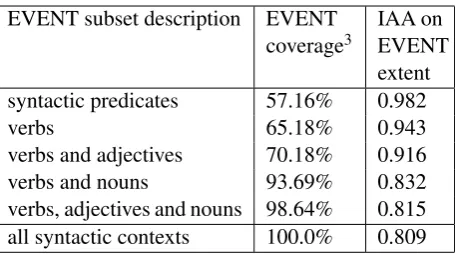
Table 1 shows how the inter-annotator
agree-2Note that not all languages have the grammatical aspect
as a property of the verb, and this is also the case with Esto-nian.
ment and the coverage on event mention annota-tions changes when the annotaannota-tions are extended beyond prototypically “eventive” syntactic con-texts. The highest agreement, F1-score 0.982, was obtained in covering syntactic predicates with event mention annotations. The syntactic predi-cate consists of the root node of the syntactic tree (mostly a finite verb), and, in some cases, also its dependents: an auxiliary verb (in case of negation) or a finite verb (e.g. in case of modal verb con-structions, where an infinite verb dominates the modal finite verb). The agreement remained rel-atively high (F1-score 0.943) if all verbs, regard-less of their syntactic function, were allowed to be annotated as event mentions. However, including part-of-speech categories other than verbs in the event model caused decrease in agreements, and the largest decrease (F1-score falling to 0.832) was noted if nouns were included as event mentions. The high-agreement model (verbs as event men-tions) covered only ∼65% of all event mentions annotated, and obtaining a high coverage (more than 90% of all event annotations) required the inclusion of the problematic noun category in the model.
4.2 Enriching Event Annotations: Providing Temporal Relation Annotations
Assumptions. Temporal semantics of events in text can be conveyed both by explicit and implicit means. Main explicit temporality indicators are verb tense, temporal relationship adverbials (e.g.
before, after oruntil), and explicit time-referring expressions (e.g.on Monday at 3 p.m.). The inter-pretation ofimplicittemporal information usually requires world knowledge (e.g. knowledge about typical ordering of events), and/or applying tem-poral inference (inferring new relations based on existing ones).
It is stated that the ultimate goal of TimeML annotation is to capture/encode all temporal re-lations in text, “regardless of whether the rela-tion is explicitly signaled or not” (Verhagen et al., 2009). The TempEval-1 and TempEval-2 evalua-tion campaigns (Verhagen et al., 2009; Verhagen et al., 2010) have approached this goal by divid-ing the task into smaller subtasks, and by provid-ing systematic (relatively extensive in the cover-age) annotations for these subtasks. Notably in 3In cases of counting EVENT coverage, each token with
EVENT subset description EVENT
coverage3 IAA onEVENT
extent syntactic predicates 57.16% 0.982
verbs 65.18% 0.943
[image:5.595.186.414.60.187.2]verbs and adjectives 70.18% 0.916 verbs and nouns 93.69% 0.832 verbs, adjectives and nouns 98.64% 0.815 all syntactic contexts 100.0% 0.809
Table 1: How the annotation coverage and inter-annotator agreement (F1-score) changed when extending EVENT annotations beyond (syntactic predicates and) verbs. Gold standard grammatical annotations were used as a guide in selecting subsets of EVENT annotations provided by three independent human annotators, and inter-annotator agreements and coverages (of all EVENT annotations provided by the annotators) were measured on these subsets. This is a revised version of the experiment firstly reported by Orasmaa (2014b).
TempEval-2, the relation annotations were guided by syntactic relations, e.g. one of the subtasks re-quired the identification of temporal relations be-tween two events in all contexts where one event mention syntactically governed another.
Estonian experience. Following the TempEval-2 (Verhagen et al., TempEval-2010) example, the Estonian TimeML annotation project split the temporal re-lation annotation into syntactically guided sub-tasks, and attempted to provide a relatively ex-tensive/systematic annotation in these subtasks. However, the resulting inter-annotator agreements showed that approaching the task in this way is very difficult: on deciding the type of temporal re-lation, the observed agreement was 0.474, and the chance-corrected agreement (Cohen’s kappa) was even lower: 0.355.
Still, the systematic coverage of the tempo-ral annotations and the availability of gold stan-dard syntactic annotations enabled us to inves-tigate whether there existed grammatically con-strained subsets of annotations exhibiting higher than average agreements. It was hypothesised that the human agreements were affected by explicit temporal cues: verb tenses encoded in morphol-ogy and temporal expressions syntactically gov-erned by verb event mentions4. Table 2 shows
how the quality of temporal relation annotation, measured in terms of the proportion of VAGUE re-lations used by annotators and the inter-annotator agreement, was affected by the presence of these 4Important explicit cues would also be temporal
relation-ship adverbials, such asbeforeoruntil, however, these tem-poral signals were not annotated in the Estonian corpus.
explicit temporal cues.
EVENT subset de-scription
Proportion of VAGUE relations
Avg
ACC Avgκ
EVENTs in simple past tense
3.5% 0.574 0.333
EVENTs in
present tense 28.5% 0.43 0.271 EVENTs
governing TIMEX
4.04% 0.607 0.476
EVENTs not governing any TIMEX
21.1% 0.447 0.291
Table 2: How presence of explicit temporal cues affected the quality of manual temporal relation annotation. The quality was measured in terms of the proportion of VAGUE relations used by anno-tators, and the average inter-annotator agreement (accuracy and Cohen’s kappa) on specifying tem-poral relation type. This is a revised version of the experiment firstly reported by Orasmaa (2014a).
making temporal relations more clearer for an-notators, while the present tense contributed to increased temporal vagueness. This can be ex-plained by the Estonian simple past serving mostly a single function—expressing what happened in the past—, while the present tense is convention-ally used to express temporal semantics of present, future, recurrence, and genericity.
4.3 Annotation of Temporal Expressions Assumptions. Temporal expressions are usually seen as an important part of event’s structure, pro-viding answers to questions such as when did the event happen (e.g.on 2nd of Februaryoron Mon-day morning), how long did the event last (e.g.six hours), or how often did the event happened (e.g.
three times a week)?
The research on temporal expression (TIMEX) annotation has a long tradition, starting along side with named entity recognition in the MUC competitions (Nadeau and Sekine, 2007), where the focus was mainly on mark-up of temporal expression phrases, and leading to the annota-tion schemes TIMEX2 (Ferro et al., 2005) and TimeML’s TIMEX3 (Pustejovsky et al., 2003a), where, in addition to the mark-up, also expres-sions’ semantics are represented in a uniform for-mat. The representation of semantics (normal-isation) in TIMEX2 and TIMEX3 builds upon a calendric time representation from the ISO 8601:1997 standard. It allows to encode mean-ings of common date and time expressions (such ason 20th of May,last Wednesday, or12 minutes after midday), as well as meanings of calendric ex-pressions with fuzzy temporal boundaries (e.g. in the summer of 2014, or at the end of May), and generic references to past, present or future (e.g.
recently ornow). The TimeML scheme assumes a relatively clear separation between temporal ex-pressions and event mentions, with the encoding of semantics of temporal expressions being con-sidered as a straightforward task, while the encod-ing of semantics of event expressions beencod-ing con-sidered a complex task of involving mark-up of events, temporal expressions, and temporal rela-tions connecting them.
From the practical point of view, the TimeML TIMEX3 scheme has proven to be relatively suc-cessful if one considers performance levels of tomatic approaches. A recent evaluation of au-tomatic temporal expression tagging in news
do-main, TempEval-3 evaluation exercise (UzZaman et al., 2013), reports 90.32% as the highest F1-score on detecting temporal expressions in English (82.71% as the highest F1-score for detection with
strictphrase boundaries), and 77.61% as the high-est F1-score on the task involving both detection and normalisation of expressions.
Estonian experience. A large-scale evaluation of an Estonian TimeML-based automatic tempo-ral expression tagger was reported by Orasmaa (2012). We took the results on the news portion of that evaluation (a corpus in size of approxi-mately 49,000 tokens and 1,300 temporal expres-sions), and recalculated precisions and recalls as TempEval-3 compatible F1-scores. The resulting scores are in the Table 3.
Subcorpus F1 F1
(strict) normal-isation (F1) Local news 89.38 84.19 80.98 Foreign news 91.83 88.44 85.68
Opinions 87.77 80.19 75.13
Sport 94.48 89.29 81.44
Economics 86.16 79.92 77.99
Culture 86.86 81.36 76.61
Total
[image:6.595.313.520.299.413.2](macro-average) 89.41 83.90 79.64 Table 3: The state-of-the-art performance of Es-tonian automatic temporal expression tagging on different subgenres of news. The scores are based on precisions and recalls reported by Orasmaa (2012), recalculated as TempEval-3 (UzZaman et al., 2013) compatible F1-scores.
The results indicate that the performance levels on automatic temporal expression tagging in En-glish (UzZaman et al., 2013) and Estonian com-pare rather well. Although the evaluation settings are not fully comparable, the initial comparison confirms the potential of the TimeML’s TIMEX3 scheme in enabling high accuracy general domain automatic temporal expression tagging across dif-ferent languages. From the theoretical point of view, however, we note that there is a room for a discussion on how well the information-extraction-oriented approach of TimeML scheme covers the language phenomenon.
Mars¸ic (2012) states that temporal expressions form “the largest subclass” of temporal adver-bials, we note that in addition to the large over-lap, the two categories also have notable differ-ences. Temporal adverbials in The Grammar of Estonian are syntactically restricted to sentence constituents that modify the meaning of the main verb or the sentence. Temporal expressions, on the other hand, are not restricted to the syntactic role of an adverbial, e.g. they can also modify the meaning of a single constituent in the sentence, such as the expressiontodayin the phrasetoday’s meeting. Semantically, the class of temporal ad-verbials in The Grammar of Estonian is open: it also includes time expressions with no explicit cal-endric information (such asin a stressful era) and event-denoting time expressions (such assince the congress). This contrasts to TimeML’s informa-tion extracinforma-tion perspective that restricts the focus mainly on temporal expressions conveying calen-dric information.
5 Discussion
TimeML proposes a compositional approach to event analysis: first event mentions should be identified in text, and then, temporal semantics of the events should be encoded via markup of tem-poral relations.
It can be argued that temporal annotation in TimeML is inherently a very complex task, even for humans (Mars¸ic, 2012), and that a high con-sistency in the process may not come from a sin-gle effort, but rather from an iterative annota-tion development process. An iteraannota-tion in this process involves modelling the phenomenon, an-notating texts manually according to the model, performing machine learning experiments on the annotations, and finally revising both the model and the machine learning algorithms before start-ing a new iteration (Pustejovsky and Moszkowicz, 2012; Pustejovsky and Stubbs, 2012). However, the aforementioned strategy may still not be suffi-cient to tackle the problem, as one could humbly remind that problems related to natural language understanding “have not been studied in linguis-tics nor anywhere else in the systematic way that is required to develop reliable annotation schemas” (Zaenen, 2006).
Reversing the compositional approach of TimeML, we can argue that a perceivable pres-ence of explicit temporal information is actually
one important indicator of “eventiveness”: that one can interpret text units as “event mentions” with a high degree of certainty only in contexts that allow to place events reliably on a time-line or temporally order with respect to each other. How-ever, the Estonian experience on manual annota-tion indicates these contexts are not pervasive in news texts, like the grammatically analysable con-texts are. Rather, the evidence shows that higher than average consistency can be obtained only in certain syntactic contexts characterised by explicit temporal cues, such as temporal expressions and past-indicating verb tenses. This calls for a dis-cussion for an alternative modeling of events, with the aim of reducing the complexity of the model.
Studies of narratology propose that the seman-tics of events have a lot to do with events’ rela-tions to other events. One could even go as far as to argue that events “become meaningful” only “in series”, and “it is pointless to consider whether or not an isolated fact is an event” (Bal, 1997). This suggests that the perspective that considers a single event as an atomic unit for analysis could be revised, and events could be analysed in se-ries from the beginning. A minimal unit to be annotated/detected would then be a pair of events connected by a relation, e.g. by a temporal or a causal relation. Note that while the ultimate aim of TimeML is capturing temporal relations, be-cause of the decomposition of the task, someone employing the framework could easily get stuck with the problems of event mention annotation (e.g. how to reliably ground the concept of event at the grammatical level), and may be hindered from reaching temporal relation annotation.
de-veloped and tested out in a general domain analy-sis, before developing more complex models, e.g. adding nouns as event mentions.
Lefeuvre-Halftermeyer et al. (2016) make a similar proposal to ”characterize eventualities not at the text level, but on the syntactic structures of a treebank”, i.e. to mark nodes in a syntactic tree as event mentions. The benefit would be that the syntactic structure would already approximate the event structure, and (to an extent) would pro-vide an access to event’s arguments without the need for an explicit markup of event-argument lations. However, the authors do not discuss re-ducing the complexity of the event model, which, in our view, would also be worth experimenting with. Focusing straightforwardly on the annota-tion of relaannota-tions could enable more simple designs both for human annotation and machine learning experiments, which, in turn, could foster more experimentation and, hopefully, improvements on the current results.
In the markup of temporal relations, the Esto-nian experience showed increased agreements and also less vagueness in the contexts of temporal pressions. As the results of automatic temporal ex-pression tagging in Estonian (reported in Table 3) were also rather encouraging, indicating that sat-isfactory practical performance levels (95% and above) may not be very far from the reach, one could argue for focusing future temporal relation annotation efforts on contexts with temporal ex-pressions, taking advantage of their high accuracy pre-annotation.
However, contrasting TimeML-compatible temporal expressions with temporal adverbials distinguished in Estonian grammatical tradition revealed that the TIMEX (TIMEX2, TIMEX3) annotation standards have been, to a large extent, “optimised” for capturing “calendric” temporal expressions, i.e. expressions whose semantics can be modeled in the calendar system. A syntax-based view suggests that TimeML’s temporal expressions do not cover non-calendric temporal references and also event mentions appearing in the syntactic positions of temporal adverbials. In-stead, event mentions in TimeML are considered as markables clearly separable from temporal expressions.
If we are to step back, and attempt to put the problem in a broader philosophical context, we may note that historically, (calendric) temporal
expressions also originate from event mentions. They refer to “major cyclic events of the human natural environment on earth”, such as “the alter-nation of light and dark, changes in the shape of the moon, and changes in the path of the sun across the sky (accompanied by marked climatic differ-ences)” (Haspelmath, 1997). One could say that (driven by the need for expressing time) the natu-ral language has developed rather systematic and relatively unambiguous ways for expressing “cal-endric events”.
This may also offer an explanation why the task of generic event analysis is so difficult to establish—compared to the task of analysing “cal-endric events” / temporal expressions. Tempo-ral expression tagging builds on the part of hu-man language usage that is already systematic, as it is based on a well-defined conventional system of time-keeping. Yet, it is still an open question whether there is a similar convention of express-ing ”events in general” in natural language, upon which a systematic general-domain event analyser can be built. While tending towards answering this question, we believe that it is also worthwhile to revise the existing event models for their com-plexity, and to test out simpler models building straightforwardly on the syntactic structure, and centring them on the explicit temporal cues avail-able in texts.
Acknowledgments
This work was supported by Estonian Ministry of Education and Research (grant IUT 20-56 “Com-putational models for Estonian”).
References
Mieke Bal. 1997. Narratology:
Introduc-tion to the Theory of Narrative. Univer-sity of Toronto Press. https://archive.org/details/ BalNarratologyIntroductionToTheTheoryOfNarrative
(Date accessed: 2017-01-10).
Cosmin Adrian Bejan and Sanda M Harabagiu. 2008. A Linguistic Resource for Discovering Event Struc-tures and Resolving Event Coreference. InLREC.
Andr´e Bittar. 2010. Building a TimeBank for French: a Reference Corpus Annotated According to the ISO-TimeML Standard. Ph.D. thesis, Universit´e Paris Diderot, Paris, France.
David B Bracewell. 2015. Long nights, rainy days, and misspent youth: Automatically extracting and cate-gorizing occasions associated with consumer prod-ucts. SocialNLP 2015 @ NAACL, pages 29–38.
Roberto Casati and Achille Varzi. 2014. Events. In Edward N. Zalta, editor, The Stanford En-cyclopedia of Philosophy. Fall 2014 edition.
http://plato.stanford.edu/archives/ fall2014/entries/events/
(Date accessed: 2017-01-20).
Tommaso Caselli, Valentina Bartalesi Lenzi, Rachele Sprugnoli, Emanuele Pianta, and Irina Prodanof. 2011. Annotating Events, Temporal Expressions and Relations in Italian: the It-Timeml Experi-ence for the Ita-TimeBank. In Linguistic Annota-tion Workshop, pages 143–151. The Association for Computer Linguistics.
Hamish Cunningham. 2005. Information Extraction, Automatic. Encyclopedia of Language and Linguis-tics, 5:665–677.
Agata Cybulska and Piek Vossen. 2013. Semantic Re-lations between Events and their Time, Locations and Participants for Event Coreference Resolution. InRANLP, pages 156–163.
Tiiu Erelt, ¨Ulle Viks, Mati Erelt, Reet Kasik, Helle Metslang, Henno Rajandi, Kristiina Ross, Henn Saari, Kaja Tael, and Silvi Vare. 1993. Eesti keele grammatika. 2., S¨untaks (Grammar of Esto-nian: The syntax). Tallinn: Eesti TA Keele ja Kir-janduse Instituut.
Lisa Ferro, Laurie Gerber, Inderjeet Mani, Beth Sundheim, and George Wilson. 2005. TIDES 2005 standard for the annotation of
tempo-ral expressions. https://www.ldc.upenn.
edu/sites/www.ldc.upenn.edu/files/ english-timex2-guidelines-v0.1.pdf
(Date accessed: 2017-01-15).
Walter R Fisher. 1984. Narration as a human commu-nication paradigm: The case of public moral argu-ment.Communications Monographs, 51(1):1–22.
Antske Fokkens, Marieke Van Erp, Piek Vossen, Sara Tonelli, Willem Robert van Hage, Luciano Serafini, Rachele Sprugnoli, and Jesper Hoeksema. 2013. GAF: A grounded annotation framework for events. In NAACL HLT, volume 2013, pages 11–20. Cite-seer.
Lucian Galescu and Nate Blaylock. 2012. A corpus of clinical narratives annotated with temporal informa-tion. InProceedings of the 2nd ACM SIGHIT Inter-national Health Informatics Symposium, pages 715– 720. ACM.
Martin Haspelmath. 1997. From space to time: Tem-poral adverbials in the world’s languages. Lincom Europa.
Graham Katz and Fabrizio Arosio. 2001. The anno-tation of temporal information in natural language sentences. In Proceedings of the Workshop on Temporal and Spatial Information Processing, vol-ume 13, pages 15–22. Association for Computa-tional Linguistics.
Ana¨ıs Lefeuvre-Halftermeyer, Jean-Yves Antoine, Alain Couillault, Emmanuel Schang, Lotfi Abouda, Agata Savary, Denis Maurel, Iris Eshkol-Taravella, and Delphine Battistelli. 2016. Covering various Needs in Temporal Annotation: a Proposal of Exten-sion of ISO-TimeML that Preserves Upward Com-patibility. InLREC 2016.
G. Mars¸ic. 2012. Syntactically Motivated Task Def-inition for Temporal Relation Identification. Spe-cial Issue of the TAL (Traitement Automatique des Langues) Journal on Processing of Temporal and Spatial Information in Language - Traitement au-tomatique des informations temporelles et spatiales en langage naturel, vol. 53, no. 2:23–55.
Marie-Francine Moens, Oleksandr Kolomiyets, Emanuele Pianta, Sara Tonelli, and Steven Bethard. 2011. D3. 1: State-of-the-art and design of novel annotation languages and tech-nologies: Updated version. Technical report, TERENCE project–ICT FP7
Programme–ICT-2010-25410. http://www.terenceproject.
eu/c/document_library/get_file?p_l_id= 16136&folderId=12950&name=DLFE-1910.pdf
(Date accessed: 2017-01-15).
Kadri Muischnek, Kaili M¨u¨urisep, Tiina Puolakainen, Eleri Aedmaa, Riin Kirt, and Dage S¨arg. 2014. Estonian Dependency Treebank and its annotation scheme. InProceedings of 13th Workshop on Tree-banks and Linguistic Theories (TLT13), pages 285– 291.
David Nadeau and Satoshi Sekine. 2007. A sur-vey of named entity recognition and classification. Lingvisticae Investigationes, 30(1):3–26.
Joel Nothman. 2013. Grounding event references in news. Ph.D. thesis, The University of Sydney.
Siim Orasmaa. 2012. Automaatne ajav¨aljendite tuvas-tamine eestikeelsetes tekstides(Automatic Recogni-tion and NormalizaRecogni-tion of Temporal Expressions in Estonian Language Texts). Eesti Rakenduslingvis-tika ¨Uhingu aastaraamat, (8):153–169.
Siim Orasmaa. 2014b. Towards an Integration of Syn-tactic and Temporal Annotations in Estonian. In LREC, pages 1259–1266.
Siim Orasmaa. 2016. Explorations of the Problem of Broad-coverage and General Domain Event Analy-sis: The Estonian Experience. Ph.D. thesis, Univer-sity of Tartu, Estonia.
James Pustejovsky and Jessica Moszkowicz. 2012. The Role of Model Testing in Standards Develop-ment: The Case of ISO-Space. In LREC, pages 3060–3063.
James Pustejovsky and Amber Stubbs. 2012. Nat-ural Language Annotation for Machine Learning. O’Reilly Media, Inc.
James Pustejovsky, Jos´e Casta˜no, Robert Ingria, Roser Saur´ı, Robert Gaizauskas, Andrea Setzer, and Gra-ham Katz. 2003a. TimeML: Robust specification of event and temporal expressions in text. InFifth In-ternational Workshop on Computational Semantics (IWCS-5).
James Pustejovsky, Patrick Hanks, Roser Sauri, An-drew See, Robert Gaizauskas, Andrea Setzer, Dragomir Radev, Beth Sundheim, David Day, Lisa Ferro, et al. 2003b. The TimeBank corpus. In Cor-pus Linguistics, volume 2003, pages 647–656.
James Pustejovsky, Kiyong Lee, Harry Bunt, and Lau-rent Romary. 2010. ISO-TimeML: An International Standard for Semantic Annotation. InLREC.
James Pustejovsky, Jessica L Moszkowicz, and Marc Verhagen. 2011. ISO-Space: The annotation of spa-tial information in language. InProceedings of the Sixth Joint ISO-ACL SIGSEM Workshop on Interop-erable Semantic Annotation, pages 1–9.
Hans Reichenbach. 1947. Elements of symbolic logic. Macmillan Co.
Livio Robaldo, Tommaso Caselli, Irene Russo, and Matteo Grella. 2011. From Italian text to TimeML document via dependency parsing. In Computa-tional Linguistics and Intelligent Text Processing, pages 177–187. Springer.
Roser Saur´ı, Robert Knippen, Marc Verhagen, and James Pustejovsky. 2005. Evita: a robust event rec-ognizer for QA systems. InProceedings of the con-ference on Human Language Technology and Em-pirical Methods in Natural Language Processing, pages 700–707. Association for Computational Lin-guistics.
Roser Saur´ı, Jessica Littman, Robert Gaizauskas, Andrea Setzer, and James Pustejovsky. 2006. TimeML annotation guidelines, version 1.2.1.
http://www.timeml.org/publications/
timeMLdocs/annguide_1.2.1.pdf (Date
ac-cessed: 2017-01-20).
Roser Saur´ı, Lotus Goldberg, Marc Verhagen, and James Pustejovsky. 2009. Annotating Events in English. TimeML Annotation Guidelines.
http://www.timeml.org/tempeval2/ tempeval2-trial/guidelines/
EventGuidelines-050409.pdf (Date accessed:
2017-01-15).
Naushad UzZaman, Hector Llorens, Leon Derczyn-ski, Marc Verhagen, James Allen, and James Puste-jovsky. 2013. SemEval-2013 Task 1: TEMPEVAL-3: Evaluating Time Expressions, Events, and Temporal Relations. http://derczynski.com/ sheffield/papers/tempeval-3.pdf
(Date accessed: 2017-01-15).
Zeno Vendler. 1957. Verbs and times.The philosophi-cal review, pages 143–160.
Marc Verhagen, Robert Gaizauskas, Frank Schilder, Mark Hepple, Jessica Moszkowicz, and James Pustejovsky. 2009. The TempEval challenge: iden-tifying temporal relations in text. Language Re-sources and Evaluation, 43(2):161–179.
Marc Verhagen, Roser Sauri, Tommaso Caselli, and James Pustejovsky. 2010. SemEval-2010 task 13: TempEval-2. InProceedings of the 5th international workshop on semantic evaluation, pages 57–62. As-sociation for Computational Linguistics.
Piek Vossen, German Rigau, Luciano Serafini, Pim Stouten, Francis Irving, and Willem Robert Van Hage. 2014. Newsreader: recording history from daily news streams. In Proceedings of the 9th Language Resources and Evaluation Conference (LREC2014), Reykjavik, Iceland, May 26-31.
Patrick Henry Winston. 2011. The Strong Story Hy-pothesis and the Directed Perception HyHy-pothesis. In Pat Langley, editor,Technical Report FS-11-01, Pa-pers from the AAAI Fall Symposium, pages 345–352, Menlo Park, CA. AAAI Press.
Nianwen Xue and Yuping Zhou. 2010.
Apply-ing Syntactic, Semantic and Discourse Constraints in Chinese Temporal Annotation. In Proceedings of the 23rd International Conference on Computa-tional Linguistics, COLING ’10, pages 1363–1372, Stroudsburg, PA, USA. Association for Computa-tional Linguistics.
Yadollah Yaghoobzadeh, Gholamreza Ghassem-Sani, Seyed Abolghasem Mirroshandel, and Mahbaneh Eshaghzadeh. 2012. ISO-TimeML Event Extrac-tion in Persian Text. InCOLING, pages 2931–2944.
Annie Zaenen. 2006. Mark-up barking up the wrong tree. Computational Linguistics, 32(4):577–580.