Guess Who’s Coming (and Who’s Going): Bringing Perspective to the
Rational Speech Acts Framework
⇤Carolyn Jane Anderson and Brian Dillon
University of Massachusetts N408 Integrative Learning Center
650 North Pleasant Street Amherst, MA 01003, USA [email protected]
Abstract
We present a Rational Speech Acts approach to modeling how conversation participants reason about perspectival expressions. The in-terpretation of perspectival expressions, such as the motion verbs come and go, depends on the point-of-view from which they are evaluated. In order to interpret a perspecti-val expression, the listener must jointly rea-son about the speaker’s intended message and their choice of perspective. We propose a Bayesian approach to this inference problem and describe an extension of the Rational Speech Acts model that incorporates perspec-tive. We lay out three sets of predictions that this model makes relating to the lexical se-mantics of go, the cost of non-speaker per-spectives, and marginal inference over worlds.
1 Introduction
Recent experimental and theoretical work at the semantics/pragmatics interface has highlighted the role of perspective. Perspectival expressions are items whose meaning depends on the point-of-view from which they are interpreted. A wide range of linguistic phenomena appear sensitive to perspec-tive, including spatial and temporal deictic expres-sions likeon the rightandtomorrow(Speas, 2000); pronouns (Loveland, 1984; Wechsler, 2010); mo-tion verbs (Fillmore, 1975; Barlew, 2017); epithets and expressives (Doron, 1991; Harris, 2012); and logophors (Huang and Liu, 2001; Park, 2017).
⇤
Many thanks to Lyn Frasier, Richard Futrell, and Jesse Har-ris, and to our SCIL reviewers for their thoughtful feedback on this work.
Perspectival items express two kinds of informa-tion: their lexical meaning, and information about the point-of-view adopted by the speaker. Consider the sentence in (1), containing the perspectival mo-tion verbcome. Come describes motion relative to the location of a perspective holder (Fillmore, 1975). Thus (1) conveys information about the perspective holder’s location in addition to its literal meaning (that Thera is in motion to Northampton).
1. Thera is coming to Northampton in an hour. In English,1 motion verbs like come and go
al-low at least three kinds of perspective holders: the speaker (e.g. You are coming to my house), the lis-tener (e.g.I am coming to your house), or the subject of an attitude verb (e.g. Thera says I am coming to her house). In order to understand who is located in Northampton, however, the listener must infer who the perspective holder is. How does she do this? That is the central question that this paper addresses. We propose to model the process of inferring a perspective holder for a perspectival expression us-ing the Rational Speech Acts model (RSA), a frame-work for pragmatic modeling rooted in Bayesian inference (Frank and Goodman, 2012; Goodman and Stuhlm¨uller, 2013). We extend the RSA to in-clude the inference required to identify a perspec-tive holder in context. In particular, we model the interpretation of perspectival utterances as inference over the joint probability of a world and a perspec-tive given an utterance. We focus on one partic-ular class of perspectival expressions, perspectival
1The set of licit perspective holders is a point of
cross-linguistic variation: see (Gathercole, 1987) and (Nakazawa, 2007; Nakazawa, 2009) for cross-linguistic work on the topic.
motion verbs, and describe the model’s predictions about some of the open questions related to these verbs, including the lexical semantics ofgoand the existence of a cost for non-speaker perspectives. In what follows we describe the model and articulate its key predictions. We hope that our model and its predictions can guide further exploration of the role of perspective at the semantics-pragmatics interface.
1.1 The semantics ofcomeandgo
Perspectival motion verbs are a good test case for pragmatic modeling of perspective because there is a rich literature on the topic that provides descriptive facts to draw upon and open questions to test. We adopt a view of the lexical semantics ofcome and go rooted in the perspectival semantics for motion verbs described in (Barlew, 2017). We use a lexical semantics for comeconsisting of two components: a motion implication, corresponding to the lexical semantics of come, and an anchoring implication, corresponding to the perspectival component, ex-pressed in (2) in a simple event semantics.
2. Semantics ofcome:
For any worldw, perspectivea, destination d, and entityx,[[Come(x, d)]]w,a= T iff
(a) Motion implication:
[[9e.M ove(x, e)^Dest(d, e)]]w,a= T (b) Anchoring implication:
9y.[[Loc(y, d)]]w,a =T andyis a salient perspective-holder with perspectivea. The motion implication is the literal meaning of the sentence: that someone moves to the destina-tion. The anchoring implication expresses that the destination is the location of a perspective-holder.
We use a non-perspectival semantics for go: we propose that it has only a motion implication.
3. Semantics ofgo:
For any worldw, perspectivea, destination d, and entityx,[[Go(x, d)]]w,a= T iff
(a) Motion implication:
[[9e.M ove(x, e)^Dest(d, e)]]w,a= T. There are a few key points about the meaning of these motion verbs that any model must capture:
First, come requires that a salient perspective-holder is located at the destination. This means thatcomecannot be used to describe motion by the perspective-holder. If this were not so, the speaker would always be able to describe their own motion
withcome, regardless of the destination.
4. Context: Matilda and Hildegard are having a conversation in New York.
Matilda: I’ve always wanted to visit Antarctica, but it’s so expensive.
Hildegard: I went / #came there last year. It was so cool!
Second, the lexical semantics of come do not directly specify the location of the speaker or the listener, but rather the location of the perspective-holder. Although the speaker of (1) (repeated as (5)) may be the perspective-holder (as illustrated by the speaker-oriented follow-up 5a, the listener also could be (as in the listener-oriented follow-up (5b)).
5. Thera is coming to Northampton in an hour. (a) I wish you could come hang out too! (b) I wish I could come hang out too!
This means that the listener must successfully in-fer the perspective-holder in order to determine the interpretation of any sentence usingcome.
Third, although the lexical semantics of go pre-sented here do not directly encode any anchoring im-plication, in practicegoseems to imply motion away from the perspective holder. If (6) is interpreted from the speaker’s perspective, then the listener will infer that the speaker is not located in Northampton.
6. Thera is going to Northampton in an hour. The source of this anti-anchoring implication is debated. With the semantics proposed here, this im-plication is derived via Gricean reasoning on the part of the listener: if the perspective holder was located in Northampton, then the speaker should have used come; that she didn’t implies that the perspective holder is not there (Wilkins and Hill, 1995; Sudo, 2018). However, in other theories,gohas a perspec-tival component (Fillmore, 1975; Oshima, 2006).
2 The pragmatics of conversations
2.1 Rational Speech Act
stored in the Common Ground, which can be viewed as the set of accepted propositions, or as the worlds compatible with those propositions.
The Rational Speech Acts model is a framework for pragmatic modeling that extends this picture by proposing that the listener uses a Bayesian inference process to determine what message the speaker is trying to convey (Frank and Goodman, 2012). In this model, the Common Ground contains not just a set of worlds, but also a probability associated with each world, the probability that it is the real world.
At each turn in the conversation, the speaker se-lects a world from the set of worlds, simulating a new piece of information that the speaker wishes to contribute, and chooses an utterance to express it. Upon hearing the speaker’s utterance, the lis-tener must reason about the message that the speaker is trying to convey. The listener assumes that the speaker selects the sentence that maximizes the probability of the observed world.
The listener interprets the sentence in order to up-date the probability distribution over possible worlds in the Common Ground, calculating the likelihood of each world given the sentence selected, according to their model of how the speaker picks sentences.
The Rational Speech Acts model is therefore re-cursive. The listener’s model of the speaker is called the literal speaker: the listener assumes that the speaker estimates the utility of each sentence based on a model of the listener, called theliteral listener, so called because it does not involve any pragmatic reasoning. The literal listener is what the listener imagines the speaker’s model of the listener to be. The listener herself is called thepragmatic listener. The Rational Speech Acts framework has been applied to a range of phenomena, including projec-tive content (Qing et al., 2016); politeness (Yoon et al., 2016); scalar implicatures (Potts et al., 2016); and word learning (Smith et al., 2013). Particularly relevant to the model we propose is the RSA lexi-cal uncertainty model, which models joint reasoning over the lexicon and the speaker’s message (Bergen et al., 2012; Kao et al., 2014; Bergen et al., 2016).
2.2 The standard RSA model
Although a RSA model is potentially infinitely re-cursive, we discuss just three levels: the literal lis-tener, literal speaker, and pragmatic listener.
For the literal listener, the posterior probability of a world given an utterance is simply the literal mean-ing of the utterance discounted by the prior proba-bility of the world. The meaning of the utterance is its denotation evaluated with respect to the world. Thus, the interpretation function for an utterance is an indicator function returning 1 or 0 depending on whether the utterance is true of the world.
The literal speaker is the listener’s mental model of the speaker. In this model, the speaker selects a sentence in proportion to its utility, which is highest for sentences that maximize the posterior probabil-ity of the observed world according to the speaker’s model of the listener (the literal listener).
The pragmatic listener is the model of the actual listener. The listener reasons about the speaker’s message according to their mental model of the speaker (the literal speaker). The posterior proba-bility over a world given the speaker’s utterance is proportional to the likelihood of the literal speaker selecting the utterance given the world, discounted by the listener’s prior belief in the world.
7. Standard RSA model (a) Literal listener:
L0(w|m)/[[m]]wp(w)
(b) Literal speaker:
S0(m|w) / softmax(logL0(w|m)
Cost(m))
(c) Pragmatic listener:
L1(w|m)/S0(m|w)p(w)
wherew= world,m= message
One other consideration is usually introduced into the model: the cost of the utterance. This repre-sents the trade-off between informativity and sen-tence complexity: although the speaker could theo-retically select an utterance that exactly isolates the observed world, as the size of the set of possible worlds increases, the complexity of this utterance also increases. In practice, people often select a sim-pler, less informative utterance rather than a maxi-mally informative but more complex utterance. The RSA model encodes this as a cost that penalizes the utility for more complex utterances at the level of the literal speaker, for some definition of complex-ity. A common cost function is the length of the sentence, although syntactic complexity or process-ing complexity can also be considered.
RSA model: the set of possible worlds, the set of utterances, and the priors over the worlds. Changes to each of these affect the competition between ut-terances and the outcome of the inference process.
In general, a uniform distribution over the possi-ble worlds is used, simulating the empty Common Ground at the beginning of a conversation.2
3 The pragmatics of perspective
What about perspectival expressions? In recent work, Roberts (2015) proposes that the Common Ground tracks a set of salient perspectives along with the set of worlds. Perspectival expressions, like come, are interpreted not just with respect to a world, but also with respect to a perspective.
In this view, a perspective is a set of centered worlds: a set of pairs consisting of a world in which the perspective-holder’s beliefs are true and the spatio-temporal slice of that world that the perspective-holder self-identifies with (Stalnaker, 2014). Intuitively, a perspective can be seen as a variable assignment that picks out the individual in each world who the perspective-holder believes themself to be. A perspectival expression is like an expression with a free variable: it cannot be inter-preted unless the perspective-holder is known.
If the Common Ground is used to track salient perspectives as well as worlds, then the same in-ference mechanisms that track the probabilities of worlds in the Common Ground can be extended to track the probabilities of the perspectives. Here we propose just such an extension.
3.1 A perspectival extension to the RSA
We introduce the Perspectival Rational Speech Acts model, which incorporates perspective into the RSA framework. Building on Roberts (2015), we pro-pose that conversation participants track probabili-ties over the set of perspectives in order to reason about the interpretation of sentences. As in the stan-dard RSA model, the listener infers the probabil-ity of the speaker’s message by reasoning about the likelihood of each sentence given the message and the prior probabilities over worlds. For
perspecti-2However, in actual conversations, the initial Common
Ground may include world knowledge that the speaker and lis-tener have not explicitly mentioned, but are likely to agree upon.
val expressions, however, the listener must also in-fer the probability of speaker adopting a certain per-spective. Therefore, in the perspectival RSA, the listener infers a joint probability: the probability of a paired world and perspective given the utter-ance. This models how listeners extract information about both the speaker’s perspective and their mes-sage from sentences containing perspectival items.
The Perspectival RSA model advances the hy-pothesis that listeners interpret utterances not with respect to a single perspective, but by considering multiple perspectives simultaneously, each weighted by its probability in context. In this, our model de-parts from much previous work on the perspective in discourse, which implicitly assumes that listeners interpret utterances with respect to a single perspec-tive (Harris, 2012; Kaiser, 2015; Roberts, 2015).
3.2 The perspectival RSA model
In the Perspectival RSA model, the literal listener reasons about the probability of a world given the ut-terance and the perspective. That is, in the speaker’s model of the listener, the listener has access to the chosen perspective. The posterior probability of the world is proportional to the utterance’s truth value with respect to the world and perspective, times the prior probability of the world given the perspective.
8. Perspectival RSA model (preliminary) (a) Literal listener:
L0(w|m, a)/[[m]]w,ap(w|a)
(b) Literal speaker:
S0(m|w, a) /softmax(logL0(w|m, a)
Cost(m))3
(c) Pragmatic listener:
L1(w, a|m)/S0(m|w, a)p(w, a)
wherew= world,m= message,a= perspective The literal speaker selects an utterance that maxi-mizes the utility of the observed world according to the speaker’s model of the listener, minus the cost of the message (we return to this below). The speaker observes a world, samples a perspective from the set of perspectives, and selects an utterance accordingly. The pragmatic listener calculates joint probabili-ties for worlds and perspectives based on the utter-ance that the speaker selects. The joint posterior they
3Thanks to Reviewer 1 for pointing out the need for the log
infer is proportional to the likelihood of the utter-ance given the world and perspective, according to the listener’s model of the speaker, times the prior joint probability of the world and perspective.
3.3 Independence assumption
Above we showed that the inference in our model re-lies on the joint prior over world / perspective pairs. However, we make an independence assumption in order to simplify the calculation and assume that the prior probability of a world is independent of the prior probability of the perspective.
9. Perspectival RSA model (intermediate) (a) Literal listener:
L0(w|m, a)/[[m]]w,ap(w)
(b) Literal speaker:
S0(m|w, a) /softmax(logL0(w|m, a)
Cost(m))
(c) Pragmatic listener:
L1(w, a|m)/S0(m|w, a)p(w)p(a)
wherew= world,m= message,a= perspective
3.4 The cost of a perspective
In addition to the utterance cost included in the stan-dard RSA, we introduce a perspective cost. The perspective cost function penalizes non-speaker per-spectives.4 We use it to explore the idea that the
default perspective is that of the speaker. This idea has been widely discussed in the previous literature on perspective. In theoretical work, Roberts (2015) posits that in the absence of explicit cues to the con-trary, the listener always assumes that the speaker is adopting their own perspective. In experimental work, Harris (2012) and Kaiser (2015) find a strong preference for interpreting expressives, epithets, and other perspectival content from the speaker’s per-spective, in the absence of explicit cues otherwise.5
10. Perspectival RSA model (final)
4We use this parameter instead of manipulating the priors
on perspectives because we intend to model effects of discourse salience through the perspective priors in future work. The idea is that as perspective holders are mentioned more frequently, the probability of adopting their perspectives increases. By con-trast, the cost of adopting non-speaker perspectives should re-main fixed over a discourse, since it reflects the cognitive diffi-culty in accomodating a non-speaker perspective.
5Note, however, that these experiments used written
state-ments where the listener was not explicit, unlike our contexts.
(a) Literal listener:
L0(w|m, a)/[[m]]w,ap(w)
(b) Literal speaker:
S0(m|w, a) /softmax(logL0(w|m, a)
Cost(m) Cost(a))
(c) Pragmatic listener:
L1(w, a|m)/S0(m|w, a)p(w)p(a)
wherew= world,m= message,a= perspective In Section 5.2, we discuss the impact that this pa-rameter has on the model’s predictions.
3.5 Probabilities over perspectives
One important part of our model is the set of perspective holders that listeners track. In the Roberts (2015) view of perspective, the speaker and listener perspectives are automatically entered into the Common Ground and attitude holder perspec-tives are entered whenever an attitude verb is used.
Another possibility would be to introduce a new perspective whenever a new entity possessing a mental state is added to the Common Ground. We plan to test the effect of different methods for intro-ducing perspective holders in future work.
We adopt a uniform prior over perspective hold-ers for the moment. However, exploring different priors on perspectives might shed light on the topic of perspective maintenance. There is experimen-tal evidence that listeners prefer to posit a coher-ent perspective over multiple utterances by the same speaker (Harris, 2012). This Maintain Perspective principle might be modeled well by a Dirichlet prior on perspectives, which would lead to a gradual in-crease in the probability of perspectives based on how frequently they are adopted by the speaker.
4 An example
To explore the predictions of the perspectival RSA model, we define toy sets of utterances and worlds.
4.1 Perspective holders
We consider a set of worlds with just three entities: Sarah, the speaker; Lydia, the listener, and Thera, a third party who is not involved in the conversation.
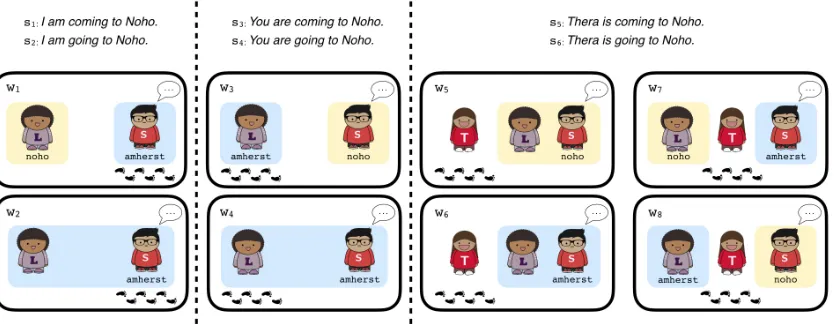
Figure 1:Worlds and utterances (destination indicated by yellow box).
4.2 Worlds
We demonstrate our model with a small set of worlds containing three individuals, Sarah, Lydia, and Thera; and two locations: Northampton (Noho) and Amherst. Since we are not considering Thera in the perspective set, we omit Thera’s location. We include just the worlds in which exactly one person is moving, for a total of eight worlds (Fig.1). We use a uniform prior distribution over the worlds.
4.3 Utterances
We consider two sentence frames: X is going to Northampton and X is coming to Northampton, where X represents any of the individuals, for a to-tal of 6 utterances (Fig. 1). One of the uses of our model is as a framework for testing the effects of dif-ferent lexical semantics forcomeandgo: we choose the relatively simple denotations in Section 1.1 for the sake of illustrating the model, but other seman-tics forcomeandgocould be substituted.
5 Model predictions
We implemented our model in the WebPPL pro-gramming language (Goodman and Stuhlm¨uller, 2014). Using the worlds and utterances described above, we ran simulations to generate predic-tions about the probabilities of world/perspective pairs inferred by the listener. For each result re-ported, we ran 100,000 iterations of Markov Chain Monte Carlo sampling; we explored settings of
{0,0.25,0.5,0.75,1.0}for perspective cost.
Our key results are: (1) perspectival
interpreta-tions ofgocan arise through pragmatic competition even if the lexical semantics ofgoare not perspecti-val; (2) the likelihood of non-speaker perspectives increases proportionally as the perspective cost is decreased; and (3) listeners should favor worlds that are consistent with multiple perspectives.
5.1 Competition betweencomeandgo
Our model shows how perspectival usage ofgocan arise through pragmatic competition withcomeeven if the lexical semantics of go are not perspectival. Wilkins and Hill (1995) posit that at least in some languages, the interpretation ofgoas ‘motion away from the perspective holder’ is not lexically en-coded, but arises through pragmatic reasoning, and Sudo (2018) proposes that Gricean reasoning is re-sponsible for the interpretation of Englishgo.
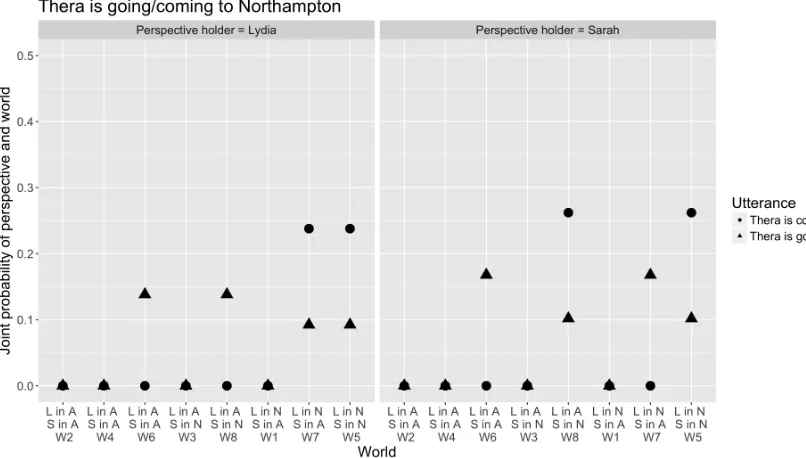
Our model verifies these theoretical proposals by showing that the perspectival interpretation of go can indeed arise solely through pragmatic compe-tition withcome. As shown in Fig. 2, our pragmatic listener infers that for sentences with go, the per-spectival holder is unlikely to be at the destination of motion— even though our lexical semantics for goare not perspectival.
For the go sentences, world / perspective pairs wherecomeis a viable alternative, such as when the perspective holder is the listener and the listener is at the destination of motion, are less likely than ones wherecomeis not a possible alternative.
Figure 2:Model predictions forThera is going to NorthamptonandThera is coming to Northampton, speaker cost = 0.5
5.2 The cost of perspective shift
Another set of predictions relates to the perspective cost parameter. As the cost for non-speaker perspec-tives increases, the likelihood of a non-speaker per-spective decreases. Because our cost function only assigns cost to non-speaker perspectives, with a uni-form prior over perspectives, a non-speaker perspec-tive will only be more likely than the speaker per-spective when the speaker perper-spective is excluded by the lexical semantics of the sentence.
In our set of utterances, this occurs only withI am coming to Northampton, where the speaker perspec-tive is excluded by the lexical semantics of ‘come’, since the speaker is moving (a person cannot be both in motion and at the destination of motion). For this sentence, the listener will infer with probability 1.0 that the perspective is the listener’s (Lydia) and the world is the one in which Lydia is in Northampton.
Although decreasing in probability as perspec-tive cost increases, the listener perspecperspec-tive remains possible for all sentences but You are coming to Northampton, where the listener perspective is elim-inated because she is in motion. In this case, the speaker perspective is inferred with probability 1.0.
For a third-party mover, the listener perspective is as likely as the speaker perspective only when the perspective cost for non-speakers is set to zero. As the speaker cost increases, the listener perspective
becomes proportionally less likely (Fig. 3).
For thegosentences, both perspectives are always valid possibilities, sincegodoes not have a perspec-tival component. For these sentences, the likelihood of the speaker perspective increases proportionally as the speaker cost is increased (Fig. 5).
Although the perspective cost parameter can be used to explore whether there is a processing cost for adopting non-speaker perspectives, since the cost is part of the listener’s model of the speaker, it can also be used to explore the listener’s beliefs about the speaker. If the listener believes that a particular speaker is more or less likely to adopt non-speaker perspectives, the listener may adjust the perspec-tive cost parameter accordingly (for instance, if the speaker has higher rank than the listener; or limited knowledge of the listener’s location).
5.3 Marginal inference
As mentioned above, one novel claim of our model is that listeners consider multiple perspectives at once when they interpret utterances. This contrasts with proposals that the default perspective holder is the speaker (Roberts, 2015), or that listeners process sentences using the most recent perspective, as Har-ris’s Maintain Perspective proposal posits (2012).
cogni-Figure 3:Model predictions forThera is coming to Northamptonat varying levels of speaker cost.
Speaker Listener Marginal Both in Noho: 0.26 0.24 0.5
Neither in Noho: 0 0 0
[image:8.612.82.523.78.256.2]Listener in Noho: 0 0.24 0.24 Speaker in Noho: 0.26 0 0.26
Figure 4:Non-zero posterior probabilities forThera is coming to Northampton, speaker cost = 0.5
tively difficult and incurs a high processing cost. He posits that listeners avoid perspective shift by processing a sentence with the last-used perspec-tive, and only shifting perspective when motivated by sufficient contextual evidence (2012).
By contrast, our proposal posits that listeners are always weighing multiple perspectives, and that they calculate the meaning of the sentence relative to each perspective as they interpret the sentence. Con-sidering multiple perspectives leads to a different marginal distribution over worlds than if the listener tracks just one perspective at a time.
To see this, consider the model’s predictions for Thera is coming to Northamptonwhen speaker cost is 0.5 (Fig. 4).The marginal distribution favors the world where both the speaker and listener are lo-cated at the destination. Although we present Fig. 4 as an example, this is true regardless of the param-eter settings, so long as there is a non-zero chance that the listener is the perspective holder.
On the other hand, if the listener interprets the sentence relative to just one perspective (say, the speaker’s), she would have no reason to prefer the world in which both the speaker and listener are
at the destination over the world in which just the speaker is there (assuming other contextual factors, like the plausibility of conversations taking place between two people in the same location, are held steady). All worlds in which the speaker is located at the destination would be equally likely.
In this way, the ‘multiple perspectives’ hypoth-esis predicts that listeners will prefer to interpret Thera is coming to Northampton as conveying a message that is true for all salient perspectives; mod-els that pick a single perspective to interpret the sen-tence do not. We plan to test this in an experi-ment where speakers are presented with perspecti-val sentences likeThera is coming to Northampton and non-perspectival equivalents likeThera is driv-ing to Northampton6, and are asked to choose the
most likely scenario for each sentence from a set of pictures. If listeners perform the kind of prag-matic inference that we propose, they should prefer the world in which both possible perspective holders are at the destination in the perspectival condition.
6 Conclusion
We have outlined an extension to the Rational Speech Acts model in which the listener jointly rea-sons about the likelihood of the speaker’s utterance and the adopted perspective. This model provides a framework for exploring the effects of various cost functions, priors, and lexical semantics for
perspec-6In order to control for the possibility that situations where
Figure 5:Model predictions forgosentences at varying levels of speaker cost.
tival items. We have described some of the predic-tions that our model makes for one kind of perspec-tival expression, perspecperspec-tival motion verbs; we hope the model that we have outlined can serve as a useful
References
Jefferson Barlew. 2017. The semantics and pragmatics of perspectival expressions in English and Bulu: The case of deictic motion verbs. Dissertation, Ohio State University.
Leon Bergen, Noah D. Goodman, and Roger Levy. 2012. That’s what she (could have) said: how alternative ut-terances affect language use. Proceedings of the An-nual Conference of the Cognitive Science Society, 34. Leon Bergen, Roger Levy, and Noah D. Goodman. 2016.
Pragmatic reasoning through semantic inference. Se-mantics and Pragmatics, 9.
Edit Doron. 1991. Point of view as a factor of content. Proceedings of tSemantics and Linguistic Theory Con-ference (SALT).
Charles J. Fillmore. 1975.Deixis.
Michael C. Frank and Noah D. Goodman. 2012. Predict-ing pragmatic reasonPredict-ing in language games. Science, 336:998–998.
Virgina Gathercole. 1987. Towards a universal for de-ictic verbs of motion. Kansas Working Papers in Lin-guistics, 3.
Noah D. Goodman and Andreas Stuhlm¨uller. 2013. Knowledge and implicature: Modeling language un-derstanding as social cognition. Topics in Cognitive Science, 5:173–184.
Noah D. Goodman and Andreas Stuhlm¨uller. 2014. The Design and Implementation of Probabilistic Program-ming Languages. http://dippl.org.
Jesse Harris. 2012. Processing Perspectives. Disserta-tion, University of Massachusetts, Amherst.
C. T. James Huang and C. S. Luther Liu. 2001. Lo-gophoricity, attitudes, andzijiat the interface. Long-distance reflexives, 33:141–195.
Elsi Kaiser. 2015. Perspective-shifting and free indirect discourse: Experimental investigations.
Justine T. Kao, Jean Y. Wu, Leon Bergen, and Noah D. Goodman. 2014. Nonliteral understanding of num-ber words. Proceedings of the National Academy of Sciences, 111.
David Lewis. 1979. Score-keeping in a language game. Semantics from a Different Point of View.
Katherine A. Loveland. 1984. Learning about points of view: spatial perspective and the acquisition of ‘i/you’. Journal of Child Language, 11:535–556.
Tsuneko Nakazawa. 2007. A typology of the ground of deictic motion verbs as path-conflating verbs: the speaker, addressee, and beyond. Poznan Studies in Contemporary Linguistics, 43.
Tsuneko Nakazawa. 2009. A typology of the ground of deictic motion verbs as path-conflating verbs: the entailment of arrival and the deictic center. Poznan Studies in Contemporary Linguistics, 45.
David Y. Oshima. 2006. Motion deixis, indexicality, and presupposition. Proceedings of Semantics and Lin-guistic Theory (SALT), 16.
Yangsook Park. 2017. Attitudesdeseand logophoricity.
Dissertation, University of Massachusetts, Amherst. Christopher Potts, Daniel Lassiter, Roger Levy, and
Michael C. Frank. 2016. Embedded implicatures as pragmatic inferences under compositional lexical un-certainty. Journal of Semantics, 33.
Ciyang Qing, Noah Goodman, and Daniel Lassiter. 2016. A rational speech-act model of projective content. Proceedings of the Cognitive Science Society, 38. Craige Roberts. 2015. Indexicality:de sesemantics and
pragmatics.
Nathaniel J. Smith, Noah D. Goodman, and Michael C. Frank. 2013. Learning and using language via re-cursive pragmatic reasoning about other agents. Ad-vances in Neural Information Processing Systems (NIPS).
Margaret Speas. 2000. Person and point of view in navajo: direct discourse complements. Proceedings of West Coast Conference on Formal Linguistics. Robert C. Stalnaker. 2014. Context. Oxford University
Press.
Yasutada Sudo. 2018. Come vs. go and perspectival shift. Ms.
Stephen Wechsler. 2010. What ‘you’ and ‘i’ mean to each other: person indexicals, self-ascription, and the-ory of mind. Language, 86:332–365.
David P. Wilkins and Deborah Hill. 1995. When ‘go’ means ‘come’: Questioning the basicness of basic mo-tion verbs.Cognitive Linguistics, 6:209–259.