Information Retrieval On Empty Fields
Victor Lavrenko, Xing Yi and James Allan Center for Intelligent Information Retrieval
Department of Computer Science University of Massachusetts Amherst, MA 01003-4610, USA
{lavrenko,yixing,allan}@cs.umass.edu
Abstract
We explore the problem of retrieving semi-structured documents from a real-world collection using a structured query. We formally develop Structured Rele-vance Models (SRM), a retrieval model that is based on the idea that plausible values for a given field could be inferred from the context provided by the other fields in the record. We then carry out a set of experiments using a snapshot of the National Science Digital Library (NSDL) repository, and queries that only mention fields missing from the test data. For such queries, typical field matching would re-trieve no documents at all. In contrast, the SRM approach achieves a mean average precision of over twenty percent.
1 Introduction
This study investigates information retrieval on semi-structured information, where documents con-sist of several textual fields that can be queried in-dependently. If documents contained subject and
author fields, for example, we would expect to see
queries looking for documents about theory of
rela-tivity by the author Einstein.
This setting suggests exploring the issue of inex-act match—is special theory of relativity relevant?— that has been explored elsewhere (Cohen, 2000). Our interest is in an extreme case of that problem, where the content of a field is not corrupted or
in-correct, but is actually absent. We wish to find rele-vant information in response to a query such as the one above even if a relevant document is completely missing the subject and author fields.
Our research is motivated by the challenges we encountered in working with the National Science Digital Library (NSDL) collection.1 Each item in the collection is a scientific resource, such as a re-search paper, an educational video, or perhaps an entire website. In addition to its main content, each resource is annotated with metadata, which provides information such as the author or creator of the re-source, its subject area, format (text/image/video) and intended audience – in all over 90 distinct fields (though some are very related). Making use of such extensive metadata in a digital library paves the way for constructing highly-focused models of the user’s information need. These models have the potential to dramatically improve the user experience in tar-geted applications, such as the NSDL portals. To illustrate this point, suppose that we are running an educational portal targeted at elementary school teachers, and some user requests teaching aids for an introductory class on gravity. An intelligent search system would be able to translate the request into a structured query that might look something like: subject=’gravity’ AND audience=’grades 1-4’
AND format=’image,video’ AND rights=’free-for-academic-use’. Such a query can be efficiently
an-swered by a relational database system.
Unfortunately, using a relational engine to query a semi-structured collection similar to NSDL will run into a number of obstacles. The simplest problem is
1http://www.nsdl.org
that natural language fields are filled inconsistently: e.g., the audience field contains values such as
K-4, K-6, second grade, and learner, all of which are
clearly semantically related.
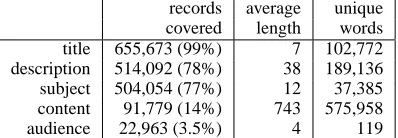
A larger problem, and the one we focus on in this study, is that of missing fields. For example 24% of the items in the NSDL collection have no sub-ject field, 30% are missing the author information, and over 96% mention no target audience (reading level). This means that a relational query for ele-mentary school material will consider at most 4% of all potentially relevant resources in the NSDL col-lection.2
The goal of our work is to introduce a retrieval model that will be capable of answering complex structured queries over a semi-structured collection with corrupt and missing field values. This study focuses on the latter problem, an extreme version of the former. Our approach is to use a generative model to compute how plausible a word would ap-pear in a record’s empty field given the context pro-vided by the other fields in the record.
The remainder of this paper is organized as fol-lows. We survey previous attempts at handling semi-structured data in section 2. Section 3 will provide the details of our approach, starting with a high-level view, then providing a mathematical framework, and concluding with implementation details. Section 4 will present an extensive evaluation of our model on the large set of queries over the NSDL collection. We will summarize our results and suggest direc-tions for future research in Section 5.
2 Related work
The issue of missing field values is addressed in a number of recent publications straddling the areas of relational databases and machine learning. In most cases, researchers introduce a statistical model for predicting the value of a missing attribute or relation, based on observed values. Friedman et al (1999) in-troduce a technique called Probabilistic Relational Models (PRM) for automatically learning the struc-ture of dependencies in a relational database. Taskar
2
Some of the NSDL metadata fields overlap substantially in meaning, so it might be argued that the overlapping fields will cover the collection better. Under the broadest possible inter-pretation of field meanings, more than 7% of the documents still contain no subject and 95% still contain no audience field.
et al (2001) demonstrate how PRM can be used to predict the category of a given research paper and show that categorization accuracy can be substan-tially improved by leveraging the relational structure of the data. Heckerman et al (2004) introduce the Probabilistic Entity Relationship (PER) model as an extension of PRM that treats relations between enti-ties as objects. Neville at al (2003) discuss predict-ing binary labels in relational data uspredict-ing Relational Probabilistic Trees (RPT). Using this method they successfully predict whether a movie was a box of-fice hit based on other movies that share some of the properties (actors, directors, producers) with the movie in question.
Our work differs from most of these approaches in that we work with free-text fields, whereas database researchers typically deal with closed-vocabulary values, which exhibit neither the synonymy nor the polysemy inherent in natural language expressions. In addition, the goal of our work is different: we aim for accurate ranking of records by their relevance to the user’s query, whereas database research has typ-ically focused on predicting the missing value.
Our work is related to a number of existing ap-proaches to semi-structured text search. Desai et al (1987) followed by Macleod (1991) proposed us-ing the standard relational approach to searchus-ing unstructured texts. The lack of an explicit rank-ing function in their approaches was partially ad-dressed by Blair (1988). Fuhr (1993) proposed the use of Probabilistic Relational Algebra (PRA) over the weights of individual term matches. Vasan-thukumar et al (1996) developed a relational imple-mentation of the inference network retrieval model. A similar approach was taken by de Vries and Wilschut (1999), who managed to improve the ef-ficiency of the approach. De Fazio et al (1995) in-tegrated IR and RDBMS technology using an ap-proached called cooperative indexing. Cohen (2000) describes WHIRL – a language that allows efficient inexact matching of textual fields within SQL state-ments. A number of relevant works are also pub-lished in the proceedings of the INEX workshop.3
The main difference between these endeavors and our work is that we are explicitly focusing on the cases where parts of the structured data are missing
or mis-labeled.
3 Structured Relevance Model
In this section we will provide a detailed description of our approach to searching semi-structured data. Before diving into the details of our model, we want to clearly state the challenge we intend to address with our system.
3.1 Task: finding relevant records
The aim of our system is to identify a set of records relevant to a structured query provided by the user. We assume the query specifies a set of keywords for each field of interest to the user, for example Q: subject=’physics,gravity’ AND
audi-ence=’grades 1-4’4. Each record in the database is a set of natural-language descriptions for each field. A record is considered relevant if it could plausibly be annotated with the query fields. For example, a record clearly aimed at elementary school students would be considered relevant to Q even if it does not contain ’grades 1-4’ in its description of the target audience. In fact, our experiments will specifically focus on finding relevant records that contain no di-rect match to the specified query fields, explicitly targeting the problem of missing data and inconsis-tent schemata.
This task is not a typical IR task because the fielded structure of the query is a critical aspect of the processing, not one that is largely ignored in fa-vor of pure content based retrieval. On the other hand, the approach used is different from most DB work because cross-field dependencies are a key component of the technique. In addition, the task is unusual for both communities because it consid-ers an unusual case where the fields in the query do not occur at all in the documents being searched.
3.2 Overview of the approach
Our approach is based on the idea that plausible val-ues for a given field could be inferred from the con-text provided by the other fields in the record. For instance, a resource titled ’Transductive SVMs’ and containing highly technical language in its descrip-tion is unlikely to be aimed at elementary-school
stu-4
For this paper we will focus on simple conjunctive queries. Extending our model to more complex queries is reserved for future research.
dents. In the following section we will describe a statistical model that will allow us to guess the val-ues of un-observed fields. At the intuitive level, the model takes advantage of the fact that records sim-ilar in one respect will often be simsim-ilar in others. For example, if two resources share the same author and have similar titles, they are likely to be aimed at the same audience. Formally, our model is based on the generative paradigm. We will describe a proba-bilistic process that could be viewed, hypothetically, as the source of every record in our collection. We will assume that the query provided by our user is also a sample from this generative process, albeit a very short one. We will use the observed query fields (e.g. audience and subject) to estimate the likely val-ues for other fields, which would be plausible in the context of the observed subject and audience. The distributions over plausible values will be called
rel-evance models, since they are intended to mimic the
kind of record that might be relevant to the observed query. Finally, all records in the database will be ranked by their information-theoretic similarity to these relevance models.
3.3 Definitions
We start with a set of definitions that will be used through the remainder of this paper. Let C be a collection of semi-structured records. Each record w consists of a set of fields w1. . .wm. Each
fieldwi is a sequence of discrete variables (words)
wi,1. . .wi,ni, taking values in the field vocabulary Vi.5 When a record contains no information for the
i’th field, we assumeni=0for that record. A user’s
query q takes the same representation as a record in the database: q={qi,j∈Vi :i=1..m, j = 1..ni}.
We will usepito denote a language model overVi,
i.e. a set of probabilitiespi(v)∈[0,1], one for each
wordv, obeying the constraintΣvpi(v) = 1. The
set of all possible language models overVi will be
denoted as the probability simplex IPi. We define
π : IP1×· · ·×IPm→[0,1]to be a discrete measure
function that assigns a probability massπ(p1. . .pm)
to a set ofm language models, one for each of the
mfields present in our collection.
5
3.4 Generative Model
We will now present a generative process that will be viewed as a hypothetical source that produced ev-ery record in the collection C. We stress that this process is purely hypothetical; its only purpose is to model the kinds of dependencies that are necessary to achieve effective ranking of records in response to the user’s query. We assume that each recordwin the database is generated in the following manner:
1. Pickmdistributionsp1. . .pmaccording toπ
2. For each fieldi= 1. . .m:
(a) Pick the lengthni of thei0thfield ofw
(b) Draw i.i.d. wordswi,1. . .wi,nifrompi
Under this process, the probability of observing a record{wi,j :i=1..m, j=1..ni}is given by the
fol-lowing expression:
Z
IP1...IPm
"m Y
i=1 ni
Y
j=1
pi(wi,j)
#
π(p1. . .pm)dp1. . .dpm (1)
3.4.1 A generative measure function
The generative measure functionπplays a critical part in equation (1): it specifies the likelihood of us-ing different combinations of language models in the process of generatingw. We use a non-parametric estimate forπ, which relies directly on the combi-nations of language models that are observed in the training part of the collection. Each training record w1. . .wm corresponds to a unique combination of
language modelspw1 . . .pwmdefined by the following equation:
pwi (v) =
#(v,wi) +µicv
ni+µi (2)
Here #(v,wi) represents the number of times the
word v was observed in the i’th field of w, ni
is the length of the i’th field, and cv is the
rela-tive frequency of v in the entire collection. Meta-parameters µi allow us to control the amount of
smoothing applied to language models of different fields; their values are set empirically on a held-out portion of the data.
We define π(p1. . .pm) to have mass N1 when
its argumentp1. . .pm corresponds to one of theN
recordswin the training part Ct of our collection,
and zero otherwise:
π(p1. . .pm) = 1
N
X
w∈Ct
m
Y
i=1
1pi=pw
i (3)
Herepwi is the language model associated with the training recordw(equation 2), and1xis the Boolean
indicator function that returns 1 when its predicatex is true and zero when it is false.
3.4.2 Assumptions and limitations of the model
The generative model described in the previous section treats each field in the record as a bag of words with no particular order. This representation is often associated with the assumption of word
in-dependence. We would like to stress that our model
does not assume word independence, on the con-trary, it allows for strong un-ordered dependencies among the words – both within a field, and across different fields within a record. To illustrate this point, suppose we let µi→0 in equation (2) to
re-duce the effects of smoothing. Now consider the probability of observing the word ’elementary’ in the audience field together with the word
’differen-tial’ in the title (equation 1). It is easy to verify that
the probability will be non-zero only if some train-ing recordwactually contained these words in their respective fields – an unlikely event. On the other hand, the probability of ’elementary’ and
’differen-tial’ co-occurring in the same title might be
consid-erably higher.
While our model does not assume word indepen-dence, it does ignore the relative ordering of the words in each field. Consequently, the model will fail whenever the order of words, or their proximity within a field carries a semantic meaning. Finally, our generative model does not capture dependencies across different records in the collection, each record is drawn independently according to equation (1).
3.5 Using the model for retrieval
In this section we will describe how the generative model described above can be used to find database records relevant to the structured query provided by the user. We are given a structured query q, and a collection of records, partitioned into the training portionCtand the testing portion Ce. We will use
records average unique
covered length words
title 655,673 (99%) 7 102,772
description 514,092 (78%) 38 189,136
subject 504,054 (77%) 12 37,385
content 91,779 (14%) 743 575,958
[image:5.612.87.286.59.128.2]audience 22,963 (3.5%) 4 119
Table 1: Summary statistics for the five NSDL fields used in our retrieval experiments.
models R1. . .Rm, intended to reflect the user’s
in-formation need. We will then rank testing records by their divergence from these relevance models. A rel-evanceRi(v)specifies how plausible it is that word
v would occur in the i’th field of a record, given that the record contains a perfect match to the query fieldsq1. . .qm:
Ri(v) =P(q1. . .v◦qi. . .qm)
P(q1. . .qi. . .qm) (4)
We use v◦qi to denote appending word v to the
string qi. Both the numerator and the
denomina-tor are computed using equation (1). Once we have computed relevance models Ri for each of the m
fields, we can rank testing recordsw0 by their sim-ilarity to these relevance models. As a simsim-ilarity measure we use weighted cross-entropy, which is an extension of the ranking formula originally proposed by (Lafferty and Zhai, 2001):
H(R1..m;w1..m) = m
X
i=1
αi
X
v∈Vi
Ri(v) logpwi(v) (5)
The outer summation goes over every field of inter-est, while the inner extends over all the words in the vocabulary of thei’th field.Riare computed
accord-ing to equation (4), while pwi are estimated from equation (2). Meta-parameters αi allow us to vary
the importance of different fields in the final rank-ing; the values are selected on a held-out portion of the data.
4 Experiments
4.1 Dataset and queries
We tested the performance of our model on a Jan-uary 2005 snapshot of the National Science Digi-tal Library repository. The snapshot contains a to-tal of 656,992 records, spanning 92 distinct (though
sometimes related) fields. 6Only 7 of these fields are present in every record, and half the fields are present in less than 1% of the records. An average record contains only 17 of the 92 fields. Our experi-ments focus on a subset of 5 fields (title, description,
subject, content and audience). These fields were
selected for two reasons: (i) they occur frequently enough to allow a meaningful evaluation and (ii) they seem plausible to be included in a potential query.7Of these fields, title represents the title of the resource, description is a very brief abstract, content is a more detailed description (but not the full con-tent) of the resource, subject is a library-like clas-sification of the topic covered by the resource, and
audience reflects the target reading level (e.g. ele-mentary school or post-graduate). Summary
statis-tics for these fields are provided in Table 1.
The dataset was randomly split into three sub-sets: the training set, which comprised 50% of the records and was used for estimating the relevance models as described in section 3.5; the held-out set, which comprised 25% of the data and was used to tune the smoothing parametersµiand the bandwidth
parametersαi; and the evaluation set, which
con-tained 25% of the records and was used to evaluate the performance of the tuned model8.
Our experiments are based on a set of 127 auto-matically generated queries. We randomly split the queries into two groups, 64 for training and 63 for evaluation. The queries were constructed by com-bining two randomly picked subject words with two
audience words, and then discarding any
combi-nation that had less than 10 exact matches in any of the three subsets of our collection. This proce-dure yields queries such asQ91={subject:’artificial intelligence’ AND audience=’researchers’}, or
Q101={subject:’philosophy’ AND audience=’high school’}.
4.2 Evaluation paradigm
We evaluate our model by its ability to find “rele-vant” records in the face of missing values. We
de-6As of May 2006, the NSDL contains over 1.5 million
doc-uments.
7The most frequent NSDL fields (id, icon, url, link and 4
brand fields) seem unlikely to be used in user queries. 8
fine a recordwto be relevant to the user’s queryq if every keyword inqis found in the corresponding field ofw. For example, in order to be relevant to
Q101a record must contain the word ‘philosophy’ in
the subject field and words ‘high’ and ‘school’ in the audience field. If either of the keywords is missing, the record is considered non-relevant.9
When the testing records are fully observable, achieving perfect retrieval accuracy is trivial: we simply return all records that match all query key-words in the subject and audience fields. As we stated earlier, our main interest concerns the sce-nario when parts of the testing data are missing. We are going to simulate this scenario in a rather ex-treme manner by completely removing the subject and audience fields from all testing records. This means that a straightforward approach – matching query fields against record fields – will yield no rel-evant results. Our approach will rank testing records by comparing their title, description and content fields against the query-based relevance models, as discussed in section 3.5.
We will use the standard rank-based evaluation metrics: precision and recall. Let NR be the total
number of records relevant to a given query, sup-pose that the firstK records in our ranking contain
NK relevant ones. Precision at rank K is defined as NK
K and recall is defined as NNKR. Average preci-sion is defined as the mean precipreci-sion over all ranks where relevant items occur. R-precision is defined as precision at rankK=NR.
4.3 Baseline systems
Our experiments will compare the ranking perfor-mance of the following retrieval systems:
cLM is a cheating version of un-structured text
search using a state-of-the-art language-modeling approach (Ponte and Croft, 1998). We disregard the structure, take all query keywords and run them against a concatenation of all fields in the testing records. This is a “cheating” baseline, since the
con-9
This definition of relevance is unduly conservative by the standards of Information Retrieval researchers. Many records that might be considered relevant by a human annotator will be treated as non-relevant, artificially decreasing the accuracy of any retrieval algorithm. However, our approach has the advan-tage of being fully automatic: it allows us to test our model on a scale that would be prohibitively expensive with manual rele-vance judgments.
catenation includes the audience and subject fields, which are supposed to be missing from the testing records. We use Dirichlet smoothing (Lafferty and Zhai, 2001), with parameters optimized on the train-ing data. This baseline mimics the core search capa-bility currently available on the NSDL website.
bLM is a combination of SQL-like structured
matching and unstructured search with query ex-pansion. We take all training records that contain an exact match to our query and select 10 highly-weighted words from the title, description, and
con-tent fields of these records. We run the resulting 30
words as a language modeling query against the con-catenation of title, description, and content fields in the testing records. This is a non-cheating baseline.
bMatch is a structured extension of bLM. As in
bLM, we pick training records that contain an ex-act match to the query fields. Then we match 10 highly-weighted title words, against the title field of testing records, do the same for the description and
content fields, and merge the three resulting ranked
lists. This is a non-cheating baseline that is similar to our model (SRM). The main difference is that this approach uses exact matching to select the training records, whereas SRM leverages a best-match lan-guage modeling algorithm.
SRM is the Structured Relevance Model, as
de-scribed in section 3.5. For reasons of both effec-tiveness and efficiency, we firstly run the original query to retrieve top-500 records, then use these records to build SRMs. When calculating the cross entropy(equ. 5), for each field we only include the top-100 words which will appear in that field with the largest probabilities.
Note that our baselines do not include a standard SQL approach directly on testing records. Such an approach would have perfect performance in a “cheating” scenario with observable subject and
au-dience fields, but would not match any records when
the fields are removed.
4.4 Experimental results
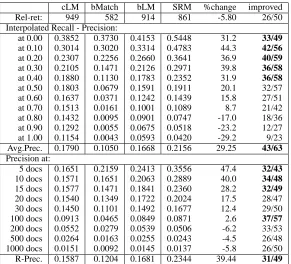
Table 2 shows the performance of our model (SRM) against the three baselines. The model parameters were tuned using the 64 training queries on the
train-ing and held-out sets. The results are for the 63 test
cLM bMatch bLM SRM %change improved
Rel-ret: 949 582 914 861 -5.80 26/50
Interpolated Recall - Precision:
at 0.00 0.3852 0.3730 0.4153 0.5448 31.2 33/49
at 0.10 0.3014 0.3020 0.3314 0.4783 44.3 42/56
at 0.20 0.2307 0.2256 0.2660 0.3641 36.9 40/59
at 0.30 0.2105 0.1471 0.2126 0.2971 39.8 36/58
at 0.40 0.1880 0.1130 0.1783 0.2352 31.9 36/58
at 0.50 0.1803 0.0679 0.1591 0.1911 20.1 32/57
at 0.60 0.1637 0.0371 0.1242 0.1439 15.8 27/51
at 0.70 0.1513 0.0161 0.1001 0.1089 8.7 21/42
at 0.80 0.1432 0.0095 0.0901 0.0747 -17.0 18/36
at 0.90 0.1292 0.0055 0.0675 0.0518 -23.2 12/27
at 1.00 0.1154 0.0043 0.0593 0.0420 -29.2 9/23
Avg.Prec. 0.1790 0.1050 0.1668 0.2156 29.25 43/63
Precision at:
5 docs 0.1651 0.2159 0.2413 0.3556 47.4 32/43
10 docs 0.1571 0.1651 0.2063 0.2889 40.0 34/48
15 docs 0.1577 0.1471 0.1841 0.2360 28.2 32/49
20 docs 0.1540 0.1349 0.1722 0.2024 17.5 28/47
30 docs 0.1450 0.1101 0.1492 0.1677 12.4 29/50
100 docs 0.0913 0.0465 0.0849 0.0871 2.6 37/57
200 docs 0.0552 0.0279 0.0539 0.0506 -6.2 33/53
500 docs 0.0264 0.0163 0.0255 0.0243 -4.5 26/48
1000 docs 0.0151 0.0092 0.0145 0.0137 -5.8 26/50
[image:7.612.162.453.56.320.2]R-Prec. 0.1587 0.1204 0.1681 0.2344 39.44 31/49
Table 2: Performance of the 63 test queries retrieving 1000 documents on the evaluation data. Bold figures show statistically significant differences. Across all 63 queries, there are 1253 relevant documents.
the evalution corpus.)
The upper half of Table 2 shows precision at fixed recall levels; the lower half shows precision at different ranks. The %change column shows rel-ative difference between our model and the base-line bLM. The improved column shows the num-ber of queries where SRM exceeded bLM vs. the number of queries where performance was different. For example,33/49means that SRM out-performed bLM on 33 queries out of 63, underperformed on
49−33=16 queries, and had exactly the same per-formance on 63−49=14 queries. Bold figures in-dicate statistically significant differences (according to the sign test withp <0.05).
The results show that SRM outperforms three baselines in the high-precision region, beating bLM’s mean average precision by 29%. User-oriented metrics, such as R-precision and precision at 10 documents, are improved by 39.4% and 44.3% respectively. The absolute performance figures are also very encouraging. Precision of 28% at rank 10 means that on average almost 3 out of the top 10 records in the ranked list are relevant, despite the re-quested fields not being available to the model.
We note that SRM continues to outperform bLM until very high recall and until the 100-document cutoff. After that, SRM degrades rapidly with re-spect to bLM. We feel the drop in effectiveness is of marginal interest because precision is already well below 10% and few users will be continuing to that depth in the list.
It is encouraging to see that SRM outperforms both cLM, the cheating baseline that takes advantage of the field values that are supposed to be “miss-ing”, and bMatch, suggesting that best-match re-trieval provides a superior strategy for selecting a set of appropriate training records.
5 Conclusions
We have developed and empirically validated a new retrieval model for semi-structured text. The model is based on the idea that missing or corrupted val-ues for one field can be inferred from valval-ues in other fields of the record. The cross-field inference makes it possible to find documents in response to a struc-tured query when those query fields do not exist in the relevant documents at all.
archive of the NSDL repository. We developed a large set of structured Boolean queries that had rel-evant documents in the test portion of collection. We then indexed the documents without the fields used in the queries. As a result, using standard field matching approaches, not a single document would be returned in response to the queries—in particular, no relevant documents would be found.
We showed that standard information retrieval techniques and structured field matching could be combined to address this problem, but that the SRM approach outperforms them. We note that SRM brought two relevant documents into the top five— again, querying on missing fields—and achieved an average precision of 23%, a more than 35% im-provement over a state-of-the-art relevance model approach combining the standard field matching.
Our work is continuing by exploring methods for handling fields with incorrect or corrupted val-ues. The challenge becomes more than just inferring what values might be there; it requires combining likely missing values with confidence in the values already present: if an audience field contains ’under-graduate’, it should be unlikely that ’K-6’ would be a plausible value, too.
In addition to using SRMs for retrieval, we are currently extending the ideas to provide field valida-tion and suggesvalida-tions for data entry and validavalida-tion: the same ideas used to find documents with miss-ing field values can also be used to suggest potential values for a field and to identify values that seem inappropriate. We have also begun explorations to-ward using inferred values to help a user browse when starting from some structured information— e.g., given values for two fields, what values are probable for other fields.
Acknowledgments
This work was supported in part by the Center for Intelligent Information Retrieval and in part by the Defense Advanced Research Projects Agency (DARPA) under contract number HR0011-06-C-0023. Any opinions, findings and conclusions or recommendations expressed in this material are the authors’ and do not necessarily reflect those of the sponsor.
References
D.C. Blair. 1988. An extended relational document re-trieval model. Inf. Process. Manage., 24(3):349–371.
W.W. Cohen. 2000. WHIRL: A word-based informa-tion representainforma-tion language. Artificial Intelligence, 118(1–2):163–196.
S. DeFazio, A. Daoud, L. A. Smith, and J. Srinivasan. 1995. Integrating IR and RDBMS Using Cooperative Indexing. In Proceedings of SIGIR, pages 84–92.
B. C. Desai, P. Goyal, and F. Sadri. 1987. Non-first nor-mal form universal relations: an application to infor-mation retrieval systems. Inf. Syst., 12(1):49–55.
N. Friedman, L. Getoor, D. Koller, and A. Pfeffer. 1999. Learning probabilistic relational models. In IJCAI, pages 1300–1309.
N. Fuhr. 1993. A probabilistic relational model for the integration of IR and databases. In Proceedings of
SI-GIR, pages 309–317.
D. Heckerman, C. Meek, and D. Koller. 2004. Proba-bilistic models for relational data. Technical Report MSR-TR-2004-30, Microsoft Research.
J. Lafferty and C. Zhai. 2001. Document language mod-els, query modmod-els, and risk minimization for informa-tion retrieval. In Proceedings of SIGIR, pages 111– 119.
I. Macleod. 1991. Text retrieval and the relational model.
Journal of the American Society for Information Sci-ence, 42(3):155–165.
J. Neville, D. Jensen, L. Friedland, and M. Hay. 2003. Learning relational probability trees. In Proceedings
of ACM KDD, pages 625–630, New York, NY, USA.
J. M. Ponte and W. B. Croft. 1998. A language modeling approach to information retrieval. In Proceedings of
SIGIR, pages 275–281.
B. Taskar, E. Segal, and D. Koller. 2001. Probabilistic classification and clustering in relational data. In
Pro-ceedings of IJCAI, pages 870–876.
S. R. Vasanthakumar, J.P. Callan, and W.B. Croft. 1996. Integrating INQUERY with an RDBMS to support text retrieval. IEEE Data Eng. Bull., 19(1):24–33.
A.D. Vries and A. Wilschut. 1999. On the integration of IR and databases. In Proceedings of IFIP 2.6 Working