Multi-document Relationship Fusion via
Constraints on Probabilistic Databases
Gideon Mann
Department of Computer Science University of Massachusetts
Amherst, MA 01003
Abstract
Previous multi-document relationship ex-traction and fusion research has focused on single relationships. Shifting the fo-cus to multiple relationships allows for the use of mutual constraints to aid extrac-tion. This paper presents a fusion method which uses a probabilistic database model to pick relationships which violate few constraints. This model allows improved performance on constructing corporate succession timelines from multiple doc-uments with respect to a multi-document fusion baseline.
1 Introduction
Single document information extraction of named entities and relationships has received much atten-tion since the MUC evaluaatten-tions1in the mid-90s (Ap-pelt et al., 1993; Grishman and Sundheim, 1996). Recently, there has been increased interest in the extraction of named entities and relationships from multiple documents, since the redundancy of infor-mation across documents has been shown to be a powerful resource for obtaining high quality infor-mation even when the extractors have access to little or no training data (Etzioni et al., 2004; Hasegawa et al., 2004). Much of the recent work in multi-document relationship extraction has focused on the extraction of isolated relationships (Agichtein, 2005; Pasca et al., 2006), but often the goal, as in
1
http://www.itl.nist.gov/iaui/894.02/related projects/muc/
single document tasks like MUC, is to extract a tem-plate or a relational database composed of related facts.
With databases containing multiple relationships, the semantics of the database impose constraints on possible database configurations. This paper presents a statistical method which picks relation-ships which violate few constraints as measured by a probabilistic database model. The constraints are hard constraints, and robust estimates are achieved by accounting for the underlying extraction/fusion uncertainty.
This method is applied to the problem of con-structing management succession timelines which have a rich set of semantic constraints. Using con-straints on probabilistic databases yields F-Measure improvements of 5 to 18 points on a per-relationship basis over a state-of-the-art multi-document extrac-tion/fusion baseline. The constraints proposed in this paper are used in a context of minimally super-vised information extractors and present an alterna-tive to costly manual annotation.
2 Semantic Constraints on Databases
This paper considers management succession databases where each record has three fields: a CEO’s name and the start and end years for that person’s tenure as CEO (Table 1 Column 1). Each record is represented by three binary logical pred-icates: ceo(c,x), start(x,y1), end(x,y2), where c is a company,x is a CEO’s name, and y1 andy2 are years.2
2
All of the relationships in this paper are defined to be bi-nary relationships. When extracting relationships of higher
Explicit Implicit Logical Constraints Relationships Relationships (a partial list)
ceo(c,x) precedes(x1,x2) ceo(c,x1),precedes(x1,x2)⇔ceo(c,x2),end(x1,y),start(x2,y) start(x,y) inoffice(x,y) start(x,y1),inoffice(x,y2),end(x,y3)⇒y1 ≤y2≤y3
[image:2.612.84.528.69.154.2]end(x,y) predates(x1,x2) inoffice(x1,y1),inoffice(x2,y2) ,y1 < y2⇒predates(x1,x2) precedes(x1,x2) ,inoffice(x1,y1),inoffice(x2,y2)⇒y1 ≤y2
Table 1: Database semantics can provide 1) a method to augment the explicit relationships in the database with implicit relationships and 2) logical constraints on these explicit and implicit relationships. In the above table, c is a company,xiis a person, andyiis a time.
In this setting, database semantics allow for the derivation of other implicit relationships from the database: the immediate predecessor of a given CEO (precedes(x1,x2)), all predecessors of a given CEO (predates(x1,x2)) and all years the CEO was in of-fice (inofof-fice(x,y3)), wherex2is a CEO’s name and
t3a year (Table 1 Column 2).
These implicit relationships and the original ex-plicit relationships are governed by a series of se-mantic relations which impose constraints on the permissible database configurations (Table 1 Col-umn 3). For example, it will always be true that a CEO’s start date precedes their end date:
∀x:start(x, y1), end(x, y2)⇒y1≤y2.
Multi-document extraction of single relationships exploits redundancy and variety of expression to ex-tract accurate information from across many docu-ments. However, these are not the only benefits of extraction from a large document collection. As well as being rich in redundant information, large docu-ment collections also contain a wealth of secondary relationships which are related to the relationship of interest via constraints as described above. These secondary relationships can yield benefits to aug-ment those achieved by redundancy.
3 Multi-Document Database Fusion
There are typically two steps in the extraction of sin-gle relationships from multiple documents. In the first step, a relationship extractor goes through the corpus, finds all possible relationshipsr in all sen-tences sand gives them a score p(r|s). Next, the
ity, typically binary relationships are combined (McDonald et al., 2005).
relationships are fused across sentences to generate one scoreφrfor each relationship.
This paper proposes a third step which combines the fusion scores across relationships. This section first presents a probabilistic database model gener-ated from fusion scores and then shows how to use this model for multi-document fusion.
3.1 A Probabilistic Database Model
A relationshipr is defined to be a 3-tuple rt,a,b =
r(t, a, b), wheretis the type of the relationship (e.g. start), andaandb are the arguments of the binary relationship.3
To construct a probabilistic database for a given corpus, the weights generated in relationship fusion are normalized to provide the conditional probability of a relationship given its type:
p(r1t,a,b|t1) =
φrt,a,b
1
P
ri:rit=tφrt,a,bi ,
whereφris the fusion score generated by the
extrac-tion/fusion system.4 By applying a prior over types
p(t), a distributionp(r1, t1) can be derived. Given strong independence assumptions, the probability of an ordered database configurationR=r1..nof types
t1..nis:
p(r1..n, t1..n) = n
Y
i=1
p(ri, ti). (1)
3
For readibility in future examples, “a” and “b” are replaced by the types of their arguments. For example, forstartthe year in which the CEO starts is referred to asryear.
4
As proposed, the model in Equation 1 is faulty since the relationships in a database are not inde-pendent. Given a set of database constraints, certain database configurations areillegaland should be as-signed zero probability. To address this, the model in Equation 1 is augmented with constraints that ex-plicitly set the probability of a database configura-tion to zero when they are violated.
A database constraint is a logical formula
η(r1..π(η)), whereπ(η)is the arity of the constraint
η. For the constraints presented in this paper, all constraintsηare modeled with two termsηαandηβ
where:
η(r1..π(η)) =
ηα(r1..π(η))⇒ηβ(r1..π(η))
.
For a set of relationships, a constraintholdsifη(·)
is true, and the constraintappliesifηα(·)is true. A
constraintη(·)can only beviolated(false) when the constraint applies, since:(false⇒X) =true.
In application to a database, each constraintη is quantified over the database to become a quantified constraintηr1..n. For example, the constraints that a
person’s start date must come before their end date is universally quantified over all pairs of relationships in a configurationR=r1..n:
ηr1..n =∀r1,r2∈R: η(r1, r2) =
(r1t =start, rt2=end, r1ceo=r2ceo) ⇒(ryear1 < r2year).
This constraint applies tostartandendrelationships whose CEO argument matches and is violated when the years are not in order. If the quantified constraint
ηr1..n is true for a given database configurationr1..n
then itholds.
To ensure that only legal database configurations are assigned positive probabilities, Equation 1 is augmented with a factor
φηr1..n =
(
1 ifηr1..nholds 0 otherwise .
To include a constraint η, the database model in Equation 1 is extended to be:
pη(r1..n, t1..n) = 1
Z
Y
i
p(ri, ti)
!
φηr1..n,
whereZis the partition function and corresponds to the total probability of all database configurations. A set of constraintsη1..Q = η1..ηQ can be integrated
similarly:
pη1..Q(r1..n, t1..n) = 1
Z
Y
i
p(ri, ti)
! Y
q
φηr1q..n
(2)
With these added constraints, the probabilistic database model assigns non-zero probability only to databases which don’t violate any constraints.
3.2 Constraints on Probabilistic Databases for Relationship Rescoring
Though the constrained probabilistic database model in Equation 2 is theoretically appealing, it would be infeasible to calculate its partition func-tion which requires enumerafunc-tion of all legal 2n
databases. This section proposes two methods for re-scoring relationships with regards to how likely they are to be present in a legal database configu-ration using the model proposed above. The first method is a confidence estimate based on how likely it is thatηholds for a given relationshipr1:
Λη(r1, t1) =Ep(r2..n,t2..n)
h
φηr
1..π(η)
i
=
P
r2..π(η)
Qπ(η)
i=2 p(ri, ti)
φηr1..π(η)
P
r2..π(η)
Qπ(η)
i=2 p(ri, ti)
=
P
r2..π(η)pη(r1..n, t1..n)
P
r2..π(η)p(r1..n, t1..n)
,
where the expectation that the constraint holds is equivalent to the likelihood ratio between the database probability models with and without con-straints. In effect, this model measures the expec-tation that the constraint holds for a finite database “look-ahead” of sizeπ(η)−1.
With this method, for a constraint to reduce the confidence in a particular relationship by half, half of all configurations would have to violate the con-straint.5Since inconsistencies are relatively rare, for a given relationship Λη(r, t) ≈ 1 (i.e. almost all
small databases are legal).
5
To remedy this, another factorφαis defined simi-larly toφη, except that it takes a value of 1 only if the constraint applies to that database configuration. An applicability probability model is then defined as:
pα(r1..n, t1..n) = 1
Z
Y
i
p(ri, ti)
!
φαr1..n.
The second confidence estimate is based on how likely it is that the constraint is holds in cases where it applies (i.e. is not violated):
Λη,α(r1, t1)
=Epα(r2..n,t2..n)
h
φηr1..π(η)
i
=
P
r2..π(η)
Qπ(η)
i=2 p(ri, ti)
φαr
1..π(η)φ
η r1..π(η)
P
r2..π(η)
Qπ(η)
i=2 p(ri, ti)
φα r1..π(η)
.
When the constraint doesn’t apply it cannot be vio-lated, so this confidence estimate ignores those con-figurations that can’t be affected by the constraint.
Recall that Λη(r, t) is the likelihood ratio
be-tween the probability of configurations in which r
holds for constraintηand all configurations. In con-trast, Λη,α(r, t) is the likelihood ratio between the
database configurations where r applies and holds for η and the database configurations where η ap-plies. In the later ratio, for confidence in a particular relationship to be cut in half, only half of the con-figurations which might actually contain an incon-sistency would be required to produce a violation.6 As a result,Λη,α(r, t)gives a much higher penalty to
relationships which create inconsistencies than does
Λη(r, t).
In order to apply multiple constraints, indepen-dent database look-aheads are generated for each constraintq:
Λη1..Q,α1..Q(r1, t1) = Y
q
Ληq,αq(r1, t1).
For a particular relationship type, these confidence scores are calculated and then used to rank the
rela-6
For example, for astartrelationship and the constraint that a CEO must start before they end, this method would only ex-amine configurations of onestartand oneendrelationship for the same CEO. The confidence in a particular start date would be halved if half of the proposed end dates for a given CEO occurred before it.
tionships via:
ˆ
cη1..Q,α1..Q(r1, t1) =p(r1, t1)
Y
q
Ληq,αq(r1, t1)
(3)
Databases with different precision/recall trade offs can be selected by descending the ranked list.7
4 Experiments
In order to test the fusion method proposed above, human annotators manually constructed truth data of complete chief executive histories for 18 Fortune-500 companies using online resources. Extraction from these documents is particularly difficult be-cause these data have vast differences in genre and style and are considerably noisy. Furthermore, the task is complicated to start with.8
A corpus was created for each company by is-suing a Google query for “CEO-of-Company OR Company-CEO”, and collecting the top ranked doc-uments, generating up to 1000 documents per com-pany. The data was then split randomly into training, development and testing sets of 6, 4, and 8 compa-nies.
Training : Anheuser-Busch, Hewlett-Packard, Lenner, McGraw-Hill, Pfizer, Raytheon Dev. : Boeing, Heinz, Staples, Textron Test : General Electric, General Motors,
Gannett, The Home Depot, IBM, Kroger, Sears, UPS
Ground truth was created from the entire web, but since the corpus for each company is only a small web snapshot, the experimental results are not simi-lar to extraction tasks like MUC and ACE in that the corpus is not guaranteed to contain the information necessary to build the entire database. In particular,
7
One thing to note is that since all relationships are given confidence estimates separately, this process may result ulti-mately in a database where constraints are violated. A potential solution, which is not explored here, would be to incrementally add relationships to the database from the ranked list only if their addition doesn’t make the database inconsistent.
8
1)Only one start or end per person. ∀r1, r2:η(r1, r2) = (rtype1 =r
type
2 = (start∪end), r
ceo
1 =rceo2 )⇒(r1year=r
year
2 )
2)Only a CEO’s start or end dates belong in the database. ∀r1∃r2:η(r1, r2) = (r1type=start∪end, r
type
2 =ceo)⇒(r
ceo
1 =r2ceo)
3)Start dates come before end dates. ∀r1, r2:η(r1, r2) = (rtype1 =start, r
type
2 =end, r
ceo
1 =rceo2 )⇒(r
year
1 ≤r
year
2 )
4)Can’t be in the middle of someone else’s tenure. ∀r1, r2, r3:η(r1, r2, r3) = (rtype1 =start∪inof f ice, r
type
2 =end∪inof f ice, r
type
3 =start∪inof f ice∪end,
r1ceo=rceo2 6=r3ceo, r
year
1 < r
year
2 )⇒(r
year
3 ≤r
year
1 ∪r
year
3 ≥r
year
2 )
5)CEO’s are only in office after their start. ∀r1, r2:η(r1, r2) = (rtype1 =start, r
type
2 =inof f ice, r
ceo
1 =r2ceo)⇒(r
year
1 ≤r
year
2 )
6)CEO’s are only in office before their end. ∀r1, r2:η(r1, r2) = (rtype1 =inof f ice, r
type
2 =end, r
ceo
1 =rceo2 )⇒(r
year
1 ≤r
year
2 )
7)Someone’s end is the same as their successor’s start. ∀r1, r2, r3:η(r1, r2, r3) =
(rtype1 =end, r
type
2 =start, r
type
3 =precedes, r
ceo
1 =rf irst3 , r
ceo
2 =r3second)⇒(ryear1 =r
year
2 )
8)All of the someone’s dates (start, inoffice, end) are before their successors. ∀r1, r2, r3:η(r1, r2, r3) = (rtype1 =start∪end∪inof f ice, r
type
2 =start∪inof f ice∪end, r
type
3 =precedes,
rceo1 =r3f irst, r
ceo
2 =rsecond3 )⇒(r1year≤r
year
2 )
9)Only CEO succession in the database.
∀r1∃r1, r2:η(r1, r2, r3) = (r1type=precedes, r
type
2 =r
type
3 =ceo)⇒(r
f irst
1 =r
ceo
[image:5.612.83.528.56.281.2]2 , r1second=rceo3 )
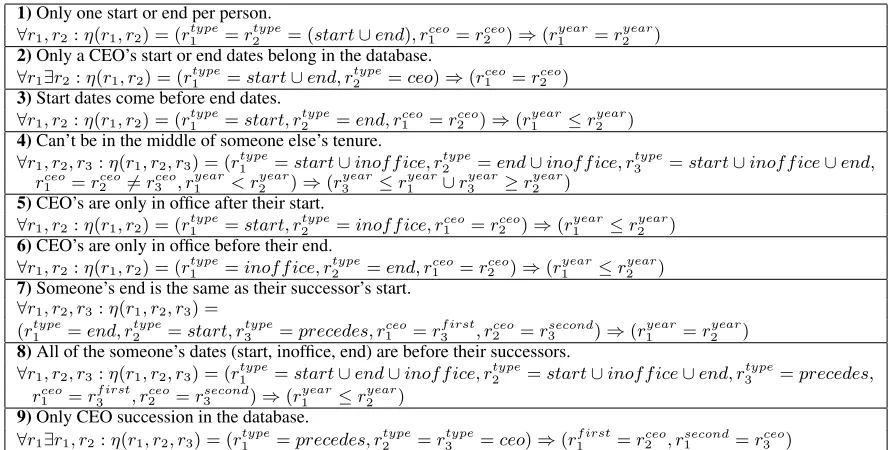
Table 2: For a CEO succession database like the one presented in Table 1, the above constraints must hold if the database is consistent.
many CEOs from pre-Internet years were either in-frequently mentioned or not mentioned at all in the database.9 In the following experiments, recall is re-ported for facts that were retrieved by the extraction system.
4.1 Relationship Extraction and Fusion
A two-class maximum-entropy classifier was trained for each relationship type. Each classifier takes a sentence and two marked entities (e.g. a person and a year)10 and gives the probability that a relation-ship between the two entities is supported by the sentence. For each relationship type, one of the ele-ments is designated as the “hook” in order to gener-ate likely negative examples.11 In training, all entity pairs are collected from the corpus. The pairs whose “hook” element doesn’t appear in the database are thrown out. The remaining pairs are then marked
9Another consequence is that assessing the effectiveness of the relationships extraction on a per-extraction basis is difficult. Because there are no training sentences where it is known that the sentence contains the relationship of interest, grading per-extraction results can be deceptive.
10
The person tagger used is the named-entity tagger from OpenNLP tools and the year tagger simply finds any four digit numbers between 1950 and 2010.
11
For the CEO relationship, the company was taken to be the hook. For the other relationships the hook was the primary CEO.
by exact match to the database. In testing, the rela-tionship extractor yields the probabilityp(r|s)of an entity pair relationshiprin a particular sentences.
The features used in the classifier are: unigrams between the given information and the target, dis-tance in words between the given information and the target, and the exact string between the given in-formation and the target (if less that 3 words long).
After extraction from individual sentences, the re-lationships are fused together such that there is one score for each unique entity pair. In the case of per-son names, normalization was performed to merge coreferent but lexically distinct names (e.g. “Phil Condit” and “Philip M. Condit”).
In the following experiments, the baseline fusion score is:
φr=
X
s
p(r|s) (4)
4.2 Experimental Results
pro-Second (8) First Before
0 0.1 0.2 0.3 0.4 0.5 0.6 0.7 0.8 0.9
0 0.2 0.4 0.6 0.8 1 Baseline
[image:6.612.80.292.57.191.2]Only One (1) CEOs Only (2) Start Before End (3) Inoffice After Start (5) 2,5 2,3,5,
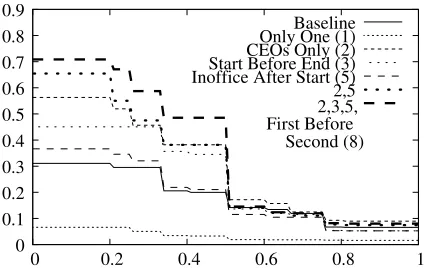
Figure 1: Precision/Recall curve for start(x,t) rela-tionships. The joint constraint “2,3,5,8” is the best performing, even though constraints “3” and “8” (not pictured) alone don’t perform well.
posed and the second looks at the precision/recall of a heterogeneous database with many relationship types. Both evaluations examine the ranked lists of relationships, where the relationships are ranked by rescoring via constraints on probabilistic databases (Equation 3) and compared to the baseline fusion score (Equation 4). The evaluations use two stan-dard metrics, interpolated precision at recall level i (PRi), and MaxF1:
PRi = max j≥i PRj,
MaxF1= max i
2
1
PRi +
1
Ri .
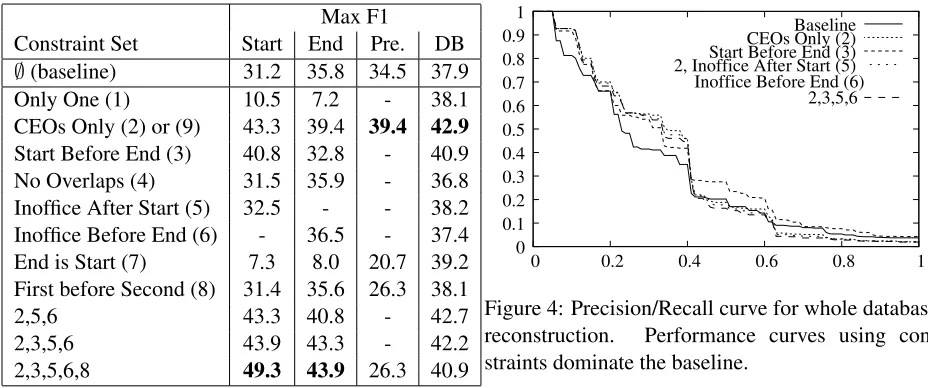
Figures 1, 2, and 3 show precision/recall curves for the application of various sets of constraints. Ta-ble 3 lists the MaxF1 scores for each of the con-straint variants. For startand end, the majority of constraints are beneficial. For precedes, only the constraint that improved performance constraints both people in the relationship to be CEOs. Across all relationships, performance is hurt when using the constraint that there could only be one relationship of each type for a given CEO. The reason behind this is that the confidence estimate based on this constraint favors relationships with few competitors, and those relationships are typically for people who are infrequent in the corpus (and therefore unlikely to be CEOs).
The best-performing constraint sets yield between 5 and 18 points of improvement on Max F1 (Ta-ble 3). Surprisingly, the gains from joint
0 0.1 0.2 0.3 0.4 0.5 0.6 0.7
0 0.2 0.4 0.6 0.8 1
Baseline Only One (1) CEOs Only (2) Inoffice Before End (6) 2,6
Figure 2: Precision/Recall curve for end(x,t) rela-tionships alone. The joint constraint “2,6” is the best performing.
0 0.1 0.2 0.3 0.4 0.5 0.6
0 0.2 0.4 0.6 0.8 1
[image:6.612.323.534.57.192.2]Baseline End is Start (7) First Before Second (8) Only CEO Succession (9)
Figure 3: Precision/Recall for precedes(x,y) rela-tionships alone. Though the constraint “First Before Second (8)” helps performance on start(x,t) relation-ships, the only constraint which aids here is “Only CEOs Succession (9)”.
straints are sometimes more than their additive gains. “2,3,5,6,8” is 6 points better for the start rela-tionship than “2,3,5,6”, but the gains from “8” alone are negligible.
[image:6.612.321.533.264.398.2]be-Max F1
Constraint Set Start End Pre. DB
∅(baseline) 31.2 35.8 34.5 37.9
Only One (1) 10.5 7.2 - 38.1
CEOs Only (2) or (9) 43.3 39.4 39.4 42.9
Start Before End (3) 40.8 32.8 - 40.9 No Overlaps (4) 31.5 35.9 - 36.8 Inoffice After Start (5) 32.5 - - 38.2 Inoffice Before End (6) - 36.5 - 37.4 End is Start (7) 7.3 8.0 20.7 39.2 First before Second (8) 31.4 35.6 26.3 38.1
2,5,6 43.3 40.8 - 42.7
2,3,5,6 43.9 43.3 - 42.2
2,3,5,6,8 49.3 43.9 26.3 40.9
Table 3: Max F1 scores for three relationships
Start(x,t), End(x,t) andPrecedes(x,y)) in isolation and within the context of whole databaseDB. The joint constraints perform best for the explicit rela-tionships in isolation. Using constraints on implicit derived fields (Inoffice and Precedes) provides ad-ditional benefit above constraints strictly on explicit database fields (start, end, ceo).
come artificially lower ranked than the unfused rela-tionship type (ceo). The best performing contrained probabilistic database approach beats the baseline by 5 points.
5 Related Work
Techniques for information extraction from min-imally supervised data have been explored by Brin (1998), Agichtein and Gravano (2000), and Ravichandran and Hovy (2002). Those techniques propose methods for estimating extractors from ex-ample relationships and a corpus which contains in-stances of those relationships.
Nahm and Mooney (2002) explore techniques for extracting multiple relationships in single document extraction. They learn rules for predicting certain fields given other extracted fields (i.e. a someone who lists Windows as a specialty is likely to know Microsoft Word).
Perhaps the most related work to what is pre-sented here is previous research which uses database information as co-occurrence features for informa-tion extracinforma-tion in a multi-document setting. Mann
Inoffice Before End (6)
0 0.1 0.2 0.3 0.4 0.5 0.6 0.7 0.8 0.9 1
0 0.2 0.4 0.6 0.8 1 Baseline
[image:7.612.71.535.56.250.2]CEOs Only (2) Start Before End (3) 2, Inoffice After Start (5) 2,3,5,6
Figure 4: Precision/Recall curve for whole database reconstruction. Performance curves using con-straints dominate the baseline.
and Yarowsky (2005) present an incremental ap-proach where co-occurrence with a known relation-ship is a feature added in training and test. Cu-lotta et al. (2006) introduce a data mining approach where discovered relationships from a database are used as features in extracting new relationships. The database constraints presented in this paper provide a more general framework for jointly conditioning multiple relationships. Additionally, this constraint-based approach can be applied without special train-ing of the extraction/fusion system.
In the context of information fusion of single rela-tionships across multiple documents, Downey et al. (2005) propose a method that models the probabili-ties of positive and negative extracted classifications. More distantly related, Sutton and McCallum (2004) and Finkel et al. (2005) propose graphical models for combining information about a given entity from multiple mentions.
In the field of question answering, Prager et al. (2004) answer a question about the list of composi-tions produced by a given subject by looking for re-lated information about the subject’s birth and death. Their method treats supporting information as fixed hard constraints on the original questions and are ap-plied in an ad-hoc fashion. This paper proposes a probabilistic method for using constraints in the con-text of database extraction and applies this method over a larger set of relations.
model applies reasoning starting from a known database. In this paper the database is built from ex-traction/fusion of relationships from web pages and contains a significant amount of noise.
6 Conclusion
This paper has presented a probabilistic method for fusing extracted facts in the context of database ex-traction when there exist logical constraints between the fields in the database. The method estimates the probability than the inclusion of a given relationship will violate database constraints by taking into ac-count the uncertainty of the other extracted relation-ships. Along with the relationships explicitly listed in the database, constraints are formed over implicit fields directly recoverable from the explicit listed re-lationships.
The construction of CEO succession timelines us-ing minimally trained extractors from web text is a particularly challenging problem because of noise resulting from the wide variation in genre in the cor-pora and errors in extraction. The use of constraints on probabilistic databases is effective in resolving many of these errors, leading to improved precision and recall of retrieved facts, with F-measure gains of 5 to 18 points.
The method presented in this paper combines symbolic and statistical approaches to natural lan-guage processing. Logical constraints are made more robust by taking into account the uncertainty of the extracted information. An interesting area of future work is the application of data mining to search for appropriate constraints to integrate into this model.
Acknowledgements
This work was supported in part by DoD contract #HM1582-06-1-2013. Any opinions, findings and conclusions or recom-mendations expressed in this material belong to the author and do not necessarily reflect those of the sponsor.
References
E. Agichtein and L. Gravano. 2000. Snowball: Extracting re-lations from large plain-text collections. InProceedings of ICDL, pages 85–94.
E. Agichtein. 2005. Extracting Relations from Large Text Col-lections. Ph.D. thesis, Columbia University.
D. Appelt, J. Hobbs, J. Bear, D. Israel, and M. Tyson. 1993. FASTUS: a finite-state processor for information extraction from real-world text. InProceedings of IJCAI.
S. Brin. 1998. Extracting patterns and relations from the world wide web. InWebDB Workshop at 6th International Confer-ence on Extending Database Technology, EDBT’98, pages 172–183.
A. Culotta, A. McCallum, and J. Betz. 2006. Integrating prob-abilistic extraction models and data mining to discover rela-tions and patterns in text. InHLT-NAACL, pages 296–303, New York, NY, June.
D. Downey, O. Etzioni, and S. Soderland. 2005. A probabilistic model of redundancy in information extraction. InIJCAI. O. Etzioni, M. Cafarella, D. Downey, S. Kok, A-M. Popescu,
T. Shaked, S. Soderland, D. Weld, and A. Yates. 2004. Web-scale information extraction in knowitall. InWWW. J. Finkel, T. Grenager, , and C. Manning. 2005. Incorporating
non-local information into information extraction systems by gibbs sampling. InACL.
R. Grishman and B. Sundheim. 1996. Message understanding conference-6: A brief history. InProceedings of COLING. T. Hasegawa, S. Sekine, and R. Grishman. 2004. Discovering
relations amoung named entities from large corpora. InACL. G. Mann and D. Yarowsky. 2005. Multi-field information
ex-traction and cross-document fusion. InACL.
R. McDonald, F. Pereira, S. Kulick, S. Winters, Y. Jin, and P. White. 2005. Simple algorithms for complex relationship extraction with applications to biomedical ie. In Proceed-ings of ACL.
U. Nahm and R. Mooney. 2002. Text mining with information extraction. InProceedings of the AAAI 2220 Spring Sympo-sium on Mining Answers from Texts and Knowledge Bases, pages 60–67.
M. Pasca, D. Lin, J. Bigham, A. Lifchits, and A. Jain. 2006. Organizing and searching the world wide web of facts - step one: The one-million fact extracion challenge. InAAAI. J. Prager, J. Chu-Carroll, and K. Czuba. 2004. Question
an-swering by constraint satisfaction: Qa-by-dossier with con-straints. InProceedings of ACL, pages 574–581.
D. Ravichandran and E. Hovy. 2002. Learning surface text patterns for a question answering system. InProceedings of ACL, pages 41–47.
M. Richardson and P. Domingos. 2006. Markov logic net-works.Machine Learning, 62:107–136.