Translation Acquisition Using Synonym Sets
Daniel Andrade
Masaaki Tsuchida
Takashi Onishi
Kai Ishikawa
Knowledge Discovery Research Laboratories, NEC Corporation, Nara, Japan
{
s-andrade@cj, m-tsuchida@cq,
t-onishi@bq, k-ishikawa@dq
}
.jp.nec.com
Abstract
We propose a new method for translation quisition which uses a set of synonyms to ac-quire translations from comparable corpora. The motivation is that, given a certain query term, it is often possible for a user to specify one or more synonyms. Using the resulting set of query terms has the advantage that we can overcome the problem that a single query term’s context vector does not always reliably represent a terms meaning due to the context vector’s sparsity. Our proposed method uses a weighted average of the synonyms’ context vectors, that is derived by inferring the mean vector of the von Mises-Fisher distribution. We evaluate our method, using the synsets from the cross-lingually aligned Japanese and English WordNet. The experiments show that our proposed method significantly improves translation accuracy when compared to a pre-vious method for smoothing context vectors.
1
Introduction
Automatic translation acquisition is an important task for various applications. For example, finding term translations can be used to automatically up-date existing bilingual dictionaries, which are an in-dispensable resource for tasks such as cross-lingual information retrieval and text mining.
Various previous research like (Rapp, 1999; Fung, 1998) has shown that it is possible to acquire word translations from comparable corpora.
We suggest here an extension of this approach which uses several query terms instead of a single query term. A user who searches a translation for
a query term that is not listed in an existing bilin-gual dictionary, might first try to find a synonym of that term. For example, the user might look up a synonym in a thesaurus1 or might use methods for automatic synonym acquisition like described in (Grefenstette, 1994). If the synonym is listed in the bilingual dictionary, we can consider the syn-onym’s translations as the translations of the query term. Otherwise, if the synonym is not listed in the dictionary either, we use the synonym together with the original query term to find a translation.
We claim that using a set of synonymous query terms to find a translation is better than using a single query term. The reason is that a single query term’s context vector is, in general, unreliable due to spar-sity. For example, a low frequent query term tends to have many zero entries in its context vector. To mit-igate this problem it has been proposed to smooth a query’s context vector by its nearest neighbors (Pekar et al., 2006). However, nearest neighbors, which context vectors are close the query’s context vector, can have different meanings and therefore might introduce noise.
The contributions of this paper are two-fold. First, we confirm experimentally that smoothing a query’s context vector with its synonyms leads in deed to higher translation accuracy, compared to smoothing with nearest neighbors. Second, we propose a sim-ple method to combine a set of context vectors that performs in this setting better than a method previ-ously proposed by (Pekar et al., 2006).
Our approach to combine a set of context
vec-1Monolingual thesauri are, arguably, easier to construct than
bilingual dictionaries.
tors is derived by learning the mean vector of a von Mises-Fisher distribution. The combined context vector is a weighted-average of the original context-vectors, where the weights are determined by the word occurrence frequencies.
In the following section we briefly show the rela-tion to other previous work. In Secrela-tion 3, we explain our method in detail, followed by an empirical eval-uation in Section 4. We summarize our results in Section 6.
2
Related Work
There are several previous works on extract-ing translations from comparable corpora rangextract-ing from (Rapp, 1999; Fung, 1998), and more re-cently (Haghighi et al., 2008; Laroche and Langlais, 2010), among others. Essentially, all these meth-ods calculate the similarity of a query term’s context vector with each translation candidate’s context vec-tor. The context vectors are extracted from the com-parable corpora, and mapped to a common vector space with the help of an existing bilingual dictio-nary.
The work in (D´ejean et al., 2002) uses cross-lingually aligned classes in a multilingual thesaurus to improve the translation accuracy. Their method uses the probability that the query term and a trans-lation candidate are assigned to the same class. In contrast, our method does not need cross-lingually aligned classes.
Ismail and Manandhar (2010) proposes a method that tries to improve a query’s context vector by us-ing in-domain terms. In-domain terms are the terms that are highly associated to the query, as well as highly associated to one of the query’s highly asso-ciated terms. Their method makes it necessary that the query term has enough highly associated context terms.2 However, a low-frequent query term might not have enough highly associated terms.
In general if a query term has a low-frequency in the corpus, then its context vector is sparse. In that case, the chance of finding a correct translation is reduced (Pekar et al., 2006). Therefore, Pekar et al. (2006) suggest to use distance-based averaging to smooth the context vector of a low-frequent query
2In their experiments, they require that a query word has at
least 100 associated terms.
term. Their smoothing strategy is dependent on the occurrence frequency of a query term and its close neighbors. Let us denoteqthe context vector of the query word, andKbe the set of its close neighbors. The smoothed context vectorq′ is then derived by using:
q′=γ·q+ (1−γ)· ∑
x∈K
wx·x, (1)
where wx is the weight of neighbor x, and all
weights sum to one. The context vectors q and x
are interpreted as probability vectors and therefore L1-normalized. The weightwxis a function of the
distance between neighborxand queryq. The pa-rameterγ determines the degree of smoothing, and is a function of the frequency of the query term and its neighbors:
γ= logf(q)
log maxx∈K∪{q}f(x)
(2)
wheref(x)is the frequency of termx. Their method forms the baseline for our proposed method.
3
Proposed Method
Our goal is to combine the context vectors to one context vector which is less sparse and more reli-able than the original context vector of query word q. We assume that for each occurrence of a word, its corresponding context vector was generated by a probabilistic model. Furthermore, we assume that synonyms are generated by the same probability tribution. Finally we use the mean vector of that dis-tribution to represent the combined context vector. By using the assumption thateachoccurrence of a word corresponds to one sample of the probability distribution, our model places more weight on syn-onyms that are highly-frequent than synsyn-onyms that occur infrequently. This is motivated by the assump-tion that context vectors of synonyms that occur with high frequency in the corpus, are more reliable than the ones of low-frequency synonyms.
and therefore the von Mises-Fisher distribution is a natural choice for our probabilistic model. The von Mises-Fisher distribution was also successfully used in the work of (Basu et al., 2004) to cluster text data.
The von Mises-Fisher distribution with location parameterµ, and concentration parameter κis de-fined as:
p(x|µ, κ) =c(κ)·eκ·x·µT ,
wherec(κ)is a normalization constant, and||x||=
||µ||= 1, andκ≥ 0. ||denotes here the L2-norm. The cosine-similarity measures the angle between two vectors, and the von Mises distribution defines a probability distribution over the possible angles. The parameterµof the von Mises distribution is es-timated as follows (Jammalamadaka and Sengupta, 2001): Given the words x1, ..., xn, we denote the
corresponding context vectors asx1, ...,xn, and
as-sume that each context vector is L2-normalized. Then, the mean vectorµis calculated as:
µ= 1
Z
n
∑
i=1
xi
n
whereZensures that the resulting context vector is L2-normalized, i.e. Zis||∑ni=1 xi
n||. For our
pur-pose,κis irrelevant and is assumed to be any fixed positive constant.
Since we assume that each occurrence of a wordx in the corpus corresponds to one observation of the corresponding word’s context vectorx, we get the following formula:
µ= 1
Z′ ·
n
∑
i=1
f(xi)
∑n
j=1f(xj)
·xi
whereZ′ is now||∑ni=1 ∑f(xi) n
j=1f(xj) ·xi||. We then
use the vector µ as the combined vector of the words’ context vectorsxi.
Our proposed procedure to combine the context vector of query wordqand its synonyms can be sum-marized as follows:
1. Denote the context vectors of q and its syn-onyms as x1, ...,xn, and L2-normalize each
context vector.
2. Calculate the weighted average of the vectors x1, ...,xn, whereas the weights correspond to
the frequencies of each wordxi.
3. L2-normalize the weighted average.
4
Experiments
As source and target language corpora we use a cor-pus extracted from a collection of complaints con-cerning automobiles compiled by the Japanese Min-istry of Land, Infrastructure, Transport and Tourism (MLIT)3 and the USA National Highway Traffic Safety Administration (NHTSA)4, respectively. The Japanese corpus contains 24090 sentences that were POS tagged using MeCab (Kudo et al., 2004). The English corpus contains 47613 sentences, that were POS tagged using Stepp Tagger (Tsuruoka et al., 2005), and use the Lemmatizer (Okazaki et al., 2008) to extract and stem content words (nouns, verbs, adjectives, adverbs).
For creating the context vectors, we calculate the association between two content words occurring in the same sentence, using the log-odds-ratio (Ev-ert, 2004). It was shown in (Laroche and Langlais, 2010) that the log-odds-ratio in combination with the cosine-similarity performs superior to several other methods like PMI5and LLR6. For comparing two context vectors we use the cosine similarity.
To transform the Japanese and English context vectors into the same vector space, we use a bilin-gual dictionary with around 1.6 million entries.7 To express all context vectors in the same vector space, we map the context vectors in English to con-text vectors in Japanese.8 First, for all the words which are listed in the bilingual dictionary we calcu-late word translation probabilities. These translation probabilities are calculated using the EM-algorithm described in (Koehn and Knight, 2000). We then create a translation matrixT which contains in each
3http://www.mlit.go.jp/jidosha/carinf/rcl/defects.html 4http://www-odi.nhtsa.dot.gov/downloads/index.cfm 5point-wise mutual information
6log-likelihood ratio
7The bilingual dictionary was developed in the course of our
Japanese language processing efforts described in (Sato et al., 2003).
8Alternatively, we could, for example, use canonical
column the translation probabilities for a word in English into any word in Japanese. Each context vector in English is then mapped into Japanese us-ing the linear transformation described by the trans-lation matrixT. For wordxwith context vectorxin English, letx′be its context vector after transforma-tion into Japanese, i.e.x′=T·x.
The gold-standard was created by considering all nouns in the Japanese and English WordNet where synsets are aligned cross-lingually. This way we were able to create a gold-standard with 215 Japanese nouns, and their respective English trans-lations that occur in our comparable corpora.9 Note that the cross-lingual alignment is needed only for evaluation. For evaluation, we consider only the translations that occur in the corresponding English synset as correct.
Because all methods return a ranked list of trans-lation candidates, the accuracy is measured using the rank of the translation listed in the gold-standard. The inverse rank is the sum of the inverse ranks of each translation in the gold-standard.
In Table 1, the first row shows the results when us-ing no smoothus-ing. Next, we smooth the query’s con-text vector by using Equation (1) and (2). The set of neighborsK is defined as the k-terms in the source language that are closest to the query word, with re-spect to the cosine similarity (sim). The weightwx
for a neighbor x is set to wx = 100.13·sim(x,q) in
accordance to (Pekar et al., 2006). Fork we tried values between 1 and 100, and got the best inverse rank when using k=19. The resulting method (Top-k Smoothing) performs consistently better than the method using no smoothing, see Table 1, second row. Next, instead of smoothing the query word with its nearest neighbors, we use as the setK the set of synonyms of the query word (Syn Smoothing). Ta-ble 1 shows a clear improvement over the method that uses nearest neighbor-smoothing. This confirms our claim that using synonyms for smoothing can lead to better translation accuracy than using nearest neighbors. In the last row of Table 1, we compare our proposed method to combine context vectors of synonyms (Syn Mises-Combination), with the
pre-9The resulting synsets in Japanese and English, contain in
average 2.2 and 2.8 words, respectively. The ambiguity of a query term in our gold-standard is low, since, in average, a query term belongs to only 1.2 different synsets.
vious method (Syn Smoothing). A pair-wise com-parison of our proposed method with Syn Smooth-ing shows a statistically significant improvement (p <0.01).10
Finally, we also show the result when simply adding each synonym vector to the query’s context vector to form a new combined context vector (Syn Sum).11Even though, this approach does not use the frequency information of a word, it performs bet-ter than Syn Smoothing. We suppose that this is due to the fact that it actually indirectly uses fre-quency information, since the log-odds-ratio tends to be higher for words which occur with high fre-quency in the corpus.
Method Top1 Top5 Top10 MIR
No Smoothing 0.14 0.30 0.36 0.23 Top-k Smoothing 0.16 0.33 0.43 0.26 Syn Smoothing 0.18 0.35 0.46 0.28 Syn Sum 0.23 0.46 0.57 0.35 Syn Mises-Combination 0.31 0.46 0.55 0.40
Table 1: Shows Top-n accuracy and mean inverse rank (MIR) for baseline methods which use no synonyms (No Smoothing, Top-k Smoothing), the proposed method (Syn Mises-Combination) which uses synonyms, and al-ternative methods that also use synonyms (Syn Smooth-ing, Syn Sum).
5
Discussion
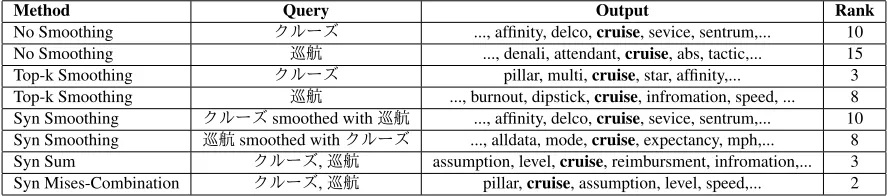
We first discuss an example where the query terms areクルーズ(cruise) and巡航(cruise). Both words can have the same meaning. The resulting trans-lation candidates suggested by the baseline meth-ods and the proposed method is shown in Table 2. Using no smoothing, the baseline method outputs the correct translation forクルーズ(cruise) and巡 航(cruise) at rank 10 and 15, respectively. When combining both queries to form one context vector our proposed method (Syn Mises-Combination) re-trieves the correct translation at rank 2. Note that we considered all nouns that occur three or more times as possible translation candidates. As can be seen in Table 2, this also includes spelling mistakes like ”sevice” and ”infromation”.
10We use the sign-test (Wilcox, 2009) to test the hypothesis
that the proposed method ranks higher than the baseline.
11No normalization is performed before adding the context
Method Query Output Rank
[image:5.612.84.529.88.186.2]No Smoothing クルーズ ..., affinity, delco,cruise, sevice, sentrum,... 10 No Smoothing 巡航 ..., denali, attendant,cruise, abs, tactic,... 15 Top-k Smoothing クルーズ pillar, multi,cruise, star, affinity,... 3 Top-k Smoothing 巡航 ..., burnout, dipstick,cruise, infromation, speed, ... 8 Syn Smoothing クルーズsmoothed with巡航 ..., affinity, delco,cruise, sevice, sentrum,... 10 Syn Smoothing 巡航smoothed withクルーズ ..., alldata, mode,cruise, expectancy, mph,... 8 Syn Sum クルーズ,巡航 assumption, level,cruise, reimbursment, infromation,... 3 Syn Mises-Combination クルーズ,巡航 pillar,cruise, assumption, level, speed,... 2
Table 2: Shows the results forクルーズand巡航which both have the same meaning ”cruise”. The third column shows part of the ranked translation candidates separated by comma. The last column shows the rank of the correct translation ”cruise”. Syn Smoothing uses Equation (1) withqcorresponding to the context vector of the query word, andKcontains only the context vector of the term that is used for smoothing.
Finally, we note that some terms in our test set are ambiguous, and the ambiguity is not resolved by using the synonyms of only one synset. For exam-ple, the term 操舵(steering, guidance) belongs to the synset ”steering, guidance” which includes the terms舵取り(steering, guidance) andガイド (guid-ance), 案内(guidance). Despite this conflation of senses in one synset, our proposed method can im-prove the finding of (one) correct translation. The baseline system using only操舵(steering, guidance) outputs the correct translation ”steering” at rank 4, whereas our method using all four terms outputs it at rank 2.
6
Conclusions
We proposed a new method for translation acquisi-tion which uses a set of synonyms to acquire transla-tions. Our approach combines the query term’s con-text vector with all the concon-text vectors of its syn-onyms. In order to combine the vectors we use a weighted average of each context vector, where the weights are determined by a term’s occurrence fre-quency.
Our experiments, using the Japanese and English WordNet (Bond et al., 2009; Fellbaum, 1998), show that our proposed method can increase the transla-tion accuracy, when compared to using only a single query term, or smoothing with nearest neighbours. Our results suggest that instead of directly search-ing for a translation, it is worth first looksearch-ing for syn-onyms, for example by considering spelling varia-tions or monolingual resources.
References
S. Basu, M. Bilenko, and R.J. Mooney. 2004. A prob-abilistic framework for semi-supervised clustering. In
Proceedings of the ACM SIGKDD International Con-ference on Knowledge Discovery and Data Mining, pages 59–68.
F. Bond, H. Isahara, S. Fujita, K. Uchimoto, T. Kurib-ayashi, and K. Kanzaki. 2009. Enhancing the japanese wordnet. InProceedings of the 7th Workshop on Asian Language Resources, pages 1–8. Association for Computational Linguistics.
H. D´ejean, ´E. Gaussier, and F. Sadat. 2002. An approach based on multilingual thesauri and model combination for bilingual lexicon extraction. InProceedings of the International Conference on Computational Linguis-tics, pages 1–7. International Committee on Computa-tional Linguistics.
S. Evert. 2004. The statistics of word cooccurrences: word pairs and collocations.Doctoral dissertation, In-stitut f¨ur maschinelle Sprachverarbeitung, Universit¨at Stuttgart.
C. Fellbaum. 1998. Wordnet: an electronic lexical database. Cambrige, MIT Press, Language, Speech, and Communication.
P. Fung. 1998. A statistical view on bilingual lexicon ex-traction: from parallel corpora to non-parallel corpora.
Lecture Notes in Computer Science, 1529:1–17. G. Grefenstette. 1994. Explorations in automatic
the-saurus discovery. Springer.
A. Haghighi, P. Liang, T. Berg-Kirkpatrick, and D. Klein. 2008. Learning bilingual lexicons from monolingual corpora. In Proceedings of the Annual Meeting of the Association for Computational Linguistics, pages 771–779. Association for Computational Linguistics. A. Ismail and S. Manandhar. 2010. Bilingual lexicon
S.R. Jammalamadaka and A. Sengupta. 2001. Topics in circular statistics, volume 5. World Scientific Pub Co Inc.
P. Koehn and K. Knight. 2000. Estimating word trans-lation probabilities from unrelated monolingual cor-pora using the em algorithm. InProceedings of the National Conference on Artificial Intelligence, pages 711–715. Association for the Advancement of Artifi-cial Intelligence.
T. Kudo, K. Yamamoto, and Y. Matsumoto. 2004. Ap-plying conditional random fields to Japanese morpho-logical analysis. InProceedings of the Conference on Empirical Methods in Natural Language Processing, pages 230–237. Association for Computational Lin-guistics.
A. Laroche and P. Langlais. 2010. Revisiting context-based projection methods for term-translation spotting in comparable corpora. In Proceedings of the In-ternational Conference on Computational Linguistics, pages 617 – 625.
N. Okazaki, Y. Tsuruoka, S. Ananiadou, and J. Tsujii. 2008. A discriminative candidate generator for string transformations. InProceedings of the Conference on Empirical Methods in Natural Language Processing, pages 447–456. Association for Computational Lin-guistics.
V. Pekar, R. Mitkov, D. Blagoev, and A. Mulloni. 2006. Finding translations for low-frequency words in com-parable corpora. Machine Translation, 20(4):247– 266.
R. Rapp. 1999. Automatic identification of word transla-tions from unrelated English and German corpora. In
Proceedings of the Annual Meeting of the Association for Computational Linguistics, pages 519–526. Asso-ciation for Computational Linguistics.
K. Sato, T. Ikeda, T. Nakata, and S. Osada. 2003. In-troduction of a Japanese language processing mid-dleware used for CRM. In Annual Meeting of the Japanese Association for Natural Language Process-ing (in Japanese), pages 109–112.
Y. Tsuruoka, Y. Tateishi, J. Kim, T. Ohta, J. McNaught, S. Ananiadou, and J. Tsujii. 2005. Developing a ro-bust part-of-speech tagger for biomedical text.Lecture Notes in Computer Science, 3746:382–392.