Two/Too Simple Adaptations of
Word2Vec
for Syntax Problems
Wang Ling Chris Dyer Alan Black Isabel Trancoso L2F Spoken Systems Lab, INESC-ID, Lisbon, Portugal
Language Technologies Institute, Carnegie Mellon University, Pittsburgh, PA, USA Instituto Superior T´ecnico, Lisbon, Portugal
{lingwang,cdyer,awb}@cs.cmu.edu
Abstract
We present two simple modifications to the models in the popularWord2Vectool, in or-der to generate embeddings more suited to tasks involving syntax. The main issue with the original models is the fact that they are insensitive to word order. While order in-dependence is useful for inducing semantic representations, this leads to suboptimal re-sults when they are used to solve syntax-based problems. We show improvements in part-of-speech tagging and dependency parsing using our proposed models.
1 Introduction
Word representations learned from neural language models have been shown to improve many NLP tasks, such as part-of-speech tagging (Collobert et al., 2011), dependency parsing (Chen and Man-ning, 2014; Kong et al., 2014) and machine trans-lation (Liu et al., 2014; Kalchbrenner and Blunsom, 2013; Devlin et al., 2014; Sutskever et al., 2014). These low-dimensional representations are learned as parameters in a language model and trained to maximize the likelihood of a large corpus of raw text. They are then incorporated as features along side hand-engineered features (Turian et al., 2010), or used to initialize the parameters of neural net-works targeting tasks for which substantially less training data is available (Hinton and Salakhutdinov, 2012; Erhan et al., 2010; Guo et al., 2014).
One of the most widely used tools for building word vectors are the models described in (Mikolov et al., 2013), implemented in the Word2Vectool,
in particular the “skip-gram” and the “continuous bag-of-words” (CBOW) models. These two mod-els make different independence and conditioning assumptions; however, both models discard word order information in how they account for context. Thus, embeddings built using these models have been shown to capture semantic information be-tween words, and pre-training using these models has been shown to lead to major improvements in many tasks (Collobert et al., 2011). While more so-phisticated approaches have been proposed (Dhillon et al., 2011; Huang et al., 2012; Faruqui and Dyer, 2014; Levy and Goldberg, 2014; Yang and Eisen-stein, 2015),Word2Vecremains a popular choice due to their efficiency and simplicity.
However, as these models are insensitive to word order, embeddings built using these models are sub-optimal for tasks involving syntax, such as part-of-speech tagging or dependency parsing. This is be-cause syntax defines “what words go where?”, while semantics than “what words go together”. Obvi-ously, in a model where word order is discarded, the many syntactic relations between words can-not be captured properly. For instance, while most words occur with the wordthe, only nouns tend to occur exactly afterwords (e.g. the cat). This is supported by empirical evidence that suggests that order-insensitivity does indeed lead to substandard syntactic representations (Andreas and Klein, 2014; Bansal et al., 2014), where systems using pre-trained withWord2Vecmodels yield slight improvements while the computationally far more expensive which use word order information embeddings of Col-lobert et al. (2011) yielded much better results.
In this work, we describe two simple modifica-tions to Word2Vec, one for the skip-gram model and one for the CBOW model, that improve the quality of the embeddings for syntax-based tasks1.
Our goal is to improve the final embeddings while maintaining the simplicity and efficiency of the orig-inal models. We demonstrate the effectiveness of our approaches by training, on commodity hard-ware, on datasets containing more than 50 million sentences and over 1 billion words in less than a day, and show that our methods lead to improve-ments when used in state-of-the-art neural network systems for part-of-speech tagging and dependency parsing, relative to the original models.
2 Word2Vec
The work in (Mikolov et al., 2013) is a popular choice for pre-training the projection matrix W ∈ <d×|V| where d is the embedding dimension with
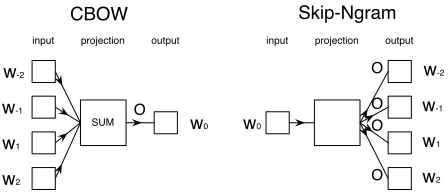
the vocabularyV. As an unsupervised task that is trained on raw text, it builds word embeddings by maximizing the likelihood that words are predicted from their context or vice versa. Two models were defined, the skip-gram model and the continuous bag-of-words model, illustrated in Figure 1.
The skip-gram model’s objective function is to maximize the likelihood of the prediction of contex-tual words given the center word. More formally, given a document ofT words, we wish to maximize
L= 1
T
T X
t=1
X
−c≤j≤c,
j6=0
logp(wt+j |wt) (1)
Where c is a hyperparameter defining the window of context words. To obtain the output probabil-ity p(wo|wi), the model estimates a matrix O ∈
<|V|×dw, which maps the embeddings rw
i into a |V|-dimensional vector owi. Then, the probability
of predicting the wordwo given the word wi is
de-fined as:
p(wo|wi) = e
owi(wo)
P
w∈V eowi(w)
(2)
This is referred as the softmax objective. However, for larger vocabularies it is inefficient to compute
1The code developed in this work is made available in
https://github.com/wlin12/wang2vec.
owi, since this requires the computation of a|V|×dw
matrix multiplication. Solutions for problem are ad-dressed in theWord2Vecby using the hierarchical softmax objective function or resorting to negative sampling (Goldberg and Levy, 2014).
The CBOW model predicts the center word wo
given a representation of the surrounding words
w−c, ..., w−1, w1, wc. Thus, the output vector
ow−c,...,w−1,w1,wc is obtained from the product of the
matrix O ∈ <|V|×dw with the sum of the
embed-dings of the context wordsP−c≤j≤c,j6=0rwj.
We can observe that in both methods, theorder of the context words does not influence the prediction output. As such, while these methods may find sim-ilar representations for semantically simsim-ilar words, they are less likely to representations based on the syntactic properties of the words.
O O O
w-2
input
w-1
w1
w2
SUM projection output
w0
O
input projection output
O
w0
w-2
w-1
w1
w2
[image:2.612.315.539.303.401.2]CBOW Skip-Ngram
Figure 1: Illustration of the Skip-gram and Continuous Bag-of-Word (CBOW) models.
3 Structured Word2Vec
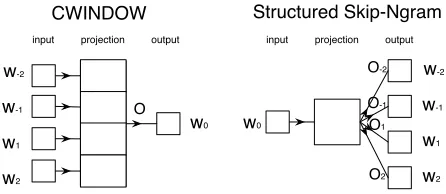
To account for the lack of order-dependence in the above models, we propose two simple modifications to these methods that include ordering information, which we expect will lead to more syntactically-oriented embeddings. These models are illustrated in Figure 2.
3.1 Structured Skip-gram Model
The skip-gram model uses a single output matrix
O ∈ <|V|×d to predict every contextual word
w−c, ..., w−1, w1, ..., wc, given the embeddings of
the center word w0. Our approach adapts the model so that it is sensitive to the positioning of the words. It defines a set of c×2 output predictors
O−c, ..., O−1, O1, Oc, with sizeO ∈ <(|V|)×d. Each
output for a specific relative position to the center word. When making a prediction p(wo | wi), we
select the appropriate output matrixOo−ito project
the word embeddings to the output vector. Note, that the number of operations that must be performed for the forward and backward passes in the network re-mains the same, as we are simply switching the out-put layerOfor each different word index.
3.2 Continuous Window Model
The Continuous Bag-Of-Words words model defines a window of words w−c, ..., wc with
size c, where the prediction of the center word
w0 is conditioned on the remaining words
w−c, ..., w−1, w1, ..., wc. The prediction matrix
O ∈ <(|V|)×d is fed with the sum of the
embed-dings of the context words. As such, the order of the contextual words does not influence the prediction of the center word. Our approach defines a different output predictor O ∈ <(|V|×2cd
which receives as input a (2c × d)-dimensional vector that is the concatenation of the embeddings of the context words in the order they occur [e(w−c), . . . , e(w−1), e(w1), . . . , e(wc)]. As matrix
O defines a parameter for the word embeddings for each relative position, this allows the words to be treated differently depending on where they occur. This model, denoted as CWindow, is essentially the window-based model described in (Collobert et al., 2011), with the exception that we do not project the vector of word embeddings into a window embedding before making the final prediction.
In both models, we are increasing the number of parameters of matrix O by a factor of c × 2, which can lead to sparcity problems when training on small datasets. However, these models are gener-ally trained on datasets in the order of 100 millions of words, where these issues are not as severe.
4 Experiments
We conducted experiments in two mainstream syntax-based tasks part-of-speech Tagging and De-pendency parsing. Part-of-speech tagging is a word labeling task, where each word is to be labelled with its corresponding part-of-speech. In dependency parsing, the goal is to predict a tree built of syntactic relations between words. In both tasks, it has been
O2
O1
O-1
w-2
input
w-1
w1
w2
projection output
w0
O
input projection output O-2
w0
w-2
w-1
w1
w2
[image:3.612.315.538.61.158.2]CWINDOW Structured Skip-Ngram
Figure 2: Illustration of the Structured Skip-gram and Continuous Window (CWindow) models.
shown that pre-trained embeddings can be used to achieve better generalization (Collobert et al., 2011; Chen and Manning, 2014).
4.1 Building Word Vectors
We built vectors for English in two very different domains. Firstly, we used an English Wikipedia dump containing 1,897 million words (60 million sentences), collected in September of 2014. We built word embeddings using the original and our proposed methods on this dataset. These embed-dings will be denoted asWIKI(L). Then, we took a sample of 56 million English tweets with 847 mil-lion words collected in (Owoputi et al., 2013), and applied the same procedure to build the TWITTER embeddings. Finally, we also use the Wikipedia documents, with 16 million words, provided in the
Word2Vec package for contrastive purposes, de-noted as WIKI(S). As preprocessing, the text was lowercased and groups of contiguous digits were re-placed by a special word. For all corpora, we trained the network with ac= 5, with a negative sampling value of 10 and filter out words with less than 40 instances. WIKI(L) and TWITTER have a vocabu-lary of 424,882 and 216,871 types, respectively, and embeddings of 50 dimensions.
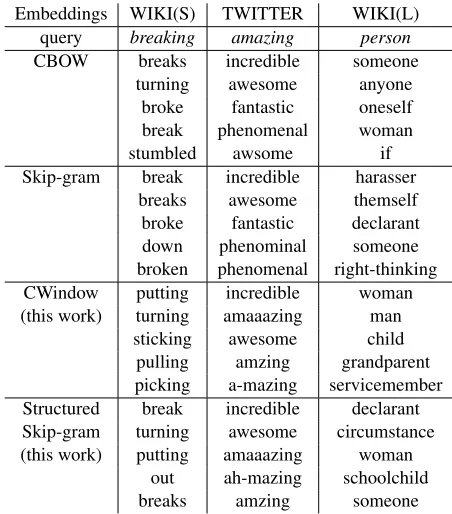
Embeddings WIKI(S) TWITTER WIKI(L) query breaking amazing person CBOW breaks incredible someone
turning awesome anyone broke fantastic oneself break phenomenal woman
stumbled awsome if
Skip-gram break incredible harasser breaks awesome themself broke fantastic declarant down phenominal someone broken phenomenal right-thinking CWindow putting incredible woman (this work) turning amaaazing man
sticking awesome child pulling amzing grandparent picking a-mazing servicemember Structured break incredible declarant Skip-gram turning awesome circumstance (this work) putting amaaazing woman
[image:4.612.72.298.60.317.2]out ah-mazing schoolchild breaks amzing someone
Table 1: Most similar words using different word embed-ding models for the wordsbreaking,amazingandperson. Each word is queried in a different dataset.
preserving such properties. As for the TWITTER embeddings, we can observe that our adapted em-beddings are much better at finding lexical variations of the words, such asa-mazing, resembling the re-sults obtained using brown clusters (Owoputi et al., 2013). Finally, for the query person, we can see that our models tend to associate this term to other words in the same class, such asman, woman and child, while original models tend to include unre-lated words, such asif andright-thinking.
In terms of computation speed, the Skip-gram and CBOW models, achieve a processing rate of 71.35k and 342.17k words per second, respectively. The Structured Skip-gram and CWindow models can process 34.64k and 124.43k words per second, respectively. There is a large drop in computa-tional speed in the CWindow model compared to the CBOW model, as it uses a larger output ma-trix, which grows with the size of the window. The Structured Skip-gram model processes words at al-most half the speed of the Skip-gram model. This is explained by the fact that the Skip-gram model sub-samples context words, varying the size of the win-dow size stochastically, so that words closer to the
center word are sampled more frequently. That is, when defining a window size of 5, the actual win-dow size used for each sample is a random value between 1 and 5. As we use a separate output layer for each position, we did not find this property to be useful as it provides less training samples for out-put matrixes with higher indexes. While our models are slower they are still suitable for processing large datasets as all the embeddings we use were all built within a day.
4.2 Part-Of-Speech Tagging
We reimplemented the window-based model pro-posed in (Collobert et al., 2011), which defines a 3-layer perceptron. In this network, words are first projected into embeddings, which are concatenated and projected into a window embedding. These are finally projected into an output layer with size of the POS tag vocabulary, followed by a softmax. In our experiments, we used a window size of 5, word em-beddings of size 50 and window emem-beddings of size 500. Word embeddings were initialized using the pre-trained vectors and these parameters are updated as the rest of the network. Additionally, we also add a capitalization feature which indicates whether the first letter of the work is uppercased, as all word fea-tures are lowercased words. Finally, for words un-seen in the training set and in the pre-trained em-beddings, we replace them with a special unknown token, which is also modelled as a word type with a set of 50 parameters. At training time, we stochasti-cally replace word types that only occur once in the training dataset with the unknown token. Evaluation is performed with the part-of-speech tag accuracy, which denotes the percentage of words labelled cor-rectly.
Experiments are performed on two datasets, the English Penn Treebank (PTB) dataset using the standard train, dev and test splits, and the ARK dataset (Gimpel et al., 2011), with 1000 training, 327 dev and 500 labelled English tweets from Twit-ter. For the PTB dataset, we use the WIKI(L) em-beddings and use TWITTER emem-beddings for the ARK dataset. Finally, the set of parameters with the highest accuracy in the dev set are used to report the score for the test set.
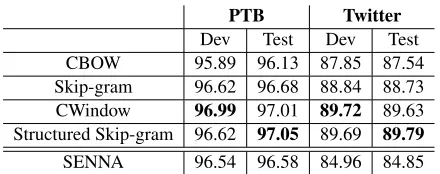
re-PTB Twitter Dev Test Dev Test CBOW 95.89 96.13 87.85 87.54 Skip-gram 96.62 96.68 88.84 88.73 CWindow 96.99 97.01 89.72 89.63 Structured Skip-gram 96.62 97.05 89.69 89.79 SENNA 96.54 96.58 84.96 84.85
Table 2: Results for part-of-speech tagging using differ-ent word embeddings (rows) on differdiffer-ent datasets (PTB and Twitter). Cells indicate the part-of-speech accuracy of each experiment.
sults than the original models in both datasets. In the Twitter dataset, our results slightly higher than the accuracy reported using only Brown clusters in (Owoputi et al., 2013), which was 89.50. We also try initializing our embeddings with those in (Col-lobert et al., 2011), which are in the “Senna” row. Even though results are higher in our models, we cannot conclude that our method is better as they are trained crawls from Wikipedia in different time periods. However, it is a good reference to show that our embeddings are on par with those learned using more sophisticated models.
4.3 Dependency Parsing
The evaluation on dependency parsing is performed on the English PTB, with the standard train, dev and test splits with Stanford Dependencies. We use neu-ral network defined in (Chen and Manning, 2014), with the default hyper-parameters2 and trained for
5000 iterations. The word projections are initial-ized using WIKI(L) embeddings. Evaluation is performed with the labelled (LAS) and unlabeled (UAS) attachment scores.
In Table 3, we can observe that results are consis-tent with those in part-of-speech tagging, where our models obtain higher scores than the original models and with competitive results compared to Senna em-beddings. This suggests that our models are suited at learning syntactic relations between words.
5 Conclusions
In this work, we present two modifications to the original models in Word2Vec that improve the word embeddings obtained for syntactically motivated
2Found in http://nlp.stanford.edu/software/nndep.shtml
Dev Test
UAS LAS UAS LAS
CBOW 91.74 88.74 91.52 88.93 Skip-gram 92.12 89.30 91.90 89.55 CWindow 92.38 89.62 92.00 89.70 Structured Skip-gram 92.49 89.78 92.24 89.92 SENNA 92.24 89.30 92.03 89.51
Table 3: Results for dependency parsing on PTB using different word embeddings (rows). Columns UAS and LAS indicate the labelled attachment score and the unla-belled parsing scores, respectively.
tasks. This is done by introducing changes that make the network aware of the relative positioning of con-text words. With these models we obtain improve-ments in two mainstream NLP tasks, namely part-of-speech tagging and dependency parsing, and re-sults generalize in both clean and noisy domains.
Acknowledgements
This work was partially supported by FCT (INESC-ID multiannual funding) through the P(INESC-IDDAC Pro-gram funds, and also through projects CMU-PT/HuMach/0039/2008 and CMU-PT/0005/2007. The PhD thesis of Wang Ling is supported by FCT grant SFRH/BD/51157/2010. The authors also wish to thank the anonymous reviewers for many helpful comments.
References
Jacob Andreas and Dan Klein. 2014. How much do word embeddings encode about syntax. InProceedings of ACL.
Mohit Bansal, Kevin Gimpel, and Karen Livescu. 2014. Tailoring continuous word representations for depen-dency parsing. InProceedings of the Annual Meeting of the Association for Computational Linguistics. Danqi Chen and Christopher D Manning. 2014. A
fast and accurate dependency parser using neural net-works. In Proceedings of the 2014 Conference on Empirical Methods in Natural Language Processing
(EMNLP), pages 740–750.
Ronan Collobert, Jason Weston, L´eon Bottou, Michael Karlen, Koray Kavukcuoglu, and Pavel Kuksa. 2011. Natural language processing (almost) from scratch.
The Journal of Machine Learning Research, 12:2493–
2537.
[image:5.612.320.536.59.144.2]Fast and robust neural network joint models for statis-tical machine translation. In52nd Annual Meeting of the Association for Computational Linguistics,
Balti-more, MD, USA, June.
Paramveer Dhillon, Dean P Foster, and Lyle H Ungar. 2011. Multi-view learning of word embeddings via cca. In Advances in Neural Information Processing
Systems, pages 199–207.
Dumitru Erhan, Yoshua Bengio, Aaron Courville, Pierre-Antoine Manzagol, Pascal Vincent, and Samy Bengio. 2010. Why does unsupervised pre-training help deep learning? The Journal of Machine Learning Research, 11:625–660.
Manaal Faruqui and Chris Dyer. 2014. Improving vector space word representations using multilingual correla-tion. InProceedings of EACL.
Kevin Gimpel, Nathan Schneider, Brendan O’Connor, Dipanjan Das, Daniel Mills, Jacob Eisenstein, Michael Heilman, Dani Yogatama, Jeffrey Flanigan, and Noah A Smith. 2011. Part-of-speech tagging for twit-ter: Annotation, features, and experiments. In Pro-ceedings of the 49th Annual Meeting of the Associa-tion for ComputaAssocia-tional Linguistics: Human Language
Technologies: short papers-Volume 2, pages 42–47.
Association for Computational Linguistics.
Yoav Goldberg and Omer Levy. 2014. word2vec explained: deriving mikolov et al.’s negative-sampling word-embedding method. arXiv preprint arXiv:1402.3722.
Jiang Guo, Wanxiang Che, Haifeng Wang, and Ting Liu. 2014. Revisiting embedding features for simple semi-supervised learning. InProceedings of EMNLP. Geoffrey E Hinton and Ruslan Salakhutdinov. 2012. A
better way to pretrain deep boltzmann machines. In
Advances in Neural Information Processing Systems,
pages 2447–2455.
Eric H Huang, Richard Socher, Christopher D Manning, and Andrew Y Ng. 2012. Improving word representa-tions via global context and multiple word prototypes. InProceedings of the 50th Annual Meeting of the Asso-ciation for Computational Linguistics: Long
Papers-Volume 1, pages 873–882. Association for
Computa-tional Linguistics.
Nal Kalchbrenner and Phil Blunsom. 2013. Recur-rent continuous translation models. InEMNLP, pages 1700–1709.
Lingpeng Kong, Nathan Schneider, Swabha Swayamdipta, Archna Bhatia, Chris Dyer, and Noah A. Smith. 2014. A dependency parser for tweets. InProc. of EMNLP, pages 1001–1012, Doha, Qatar, October.
Omer Levy and Yoav Goldberg. 2014. Dependency-based word embeddings. InProceedings of the 52nd
Annual Meeting of the Association for Computational Linguistics, volume 2.
Shujie Liu, Nan Yang, Mu Li, and Ming Zhou. 2014. A recursive recurrent neural network for statistical ma-chine translation. InProceedings of ACL, pages 1491– 1500.
Tomas Mikolov, Ilya Sutskever, Kai Chen, Greg S Cor-rado, and Jeff Dean. 2013. Distributed representations of words and phrases and their compositionality. In
Advances in Neural Information Processing Systems,
pages 3111–3119.
Olutobi Owoputi, Brendan O’Connor, Chris Dyer, Kevin Gimpel, Nathan Schneider, and Noah A Smith. 2013. Improved part-of-speech tagging for online conversa-tional text with word clusters. InHLT-NAACL, pages 380–390.
Ilya Sutskever, Oriol Vinyals, and Quoc VV Le. 2014. Sequence to sequence learning with neural networks.
In Advances in Neural Information Processing
Sys-tems, pages 3104–3112.
Joseph Turian, Lev Ratinov, and Yoshua Bengio. 2010. Word representations: A simple and general method for semi-supervised learning. In Proceedings of the 48th Annual Meeting of the Association for Computa-tional Linguistics, ACL ’10, pages 384–394, Strouds-burg, PA, USA. Association for Computational Lin-guistics.
Yi Yang and Jacob Eisenstein. 2015. Unsupervised multi-domain adaptation with feature embeddings. In
Proceedings of the 2015 Conference of the North American Chapter of the Association for
Computa-tional Linguistics: Human Language Technologies.