LR Parsing for LCFRS
Laura Kallmeyer and Wolfgang Maier
Institute for Language and Information University of D¨usseldorf
D¨usseldorf, Germany
{kallmeyer,maierwo}@phil.hhu.de
Abstract
LR parsing is a popular parsing strategy for variants of Context-Free Grammar (CFG). It has also been used for mildly context-sensitive formalisms, such as Tree-Adjoining Gram-mar. In this paper, we present the first LR-style parsing algorithm for Linear Context-Free Rewriting Systems (LCFRS), a mildly context-sensitive extension of CFG which has received considerable attention in the last years.
1 Introduction
LR parsing is an incremental shift-reduce parsing strategy in which the transitions between parser states are guided by an automaton which is com-piled offline. LR parsers were first introduced for deterministic context-free languages (Knuth, 1965) and later generalized to context-free lan-guages (Tomita, 1984) and tree-adjoining lanlan-guages (Nederhof, 1998; Prolo, 2003).
Linear Context-Free Rewriting System (LCFRS) (Vijay-Shanker et al., 1987) is an immediate ex-tension of CFG in which each non-terminal can cover more than one continuous span of the in-put string. LCFRS and equivalent formalisms have been used for the modeling of discontinu-ous constituents (Maier and Lichte, 2011) and non-projective dependencies (Kuhlmann, 2013), as well as for data-driven parsing of such structures (Maier and Kallmeyer, 2010; Kallmeyer and Maier, 2013; van Cranenburgh, 2012; Angelov and Ljungl¨of, 2014). They have also been used for modeling
non-concatenative morphology (Botha and Blun-som, 2013), for grammar engineering (Ranta, 2011), and for modeling alignments in machine translation (Søgaard, 2008; Kaeshammer, 2013). To our knowl-edge, so far, no LR strategy for LCFRS has been presented in the literature. In this paper, we present an LR-style parser for LCFRS. It is based on the in-cremental parsing strategy implemented by Thread Automata (Villemonte de la Clergerie, 2002).
The remainder of the article is structured as fol-lows. In the following section, we introduce LCFRS and thread automata. Section 3 presents the algo-rithm along an example. In particular, section 3.2 gives the algorithms for automaton and parse table constructions, and section 3.3 presents the parsing algorithm. Section 4 concludes the article.
2 Preliminaries
2.1 LCFRS
In this paper, we restrict ourselves to string rewriting LCFRS and omit the more general definition (Weir, 1988).
In LCFRS, a single non-terminal can spank ≥1 continuous blocks of a string. A CFG is simply a special case of an LCFRS in which k = 1. k is called the fan-out of the non-terminal. We notate LCFRS with the syntax of Simple Range Concate-nation Grammars (SRCG) (Boullier, 1998), a for-malism equivalent to LCFRS.
An LCFRS1 (Vijay-Shanker et al., 1987; Seki et
al., 1991) is a tuple G = (N, T, V, P, S) whereN 1Note that for purposes of exposition, we limit ourselves to
ε-free LCFRS.
is a finite set of non-terminals with a functiondim: N → Ndetermining thefan-outof eachA∈N;T and V are disjoint finite sets of terminals and vari-ables;S∈N is the start symbol withdim(S) = 1.
P is a finite set of rewriting rules withrankm≥
0. Allγ ∈P have the form
A(α0, . . . , αdim(A)−1)→A1(X0(1), . . . , Xdim(1)(A1)−1)
· · ·Am(X0(m), . . . , Xdim(m)(Am)−1)
where A, A1, . . . , Am ∈ N, Xj(l) ∈ V for 1 ≤ l ≤m,0 ≤ j < dim(Ai)and αi ∈ (V ∪T)+for 0 ≤ i <dim(A). Allαi andXj(l) are called argu-ments (or sometimescomponents); the elements in αi are called argument elements. Aγ is the set of all argument elements ofγ. Variable occurrences in the arguments of the non-terminals ofγare ordered by a strict total order ≺. For all X1, X2 ∈ V
oc-curring in arguments of a non-terminal ofγ, it holds thatX1 ≺X2iff eitherX1precedesX2in an
argu-ment of the non-terminal or the arguargu-mentX1occurs
in precedes the argumentX2occurs in.
For all γ ∈ P, every variable X occurring in γ occurs exactly once in the left-hand side (LHS) and exactly once in the right-hand side (RHS). Further-more, if for two variablesX1, X2 ∈V, it holds that
X1 ≺ X2 on the RHS, then also X1 ≺ X2 on the
LHS. Therank ofGis the maximal rank of any of its rules, itsfan-outis the maximal fan-out of any of its non-terminals.
We use the following additional notation: For a rule γ ∈ P, lhs(γ) gives the LHS non-terminal; lhs(γ, i) gives the ith argument of the LHS and lhs(γ, i, j) its jth symbol; rhs(γ, k) gives the kth RHS non-terminal; and rhs(γ, k, l) gives the lth component of thekth RHS element (starting with in-dex0in all four cases). These function have value⊥
whenever there is no such element. Furthermore, in the sense of dotted productions, we define for each γ ∈P a set of symbols denoting computation points ofγ,Cγ ={γi.j |0≤i <dimA,0≤j≤ |αi|}, as well as the setC=Sγ∈PCγ.
A non-terminal A ∈ N can be instantiated w.r.t. an input string w1· · ·w|w| and a rule γ ∈ P
with lhs(γ) = A. An instantiation maps all argu-ment eleargu-ments ofγto spans ofw((i−1, j)wdenotes the span wi· · ·wj,1 ≤ i ≤ j ≤ n). All instantia-tions are given by a functionσ :Aγ →N×Nwhere
α:S(xy)→A(x, y) γ:A(a, b)→ε β :A(ax, ya)→A(x, y)
Figure 1: LCFRS for{anaban|n≥0}
for all x, y ∈ Aγ withx 6= y,σ(x) = (i, j)w and σ(y) = (k, l)w it holds thati, k ≥ 0;j, l ≤ |w|; if x (y) is a terminal, then j = i+ 1 (l = k + 1), otherwise j > i (k > l). Iff x ≺ y in γ, then j ≤ k. A derivation rewrites strings of instantiated non-terminals, i.e., given an instantiated clause, the instantiated LHS non-terminal may be replaced with the sequence of instantiated RHS terminals. The lan-guage of the grammar is the set of strings which can be reduced to the empty word, starting with S in-stantiated to the input string.
See figure 1 for a sample LCFRS.
2.2 Thread Automata
Thread automata (TA) (Villemonte de la Clergerie, 2002) are a generic automaton model which can be parametrized to recognize different mildly context-sensitive languages. The TA for LCFRS (LCFRS-TA) implements a prefix-valid top-down incremen-tal parsing strategy similar to the ones of Kallmeyer and Maier (2009) and Burden and Ljungl¨of (2005).
An LCFRS-TA for some LCFRS G = (N, T, V, P, S) works as follows. The process-ing of a sprocess-ingle rule is handled by a sprocess-ingle thread which will traverse the LHS arguments of the rule. A thread is given by a pair p : X, where p ∈ {1, . . . , m}∗ with m the rank of G is the
address, andX ∈ N ∪ {ret} ∪ C whereret ∈/ N is the content of the thread. An automaton state is given by a tuple hi, p,T i where T is a set of threads, the thread store, p is the address of the active thread, andi≥0indicates thatitokens have been recognized. We introduce a new start symbol S0 ∈/N that expands toSand useh0, ε,{ε:S0}ias
start state.
The specific TA for a given LCFRS G = (N, T, V, P, S) can be defined as tuple
hN0, T, S0,ret, δ,ΘiwithN0 =N ∪ C ∪ {S0, ret};
δ is a function from C to {1, . . . , m} ∪ {⊥}
Call: S0→[S0]S α0,0→[α0,0]A β0,1→[β0,1]A
Predict: S→α0,0 A→β0,0 A→γ0,0
Scan: β0,0→a β0,1 β1,1→a β1,2 γ0,0→a γ0,1 γ1,0→b γ1,1 Publish: α0,2→ret β1,2→ret γ1,1→ret
Suspend: [α0,1]ret →α0,2 [β1,0]ret →β1,1
[image:3.612.77.526.61.148.2][α0,0]β0,2→α0,1[β0,2] [α0,0]γ0,1→α0,1[γ0,1] [β0,1]β0,2→β0,2[β0,2] [β0,1]γ0,1→β0,2[γ0,1] Resume: α0,1[β0,2]→[α0,1]β1,0 α0,1[γ0,1]→[α0,1]γ1,0 β1,0[β0,2]→[β1,0]β1,0 β1,0[γ0,1]→[β1,0]γ1,0
Figure 2: TA transitions for the LCFRS from figure 1
is an argument of the jth RHS non-terminal); and Θis a finite set of transitions. Every transition has the formα→a βwitha∈T ∪ {ε}and they roughly indicate that in the thread store, αcan be replaced withβ while scanninga. Square brackets inα and β indicate parts that do not belong to the active thread. This will be made more precise below. Θ contains the following transitions (see figure 2):
• Call transitions start a new thread, either for the start symbol or for a daughter non-terminal. They move down in the parse tree.
S0 → [S0]S (initial call),γk,i → [γk,i]AifA =
rhs(γ, j−1)andlhs(γ, k, i) =rhs(γ, j−1,0) wherej=δ(γk,i).
• Predicttransitions predict a new rule for a non-terminalA:A→γ0,0ifA=lhs(γ).
• Scan reads a LHS terminal while scanning the next input symbol:
γk,ilhs(→γ,k,i)γk,i+1iflhs(γ, k, i)∈T.
• Publish marks the completion of a production, i.e., its full recognition:
γk,j → ret if dim(lhs(γ)) = k + 1and j =
|lhs(γ, k)|.
• Suspend suspends a daughter thread and re-sumes the parent. i.e., moves up in the parse tree. There are two cases:
(i) The daughter is completely recognized: [γk,i]ret → γk,i+1 if lhs(γ, k, i) =
rhs(γ, δ(γk,i)−1,dim(rhs(δ(γk,i)−1))−1). (ii) The daughter is not yet completely recog-nized, we have only finished one of its components: [γk,i]βl,j → γk,i+1[βl,j] if dim(lhs(β)) > l + 1, |lhs(β, l)| = j, lhs(γ, k, i) = rhs(γ, δ(γk,i) − 1, l) and rhs(γ, δ(γk,i)−1) =lhs(β).
• Resume resumes an already present daughter thread, i.e., moves down into some daughter that
has already been partly recognized.
γk,i[βl,j] → [γk,i]βl+1,0 if lhs(γ, k, i) =
rhs(γ, δ(γk,i)−1, l+ 1),rhs(γ, δ(γk,i)−1) = lhs(β)andβl,j+1∈ C/ .
This is not exactly the TA for LCFRS proposed in Villemonte de la Clergerie (2002) but rather the one from Kallmeyer (2010), which is close to the Earley parser from Burden and Ljungl¨of (2005).
The set of configurations for a given inputw∈T∗
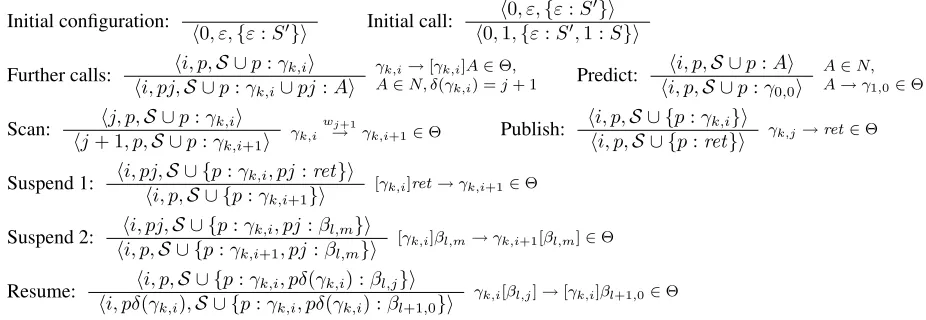
is then defined by the deduction rules in figure 3 (the use of set unionS1∪ S2in these rules assumes that
S1∩ S2 =∅). The accepting state of the automaton
for some inputwish|w|,1,{ε:S0,1 :ret}i.
2.3 LR Parsing
In an LR parser, the parser actions are guided by an automaton, resp. a parse table which is com-piled offline. Consider the context-free case. An LR parser for CFG is a guided shift-reduce parser, in which we first build the LR automaton. Its states are sets of dotted productions closed under prediction, and its transitions correspond to having recognized a part of the input, e.g., to moving the dot over a RHS element after having scanned a terminal or rec-ognized a non-terminal. Given an automaton withn states, we build theparse table withnrows. Each rowi,0 ≤i < n, describes the possible parser ac-tions associated with the stateqi, i.e., for each state and each possible shift or reduce operation, it tells us in which state to go after the operation.
3 LR for LCFRS
3.1 Intuition
Initial configuration: h0, ε,{ε:S0}i Initial call: h0, ε,{ε:S 0}i h0,1,{ε:S0,1 :S}i
Further calls: hi, pj,hi, p,S ∪S ∪p:γp:γk,ii
k,i∪pj:Ai
γk,i→[γk,i]A∈Θ,
A∈N, δ(γk,i) =j+ 1 Predict:
hi, p,S ∪p:Ai hi, p,S ∪p:γ0,0i
A∈N, A→γ1,0∈Θ
Scan: hj+ 1, p,hj, p,S ∪S ∪pp::γγk,ii
k,i+1i γk,i
w→j+1γ
k,i+1∈Θ Publish: hhi, p,i, p,S ∪ {S ∪ {pp::γretk,i}i}i γk,j→ret∈Θ
Suspend 1: hi, pj,hi, p,S ∪ {S ∪ {p:pγk,i:γ, pj:ret}i
k,i+1}i [γk,i]ret→γk,i+1∈Θ
Suspend 2: hi, pj,S ∪ {p:γk,i, pj :βl,m}i
hi, p,S ∪ {p:γk,i+1, pj:βl,m}i [γk,i]βl,m→γk,i+1[βl,m]∈Θ
Resume: hi, pδ(γhi, p,S ∪ {p:γk,i, pδ(γk,i) :βl,j}i
[image:4.612.68.531.62.222.2]k,i),S ∪ {p:γk,i, pδ(γk,i) :βl+1,0}i γk,i[βl,j]→[γk,i]βl+1,0∈Θ
Figure 3: Deduction rules for TA configurations
stack, a set of completed components and the re-maining input. The completed components are of the form p : γi where p is an address and γi the component of a rule. The stack has the form Γ1x1Γ2. . . xn−1ΓnwhereΓiis an address followed by a state and xi ∈ T ∪ {Ak|A ∈ N,1 ≤ k ≤ dim(A)}.
Shift: Whenever we havep:qon top of the stack and an edge fromqtoq0 labeled with the next input
symbol and an addressp0, we add the input symbol
followed bypp0 :q0to the stack.
Suspend: Whenever the top of the stack isp1 :q
such that there is aγi−1,k ∈qwithk =|lhs(γ, i− 1)|and i < dim(γ), we can suspend. If i = 1, we addp1 :γi to the set of completed components and we remove|lhs(γ, i)|terminals/component non-terminals and their preceding states from the stack. Ifi≥1, we check whether there is ap2 :γi−1in the
set of completed components such that the intersec-tionL(p1)∩L(p2)is not empty.2 We then remove
p2 :γi−1from the set of complete components and
we addp : γi to it wherep is a regular expression denotingL(p1)∩L(p2). Suppose the topmost state
on the stack is nowp0 : q0. We then have to follow
the edge leading fromq0to someq00labeledAi :p00
where A = lhs(γ). This means that we push Ai followed byp0p00:q00on the stack.
2Note that the corresponding finite state automata can be
de-terministic; in this case the intersection is quadratic in the size of the two automata.
In LCFRS without left recursion in any of the components, the intersection is trivial since the regular expressions denote only a single path each.
Reduce: Whenever there is aγi−1,kin our current state with k = |lhs(γ, i−1)|andi = dim(γ), we can reduce, which is like suspend except that noth-ing is added to the set of completed components.
3.2 Automaton and parse table construction The states of the LR-automaton are sets of pairsp : X wherepis a regular expression over{1, . . . , m}, mthe rank ofG, andX ∈ C ∪ {S0}. They represent
predict and resume closures.The predict/resume clo-sure q of some set q is described by the deduction rules in figure 4. This closure is not always finite.
ε:S0
1 :α0,0 lhs(α) =S
p:γi,j pk:γ0
l,0
lhs(γ, i, j) =rhs(γ, k−1, l),
rhs(γ, k) =lhs(γ0)
Figure 4: Predict/resume closure
However, if it is not, we obtain a set of items that can be represented by a finite set of pairs r : γi,j plus eventually ε : S0 such that r is a regular
ex-pression denoting a set of possible addresses. As an example for such a case, seeq3in figure 5.
The reason why we can represent these closures by finite sets using regular expressions for paths is the following: There is a finite number of pos-sible elements γi,j. For each of these, the set of possible addresses it might be combined with in a state that is the closure of {ε : X1, ε :
X2, . . . , ε:Xn}is generated by the CFGhC∪{S0}∪
in-stances pkp:X:Y of deduction rules andγi,j → ε. This is a regular grammar, its string language can thus be characterized by a regular expression.
The construction of the set of states starts with q0 = {ε:S0}. For every state q, every
non-terminalA and every1 ≤ i ≤ dim(A), we define read(q, Ai, p) ={ε:γj,k+1|p:γj,k ∈ qand there is somelsuch thatrhs(γ, l) =Aandlhs(γ, j, k) = rhs(γ, l, i−1)}andread(q, Ai, p) =read(q, Ai, p). Similarly, for every suchqand everya∈T, we de-fine read(q, a, p) = {ε : γj,k+1|p : γj,k ∈ q and lhs(γ, j, k) = a}andread(q, a, p) = read(q, a, p). The set of states of our automaton is then the closure of{q0}under the application of theread-functions.
The edges in our automaton correspond to read-transitions, where each edge is labeled with the cor-responding pair Ai, p or a, prespectively. The au-tomaton we obtain for the grammar in figure 1 is shown in figure 5. The number of possible states
ε:S0,1 :α0,0 11 :β0,0,11 :γ0,0
q0
ε:β0,1,ε:γ0,1 1 :β0,0,1 :γ0,0 q1
ε:β0,2
q2
ε:α0,1
1+:β1,0,1+:γ1,0
q3
ε:β1,1
q4
ε:β1,2
q5
ε:γ1,1
q6 ε:α0,2
q7
ε:S0• q8
a,11
a,1
A1, ε
A1,1
A2,1+
b,1+ A2, ε a, ε
S1, ε
Figure 5: The automaton
is necessarily finite since each state is the closure of some set containing only items with address ε. There are only finitely many such sets.
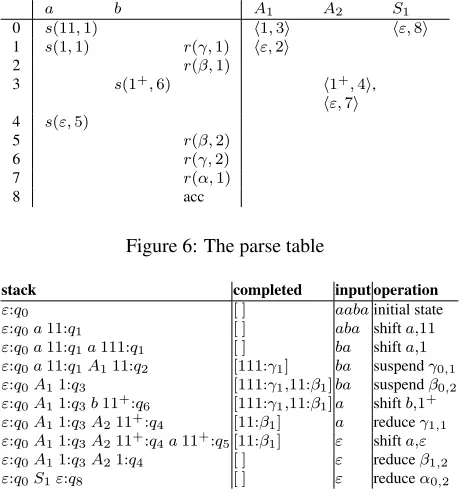
In the parse table, our operations are s(p, q) for shifting some terminal a followed by the old ad-dress concatenated with p and state q and r(α, i) for reducing the ith component of rule α. The two reduce operations can be distinguished by the component indices. Furthermore, the goto-part of the table tells where to go when traversing a com-ponent edge and which address to add then. The parse table can be read off the automaton as fol-lows: action(q, a) =s(p, q0)iffread(q, a, p) =q0;
action(q,−) =r(γ, i)iff there is somep:γi,k ∈q such that k = |lhs(γ, i)|. Concerning the goto part of the table, we havegoto(q, Ai) = hp, q0iiff read(q, Ai, p) =q0. Figure 6 shows the parse table
a b A1 A2 S1
0 s(11,1) h1,3i hε,8i
1 s(1,1) r(γ,1) hε,2i
2 r(β,1)
3 s(1+,6) h1+,4i,
hε,7i 4 s(ε,5)
5 r(β,2)
6 r(γ,2)
7 r(α,1)
[image:5.612.310.540.61.309.2]8 acc
Figure 6: The parse table
stack completed input operation
ε:q0 [ ] aabainitial state
ε:q0a11:q1 [ ] aba shifta,11
ε:q0a11:q1a111:q1 [ ] ba shifta,1
ε:q0a11:q1A111:q2 [111:γ1] ba suspendγ0,1
ε:q0A11:q3 [111:γ1,11:β1]ba suspendβ0,2
ε:q0A11:q3b11+:q6 [111:γ1,11:β1]a shiftb,1+
ε:q0A11:q3A211+:q4 [11:β1] a reduceγ1,1
ε:q0A11:q3A211+:q4a11+:q5[11:β1] ε shifta,ε
ε:q0A11:q3A21:q4 [ ] ε reduceβ1,2
ε:q0S1ε:q8 [ ] ε reduceα0,2
Figure 7: Sample run withw=aaba
for our example. 3.3 Parsing
We run the automaton with hε : q0,[ ], wi and
in-putw = aaba. The trace is shown in figure 7. We start in q0, and shift two as, which leads toq1. We
have then fully recognized the first components ofγ andβ: We suspend them and keep them in the set of completed components, which takes us toq3.
Shift-ing thebtakes us toq6, from where we can reduce,
which finally takes us toq4. From there, we can shift
the remaining a(to q5), with which we have fully
recognizedβ. We can now reduce bothβ and with that,α, which takes us to the accepting stateq8. 4 Conclusion
We presented the first LR style algorithm for LCFRS parsing. It offers a convenient factorization of pre-dict/resume operations. We are currently exploring the possibility to use it in data-driven parsing.
Acknowledgments
[image:5.612.72.283.329.465.2]References
Krasimir Angelov and Peter Ljungl¨of. 2014. Fast statis-tical parsing with parallel multiple context-free gram-mars. InProceedings of the 14th Conference of the Eu-ropean Chapter of the Association for Computational Linguistics, pages 368–376, Gothenburg, Sweden. Jan A. Botha and Phil Blunsom. 2013. Adaptor
gram-mars for learning non-concatenative morphology. In Proceedings of the 2013 Conference on Empirical Methods in Natural Language Processing, pages 345– 356, Seattle, WA.
Pierre Boullier. 1998. Proposal for a Natural Language Processing syntactic backbone. Research Report 3342, INRIA-Rocquencourt, Rocquencourt, France. H˚akan Burden and Peter Ljungl¨of. 2005. Parsing linear
context-free rewriting systems. InProceedings of the Ninth International Workshop on Parsing Technology, pages 11–17, Vancouver, BC.
Miriam Kaeshammer. 2013. Synchronous linear context-free rewriting systems for machine translation. InProceedings of the Seventh Workshop on Syntax, Se-mantics and Structure in Statistical Translation, pages 68–77, Atlanta, GA.
Laura Kallmeyer and Wolfgang Maier. 2009. An incremental Earley parser for simple range con-catenation grammar. In Proceedings of the 11th International Conference on Parsing Technologies (IWPT’09), pages 61–64, Paris, France.
Laura Kallmeyer and Wolfgang Maier. 2013. Data-driven parsing using probabilistic linear context-free rewriting systems. Computational Linguistics, 39(1):87–119.
Laura Kallmeyer. 2010. Parsing beyond Context-Free Grammar. Springer, Heidelberg.
Donald E. Knuth. 1965. On the translation of languages from left to right. Information and Control, 8(6):607– 639, July.
Marco Kuhlmann. 2013. Mildly non-projective dependency grammar. Computational Linguistics, 39(2):355–387.
Wolfgang Maier and Laura Kallmeyer. 2010. Discon-tinuity and non-projectivity: Using mildly context-sensitive formalisms for data-driven parsing. In Proceedings of the Tenth International Workshop on Tree Adjoining Grammar and Related Formalisms (TAG+10), pages 119–126, New Haven, CT.
Wolfgang Maier and Timm Lichte. 2011. Characteriz-ing discontinuity in constituent treebanks. InFormal Grammar. 14th International Conference, FG 2009. Bordeaux, France, July 25-26, 2009. Revised Selected Papers, volume 5591 ofLecture Notes in Artificial In-telligence, pages 167–182, Berlin, Heidelberg, New York. Springer-Verlag.
Mark-Jan Nederhof. 1998. An alternative LR algorithm for TAGs. InProceedings of the 36th Annual Meet-ing of the Association for Computational LMeet-inguistics and 17th International Conference on Computational Linguistics, volume 1, pages 946–952, Montreal, QC. Carlos A. Prolo. 2003. LR Parsing for Tree
Adjoin-ing Grammars and its Application to Corpus-based Natural Language Parsing. Ph.D. thesis, Department of Computer and Information Science, University of Pennsylvania, Philadelphia, PA.
Aarne Ranta. 2011. Grammatical Framework: Pro-gramming with Multilingual Grammars. CSLI Pub-lications, Stanford.
Hiroyuki Seki, Takashi Matsumura, Mamoru Fujii, and Tadao Kasami. 1991. On multiple context-free gram-mars.Theoretical Computer Science, 88(2):191–229. Anders Søgaard. 2008. Range concatenation grammars
for translation. InThe 22nd International Conference on Computational Linguistics (COLING), pages 103– 106, Manchester, England.
Masaru Tomita. 1984. LR parsers for natural lan-guages. InProceedings of COLING 1984: The 10th International Conference on Computational Linguis-tics, pages 354–357, Stanford University.
Andreas van Cranenburgh. 2012. Efficient parsing with linear context-free rewriting systems. InProceedings of the 13th Conference of the European Chapter of the Association for Computational Linguistics, pages 460–470, Avignon, France.
K. Vijay-Shanker, David Weir, and Aravind K. Joshi. 1987. Characterising structural descriptions used by various formalisms. InProceedings of the 25th Annual Meeting of the Association for Computational Linguis-tics, pages 104–111, Stanford, CA.
´Eric Villemonte de la Clergerie. 2002. Parsing mildly context-sensitive languages with thread automata. In Proceedings of COLING 2002: The 19th International Conference on Computational Linguistics, Taipei, Tai-wan.