409
HATERecognizer at SemEval-2019 Task 5: Using Features and Neural
Networks to Face Hate Recognition
Victor Nina-Alcocer
Department of Computer Systems and Computation Universitat Polit`ecnica de Val`encia, Spain
Abstract
This paper presents a detailed description of our participation in task 5 on SemEval-20191. This task consists of classifying English and Spanish tweets that contain hate towards wo-men or immigrants. We carried out several ex-periments; for a finer-grained study of the task, we analyzed different features and designing architectures of neural networks. Additionally, to face the lack of hate content in tweets, we include data augmentation as a technique to in-crease hate content in our datasets.
1. Introduction
HatEval(Basile et al.,2019) aims to identify ca-ses of aggressiveness and hate speech towards wo-men and immigrants in social media considering tweets messages written in English and Spanish. This task defines two main sub-tasks:
Task1. Hate Speech Detection against Immi-grants and Women: predict whether a tweet in English or in Spanish is hateful or not ha-teful.
Task2. Aggressive behavior and Target Clas-sification: to identify if a tweet is aggressive or not aggressive, and to identify the target harassed as individual or generic.
To tackle the subtasks mentioned above we will use Natural Language Processing (NLP) and Ma-chine Learning (ML) fields to propose two approa-ches. The first approach pretends to know more about valuable features that allow us to get a good understanding of its embedded knowledge. To get this knowledge we study four features that we con-sider important: its structure, its embedded emo-tions, patterns on its pos tagging and skip-grams. Each of these features will allow us to know if
1http://alt.qcri.org/semeval2019/index.php?id=tasks
tweets have some patterns that can be used to dis-criminate tweets that contain hate or not.
The second approach will try to recognize pat-terns using weights among neurons. To implement this focus we designed several architectures of neural networks (NN), which were fed with dif-ferent kinds of corpora that were processed consi-dering many aspects such as, lemmatization, stem-ming, normalized hashtags, etc.
This work is organized into three sections. The first section provides an introduction to this paper. The second one describes the proposed approa-ches, the experiments conducted, and the results that we achieved. The third section presents some conclusions.
2. Systems Description
In this section, we present the main features of the two approaches considered in this paper and its respective experiments.
The organizers provided a training dataset of 9000 and 4500 tweets written in English and Spa-nish labeled with hate speech (HS), Aggressive behavior (AG) and Target (TR). For what concerns HS the distribution is almost balanced among hate(42 %) and no-hate (58 %) tweets in both lan-guages. Regarding AG and TR, the distribution is skewed towards tweets that do not contain TR (75 %) or AG(67 %) respectively. In order to as-ses, the performance of the systems, tests set of 3000 and 1600 unlabeled tweets were provided. The official evaluation metrics to evaluate the sys-tems were: For the task1, accuracy (Acc.), preci-sion (P), recall (R), and F1-score. For task2, The models were evaluated using EMR and F1-score as describe in (Basile et al.,2019)
2.1. Based on Classical ML
algo-rithms. Firstly, we established a baseline (called ((our baseline))) using Term frequency - Inverse document frequency (TF-IDF) scheme based on words and Support Vector Machine (SVM) as a su-pervised learning model. This baseline gives us an idea of whether the experiments that consider new features or simply the use of other machine lear-ning algorithms help us to achieve good results.
Preprocessing:The preprocessing consisted of ridding of URLs, numbers, users, times, date, email, percents. But, we decided to keep norma-lized hashtags, elongated words, repetitions, emp-hasis, and censored words. Next, we present an example to show a raw and normalized version of a tweet:
Raw tweet:
@KamalaHarris Illegalssssssss Dump their Kids at the border like Road Kill and Refuse to Unite! They Hope they get Amnesty, Free Edu-catioon and Welfare Illegal #FamilesBelongToget-her in their Country not on the Taxpayer Di-me Its a SCAM #NoDACA #NoAmnesty #SendThe https://t.co/Ks0SHbtYqn2
Normalized tweet:
illegals dump their kids at the border like road kill and refuse to unite they hope they get amnesty free education and welfare illegal familesbelong-together in their country not on the taxpayer dime its a scam nodaca noamnesty sendthe
Feature Extraction and Selection.As in ( Sch-midt and Wiegand,2017) our models considered a set of features. The first one takes into account the
structure of tweets, with this focus we are going to consider and count if tweets have hashtags, pun-ctuation marks, presence and itsUnicode Common Locale Data Repository(CLDR)3version of emo-jis, capital letters, number of words, numbers of user and so on. To get the second group of featu-res was necessary to considerpos taggingas des-cribed (Bretschneider et al.,2014), but analyzing some patterns on how people usually write or use hate content in tweets as was mentioned by (Silva et al.,2016), for instance, we noticed in the dataset that people usually use this pattern to denigrate a woman: “eres una maldita zorra” now to discover some pattern we show its pos tagging
representa-2This raw tweet belongs to the original training
data-set and it was intentionally rewritten with typos to illustrate which considerations were taken into account to its normali-zation.
3http://cldr.unicode.org/translation/short names and keywords
Word Pejorati
v
e
Der
ogati
v
e
Offensi
v
e
V
ulgar
* solterona (es) - -
-* puta/puta de quinta (es) -
-* idiota (es) - -
-* huevon (es) - -
-* asswhore (en) - -
-* fucknigga/nigga (en) - -
-* pisslamist (en) - -
-* dogfucker (en) - -
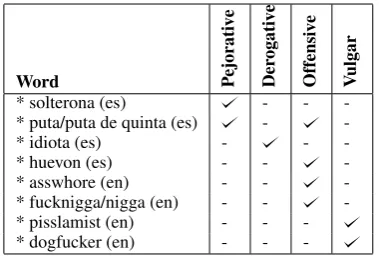
-Table 1: Categories considered in our hate lexicon.
tion below:
eresAUXunaDETmalditaADJ Gender=Fem
puta NOUN Gender=Fem zorra
ADJ Gender=Fem.PUNCT PunctType=Peri As we know a sentence is composed by verbs, prepositions, adjectives, adverbs and so on. In this particular sentence shown above, we see that is composed by auxiliaries, determiner, adjectives, noun and a punctuation mark. All these tags plus the gender of each word will give us a piece of im-portant information to discriminate hate towards women and immigrants. The third feature that we consider important is to try tofind out if a word is pejorative, derogative, offensive or vulgar. To get this aim we created a lexicon with these four categories already mentioned before. In short, we selected words that we called “seeds” then we start to get synonyms or related words using seve-ral sources4. Using this method we got more than 4900 words classified in the four mentioned gories. Some of the words and its respective cate-gories are shown in Table 1.
We noticed that extending a little bit more the four categories in the third feature, we can im-prove slightly our results. Therefore, we take in-to account the percentage of embedded emotions
in tweets, for this goal we used Linguistic Inquiry and Word Count (LIWC)5. And we chose some additional categories (sexual, anxiety feeling, an-ger and so on.) that help us to discriminate bet-ween tweets which contents hate or not. And fi-nally, we have considered using TF-IDF schemes over skip-grams (bigram and trigrams) (Davidson et al.,2017).
In these experiments, we used scikit-learn to test several machine learning algorithms and its res-pective parameters. Some algorithms that we used
4
https://www.dictionary.com
[image:2.595.322.512.61.190.2]Approach Task1 Task1 Task2 Task2 Task1 Task1 Task1 Task1
English English English English Spanish Spanish Spanish Spanish Acc. F1-sc. F1-sc.(avg) EMR Acc. F1-sc. F1-sc.(avg) EMR
OUR BASELINE(See section 2.1) 0.763 0.766 0.731 0.629 0.834 0.840 0.785 0.710
TFIDF+POS 0.769 0.770 0.740 0.633 0.840 0.837 0.792 0.719
TFIDF+EMOTIONS 0.759 0.749 0.747 0.711 0.85 0.847 0.788 0.698
TFIDF+STRUCT 0.771 0.780 0.75 0.648 0.790 0.798 0.789 0.702
TFIDF+POS+EMOTIONS ↓ ↓ ↓ 0 0.849 0.842 0.791 0.700
TFIDF+POS+STRUCT ↓ ↓ ↓ 0 0.810 0.800 0.787 0.700
TFIDF+EMOTIONS+POS ↓ ↓ ↓ 0 0.846 0.839 0.781 0.698
TFIDF+SKIP-BIGR. ↓ ↓ ↓ ↓ ↓ ↓ ↓ ↓
TFIDF+SKIP-TRIGR. ↓ ↓ ↓ ↓ ↓ ↓ ↓ ↓
TFIDF+SKIP-BIGR.+EMOTIONS
↓ ↓ ↓ ↓ ↓ ↓ ↓ ↓
TFIDF+SKIP-BIGR.+STRUCT ↓ ↓ ↓ ↓ ↓ ↓ ↓ ↓
TFIDF+SKIP-BIGR.+EMOTIONS+STRUCT
↓ ↓ ↓ ↓ ↓ ↓ ↓ ↓
TFIDF+SKIP-TRIGR.+EMOTIONS
↓ ↓ ↓ ↓ ↓ ↓ ↓ ↓
TFIDF+SKIP-TRIGR.+STRUCT ↓ ↓ ↓ ↓ ↓ ↓ ↓ ↓
TFIDF+SKIP-TRIGR.+EMOTIONS+STRUCT
[image:3.595.72.525.60.313.2]↓ ↓ ↓ ↓ ↓ ↓ ↓ ↓
Table 2: Results achieved using LinearSVC algorithm for English and Spanish development datasets.
were: RandomForestClassifier (Breiman, 2001), LogisticRegression, Naive Bayes (Kibriya et al.,
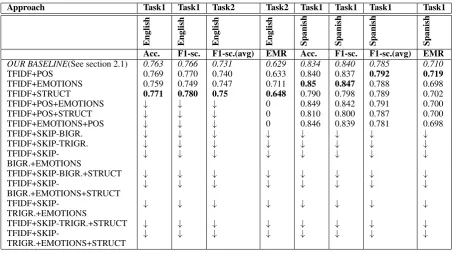
2004), LinearSVC (Hearst,1998) and so on ( For-tuna,2017). A summary of applying this approach to the developing dataset and its respective results are shown in Table 2. This table shows just results using LinearSVC because it was the algorithm that achieved good results. Other variations of corpus like stemming or lemmatization version were not used because we did not achieve good results.
Basically, we can highlight in table 2, that the use of skip-grams does not help a lot, this fact is due to the lack of skip-grams contained in tweets, for instance, in the tweet mentioned before, the skip-trigram((illegals dump kids))is just repeated once in the whole dataset. A similar situation hap-pens with skip-bigrams and skip-trigrams. On the other hand, the use of the structure and emotions (lexicon) embedded in tweets help to improve our baseline in both languages respectively. We used down arrow symbol↓to show that the value is be-low of our baseline, so is not valuable include it.
2.2. Based on NN
This second approach tackle hate speech detec-tion trough neural networks (Schmidt and Wie-gand,2017). In this stage, we used several neural networks architectures which works enough well with text, some of them are: Convolutional Neural Networks (CNN) (Jacovi et al.,2018), Long short
term memory (LSTM) and its variations: Peepho-le, Bidirectional (BILSTM) and Gated Recurrent Unit (GRU) (Lu and Salem,2017). We tested the-se architectures with different corpora which were slightly modified, in some cases we used a corpus with stop words, or simply a stemming or a lem-matized version of words. Additionally, we used other variations to see which of them help us to improve the performance of the system, the next paragraph describes how the corpora were proces-sed.
Preprocessing:Is valuable to mention that the preprocessing of raw tweets was slightly different for machine learning and NN, because we saw that keeping an identical preprocess for both approa-ches do not help a lot. So we decided to customi-ze the preprocess for each focus as we describe in section 2.1 and section 2.2. Swear words were kept for both focuses because they helped to achieve better results. Furthermore, emojis were normali-zed using its CLDR short name, For instance, we changed for ’:smiling face with smiling eyes:’ cleaned (without any additional symbol).
For this particular preprocess for NN were taken to account many aspects that were already consi-dered for ML’s preprocessing. Perhaps the main difference is when we process the hashtag. For instance, its version normalized for the raw tweet shown in section 2.1, would be:
road kill and refuse to unite they hope they get amnesty free education and welfare ille-gal families belong together in their country
not on the taxpayer dime its a scam no daca no amnesty send the
As is shown, this version separates the content of hashtags, additionally, we correct typos using dictionaries6. For instance, we changed “familes” by “families” in the above tweet.
This preprocess used for NN was used for ML too, but we noticed that accuracy got down in our experiments. Then we decided to keep the original way of hashtags for ML (no splitting).
The results shown in Table 3 were achieved using the developing datatset with the prepro-cess commented in section 2.2. Summing up, stop words, normal words (no stemming, no lemmati-zation), normalized hashtags, spelling corrections were considered. Furthermore, word embeddings (Mikolov et al., 2013) (Goldberg, 2015) as effi-cient word representation were used for all the ex-periments in this stage.
Carrying on several experiments we realized that Convolutional Neural Networks performed well enough compared to other architectures, see Table 3. Therefore, we named this architecture as
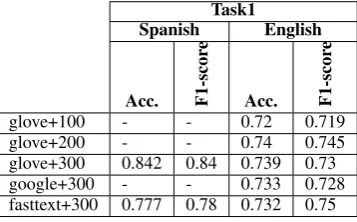
architecture A. This architecture is compound by an input embedding layer, followed by and spatial dropout and next to a convolutional layer with a set up of 256 filters and kernel size of 2. Next a globalmaxpooling is defined and finally, a dense layer of 2 neurons with softmax is used to get the results. The good performance of this architecture encouraged us to use different word embeddings to improve accuracy, the results of these experi-ments are shown in Table 4.
As we can see in Table 4, there is a lack of results on the Spanish language, this fact is due that we could find in Spanish all the correspon-ding resources exploited for experiments with En-glish portion of the data. Sometimes some authors publish word embeddings for this specific langua-ge but mostly this embeddings does not fit with our study case due to the language used in twitter is kind of informal and use a lot of slang, swear words and so on. And this important aspect redu-ces the performance of our system.
Data Augmentation:As we commented at the beginning of section 2, we noticed a slight skew in favor of tweets that do not contain HS, AG or
6https://www.dictionary.com
TR. To deal with this unbalanced training data-set, like in (Risch and Krestel,2018) we adopted a technique which allows us to increase the number of tweets with hate content. To do this we analy-zed some ways to get synonyms or similar words. Firstly, we try to use synonyms only if these sy-nonyms do not change the meaning of the who-le sentence. This fact is chalwho-lenging because is kind of hard to use synonyms to increase our data-set. For instance, the next tweet:”Hurray, saving us$$$in so many ways potus realDonaldTrump #LockThemUp #BuildTheWall #EndDACA #Boy-cottNFL #BoycottNike” has to be cleaned and it has to just keep words to get its synonyms. The re-sult to process the tweet above is:”hurray saving us in so many ways lock them up build the wall end daca boycott nfl boycott nike”. Now, we just have to get synonyms for each word, in our case using some resources such as: wordnet, dictionaries and so on. It is important to highlight that wordnet and dictionaries contain a formal language and those have a lack of slang or informal language used in tweets. Therefore, we decided to use word em-beddings to get the most similar words, Additio-nally, we defined a threshold7 to control that the synonym was so close to the original word. In our case, the threshold has been defined as0.7and the results for the tweet mentioned before are shown in Table 5.
Some remarkable facts that we saw in our ex-periments are: if we keep a threshold over 0.9 for sure we would not be able to get synonyms be-cause with a high threshold we are just recovering almost the same words used on the original sen-tence. On the other hand, if we keep a threshold under 0.5 we will get synonyms or similar words that are not coherent and additionally those new words change the meaning of the whole senten-ce. For instance, in the syn3 with a threshold 0.3, the original word (us) was changed by (states), we assume that it refers to the country called the Uni-ted States, that sometimes is written likeus, this is just an example of how many of these words change the meaning of the sentence when is used a lower threshold. Unfortunately, this approach was not able to achieve good results. But we noticed that is valuable go deeper with this focus.
7most similar function return the top n similar words and
Architecture
Spanish English
Task1 Task2 Task1 Task2
P R A F1-score F1-score(a
vg)
EMR P R A F1-score F1-score(a
vg)
EMR
Emb.+CNN1d 0.84 0.84 0.84 0.84 0.78 0.69 0.74 0.73 0.74 0.72 0.74 0.62
Emb.+CNN1d*4+dense*2 0.70 0.70 0.70 0.70 0.67 0.58 0.63 0.64 0.64 0.64 0.62 0.51
Emb.+LSTM 0.78 0.77 0.78 0.77 0.75 0.67 0.61 0.63 0.63 0.62 0.73 0.64
Emb.+LSTM Peep 0.77 0.77 0.77 0.77 0.74 0.65 0.57 0.57 0.57 0.58 0.70 0.58
Emb.+BILSTM 0.79 0.79 0.79 0.79 0.75 0.66 0.70 0.70 0.71 0.70 0.71 0.59
[image:5.595.78.521.59.200.2]Emb.+BILSTM GRU 0.81 0.81 0.81 0.81 0.75 0.66 0.73 0.73 0.73 0.74 0.72 0.63
Table 3: Results achieved using several NN architectures for English and Spanish development datasets.
Task1 Spanish English
Acc. F1-scor
e
Acc. F1-scor
e
glove+100 - - 0.72 0.719
glove+200 - - 0.74 0.745
glove+300 0.842 0.84 0.739 0.73
google+300 - - 0.733 0.728
[image:5.595.210.389.237.348.2]fasttext+300 0.777 0.78 0.732 0.75
Table 4: Results achieved by applying word embeddings to architecture A over development dataset.
Threshold Original Sentence
hurray saving us in so many ways lock them up build the wall end daca boycott nfl boycott nike
Threshold Similar Sentence
0.9 syn1: ’hurray saving us in so many ways lock them up build the wall end daca boycott nfl boycott nike’ 0.9 syn2: ’hurray saving us in so many ways lock them up build the wall end daca boycott nfl boycott nike’ 0.9 syn3: ’hurray saving us in so many ways lock them up build the wall end daca boycott nfl boycott nike’ 0.7 syn1: ’hurray save us in but several ways locks themselves up construct of walls end daca boycotting redskins
boycotting adidas’
0.7 syn2: ’hurray saved us in anyway numerous ways lock them up rebuild the wall end daca boycotts usfl boycotts nike’
0.7 syn3: ’hurray saving us in even countless ways lock them up build the wall end daca boycotted packers boycotted nike’
0.5 syn1: ’hurra save u the but several way locks themselves ups construct of walls beginning daca boycotting redskins boycotting adidas’
0.5 syn2: ’hurrah saved us/uk , anyway numerous things locking they up/ rebuild which ramparts ends daca boycotts usfl boycotts reebok’
0.5 syn3: ’hooray rescuing states where even countless possibilities padlocks those messed constructing and door-way ending daca boycotted packers boycotted sportswear’
0.3 syn1: ’hurra save u the but several way locks themselves ups construct of walls beginning s˘a boycotting redskins boycotting adidas’
0.3 syn2: ’hurrah saved us/uk , anyway numerous things locking they up/ rebuild which ramparts ends nica boy-cotts usfl boyboy-cotts reebok’
[image:5.595.73.530.381.629.2]0.3 syn3: ’hooray rescuing states where even countless possibilities padlocks those messed constructing and door-way ending bucuresti boycotted packers boycotted sportswear’
Table 5: Similar words that were gotten using word embeddings.
Official Ranking
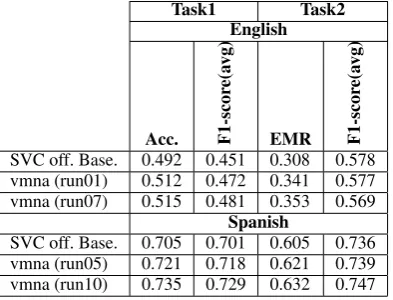
Table 6 shows the official results published by the organizers of HatEval. We submitted 10 runs for each task, the runs that achieved good results were run01 and run07 for English and run05 and run10 for Spanish. As we see too the
achie-ved good results using Support Vector Machine. The system used in run07 is the architecture A
which was already described in section 2.2. Run10 used an embedding layer as input, followed by an LSTMPeephole layer and finally a dense layer of 2 neurons with softmax is used. The last two runs that use neural networks were fed with a corpus described in section 2.2. As we notice both ap-proaches perform enough well, but architectures that use neural networks work slightly better than focuses that use classical machine learning algo-rithms.
Task1 Task2 English
Acc. F1-scor
e(a
vg)
EMR F1-scor
e(a
vg)
SVC off. Base. 0.492 0.451 0.308 0.578 vmna (run01) 0.512 0.472 0.341 0.577 vmna (run07) 0.515 0.481 0.353 0.569
Spanish
SVC off. Base. 0.705 0.701 0.605 0.736 vmna (run05) 0.721 0.718 0.621 0.739 vmna (run10) 0.735 0.729 0.632 0.747
Table 6: Official results for task1 and task2.
Having the golden labels we realize that our proposed system misclassified several tweets. As we can see in the next examples:
1. * (original tweet) Estas navidades mi polla mereces
* (Engish version) you deserve my dick for Christmas
Language: Spanish Golden Label: no-hate (0) our system(run05): hate (1)
2. *(original tweet ) @shakhepri69 @KuriMe-lon21 @HoruSenpai @crafter657 oye puta basura, c´allate
*(Engish version) @shakhepri69 @KuriMe-lon21 @HoruSenpai @crafter657 shut the fuck up, bitch
Language: Spanish Golden Label: no-hate (0) our system(run05): hate (1)
3. * (original tweet) @GMA @TVMarci His own fault #SENDTHEMBACK
* (Spanish version) @GMA @TVMarci su culpa #SENDTHEMBACK
Language: English
Golden Label: no-hate (0) our system(run01): hate (1)
All three examples have been labeled as hate by our classifier. On the first example, after pre-processing, the system just kept the words navida-des (Christmas), polla (dick) and mereces (navida-deser- (deser-ve). And looking for these words in our lexicons just the last two words were found, so the sys-tem marked the tweet as hate-content. The same situation happened with example 2 and 3, just the words puta (bitch), basura (trash), callate (shut up) and culpa (fault), send (enviar), back (regreso) were found. As (Zhang and Luo, 2018) noticed, that some times hate and no-hate tweets have no enough features to be differentiated. Doing a ma-nual analysis in the datasets we notice that fact to in several tweets.
3. Conclusions
This work proposed two main approaches. The first one, take into account some features that can be considered to feed classical machine learning algorithms, some of these features are: structure, embedded emotions, pos tagging, and skip-grams. On the other hand, the second approach consists of designing several neural networks architectures to test a variety of corpora and word representations. Moreover, we face an unbalanced dataset using a technique called data augmentation. To get simi-lar words were used pre-trained word embeddings with a tuned few thresholds. Using data augmenta-tion our results did not improve but we noticed that is a promising field to study. Furthermore, looking at the results in Table 6 we appreciate that both ap-proaches contribute to achieving good results, per-haps a deep study in both approaches can help us to understand and improve our results. As a future work, it is interesting to explore more deep lear-ning or neural networks and design more complex architectures.
References
[image:6.595.73.270.236.386.2]Se-mantic Evaluation (SemEval-2019). Association for Computational Linguistics.
Leo Breiman. 2001. Random forests. Mach. Learn., 45(1):5–32.
Uwe Bretschneider, Thomas W¨ohner, and Ralf Peters. 2014. Detecting online harassment in social net-works. InICIS.
Thomas Davidson, Dana Warmsley, Michael Macy, and Ingmar Weber. 2017. Automated Hate Speech De-tection and the Problem of Offensive Language.
Paula Fortuna. 2017. FACULDADE DE ENGENHA-RIA DA UNIVERSIDADE DO PORTO Automatic detection of hate speech in text: an overview of the topic and dataset annotation with hierarchical clas-ses. Technical report.
Yoav Goldberg. 2015. A primer on neural network models for natural language processing. CoRR, abs/1510.00726.
Marti A. Hearst. 1998. Support vector machines.IEEE Intelligent Systems, 13(4):18–28.
Alon Jacovi, Oren Sar Shalom, and Yoav Goldberg. 2018.Understanding convolutional neural networks for text classification. InProceedings of the 2018 EMNLP Workshop BlackboxNLP: Analyzing and In-terpreting Neural Networks for NLP, pages 56–65. Association for Computational Linguistics.
Ashraf M. Kibriya, Eibe Frank, Bernhard Pfahringer, and Geoffrey Holmes. 2004. Multinomial naive ba-yes for text categorization revisited. InProceedings of the 17th Australian Joint Conference on Advan-ces in Artificial Intelligence, AI’04, pages 488–499, Berlin, Heidelberg. Springer-Verlag.
Yuzhen Lu and Fathi M. Salem. 2017. Simplified ga-ting in long short-term memory (LSTM) recurrent neural networks.CoRR, abs/1701.03441.
Tomas Mikolov, Kai Chen, Greg Corrado, and Jeffrey Dean. 2013. Efficient estimation of word represen-tations in vector space.CoRR, abs/1301.3781.
Julian Risch and Ralf Krestel. 2018. Aggression identi-fication using deep learning and data augmentation.
Anna Schmidt and Michael Wiegand. 2017. A sur-vey on hate speech detection using natural language processing. In Proceedings of the Fifth Internatio-nal Workshop on Natural Language Processing for Social Media, pages 1–10. Association for Compu-tational Linguistics.
Leandro Silva, Mainack Mondal, Denzil Correa, Fabri-cio Benevenuto, and Ingmar Weber. 2016. Analy-zing the Targets of Hate in Online Social Media.