Review Article
Comparative effectiveness of acupuncture and
HRT interventions for premature ovarian
failure: a bayesian meta-analysis
Songfeng Wang*, Xiaohui Wan*, Jing Zhao, Xinmin Mao, Xiaolin La
Department of Reproduction, First Affiliated Hospital of Xinjiang Medical University, Urumqi 830054, Xinjiang, China. *equal contributors.
Received January 4, 2017; Accepted March 31, 2017; Epub November 15, 2017; Published November 30, 2017
Abstract: Premature ovarian failure (POF) is the loss of normal function of the ovaries before age 40. While hormone
replacement therapy (HRT) significantly improves the effective rate of patients with POF, it may also raises a woman’s
risk of heart disease and breast cancer. Acupuncture is a form of alternative medicine and has been sanctioned by
many countries. Acupuncture is usually safe and has definite effect without side effects on the treatment of patients
with POF, so long as it is administered by experienced physicians. This Bayesian meta-analysis of randomized trials was designed to synthesize the evidence of the comparative effectiveness of Acupuncture and HRT interventions used for patients with POF. Seven electronic literature databases, including Cochrane Library, PubMed, EMBASE, China National Knowledge Infrastructure (CNKI), Chongqing VIP, Wanfang DATA and the Chinese Biomedicine (CBM) databases, were searched for relevant randomized controlled trials until September 20, 2016. Only RCTs that com-pared acupuncture to HRT alone for women POF were selected. Study selection and data extraction were carried out by two reviewers independently. Study quality was assessed with the Cochrane Collaboration risk of bias tool. Results were pooled by a hierarchical Bayesian random-effects model with parameters used non-informative prior distributions. The primary outcomes examined were follicle-stimulating hormone (FSH), estradiol (E2), luteinizing hormone (LH) and effective rate after treatment in both Acupuncture groups and HRT groups. The 2-level hierarchi-cal Bayesian random effect models were developed to estimate posterior means and 95% credible intervals (CrI) for mean difference (MD) of hormonal levels (FSH, E2, LH) and pooled odds ratio (OR) of effective cases. Eight studies involving 735 patients (368 with acupuncture treatment, 367 with HRT treatment) with POF were included in the meta-analysis. The posterior means and 95% CrI for pooled OR (5.587, [3.095, -9.196]) showed between-group difference and a higher effective rate of patients with acupuncture than with HRT interventions. Compared to HRT treatment, included studies in this review showed that acupuncture therapy was effective in reducing the levels of FSH (MD=-7.691, 95% CrI: -11.87 to -3.91) and increasing the levels of E2 (MD=26.670, 95% CrI: 3.004 to 49.85), whereas acupuncture therapy had no effect on reducing the levels of LH (-3.164, 95% CrI: -6.815 to 1.292). In
addi-tion, there was no evidence of significant publication bias. The results of sensitivity analyses showed that pooled OR and MD estimates were influenced by no single study. In conclusion, this Bayesian meta-analysis provides evidence
that acupuncture therapy is superior to HRT in some areas of comparisons, including effective rate, reduced the level of FSH and increased the E2 level. However, there is no evidence that acupuncture therapy has effect on reduc-ing the levels of LH compared to HRT treatment. High quality and well-designed studies are needed to enhance the credibility of the results about the effectiveness of acupuncture in patients with POI.
Keywords: Premature ovarian failure, acupuncture therapy, hormone replacement therapy, bayesian meta-analy-sis
Introduction
Premature ovarian failure (POF) is character-ized by hypoestrogenism, elevated serum folli-cle-stimulating hormone (FSH, usually above 40 IU/L) and luteinizing hormone (LH) levels in
under 30 years old and 1% of women below 40
years old, which influenced nearly 1% of women
in period reproduction [4, 5]. Generally, hor-mone replacement therapy (HRT) (including estrogen and progesterone) is considered as the appropriate therapeutic method and plays an irreplaceable role against POF [6]. However, previous studies found that HRT had been related to increased risks of strokes, breast cancer and coronary heart disease [7-9].
Further, the influence of HRT adverse events on
older women was usually greater than younger women. Acupuncture is a form of alternative medicine and a main component of traditional Chinese medicine and has been used as medi-cal means since antiquity in China [10]. At pres-ent, Acupuncture has been sanctioned by many countries and become commonplace in the US, Australia, and Europe. Acupuncture has been used to treat many diseases. Some studies suggested that acupuncture was effective for gastrointestinal dysfunction [11], gastrointesti-nal disorders [12] and POF [13]. As long as acu-puncture was administered by experienced
physicians, it was generally safe and had defi
-nite effect without side effects. There have been concerns about the effectiveness of
acu-puncture on POF, but the important efficacy
variables may become apparent only in larger sample. Therefore, we searched the literatures in which POF patients had been treated with acupuncture and compared to patients treated with HRT alone and performed a Bayesian meta-analysis to evaluate the effect of acu-puncture in patients with POF. Non-informative prior distributions were used for all parameters, so that the pooled estimates were determined by the included study data.
Materials and methods
Eligibility criteria
Studies were selected according to the follow-ing criterion: Study designs: Randomized con-trolled trials (RCTs) without restrictions for
pub-lication language which compared the efficacy
of Acupuncture with HRT in the treatment of Premature Ovarian Failure were eligible for inclusion in the Meta-Analysis. Case-control design, letters, reviews, cross-over trials or case reports were excluded.
Populations: All women with Premature Ovarian Failure (POF) were eligible for inclusion.
Premature Ovarian Failure (POF) is defined as
primary or secondary amenorrhea associated with high levels of follicle stimulating hormone (>40 IU/L) on two occasions at intervals of 1 month, and estrogen (E2) less than 73.2 mol/L in women less than 40 years of age [22]. Interventions and comparisons: We included all the studies in which patients had been treated with Acupuncture and compared to patients treated with HRT alone. Studies investigating the combined effects of acupuncture plus other interventions were excluded. In addition, we also excluded trials in which patients of control group were not just given HRT.
Outcomes: Our outcomes were hormone levels (FSH, LH, E2) and effective rate after treatment in both Acupuncture groups and HRT groups. We included the studies in which the mean and standard deviation for hormone levels, the total number of Subjects and the effective number of Subjects in each group were clearly present. Search strategy
The Cochrane Library, PubMed, EMBASE, China National Knowledge Infrastructure (CNKI), Chongqing VIP, Wanfang DATA, and the Chinese Biomedicine (CBM) databases were searched
to identify published studies. We also identified
all relevant articles found on PubMed by using
the ‘related articles’ feature. These databases
were searched until September 20, 2016, with-out restrictions for starting date of search or publication language. Search terms, combined
with an RCT filter, were “premature ovarian fail
-ure”, “premature ovary dysfunction”, “prema
-ture ovary insufficiency”, “estrogen therapy”, “Acupuncture”, “Acupressure”, “Electroacupun-cture”, “hormone replacement therapy”, and “combined estrogen and progestogen
ther-apy”.
Study selection and data extraction
The titles and abstracts of all relevant studies
were screened by the first author (###) to
exclude the studies that failed to meet the pur-poses of this Bayesian meta-analyses. Two
reviewers (### and ###) independently extract
differenc-es between the extracted datasets were resolved by discussion with the third reviewer
(###) when necessary.
Quality assessment
Risk of bias was assessed independently by
two reviewers (### and ###) using the
Cochrane Collaboration risk of bias tool [23], and all disagreements were resolved by
discus-sion and arbitration by a third reviewer (###).
The Cochrane Collaboration risk of bias tool consists of six domains: selection bias (random sequence generation, allocation concealment), performance bias (blinding of participants and personnel), detection bias (blinding of asses-sors), attrition bias (incomplete outcome data), reporting bias (selective reporting of outcomes), and other source of bias.
Statistical methods
Statistical analyses were performed with R sta-tistical software (version 3.31). Stasta-tistical het-erogeneity was tested using the Chi-squared test and I2 statistic. The I2 statistic values of 25%, 50%, and 75% correspond to low, moder-ate, and high levels of heterogeneity, respec-tively [24]. In the absence of heterogeneity the
was included in the 95% CrIs of OR (MD), there
was significant difference between experimen
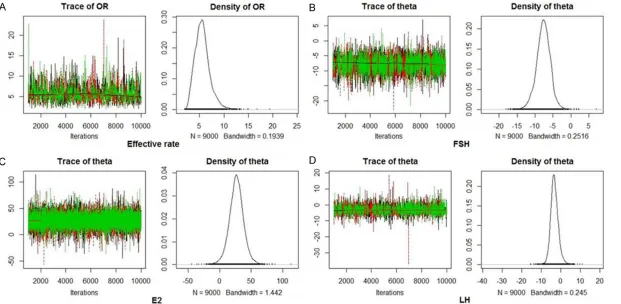
-tal group and control group. All posterior param-eters were calculated by Markov chain Monte Carlo methods (MCMC). In order to the pooled estimates were determined by the included studies, non-informative prior distributions were used for all parameters, and the details of the statistical model were shown in Supple- mentary Appendix. We initiated three chains with disparate initial values, and each chain was run for 10000 iterations with a burn-in of 1000 iterations. Convergence was assessed through Trace plot and Gelman-Rubin statistic. We let the chain run until the MC error was less than 5% of the posterior SD. Potential
publica-tion bias was investigated by Begg’s rank cor
-relation test, with P<0.05 indicating statistical
significance [25]. In the end, sensitivity analysis
was done to examine the effect of a single study on the overall meta-analysis estimate.
Results
Search results and baseline characteristics
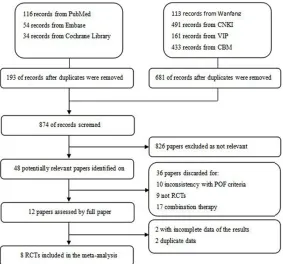
The literature search results identified 1402
[image:3.612.93.376.72.336.2]articles, of which we excluded 874 as they were Figure 1. Flow diagram of articles selection process for Bayesian
meta-anal-ysis.
Bayesian fixed effects model
was adopted for combining the data (I2<50%, P>0.05). The Bayesian random effects model was performed if there
was significant heterogeneity
(I2>50%, P<0.05). The Baye-
sian fixed effects model and
Hierarchical Bayesian random effects model were imple-mented with the OpenBUGS software (version 3.2.3) by running it from within the R statistical software using the
“R2OpenBUGS” package.
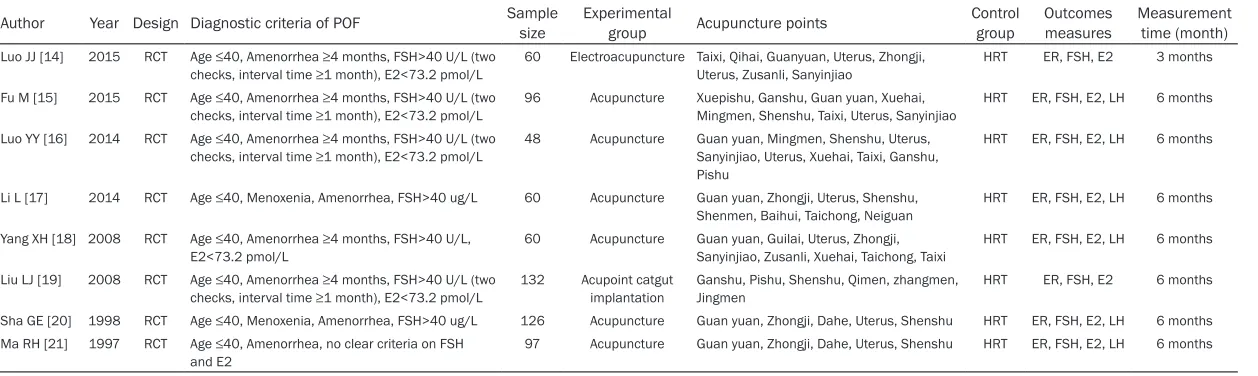
Table 1. Summary of characteristics of clinical studies included in the Bayesian meta-analysis
Author Year Design Diagnostic criteria of POF Sample size Experimental group Acupuncture points Control group Outcomes measures Measurement time (month)
Luo JJ [14] 2015 RCT Age ≤40, Amenorrhea ≥4 months, FSH>40 U/L (two checks, interval time ≥1 month), E2<73.2 pmol/L
60 Electroacupuncture Taixi, Qihai, Guanyuan, Uterus, Zhongji, Uterus, Zusanli, Sanyinjiao
HRT ER, FSH, E2 3 months
Fu M [15] 2015 RCT Age ≤40, Amenorrhea ≥4 months, FSH>40 U/L (two checks, interval time ≥1 month), E2<73.2 pmol/L
96 Acupuncture Xuepishu, Ganshu, Guan yuan, Xuehai, Mingmen, Shenshu, Taixi, Uterus, Sanyinjiao
HRT ER, FSH, E2, LH 6 months
Luo YY [16] 2014 RCT Age ≤40, Amenorrhea ≥4 months, FSH>40 U/L (two
checks, interval time ≥1 month), E2<73.2 pmol/L 48 Acupuncture Guan yuan, Mingmen, Shenshu, Uterus, Sanyinjiao, Uterus, Xuehai, Taixi, Ganshu, Pishu
HRT ER, FSH, E2, LH 6 months
Li L [17] 2014 RCT Age ≤40, Menoxenia, Amenorrhea, FSH>40 ug/L 60 Acupuncture Guan yuan, Zhongji, Uterus, Shenshu, Shenmen, Baihui, Taichong, Neiguan
HRT ER, FSH, E2, LH 6 months
Yang XH [18] 2008 RCT Age ≤40, Amenorrhea ≥4 months, FSH>40 U/L,
E2<73.2 pmol/L 60 Acupuncture Guan yuan, Guilai, Uterus, Zhongji, Sanyinjiao, Zusanli, Xuehai, Taichong, Taixi HRT ER, FSH, E2, LH 6 months Liu LJ [19] 2008 RCT Age ≤40, Amenorrhea ≥4 months, FSH>40 U/L (two
checks, interval time ≥1 month), E2<73.2 pmol/L 132 Acupoint catgut implantation Ganshu, Pishu, Shenshu, Qimen, zhangmen, Jingmen HRT ER, FSH, E2 6 months Sha GE [20] 1998 RCT Age ≤40, Menoxenia, Amenorrhea, FSH>40 ug/L 126 Acupuncture Guan yuan, Zhongji, Dahe, Uterus, Shenshu HRT ER, FSH, E2, LH 6 months Ma RH [21] 1997 RCT Age ≤40, Amenorrhea, no clear criteria on FSH
and E2 97 Acupuncture Guan yuan, Zhongji, Dahe, Uterus, Shenshu HRT ER, FSH, E2, LH 6 months
reviews, duplicated reports, animal studies, without suitable controls, etc. The 874 trials were excluded for the detailed reasons shown in Figure 1. Eight RCTs met our inclusion crite-ria and were remained for further analysis [14-21]. The characteristics of the studies incl- uded in the Bayesian meta-analysis were sum-marized in Table 1. Eight RCTs studies had been conducted in China between 1997 and 2015. The total of 368 participants with pre- mature ovarian failure were treated with Acupuncture and 367 participants were treat-ed with HRT. Further, some details characteris-tics of the studies included were presented in the Table 1.
Quality assessment
The risk of bias assessed for included studies were presented in Table 2. The risk of bias was low for the random sequence generation pro-cess for two included studies (Luo JJ, 2015 and Liu LJ, 2008). Because the other six studies
[15-18, 20, 21] didn’t describe the specific ran
-domization strategies, we assigned an unclear
risk of bias. All included studies [14-21] didn’t
provide details of the method of allocation con-cealment and report any information on blind-ing of outcome assessors. All of the included
trials were classified as having low risk of bias
for incomplete outcome data, selective report-ing of outcomes and other source of bias.
effects of interventions
As shown in Table 3, the heterogeneity (I2) var-ied from 0% to 94.1%. We accounted for such heterogeneity by using Bayesian random ef- fects model in our analysis. We also calculated the deviance information criterion (DIC) [26] and DIC values were lower for all Bayesian ran-dom effects model for each outcome measure. Trace plots for chains using different starting values for the estimated parameter. All conver-gence plots indicated that the algorithm has reached convergence since trace plots did not present irregularities and ergodic means had been stabilized (Figure 2). In addition, Rhat is the potential scale reduction factor. The result also illustrated that convergence had been reached, with all Rhat values closed to 1.0 (Table 3).
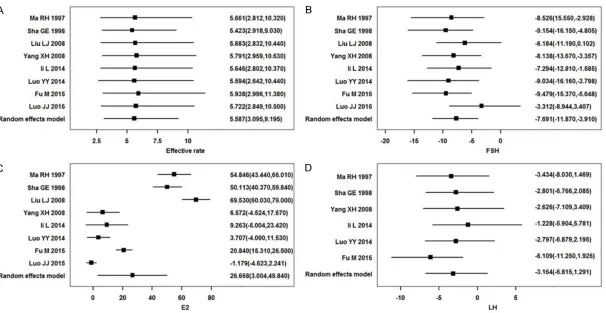
A total of 8 studies [14-21] including 735 patients reported effective rate after treatment in both Acupuncture groups and HRT groups. We observed that the overall pooled data sug-gested a higher effective rate of premature ovarian failure patients with acupuncture than with HRT interventions (odds ratio 5.587, 95% credible interval: 3.095-9.196). Eight of the RCTS [14-21] evaluated the FSH and E2 between treatment and control groups. We
found that there were significant differences in
[image:5.612.91.521.84.200.2]FSH and E2 between acupuncture group and
Table 2. Risk of bias of clinical studies included in the Bayesian meta-analysis
Author Year Random sequence generation concealmentAllocation Blinding outcome dataIncomplete Selective reporting of outcomes Other source of bias
Luo JJ 2015 Low risk of bias Unclear risk of bias High risk of bias Low risk of bias Low risk of bias Low risk of bias Fu M 2015 Unclear risk of bias Unclear risk of bias High risk of bias Low risk of bias Low risk of bias Low risk of bias Luo YY 2014 Unclear risk of bias Unclear risk of bias High risk of bias Low risk of bias Low risk of bias Low risk of bias Li L 2014 Unclear risk of bias Unclear risk of bias High risk of bias Low risk of bias Low risk of bias Low risk of bias Yang XH 2008 Unclear risk of bias Unclear risk of bias High risk of bias Low risk of bias Low risk of bias Low risk of bias Liu LJ 2008 Low risk of bias Unclear risk of bias High risk of bias Low risk of bias Low risk of bias Low risk of bias Sha GE 1998 Unclear risk of bias Unclear risk of bias High risk of bias Low risk of bias Low risk of bias Low risk of bias Ma RH 1997 Unclear risk of bias Unclear risk of bias High risk of bias Low risk of bias Low risk of bias Low risk of bias
Table 3. Bayesian Meta-Analysis output and statistics for each target
Target The number of included articles Mean (95% CrI) I2 DIC Rhat Begg’s test (P)
Effective rate (OR) 8 5.587 (3.095, 9.196) 0.0% 14.6 1.004 0.386
FSH (MD) 8 -7.691 (-11.870, -3.910) 39.0% 51.4 1.004 0.536
E2 (MD) 8 26.668 (3.004, 49.840) 94.1% 54.1 1.001 0.386
[image:5.612.90.526.235.314.2]HRT group, and the pooled posterior mean dif-ferences (MD) were -7.691 (95% CrI: -11.87 to -3.91) and 26.67 (95% CrI: 3.004 to 49.85), respectively. Six studies [15-18, 20-21] involv-ing 487 patients were included in the Bayesian meta-analysis to evaluate the LH levels after treatment. The posterior MD for LH levels was -3.164 (95% CrI: -6.815 to 1.292) and the dif-ference between the two treatment groups was
not statistically significant. The single article
estimates with their credibility intervals were showed through forest plots as seen in Figure 3.
Publication bias and sensitivity analyses
Publication bias was analyzed by Begg’s test.
The results showed that there were no signifi
-cant publication biases (P>0.05), as shown in
Table 3. Finally, sensitivity analyses of effective rate, FSH, E2 and LH levels were conducted by sequentially omitting one study at each turn. The results suggested that the pooled OR and MD estimates were affected by no single study.
Therefore, we confirmed that the results were
statistically robust.
Discussion
The objective of our Bayesian meta-analysis was to observe the curative effect of
acupunc-ture to POF. The main findings of the current
Bayesian meta-analysis provided evidence that
acupuncture intervention could significantly
increase the effective rate in POF women.
Specifically, the effective rate of POF women
who received acupuncture intervention is high-er (odds ratio: 5.587, 95% CrI: 3.095-9.196) than in their counterparts who received HRT intervention alone. For example, Jo J et al. [13] also reported that the effective rate in acu-puncture group was higher than that of the con-trol group. Moreover, These Bayesian
meta-analysis findings support that acupuncture
intervention reduce FSH levels (MD=-7.691, 95% CrI: -11.870 to -3.910) and increase E2 levels (MD=26.670, 95% CrI: 3.004 to 49.85).
These findings are similar with the general
meta analysis [13] which revealed no
statisti-cally significant differences on FSH levels
(SMD=-9.260, 95% CI: -13.11 to -5.41) and E2 levels (SMD=31.510, 95% CI: 6.060 to 56.950) between the patients in acupuncture interven-tion groups and those in control groups. It was worth noting that Jo J et al. included studies
which adopted no treatment, or other treat-ments for control group, and also included studies which adopted other treatments for experimental group and control group in the same manner. In the current Bayesian meta analysis, six of the RCT [15-18, 20, 21]
evalu-ated the LH levels but no statistically significant
decrease in LH levels was found for acupunc-ture treatment. Yang, XH et al. [18] found no
significantly reduction of LH levels with acu -puncture as compared to the HRT approach. However, the different results were found in the research by Luo YY et al. [16].
The strengths of our Bayesian meta-analysis are as follows. First, we only included the stud-ies in which patients had been treated with Acupuncture and compared to patients treated with HRT alone. In addition, studies investigat-ing the combined effects of acupuncture plus other interventions were excluded. These made it more precise when we compared the effec-tive of Acupuncture and HRT interventions for POF.
Second, we searched multiple databases to identify published studies, including Cochrane Library, PubMed, EMBASE, China National Knowledge Infrastructure (CNKI), Chongqing VIP, and so on. Further, these databases were searched without restrictions for starting date of search and publication language. Third, the 2-level hierarchical Bayesian random effect model was selected to perform meta-analysis could handle the heterogeneity of the included studies, and yet provided more precise esti-mates by borrowing strength using information from all included studies even when few stud-ies were available. The Bayesian hierarchical model conclusions needs to be supported by a
‘significant result’ using the credibility interval
of the posterior parameter, it is superior to the traditional meta-analyses [27, 28].
However, although only RCTs were included in the Bayesian current meta-analysis, there were
several limitations that might influence on the
results. First of all, the randomization strate-gies were inadequate in 6 of 8 included studies [15-18, 20, 21], which could led to bias of selection. And as in Ma RH et al., the diagnostic
criteria for POF hadn’t been described in detail.
Bayesian meta-analysis were all single-center RCTs studies done in China, even though we
didn’t apply language restrictions to our litera
-ture search. The Bayesian meta-analysis re- sults were based on published data only, not unpublished data. Third, of the eight studies included in this review, only two [14, 15] report-ed information about age, and therefore the
subgroup analysis based on age wasn’t
im-plemented.
Finally, the 2-level hierarchical Bayesian ran-dom effect models were constructed and based on non-informative prior distributions for all parameters, sometimes the normality
assumption for the parameters’ posterior distri
-bution might not be reasonable but this prob-lem and the alternative approaches had not been done systematically. In this study, we also
didn’t try out a community of priors and exam
-ine the sensitivity of the results to the choice of the prior. In spite of the limitations listed earlier, the general conclusion was that this Bayesian meta-analysis supported the patients who were given acupuncture therapy had better effects than who were HRT interventions.
Furthermore, the acupuncture safety is an important problem concerned by patients all the time. It is a popular belief that it is generally safe as long as acupuncture is administered by experienced physicians and the side effects of acupuncture therapy are less when compared to hormone therapy.
To conclude, this is the first Bayesian
meta-analysis to synthesize evidence on the compar-ative effectiveness of acupuncture and HRT interventions for POF. This research has revealed that acupuncture therapy is even superior to HRT in some areas of comparisons, for instance, effective rate, reduced the level of FSH and increased the E2 level, yet HRT plays an irreplaceable role in the treatment of prema-ture ovarian failure. In addition, high quality and well-designed studies with larger samples arti-cles are required to enhance the credibility of the results about the effectiveness of acupunc-ture in patients with POI.
Acknowledgements
This study was supported by the Xinjiang Uygur Autonomous Region Natural Science Fund (No: 2016D01C281).
Disclosure of conflict of interest
None.
Address correspondence to: Xiaolin La, Department
of Reproduction, First Affiliated Hospital of Xinjiang
Medical University, No.137 Liyushan Road, Urumqi 830054, Xinjiang, China. Tel: 0991-4366065; Fax: 0991-4366065; E-mail: [email protected]
References
[1] Larsen EC, Müller J, Schmiegelow K, Rech-nitzer C, Andersen AN. Reduced ovarian func-tion in long-term survivors of radiafunc-tion- and chemotherapy-treated childhood cancer. J Clin Endocrinol Metab 2003; 88: 5307-5314. [2] Burton KA, Van Ee CC, Purcell K, Winship I,
Shelling AN. Autosomal translocation associ-ated with premature ovarian failure. J Med Genet 2000; 37: E2-E2.
[3] Kalantaridou SN and Nelson LM. Premature ovarian failure is not premature menopause. Ann N Y Acad Sci 2000; 900: 393-402. [4] Coulam CB, Adamson SC and Annegers JF.
In-cidence of premature ovarian failure. Obstet Gynecol 1986; 67: 604-606.
[5] Baker VL. Primary ovarian insufficiency in the
adolescent. Curr Opin Obstet Gynecol 2013; 25: 375-381.
[6] Panay N and Kalu E. Management of prema-ture ovarian failure. Best Pract Res Clin Obstet Gynaecol 2009; 23: 129-140.
[7] Cust MP. Changes in practice since the publi-cation in 2007 of further results from the
wom-en’s health initiative and the million women
study. Menopause Int 2007; 13: 141-143. [8] Jeprentice R. Postmenopausal hormone
thera-py and risk of cardiovascular disease by age and years since menopause. JAMA 2007; 297: 1465-1477.
[9] Hendrix SL, Wassertheilsmoller S, Johnson KC, Howard BV, Kooperberg C, Rossouw JE, Trev-isan M, Aragaki A, Baird AE, Bray PF, Buring JE, Criqui MH, Herrington D, Lynch JK, Rapp SR, Torner J; WHI Investigators. Effects of conju-gated equine estrogen on stroke in the
wom-en’s health initiative. Circulation 2006; 113:
2425-2434.
[10] Berman BM, Langevin HM, Witt CM, Dubner R. Acupuncture for chronic low back pain. New England Journal of Medicine 2010; 363: 1777-1778.
[11] Toku T. Mechanism of acupuncture on neuro-modulation in the gut-a review. Neuromodula-tion 2011; 14: 8-12.
gastroin-testinal function. World J Gastroenterol 2015; 21: 8304-8313.
[13] Jo J, Lee YJ, Lee H. Effectiveness of
acupunc-ture for primary ovarian insufficiency: a sys -tematic review and meta-analysis. Evid Based Complement Alternat Med 2015; 2015: 842180.
[14] Luo JJ, Li H and Liu DZ. The clinical observation of combination of Electro acupuncture and Western medicines in the treatment of 30 women with premature ovarian failure. Guid-ing Journal of Traditional Chinese Medicine and Pharmacy 2015; 21: 46-48.
[15] Fu M. Application of acupuncture in the treat-ment of premature ovarian failure. The Word Clinical Medicine 2015; 9: 173.
[16] Luo YY and Fu B. The clinical treatment obser-vation of premature ovarian failure with acu-puncture. Hubei Journal of Traditional Chinese Medicine 2014; 36: 63.
[17] Li L, Jiang QY, Zhong L, et al. Clinical Observa-tions on acupuncture therapy in the treatment of premature ovarian failure. Beijing, China: National Conference on the regulation of ovar-ian function by Integrated Traditional Chinese and Western Medicine; 2014. pp. 207-210. [18] Yang XH, Lai XM and Huang ZB. Acupuncture
treatment in 60 patients of premature ovarian failure. Journal of Sichuan of Traditional Chi-nese Medicine 2008; 26: 106-107.
[19] Liu HJ, Peng JH and Xu XB. Clinical observation on catgut implantation at shu-and mu-acu-points for treatment of premature ovarian fail-ure. Chinese Acupuncture & Moxibustion 2008; 28: 325-327.
[20] Sha GE and Wang SM. Clinical study of acu-puncture treatment for 84 premature ovarian failure patients. Journal of Clinical Acupunc-ture and Moxibustion 1998; 14: 16-18. [21] Ma RH, Yi P, Sha GE, et al. Clinical
Observa-tions on Acupuncture Treatment of 56 prema-ture ovarian failure cases. Chinese Acupunc-ture & Moxibustion 1997; 7: 395-396. [22] Gelbaya T, Vitthala S, Nardo L, Seif M.
Optimiz-ing hormone therapy for future reproductive performance in women with premature ovari-an failure. Gynecol Endocrinol 2011; 27: 1-7. [23] Higgins JP, Green S. Cochrane handbook for
systematic reviews of interventions: version 5.1.0 (updated March 2011). London, UK: Co-chrane Collaboration; 2011.
[24] Higgins JP, Thompson SG, Deeks JJ, Altman DG. Measuring inconsistency in meta-analy-ses. BMJ 2003; 327: 557-560.
[25] Begg CB and Mazumdar M. Operating charac-teristics of a rank correlation test for publica-tion bias. Biometrics 1994; 50: 1088-1101. [26] Spiegelhalter DJ, Best NG, Carlin BP, et al.
Bayesian measures of model complexity and
fit. Journal of the Royal Statistical Society
2001; 64: 583-639.
[27] Ying Y and Little RJ. Meta-analysis of studies with missing data. Biometrics 2009; 65: 487-496.
Supplementary appendix
1. The Bayesian random-effects model for binary data model <- function() {
for(i in 1:n) {
d[i]<-log(rt[i]/(nt[i]-rt[i]))-log(rc[i]/(nc[i]-rc[i]))
sigmasquare[i]<-1/rt[i]+1/(nt[i]-rt[i])+1/rc[i]+1/(nc[i]-rc[i]) d[i]~dnorm(delta[i],precision[i])
precision[i]<-1/sigmasquare[i] delta[i]~dnorm(theta,precision.tau) }
precision.tau~dgamma(0.001,0.001) sigma2<-1/precision.tau
theta~dnorm(0.0,1.0E-6) OR<-exp(theta)
}
inits <- function() {
list(theta= rnorm(1,0,1),precision.tau= runif(1, 0, 1)) }
2. The Bayesian random-effects model for Continuous data model <- function() {
for(i in 1:r) {
d[i]<-x1[i]-x2[i]
v[i]<-s1[i]*s1[i]/n1[i]+s2[i]*s2[i]/n2[i] t[i]<-1/v[i]
d[i]~dnorm(delta[i],t[i]) delta[i]~dnorm(theta,inv.tau) }
theta~dnorm(0.0,1.0E-6) inv.tau~dgamma(0.001,0.001) tau2<-1/inv.tau
tau<-sqrt(tau2) }
inits <- function() {