Random Positive-Only Projections:
PPMI-Enabled Incremental Semantic Space Construction
Behrang QasemiZadeh
DFG SFB 991
Heinrich-Heine-Universit¨at D¨usseldorf D¨usseldorf, Germany
Laura Kallmeyer
DFG SFB 991
Heinrich-Heine-Universit¨at D¨usseldorf D¨usseldorf, Germany
Abstract
We introduce positive-only projection (PoP), a new algorithm for constructing semantic spaces and word embeddings. The PoP method employs random projec-tions. Hence, it is highly scalable and com-putationally efficient. In contrast to pre-vious methods that use random projec-tion matrices R with the expected value of 0 (i.e., E(R) = 0), the proposed method uses Rwith E(R) > 0. We use Kendall’sτbcorrelation to compute vector
similarities in the resulting non-Gaussian spaces. Most importantly, since E(R) >
0, weighting methods such as positive pointwise mutual information (PPMI) can be applied to PoP-constructed spaces after their construction for efficiently transfer-ring PoP embeddings onto spaces that are discriminative for semantic similarity as-sessments. Our PoP-constructed models, combined with PPMI, achieve an average score of 0.75 in theMEN relatedness test, which is comparable to results obtained by state-of-the-art algorithms.
1 Introduction
The development of data-driven methods of nat-ural language processing starts with an educated guess, a distributional hypothesis: We assume that some properties of linguistic entities can be modelled by ‘some statistical’ observations in lan-guage data. In the second step, this statistical in-formation (which is determined by the hypothe-sis) is collected and represented in a mathemati-cal framework. In the third step, tools provided by the chosen mathematical framework are used to implement a similarity-based logic to iden-tify linguistic structures, and/or to verify the
pro-posed hypothesis. Harris’s distributional hypothe-sis (Harris, 1954) is a well-known example of step one that states that meanings of words correlate with the environment in which the words appear. Vector space models andη-normed-based similar-ity measures are notable examples of steps two and three, respectively (i.e., word space models or word embeddings).
However, as pointed out for instance by Ba-roni et al. (2014), thecount-based modelsresulting from the steps two and three are not discrimina-tive enough to achieve satisfactory results; instead, predictive modelsare required. To this end, an ad-ditional transformation step is often added. Tur-ney and Pantel (2010) describe this extra step as a combination ofweightinganddimensionality re-duction.1This transformation from count-based to predictive models can be implemented simply via a collection of rules of thumb (such as frequency threshold to filter out highly frequent and/or rare context elements), and/or it can involve more so-phisticated mathematical transformations, such as converting raw counts to probabilities and using matrix factorization techniques. Likewise, by ex-ploiting the large amounts of computational power available nowadays, this transformation can be achieved via neural word embedding techniques (Mikolov et al., 2013;Levy and Goldberg, 2014).
To a large extent, the need for such transfor-mations arises from theheavy-taileddistributions that we often find in statistical natural language models (such as the Zipfian distribution of words in contexts when building word spaces). Conse-quently, count-based models are sparse and high-dimensional and therefore both computationally expensive to manipulate (due of the high dimen-sionality of models) and nondiscriminatory (due to the combination of the high-dimensionality of the
1Similar to topics of feature weighting, selection, and
en-gineering in statistical machine learning.
models and the sparseness of observations—see Minsky and Papert (1969, chap. 12)).2
On the one hand, although neural networks are often the top performers for addressing this problem, their usage is costly: they need to be trained, which is often very time-consuming,3and their performance can vary from one task to an-other depending on their objective function.4 On the other hand, although methods based on ran-dom projections efficiently address the problem of reducing the dimensionality of vectors—such as random indexing (RI) (Kanerva et al., 2000), reflective random indexing (RRI), (Cohen et al., 2010), ISA (Baroni et al., 2007) and random Man-hattan indexing (RMI) (Zadeh and Handschuh, 2014)—in effect they retain distances between en-tities in the original space.5Moreover, since these methods use asymptotic Gaussian or Cauchy ran-dom projection matricesRwith E(R) = 0, their resulting vectors cannot be adjusted and trans-formed using weighting techniques such as PPMI. Consequently, these methods often do not out-perform neural embeddings and combinations of PPMI weighting of count-based models followed by matrix factorization—such as the truncation of weighted vectors using singular value decomposi-tion (SVD).
To overcome these problems, we propose a new method calledpositive-only projection (PoP). PoP is an incremental semantic space construc-tion method which employs random projecconstruc-tions. Hence, building models using PoP does not re-quire training but simply generating random vec-tors. However, in contrast to RI (and previous methods), the PoP-constructed spaces can undergo weighting transformations such as PPMI, after their construction and at a reduced dimensional-ity. This is due to the fact that PoP uses random vectors that contain only positive integer values. Because the PoP method employs random pro-jections, models can be built incrementally and efficiently. Since the vectors in PoP-constructed models are small (i.e., with a dimensionality of a few hundred), applying weighting methods such
2That is, the well knowncurse of dimensionalityproblem. 3Baroni et al. (2014) state that it tookRonan Collobert
two months to train a set of embeddings from a Wikipedia dump. Even using GPU-accelerated computing, the required computation and training time for inducing neural word em-beddings is high.
4Ibid, see results reported in supplemental materials. 5Forη-normed space that they are designed for, i.e.,η= 2
for RI, RRI, and ISA andη= 1for RMI.
as PPMI to these models is incredibly faster than applying them to classical count-based models. Combined with a suitable weighting method such as PPMI, the PoP algorithm yields competitive results concerning accuracy in semantic similar-ity assessments, compared for instance to neural net-based approaches and combinations of count-based models with weighting and matrix factoriza-tion. These results, however, are achieved without the need for heavy computations. Thus, instead of hours, models can be built in a matter of a few sec-onds or minutes. Note that even without weighting transformation, PoP-constructed models display a better performance than RI on tasks of semantic similarity assessments.
We describe the PoP method in§2. In order to evaluate our models, in§3, we report the perfor-mance of PoP in the MEN relatedness test. Finally, §4concludes with a discussion.
2 Method
2.1 Construction of PoP Models
A transformation of a count-based model to a pre-dictive one can be expressed using a matrix nota-tion such as:
Cp×n×Tn×m =Pp×m. (1)
In Equation 1, Cdenotes the count-based model consisting of p vectors and n context elements (i.e.,ndimensions). T is the transformation ma-trix that maps thep n-dimensional vectors inCto anm-dimensional space (often, but not necessar-ily,m6=nandmn). Finally,Pis the resulting m-dimensional predictive model. Note thatTcan be a composition of several transformations, e.g., a weighting transformationWfollowed by a pro-jection onto a space of lower dimensionality R, i.e.,Tn×m=Wn×n×Rn×m.
In the proposed PoP technique, the transforma-tionTn×m (form n, e.g.,100 ≤m ≤7000)
is simply a randomly generated matrix. The el-ements tij of Tn×m have the following
distribu-tion:
tij = (
0 with probability1−s
bU1αc with probabilitys , (2)
Pm
i=1tji 6= 0 for each row vectortj ∈ T). For
α, we chooseα = 0.5. Given Equations1 and2
and using the distributive property of multiplica-tion over addimultiplica-tion in matrices,6the desired seman-tic space (i.e.,Pin Equation1) can be constructed using the two-step procedure of incremental word space construction (such as used in RI, RRI, and RMI):
Step 1. Each context element is mapped to one m-dimensionalindex vector~r.~ris randomly gen-erated such that most elements in~rare 0 and only a few are positive integers (i.e., the elements of~r have the distribution given in Equation2).
Step 2. Each target entity that is being analysed in the model is represented by acontext vector~v in which all the elements are initially set to 0. For each encountered occurrence of this target entity together with a context element (e.g., through a se-quential scan of a corpus), we update~vby adding the index vector~rof the context element to it.
This process results in a model built directly at the reduced dimensionality m (i.e., P in Equa-tion1). The first step corresponds to the construc-tion of the randomly generated transformaconstruc-tion ma-trixT: Each index vector is a row of the transfor-mation matrixT. The second step is an implemen-tation of the matrix multiplication in Equation 1
which is distributed over addition: Each context vector is a row ofP, which is computed in an iter-ative process.
2.2 Measuring Similarity
OncePis constructed, if desirable, similarities be-tween entities can be computed by theirKendall’s τb (−1≤τb ≤1) correlation (Kendall, 1938). To
computeτb, we adopt an implementation of the
al-gorithm proposed byKnight (1966), which has a computational complexity of O(nlogn).7
In order to computeτb, we need to define a
num-ber of values. Given vectors~xand~yof the same dimension, we call a pair of observations(xj, yj)
and(xj+1, yj+1) in~xand~y concordantif(xj <
xj+1∧yj < yj+1)∨(xj > xj+1∧yj > yj+1).
The pair is calleddiscordantif(xj < xj+1∧yj >
yj+1)∨(xj > xj+1 ∧yj < yj+1). Finally, the
pair is calledtiedifxj =xj+1∨yj =yj+1. Note
that a tied pair is neither concordant nor discor-dant. We definen1 andn2as the number of pairs
6That is(A+B)×C=A×C+B×C.
7In our evaluation, we use the implementation of Knight’s
algorithm in theApache Commons Mathematics Library.
with tied values in~xand~y, respectively. We use ncandndto denote the number of concordant and
discordant pairs, respectively. Ifm is the dimen-sion of the two vectors, then n0 is defined as the
total number of observation pairs: n0 = m(m2−1).
Given these definitions, Kendall’sτbis given by
τb = p nc−nd
(n0−n1)(n0−n2).
The choice ofτb can be motivated by
generalis-ing the role that cosine plays for computgeneralis-ing sim-ilarities between vectors that are derived from a standard Gaussian random projection. In random projections with R of (asymptotic) N(0,1) dis-tribution, despite the common interpretation of the cosine similarity as the angle between two vectors, cosine can be seen as a measure of the product-moment correlation coefficient between the two vectors. SinceRand thus the obtained projected spaces have zero expectation, Pearson’s correla-tion and the cosine measure have the same defi-nition in these spaces (see alsoJones and Furnas (1987) for a similar claim and on the relationships between correlation and the inner product and co-sine). Subsequently, one can propose that in Gaus-sian random projections, Pearson’s correlation is used to compute similarities between vectors.
However, the use of projections proposed in this paper (i.e.,Twith a distribution set in Equation2) will result in vectors that have a non-Gaussian distribution. In this case, τb becomes a
reason-able candidate for measuring similarities (i.e., cor-relations between vectors) since it is a nonpara-metric correlation coefficient measure that does not assume a Gaussian distribution (seeChen and Popovich (2002)) of projected spaces. However, we do not exclude the use of other similarity mea-sures and may employ them in future work. In particular, we envisage additional transformations of PoP-constructed spaces to induce vectors with Gaussian distributions (see for instance the log-based PPMI transformation used in the next sec-tion). If a transformation to a Gaussian-like distri-bution is performed, then it is expected that the use of Pearson’s correlation, which works under the assumption of Gaussian distribution, yields better results than Kendall’s correlation (as confirmed by our experiments).
2.3 Some Delineation of the PoP Method
tolera-ble loss in accuracy of the outcome of the com-putations (of course, with a certain acceptable amount of probability) and by the help of ran-dom decisions, the computational complexity of algorithms for solving a problem is reduced (see, e.g.,Karp (1991), for an introduction to random-ized algorithms).8 For instance, using Gaussian-based sparse random projections in RI, the com-putation of eigenvectors (often of the complexity of O(n2logm)) is replaced by a much simpler
process of random matrix construction (of an es-timated complexity of O(n))—see Bingham and Mannila (2001). In return, randomized algorithms such as the PoP and RI methods give different re-sults even for the same input.
Assume the difference between the optimum re-sult and the rere-sult from a randomized algorithm is given by δ (i.e., the error caused by replacing deterministic decisions with random ones). Much research in theoretical computer science and ap-plied statistics focuses on specifying bounds forδ, which is often expressed as a function of the prob-abilityof encountered errors. For instance,δand in Gaussian random projections are often derived from the lemma proposed byJohnson and Linden-strauss (1984) and its variations. Similar studies for random projections in `1-normed spaces and
deep neural networks areIndyk (2000) andArora et al. (2014), respectively.
At this moment, unfortunately, we are not able to provide a detailed mathematical account for specifyingδ andfor the results obtained by the PoP method (nor are we able to pinpoint a theo-retical discussion about PoP’s underlying random projection). Instead, we rely on the outcome of our simulations and the performance of the method in an NLP task. Note that this is not an unusual sit-uation. For instance, Kanerva et al. (2000) pro-posed RI with no mathematical justification. In fact, it was only a few years later that Li et al. (2006) proposed mathematical lemmas for justify-ing very sparse Gaussian random projections such as RI (QasemiZadeh, 2015). At any rate, projec-tions onto manifolds is a vibrant research both in theoretical computer science and in mathematical statistics. Our research will benefit from this in the near future. Ifδ refers to the amount of distortion in pairwise`2norm correlation measures in a PoP
space,9 it can be shown thatδand its varianceσ2 δ
8Such as many classic search algorithms that are proposed
for solving NP-complete problems in artificial intelligence.
9As opposed to pairwise correlations in the original
high-are functions of the dimensionmof the projected space, that is: σ2
δ ≈ m1, based on similar
mathe-matical principles proposed byKaski (1998) (and ofHecht-Nielsen (1994)) for therandom mapping. Our empirical research and observations on language data show that projections using the PoP method exhibit similar behavioural patterns as other sparse random projections in α-normed spaces. The dimensionmof random index vectors can be seen as the capacity of the method to mem-orize and distinguish entities. Formup to a certain number (100≤m≤6000) in our experiments, as was expected, a PoP-constructed model for a large mshows a better performance and smallerδthan a model for a smallm. Since observations in se-mantic spaces have avery-long-tailed distribution, choosing different values of non-zero elements for index vectors does not effect the performance (as mentioned, in most cases 1, 2 or 3 non-zero ele-ments are sufficient). Furthermore, changes in the adopted distribution oftij only slightly affect the
performance of the method.
In the next section, using empirical investiga-tions we show the advantages of the PoP model and support the claims from this section.
3 Evaluation & Empirical Investigations 3.1 Comparing PoP and RI
For evaluation purposes, we use the MEN re-latedness test set (Bruni et al., 2014) and the UKWaC corpus (Baroni et al., 2009). The dataset consists of 3000 pairs of words (from 751 dis-tinct tagged lemmas). Similar to other ‘related-ness tests’, Spearman’s rank correlation ρ score from the comparison of human-based ranking and system-induced rankings is the figure of merit. We use these resources for evaluation since they are in public domain, both the dataset and corpus are large, and they have been used for evaluating sev-eral word space models—for example, see Levy et al. (2015),Tsvetkov et al. (2015),Baroni et al. (2014), Kiela and Clark (2014). In this section, unless otherwise stated, we use cosine for similar-ity measurements.
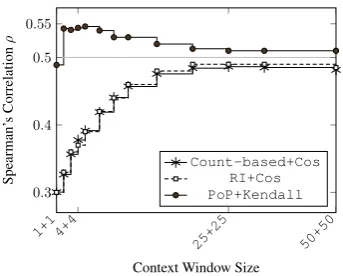
Figure 1 shows the performance of the simple count-based word space model for lemmatized-context-windows that extend symmetrically around lemmas from MEN.10 As expected, up to
dimensional space.
10We use the tokenized preprocessed UKWaC. However,
a certain context-window size, the performance using count-based methods increases with an extension of the window.11 For context-windows larger than 25+25 the performance gradually declines. More importantly, in all cases, we have ρ <0.50.
We performed the same experiments using the RI technique. For each context window size, we performed 10 runs of the RI model construction. Figure1reports for each context-window size the average of the observed performances for the 10 RI models. In this experiment, we used index vectors of dimensionality 1000 containing 4 non-zero elements. As shown in Figure 1, the aver-age performance of the RI is almost identical to the performance of the count-based model. This is an expected result since RI’s objective is to re-tain Euclidean distances between vectors (thus co-sine) but in spaces of lowered dimensionality. In this sense, RI is successful and achieves its goal of lowering the dimensionality while keeping Eu-clidean distances between vectors. However, us-ing RI+cosine does not yield any improvements in the similarity assessment task.
We then performed similar experiments using PoP-constructed models, with the same context window sizes and the same dimensions as in the RI experiments, averaging again over 10 runs for each context window size. The performance is also reported in Figure 1. For the PoP method, however, instead of using the cosine measure we use Kendall’s τb for measuring similarities. The
PoP-constructed models converge faster than RI and count-based methods and for smaller context-windows they outperform the count-based and RI methods with a large margin. However, as the sizes of the windows grow, performances of these methods become more similar (but PoP still out-performs the others). In any case, the performance of PoP remains above0.50(i.e.,ρ > 0.50). Note that in RI-constructed models, using Kendall’sτb
also yield better performance than using cosine.
3.2 PPMI Transformation of PoP Vectors
Although PoP outperforms RI and count-based models, compared to the state-of-the-art methods,
listed in MEN, we do not use any additional information or processes (i.e., no frequency cut-off for context selection, no syntactic information, etc.).
11After all, in models for relatedness tests, relationships of
topical nature play a more important role than other relation-ships such as synonymy.
1+1 4+4
25+25 50+50 0.3
0.4 0.5 0.55
Context Window Size
Spearman’
sCorrelation
ρ
Count-based+Cos RI+Cos PoP+Kendall
Figure 1: Performance of the classic count-based a-word-per-dimension model vs. RI vs. Pop in the MEN relatedness test. Note that count-based and RI models show almost an identical performance in this task.
its performance is still not satisfying. Transfor-mations based on association measures such as PPMI have been proposed to improve the discrim-inatory power of context vectors and thus the per-formance of models in semantic similarity assess-ment tasks (seeChurch and Hanks (1990),Turney (2001), Turney (2008), and Levy et al. (2015)). For a given set of vectors, pointwise mutual mation (PMI) is interpreted as a measure of infor-mation overlap between vectors. As put byBouma (2009), PMI is a mathematical tool for measuring how much the actual probability of a particular co-occurrence (e.g., two words in a word space) deviate from the expected probability of their in-dividual occurrences (e.g., the probability of oc-currences of each word in a words space) under the assumption of independence (i.e., the occur-rence of one word does not affect the occuroccur-rences of other words).
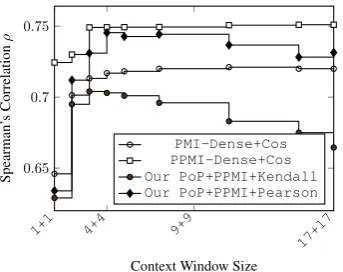
In Figure2, we show the performance of PMI-transformed spaces. Count-based PMI+Cosine models outperform other techniques including the introduced PoP method. The performance of PMI models can be further enhanced by their normalization, often discarding negative values12 and using PPMI. Also, SVD truncation of PPMI-weighted spaces can improve the performance slightly (see the above mentioned references) requiring, however, expensive computations of eigenvectors.13 For ap×nmatrix with elements vxy,1 ≤ x ≤pand1≤ y ≤ n, we compute the
12SeeBouma (2009) for a mathematical delineation.
Juraf-sky and Martin (2015) also provide an intuitive description.
13In our experiments, applying SVD truncation to models
[image:5.595.332.504.59.197.2]1+1 4+4 9+9
17+17 0.65
0.7 0.75
Context Window Size
Spearman’
sCorrelation
ρ
[image:6.595.98.270.60.196.2]PMI-Dense+Cos PPMI-Dense+Cos Our PoP+PPMI+Kendall Our PoP+PPMI+Pearson
Figure 2: Performances of (P)PMI-transformed models for various sizes of context-windows. From context size 4+4, the performance re-mains almost intact (0.72 for PMI and 0.75 for PPMI). We also report the average performance for PoP-constructed models constructed at the dimensionality m = 1000 and s = 0.002. PoP+PPMI+Pearson exhibits a performance sim-ilar as dense PPMI-weighted models, however, much faster and using far less amount of computa-tional resources. Note that reported PoP+PMI per-formances can be enhanced by usingm >1000.
PPMI weight for a componentvxy as follows:
ppmi(vxy) = max(0,logvxy× Pp
i=1Pnj=1vij Pp
i=1viy×Pnj=1vxj). (3) The most important benefit of the PoP method is that PoP-constructed models, in contrast to pre-viously suggested random projection-based mod-els, can be still weighted using PPMI (or any other weighting techniques applicable to the original count-based models). In an RI-constructed model, the sum of values of row and column vectors of the model are always 0 (i.e.,Ppi=1viyandPnj=1vxj
in Equation 3 are always 0). As mentioned ear-lier, this is due to the fact that a random projec-tion matrix in RI has an asymptotic standard Gaus-sian distribution (i.e., transformation matrixRhas E(R) = 0). As a result, PPMI weights for the RI-induced vector elements are undefined. In contrast to RI, the sum of values of vector elements in the PoP-constructed models is always greater than 0 (because the transformation is carried out by a pro-jection matrixRof E(R) > 0). Also, depending on the structure of data in the underlying count-based model, by choosing a suitably large value of s, it can be guaranteed that the sum of column vec-tors is always a non-zero value. Hence, vecvec-tors in PoP models can undergo the PPMI transformation defined in Equation3. Moreover, the PPMI
trans-formation in PoP models is much faster, compared to the one performed on count-based models, due to the low dimensionality of vectors in the PoP-constructed model. Therefore, the PoP method makes it possible to benefit both from the high ef-ficiency of randomized techniques as well as from the high accuracy of PPMI transformation in se-mantic similarity tasks.
If we put aside the information-theoretic inter-pretation of PPMI weighting (i.e., distilling sta-tistical information that matters), the logarithmic transformation of probabilities in the PPMI def-inition plays the role of a power transformation process for converting long-tailed distributions in the original high-dimensional count-based models to Gaussian-like distributions in the transformed models. From a statistical perspective, any varia-tion of PMI transformavaria-tion can be seen as an at-tempt to stabilize the variance of vector coordi-nates and therefore to make the observations more similar/fit to Gaussian distribution (a practice with a long history in research, particularly in the bio-logical and psychobio-logical sciences).
To exemplify this phenomenon, in Figure3, we show histograms of the distributions of the as-signed weights to the vector that represents the lemmatized form of the verb ‘abandon’ in vari-ous models. As shown, the raw collected fre-quencies in the original high-dimensional count-based model have a long tail distribution (see Fig-ure 3a). Applying the log transformation to this vector yields a vector of weights with a Gaus-sian distribution (Figure 3b). Weights in the RI-constructed vector (Figure 3c) have a perfect Gaussian distribution but with an expected value of 0 (i.e., N(0,1)). The PoP method, however, largely preserves the long tail distribution of coor-dinates from the original space (Figure3d), which in turn can be weighted using PPMI and thereby transformed into a Gaussian-like distribution.
Given that models after the PPMI transforma-tion have bell-shaped Gaussian distributransforma-tions, we expect that a correlation measure such as Pear-son’sr, which takes advantage of the prior knowl-edge about the distribution of data, outperforms the non-parametric Kendall’s τb for computing
similarities in PPMI-transformed spaces.14 This is indeed the case (see Figure2).
14Note that using correlation measures such as Pearson’sr
100 10,000 1
10 100 1,000
log(Raw Frequencies)
log(Frequency)
(a) Count-based
0 50 100
200 300 400
PMI Weights Frequency
(b) PMI
−1,700 0 1,700 20
40
RI Weights Frequency
(c) RI
10 1,000 100,000 10
log(POP Weights) log(Frequency)
(d) POP
−50 0 50 100 100
200 300 400
POP PMI Weights Frequency
[image:7.595.92.512.73.180.2](e) POP+PMI Figure 3: A histogram of the distribution of frequencies of weights (i.e., the value of the coordinates) in various models built from 1+1 context-windows for the lemmatized form of the verb ‘abandon’ in the UKWaC corpus.
3.3 PoP’s Parameters, its Random Behavior and Performance
As discussed in § 2.3, PoP is a randomized al-gorithm and its performance is influenced by a number of parameters. In this section, we study the PoP method’s behavior by reporting its perfor-mance in the MEN relatedness test under different parameter settings. To keep evaluations and re-ports to a manageable size, we focus on models built using context-windows of size 4+4.
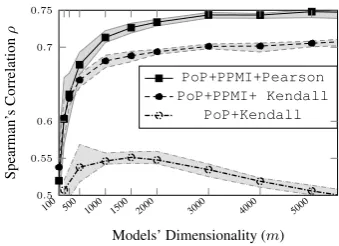
Figure4shows the method’s performance when the dimensionmof the projected index vectors in-creases. In these experiments, index vectors are built using 4 non-zero elements; thus, as m in-creases, s in Equation2 decreases. For each m,
100 ≤ m ≤ 5000, the models are built 10 times and the average as well as the maximum and the minimum observed performances in these exper-iments are reported. For PPMI transformed PoP spaces, with increasing dimensions, the perfor-mance boosts and, furthermore, the variance in performance (i.e., the shaded areas)15gets smaller. However, for the count-based PoP method with-out PPMI transformation (shown by the dash-dotted lines) and with the number of non-zero ele-ments fixed to 4, increasingmover 2000 decreases the performance. This is unexpected since an in-crease in dimensionality is usually assumed to en-tail an increase in performance. This behavior, however, can be the result of using a very small s; simply put, the number of non-zero elements are not sufficient to build projected spaces with adequate distribution. To investigate this matter, we study the performance of the method with the dimension m fixed to 3000 but with index
vec-15Evidently, the probability of worst and best
perfor-mances can be inferred from the reported average results.
100 500 1000 1500 2000 3000 4000 5000
0.5 0.55 0.6 0.7 0.75
Models’ Dimensionality (m)
Spearman’
sCorrelation
ρ
PoP+PPMI+Pearson PoP+PPMI+ Kendall
[image:7.595.332.502.251.374.2]PoP+Kendall
Figure 4: Changes in PoP’s performance when the dimensionality of models increases. The av-erage performance in each set-up is shown by the marked lines. The margins around these lines show the minimum and maximum performance observed in 10 independent executions.
tors built using different numbers of non-zero ele-ments, i.e., different values ofs.
1 2 4 8 16 32
0.5 0.55 0.6 0.7 0.75
1
Number of Non-Zero Elements in Index Vectors
Spearman’
sCorrelation
ρ
PoP+PPMI+Pearson PoP+PPMI+ Kendall
[image:8.595.99.265.61.173.2]PoP+Kendall
Figure 5: Changes in PoP’s performances when the dimensionality of models are fixed to m = 3000and the number of non-zero elements in in-dex vectors (i.e.,s) increases. The average perfor-mances in each set-up are shown by marked lines. The margins around these lines show the minimum and maximum performance observed in 10 inde-pendent executions.
the original space and the projected/transformed spaces. It seems that the sparsity of vectors in the original matrix plays a role in finding the optimal value for s. If PoP-constructed models are used directly (together with τb) for
comput-ing similarities, then we propose 0.002 < s. If PoP-constructed models are subject to an addi-tional weighting process for stabilizing vector dis-tributions into Gaussian-like disdis-tributions such as PPMI, we propose using only 1 or 2 non-zero ele-ments.
Last but not least, we confirm that by care-fully selecting context elements (i.e., removing stop words and using lower and upper bound fre-quency cut-offs for context selection) and fine tun-ing PoP+PPMI+Pearson (i.e., increastun-ing the di-mension of models and scaling PMI weights as inLevy et al. (2015)) we achieve an even higher score in the MEN test (i.e., an average of 0.78 with the max of 0.787). Moreover, although improve-ments from applying SVD truncation are negligi-ble, we can employ it for reducing the dimension-ality of PoP vectors (e.g., from 6000 to 200).
4 Conclusion
We introduced a new technique called PoP for the incremental construction of semantic spaces. PoP can be seen as a dimensionality reduction method, which is based on a newly devised random pro-jection matrix that contains only positive integer values. The major benefit of PoP is that it trans-fers vectors onto spaces of lower dimensionality without changing their distribution to a Gaussian
4 6 8 10 12 14 16 18 20
0
0.2
0.4
0.6
0.8
1
non-zero elements P6⊥
#index vectorsn= 104
1 4
·104
n #non-zero elements= 8
m= 100
m= 1000
m= 2000
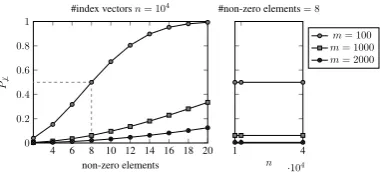
Figure 6: The proportion of non-orthogonal pairs of index vectors (P6⊥) obtained in a simulation for
various dimensionality and number of non-zero el-ements. The left figure shows the changes ofP6⊥
for a fixed number of index vectorsn= 104when
the number of non-zero elements increases. The right figure showsP6⊥ when the number of
non-zero elements is fixed to 8 but the number of index vectorsnincreases. As shown,P6⊥is determined
by the number of non-zero elements and the di-mensionality of index vectors and independently ofn.
shape with zero expectation. The obtained trans-formed spaces using PoP can, therefore, be manip-ulated similarly to the original high-dimensional spaces, only much faster and consequently requir-ing a considerably lower amount of computational resources.
PPMI weighting can be easily applied to PoP-constructed models. In our experiments, we observe that PoP+PPMI+Pearson can be used to build models that achieve a high perfor-mance in semantic relatedness tests. More con-cretely, for index vector dimensions m ≥ 3000, PoP+PPMI+Pearson achieves an average score of 0.75 in the MEN relatedness test, which is compa-rable to many neural embedding techniques (e.g., see scores reported inChen and de Melo (2015) andTsvetkov et al. (2015)). However, in contrast to these approaches, PoP+PPMI+Pearson achieves this competitive performance without the need for time-consuming training of neural nets. Moreover, the processes involved are all done on vectors of low dimensionality. Hence, the PoP method can dramatically enhance the performance in tasks in-volving distributional analysis of natural language.
Acknowledgments
[image:8.595.311.504.63.149.2]References
Sanjeev Arora, Aditya Bhaskara, Rong Ge, and Tengyu Ma. 2014. Provable bounds for learning some deep
representations. In Proceedings of the 31st
Inter-national Conference on Machine Learning, ICML 2014, Beijing, China, 21-26 June 2014, pages 584– 592.
Marco Baroni, Alessandro Lenci, and Luca Onnis. 2007. ISA meets Lara: An incremental word space model for cognitively plausible simulations of
se-mantic learning. In Proceedings of the Workshop
on Cognitive Aspects of Computational Language Acquisition, pages 49–56, Prague, Czech Republic, June. Association for Computational Linguistics. Marco Baroni, Silvia Bernardini, Adriano Ferraresi,
and Eros Zanchetta. 2009. The wacky wide web: a collection of very large linguistically processed
web-crawled corpora. Language Resources and
Evaluation, 43(3):209–226.
Marco Baroni, Georgiana Dinu, and Germ´an
Kruszewski. 2014. Don’t count, predict! a
systematic comparison of context-counting vs.
context-predicting semantic vectors. InProceedings
of the 52nd Annual Meeting of the Association for Computational Linguistics (Volume 1: Long Papers), pages 238–247, Baltimore, Maryland, June. Association for Computational Linguistics. Ella Bingham and Heikki Mannila. 2001. Random
projection in dimensionality reduction: applications
to image and text data. InProceedings of the
Sev-enth ACM SIGKDD International Conference on Knowledge discovery and data mining, KDD ’01, pages 245–250, New York, NY, USA. ACM. Gerlof Bouma. 2009. Normalized (pointwise) mutual
information in collocation extraction. In
Proceed-ings of the Biennial GSCL Conference.
Elia Bruni, Nam Khanh Tran, and Marco Baroni. 2014.
Multimodal distributional semantics. J. Artif. Int.
Res., 49(1):1–47, January.
Jiaqiang Chen and Gerard de Melo. 2015. Semantic information extraction for improved word
embed-dings. InProceedings of the 1st Workshop on Vector
Space Modeling for Natural Language Processing, pages 168–175, Denver, Colorado, June. Associa-tion for ComputaAssocia-tional Linguistics.
Peter Y. Chen and Paula M. Popovich. 2002.
Cor-relation: Parametric and Nonparametric Measures. Quantitative Applications in the Social Sciences. Sage Publications.
Kenneth Ward Church and Patrick Hanks. 1990. Word association norms, mutual information, and
lexicog-raphy.Comput. Linguist., 16(1):22–29, March.
Trevor Cohen, Roger Schvaneveldt, and Dominic Wid-dows. 2010. Reflective random indexing and indi-rect inference: A scalable method for discovery of
implicit connections. Journal of Biomedical
Infor-matics, 43(2):240 – 256.
Zellig Harris. 1954. Distributional structure. Word,
10(2-3):146–162.
Robert Hecht-Nielsen. 1994. Context vectors: gen-eral purpose approximate meaning representations
self-organized from raw data. Computational
Intel-ligence: Imitating Life, pages 43–56.
Piotr Indyk. 2000. Stable distributions, pseudorandom generators, embeddings and data stream
computa-tion. In41st Annual Symposium on Foundations of
Computer Science, pages 189–197.
William Johnson and Joram Lindenstrauss. 1984. Ex-tensions of Lipschitz mappings into a Hilbert space. In Conference in modern analysis and probabil-ity (New Haven, Conn., 1982), volume 26 of Con-temporary Mathematics, pages 189–206. American Mathematical Society.
William P. Jones and George W. Furnas. 1987. Pic-tures of relevance: A geometric analysis of
similar-ity measures. Journal of the American Society for
Information Science, 38(6):420–442.
Daniel Jurafsky and James H. Martin, 2015. Speech
and Language Processing, chapter Chapter 19: Vec-tor Semantics. Prentice Hall, 3rd edition. Draft of August 24, 2015.
Pentti Kanerva, Jan Kristoferson, and Anders Holst. 2000. Random indexing of text samples for latent
semantic analysis. InProceedings of the 22nd
An-nual Conference of the Cognitive Science Society, pages 103–6. Erlbaum.
Richard M. Karp. 1991. An introduction to
ran-domized algorithms. Discrete Applied Mathematics,
34(13):165 – 201.
Samuel Kaski. 1998. Dimensionality reduction by ran-dom mapping: fast similarity computation for
clus-tering. InThe 1998 IEEE International Joint
Con-ference on Neural Networks, volume 1, pages 413– 418.
Maurice G. Kendall. 1938. A new measure of rank
correlation. Biometrika, 30(1-2):81–93.
Douwe Kiela and Stephen Clark. 2014. A systematic study of semantic vector space model parameters. In Proceedings of the 2nd Workshop on Continu-ous Vector Space Models and their Compositionality (CVSC), pages 21–30, Gothenburg, Sweden, April. Association for Computational Linguistics.
William R. Knight. 1966. A computer method
Omer Levy and Yoav Goldberg. 2014. Neural word embedding as implicit matrix factorization. In Z. Ghahramani, M. Welling, C. Cortes, N. D.
Lawrence, and K. Q. Weinberger, editors,Advances
in Neural Information Processing Systems 27, pages 2177–2185. Curran Associates, Inc.
Omer Levy, Yoav Goldberg, and Ido Dagan. 2015. Im-proving distributional similarity with lessons learned
from word embeddings. Transactions of the
Associ-ation for ComputAssoci-ational Linguistics, 3:211–225.
Ping Li, Trevor J. Hastie, and Kenneth W. Church.
2006. Very sparse random projections. In
Proceed-ings of the 12th ACM SIGKDD International Con-ference on Knowledge Discovery and Data Mining, KDD ’06, pages 287–296, New York, NY, USA. ACM.
Tomas Mikolov, Ilya Sutskever, Kai Chen, Greg S Cor-rado, and Jeff Dean. 2013. Distributed representa-tions of words and phrases and their composition-ality. In C. J. C. Burges, L. Bottou, M. Welling,
Z. Ghahramani, and K. Q. Weinberger, editors,
Ad-vances in Neural Information Processing Systems
26, pages 3111–3119. Curran Associates, Inc.
Marvin Lee Minsky and Seymour Papert. 1969.
Per-ceptrons: An Introduction to Computational
Geom-etry. MIT Press.
Behrang QasemiZadeh. 2015. Random indexing
revis-ited. In20th International Conference on
Applica-tions of Natural Language to Information Systems,
NLDB, pages 437–442. Springer.
The Apache Commons Mathematics
Li-brary [Computer Software]. 2016.
KendallsCorrelation Class. Retrieved from
https://commons.apache.org/proper/commons-math/javadocs/api-3.6.1/index.html.
Yulia Tsvetkov, Manaal Faruqui, Wang Ling, Guil-laume Lample, and Chris Dyer. 2015. Evaluation of word vector representations by subspace alignment. In Proceedings of the 2015 Conference on Empiri-cal Methods in Natural Language Processing, pages 2049–2054, Lisbon, Portugal, September. Associa-tion for ComputaAssocia-tional Linguistics.
Peter D. Turney and Patrick Pantel. 2010. From fre-quency to meaning: Vector space models of
seman-tics. J. Artif. Int. Res., 37(1):141–188, January.
Peter D. Turney. 2001. Mining the web for synonyms:
PMI-IR versus LSA on TOEFL. InProceedings of
the 12th European Conference on Machine
Learn-ing, EMCL ’01, pages 491–502, London, UK, UK.
Springer-Verlag.
Peter D. Turney. 2008. The latent relation mapping
engine: Algorithm and experiments. J. Artif. Int.
Res., 33(1):615–655, December.
Behrang Q. Zadeh and Siegfried Handschuh. 2014. Random Manhattan integer indexing: Incremental
L1 normed vector space construction. In
Proceed-ings of the 2014 Conference on Empirical Methods in Natural Language Processing, EMNLP 2014, Oc-tober 25-29, 2014, Doha, Qatar, A meeting of SIG-DAT, a Special Interest Group of the ACL, pages 1713–1723.
A Supplemental Material