Improving unsupervised vector-space thematic fit evaluation
via role-filler prototype clustering
Clayton Greenberg, Asad Sayeed and Vera Demberg
Computational Linguistics and Phonetics / M2CI Cluster of Excellence Saarland University
66123 Saarbr¨ucken, Germany
{claytong,asayeed,vera}@coli.uni-saarland.de
Abstract
Most recent unsupervised methods in vector space semantics for assessing thematic fit (e.g. Erk, 2007; Baroni and Lenci, 2010; Sayeed and Demberg, 2014) create prototypical role-fillers without performing word sense disam-biguation. This leads to a kind of sparsity problem: candidate role-fillers for different senses of the verb end up being measured by the same “yardstick”, the single prototypical role-filler.
In this work, we use three different feature spaces to construct robust unsupervised mod-els of distributional semantics. We show that correlation with human judgements on the-matic fit estimates can be improved consis-tently by clustering typical role-fillers and then calculating similarities of candidate role-fillers with these cluster centroids. The sug-gested methods can be used in any vector space model that constructs a prototype vec-tor from a non-trivial set of typical vecvec-tors.
1 Introduction
Thematic fit estimations can be quite useful for many NLP applications and also for cognitive mod-els of human language processing difficulty, since human processing difficulty is highly sensitive to semantic plausibilities (Ehrlich and Rayner, 1981). For example, we expect that after the word mash, banana would be easier to process because it fits well as the patient, or direct object, of mash, but milkwould be harder to process because it does not fit well.
A common method for estimating the thematic fit between a verb and a proposed role filler involves computing a centroid, or vector average, over the most typical role fillers for that verb, and then cal-culating the cosine similarity between this centroid and the proposed role filler (Baroni and Lenci, 2010; Blacoe and Lapata, 2012; Erk, 2012). For instance, we use the cosine of the angle between thebanana vector and a vector average of the 20 nouns that, according to training data, are most likely to be mashed as a score for how wellbanana fits as the patient ofmash. Hopefully, thebananavector will be closer to the centroid thanmilk, so banana will have a higher cosine similarity to the centroid, and thus a higher thematic fit score, thanmilk.
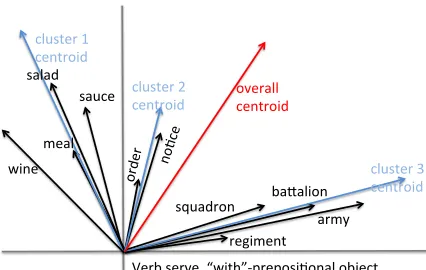
This conceptualization assumes that the most typ-ical fillers for a verb-role will all be variants of a single prototype, i.e. distributionally similar to each other. However, such an assumption may not be true for ambiguous verbs. A verb with many dif-ferent senses may have typical fillers for each sense, which fit relatively equally well, but are distribution-ally very different from one another. This means that the calculated prototypical filler will be a mixture of the arguments that are typical role fillers for the main senses of the verb. For example, consider the verbserve, for which the 24 most typical preposi-tional arguments related via the prepositionwithfall into three different senses, as illustrated in Figure 1. Supposing that the centroid occupies a part of the vector space between two typical role fillers, but is relatively far from any one of the typical role fillers from which it was composed, as in Figure 1, none of the original typical role fillers will achieve high
overall centroid
regiment
Verb serve, “with”-‐preposi9onal object ba;alion squadron
army no9c
e
orde r sauce salad
meal
wine cluster 3 centroid cluster 2
centroid cluster 1
[image:2.612.85.298.55.190.2]centroid
Figure 1: Illustration ofTypeDM centroid for with-PP arguments of the verbserve.
matic fit scores. Also, verbs will be “penalized” for having many senses in that it will seem as though no role filler fits as well as they do with unambiguous verbs. This may produce inconsistent judgements when comparing one verb that is highly polysemous with a second, more restrictive verb whose mean-ing overlaps with the most dominant meanmean-ings of the first verb. For example, cutcan be used in the sense of “cutting costs,” which carries with it re-strictions on instruments, locations, and so on that somewhat overlap witheliminateas in “eliminating costs.” Things that are plausible to be eliminated are also plausible to be cut. Butcutis also used in the sense of “cutting a cake” or “cutting (editing) a film.” Without taking word sense into account,costs would be judged by the model as being less appro-priate as a patient ofcutthan it should, and also its score for filling the patient role ofeliminatewould be infelicitously higher than its score for filling the patient role ofcut.
One possible solution to this problem would be to do full word sense disambiguation on the re-sources from which these vector spaces are con-structed. Then, there would be separate entries in the space for each meaning. This would however increase the overall size of the vector space by a sig-nificant factor and also cause an additional burden on corpus construction and annotation, even if auto-matic.
In this paper, we will approach the verb-role sense problem by clustering the most typical role-filler vectors and calculating the maximal cosine similar-ity for a candidate role filler with respect to each
cluster prototype vector. So, to estimate the the-matic fit ofsaladas an item with which something is served, in the vector space represented by Fig-ure 1, we would use the cosine similarity with the nearest cluster centroid, the cluster 1 centroid. For a thematic fit task, the correlation between calcu-lated estimates and human judgements can be ex-pected to improve. In particular, good role fillers that are very different from one another and belong to different senses of a verb can all be assigned the-matic fit scores as high as those of good role fillers of monosemous verbs.
We will evaluate our system using three distribu-tional spaces: TypeDM (Baroni and Lenci, 2010), which is based on a syntactic dependency parser,
SDDM (Sayeed and Demberg, 2014), which uses features obtained from the semantic role labeller SENNA (Collobert et al., 2011), and SDDMX, a novel extension ofSDDM. This way, we can draw conclusions about feature space-specific and feature space-general trends.
The effects of clustering and choice of distri-butional space will be evaluated against the Pad´o (2007) and McRae et al. (1998) datasets of hu-man judgements on thematic fit of agent and patient roles, and the Ferretti et al. (2001) datasets of human judgements on thematic fit of instrument and loca-tion roles. These different roles are conceptually in-teresting to compare, as instruments tend to be more strongly constrained by verbs than locations.
2 Background and related work
2.1 Thematic fit
Verb Noun Semantic role Score
advise doctor agent 6.8
advise doctor patient 4.0
confuse baby agent 3.7
confuse baby patient 6.0
eat lunch agent 1.1
eat lunch patient 6.9
kill lion agent 2.7
kill lion patient 4.9
kill man agent 3.4
[image:3.612.85.284.57.210.2]kill man patient 5.4
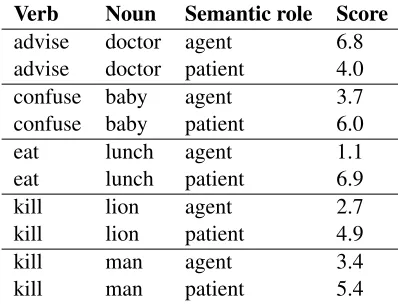
Table 1: Sample of judgements from Pad´o (2007).
In order to model thematic roles, we use the in-sight that thematic fit correlates with human plau-sibility judgements (Pad´o et al., 2009; Vandekerck-hove et al., 2009). Therefore, we can use datasets of human plausibility judgements to evaluate com-putational thematic fit estimates. One such dataset by Pad´o (2007) includes 18 verbs with up to 12 can-didate nominal arguments and totals 414 verb-noun-role triples. The words were chosen based on their frequencies in the Penn Treebank and FrameNet. Human participants were asked to rate the appropri-ateness of given nouns as agents and as patients for given verbs on a scale from 1 to 7. The judgements were then averaged. We provide a small sample of these judgements in Table 1.
We use three other datasets as well. Ferretti et al. (2001) provide two datasets, one with 248 verb-instrument pairs and one with 274 verb-location pairs. Additionally, McRae et al. (1998) give a dataset of 1444 more agent/patient judgements. We write agent/patient as such because like Pad´o (2007), the agent plausibility and patient plausibility are given in the same dataset, albeit separately. Once again, human participants were asked to rate the ap-propriateness of given nouns as locations, instru-ments, and agents/patients, respectively, of the verbs in each dataset on a scale from 1 to 7. We will make use of these in our evaluation in order to see how well the models and algorithms we propose apply to various thematic roles, not just the most commonly tested and to-date most accurately estimated roles of agent and patient.
2.2 Distributional Semantics 2.2.1 Distributional Memory
Our semantic modeling technique comes from Baroni and Lenci (2010), who developed an explic-itly multifunctional, i.e. not tightly bound to a par-ticular task, framework for recording distributional information about linguistic co-occurrence. Distri-butional Memory (DM) records frequency informa-tion about links between words in a sentence as a third order tensor, in which words or lemmata are represented as two of the tensor axes and the syntac-tic or semansyntac-tic link between them is the third axis.
The following corpora were used to construct the Baroni and Lenci (2010) version of DM:
• ukWaC, a corpus of about two billion words collected by crawling the .uk web domain (Ferraresi et al., 2008).
• WackyPedia, a snapshot selection of Wikipedia articles.
• The British National Corpus (BNC), a 100-million word corpus including documents such as books and periodicals.
The sentences from these sources were first run through MaltParser (Nivre et al., 2007). The dependency links (e.g. SBJ, NMOD) were run through a set of hand-crafted patterns to identify higher-level lexicalized links (e.g. as-long-as, in-a-kind-of). They then counted link type fre-quencies, so that links that involve the same lexi-cal item (e.g. long, kind, as in the lexicalized links just mentioned) were collapsed into a single link, and the number of surface form realizations was used as the frequency count. All words were lemmatized and stored with basic part of speech in-formation.
All these counts were then adjusted by Local Mu-tual Information (Baroni and Lenci, 2010), which is given by
LMI(i, j, k) =OijklogOEijkijk (1)
2.2.2 DM Based on Semantic Role Labels In order to create a competitor to the much less manually pruned cousin of TypeDM named DepDM, Sayeed and Demberg (2014) basedSDDM
(short for SENNA-DepDM) on similar corpora but used alternative features. Namely, this tensor was built from ukWaC and BNC, but the features came from a semantic role labelling (SRL) system called SENNA (Collobert and Weston, 2007; Collobert et al., 2011). SENNA uses a multi-layer neural net-work architecture that learns in a sliding window over token sequences working on raw text instead of syntactic parses, as other semantic role labellers do (Bohnet, 2010). SENNA extracts word features re-lated to identity, capitalization, and suffix/tense (ap-proximated by the last two characters of the word). From these features, in a process similar to decod-ing a conditional random field, the network derives features related to verb position, part of speech, and chunk membership.
SENNA was trained on PropBank and large amounts of unlabelled data. It achieves a role la-belling F-score of 75.49% (in this case, tested on CoNNL 2005 data), which is slightly lower than state of the art SRL systems which use parse trees as input.
SDDM was built by running the sentences from the input corpora through SENNA and using the role labels as links between predicates and role-fillers. Unlike TypeDM, SDDM required almost no fur-ther processing; the raw frequency counts of triples were used in the LMI calculation.
In this paper, we present SDDMX, an extended version of theSDDM model1. SDDMX contains
the same links asSDDMand also contains links be-tween nouns that belong to the same predicate in-stance, using the predicate as a link label. For exam-ple, supposing that during training the system en-counteredthe man eats a donutwith a role link be-tween man and eat and another role link between donut and eat, then in SDDMX, a link was cre-ated betweenmananddonut. This link was labelled with the verb lemma for the 400 most frequent verbs (eatin our example), andvbotherwise.
Sayeed and Demberg (2014) found that although
1We provideSDDM andSDDMXat
http://rollen.mmci.uni-saarland.de/.
the donut was eaten by Bob NMOD
SBJ VC
LGS PMOD
the donut was eaten by Bob
[image:4.612.343.512.55.145.2]ARG1 V ARG0
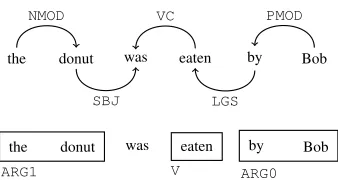
Figure 2: The same sentence with MaltParser (above) and SENNA (below) labels. Sayeed and Demberg (2014) used a simplified approach similar to the head percola-tion table of Magerman (1994) to find head nouns from SENNA annotation.
SDDM is an arguably simpler DM model than
TypeDM, it performs nearly as well asTypeDM on a thematic fit estimation task using the Pad´o (2007) and McRae et al. (1998) agent/patient datasets. They also found that averaging the thematic fit scores of SDDM with those of TypeDM outperforms
TypeDM alone and nearly reaches the performance of a supervised model (Herda˘gdelen and Baroni, 2009). This suggests that TypeDM and SDDM
cover different aspects of the corpora on which they were trained. Links generated by SENNA may directly access semantic role features that the MaltParser-based TypeDM must infer through hand-crafted rules, such as tagging the subject as a patient instead of an agent in passive-voice contexts. Figure 2 illustrates the differences between the la-belling approaches.
We make use of the SDDM, SDDMX, and
TypeDM tensors in our experiments to demonstrate how our techniques improve performance in the-matic fit modelling across different feature spaces.
2.2.3 Centroid-based thematic fit calculation in DM
Investigating alternative ways to calculate the-matic fit over the DM framework is a major goal of this work, so we now describe the baseline process.
Baroni and Lenci (2010) used the following ap-proach to estimate thematic fit on the Pad´o (2007) agent/patient dataset: To assess the fit of a nounw1
in a role r for a verbw2, they construct a centroid
from the 20 highest-ranked fillers forrwithw2
thematic roles. To illustrate, in order to determine how well workshop fits as a location for eat, they would construct a centroid of other locations foreat that appear in the DM, e.g.kitchen, restaurant, cafe-teriaup to 20.
Each of these top 20 represent a “slice” of the ten-sor along one of the word axes. One such slice, cor-responding tow1, is a matrix of links and words to
whichw1is connected. This tensor slice is collapsed
into a vector whose components are word-link pairs. This is the vector ofw1.
All 20 such vectors are added up and the sum is the centroid that represents, e.g., the typical loca-tions ofeat. Then a vector is constructed from the slice of the tensor corresponding toworkshop. The thematic fit score is the cosine of the location cen-troid ofeatand the vector ofworkshop.
Accessing thematic roles in SDDM and
SDDMX is straightforward, as the links in these models are PropBank roles. Agent isARG0, patient is ARG1, location is ARGM-LOC, and we use a combination of ARGM-MNR, ARG2, and ARG3 to represent instruments, based on a translation of the roles used by Ferretti et al. (2001). The role mapping for TypeDM involves a combination of sbj tr and subj intr (transitive and intran-sitive subjects) for agents, obj for patients, the prepositional links in, at, and on for locations, andwithfor instruments.
2.3 Word Sense Disambiguation in Distributional Models
While distributional models carry important infor-mation about the relative frequencies of word us-ages, and perhaps even phrase usus-ages, they often must collapse such usages into one representation. For example, suppose within the domain of cooking recipes, serve occurs in its food sense (see cluster 1 in Figure 1) 97% of the time. The other senses will have negligible effect on the representation of servebecause their frequencies are so much lower. But in a web crawl, the distribution is quite likely to be more uniform, which means the senses will “split the difference” in the representation and end up not being that similar to any instance ofserve.
Many systems work to alleviate this problem by performing manipulations on words as they occur in training corpora (e.g., Thater et al., 2011). Namely,
the base vector for the potentially ambiguous word is contextualized, as in scaled element-wise, by the vectors of the neighboring words for that instance. This is quite intuitive because ifserveandcake oc-cur next to each other, the chance that a non-food sense of the wordservewas intended would be ex-tremely small, in fact much smaller than a corpus-wide distribution would predict. These systems have been effective at improving correlation with human judgements for a verb-object composition model, i.e. approximating a vector for serve cake given a vector for serveand a vector for cake (Kartsak-lis et al., 2014), and also reducing noise in simi-larity scores for a nearest neighbor-based preposi-tional phrase attachment disambiguator (Greenberg, 2014).
It remains a choice of the system whether to store explicit senses separately, and relatedly, whether to consult a knowledge base for the number of senses for each word, or even for meaning representations of those senses. Using a task-general knowledge base, in addition to the inherent cost of building one, is not particularly suited for our task because the items to be disambiguated are verb-role pairs, as opposed to just verbs, and usually such knowledge bases do not handle individual thematic roles sepa-rately. For instance, it may be optimal to analyze serveas having three senses with respect to instru-ments, two senses with respect to patients, and one sense with respect to agents.
3 Methods
We begin our discussion of sense disambiguation for thematic fit with the following insight: the baseline (Centroid) method takes as input a set of typical role-fillers, the highest-ranked ones according to the DM, and returns a single prototype vector. How-ever, if we allow the system to return asetof proto-type vectors, then the framework gains the capacity to handle multiple senses of the verb-role pair.
The first choice is how to handle the output. Now instead of one cosine similarity, we would have a set of cosines corresponding to the similarities between the test role-filler and each prototype vector in the set. But if we make the theoretical assumption that each prototype corresponds to a sense, then roughly only one should apply at a time. So, we choose to use the one that is most relevant, i.e. similar, to the test role-filler. Therefore, we use the maximum of the cosine similarities as the thematic fit score.
3.1 One best or nearest
In the extreme case, we can just use the unaltered set of highly-ranked role-fillers as our set of prototypes. For example, if we queryTypeDM for the top four instrument-fillers of eat, we would retrieve spoon, hand, bread,andsauce. Then, to assign a thematic fit score forforkas an instrument-filler, we compute the cosine similarities of (fork,spoon), (fork,hand), (fork, bread), and (fork, sauce). The cosine simi-larity of (fork, spoon) is the highest, so this cosine determines the score. We refer to this method as
OneBest. Note that OneBest requires the calcu-lation of a large number of cosines, which is a rel-atively expensive operation given the sparse repre-sentations of words in DM spaces.
The number of retrieved top role-fillers (n) ap-pears to be the only parameter for OneBest. Yet, this method poses a few theoretical questions. First, there most likely should be an upper bound on the number of role-fillers that the system can retrieve at once. Mathematically, allowing the system to re-trieve the entire relevant cross-section of the ten-sor would be equivalent to reducing the thematic fit evaluation task to a binary decision, i.e. whether the verb-role has occurred with the test role-filler in the training data. So, we would not be able to model any graded effect on the fit of two seen role-fillers, even
if one of them fits with the verb-role better than the other. Also, psycholinguistically, it seems implausi-ble that one must remember all of the times that one has encountered a word in order to use it. Therefore, we impose 50 as an arbitrary upper bound onn. We also set a lower bound of 10 on n because values smaller than this generated quite erratic sets of top role-fillers.
Second,OneBest might return a cosine of 1.0 if the DM retrieves the test role-filler itself as one of the top role-fillers. This could unfairly help the cor-relation between the cosines returned by the system and human judgements because the good role-fillers would all have the same cosine value, thus reducing the effect of the cosine ratings produced for the more distant (interesting) role-fillers. Therefore, we pro-hibit our system from returning any cosines of 1.0. The test role-filler thus achieves a high score by hav-ing a closely related role-filler in the prototype set, not by being present itself.
3.2 Clustering
In order to reduce noise fromOneBest, we cluster similar top role-fillers together, calculate centroids for each cluster, and use these cluster centroids as the prototype set. This way, the presence of an anomalous vector in the centroid set has less effect. We use the group average agglomerative clustering package within NLTK (Bird et al., 2009). This algo-rithm works by initializing each top role-filler in its own cluster and iteratively combining the two most similar clusters.
For the stopping criterion, which determines the final number of clusters for the verb-role, we use the Variance Ratio Criterion (V RC) method (Cali´nski and Harabasz, 1974). Letcbe the baseline centroid of all top role-fillers retrieved,f be a top role-filler, andcf be the cluster centroid of the cluster to which fis assigned. Then, this method works by (a) calcu-lating theV RC metric for each number of clusters (k), given by
V RC(k) = kSS−B1/nSS−Wk (2)
where we define
SSB=
X
and
SSW =
X
f(1−cos2(f, cf)) (4) and then (2) choosing the final number of clusters such that
ωk= (V RCk+1−V RCk)−(V RCk−V RCk−1)
(5) is minimized. Intuitively, this procedure is meant to find the number of clusters for which adding another cluster does not explain significantly more variance in the data. Also, note that theV RCmetric is equivalent to the F-score in a one way ANOVA.
The main drawback of theV RCmethod is that it cannot evaluate fewer than three clusters, due to hav-ing both aV RCk+1 and aV RCk−1 term in
Equa-tion (5). However, as long as enough top role-fillers are retrieved, it should not hurt the system. Equiva-lently, we setV RC0andV RC1equal toV RC2. To
examine the effect of this choice, we evaluate two clustering methods: 2Clusters, which chooses two clusters for every verb-role, and kClusters, which dynamically chooses a number of clusters between 3 and 10 based on the above criterion.
Once again, the system is prohibited from return-ing a cosine of 1.0. This means that if the DM re-trieves the test filler itself as one of the top role-fillers, the system would skip comparing the test role-filler against itself if it were in a singleton clus-ter, but would not skip it if it were a member of a cluster of size two or greater. The alternative to this would have been removing the test role-filler before clustering, but we saw these role-filler-specific par-titions as a form of supervision.
3.3 Evaluation procedure
TheCentroid,OneBest,2Clusters, andkClusters
methods each determine their own prototype vector set for a verb-role, and then return the maximum co-sine similarity value for each test role-filler. Proto-type sets are stored in a dictionary so they can be reused. It is necessary to expand the sparse data structure of each vector in order to efficiently com-pute all of the necessary cosine similarities. Finally, we calculate Spearman’s ρ values to measure the correlations between these sets of thematic fit scores and the four datasets of human judgements.
Dataset SDDM(X) TypeDM
Pad´o (2007) 98.6 100.0
McRae et al. (1998) 96.0 95.2
[image:7.612.315.553.59.128.2]Ferretti et al. (2001) inst. 94.0 93.1 Ferretti et al. (2001) loc. 99.6 98.9
Table 2: Coverage (%) by dataset for each DM model.
10 20 30 40 50
0.20
0.30
0.40
Role−fillers retrieved (n)
Spear
man's rho
SDDMX Centroid SDDMX OneBest SDDMX kClusters TypeDM Centroid TypeDM OneBest TypeDM kClusters
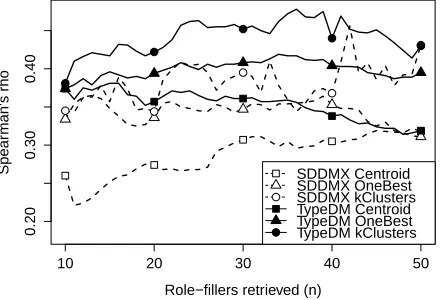
Figure 3: Spearman’sρvalues for Ferretti et al. (2001) instruments vs. the number of vectors retrieved.
For our main experiment, we always retrieve the top 20 highest-ranked role-fillers for the verb-role pair to compute the prototype set. This allows our work to be more directly comparable with other im-plementations. Also, choosing a value of n that maximizesρwould make this unsupervised system more supervised. However, it is useful to know how the number of top role-fillers retrieved affects the correlation with human judgements, so as a follow-up experiment, we evaluate versions of the
Centroid, OneBest, and kClusters methods, with theSDDMX andTypeDM models, retrieving from 10 to 50 top role-fillers, against the Ferretti et al. (2001) instruments dataset.
4 Results
In Table 2, we report the coverage percentages for the DM models on each of the thematic fit datasets. Note that sinceSDDM andSDDMX differ only in the additional links added between existing pairs of words, their coverages are the same.
[image:7.612.315.535.168.318.2]Pad´o (2007) agents McRae et al. (1998) agents Ferretti et al. (2001) instruments
SDDM SDDMX TypeDM SDDM SDDMX TypeDM SDDM SDDMX TypeDM Centroid 0.515 0.528 0.535 0.371 0.394 0.359 0.193 0.274 0.357
OneBest 0.321 0.324 0.464 0.375 0.376 0.431 0.274 0.336 0.394
2Clusters 0.489 0.412 0.522 0.367 0.373 0.370 0.252 0.331 0.388
kClusters 0.281 0.322 0.460 0.396 0.394 0.416 0.335 0.344 0.422 Pad´o (2007) patients McRae et al. (1998) patients Ferretti et al. (2001) locations
SDDM SDDMX TypeDM SDDM SDDMX TypeDM SDDM SDDMX TypeDM Centroid 0.511 0.505 0.525 0.133 0.131 0.343 0.187 0.248 0.230
OneBest 0.447 0.467 0.509 0.214 0.233 0.307 0.234 0.276 0.244
2Clusters 0.526 0.498 0.551 0.175 0.166 0.353 0.294 0.249 0.235
kClusters 0.401 0.428 0.555 0.212 0.227 0.350 0.293 0.326 0.289
All from Pad´o (2007) All from McRae et al. (1998) All datasets
SDDM SDDMX TypeDM SDDM SDDMX TypeDM SDDM SDDMX TypeDM Centroid 0.512 0.521 0.530 0.237 0.251 0.325 0.258 0.296 0.354
OneBest 0.385 0.395 0.482 0.273 0.287 0.345 0.275 0.304 0.359
2Clusters 0.508 0.458 0.532 0.252 0.256 0.336 0.287 0.289 0.366
[image:8.612.70.542.56.290.2]kClusters 0.343 0.375 0.503 0.287 0.294 0.359 0.294 0.317 0.385
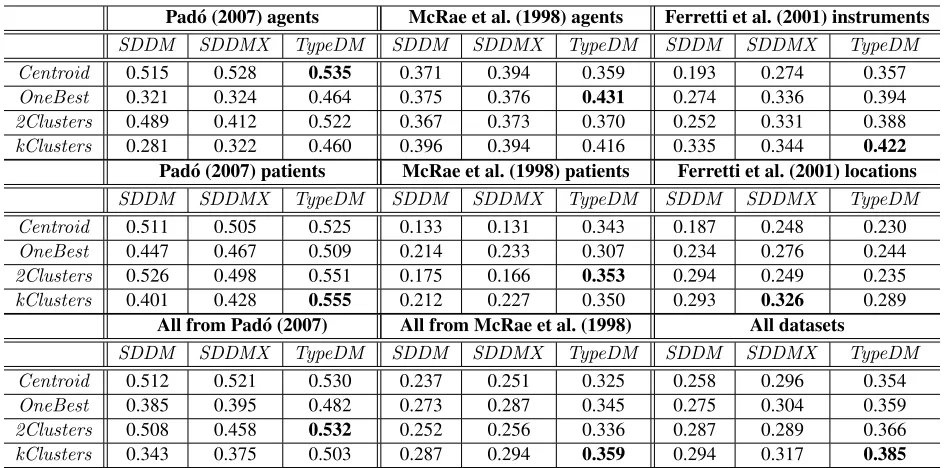
Table 3: Spearman’sρfor each method on each dataset and on all datasets together, using the 20 highest ranked words per verb-role.
The first six sections of Table 3 give the Spear-man’sρvalues for our four centroid set construction methods evaluated against the four datasets of hu-man judgements, organized by thematic role, all us-ing the 20 highest-ranked words per verb-role. We note that theρvalue for the Pad´o (2007) dataset us-ing TypeDM and the Centroid method is slightly higher than the value reported in Baroni and Lenci (2010) due to correcting some transpositions in the original file. Finally, the last three sections of Table 3 give the performance of each method on the two whole agent/patient datasets (for comparison with previous work), as well as on all datasets merged together.
5 Discussion
While SDDM and SDDMX have marginally bet-ter coverage than TypeDM, we do not expect that this had an effect on our results. Figure 3 shows that for the various numbers of vectors retrieved from the DM models, kClusters consistently out-performsOneBest, which consistently outperforms
Centroid on the Ferretti et al. (2001) instruments dataset. So, using just a single centroid that is a mix-ture of all possible good role-fillers for a verb leads to problems due to conflating different word
mean-ings. But at the other extreme, we see how the ρ values for theOneBest method peak (atn= 13for
SDDMX andn = 34 for TypeDM) and then de-crease instead of increasing monotonically. This is because we disallowed cosines of 1.0 and because as we increase the number of vectors retrieved, the easier it becomes to be close to one of the prototype vectors, regardless of thematic fit distinctions within the prototype set.
For the model comparison, we see that while
TypeDM generally performs better than SDDMX
on instruments, clustering reduces the gap consider-ably. AlsoSDDMX outperforms TypeDM for all methods on locations as shown in Table 3. This dif-ference suggests that locations appear in sufficiently diverse syntactic configurations such that the hand-crafted rules fromTypeDM do not work well.
From the All datasets section of Table 3, we see that bothOneBestandkClustersimprove theρ val-ues over the Centroid baseline for all three DM models. This holds, too, for the individual instru-ments and locations datasets. Also, the two cluster-ing methods perform better thanCentroid on Pad´o (2007) patients with all DM models and on McRae et al. (1998) patients withTypeDM. The fact that
con-firms previous analyses that have shown that the dis-tribution of objects is more sensitive to verb sense than subjects. kClusters outperforming OneBest
in a majority of cases suggests that clustering has successfully smoothed the top role-fillers, thus cap-turing sense-like patterns in the verb-roles.
As an example of the effect of the kClusters
method, we obtained the following top 20 instrument-fillers for the verb “eat” in 4 clusters us-ingTypeDM:
• gusto, relish
• family, friend
• chopstick, finger, fork, hand, knife, spoon
• appetite, bread, butter, cheese, food, meal, meat, mouth, rice, sauce
TheV RC method selected 7 to 9 clusters a little more often than 3 to 6, which is perhaps more clus-ters than the number of senses we could expect from a task general knowledge base. We can see from this example that the four clusters do not all correspond to separate senses, but instead, they rather nicely separate out noise from true instruments. Note that since these role-fillers came fromTypeDM, they ap-peared as the object of “with,” as a proxy for finding instruments. The true instruments ended up all in the third cluster, which created a cluster centroid that is less affected by noise and errors from the syntactic or semantic parse. So, the higher number of senses seems appropriate for this task and data.
We attribute the differences in results between the Pad´o (2007) and McRae et al. (1998) datasets to the differences in how these datasets were con-structed. First, the Pad´o (2007) dataset contains only frequent verbs and most, but not all, of the verb-role pairs contain well-fitting and poorly-fitting verb- role-fillers. The latter point is especially important be-cause if the range of human judgements is small for a certain verb, then it is much more difficult to achieve a largeρvalue regardless of the general per-formance level of the system. McRae et al. (1998), however, selected role-fillers much more automat-ically for their psycholinguistic study, so the data points do not necessarily reflect a typical sample of thematic role fitness decisions that occur in natu-ralistic language samples. So, it makes sense that
the McRae et al. (1998)ρvalues are systematically lower than those of Pad´o (2007). In fact, the Pad´o (2007)ρ values approach the ceiling of 0.6 as ap-proximated by the supervised system.
Lastly, the effect of clustering was larger on in-struments and locations than on agents and patients. A possible explanation is that instruments and lo-cations are less-precisely defined thematic roles and better explained by several subclasses, i.e. clusters. In addition it could be that clustering helps to com-bat SRL inconsistencies.
6 Conclusions and future work
We show that clustering verb-roles into “senses” within a vector space framework achieves a higher correlation with human judgements on thematic fit over pureCentroid andOneBest methods. While we demonstrated this using the Distributional Mem-ory technique by Baroni and Lenci (2010), the method will also be applicable to other vector space models.
This task has also been useful for comparing among DM models and the different thematic fit datasets. In particular, we can qualitatively eval-uate how reliable syntax can be for determining the semantic notion of thematic fit, and the rela-tive strength of human intuitions on verb-imposed restrictions on the various roles (agent, patient, in-strument, and location).
In future work, we can investigate more sophisti-cated methods of vector clustering (such as expec-tation maximization and non-negative matrix factor-ization), interactions with verb and noun frequency, and interactions with number of word senses from a task-general knowledge-base such as WordNet. It would be especially useful to evaluate this system of a dataset of human judgements with verbs that systematically vary in polysemy, as this would more clearly expose the general trends we wish to model computationally.
Acknowledgments
References
Baroni, M. and Lenci, A. (2010). Distribu-tional memory: A general framework for corpus-based semantics. Computational Linguistics, 36(4):673–721.
Bird, S., Klein, E., and Loper, E. (2009). Natural Language Processing with Python. O’Reilly Me-dia.
Blacoe, W. and Lapata, M. (2012). A comparison of vector-based representations for semantic compo-sition. In Proceedings of the 2012 Joint Confer-ence on Empirical Methods in Natural Language Processing and Computational Natural Language Learning, pages 546–556, Jeju Island, Korea. As-sociation for Computational Linguistics.
Bohnet, B. (2010). Very high accuracy and fast de-pendency parsing is not a contradiction. In Pro-ceedings of the 23rd International Conference on Computational Linguistics, COLING ’10, pages 89–97, Stroudsburg, PA, USA. Association for Computational Linguistics.
Cali´nski, T. and Harabasz, J. (1974). A dendrite method for cluster analysis. Communications in Statistics-Simulation and Computation, 3(1):1– 27.
Collobert, R. and Weston, J. (2007). Fast semantic extraction using a novel neural network architec-ture. InProceedings of the 45th Annual Meeting of the Association of Computational Linguistics, pages 560–567, Prague, Czech Republic. Associ-ation for ComputAssoci-ational Linguistics.
Collobert, R., Weston, J., Bottou, L., Karlen, M., Kavukcuoglu, K., and Kuksa, P. (2011). Natural language processing (almost) from scratch. The Journal of Machine Learning Research, 12:2493– 2537.
Ehrlich, S. F. and Rayner, K. (1981). Contextual ef-fects on word perception and eye movements dur-ing readdur-ing.Journal of verbal learning and verbal behavior, 20(6):641–655.
Erk, K. (2007). A simple, similarity-based model for selectional preferences. InProceedings of the 45th Annual Meeting of the Association of Com-putational Linguistics, pages 216–223, Prague,
Czech Republic. Association for Computational Linguistics.
Erk, K. (2012). Vector space models of word mean-ing and phrase meanmean-ing: A survey.Language and Linguistics Compass, 6(10):635–653.
Erk, K., Pad´o, S., and Pad´o, U. (2010). A flexi-ble, corpus-driven model of regular and inverse selectional preferences. Computational Linguis-tics, 36(4):723–763.
Ferraresi, A., Zanchetta, E., Baroni, M., and Bernar-dini, S. (2008). Introducing and evaluating ukwac, a very large web-derived corpus of en-glish. Proceedings of the 4th Web as Corpus Workshop (WAC-4) Can we beat Google, pages 47–54.
Ferretti, T. R., McRae, K., and Hatherell, A. (2001). Integrating verbs, situation schemas, and thematic role concepts. Journal of Memory and Language, 44(4):516–547.
Greenberg, C. (2014). Disambiguating prepositional phrase attachment sites with sense information captured in contextualized distributional data. In Proceedings of the ACL 2014 Student Research Workshop, pages 71–77, Baltimore, Maryland, USA. Association for Computational Linguistics. Herda˘gdelen, A. and Baroni, M. (2009). BagPack: A general framework to represent semantic rela-tions. In Proceedings of the Workshop on Ge-ometrical Models of Natural Language Seman-tics, pages 33–40, Athens, Greece. Association for Computational Linguistics.
Huang, E. H., Socher, R., Manning, C. D., and Ng, A. Y. (2012). Improving word representations via global context and multiple word prototypes. In Proceedings of the 50th Annual Meeting of the Association for Computational Linguistics: Long Papers - Volume 1, ACL ’12, pages 873–882, Stroudsburg, PA, USA. Association for Compu-tational Linguistics.
Magerman, D. M. (1994). Natural Lagnuage Pars-ing as Statistical Pattern Recognition. PhD thesis, Stanford University.
McRae, K., Spivey-Knowlton, M. J., and Tanen-haus, M. K. (1998). Modeling the influence of thematic fit (and other constraints) in on-line sen-tence comprehension. Journal of Memory and Language, 38(3):283–312.
Neelakantan, A., Shankar, J., Passos, A., and Mc-Callum, A. (2014). Efficient non-parametric esti-mation of multiple embeddings per word in vector space. InProceedings of the 2014 Conference on Empirical Methods in Natural Language Process-ing (EMNLP), pages 1059–1069. Association for Computational Linguistics.
Nivre, J., Hall, J., Nilsson, J., Chanev, A., Eryigit, G., K¨ubler, S., Marinov, S., and Marsi, E. (2007). Maltparser: A language-independent system for data-driven dependency parsing. Natural Lan-guage Engineering, 13(2):95–135.
Pad´o, U. (2007). The integration of syntax and se-mantic plausibility in a wide-coverage model of human sentence processing. PhD thesis, Saarland University.
Pad´o, U., Crocker, M. W., and Keller, F. (2009). A probabilistic model of semantic plausibil-ity in sentence processing. Cognitive Science, 33(5):794–838.
Reisinger, J. and Mooney, R. J. (2010). Multi-prototype vector-space models of word meaning. InHuman Language Technologies: The 2010 An-nual Conference of the North American Chapter of the Association for Computational Linguistics, HLT ’10, pages 109–117, Stroudsburg, PA, USA. Association for Computational Linguistics. Resnik, P. (1996). Selectional constraints: An
information-theoretic model and its computa-tional realization. Cognition, 61(1):127–159. Rooth, M., Riezler, S., Prescher, D., Carroll, G., and
Beil, F. (1999). Inducing a semantically anno-tated lexicon via em-based clustering. In Pro-ceedings of the 37th Annual Meeting of the As-sociation for Computational Linguistics on Com-putational Linguistics, ACL ’99, pages 104–111, Stroudsburg, PA, USA. Association for Computa-tional Linguistics.
Sayeed, A. and Demberg, V. (2014). Combining unsupervised syntactic and semantic models of thematic fit. In Proceedings of the first Italian Conference on Computational Linguistics (CLiC-it 2014).
Thater, S., F¨urstenau, H., and Pinkal, M. (2011). Word meaning in context: A simple and effec-tive vector model. In Proceedings of 5th Inter-national Joint Conference on Natural Language Processing, pages 1134–1143, Chiang Mai, Thai-land. Asian Federation of Natural Language Pro-cessing.