Inflection Generation as Discriminative String Transduction
Garrett Nicolai† Colin Cherry‡ Grzegorz Kondrak†
†Department of Computing Science ‡National Research Council Canada
University of Alberta 1200 Montreal Road
Edmonton, AB, T6G 2E8, Canada Ottawa, ON, K1A 0R6, Canada
{nicolai,gkondrak}@ualberta.ca [email protected]
Abstract
We approach the task of morphological inflec-tion generainflec-tion as discriminative string trans-duction. Our supervised system learns to gen-erate word-forms from lemmas accompanied by morphological tags, and refines them by re-ferring to the other forms within a paradigm. Results of experiments on six diverse lan-guages with varying amounts of training data demonstrate that our approach improves the state of the art in terms of predicting inflected word-forms.
1 Introduction
Word-forms that correspond to the same lemma can be viewed as paradigmatically related instantiations of the lemma. For example, take, takes, taking, took, and taken are the word-forms of the lemma
take. Many languages have complex morphology with dozens of different word-forms for any given lemma: verbs inflect for tense, mood, and person; nouns can vary depending on their role in a sen-tence, and adjectives agree with the nouns that they modify. For such languages, many forms will not be attested even in a large corpus. However, different lemmas often exhibit the same inflectional patterns, calledparadigms, which are based on phonological, semantic, or morphological criteria. The paradigm of a given lemma can be identified and used to gen-erate unseen forms.
[image:1.612.314.539.232.341.2]Inflection prediction has the potential to improve Statistical Machine Translation (SMT) into mor-phologically complex languages. In order to ad-dress data sparsity in the training bitext, Clifton and Sarkar (2011) and Fraser et al. (2012) reduce diverse
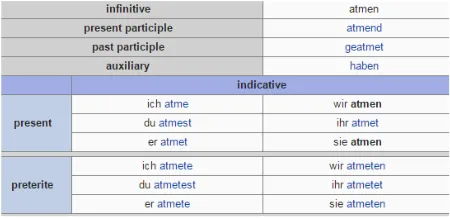
Figure 1: A partial inflection table for the German verb
atmen“to breathe” in Wiktionary.
inflected forms in the target language into the cor-responding base forms, or lemmas. At test time, they predict an abstract inflection tag for each trans-lated lemma, which is then transformed into a proper word-form. Unfortunately, hand-crafted morpho-logical generators such as the ones that they use for this purpose are available only for a small number of languages, and are expensive to create from scratch. The supervised inflection generation models that we investigate in this paper can instead be trained on publicly available inflection tables.
The task of an inflection generator is to produce an inflected form given a base-form (e.g., an in-finitive) and desired inflection, which can be spec-ified as an abstract inflectional tag. The generator is trained on a number of inflection tables, such as the one in Figure 1, which enumerate inflection forms for a given lemma. At test time, the generator pre-dicts inflections for previously unseen base-forms. For example, given the input atmen+ 1SIA, where the tag stands for “first person singular indicative preterite,” it should outputatmete.
Recently, Durrett and DeNero (2013) and Ahlberg
et al. (2014) have proposed to model inflection gen-eration as a two-stage process: an input base-form is first matched with rules corresponding to a paradigm seen during training, which is then used to gen-erate all inflections for that base-form simultane-ously. Although their methods are quite different, both systems account for paradigm-wide regulari-ties by creating rules that span all inflections within a paradigm. We analyze both approaches in greater detail in Section 2.
In this paper, we approach the task of supervised inflection generation as discriminative string trans-duction, in which character-level operations are ap-plied to transform a lemma concatenated with an in-flection tag into the correct surface word-form. We carefully model the transformations carried out for a single inflection, taking into account source charac-ters surrounding a rule, rule sequence patterns, and the shape of the resulting inflected word. To take advantage of paradigmatic regularities, we perform a subsequent reranking of the topnword-forms pro-duced by the transducer. In the reranking model, soft constraints capture similarities between different in-flection slots within a table. Where previous work leveraged large, rigid rules to span paradigms, our work is characterized by small, flexible rules that can be applied to any inflection, with features de-termining what rule sequence works best for each pairing of a base-form with an inflection.
Since our target application is machine transla-tion, we focus on maximizing inflection form ac-curacy, rather than complete table accuracy. Unlike previous work, which aims at learning linguistically-correct paradigms from crowd-sourced data, our ap-proach is designed to be robust with respect to in-complete and noisy training data, which could be ex-tracted from digital lexicons and annotated corpora. We conduct a series of experiments which demon-strate that our method can accurately learn complex morphological rules in languages with varying lev-els of morphological complexity. In each experi-ment we either match or improve over the state of the art reported in previous work. In addition to pro-viding a detailed comparison of the available inflec-tion predicinflec-tion systems, we also contribute four new inflection datasets composed of Dutch and French verbs, and Czech verbs and nouns, which are made available for future research.
2 Inflection generation
Durrett and DeNero (2013) formulate the specific task of supervised generation of inflected forms for a given base-form based on a large number of train-ing inflection tables, while Ahlberg et al. (2014) test their alternative method on the same Wiktionary dataset. In this section, we compare their work to our approach with respect to the following three sub-tasks:
1. character-wise alignment of the word-forms in an inflection table (Section 2.1),
2. extraction of rules from aligned forms (2.2), 3. matching of rules to new base-forms (2.3).
2.1 Table alignment
The first step in supervised paradigm learning is the alignment of related inflected forms in a ta-ble. Though technically a multiple-alignment prob-lem, this can also be addressed by aligning each inflected form to a base-form. Durrett & DeNero do exactly this, aligning each inflection to the base with a paradigm-aware, position-dependent edit dis-tance. Ahlberg et al. use finite-state-automata to implement a multiple longest-common-subsequence (LCS) alignment, avoiding the use of an explicit base-form. Both systems leverage the intuition that character alignment is mostly a problem of aligning those characters that remain unchanged throughout the inflection table.
Our alignment approach differs from previous work in that we use an EM-driven, many-to-many aligner. Instead of focusing on unchanged charac-ters within a single paradigm, we look for small multi-character operations that have statistical sup-port across all paradigms. This includes operations that simply copy their source into the target, leaving the characters unchanged.
2.2 Rule extraction
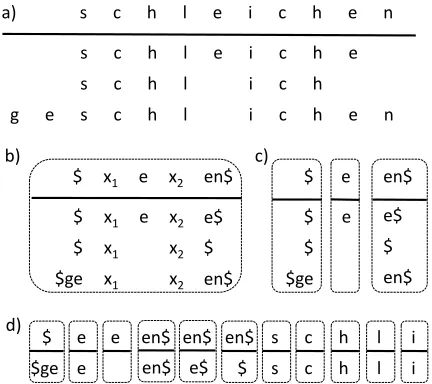
a) s c h l e i c h e n
s c h l e i c h e s c h l i c h
g e s c h l i c h e n
$ x1 e x2 en$
$ x1 e x2 e$ $ x1 x2 $ $ge x1 x2 en$
$
$ $ $ge
en$ e$ $ en$ b) c)
d) e e
e en$ e$
en$ $
s s
c c
h h
l l $
$ge
e
e
en$ en$
[image:3.612.80.296.62.254.2]i i
Figure 2: Competing strategies for rule extraction: (a) an aligned table; (b) a table-level rule; (c) vertical rules; (d) atomic rules.$is a word boundary marker.
each changed span, with the rule specifying trans-formations to perform for each inflection. Ahlberg et al. instead replace eachunchangedspan with a vari-able, creating a single rule that specifies complete inflections for the entire table. The latter approach creates larger rules, which are easier to interpret for a linguist, but are less flexible, and restrict informa-tion sharing across paradigms.
We move in the opposite direction by extracting a rule for each minimal, multi-character transforma-tion identified by our aligner, with no hard constraint on what rules travel together across different inflec-tions. We attempt to learn atomic character transfor-mations, which extends the flexibility of our rules at the cost of reduced interpretability.
The differences in rule granularity are illustrated on the German verb schleichen “to sneak” in Fig-ure 2. The single rule of Ahlberg et al. comprises three vertical rules of Durrett & DeNero, which in turn correspond to eleven atomic rules in our system. Note that this is a simplification, as alignments and word boundary markers vary across the three sys-tems.
2.3 Rule selection
The final component of an inflection generation sys-tem is a mechanism to determine what rules to ap-ply to a new base-form, in order to generate the inflected forms. The strongest signal for this task
comes from learning how the training base-forms use the rules. With their highly restrictive rules, Ahlberg et al. can afford a simple scheme, keeping an index that associates rules with base-forms, and employing a longest suffix match against this index to assign rules to new base-forms. They also use the corpus frequency of the inflections that would be created by their rules as a rule-selection feature. Durrett & DeNero have much more freedom, both in what rules can be used together and in where each rule can be applied. Therefore, they employ a more complex semi-Markov model to assign rules to spans of the base-form, with features character-izing then-gram character context surrounding the source side of each rule.
Since our rules provide even greater flexibility, we model rule application very carefully. Like Dur-rett & DeNero, we employ a discriminative semi-Markov model that considers source character con-text, and like Ahlberg et al., we use a corpus to re-evaluate predictions. In addition, we model rule se-quences, and the character-shape of the resulting in-flected form. Note that our rules are much more general than those of our predecessors, which makes it easy to get statistical support for these additional features. Finally, since our rules are not bound by paradigm structure, we employ a reranking step to account for intra-paradigm regularities.
3 Discriminative Transduction
In this section, we describe the details of our approach, including the affix representation, the string alignment and transduction, and the paradigm reranking.
3.1 Affix representation
Our inflection generation engine is a discriminative semi-Markov model, similar to a monotonic phrase-based decoder from machine translation (Zens and Ney, 2004). This system cannot insert characters, except as a part of a phrasal substitution, so when inflecting a base form, we add an abstract affix rep-resentation to both provide an insertion site and to indicate the desired inflection.
gen-eralize the context of a morpheme boundary. For example, the third person singular indicative present of the verbatmenis represented asatmen+3SIE. We use readable tags throughout this paper, but they are presented to the transducer as indivisible units; it cannot translate them character-by-character.
German and Dutch past participles, as well as sev-eral Czech inflections, are formed by circumfixa-tion, a special process of simultaneous prefixation and suffixation. We represent such inflections with separate copies of the circumfix tag before and after the lemma. For example, the past participlegebracht
“brought” is represented asPPL+bringen+PPL. In the absence of language-specific information regard-ing the set of inflections that involve circumfixation, the system can learn to transduce particular affixes into empty strings.
During development, we experimented with an al-ternative method, in which affixes are represented by a default allomorph. Allomorphic representations have the potential advantage of reducing the com-plexity of transductions by the virtue of being sim-ilar to the correct form of the affix. However, we found that allomorphic affixes tend to obfuscate dif-ferences between distinct inflections, so we decided to employ abstract tags instead.
3.2 String transduction
We perform string transduction adapting the tool DIRECTL+, originally designed for
grapheme-to-phoneme conversion (Jiampojamarn et al., 2010). DIRECTL+ is a feature-rich, discriminative
charac-ter transducer, which searches for a model-optimal sequence of character transformation rules for its in-put. The core of the engine is a dynamic program-ming algorithm capable of transducing many con-secutive characters in a single operation, also known as a semi-Markov model. Using a structured version of the MIRA algorithm (McDonald et al., 2005), training attempts to assign weights to each feature so that its linear model separates the gold-standard derivation from all others in its search space.
DIRECTL+ uses a number of feature templates to
assess the quality of a rule: source context, target
n-gram, and jointn-gram features. Context features conjoin the rule with indicators for all source char-acter n-grams within a fixed window of where the rule is being applied. Targetn-grams provide
indi-cators on target character sequences, describing the shape of the target as it is being produced, and may also be conjoined with our source context features. Joint n-grams build indicators on rule sequences, combining source and target context, and memoriz-ing frequently-used rule patterns. Durrett & DeNero also use source context features, but we are the first group to account for features that consider rule se-quences or target word shape.
Following Toutanova and Cherry (2009), we modify the out-of-the-box version of DIRECTL+ by
implementing an abstract copy feature that indicates when a rule simply copies its source characters into the target, e.g. p → p. The copy feature has the ef-fect of biasing the transducer towards preserving the base-form within the inflected form.
In addition to the general model that is trained on all inflected word-forms, we derive tag-specific models for each type of inflection. Development ex-periments showed the general model to be slightly more accurate overall, but we use both types of mod-els in our reranker.
3.3 String alignment
DIRECTL+ training requires a set of aligned pairs
of source and target strings. The alignments account for every input and output character without the use of insertion. Derivations that transform the input substrings into the desired output substrings are then extracted from the alignments.
We induce the alignments by adapting the M2M aligner of (Jiampojamarn et al., 2007), which uses Expectation-Maximization to maximize the joint likelihood of its input under a pairwise alignment scheme. Previous work creates alignments based upon entire inflection tables, while ours considers each inflection paired with its base form indepen-dently. M2M goes beyond linking single characters by aligning entire substrings instead. In practice, the base-form serves as a pivot for the entire inflection table, leading to consistent multiple alignments.
In order to encourage alignments between iden-tical letters, we augment the training set by pair-ing each inflected form with itself. In addition, we modify the aligner to generalize the identity align-ments into a single operation, which corresponds to the copy feature described in Section 3.2.
3.4 Reranking
Morphological processes such as stem changes tend to be similar across different word-forms of the same lemma. In order to take advantage of such paradig-matic consistency, we perform a reranking of then -best word-forms generated by DIRECTL+. The
cor-rect form is sometimes included in the n-best list, but with a lower score than an incorrect form. We propose to rerank such lists on the basis of features extracted from the 1-best word-forms generated for other inflection slots, the majority of which are typ-ically correct.
We perform reranking with the Liblinear SVM (Fan et al., 2008), using the method of Joachims (2002). An initial inflection table, created to generate reranking features, is composed of 1-best predictions from the general model. For each inflection, we then generate lists of candidate forms by taking the intersection of the n-best lists from the general and the tag-specific models.
In order to generate features from our initial in-flection table, we make pairwise comparisons be-tween a prediction and each form in the initial ta-ble. We separate stems from affixes using the align-ment. Our three features indicate whether the com-pared forms share the same stem, the same affix, and the same surface word-form, respectively. We gen-erate a feature vector for each aligned pair of related word-forms, such as past participle vs. present par-ticiple. In addition, we include as features the confi-dence scores generated by both models.
Two extra features are designed to leverage a large corpus of raw text. A binary indicator feature fires if the generated form occurs in the corpus. In order to model the phonotactics of the language, we also derive a 4-gram character language model from the same corpus, and include as a feature the normalized log-likelihood of the predicted form.
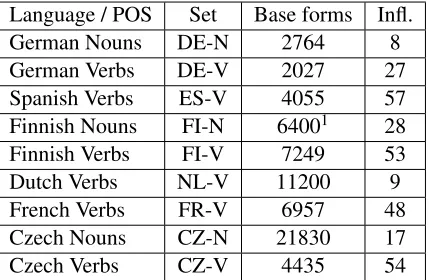
Language / POS Set Base forms Infl. German Nouns DE-N 2764 8 German Verbs DE-V 2027 27 Spanish Verbs ES-V 4055 57 Finnish Nouns FI-N 64001 28
[image:5.612.321.536.57.197.2]Finnish Verbs FI-V 7249 53 Dutch Verbs NL-V 11200 9 French Verbs FR-V 6957 48 Czech Nouns CZ-N 21830 17 Czech Verbs CZ-V 4435 54
Table 1: The number of base forms and inflections for each dataset.
4 Experiments
We perform five experiments that differ with respect to the amount and completeness of training data, and whether the training is performed on individual word-forms or entire inflection tables. We follow the experimental settings established by previous work, as much as possible.
The parameters of our transducer and aligner were established on a development set of German nouns and verbs, and kept fixed in all experiments. We limit stem alignments to 2, affix alignments to 2-4, source context to 8 characters, joint n-grams to 5 characters, and target Markov features to 2 charac-ters.
4.1 Inflection data
We adopt the Wiktionary inflection data made avail-able by Durrett and DeNero (2013), with the same training, development, and test splits. The develop-ment and test sets contain 200 inflection tables each. and the training sets consist of the remaining data. Table 1 shows the total number of tables in each lan-guage set. We convert their inflectional information to abstract tags for input to our transducer.
We augment the original five datasets with four new sets: Dutch verbs from the CELEX lexical database (Baayen et al., 1995), French verbs from Verbiste, an online French conjugation dictionary2,
and Czech nouns and verbs from the Prague Depen-dency Treebank (B¨ohmov´a et al., 2003). For each of
1Durrett & DeNero report 40589 forms, but only use 6000 for training, and 200 each for development and testing
Case Singular Plural Nominative Buch B¨ucher
[image:6.612.347.505.55.170.2]Accusative Buch B¨ucher Dative Buch B¨uchern Genitive Buches B¨ucher
Table 2: All word-forms of the German nounBuch.
these sets, the training data is restricted to 80% of the inflection tables listed in Table 1, with 10%each for development and testing. Each lemma inflects to a finite number of forms that vary by part-of-speech and language (Table 1); German nouns inflect for number and case (Table 2), while French, Spanish, German, and Dutch verbs inflect for number, person, mood, and tense.
We extract Czech data from the Prague Depen-dency Treebank, which is fully annotated for mor-phological information. This dataset contains few complete inflection tables, with many lemmas rep-resented by a small number of word-forms. For this reason, it is only suitable for one of our experiments, which we describe in Section 4.5.
Finnish has a morphological system that is un-like any of the Indo-European languages. There are 15 different grammatical cases for nouns and adjectives, while verbs make a number of distinc-tions, such as conditional vs. potential, and affir-mative vs. negative. We derive separate models for two noun classes (singular and plural), and six verb classes (infinitive, conditional, potential, participle, imperative, and indicative). This is partly motivated by the number of individual training instances for Finnish, which is much larger than the other lan-guages, but also to take advantage of the similarities within classes.
For the reranker experiments, we use the appro-priate Wikipedia language dump. The number of to-kens in the corpora is approximately 77M for Czech, 200M for Dutch, 6M for Finnish, 425M for French, 550M for German, and 400M for Spanish.
4.2 Individual inflections
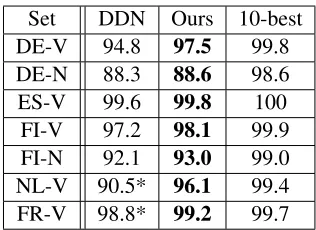
In the first experiment, we test the accuracy of our basic model which excludes our reranker, and there-fore has no access to features based on inflection ta-bles or corpus counts. Table 3 compares our results
[image:6.612.104.270.58.128.2]Set DDN Ours 10-best DE-V 94.8 97.5 99.8 DE-N 88.3 88.6 98.6 ES-V 99.6 99.8 100 FI-V 97.2 98.1 99.9 FI-N 92.1 93.0 99.0 NL-V 90.5* 96.1 99.4 FR-V 98.8* 99.2 99.7
Table 3: Prediction accuracy of models trained and tested on individual inflections.
against the Factored model of Durrett & DeNero (DDN), which also makes an independent prediction for each inflection. The numbers marked with an as-terisk were not reported in the original paper, but were generated by running their publicly-available code on our new Dutch and French datasets. For the purpose of quantifying the effectiveness of our reranker, we also include the percentage of correct answers that appear in our 10-best lists.
Our basic model achieves higher accuracy on all datasets, which shows that our refined transduc-tion features are consistently more effective than the source-context features employed by the other sys-tem. Naturally, their system, as well as the system of Ahlberg et al., is intended for whole-table scenarios, which we test next.
4.3 Complete paradigms
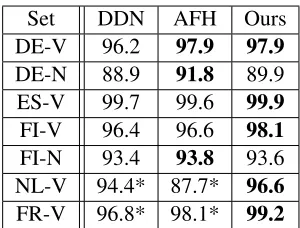
In this experiment, we assume the access to com-plete inflection tables, as well as to raw corpora. We compare our reranking system to the Joint model of Durrett & DeNero (DDN), which is trained on complete tables, and the full model of Ahlberg et al. (AFH), which is trained on complete tables, and matches forms to rules with aid of corpus counts. Again, we calculated the numbers marked with an asterisk by running the respective implementations on our new datasets.
accord-Set DDN AFH Ours DE-V 96.2 97.9 97.9
DE-N 88.9 91.8 89.9 ES-V 99.7 99.6 99.9
FI-V 96.4 96.6 98.1
FI-N 93.4 93.8 93.6 NL-V 94.4* 87.7* 96.6
[image:7.612.110.260.55.169.2]FR-V 96.8* 98.1* 99.2
Table 4: Individual form accuracy of models trained on complete inflection tables.
ing to single-form accuracy, neither our system nor DDN benefits too much from joint predictions. Ta-ble 5 shows the same results evaluated with respect to complete table accuracy.
4.4 Incomplete paradigms
In this experiment, we consider a scenario where, instead of complete tables, we have access to some but not all of the possible word-forms. This could occur for example if we extracted our training data from a morphologically annotated corpus. We sim-ulate this by only including in our training tables the forms that are observed in the corresponding raw corpus. We then test our ability to predict the same test forms as in the previous experiments, regardless of whether or not they were observed in the corpus. We also allow a small held-out set of complete ta-bles, which corresponds to the development set. For Durrett & DeNero’s method, we include this held-out set in the training data, while for our system, we use it to train the reranker.
The Joint method of DDN and the methods of AFH are incapable of training on incomplete tables, and thus, we can only compare our results against the Factored model of DDN. However, unlike their Factored model, we can then still take advantage of paradigmatic and corpus information, by applying our reranker to the predictions made by our simple model.
The results are shown in Table 6, where we re-fer to our independent model as Basic, and to our reranked system as Reranked. The latter outper-forms DDN on all sets. Furthermore, even with only partial tables available during training, rerank-ing improves upon our independent model in every
Set DDN AFH Ours DE-V 85.0 76.5 90.5
DE-N 79.5 82.0 76.5 ES-V 95.0 98.0 99.0
FI-V 87.5 92.5 94.5
FI-N 83.5 88.0 82.0 NL-V 79.5* 37.7* 82.1
FR-V 92.1* 96.0* 97.1
Table 5: Complete table accuracy of models trained on complete inflection tables.
case.
4.5 Partial paradigms
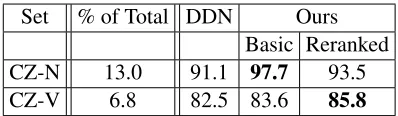
We run a separate experiment for Czech, as the data is substantially less comprehensive than for the other languages. Although the number of 13.0%observed noun forms is comparable to the Finnish case, the percentages in Table 6 refer only to the training set: the test and held-out sets are complete. For Czech, the percentage includes the testing and held-out sets. Thus, the method of Durrett & DeNero and our reranker have access to less training data than in the experiment of Section 4.4.
The results of this experiment are shown in Ta-ble 7. Our Basic model outperforms DDN for both nouns and verbs, despite training on less data. How-ever, reranking actually decreases the accuracy of our system on Czech nouns. It appears that the reranker is adversely affected by the lack of com-plete target paradigms. We leave the full investiga-tion into the effectiveness of the reranker on incom-plete data to future work.
4.6 Seed paradigms
[image:7.612.351.503.55.171.2]Set % of Total DDN Ours Basic Reranked DE-V 69.2 90.2 96.2 97.9
DE-N 92.7 88.3 88.4 89.8
ES-V 36.1 97.1 95.9 99.6
FI-V 15.6 73.8 78.7 85.6
FI-N 15.2 71.6 78.2 80.4
DU-V 50.5 89.8 94.9 96.0
[image:8.612.327.526.56.114.2]FR-V 27.6 94.6 96.6 98.9
Table 6: Prediction accuracy of models trained on ob-served forms.
with the models trained on 50 and 100, respectively. For reranking, we use the same German corpus as in our previous experiments, but limited to the first 10M words.
The results are shown in Table 8. When trained on 50 seed tables, the accuracy of our models is comparable to both the basic model of Dreyer and Eisner (DE) and the Factored model of DDN, and matches the best system when we add reranking. When trained on 100 seed tables, our full reranking model outperforms the other models.
5 Error analysis
In this section, we analyze several types of errors made by the various systems. Non-word predictions are marked with an asterisk.
German and Dutch are closely-related languages that exhibit similar errors. Many errors involve the past participle, which is often created by circumfix-ation. For the German verbverfilmen“to film,” we predict the correctverfilmt, while the other systems haveverfilmen*, andgeverfilmt*, respectively. DDN simply select an incorrect rule for the past partici-ple. AFH choose paradigms through suffix analy-sis, which fails to account for the fact that verbs that begin with a small set of prefixes, such asver-, do not take age-prefix. This type of error particularly affects the accuracy of AFH on Dutch because of a number of verbs in our test set that involve infixation for the past participle. Our system uses its source and target-siden-gram features to match these pre-fixes with their correct representation.
The second type of error is an over-correction by the corpus. The past participle of the verbdimmenis
[image:8.612.86.288.56.185.2]Set % of Total DDN Ours Basic Reranked CZ-N 13.0 91.1 97.7 93.5 CZ-V 6.8 82.5 83.6 85.8
Table 7: Prediction accuracy of models trained on ob-served Czech forms.
gedimmt, but AFH predictdimmt*, and then change it to dummen with the corpus. Dummen is indeed a valid word in German, but unrelated to the verb
dimmen. It is also far more common, with 181 oc-currences in the corpus, compared with only 28 for
gedimmt. Since AFH use corpus frequencies, mis-takes like this can occur. Our system is trained to balance transducer confidence against a form’s ex-istence in a corpus (as opposed to log frequency), which helps it ignore the bias of common, but incor-rect, forms.
The German verbbrennen“to burn” has an irregu-lar past participle:gebrannt. It involves both a stem vowel change and a circumfix, two processes that only rarely co-occur. AFH predict the formbrannt*, using the paradigm of the similar bekennen. The flexibility of DDN allows them to predict the correct form. Our basic model predicts gebrennt*, which follows the regular pattern of applying a circumfix, while maintaining the stem vowel. The reranker is able to correct this mistake by relating it to the form
gebranntin the corpus, whose stem is identical to the stem of the preterite forms, which is a common paradigmatic pattern.
Our system can also over-correct, such as with the second person plural indicative preterite form for the verbreisen, which should bereistet, and which our basic model correctly predicts. The reranker, how-ever, changes the prediction torist. This is a nominal form that is observed in the corpus, while the verbal form is not.
An interesting example of a mistake made by the Factored model of DDN involves the Dutch verb
aandragen. Their model learns that stem vowel a
Seed Tables DE DDN Ours Basic Full Factored Joint Basic Full 50 89.9 90.9 89.6 90.5 89.7 90.9
[image:9.612.160.456.57.115.2]100 91.5 92.2 91.4 92.3 92.0 92.6
Table 8: Prediction accuracy on German verb forms after training on a small number of seed inflection tables.
Finnish errors tend to fall into one of three types. First, words that involve harmonically neutral vow-els, such as “e” and “i” occasionally cause errors in vowel harmony. Second, all three systems have diffi-culty identifying syllable and compound boundaries, and make errors predicting vowels near boundaries. Finally, consonant gradation, which alternates con-sonants in open and closed syllables, causes a rel-atively large number of errors; for example, our system predicts*heltempien, instead of the correct
hellempienas the genitive singular of the compara-tive adjeccompara-tivehellempi“more affectionate”.
6 Conclusion
We have proposed an alternative method of generat-ing inflected word-forms which is based on discrim-inative string transduction and reranking. We have conducted a series of experiments on nine datasets involving six languages, including four new datasets that we created. The results demonstrate that our method is not only highly accurate, but also robust against incomplete or limited inflection data. In the future, we would like to apply our method to non-European languages, with different morphological systems. We also plan to investigate methods of ex-tracting morphological tags from a corpus, including differentiating syncretic forms in context.
Acknowledgments
We thank Mans Hulden and Aki-Juhani Kyr¨ol¨ainen for their assistance in analyzing Finnish errors..
This research was supported by the Natural Sci-ences and Engineering Research Council of Canada, and the Alberta Innovates Technology Futures.
References
Malin Ahlberg, Markus Forsberg, and Mans Hulden. 2014. Semi-supervised learning of morphological paradigms and lexicons. In Proceedings of the 14th
Conference of the European Chapter of the
Associ-ation for ComputAssoci-ational Linguistics, pages 569–578,
Gothenburg, Sweden, April. Association for Compu-tational Linguistics.
Harald R. Baayen, Richard Piepenbrock, and Leon Gu-likers. 1995. The CELEX Lexical Database. Release
2 (CD-ROM). Linguistic Data Consortium, University
of Pennsylvania, Philadelphia, Pennsylvania.
Alena B¨ohmov´a, Jan Hajiˇc, Eva Hajiˇcov´a, and Barbora Hladk´a. 2003. The Prague dependency treebank. In
Treebanks, pages 103–127. Springer.
Ann Clifton and Anoop Sarkar. 2011. Combin-ing morpheme-based machine translation with post-processing morpheme prediction. In Proceedings of the 49th Annual Meeting of the Association for Computational Linguistics: Human Language
Technologies-Volume 1, pages 32–42. Association for
Computational Linguistics.
Markus Dreyer and Jason Eisner. 2011. Discover-ing morphological paradigms from plain text usDiscover-ing a dirichlet process mixture model. In Proceedings of the Conference on Empirical Methods in Natural
Language Processing, pages 616–627. Association for
Computational Linguistics.
Greg Durrett and John DeNero. 2013. Supervised learn-ing of complete morphological paradigms. In
Pro-ceedings of NAACL-HLT, pages 1185–1195.
Rong-En Fan, Kai-Wei Chang, Cho-Jui Hsieh, Xiang-Rui Wang, and Chih-Jen Lin. 2008. LIBLINEAR: A li-brary for large linear classification. The Journal of
Machine Learning Research, 9:1871–1874.
Alexander Fraser, Marion Weller, Aoife Cahill, and Fa-bienne Cap. 2012. Modeling inflection and word-formation in SMT. InProceedings of the 13th Confer-ence of the European Chapter of the Association for
Computational Linguistics, pages 664–674.
Associa-tion for ComputaAssocia-tional Linguistics.
Sittichai Jiampojamarn, Grzegorz Kondrak, and Tarek Sherif. 2007. Applying many-to-many alignments and hidden markov models to letter-to-phoneme con-version. InHuman Language Technologies 2007: The Conference of the North American Chapter of the As-sociation for Computational Linguistics; Proceedings
of the Main Conference, pages 372–379, Rochester,
Sittichai Jiampojamarn, Colin Cherry, and Grzegorz Kondrak. 2010. Integrating joint n-gram features into a discriminative training framework. InProceedings
of NAACL-2010, Los Angeles, CA, June. Association
for Computational Linguistics.
Thorsten Joachims. 2002. Optimizing search engines using clickthrough data. InProceedings of the eighth ACM SIGKDD international conference on
Knowl-edge discovery and data mining, pages 133–142.
ACM.
Ryan McDonald, Koby Crammer, and Fernando Pereira. 2005. Online large-margin training of dependency parsers. InProceedings of the Annual Meeting of the
Association for Computational Linguistics.
Kristina Toutanova and Colin Cherry. 2009. A global model for joint lemmatization and part-of-speech pre-diction. InProceedings of the Joint Conference of the 47th Annual Meeting of the ACL and the 4th Interna-tional Joint Conference on Natural Language
Process-ing of the AFNLP: Volume 1-Volume 1, pages 486–
494. Association for Computational Linguistics. Richard Zens and Hermann Ney. 2004. Improvements in
phrase-based statistical machine translation. In
HLT-NAACL 2004: Main Proceedings, pages 257–264,