-Plannin
g a
nd th
e E
n
v
ironment
J. Peter Clinch
Department of Planning and Environmental Policy, University College Dublin
Ablliract
This paper discusses the relationship between planning, sustainable development and the cnviromnent in Ireland. The paper firstly c:\-plorcs the development of planning as a conccpt. It then sets oul the key 'actors' in Irish environmental policy. The paper goes
on
10describe
th
e
plannin
g system in
Ireland with
a specific emphasis on its
relationship to sustainable development and the environment. Irish environmental
perfo
rman
ce
i
s assessed.
Iri
s
h
e
n
vi
ronmental policy
'
drivers
'
are the
n
exam
ined
wilh a
vicw to explaining the emphasis of Irish environmental policy.
The paper demonstrates and explains the lack of influence oCthe planning system on key areas of environmental policy but cmphasises its importance in addressing, in particular, urban and suburban environmcntal problems. The paper idcntifics the following impediments to the effective operation of tile planning system in enhancing sustainable development: lack of consistency in government policy and legislation as regards sustainable development; poor public perception of planning and the role of political system therein; limited policy instruments and thc emphasis on regulation; and lack of research for evidcnce-based policymaking.Introduction
If one asks Irish students entering a postgraduate plaJUling course to provide a definition of planning, a consensus is unlikely to be reached 011 its mcaning or purpose. Exprcssions which usually emcrge during a discussion include 'sustainable development', 'conservation', 'development control', 'cconomic dC\'elopment', 'environmental protection'. If one asks the Irish public what they understand planning to be, they would likcly refer to the development control aspects of planning using phrases such as 'getting planning' and/or to perceived corruption in the planning system. These students and the public are not alone in their difficulty in defining or understanding planning. Indeed, in one of his mally books, Sir Peter Hall (2002, I) states that 'plannjng is an extremely ambiguous and di.fficuit word to define'.
Hall (2002, 3) goes on to state that planning, in a general sense, does not refer to the art of drawing up a physical plan. Rather, thc emphasis is on tracing an orderly sequence of events which will achieve a predetermined goal. The output of spatial planning practice before and after the Second World War was very minute and detailed and 'tended to consist of vcry precise large scale maps showing the exact disposition of land uses and activitics and proposed developments'. In the 1960s, however, such an approach was criticised as being too proscriptive as to the end result and that planning needed to concentrate on broad principles, I
42 J. Peter Clinch
A fomler limitation of what was seen to be 'Town and Country Planning' or 'Regional and Urban Planning' was its focus on land. Whilc the regulation of thc use of land is still a fundamcntal issue in modem planning and may still be a key component of what might be viewed as the 'planning
sys
t
e
m
',
modern planning has become much more broad in its concems. Perhaps the driving force behind this broadening of that which concerns planning has been the rise in environmental concerns and the notion of sustainable developmcnt. Thcse environmental conccrns involve not only land but also the atmosphere (air) and water but, more generally, quality of life.Following on fTOm the rise in cnvironmental concerns in the 1980s, the concept of sustainable development became finnly established as part of the environmental debme in the afiennath of the Bruntland report of 1987 (which provided the most frequcntly cited definition) and has been prominent on thc political agenda since the Rio Earth Summit in 1992. 'Sustainability' as an expression has, rathcr unfonunatcly, becomc somcwhat of a buzz word that is often used by politicians but rarely defined in any
operational sense. Breheny (1992) notes some 'frustration' in the way sustainable
development as a phrase has come to dominate the debate, and tends to be used rather loosely, but notes that it has been useful for researchers and pOlicymakers. The notion of sustainable development has ecrtainly been particularly useful in focusing the minds of
planning researchers and policymakers and has provided a revised rationale for planning
because it involves the interaction between thc economy, society and environment. As Raemaekers (2000) points out, the reconciliation of the demands of these three interlinked areas is commonly conceived to be the principal goal of planning.
The question to be addressed in this paper is the extent to which the planning system in Ireland addresses pressing environmental concerns. To examine this question, the paper briefly examines the key 'actors' in Irish environmental policy. It goes on to describe
briefly the Irish plamung system with a particular view to exploring its emphasis on
sustainable developmellt. It cominues by assessing Irish environmental perfonnance in recent years. The paper then explores the 'dri\'ers' of irish envirorunental policy with a view to explaining the emphasis of environmental policy. The paper concludes by exploring the lack of influcnce of the plamung system on key areas of environmental policy bnt emphasises its importance in addressing, in particular, urban and suburban environmental problems. Some impediments to the effectivc operation of the planning
system in enhancing sustainable development are outlined.
Environmental Policy 'Actors'
Key actors shaping Irish environmental perfonnancc arc the following:
The Department of Finance has lead responsibility for thc preparation and execution of
the National Development Plan, for fiscal policy, and for controlling expenditure. It
leads an interdepartmental group that reviews the fiscal situation and the potential for the application of fiscal measures to advance environmental objectives. It produces periodic reports.
The Department of Envirorunellt, Heritage and Local Government has lead policy
responsibility for housing, water and air, waste, and for the planning system (see
below). It allocates funding to local authorities for housing, local roads, water supply
Planning and the Environment 43
Strategy in 2002. It leads a 'Green Network of Government Departments' that
comprises a network of Assistant Secretaries in departments with significant
environmental impact. They aim to integrate environmental considerations into
economic development. Eco-auditing is regarded as a key clcment in the attainmcnt of
such integration.
The Department of Community, Rural and Gaeltacht Affairs has responsibility for the
promotion and support of the sustainable and inclusive development of communities,
both urban and rural, including Gaeltacht and island communities, in order to foster
bener regional balance.
The key scctoral departments, Agriculture and Food (including forestry), Enterprise,
Trade and Employment (industry), Communications, Marine and Natural Resources
(freshwater and marine fisheries, mining, energy), and Arts, Sport and Tourism, have
units addressed to the environmental aspects of their activities.
There are a number of government agencies and bodies with responsibilities for aspects
of environmental pcrfonnance. The Enviromnental Protection Agency is an independent
organisation with responsibilities for licensing of industry (Integrated Pollution Control
[IPC] licensing), enviromnenlal monitoring and enforcement (including production of
state of the environment reports), research, and overview and support of the local
authorities in the implementation of their responsibilities. The Heritage Council has
responsibility for promoting conservation of the heritage endowment; ENFO has the
lead responsibility for promoting public awareness of enviromnental issues and
performance; Sustainable Energy Ireland (SEI) has an infonnation role in promoting
energy conservation and enhancing research in the area.
Policy as regards housing, waler supply, wastewater treatment, solid ""aste and land use
are implemented by the local authorities, from whom permission must be sought for
most industrial, residential and commercial development. Decisions by the local
authorities are based on the provisions of the Development Plan for the area for which
they have jurisdiction (see below), and any policy guidance by the Minister for the
Environment, Heritage and Local Government. The decision can be appealed by the
proposer or by any third party to a national appeals authority (An Bord Pleamila) whose
decision is final.
There are a number of non-governmental environmental organisations, including An
Taisce, the National Trust for Ireland. Under the planning regulations, this organisation
receives planning applications likely to be of significant environmental importance.
The lrish Planning System and Sustainable Development
The objectiYe of the Department of the Environment, Heritage and Local Government
(DEHLG) with regard to planning is 'To provide a policy and legislative framework
which facilitates and encourages development patterns consistent with the principles of
proper planning and sustainable development, balanced regional development,
conservation of the natural and built environment, quality in construction and urban and
village regeneration' (DELG, 2003).
Planning is the overall responsibility of the Minister of that Department, and the
44 J. Peter Clinch
being to 'facilitate and encourage development within suslainable patterns of settlement whilst fostering protection of the natural and built environment and promoting the efficient use of land and infrastructure' (DELG, 2003, 26). The key stratcgies of the DEHLG are to lead and manage implementation of the National Spatial Strategy (see below), to maintain an up-to-date legislative and policy framework to facilitate an efficient, effective, balanced and quality planning system which promotes sustainable development and to develop and maintain in cooperation with other and relevant interests targeted and integrated urban/town/village renewal programmes aimed at the economic, social and sustainable regeneration of such areas (DELG, 2003).
In tenns of national-level planning, the Government published the National Spatial Strategy (NSS) in November 2002. This provides a twenty-year planning framework for Ireland. It aims to achieve a bener balance of social, economic and physical development across Ireland, supported by more effective planning. In order to drive development in the regions, the NSS requires that areas of sufficient scale and critical mass be built up through a network of gateways and hubs. The NSS also identifies the need to support the role of smaller towns, villages and rural areas at the locallevc1. The intention is that the NSS will be implemented through the translation ofils policies into regional and local planning by regional and local authorities and the consideration of its objectives in all government policies.
In April 2004, the Minister for the Environment, Heritage and Local Government
launched new guidelines on the vexed issue of rural housing. These slate that, subject to good planning practice, people with rural links are to be favoured for planning pennission for rural housing, as will any applicant applying for permission in an area
suffering from population decline. Applicants for housing in rural areas must meet
normal planning requirements in relation to mallers.
Irish planning regulations are consolidated in the Planning and Development Act 2000.
The Aet recognised the centrality of the principle of sustainable development. The Plamung and Development (Regional Planning Guidelines) Direction (2003) and Regulations (SI No.175) (2003) direct each Regional Authority to formulate regional planning guidelines for its region and oblige them to take account of the NSS.
Local Authorities are, in the first instance, responsible for local physical planning. The core components of this arc the De,'elopment Plan, which is the principal instmment for the regulation and control of development, and Development Control, which involves the granting or othemise of permission that is required for all developments unless specifically exempted. Certain developments must be assessed for likely environmental
effects via Environmental Impact Assessment before planning permission can be
granted while Strategic Environmental Assessments (SEA) provides for strategic environmental consideration at an early stage in the decision-making process (DEHLG, 2004).
The Government's Sustainable Development Strategy provides for local authorities to
complete Local Agenda 21 (now termed 'Local Action') Plans for their areas. Each
local authority was expected to enter into dialogue with its citizens, local organisations and private enterprises and adopt 'a local Agenda 21'. Through consultation and
consensus building, the objective was that local authorities would learn from citizens
Planning and fhe Errvironmenf 45
infonnatioll needed for formulating the best strategies. Each county council and county
borough has a designated Local Agenda 21 Officcr, and these are networked at regional
and national levels (DEHLG, 2004).2
The following qucstions now arise: how has Ireland performed in recent years in
relation to the environment? What are the kcy 'drivers' of environmental policy and
what role does the plamung system play in addressing key issues? The paper now
endeavours to address these questions.
Irish Em'ironmental Periormance
The conference at which this paper was presented was concerned with renectillg 011 the
first forty years of planning. For the first thirty years, Irish environmental performance
on average was relatively good despite some notable exceptions (in particular some high
profile damage to our architectural and archaeological endowments and the perverse
environmental effects of the Common Agricultural Policy). It is sometimes said that this
was the result of relatively poor economic performance such that there was less pressnre
on Ireland's environmental endowment than was the case in neighbouring European countries. However, in the lasltcn years, the Irish economy has been the fastest growing
economy in Europe. The grO\\<1h of output was unprecedented in an Irish context and the
growth in employment a record in an illtematiollal context. Between 1990 and 2000, Gross Domestic Product doubled with the real growth rate at a h.igh of II % in 1999 (Clinch et aI., 2002). While the gro\\1h rate fell back considerably in the first few years of the new millennium, gro\\1h continues to be in the order of four to five per cent.
While this extraordinary economic success, in particular thc fall in unemployment, has
been most welcome, the pace of the growth has had the potential to have significant
implications for the cnvironment. The question arises as to whethcr development has
taken placc in a 'sustainable' manncr.
Standard national accounting procedures fail to reOect the deterioration in
environmental quality that can result from economic growth. Therefore, the accounts do
not givc a tOle picture of our well-being. 'Green' accounting endeavours to reflect the value of environmental services in figures of national product. Scott (1999) develops
parallel environmental accounts for the Irish economy for 1994 and recent figures can
be obtained from the Central Statistics Office. However, this approach does not attempt
to provide a single number that could characterise overall pcrfonnance.
Achieving sustainability, however defined, involves creating and maintaining wealth.
Following the pioneering work of Pearce and Atkinson (1995) there have been
continuing cfforts to expand the concept of net savings and consequent changes in
wealth by adjusting conventional mcasures to include changes in natural resource
stocks, changes in health and education, and changes in utility/well-being as a result of
environmental degradation (Hamilton and Clemens, 1999; Hamilton, 2000). A key
underlying assumption of the 'weak sustainability' rule is that forms of capital are
substitutes. Man-made capital consists of those things made by humans such as
46 J. Peter Clinch
buildings, roads, machinery. Human capital represents the ability of humans to be productive and is potentially enhanced by investments in education and health. Natural
capital consists of ecological service~. This weak sustainability rule implies that a
country could run down its natural capital but, if it were investing in education and
health, it could be judged to be 'sustainable' according to this weak criterion (Clinch, 2002).
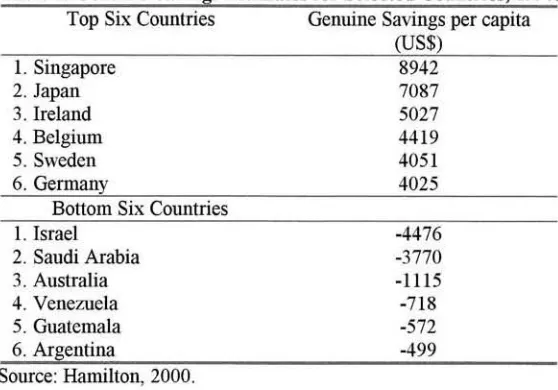
[image:6.482.116.395.323.518.2]Genuine savings (GS), a form of green accounting, may be defined as Gross Domestic Product less consumption, depreciation, and depletion of natural assets, plus investment in education, primary health and research and development. There are difficulties in quantifYing some of these adjustments. For example, damage estimates associated with air emissions are used as a proxy for most environmental degradation. A significant ,veakness with this approach is that it does not (although no altemative does better at this point) net out 'imported sustainability', e.g. if the manufacturing of the goods imported by Singapore results in the country of origin being unsustainable, this is not reflected in Singapore's rating. However, this work still represents considerable progress. The World Bank has published estimates for 100 countries which indicate that many developing countries fail the weak sustainability test, I.e. their net capital stock is in decline. Expressing these changes in per-capita tenns for 1997, we find that Ireland's rapid growth gives it a high positive net savings rate leaving it ranked third in the world, behind Japan and Singapore (Table I).
Table 1. Genuine-Sa\'ings Estimates for Selected Countries, 1997. Top Six Countries Genuine Savings per capita
1. Singapore 2. Japan 3. Ireland 4. Belgium
5. Sweden
6. Germany
Bottom Six Countries I. Israel
2. Saudi Arabia 3. Australia
4 Venezuela
5. Guatemala 6. Argentina
Source: Hamilton, 2000.
(US$)
8942
70R7 5027 4419 4051 4025
-4476 -3770 -1115 -718 -572 -499
The countries that have high rates of genuinc savings have some combination of high ratcs of savings and net investment, and low rates of domestic resource exploitation and
environmental degradation. The large negative-savings countries have some
combination of large net depletion of natural resources and environmental degradation,
and low net savings and invcstment. Ireland comprehensively passes the 'weak
sustainability' test. An important explanation of this is that the estimatcs of
environmental degradation used in the calculation of net savings above exelude the most
serious negative effects on quality of life in Ireland. Emissions to air are used as a proxy
for envirOlUuental performance. Using this measure, Ireland is seen to have a mixed
Planning and the Erwironment 47
[image:7.482.54.401.160.467.2]Between 1990 and 1998, emissions of
50
2 stayed relatively constant, but in 2002 was nearly half what it was at the beginning of the 1990s. CO was reduced by 25% between 1990 and 2002. However, emissions of greenhouse gases increased by 29%, NO~ emissions increased by G%, and Volatile Organic Compounds (VOCs) increased by G% between 1990 and 1998 but are now about one-quarter less than in 1990. This compares with GNP grO\\1h over the same period of 100%, so that while deterioration in an absolute sense is evident in some quarters, the rate of deterioration is much lower than the rate of GNP growth (Figure I).Figure I. GDP, House Prices and Em'ironmental Performance, 1990--2002.
300 280
/ '
use Prices 260/
240/
.?'
GOP220
8
200/
~ GNPi
180!'
/
/
/
x::?'
Vehicles:0 160
•
~
•
140 ~< GHG,
-
120.
~
-100 ~
....::,;.:
80VOC
60 CO
"'502 40
19901991 199219931994199519961997199819992000 20012002 ___ G"",
--.-502
-><-"'"
---.-Real GOP
-+--
Vehicles -+-M13-+-VOC - C O
-+-
Real House Prices- Real GNP
These figures should not be seen as reassuring when considering the policy constraints faced by Ireland under the Kyoto and Gothenburg protocols. For example, it is predicted that Ireland will exceed its greenhouse gas emissions target (of 13% over 1990 levels) set in the Kyoto Protocol by a large margin. This is because most of this growth in greenhouse gas emissions has occurred since the 1990 base year. EPA (2004) estimates that Ireland is already 29% over its Kyoto limit. Ireland's unprecedented growth has resulted in estimates that, under a 'business as usual' scenario, total emissions would increase by between 37% and 41% by 20]0.
48 J. Peter Clinch
envirorunental conditions. Using vehicle numbers as a proxy for congestion, it can be seen (rom Figure I that, unlike emissions to air, this enviroruuental impact has been more in line with GNP gro\~th. While ~tween 1990 and 2002 GNP increased by 100%,
vehicle numbers increased by 76%. Measurement of particulate matter emissions began in Dubhn in 1996. Emissions havc been reduced in the areas of most concern including
College Green but the number of days exceeding limit values (50 Jlglm3) is in excess of
that which will be permitted by EU law in 2005. The real rise in house prices has, of
course, given 'pre-boom' owncrs a substantial capital gain, but for new entrants attlic margin, the incremental costs are substantial. Noise complaints to Dublin Corporation almost doubled between 1996 and 1998.
In addition to thc thrcc-fold increase in real house prices between 1990 and 2003, Ihe inadequacy of housing policy during the Irish boom has had a number of other negative
effects. In particular, the sprcad of the Dublin commuter belt to include all of Leinster,
and even further afield, has led to many undesirable externalities. These include further congestion, increased travel lime to work, rising frustrations and stress, increased fuel use and associated greenhouse gas and pollution emissions. Much of the energy in the new Dublin economy is deriving from developments along the 'C ring' motonvay
circling the city to the west, with nodes at Swords/Dublin airport (Motorola, Hertz.),
BlanchardstownIMulihudart (IBM complex), West DublinlNorth Kildare (Intel, Hewlett
Packard), Tallaght (City west, Park west) and Leopardstown/Sandyford (Microsoft,
Cherrywood Technology Park). This development of an 'cdge city' is symptomatic of developments in many urban areas, but has happened with particular rapidity in the Dublin region. Except for some apartment development in the inner city and some new
large housing plans (e.g. Adamstown), most housing is low-density suburban, and this
process of urban sprawl and dispersal seems to be accelerating, with much of the development leapfrogging the established commuter belt (Clinch et aI., 2002).
Environmental Policy Drivers and tbe Role of Planning
In addressing the environmental challenges generated in the main by economic growth,
Irish policymakers face a number of constraints. As regards domestic pressure for
improved environmental perfonnance, there is a direct negative feedback loop to the
economy as regards environmental degradation. For the rapidly growing tourist industry, a high-quality environment, and heritage buildings and associated cultural
endowments, are key assets. For the food industry, a high-quality environment is
important for the image of the product in international markets. For the inforn13tiou technology and financial service industries, a high quality of life, including a good enviroIUuent, is an important attraction for some high-, and relatively scarce, skilled
workers and entrepreneurial talents.
Secondly, there is the pressure from Irish residents for a local high-quality environment. This is expressed most forcefully in the development of avoidance strategics concerning
the location of landfill and incineration, but tends to be relatively weak as a source of pressure in rclation to strategic national and regional issues such as congestion and
setllement.
The question arises from Section IV as to why there is such a discrepancy in
performance between air emissions and urban environmental indicators. Partly, it lies in
Planning and Ihe Environment 49
the case of greenhouse gases and acid precursors, in the form of emission standards in
thc case of wastewater treatment, or as ambient standards in the case of smoke and sulphur concentrations in the atmosphere~ First, in a series of European Union Directives and Regulations, the Irish Government is obliged to meet legal obligations
concerning a wide and growing range of issues, including: emission standards for waste
water; ambient air and water standards; standards for drinking water; quantified targets
for recycling and re·use of packaging; rcquiremcnts for provision of environmental perfonnance information; and identification and protection of a network of Special
Areas of Conservation (SACs) comprising habitats for flora and fauna that arc of
Europe·wide significance. Provisions in the Amsterdam Treaty allow the European
Court of Justice to impose large fines on Member States that are judged to be in
non-compliance, so that the potential costs arc real. Secondly, at global and European
regional level, there are commitments not 10 exceed assigned amounts of greenhouse gases (Kyoto Protocol), to phase oul the production and use of stratospheric ozone depleting CFCs (Montreal Protocol), and limits on emissions of acidiiication precursors
(Gothenburg Protocol).
Generally, with the exception of a few key areas of concern stich as environmental health impacts of, for example, siting of waste facilities (incineration particularly) and
telephone masts, domestic concerns about environmental issues have been seen to be
less immediate than legally binding European policies.
At present, the Planning system plays a limited role in addressing the principal
international environmental policy issues for Ireland, in particular, meeting the Kyoto
greenhouse gas limits and the Gothenburg Protocol targets and EU Directive on SO:!,
NOx and PM10, meeting water quality objectives in Irish and EU legislation, addressing
the growth in energy demand in household and transport sectors (even though there is
the potential for planning to have a greater role in this area) and dealing with ammonia
reduction (acid precursor), eutrophication of water, rtitrification of groundwater,
biodiversity loss, and methane (greenhouse gas) from agriculture.
Conclusions
This paper has hypothesised that planning has had a limited role in addressing the issues of major concern to environmental policymakers. This is primarily because those concerns arc driven by international policy drivers. Nevertheless, the planning system has a key role to play in addressing what have been demonstrated to be the most
pressing environmental problems for Irish residents, in particular, urban and suburban
environmental problems such as housing, transport infrastructure, and localised
environmental performance such as noise reduction and improvements of urban
amenities. Planning also has a key role in ensuring that rural envirornnents which, at
present, are of good quality, do not suffer due to poor planning practice.
Some of the failures of the planning system (including infrastructure delivery) arc
detailed elsewhere so it is unnecessary to repeat them here. However, key impediments
to the effective operation of the planning system in regard to the environment include
the following:
Lack oj consistency in government policy and legislation as regards sustainable development: there are inconsistencies between the major policies which relate to
50 1. Peter Clinch
encouraged sustainable development and commuting pallcrns whereas it is debatable whether the Sustainable Rural Planning guidelines will do likewise. Moreover, the
Government's decentralisation policy is very inconsistent with the goals of the NSS. In
addition, interpretation of legislation sometimes exposes the rhetoric of the integration of sustainable development and planning as expressed in the Planning and Development
Act 2000. For example, the Chainnan of the Appeals Board examining plans for the
Ringaskiddy incinerator ruled that 'the appeals board was restricted under legislation to dealing with matters solely related to planning concerns and would be proceeding on
this basis' and thereby ruled that submissions from anti-incinerator campaigners on the
risk of environmental pollution for human health were out of order ('Ringaskiddy ruling
angers objectors', 2003).
Poor public perception ofplannillg alld the role of political system thereill: the planning system is the main interface between government and the public on environmental issues and is therefore of great importance. However, there is an over-cmphasis on the
development control aspects of planning. The many positive aspects of planning, such
as developmenl planning and provision of public goods, do not tend to be what is
associated with planning in the public's mind. People naturally object when they perceive themselves as losing as a result of a development control decision whereas the
many who win from a 'good' development control decision arc less likely to notice and
be supportive publicly. Planners, of course, do not always make the right decisions and
in some instances have not been seen to be reactive to inquiries from the public (in some cases this may be due to inadequate resources). Nevertheless, it suits local politicians to
be able to blame planners when a decision is made that docs not favour a constituent
even if the planner is merely implementing legislation laid down by the Oireachtas.
Government, both local and national, needs to improve the public's understanding of the necessity for a planning system.
Limited policy instruments and the emphasis 011 regulatioll: planning has generally relied upon regulatory planning instruments, such as zoning and planning pernlissions,
which have in some cases resulted in increased inequities. The introduction of development levies in the 2000 Act is welcome although their functioning has yet to be
assessed. There is a need for an expansion in the use of market-based instruments (used
successfully in environmental policy intemationally) in order to provide more effective,
efficient and equitable outcomes.
Lack ofillfomzatioll for evidellce-based policymaking: there is government funding for planning-related research. The information base on which planning decisions are made
is appallingly poor. This allows vested interests to promote their opinions and they are
just as valid as any other as there is little information to refute extreme claims. Thus,
who shouts loudest or has most polhical power wins. This is particularly the case in the
contentious issue of rural housing. There is a desperate need for a massive expansion in planning research at PhD-level and beyond and the universities have an extremely
important role in this regard but government (both local and national) must provide the
Planning and the Environment 51
Refcrenccs
Breheny, MJ. (1992) 'Sustainable Developmem and Urban Form: An Introduction', in Breheny, M.l (cd) Sustainable Developmellt and Urban Form, Pion, London.
Clinch, lP. (2002) 'Reconciling Rapid Economic Growth and Environmental
Sustainability in Ireland', the Barrington Prize Lecture, Journal oj the Statistical and
Social Inquiry Society oJIrelalld vol. 30, 159-218.
Clinch, J.P., Convery, F.l., and Walsh, B.M. (2002) After the Celtic Tiger: Challenges Ahead, O'Bricn Press, Dublin.
DEHLG (2004) Department of the Environment, Heritage and Local Government website, <hnp://www.cnvironje> accessed I December 2004.
DELG (2003) Statement oj Strategy 2003-2005, Dcpartment of the Environment and Local Govcrnment, Dublin.
Ellis, G, Mothenvay, B., Neill, W.J.Y., and Hand, U. (2004) Towards a Green Isle?
Local Sustainable Development on the Island of Ireland, Centre for Cross Border Studies, Annagh.
EPA (2004) Ireland's Environment 2004: The State of the EnVironment, Environmental
Protection Agency, Dublin.
Hall, P. (2002) Urban alld Regional Planning, Routledge, London and New York.
Hamilton, K. and Clemens, M. (1999) 'Gcnuine Savings Rates in Developing Countries', World Bank Economic Review vol. 13, no. 2,333-56.
Pearce, D. and Atkinson,
G
.
(1995) 'Measuring Sustainable Development', in Bromley,D.W. (ed) The Handbook of Environmental Economics, Blackwell, Oxford and
Cambridge M.A.
Raemackers, 1. (2000) 'Planning for Sustainable Development', in Allmendinger, P., Prior, A. and Raemaekcrs, 1 (eds) Introduction to Planning Practice, Wiley. Chichester.
'Ringaskiddy ruling angers objectors' (2003), Irish Times 24 September, downloaded from
<http://www.ireland.comlnewspapcr/i rcland/2003/0924/41 72 4034 56HM2QRALHEAR
html>