Transportation
Operations
U.S. Marine Corps
Changes:
Readers of this publication are encouraged to submit suggestions and changes that
will improve it. Recommendations may be sent directly to Commanding General, Marine
Corps Combat Development Command, Doctrine Division (C 42), 3300 Russell Road, Suite
318A, Quantico, VA 22134-5021 or by fax to 703-784-2917 (DSN 278-2917) or by E-mail to
[email protected]
. Recommendations should include the following information:
✝
Location of change
Publication number and title
Current page number
Paragraph number (if applicable)
Line number
Figure or table number (if applicable)
✝
Nature of change
Add, delete
Proposed new text, preferably double-spaced and typewritten
✝
Justification and/or source of change
Additional copies:
A printed copy of this publication may be obtained from Marine Corps
Logistics Base, Albany, GA 31704-5001, by following the instructions in MCBul 5600,
Ma-rine Corps Doctrinal Publications Status. An electronic copy may be obtained from the
Doc-trine Division, MCCDC, world wide web home page which is found at the following universal
reference locator:
http://www.doctrine.usmc.mil
.
Washington, D.C. 20380-1775
5 September 2001
FOREWORD
Marine Corps Warfighting Publication (MCWP) 4-11.3, Transportation Operations, addresses the fundamental principles required for the planning and execution of Marine air-ground task force (MAGTF) transportation operations. This manual provides an overview of transportation support and motor transport organizational structure, transportation task organizations, movement fundamentals, procedures, and capabilities.
MCWP 4-11.3 provides a broad doctrinal overview for commanders and their staffs on transportation support and motor transport tasks and functions in support of the MAGTF. Specifically, it gives general planning requirements, command relationships, support requirements and considerations, and capabilities.
MCWP 4-11.3 supersedes FMFM 4-9, Motor Transport, dated 27 April 1992 and FMFM 4-3, MAGTF Landing Support Operations, dated 25 January 1994.
Reviewed and approved this date.
BY DIRECTION OF THE COMMANDANT OF THE MARINE CORPS
/s/
EDWARD HANLON, JR. Lieutenant General, U.S. Marine Corps
Commanding General
Marine Corps Combat Development Command
T
ABLE
OF
C
ONTENTS
Chapter 1. Transportation Overview
Sub-Functions . . . 1-1 Motor Transport . . . 1-1 Materials Handling . . . 1-1 Landing Support . . . 1-1 Embarkation . . . 1-2 Freight/Passenger Transportation . . . 1-2 Aerial Delivery . . . 1-2 Port and Terminal Operations . . . 1-2 Throughput Concept . . . 1-2 Deployment Transportation . . . 1-3 Concept of Deployment Support . . . 1-3 Deployment Agencies . . . 1-3 Deployment Modes . . . 1-4 Employment Transportation . . . 1-4 Transportation within the AOR/Theater. . . 1-4 Movement Control in the AO. . . 1-4 Movement Control in Theater Areas . . . 1-4
Chapter 2. Transportation Organizations
Shore Party Group . . . 2-9 Beach Party Group . . . 2-13 Special Attachments to LSFP . . . 2-15 Arrival and Assembly Operations Group . . . 2-15 Tactical-Logistics Group . . . 2-16 Mission . . . 2-16 Responsibilities . . . 2-16 Tasks . . . 2-17 Task Organization. . . 2-18 Helicopter Support Teams . . . 2-18 Mission . . . 2-18 HST Organizational Structure . . . 2-19
Chapter 3. Transportation Command and Control
Chapter 4. Landing Support Operations
The Planning Process . . . 4-1 Preliminary Planning . . . 4-1 Concurrent Planning . . . 4-1 Detailed Planning . . . 4-1 Parallel Planning. . . 4-1 Augmentation . . . 4-1 Planning Considerations . . . 4-2 Planning Documents. . . 4-2 Intelligence Considerations . . . 4-3 Ship-to-Shore Movement . . . 4-3 Shore Party Team . . . 4-4 Helicopter Support Team . . . 4-4 Shore Party Group . . . 4-4 Beach Party Team. . . 4-5 Landing Force Support Party . . . 4-5 Operations Ashore. . . 4-5 Shore Party Team . . . 4-5 Shore Party Group . . . 4-7 Organization of the Beach . . . 4-8
Chapter 5. Other Transportation Support Operations
Coordination Requirements . . . 5-10 Execution . . . 5-10 Rail Movement Operations . . . 5-10 Organization . . . 5-11 Tasks and Responsibilities . . . 5-11 Planning Considerations . . . 5-11 Coordination Requirements . . . 5-12 Execution . . . 5-12 Motor Transport Operations . . . 5-12 Jungle Operations . . . 5-12 Desert Operations . . . 5-13 Mountain Operations . . . 5-14 Cold Weather Operations . . . 5-15 Mobile Operations . . . 5-17 Mechanized Operations . . . 5-17
Appendices
A. Beach and Landing Site Markers . . . A-1 B. Departure Airfield Control Group Checklist . . . B-1 C. Arrival Airfield Control Group Checklist. . . C-1 D. Deploying Unit and D/AACG Planning and Preparation Phase
Sub-Functions
The sub-functions of transportation include—
l Motor Transport. l Materials Handling. l Landing Support. l Embarkation.
l Freight/Passenger Transportation. l Aerial Delivery.
l Port and Terminal Operations.
Motor Transport
Motor transport is surface transportation using wheeled vehicles. It is the most versatile mode of transport. It links the aerial ports, ocean ports, supply centers, rail, and inland waterway terminals. During combat operations, motor transport links combat service support (CSS) units and combat units. It is an all-weather mode of transport that the MAGTF commander can use over any trafficable terrain, to include off-road. Motor transport units can move nearly any type of cargo. They can provide local, line or zonal hauls. The commander may use organic, attached, contracted or supporting motor transport assets to support operations.
The Marine Corps motor transport system provides an effective means of meeting the requirements of the landing force for ground transportation. The tactical motor transport fleet is specifically designed to provide ground mobility to combat, combat support, and CSS units. The restructured CSS organization has resulted in a change in motor transport operations philosophy, a reorganization of motor transport units, and a reallocation of associated resources within the Marine Corps.
Function
The function of motor transport is to provide elements of the MAGTF with tactical and logistical motor t r a n s p o r t s u p p o r t . T h i s s u p p o r t i n c l u d e s t h e
transportation of personnel, weapons, communications equipment, general cargo, specialized cargo, and s h e l t e r s / c o n t a i n e r s c o n f o r m i n g t o A m e r i c a n N a t i o n a l S t a n d a r d s I n s t i t u t e / I n t e r n a t i o n a l Standardization Organization (ISO) specifications.
Capabilities
Marine Corps motor transport units are organized and equipped to perform missions under all environmental conditions. Only minor changes in equipment are required for extreme conditions of climate and terrain. In most cases, these changes are made by the installation of special kits. Motor transport equipment includes vehicles that are designed to meet all a s s i g n e d m o t o r t r a n s p o r t m i s s i o n s . I n c r e a s e d efficiency of authorized motor transport assets is achieved through—
l Equipment standardization with fewer types of vehicles. l Centralized control of vehicles assigned combat service support missions to ensure effective, on time delivery of support.
l Decentralized control of vehicles providing tactical mobility missions to combat units to ensure maximum flexibility.
Materials Handling
Materials handling is the movement of materials to, t h r o u g h , a n d f r o m p r o d u c t i v e p r o c e s s e s ; i n warehouses and storage; and in receiving and shipping areas. (Joint Publication [JP] 1-02, Department of Defense Dictionary of Military and Associated Terms) Materials handling equipment (MHE) is a group of mechanical devices for handling of supplies with greater ease and economy. (JP 1-02) Effective use of available MHE is essential to movement control and maintaining the throughput of supplies and equipment.
Landing Support
movement phase of the amphibious assault or across beaches in support of operations ashore. It includes control of the flow of personnel and material across the beach and into landing zones. Landing support does not end when the MAGTF completes the assault. It continues through landing of the assault follow-on echelons (AFOEs). Landing support also includes the evacuation of casualties and enemy prisoners of war (EPWs) during the early stages of the assault.
Embarkation
Embarkation is the process of putting personnel and/or vehicles and their associated stores and equipment into ships and/or aircraft. (JP 1-02) A characteristic of successful operations is the rapid and effective manner in which a MAGTF can establish itself ashore. The MAGTF must expand its power and size to the maximum in the shortest possible time. This requires a rapid and orderly buildup of personnel and material. The ability to do this depends largely on the manner in which the MAGTF has loaded its transportation vessels/assets for deployment. Proper loading increases the flexibility of the MAGTF.
Freight/Passenger Transportation
Freight/passenger transportation includes the procurement of both Department of Defense (DOD) and commercial transportation assets. It encompasses the movement of personnel, equipment, and supplies via all modes of transportation (air, bus/truck, rail, and water). It includes planning for troop movements on scheduled or chartered trains, aircraft, and buses in continental United States (CONUS) and overseas. It also entails port calling of passengers for overseas movement.
Aerial Delivery
Aerial delivery is the in-flight delivery of specially rigged equipment and supplies to land-based forces. It is performed by either fixed-winged or rotary-winged aircraft from varying altitudes.
Port and Terminal Operations
A port is a place at which ships may discharge or receive their cargoes. It includes any port accessible to ships on the seacoast, navigable rivers or inland w a t e r w a y s . ( J P 1 - 0 2 ) A p o r t o p e r a t i o n i s t h e
expeditious loading and unloading of personnel, supplies, and equipment.
Terminal operations are defined as the reception, processing, and staging of passengers; the receipt, transit storage, and marshaling of cargo; the loading and unloading of ships or aircraft; and the manifesting a n d f o r w a r d i n g o f c a r g o a n d p a s s e n g e r s t o destination. (JP 1-02)
Whereas port operations are specific to the loading and unloading of ships, terminal operations encompass any or all modes of transportation (air, rail, water, l a n d , p i p e l i n e ) a n d t h r o u g h p u t p r o c e d u r e s . A t e r m i n a l c a n b e a n y m i l i t a r y o r c o m m e r c i a l transportation facility.
Throughput Concept
Throughput is the flow of sustainability assets in support of military operations, at all levels of war, from point of origin to point of use. It involves the movement of personnel and material over lines of c o m m u n i c a t i o n s ( L O C s ) u s i n g p i p e l i n e s a n d distribution systems. (JP 1-02)
For the purposes of this publication, the throughput concept is defined as the logistical infrastructure that links—
l Production logistics to consumer logistics.
l Sources of operating forces’ military capability to the sustainability of those forces.
The throughput system is composed of LOCs; the pipeline and associated distribution systems; posts, bases, and airfields; and civilian agencies and supporting forces, which operate those facilities and installations.
of departure, to in-transit support, to ship-to-shore movement, to the inland transfer of personnel, supplies and equipment to points of use.
Deployment Transportation
Concept of Deployment Support
Deployment and redeployment of forces and support of those forces are functions of command. The deploying MAGTF/unit is the supported command. Units and organizations that support the deploying MAGTF/unit are supporting commands.
Deployment support is support provided to forces to allow the efficient and effective movement of forces from the point or origin to port of embarkation (POE), POE to port of debarkation (POD), and POD to final destination. Deployment support allows the deploying MAGTF/unit to properly marshal, stage, embark, debark, and employ.
Supporting commands provide support to deploying MAGTFs during deployments and ensure that forces, sustainment, replacements, and supplies are available, prepared, and moved to the POE in the types and amounts required by the deploying MAGTF. This is accomplished by activating control organizations, reserve units and base/station support organizations, a n d b y c o o r d i n a t i n g w i t h t h e s u p p o r t i n g establishment, Headquarters Marine Corps, and the transportation component commands of United States Transportation Command (USTRANSCOM).
Deployment planning encompasses both deliberate and crisis action planning.
Deployment execution can encompass several phases, including—
l Preparation for movement.
l Movement from unit areas to marshaling areas.
l Movement from marshaling areas to staging areas at air and/or sea ports of embarkation (A/SPOE).
l Movement from A/SPOE to air and/or sea ports of debarkation (A/SPOD).
l Movement from A/SPOD to tactical assembly areas.
Deployment Agencies
MAGTFs deploy from permanent installations for training exercises, forward deployments, and combat operations. Regardless of the type of deploying force, designated transportation operating agencies control and coordinate the marshaling, embarkation, and movement of forces.
External
External organizations involved in transportation planning/execution may include—
l Supported commander in chief (CINC).
l Supporting CINC(s).
l Subordinate Joint Forces/Commanders such as Joint Task Forces (JTFs), Joint Logistics Over the Shore (JLOTS) Commander and Joint Interagency Task Forces (JIATFs).
l Other service components (U.S. Army, Navy, and Air Force) such as Army echelon above corps units.
l Fleet commander.
l USTRANSCOM and its subordinate commands:
n Military Sealift Command (MSC).
n Air Mobility Command (AMC).
n Military Traffic Management Command (MTMC).
l Defense Logistics Agency (DLA).
Internal
Marine Corps commands may include—
l Headquarters, U.S. Marine Corps. l Marine Force(s).
l Deploying Marine expeditionary forces (MEFs). l Deploying MAGTF command element (if other
than a MEF).
l Bases and air stations from which the forces deploy. l Marine Corps Materiel Command.
Deployment Modes
Transportation modes vary depending on the type of MAGTF, the purpose and duration of the deployment, and the anticipated employment. Deployments of MEFs generally require use of all transportation modes. MEFs are the most complex deployments from a transportation perspective, as elements of the MEF commonly deploy from different bases and stations, which may be in widely separated geographic areas.
Employment Transportation
Transportation within the AOR/Theater
Transportation in the area of responsibility (AOR)/ theater includes the organic assets of the MAGTF. It may also include transportation belonging to the joint force commander (JFC), coalition forces or the host
nation. Assets may include airlift, rail, trucks, ships, barges, and pipelines.
Movement Control in the AO
The component commander is responsible for movement control in the assigned area of operations (AO) and normally delegates this responsibility to subordinate commanders within whose zones of action or areas the movement takes place.
Movement Control in Theater Areas
Force Service Support Group
I n a d d i t i o n t o t h e m o t o r t r a n s p o r t a s s e t s o f Transportation Support Battalion (TSB), most units within the FSSG are authorized motor transport equipment to meet organic lift requirements.
Note: The organizations described within this chapter are notional. Geographic location and unique or specific mission requirements may dictate that structure will differ from that depicted.
Transportation Support Battalion
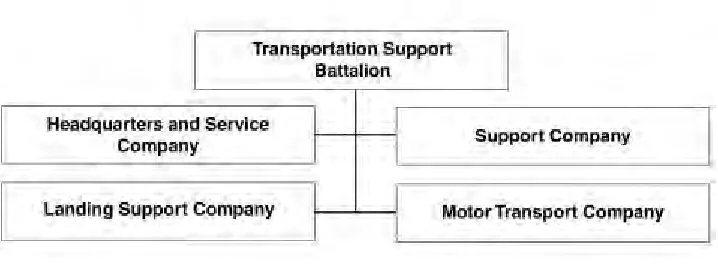
The TSB provides motor transport and landing support for the MAGTF (see figure 2-1). The TSB can provide the nucleus of personnel and equipment from which a landing force support party (LFSP) or combat service support element (CSSE) is task- organized. The TSB has the assets required to support all types of Navy and Marine Corps operations.
Mission
Provide tactical throughput support and associated command and control (C2) for the MAGTF to facilitate the distribution of personnel, equipment, and supplies by air, ground, and sea.
Tasks
l Provide centralized command, control, and communications for landing support, distribution and throughput functions (including port and terminal operations), materials handling, air d e l i v e r y s u p p o r t , c o n v o y o p e r a t i o n s , a n d m o t o r transportation during operations conducted by the MAGTF.
l Provide selected heavy equipment lift augmentation in support of the MAGTF.
l Transport personnel, equipment, and supplies within organic lift capabilities.
l Provide throughput and distribution of bulk, liquid, containerized, and dry cargo.
l Provide port and terminal operations at ports, beaches, airheads, railheads, and cargo terminals, a n d m a n a g e m e n t o f f r e i g h t / p a s s e n g e r a n d breakbulk/container cargo throughput.
l Provide air delivery support for MAGTF operations.
[image:12.612.131.490.577.709.2]l Perform basic engineer tasks required for landing s u p p o r t o p e r a t i o n s t o i n c l u d e a u s t e r e s i t e preparations, construction/removal of obstacles and barriers, and establishment of routes of egress from the beach when properly augmented.
l Provide a nucleus for the task organization of LFSP/arrival and assembly operations group (AAOG) from organic assets to provide C2 structure for the landing support and distribution for initial CSS for MAGTF operations.
l Provide security for organic units.
Concept of Organization
The battalion is organized to plan, coordinate, and supervise the throughput and distribution functions in support of MAGTF operations. It is structured to facilitate task organization for operations conducted by the battalion in support of the MAGTF.
Concept of Employment
T h e b a t t a l i o n i s s t r u c t u r e d t o f a c i l i t a t e t a s k organization for landing support and throughput operations conducted in support of the MAGTF. It is equipped to provide medium through heavy cargo transportation to the MAGTF. Additionally, the battalion provides the initial source for centralized CSS for MAGTF operations.
Headquarters and Service Company
Mission
Provide C2, administration, and command support functions for TSB, FSSG.
Tasks
l Provide command support functions to include supply, ordnance, information management, and food service support for the battalion.
l Provide organizational maintenance for ordnance and communication-electronic equipment.
l Provide support for the battalion’s local security.
Concept of Organization
The company is organized to plan, coordinate, and supervise the command support functions for the battalion. It is structured to facilitate task organization for operations conducted by the battalion in support of MAGTF operations.
Concept of Employment
T h e c o m p a n y p r o v i d e s t h e c o m m a n d s u p p o r t functions to plan, coordinate, and supervise the general intermodal transportation, landing support, and throughput functions conducted by the battalion in support of the MAGTF.
Support Company
Mission
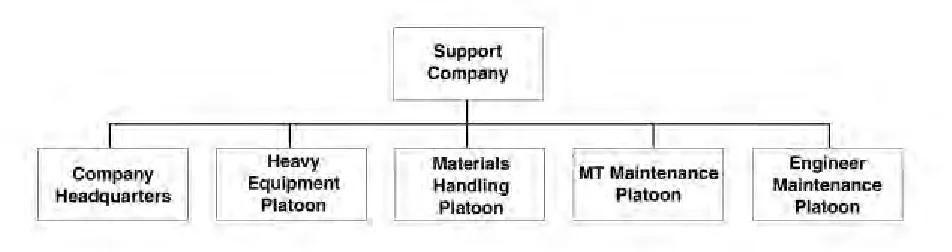
Provide MHE, container handling support, and organizational maintenance support for engineer and motor transport assets of the battalion in support of MAGTF operations (see figure 2-2).
Tasks
l Provide MHE support for the MAGTF beyond the organic capability of supported units.
[image:13.612.65.541.586.712.2]l Provide specialized MHE and container handling support for the management of container/cargo throughput operations on beaches, at ports, railheads, airheads, and cargo terminals.
l P r o v i d e o r g a n i z a t i o n a l ( 1 s t , 2 d e c h e l o n ) maintenance support for engineer and motor transport equipment organic to the battalion.
Concept of Organization
The company is organized to plan, coordinate, and supervise the command support functions of the company. It is structured to facilitate task organization for throughput operations conducted by the battalion in support of the MAGTF.
Concept of Employment
The company provides centralized support to expedite throughput operations. It is equipped with tactical engineering cranes, buckets, graders, forklifts, and light sets to facilitate operations. The company can be task-organized to provide CSSEs.
Landing Support Company
Mission
Provide direct support for landing and throughput operations at helicopter landing zones (HLZs), assault beaches, and airfields (see figure 2-3).
Tasks
l Provide shore party and/or helicopter support teams (HSTs) in direct support of assault and sustained operations.
l Prepare, mark, and control assault landing beaches or zones as required.
l Establish multi-class supply storage sites ashore.
l Coordinate the unloading of supplies and equipment from landing craft, ships, and helicopters through designated assault beaches and HLZs.
l Coordinate transportation support for the evacuation of casualties, noncombatants, and EPWs.
l Provide departure airfield control group/arrival airfield control group (DACG/AACG) to control and coordinate the loading and unloading of units deploying or redeploying by fixed-wing aircraft.
Concept of Organization
The company is organized to provide the nucleus of personnel and equipment required for a shore party group or AAOG.
Concept of Employment
The company provides direct landing support in support of amphibious and helicopterborne operations. When reinforced with battalion assets, it provides the nucleus for the shore party group and AAOG which provides initial throughput and sustainment for the M A G T F . U p o n e s t a b l i s h m e n t o f t h e C S S E , operational control passes to the CSSE commander for the continuation of direct landing support as required. The company coordinates local security for a colored beach. The company can provide AACG/DACG to support deploying/redeploying units.
Beach and Terminal Operations
Mission
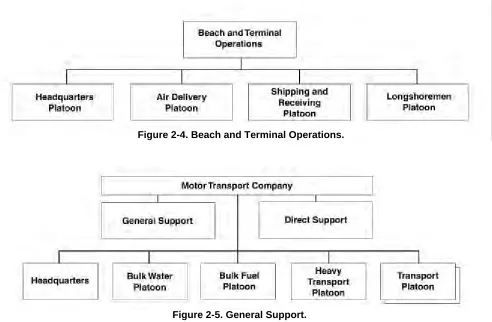
Provide general transportation support to coordinate t h r o u g h p u t o p e r a t i o n s f o r t h e M A G T F ( s e e figure 2-4).
Tasks
l Provide personnel and equipment for the loading, u n l o a d i n g , a n d m o v e m e n t o f s u p p l i e s a n d equipment at ports, beaches, railheads, airheads, cargo terminals, dumps, and depots.
l Provide air delivery support.
Concept of Organization
Beach and terminal operations is organized to support throughput operations. It provides management and operation of ports, airheads, railheads, and other cargo/passenger terminal operations including aerial delivery support.
Concept of Employment
When directed, beach and terminal operations assumes responsibility for the throughput operations after control of beaches, ports, and terminals is passed to the CSSE. It provides aerial delivery support and, when augmented by other elements of the CSSE, controls air terminals to include conducting DACG/ AACG operations.
Motor Transport Company, General Support
Mission
Provide general support, medium and heavy lift transportation support for throughput, and sustainment operations (see figure 2-5).
Tasks
l Provide distribution of bulk water (Class I) and bulk fuel (Class III and III[A]).
l Provide medium and heavy lift motor transport for the movement of bulk dry cargo, Class V and V(A), and heavy equipment.
[image:15.612.60.552.410.732.2]Figure 2-5. General Support.
l Provide unit and supply point distribution of bulk water and fuel.
l Augment the motor transport and supply distribution capabilities of the Direct Support Motor Transport Company, TSB, FSSG, as required.
Concept of Organization
The company is organized to plan, coordinate, and supervise the command, supply, and transportation support functions for the company. It is structured to facilitate task organization for operations conducted by the battalion.
Concept of Employment
The company provides medium and heavy lift motor transport and bulk fuel and water distribution. It is employed in general support to transport cargo, equipment, and personnel over extended distances for sustained periods of time. Organic equipment includes 5-ton tactical cargo trucks, Logistics Vehicle Systems (LVSs), and 40- and 70-ton semitrailers.
Motor Transport Company, Direct Support
Mission
Provide direct and general support, medium and heavy lift transportation support for throughput and sustainment operations of the CSSE in support of the MAGTF (see figure 2-6).
Tasks
l Provide line haul and distribution of bulk water (Class I) and bulk fuel (Class III and III[A]) for the CSSE.
l Provide medium and heavy lift motor transport for the movement of bulk dry cargo, Class V and V(A), and heavy equipment.
l Augment the personnel lift capability, as required, of elements of the MAGTF.
Concept of Organization
The company is organized to plan, coordinate, and supervise the command, supply, and transportation support functions for the company. It is equipped with 5- and 7-ton tactical cargo trucks, LVSs, and sixcon fuel and water modules.
Concept of Employment
The company is structured to provide sustained, direct support transportation to the CSSE, and general support transportation to the MAGTF. It transports cargo, equipment, fuel, water, and personnel over extended distances for sustained periods of time.
Marine Division Motor Transport
Subordinate elements of the division have motor transport equipment authorized for organizational use. Because of the limited quantities and specialized roles
of that equipment, it will normally not be available for routine logistical support.
Truck Company, Headquarters
Battalion, Marine Division
The truck company provides limited tactical mobility to the Marine division. The company consists of a headquarters and three truck platoons containing two truck sections each (see figure 2-7). The company commander directs and controls all matters pertaining t o c o m p a n y a d m i n i s t r a t i o n a n d s u p p o r t . T h e c o m p a n y h e a d q u a r t e r s s u p p o r t s t h e c o m p a n y commander in exercising C2 of the operating elements in the three truck platoons. The truck company is under the administrative control (ADCON) of the headquarters battalion commander. Operational tasking of the truck company is coordinated by the d i v i s i o n m o t o r t r a n s p o r t o f f i c e r . H e m a k e s recommendations as appropriate to the commander, usually via the principal staff officers, as requirements are developed.
The truck company is a combat support asset of the Marine division. It is capable of transporting the a s s a u l t e l e m e n t s o f t w o i n f a n t r y b a t t a l i o n s simultaneously. Truck platoons will normally be attached to or placed in direct support of infantry regiments and are capable of sustained operations on a 24-hour basis. Normally the tactical situation will require that motor transport assets of the truck company be used to augment the limited organic capability of subordinate division units.
T h e t r u c k c o m p a n y i s c a p a b l e o f p r o v i d i n g organizational (1st and 2d echelon) maintenance for a l l o r g a n i c e q u i p m e n t e x c e p t c o m m u n i c a t i o n equipment. Both 2d and 3d echelon maintenance for organic communication equipment are provided by communications company, headquarters battalion, d i v i s i o n . I n t e r m e d i a t e ( 3 d a n d 4 t h e c h e l o n ) maintenance for all other equipment is provided by maintenance battalion, FSSG. Selected items of equipment are listed in table 2-1.
Motor Transport Section,
Division Headquarters
The motor transport section, division headquarters, consists of the division motor transport officer and a small administrative staff. The motor transport officer performs the general duties of a special staff officer under the cognizance of the assistant chief of staff, G-4. The staff responsibilities of the division motor transport officer include—
l Supervising the planning and technical training and motor transport related duties and programs within the division.
l Coordinating planning for motor transport intelligence and the dissemination thereof.
l Conducting comprehensive analyses of all motor t r a n s p o r t t a s k s r e q u i r e d t o i m p l e m e n t t h e commander’s plan.
l Maintaining liaison with higher, lower, and adjacent commands pertaining to motor transport matters.
l Analyzing and evaluating motor transport capabilities throughout the command.
Figure 2-7. Truck Company, Marine Division.
Table 2-1. Truck Company, Selected Items of Equipment.
TAMCN Description Model Qty
D0860 Trailer, Cargo, 1½-ton M105A2 57 D0880 Trailer, Tank, Water, 400
Gallon
M149A1 13
D1059 Truck, Cargo 5-ton M923 100 D1158 Truck, Utility,
1¼-ton
M998 12
l Coordinating all motor transport support requirements and directing commitments, as appropriate, to organizations best capable of providing the support required.
l Monitoring and providing technical supervision to all motor transport requirements, commitments, and movements of truck company.
l Supervising and coordinating the maintenance of required motor transport records and reports.
l Developing, coordinating, implementing, and monitoring command technical inspections for motor transport.
l Monitoring motor transport combat readiness in all subordinate organizations of the command.
l Advising the commander of all technical matters concerning motor transport.
Marine Aircraft Wing Motor Transport
Some subordinate elements of the Marine aircraft wing (MAW) have limited, special purpose motor transport equipment authorized for organizational use. Other than limited general purpose motor transport equipment, units of the MAW receive organic motor transport support from the Marine wing support squadrons (MWSSs).
Marine Wing Support Squadron, Marine Wing
Support Group, MAW
Organic motor transport support for the MAW is provided by the MWSSs of the Marine wing support group (MWSG). There are four MWSSs in each MWSG. Each MAW has two MWSSs designed to support a fixed-wing (FW) aircraft group and two MWSSs to support a rotary-wing (RW) aircraft group. These are designated MWSS/FW and MWSS/RW, respectively. The exception to this is in 1st MAW, which has one FW and one RW MWSS.
The MWSS is organized to provide essential aviation ground support to the FW or RW components of an aviation combat element (ACE). An MWSS may also supplement the garrison support provided by a permanent Marine Corps air station. In addition to motor transport, this support includes explosive ordnance disposal, security and law enforcement, photographic services, air freight services, weather services, internal airfield communications, crash/ fire/rescue and structural firefighting services, essential engineer services, expeditionary airfield services, aircraft and ground equipment refueling, aircraft recovery, messing facilities, medical services, training support, and internal nuclear, biological, and chemical (NBC) defense.
Motor Transport Operations Division
The motor transport operations division of the MWSS is organized into two branches: the light/medium motor vehicle branch and the heavy motor vehicle branch (see figure 2-8). Table 2-2, on page 2-8, presents a list of selected items of equipment.
The motor transport section, MAW consists of the wing MAW motor transport officer and a small administrative staff. The motor transport officer performs the general duties of a special staff officer parallel to those of the division motor transport officer.
Transportation Task Organizations LFSP
Fundamentals
The TSB is responsible for the MAGTF’s landing support services and provides the units required to form the LFSP. The LFSP’s mission is to perform specified combat service support operations for the landing force during the amphibious assault. It also provides initial landing support and combat service support to the landing force during the amphibious operation. The LFSP facilitates the MAGTF’s ship-to-shore movement by—
l Supporting the landing plan.
l Avoiding excessive concentration of equipment, people, and supplies.
l Providing a uniform flow ashore of material required by the landing force.
The LFSP is peculiar to an amphibious operation. It is a temporary task organization composed of Navy and Marine Corps elements tasked to provide initial combat service support during the ship-to-shore movement. The LFSP’s strength and composition are determined during the amphibious operation’s initial planning phase. The LFSP may include units or detachments from the ground combat element (GCE), ACE, CSSE, and the Navy. The MAGTF’s organization and mission, the number of landing beaches/zones through which the MAGTF will land, and the mission and size of the units assigned to the beaches/zones determine the LFSP’s configuration. The LFSP is under the operational control (OPCON) of the commander, landing force (CLF) (see figure 2-9).
The LFSP provides CSS to the landing force until the C S S E i s a s h o r e a n d c a p a b l e o f a s s u m i n g responsibility for logistics support. While the LFSP
[image:19.612.156.447.100.194.2]organization may vary, it typically consists of a headquarters, two or more shore party groups and HSTs, a beach party group, and various special attachments (see figure 2-10).
Table 2-2. Truck Company, Selected Items of Equipment.
TAMCN Description Model Qty
[image:19.612.316.553.292.479.2]D0860 Trailer, Cargo, 1 1/2 ton M105A2 57 D0880 Trailer, Tank, Water, 400 gal M149A1 13 D1059 Truck, Cargo 5-ton M923 100 D1158 Truck, Utility, 1 1/4-ton M998 12 D1212 Truck, Wrecker M936 3
[image:19.612.316.552.507.711.2]Figure 2-9. LFSP Relationship within the MAGTF.
Headquarters
The LFSP headquarters controls and supervises landing support operations within the landing area as set forth in the landing force operation plan. The LFSP headquarters ensures effective landing support through close coordination, timely reinforcement, and consolidation of shore party group and beach party group activities.
During the initial stages of ship-to-shore movement, the LFSP headquarters typically remains afloat where it can best control and supervise the landing forces’ landing support operations. However, operational necessity may require the LFSP headquarters to move ashore earlier. As more functions and capabilities m o v e a s h o r e , t h e L F S P h e a d q u a r t e r s g r o w s accordingly. Once the CSSE, ACE, and naval beach group (NBG) are established ashore, they assume responsibility for their appropriate tasks.
Command and Administrative Section
TSB headquarters or the MAGTF CSSE provides the p e r s o n n e l n e e d e d t o f o r m t h e c o m m a n d a n d administrative section.
Medical Section
Medical battalion, FSSG provides the nucleus of the medical section. The medical section plans the LFSP’s medical evacuation functions, supervises patient operations within the shore party and the HST’s evacuation sections, and prepares medical reports.
Military Police Section
Normally, the military police (MP) section consists of personnel taken from the MP company, FSSG. This section supervises the shore party and HST’s MP sections. In addition, this section establishes the landing force’s EPW stockade and organizes and evacuates EPWs from the objective area.
Communications Section
The nucleus of the communications section is provided by the TSB or MAGTF CSSE and may be augmented from other sources. This section provides required
communications ashore. Marine Corps Warfighting Publication (MCWP) 6-22, Communications and I n f o r m a t i o n S y s t e m s, c o n t a i n s a d d i t i o n a l information on landing support communications.
The Motor Transport and Equipment Section
The TSB or MAGTF CSSE provides motor transport and equipment section personnel. Only those vehicles required by the LFSP headquarters operate under the direct control of this section. The remaining assets are assigned to augment the LFSP and are normally attached to the shore party team, shore party group, and HSTs.
Liaison Section
The liaison section consists of liaison personnel from units that are attached to or under the OPCON of the LFSP.
Shore Party Group
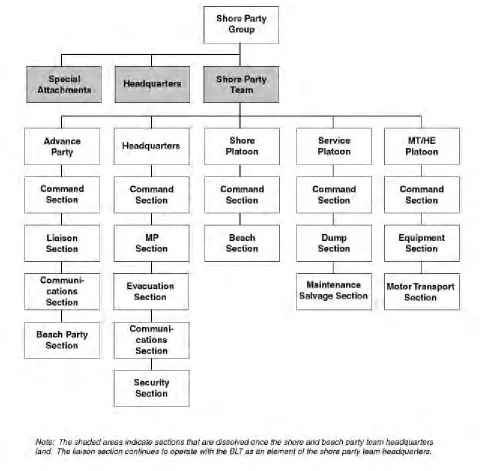
The shore party group provides landing support across the beach by assisting movement of troops and supplies, evacuating casualties and EPWs, and controlling landing craft and amphibious vehicles. Marine components of the shore party group perform tasks inland from the water’s edge, and Navy components perform tasks seaward from the water’s edge. The shore party group is capable of providing CSS to a regimental landing team over a designated (colored) beach. All tasks are performed under the direction of the shore party group commander, who is designated by the LFSP commander.
The shore party team lands ahead of the shore party group to assist with the initial landing. Once the shore party group moves ashore, shore party teams are absorbed into the shore party group. Shore party teams are capable of supporting a battalion landing team over a numbered beach.
Headquarters
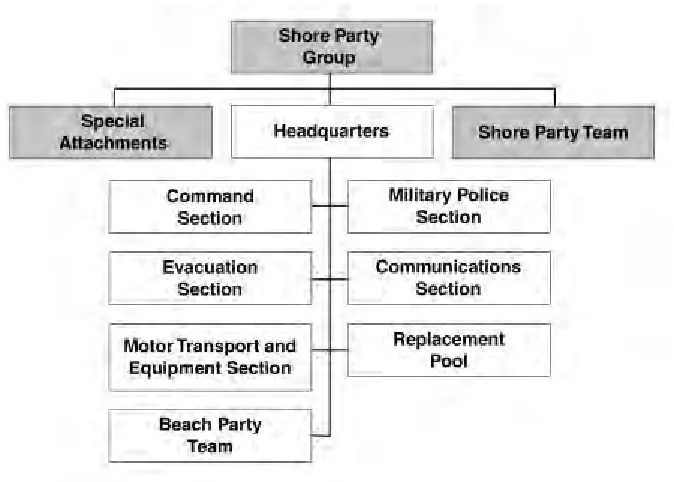
The headquarters section controls and supervises landing support operations within the landing area as set forth in the landing force operation plan. It coordinates with the LFSP aboard ship, the tactical logistical group (TACLOG), and the landing force (see figure 2-12).
Command Section. The nucleus of the command section is drawn from the landing support company’s headquarters. This section handles the shore party group’s administrative functions.
Military Police Section. The MP section consists of the section leader of the attached MP unit and the
a s s i g n e d a d m i n i s t r a t i v e a n d c o m m u n i c a t i o n s personnel. This section coordinates each of the shore party teams’ MP operations and is absorbed by the CSSE once the shore party group dissolves.
Evacuation Section. When the evacuation section is established ashore, it assumes control of the shore party teams’ evacuation sections. This section is comprised of personnel from the CSSE’s attached medical units and assets from the ACE’s helicopter units. This section maintains the records of evacuated personnel and evaluates the casualty evacuation procedures for effectiveness.
[image:21.612.126.480.75.201.2]Communications Section. The communications section provides communications for the shore party Figure 2-11. Shore Party Group.
[image:21.612.133.470.463.704.2]group headquarters. Personnel and assets for this section come from the CSSE. Once the shore p a r t y group is established ashore, it coordinates communications established by the shore party teams and assumes control of the shore party team’s communications section.
Motor Transport and Equipment Section. Once the shore party group assumes control of shore party team operations, this section assumes control of all motor transport functions and equipment attached to shore party teams. Personnel and assets for this section come primarily from the TSB.
Replacement Pool. The replacement pool consists of personnel waiting to be drafted into operation and are referred to as replacement units. Replacement units may be used to form ships platoon. Typically, replacement units assist the shore party in the accomplishment of general tasks. During the selective and general unloading phases, replacement units are used as longshoremen at unloading points and dumps in the beach support area (BSA).
Beach Party Team. See paragraph entitled “Beach Party Team” on page 2-13 for a detailed discussion.
Special Attachments
Special attachments do not perform service or tasks associated with shore party teams. They are normally retained under the control of the shore party team headquarters. Special attachments may include liaison personnel from the augmentation units attached to the shore party teams.
Shore Party Team
The shore party team provides CSS to a battalion landing team (BLT) landing across a designated (numbered) beach. It is subordinate to the shore party group. The nucleus of the team is drawn from the landing support platoon, landing support company, TSB and augmented as required to accomplish the specific shore party group’s or shore party team’s m i s s i o n . T h e s h o r e p a r t y t e a m c o n s i s t s o f a headquarters, shore platoon, service platoon, and
motor transport/heavy equipment platoon (see figure 2-13, on page 2-12).
The Marine component of the shore party team performs the following tasks:
l Marking limits of the beach unloading points. l Designating and marking landing sites for
helicopters.
l Locating and establishing multi-class supply dumps.
l Assisting the beach party in the landing and moving of units across the beach.
l Marking and removing obstacles in the BSA that a r e h a z a r d o u s t o p e r s o n n e l o r m a y i m p e d e operations.
l Constructing and maintaining beach roads. l Establishing and operating information centers. l Maintaining current situation maps to assist landed
units.
l Controlling traffic in the BSA.
l M a i n t a i n i n g c o m m u n i c a t i o n s w i t h t r o o p commanders of waterborne and helicopterborne a s s a u l t u n i t s a n d t h e T A C L O G f o r c o n t r o l purposes.
l Establishing lateral communications between beaches and HLZs.
l Marking contaminated/decontaminated portions of the BSA.
l Evacuating casualties and EPWs.
l Providing emergency maintenance for equipment in the waterborne assault.
l Maintaining continuous records, by category, of units, equipment, and amounts of supplies landed.
l Coordinating movement of amphibious vehicles carrying supplies.
l Loading/unloading supplies from landing craft, ships, and helicopters.
l Moving supplies to inland dumps or using units as required.
l Providing security and coordinating defense of the BSA.
l Establishing and maintaining, as a part of the landing force warning system, a system to warn of air; ground; and NBC attacks within the BSA.
l Providing mortuary affairs services as directed.
l Constructing helicopter landing sites within the BSA.
l Establishing forward arming and refueling points (FARP) as required.
[image:23.612.60.540.74.545.2]units as the shore party team comes ashore (except liaison sections operating with the GCE).
Headquarters. The shore party team headquarters includes a command section, evacuation section, MP section, communications section, and security section. This section provides the C2 for the shore party team.
Shore Platoon. The shore platoon is a detachment from the shore party platoon and is augmented as required. The shore platoon organizes and operates the facilities for unloading supplies and equipment at the water’s edge. It also organizes and operates the movement of material to the dump area or staging area or out of the BSA.
Service Platoon. The service platoon’s nucleus comes from the shore party platoon and is augmented by specialists from CSS units. The service platoon organizes and operates dumps and maintenance/ salvage areas in the BSA.
Motor Transport/Heavy Equipment Platoon. The motor transport/heavy equipment platoon is drawn from primarily from TSB. This platoon provides equipment and motor transport support to the shore party team’s sections and platoons.
Beach Party Group
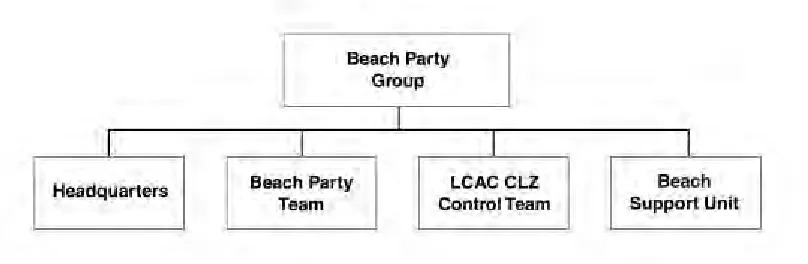
The beach party group is the Navy counterpart to the shore party group. A beach party group is assigned to each designated beach and supervises, controls, and coordinates all Navy activities on that beach, such as boat salvage and lane clearing for landing craft. The beach party group includes a beach party group headquarters, beach party team(s), landing craft air
cushion (LCAC) craft landing zone (CLZ) control team(s), and a beach support unit (see figure 2-14).
The beach party group’s mission is to provide the beach master, traffic control, causeway lighterage, causeways, ship-to-shore bulk fuel systems, limited construction capabilities, landing craft, and beach salvage capabilities. It also provides communications to C2 to its specially equipped teams. The beach party group facilitates the flow of troops, equipment, and supplies to the beaches and evacuates casualties, refugees, and EPWs as required.
Headquarters
The beach party group headquarters is drawn from the beach master unit of the NBG. The group commander and staff embark and land with the shore party group headquarters. The beach party group commander advises the shore party group commander on Navy matters, and they jointly plan for the expeditious use of all units employed in the BSA.
Beach Party Team
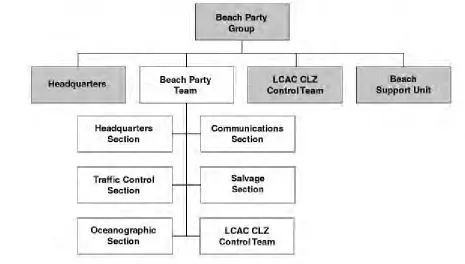
The beach party team is the Navy component to the shore party team and is commanded by a navy officer. The beach party team provides Navy functions (e.g., boat salvage, boat repair) for the shore party (see figure 2-15, on page 2-14).
[image:24.612.120.524.575.707.2]Headquarters Section. The headquarters section contains the beach party team commander and communications and administrative assistants. A part of this team lands with the shore party team’s advance party.
Communications Section. The communications section contains personnel and equipment to transmit and receive operational information from various sources. This section uses lights, flags, and public address and broadcasting equipment to direct personnel and craft in the vicinity of the beach area. The communication section uses portable and mobile radio equipment to provide communications with units afloat and on adjacent beaches. It monitors the m o v e m e n t o f l a n d i n g c r a f t ’ s d e s i g n a t e d communications nets for beach touchdown points.
Traffic Control Section. The traffic control section, equipped with signal flags and other signal devices, controls traffic at unloading slots along the beach and directs beaching and retraction of craft.
Salvage Section. The salvage section contains personnel and equipment from the amphibious construction battalion and the NBG’s beach master unit. This section assists the beaching and retraction of landing craft and ships, accomplishes minor beach improvement, and effects salvage of landing craft and amphibious vehicles. This section’s equipment includes dozers, amphibious vehicles, and surf cranes. Landing craft may be assigned to this section to assist in boat salvage.
Oceanographic Section. The oceanographic section contains personnel drawn from the sea-air-land team, which is normally attached to the beach party group or beach party team. This section reports to the beach party team commander after completion of its tasks with the advance force. The oceanographic section performs tasks such as marking and removing o b s t a c l e s i n b e a c h a p p r o a c h e s u p t o t h e h i g h watermark. It also performs hydrographic surveys and lifeguard duties, marks channels and navigational hazards, and improves seaward approaches. This section is equipped with inflatable boats, survey equipment, buoys, and demolitions.
L C A C C L Z C o n t r o l S e c t i o n .T h e d u t i e s a n d responsibilities of the LCAC CLZ control section are the same as the LCAC CLZ control team.
LCAC CLZ Control Team
[image:25.612.62.527.77.341.2]LCAC CLZ control team. See Fleet Marine Force Manual (FMFM) 1-8, Ship-to-Shore Movement, for more detail.
Beach Support Unit
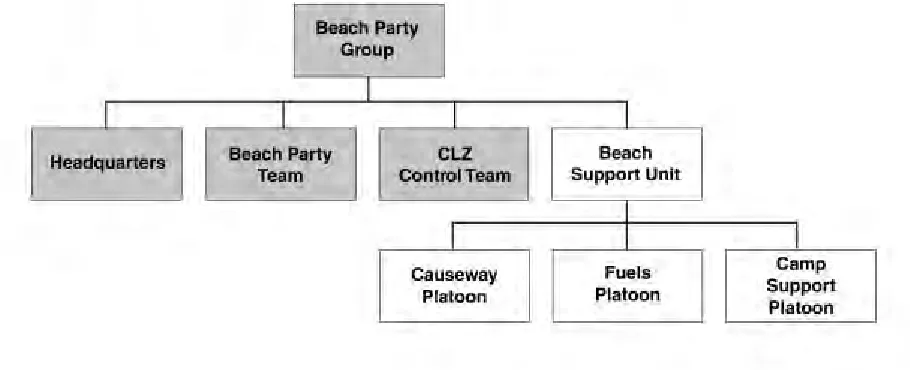
The beach support unit is drawn from the amphibious construction battalion of the NBG. This unit consists of a causeway platoon, fuels platoon, and camp support platoon (see figure 2-16). The beach support unit’s primary mission is to provide causeway and fuel system support for the LFSP. Its secondary mission is to undertake military construction projects within the capabilities of assigned personnel and equipment. A beach support unit performs the following tasks:
l Installs causeway piers and uses causeway ferries to ferry equipment ashore.
l Provides capability to conduct ship causeway standoffs and compression marriages.
l Installs, operates, and maintains container over the shore systems.
l Installs and operates the roll-on/roll-off ship discharge facility.
l Installs, operates, and maintains amphibious assault fuel systems.
l Installs off shore petroleum, oils, and lubricants (POL) discharge systems.
l Provides beach salvage sections.
l Provides camp support and limited construction sections.
Special Attachments to Beach Party Group
Special attachments are attached to the beach party group to perform tasks or provide capability not normally included in the beach party organization. These attachments may provide support to the landing force, however, they typically perform Navy tasks that are more effective when performed from the beach.
Special Attachments to LFSP
There are many special attachments that may be made to the LFSP in order to perform the LFSP’s assigned tasks. For example, units may be attached to the LFSP for defense or the landing force commander may deploy units to counter threats. The landing support commander may employ units operating in the BSA or landing zone support area (LZSA) in emergency situations, particularly in defense of the area.
Arrival and Assembly Operations Group
[image:26.612.91.546.527.712.2]The AAOG is a task-organized group from the MAGTF whose function is to coordinate and control arrival and assembly operations (see figure 2-17 on page 2-16). It
consists of personnel from all MAGTF elements plus liaison from the commander, naval support element (CNSE).
The AAOG—
l Monitors the airflow of the fly-in echelon (FIE) into the arrival and assembly area (AAA).
l Coordinates and monitors the throughput and distribution of maritime pre-positioned equipment and supplies (MPE/S) from the MPS to the unit assembly areas, specifically the arrival and assembly operations elements (AAOEs) within those assembly areas.
l Coordinates the association of MPE/S with designated organizations.
l Provides initial C2 functions for the MAGTF in the AAA.
l Directs and coordinates the AAOEs operations. l Provides direction, coordination, and interface with
the LFSP and airfield coordination officer (ACO) until such time as the respective MAGTF elements assume responsibility for those functions.
Tactical-Logistics Group
A parallel chain of command is established between the Navy and the MAGTF to conduct amphibious
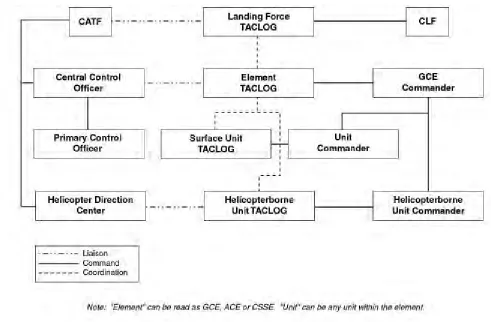
operations in accordance with JP 3-02, Joint Doctrine for Amphibious Operations. This chain of command allows the resolution of command and control issues at the lowest possible level. To effect this chain of command, the MAGTF establishes a TACLOG wherever a Navy ship-to-shore control organization is e s t a b l i s h e d . T h e T A C L O G i s t h e M A G T F ’ s counterpart to the Navy’s control organization. It is n o t p a r t o f t h e N a v y s h i p - t o - s h o r e c o n t r o l organization; it is the MAGTF’s liaison to the Navy. TACLOGs embark on the same ship as the Navy control officer exercising control over the ship-to-shore movement (see figure 2-18).
Mission
A MAGTF commander establishes TACLOGs as r e q u i r e d . A T A C L O G i s a t e m p o r a r y t a s k organization formed by the MAGTF, and it is composed of MAGTF personnel. It is concerned with both tactical and logistical ship-to-shore movement. A TACLOG’s mission is to communicate MAGTF ship-to-shore movement requirements to the Navy’s control organization and to assist the Navy in landing personnel, supplies and equipment in accordance with the MAGTF landing plan. The landing force TACLOG monitors the operations of subordinate TACLOGs and intervenes only if necessary to provide control/coordination at a higher level. TACLOGs link the LFSP, shore party, HST, and the Navy control organization. They also serve as the landing force commander’s p r i m a r y s o u r c e o f information concerning the status of MAGTF units during the ship-to-shore movement. FMFM 1-8 has detailed information concerning TACLOG.
Responsibilities
It is the collective responsibility of the Navy control organization, TACLOG, LFSP, and HST to—
l Know, at all times, what units are ashore and the status of any requests made for landing additional personnel, supplies, and/or equipment.
l Orchestrate and regulate movement of scheduled waves to ensure personnel, supplies, and equipment arrive at the designated location at the prescribed time and in the condition required to accomplish the assigned mission.
l Ensure pre-positioned emergency supplies and floating dumps are responsive to the MAGTF’s needs and moved rapidly to the designated location when required.
l Ensure on-call waves are prepared to move ashore rapidly to the designated location.
l Orchestrate preparations for nonscheduled waves to move ashore.
Based on the mission, TACLOG becomes the primary and critical link between the MAGTF and the Navy control organization, LFSP, and HST. The TACLOG must know the status of all phases of the ship-to-shore movement and the status of the LFSP, shore party, HST, and the Navy control organization.
Tasks
Each TACLOG, despite command level or specific focus, must be prepared to process requests and p r o v i d e r e c o m m e n d a t i o n s t o N a v y c o n t r o l
organizations. TACLOGs must also be capable of performing the following tasks:
l Coordinating pre-D-day and pre-H-hour transfers involving landing force personnel and equipment.
l Monitoring scheduled waves.
l Providing information and recommendations to the Navy control organization to facilitate the landing of on-call and nonscheduled serials/waves.
l Processing and coordinating requests for support. l Expediting, in coordination with the Navy control
organization, the landing of personnel, supplies, and equipment in accordance with plans and orders.
l Advising the Navy control organization of the location of requested items.
l Recommending the type of landing craft or helicopter(s) required based on the tactical situation ashore and the availability of transportation assets.
[image:28.612.61.552.73.395.2]l Anticipating requirements and coordinating the debarkation of nonscheduled serials.
l Advising the Navy control organization of the priority for landing serials during periods of congestion at the off-load site or when a shortage of transportation assets affects the tactical situations ashore.
l Advising the Navy control organization of changes in the landing sequence or landing plan and their effect on the tactical situation ashore.
l Maintaining records of the landing’s progress. This includes the date-time-group (DTG) of scheduled, on-call, and nonscheduled serials; indicating those requested and those landed; and the current location of serials not yet landed.
l Sending/receiving periodic serial status reports to the landing force commander concerning the buildup ashore and other factors that may delay or change the landing plan.
l Coordinating with the Navy control organization to ensure that the ship’s locations and movements d o n o t c o n f l i c t w i t h M A G T F o p e r a t i o n s o r communications.
l Monitoring the progress of tactical operations to anticipate requirements, coordinate the landing of nonscheduled and nonserialized sections, and recommend adjustments or deviations from the landing plan as required.
l Formulating decisions that may affect tactical operations ashore (within the limits of authority delegated to the TACLOG officer in charge [OIC]).
l Coordinating the buildup of supplies at BSAs and HLZs and/or combat service support areas (CSSAs) with the LFSP, HST, and other CSS organizations.
l Identifying landing requirements (landing craft/ helicopters).
l Maintaining records of the ship’s location and informing the LFSP and HST commanders of changes as they occur.
l Coordinating and assisting in the control of withdrawal operations with the Navy control organization and ship’s combat cargo officer as required.
Task Organization
The organization of each TACLOG varies to meet the requirements of a specific unit and operation. TACLOGs are composed of landing force tactical and logistical representatives. The landing force TACLOG
is normally located aboard the amphibious force flagship. The basic organization is prescribed by the landing force commander and indicated in the M A G T F o p e r a t i o n o r d e r . T h e l a n d i n g f o r c e commander specifies which subordinate commanders are to organize and operate TACLOGs and ensures the TACLOG structure parallels the Navy control structure. If subordinate commanders are required to establish TACLOGs, their operation orders should specify the composition of their TACLOG.
Personnel assigned to the TACLOG must include both tactical and CSS personnel who are thoroughly familiar with MAGTF plans, Navy control procedures, and movement capabilities of both the Navy and the MAGTF. Representatives should include a G-3/S-3 (operations staff officer) representative (responsible for the TACLOG until the general off-load), a G-4/S-4 (logistic staff officer) representative (responsible for the TACLOG once the general off-load begins), a M A G T F / u n i t e m b a r k a t i o n o f f i c e r , a C S S E r e p r e s e n t a t i v e , c o m m u n i c a t i o n s p e r s o n n e l , administrative personnel, and liaison personnel from other units. Assigned personnel must possess a d e t a i l e d k n o w l e d g e o f t h e o p e r a t i o n o r d e r ; embarkation order; CSS concept; ship’s loading plans; tactical and CSS requirements; and plans, capabilities, and documents relating to the landing.
Helicopter Support Teams
Mission
The HST’s mission is to facilitate the landing and movement of helicopterborne forces, equipment, and supplies to and within the landing zone. Normally, an HST is employed in each landing zone to provide support to units operating in and around that zone. An HST is formed for all helicopterborne operations. The HST also supports the evacuation of casualties and EPWs.
the primary means of support or when a combat s e r v i c e s u p p o r t b u i l d u p c o m m e n c e s i n t h e landing zone.
HST Organizational Structure
The HST is a task organization composed of personnel and equipment from the helicopterborne unit and the LFSP. It is augmented from other units as required. The actual organization and commander of the HST is decided by the helicopterborne unit commander. This decision is based on the mission and whether a combat service support buildup is planned for the area.
The HST normally consists of an advance party, headquarters, helicopter control section, and landing zone platoon (see figure 2-19). HST personnel must be fully trained and capable of carrying out their assigned duties (including the special considerations required of helicopterborne operations).
[image:30.612.125.503.286.685.2]The MAGTF operation order specifies when control of the landing zone passes from the HST to the CSSE. Passing control can be specified by a specific time or event (i.e., when sufficient CSSE C2 capability is in the landing zone) or by order of the landing force commander.
Advance Party
The advance party consists of eight to ten personnel drawn from each section of the HST. The advance party lands early, reconnoiters a site for the CSS installation, establishes the command post, and erects u n l o a d i n g p o i n t m a r k e r s ( a p p e n d i x A ) . Communications personnel provide immediate communications. Landing zone control personnel control the helicopters operating within the zone. The OIC of the advance party assumes OPCON over the reconnaissance unit that provided the initial terminal guidance into the landing zone. The OIC retains control of the reconnaissance unit until the helicopter control section assumes responsibility. After the HST is established in the landing zone, the advance party disbands and its personnel revert to their parent section within the HST.
Helicopter Support Team Headquarters
If no CSS buildup is planned, the HST headquarters comes from the helicopterborne unit. If a CSS buildup is planned, the HST headquarters comes from the LFSP’s or CSSE’s landing support platoon, this simplifies transfer of control to the CSSE once the CSS buildup begins. The HST headquarters assumes control of the landing zone as rapidly as possible. The HST headquarters consists of—
l A command section provided by the appropriate platoon headquarters and augmented as required.
l A communications section provided by the communications platoon of the helicopterborne unit or from the shore party as appropriate.
l An MP section from the shore party.
l A security section for internal security of the landing zone. The security section is provided by the helicopterborne unit.
l An evacuation section provided by the medical section of the helicopterborne unit.
l The liaison section that accompanied the headquarters element of the helicopterborne unit.
Helicopter Control Section
The ACE provides personnel for the helicopter control section. The helicopter control section is generally organized into three sections: air traffic control, communications, and helicopter maintenance and refueling. The helicopter control section establishes and operates electronic and visual navigation aids that guide aircraft. It directs and controls helicopter operations within the landing zone.
Landing Zone Platoon
Movement Control
The organizations and their movement control responsibilities described in this paragraph are applicable to marshaling, movement and deployment. Amphibious and maritime pre-positioning force (MPF) operations apply a transportation C2 structure tailored specifically to their specialized mission, which is detailed later in this chapter.
Movement control centers (MCCs) are agencies that plan, route, schedule, and control personnel, supplies, and equipment movements over LOCs (point of origin to POE, POD to final destination or movements within the AO).
[image:32.612.70.563.357.713.2]Transportation management and movement control agencies must function the same during training exercises as they do during operations. In some cases, the agencies are permanent. For example, every MAGTF should have a full-time transportation section. For smaller MAGTFs, this may be no more than one or two Marines in the combat service support operations center. In other cases, movement c o n t r o l a g e n c i e s a r e t e m p o r a r y . B a t t a l i o n s , squadrons, regiments, and aircraft groups establish temporary movement control centers when their organizations are moving. Local standing operating procedures (SOPs) establish the composition and p r o c e d u r e s f o r M C C s . F i g u r e 3 - 1 d e p i c t s t h e relationships between various commands, their m o v e m e n t c o n t r o l a g e n c i e s , a n d s u p p o r t i n g organizations during deployment of a MAGTF.
Movement Control Agencies
The following paragraphs describe movement control agencies during deployment.
Marine Force Headquarters’ MCC
This is primarily an information processing agency to keep the Marine Corps forces (MARFOR) commander abreast of the status of subordinate unit deployments. This MCC can coordinate with the USTRANSCOM on transportation requirements, priorities, and allocations as required. When the MARFOR commander is operating in support of a JFC, the MARFOR’s MCC coordinates w i t h T R A N S C O M v i a t h e J F C ’ s J M C , w h i c h coordinates the requirements for all service components.
Force Movement Control Center
This is the MAGTF commander’s agency to control and coordinate all deployment support activities. It is a l s o t h e a g e n c y t h a t c o o r d i n a t e s w i t h t h e transportation component commands (AMC, MTMC, M S C ) o f U S T R A N S C O M . W h e n t h e M A G T F operates as part of a joint force under a JFC, the force movement control center (FMCC) coordinates with TRANSCOM via the JFC’s JMC, which coordinates the requirements for all service components.
Logistic Movement Control Center
A CSSE or the supporting establishment(s) organize logistic movement control centers (LMCCs) near deploying units. The FMCC tasks the LMCC to provide organic or commercial transportation, transportation scheduling, MHE, and other support during marshaling and movement. The FSSG/CSSE can also e s t a b l i s h t w o a d d i t i o n a l m o v e m e n t control organizations subordinate to the LMCC to support deployment: the arrival/departure airfield control group (A/DACG) and the port operations group (POG).
Major Subordinate Command Unit
Movement Control Centers
The division, wing, and FSSG commanders provide forces to deploying MAGTFs. The commanders control transportation and communications assets
needed to execute deployments. On order, each command activates its unit movement control center (UMCC) to support marshaling and movement.
Organizational UMCCs
Every deploying unit down to battalion/squadron/ separate company level activates a UMCC to control and manage its marshaling and movement.
Base Operations Support Group
Bases from which MARFOR units deploy establish base operations support groups to coordinate their efforts with those of the deploying units. Like MARFOR commands, bases have transportation, communications, and other assets useful to all commands during deployment.
Station Operations Support Group
Air stations from which MARFOR units deploy establish station operations support groups to coordinate their efforts with those of the deploying units. Like major MARFOR commands, air stations have transportation, communications, and other assets useful to all commands during deployment.
Flight Ferry Control Center
In addition to its MCC, the aircraft wing establishes a flight ferry control center to control deploying aircraft. The flight ferry control center operates under the cognizance of the MAW G-3.
Movement Control in the Area of Operations
Movement Control Center
other commands or host nations in whose areas it is operating.
Local SOPs
As with operations of MCCs during deployment, local SOPs establish the composition and procedures for MCCs. Figure 3-2 depicts relationships between various commands, their movement control agencies, and supporting organizations after arrival in the AO. T h e M A G T F c o m m a n d e r o f t e n d e l e g a t e s responsibility for routine day-to-day movement control to the CSSE. Modifications to meet specific operational requirements are in the transportation appendix to annex D of the operation order.
MAGTF Movement Control Agencies
Movement control agencies in the AO are the same as in CONUS before deployment. Unit SOPs should be applicable during both deployment and employment.
Host-Nation Support
T h e M A G T F s h o u l d u s e h o s t - n a t i o n s u p p o r t transportation support to the maximum extent feasible, consistent with tactical considerations, to augment its organic capability.
Standardization Agreements
When operating in North Atlantic Treaty Organization (NATO) or quadripartite American, British, Canadian, and Australian Armies Standardization Program (ABCA), there are certain standardization agreements (STANAGs) among the participating nations by which the MAGTF is obligated to abide. These agreements a r e c a l l e d S T A N A G s i n t h e N A T O a r e n a a n d quadripartite standardization agreements (QSTAGs) in the ABCA arena.
Motor Transport Command and Control
[image:34.612.103.510.417.705.2]T h e M A G T F c o m m a n d e r a n d h i s s u b o r d i n a t e commanders must exercise varying degrees of control