Unsupervised Detection of Argumentative Units though Topic Modeling
Techniques
Alfio Ferrara and Stefano Montanelli
Dipartimento di Informatica, Universit`a degli Studi di Milano Via Comelico 39, 20135 - Milano, Italy
{alfio.ferrara,stefano.montanelli}@unimi.it
Georgios Petasis
Institute of Informatics and Telecommunications,
National Centre for Scientific Research (N.C.S.R.) “Demokritos” P.O. BOX 60228, Aghia Paraskevi, GR-153 10, Athens, Greece
Abstract
In this paper we present a new unsuper-vised approach, “Attraction to Topics” – A2T, for the detection of argumentative units, a sub-task of argument mining. Mo-tivated by the importance of topic identi-fication in manual annotation, we exam-ine whether topic modeling can be used for performing unsupervised detection of argumentative sentences, and to what ex-tend topic modeling can be used to classify sentences as claims and premises. Prelim-inary evaluation results suggest that topic information can be successfully used for the detection of argumentative sentences, at least for corpora used in the evaluation. Our approach has been evaluated on two English corpora, the first of which con-tains 90 persuasive essays, while the sec-ond is a collection of 340 documents from user generated content.
1 Introduction
Argument mining involves the automatic dis-covery of argument components (i.e. claims, premises) and the argumentative relations (i.e. supports, attacks) among these components in texts. Primarily aiming to extract arguments from texts in order to provide structured data for compu-tational models of argument and reasoning engines (Lippi and Torroni, 2015a), argument mining has additionally the potential to support applications in various research fields, such as opinion mining (Goudas et al.,2015), stance detection (Hasan and Ng,2014), policy modelling (Florou et al.,2013; Goudas et al., 2014), legal information systems (Palau and Moens,2009), etc.
Argument mining is usually addressed as a pipeline of several sub-tasks. Typically the first sub-task is the separation between argumenta-tive and non-argumentaargumenta-tive text units, which can be performed at various granularity levels, from clauses to several sentences, usually depending on corpora characteristics. Detection of argumenta-tive units (AU)1, as discussed in Section2, is
typ-ically modeled as a fully-supervised classification task, either a binary one, where units are separated in argumentative and non-argumentative ones with argumentative ones to be subsequently classified in claims and premises as a second step, or as a multi-class one, where identification of argu-mentative units and classification into claims and premises are performed as a single step. Accord-ing to a recent survey (Lippi and Torroni,2015a), the performance of proposed approaches depends on highly engineered and sophisticated, manually constructed, features.
However, fully-supervised approaches rely on manually annotated datasets, the construction of which is a laborious, costly, and error-prone pro-cess, requiring significant effort from human ex-perts. At the same time, reliance on sophisticated features may hinder the generalisation of an ap-proach to new corpora types and domains (Lippi and Torroni,2015a). The removal of manual su-pervision through exploitation ofunsupervised ap-proachesis a possible solution to both of the afore-mentioned problems.
1.1 Motivations of our work
Topics seem to be related to the task of argument mining, at least for some types of corpora, as topic
1Also known as “Argumentative Discourse Units –
ADUs” (Peldszus and Stede,2013).
identification frequently appears as a step in the process of manual annotation of arguments in texts (Stab and Gurevych,2014a). However, despite its apparent importance in manual annotation, only a small number of studies have examined the in-clusion of topic information in sub-tasks of argu-ment mining.Habernal and Gurevych(2015) have included sentiment and topic information as fea-tures for classifying sentences as claims, premises, backing and non-argumentative units. A less di-rect exploitation of topic information has been pre-sented in (Nguyen and Litman,2015), where top-ics have been used to extract lexicons of argument and domain words, which can provide evidence re-garding the existence of argument components.
In this paper we propose “Attraction to Top-ics” – A2T, an unsupervised approach based on topic modeling techniques for detecting argumen-tative discourse units at sentence-level granularity (a sub-task known as “argumentative sentence de-tection”). The goals ofA2T are twofold. On the one side,A2T enforces identification of sentences that contain argument components, by also dis-tinguishing them from the non-argumentative sen-tences that do not contain argument components. On the other side, A2T classifies the discovered argumentative sentences according to their role, as
major claims,claims, andpremises.
The rest of the paper is organized as follows: Section2presents an overview of approaches re-lated to argument mining focusing on the detection of argumentative units, while Section 3 presents our approach on applying topic modeling for iden-tifying sentences that contain argument compo-nents. Section4presents our experimental setting and evaluation results, with Section5 concluding this paper and proposing some directions for fur-ther research.
2 Related work
Almost all argument mining frameworks proposed so far employ a pipeline of stages, each of which is addressing a sub-task of the argument mining problem (Lippi and Torroni,2015a). The segmen-tation of text into argumentative units is typically the first sub-task encountered in such an argument mining pipeline, aiming to segment texts into ar-gumentative and non-arar-gumentative text units (i.e. segments that do contain or do not contain argu-ment components, such as claims or premises). The granularity of argument components is
text-dependant. For example, in Wikipedia articles studied in (Rinott et al.,2015), argument compo-nents spanned from less than a sentence to more than a paragraph, although90%of the cases was up to 3 sentences, with95%of components being comprised of whole sentences.
Several approaches address the identification of argumentative units at the sentence level, a sub-task known as “argumentative sentence detection”, which typically models the task as a binary clas-sification problem. Employing machine learn-ing and a set of features representlearn-ing sentences, the goal is to discard sentences that are not part (or do not contain a component) of an argument. As reported also by Lippi and Torroni (2015a), the vast majority of existing approaches employ “classic, off-the-self” classifiers, while most of the effort is devoted to highly engineered features. A plethora of learning algorithms have been ap-plied on the task, including Naive Bayes (Moens et al.,2007;Park and Cardie,2014), Support Vec-tor Machines (SVM) (Mochales and Moens,2011; Rooney et al.,2012;Park and Cardie,2014;Stab and Gurevych,2014b;Lippi and Torroni,2015b), Maximum Entropy (Mochales and Moens,2011), Logistic Regression (Goudas et al., 2014, 2015; Levy et al., 2014), Decision Trees and Random Forests (Goudas et al., 2014, 2015; Stab and Gurevych,2014b).
distributions of sentences from LDA (Blei et al., 2003).
Topic modeling has been mainly exploited for identification of argumentative relations and for extraction of argument and domain lexicons. In Lawrence et al. (2014), LDA is used to decide whether a proposition can be attached to its pre-vious proposition in order to identify non di-rectional relations among propositions detected through classifiers based on words and part-of-speech tags. LDA has been also used to mine lexicons of argument (words that are topic inde-pendent) and domain words (Nguyen and Litman, 2015), by post-processing document topics gener-ated by LDA. These lexicons have been used as features for supervised approaches for argument mining (Nguyen and Litman,2016a,b). However, to the best of our knowledge, no prior approach has applied topic modeling to argumentative sen-tence detection in an unsupervised setting, which is the featuring aspect of the proposed A2T ap-proach presented in the following.
3 Topic modeling for argument mining Given a document corpus, topic modeling tech-niques can be employed to discover the most rep-resentative topics throughout the corpus, and to provide an assignment of documents to topics, meaning that the higher is the assignment value of a document to a certain topic, the higher is the probability that the document is “focused” on that topic.
The idea ofA2T is that an argumentative unit is a sentence highly focused on a specific topic, namely a sentence with high assignment value to a certain topic and low assignment value to the other topics. To this end,A2T introduces the no-tion ofattraction with the aim at recognizing the sentences highly focused on specific topics, that represent the recognized argumentative units. In the following, theA2T approach and related tech-niques are described in detail.
3.1 A2T approach
The schema of the A2T approach is shown in Figure 1. Consider a corpus of texts C =
{c1, . . . , cn}, where a text ci ∈ C is a sequence
of sentences, like for example an essay, a web page/post, or a scientific paper. The ultimate goal of theA2T approach is to derive a set of argumen-tative unitsU = {hs1, c, li, . . . ,hsh, c, li}, where
Corpus of Texts ( C )
Argumentative Units ( U)
Sentence Extraction
Attraction Evaluation
Topic Modelling
[image:3.595.306.524.63.141.2]Sentence Index ( S)
Figure 1: Schema of theA2T approach
siis a sentence containing an argumentative unit,
cis the text containings, andlis the argumenta-tive role expressed by the unit (e.g., major claim, claim, premise). TheA2T approach is articulated in the following activities:
Sentence extraction. A2T approach is
charac-terized by the use of topic modeling at sentence-level granularity. For this reason, a pre-processing step of the corpusCis enforced based on conven-tional techniques for sentence tokenization, words tokenization, normalization, and indexing (Man-ning et al., 2008). The result is a sentence set
S ={h−→s1, c, pos1i, . . . ,h−→sm, c, posmi}, where−→si
is the vector representation of the sentencesi and
c, posare text and position in the text where the sentence appears, respectively. The sentence set is stored in a sentence index for efficient access ofS elements.
Topic modeling. The set of extracted sentences
S is used as the document corpus on which topic modeling is applied. The result of this activity is twofold. First, topic modeling returns a set of
top-icsT = {t0, . . . , tk}representing the latent
vari-ables that are most representative for the sentences S. Second, topic modeling returns a distribution of sentences over topicsθ={θs1, . . . , θsm}. In par-ticular, θsi = [p(t0|si), . . . , p(tk|si)]is the prob-ability distribution of the sentencesi over the set of topicsT, wherep(tj|si) represents the proba-bility of the topictjgiven the sentencesi(i.e., the so-called assignment value ofsitotj).
Attraction evaluation. The notion of attraction
is introduced to measure the degree of focus
that characterizes sentences with respect to the emerged topics. To this end, the distribution of sentences over topics θis exploited with the aim at determining the best topic assignment for each sentence of S. The result is an attraction set
A = {hs1, a1i, . . . ,hsm, ami}wheresi is a
value.
Sentence labeling. By exploiting the attraction
setA, labeling has the goal to determine the sen-tences of S that are more focused on a specific topic, according to the hypothesis that those sen-tences are the argumentative units. In a basic sce-nario, labeling consists in distinguishing between sentences that are argumentative units (l = au) and sentences that are not argumentative units (l=
au). In a more articulated scenario, labeling con-sists in assigning a role to sentences that are rec-ognized as argumentative units. For instance, it is possible to distinguish argumentative-unit sen-tences that are claims (l = cl), major claims (l = mc), or premises (l = pr). A sentence s
recognized as argumentative unit is inserted in the final setUwith the assigned label and it is returned as a result ofA2T.
3.2 A2T techniques
InA2T, the sentence extractionstep is enforced by relying on standard techniques for represent-ing documents in terms of feature vectors and bag of words (usingtf-idfas weighting scheme) (Cas-tano et al.,2017). Probabilistic topic modeling is exploited to enforce the subsequent topic model-ing step. Probabilistic topic models are a suite of algorithms whose aim is to discover the hid-den thematic structure in large archives of doc-uments, namely sentences in A2T. The idea is that documents are represented as random mix-tures over latent topics, where each topic is char-acterized by a distribution over words (Blei et al., 2003). Probabilistic topic modeling algorithms in-fer the distributionθof documents over topics and the distribution φ of words over topics, by sam-pling from the bag of words of each document. In our approach, we choose to exploit the Hierarchi-cal Dirichlet Process (HDP). With respect to other algorithms (such as LDA), HDP has the advantage to provide the optimal number of topics instead of requiring to set such a number as input (Teh et al., 2006).
Attraction evaluation. The notion of attraction
is introduced inA2T to capture the intuition that argumentative units are related to the distribution of sentences over topics. Consider a set of sen-tencesS and the distributionθ of sentences over the set of topicsT. The more the distributionθsi of a sentence si over the topics is unequal, the moresi is focusedon a topic, thus suggesting si
as a possible argumentative unit. A further feature that attraction aims to capture is that argumenta-tive units often appear either at the beginning or at the end of texts. The attractionaiof a sentencesi is calculated as follows:
ai =Kϕsi+ (1−K)
ρsi
P
sj∈c
ρsj
,
ϕsi = max(θsi) is a measure of how much si is focused on a topic and ρsi = αf(posi)2 + βf(posi) +γ is a parabolic function over the po-sition of the sentence in c. In particular, given
L(c) as the number of sentences inc, f(posi) =
L(2c) −posisuch thatf(posi)is higher whensi appears either at the beginning or at the end of
c. The parameters α, β, γ determine the shape of ρsi. K ∈ [0,1] is a constant value used to balance the role of focus and position in calcu-lating the attraction. The attractionai can be in-terpreted as the probability of a sentence si to contain an argumentative unit. According to this interpretation, given si, also the contiguous sen-tences si−1 and si+1 have a chance to be argu-mentative units. As a result, given the calculated attraction setA, we update the attraction valuesai through an interpolation mechanism based on the Savitzky-Golay smoothing filter (SGF) (Savitzky and Golay,1964), so thatA:=SGF(A).
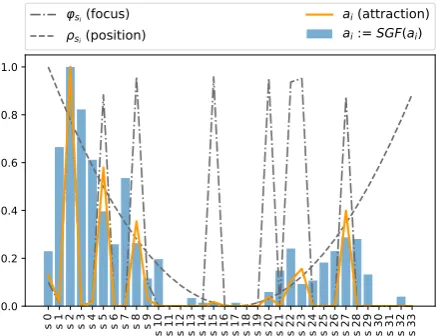
In Figure 2, an example of attraction evalua-tion is provided by showing the values of ϕ, ρ, attraction, and interpolated attraction for all the sentences within one considered student essays in-cluded in the corpus from (Stab and Gurevych, 2014a) (see Section4).
s 0 s 1 s 2 s 3 s 4 s 5 s 6 s 7 s 8 s 9 s 10 s 11 s 12 s 13 s 14 s 15 s 16 s 17 s 18 s 19 s 20 s 21 s 22 s 23 s 24 s 25 s 26 s 27 s 28 s 29 s 30 s 31 s 32 s 33 0.0
0.2 0.4 0.6 0.8 1.0
si (focus) si (position)
ai (attraction)
[image:4.595.307.526.546.714.2]ai := SGF(ai)
Sentence labeling. Sentence labeling has the goal to turn attraction values into labeled cate-gories. Consider a set of possible labels L =
{l1, . . . , lg}, each one denoting a possible
argu-mentative role that can be assigned to a sentence. Given a set of attraction values A, a threshold-based mechanism is enforced to assign labels to sentences according to the following scheme:
ai < τ1 : si ←l1
τ1 ≤ai < τ2 : si ←l2
. . . .
ai ≥τg−1 : si ←lg
whereτ1 < τ2 < ... < τg−1 (τ1, . . . τg−1 ∈(0,1]) are prefixed threshold values. The result of sen-tence labeling is a partition ofS intogcategories with associated labels.
In the experiments, we discuss two different strategies for sentence labeling. The first one is a
two-class labelingstrategy where the possible la-bels for a sentence are argumentative unit (au) and non-argumentative unit (au. The second strategy is amulti-class labeling in which the possible la-bels of a sentence are non-argumentative unitau, premise (pr), claim (cl), and major claim (mc). 4 Experimental results
For evaluation of the proposed A2T approach, we have used two English corpora. The first corpus (C1 in the following) is a collection of 90 student persuasive essays (Stab and Gurevych, 2014a) which has been manually annotated with major claims (one per essay), claims and premises at the clause level. In addition, the corpus con-tains manual annotations of argumentative rela-tions, where the claims and premises are linked, while claims are linked to the major claim ei-ther with a support or an attack relation. Inter-annotation agreement has been measured to uni-tized alpha (Krippendorff, 2004) αU = 0.724. These 90 essays consist of a total of 1,675 sen-tences (from which 19.3% contain no argument components), with an average length of18.61±7 sentences per essay, while the 5.4% of sentences contain a major claim,26.4%contain a claim, and 61.1%contain a premise.
The second corpus (C2 in the following) has been compiled and manually annotated as de-scribed in (Habernal and Gurevych, 2017). This corpus focuses on user generated content, includ-ing user comments, forum posts, blogs, and news-paper articles, covering several thematic domains
from educational controversies, such as home-schooling, private vs. public schools, or single-sex education. Containing in total 340 documents, the corpus has been manually annotated with an argument scheme based on extended Toulmin’s model, involving claims, premises, and backing, rebuttal, refutation argument units. The corpus contains documents of various sizes, with a mean size of 11.44 ± 11.70 sentences per document, while the inter-annotator agreement was measured asαU = 0.48. The corpus consists of 3,899 sen-tences, from which 2,214 sentences (57%) contain no argument components.
Both corpora have been preprocessed with NLTK (Loper and Bird,2002) in order to identify tokens and sentences. Then, each sentence was annotated as argumentative or non-argumentative, depending on whether it contained an argument unit (i.e. a text fragment annotated as major claim, claim, or premise). In addition, each argumenta-tive sentence was further annotated with one of
major claim, claim, and premise, based on the type of the contained argumentative unit. For the second corpus, which utilizes a richer argument scheme, we have considered backing, rebuttal and refutation units as premises. This second corpus does not contain units annotated as major claims. The following three tasks have been executed:
• Task 1: Argumentative sentence identifica-tion – given a sentence, classify whether or not it contains an argument component. • Task 2: Major claim identification – given a
argumentative sentence, classify whether or not it contains a major claim.
• Task 3: Argumentative sentence classifica-tion – given a sentence, classify the sen-tence asmajor claim,claim,premise, or non-argumentative.
Baseline. As a baseline for comparison against
our approach, we created a probabilistic classi-fier of sentences which evaluates the probability
p(l = au|si) as follows. Given the text c con-taining L(c) sentences si, let be ζc ∼ Dir(α) the probability distribution of the sentences in c, such that ζsi
evi-dence that in several types of documents, the den-sity of argumentative units in various sections of documents depends on the structure of documents. The beginning and end of a document are expected to contain argumentative units in structured doc-uments like news, scientific publications, or ar-gumentative essays (Stab and Gurevych, 2017), where major claims and supporting premises are frequently found in the beginning of documents, with documents frequently ending with repeating the major claims and supporting evidence.
4.1 Task 1: Argumentative sentence identification
The goal of Task 1 is to associate each sentence of the corpora to a label inL={au, au}by follow-ing a two-class labelfollow-ing strategy (see Section 3). As a first experiment, we performed sentence la-beling with different threshold ranging from0 to 1with step0.05. In Figure3, we report the preci-sion, recall, and F1-measure forA2T and for the baseline. In addition, we report also the results of applying sentence labeling based on ϕ and ρ
(the components of attraction) separately. The pa-rameter K for attraction calculation has been set to 0.5. Since A2T is an unsupervised method, there is no easy way to define the threshold pa-rameterτ, which has been empirically defined to
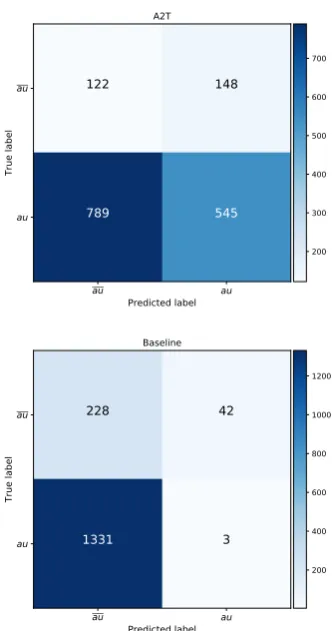
τ = 0.3. The different behavior ofA2T with re-spect to the baseline is shown in the confusion ma-trices reported in Figures4and5.
From Figure 3, we can see that A2T is sig-nificantly better than the baseline, especially for the C1 corpus. A characteristic of this corpus is that argumentative units are frequently located in the introduction or the conclusion of an es-say, which is also reflected by the baseline that achieved an F1-measure of 0.35 for a threshold of τ = 0.05 (with the baseline being particu-larly precise, suggesting that argumentative units are very frequently at the beginning and end of es-says). Both components of attraction (ϕ andρ) perform well, with the topic component ϕbeing slightly better than position information ρ, both in precision and recall. The results are similar for corpus C2, withA2T surpassing the baseline, although A2T advantage in precision is smaller. As shown in the confusion matrix of Figure 5, the main source of error is the large number of false positives for the au class, proposing more argumentative units than what have been
manu-ally identified in corpus C2. This can be attributed to the sparseness of argumentative units in the C2 corpus, with almost 60% of the sentences being non-argumentative.
4.2 Task 2: Major claim identification
[image:6.595.311.505.371.489.2]As a second experiment, we exploited probabili-ties associated with sentences to perform a ranked evaluation. In particular, we calculated two mea-sures, namely P that is the area the under the precision-recall curve andRthat is the area under the receiver operating characteristic (ROC) curve. In this experiments, we used different criteria for defining the true labels: in P CM, an annotated sentence in the corpus is considered a true argu-mentative unit if it is either a premise, a claim, or a major claim; inCMonly claims and major claims are taken as validau; inM only major claims are taken into account. Results are reported in Table1.
Table 1: Area under the precision-recall (P) and the ROC (R) curves
C1 C2
P PCM CM M PCM CM
A2T 0.79 0.31 0.08 0.26 0.19 ϕ 0.84 0.29 0.06 0.19 0.1 ρ 0.68 0.29 0.09 0.24 0.19 Baseline 0.68 0.31 0.11 0.16 0.06
R PCM CM M PCM CM
A2T 0.4 0.52 0.62 0.7 0.76 ϕ 0.52 0.51 0.53 0.58 0.57 ρ 0.16 0.52 0.77 0.69 0.77 Baseline 0.16 0.53 0.79 0.31 0.18
4.3 Task 3: Argumentative sentence classification
C1
0.0 0.1 0.2 0.3 0.4 0.5 0.6 0.7 0.8 0.9 1.0 Threshold 0.0 0.1 0.2 0.3 0.4 0.5 0.6 0.7 0.8 0.9 1.0 Precision A2T Baseline
0.0 0.1 0.2 0.3 0.4 0.5 0.6 0.7 0.8 0.9 1.0 Threshold 0.0 0.1 0.2 0.3 0.4 0.5 0.6 0.7 0.8 0.9 1.0 Recall
0.0 0.1 0.2 0.3 0.4 0.5 0.6 0.7 0.8 0.9 1.0 Threshold 0.0 0.1 0.2 0.3 0.4 0.5 0.6 0.7 0.8 0.9 1.0 F1-measure C2
0.0 0.1 0.2 0.3 0.4 0.5 0.6 0.7 0.8 0.9 1.0 Threshold 0.0 0.1 0.2 0.3 0.4 0.5 0.6 0.7 0.8 0.9 1.0 Precision A2T Baseline
0.0 0.1 0.2 0.3 0.4 0.5 0.6 0.7 0.8 0.9 1.0 Threshold 0.0 0.1 0.2 0.3 0.4 0.5 0.6 0.7 0.8 0.9 1.0 Recall
[image:7.595.77.513.66.313.2]0.0 0.1 0.2 0.3 0.4 0.5 0.6 0.7 0.8 0.9 1.0 Threshold 0.0 0.1 0.2 0.3 0.4 0.5 0.6 0.7 0.8 0.9 1.0 F1-measure
Figure 3: Precision, Recall and F1-measure with different thresholds
au au Predicted label au au True label 122 148 789 545 A2T au au Predicted label au au True label 228 42 1331 3 Baseline 200 300 400 500 600 700 200 400 600 800 1000 1200
Figure 4: Two-class confusion matrices for corpus C1 (Thresholdτ = 0.3)
of sentences may change in different texts so that claims in one context are premises in another. This kind of contextual shift is only partially addressed
[image:7.595.97.264.347.663.2]au au Predicted label au au True label 1790 1504 152 430 A2T au au Predicted label au au True label 3037 257 515 67 Baseline 200 400 600 800 1000 1200 1400 1600 500 1000 1500 2000 2500 3000
Figure 5: Two-class confusion matrices for corpus C2 (Thresholdτ = 0.3)
[image:7.595.332.500.351.662.2]au pr cl mc
Predicted label
au
pr
cl
mc
True label
31 91 94 54
213 313 232 101
84 145 104 55
4 30 36 17
A2T
au pr cl mc
Predicted label
au
pr
cl
mc
True label
111 117 41 1
800 58 1 0
335 52 1 0
50 36 1 0
Baseline
50 100 150 200 250 300
[image:8.595.130.469.62.216.2]0 100 200 300 400 500 600 700 800
Figure 6: Multi-class confusion matrices for corpus C1
au pr cl mc
Predicted label
au
pr
cl
mc
True label
1790 1033 469 2
111 104 60 0
41 136 129 1
0 0 0 0
A2T
au pr cl mc
Predicted label
au
pr
cl
mc
True label
3037 18 93 146
230 0 5 40
285 0 5 17
0 0 0 0
Baseline
0 200 400 600 800 1000 1200 1400 1600
0 500 1000 1500 2000 2500 3000
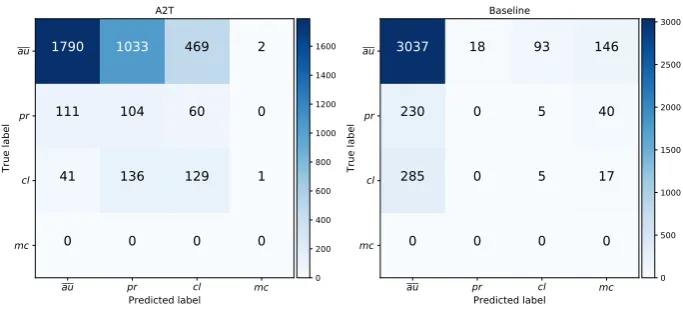
Figure 7: Multi-class confusion matrices for corpus C2
it may be useful to work also on semantic relations holding among sentences. This is actually one of the future tasks in our research work.
Another specific challenge emerges when we consider the corpus C2. Indeed, C2 contains a limited number of argumentative sentences with respect to the corpus size. In this case, since we analyze all the sentences according to their bag of words, we tend to overestimate the number of argumentative units, collecting a relatively high number of false positives.
4.4 Lessons learned from error analysis A first evidence emerging from the analysis of confusion matrices for both corpora C1 and C2 is that the role of sentences is strictly dependent on the type of documents. C1 contains structured es-says of various topics, while C2 provides conver-sational texts extracted from blogs and chats. In the first case, the number of argumentative units is higher than in the second one. In particular, for C2 we overestimated the probability of sentences to be an argumentative unit. This is mainly due
to the fact that those sentences contain words that are semantically related to the main topic of the conversation although they are not playing a role in the argumentation. An example is the follow-ing sentence, taken from a document associated with the topic “school”: “why do some parents not think their kids can attain?”. The sentence is clearly part of a conversation and it has been annotated as a non argumentative unit because it is a question. However, since it contains words that are relevant for the topic (i.e., parents, kids, attain),A2T associates the sentence with a good level of attraction, labeling it as a premise. In or-der to address this kind of false positives, we aim in our future work to study the dependency rela-tions among sentences in text (such as question-answers) to the goal of achieving a better insight of the sentences role.
[image:8.595.128.470.249.404.2]an essay about the role of sports in favor of peace.
• (s1)for example, when Irak was hardly struck by the second gulf war, its citizens tried to catch any incoming news about the football-world cup through their portable receivers.
• (s2) thus, world sports events strongly par-ticipate in eventually pulling back people to-wards friendship and peace
The sentence (s1) has been annotated as a premise, while (s2) as a claim. In our classifica-tion, they are both claims. The reason is that they both contain topic-related words and their position in text is similar. The main distinction is the pres-ence of the expression “for example” in the first sentence which qualifies it as a premise. To this end, in our future work we aim at adding some special words (such as “for example”, “therefore”) in the background knowledge of the classifier, in order to improve the capability of discriminating premises and claims.
5 Concluding remarks
In this paper, we present the “Attraction to Topics” –A2T unsupervised approach for detecting argu-mentative discourse units, at sentence-level gran-ularity. Motivated by the observation that topic information is frequently employed as a sub-task in the process of manual annotation of arguments, we propose an approach that exploits topic mod-eling techniques in order to identify argumenta-tive units. Since manual supervision is not re-quired,A2T has the potential to be applicable on documents of various genres and domains. Pre-liminary evaluation results on two different cor-pora are promising. First, A2T performs signif-icantly better than the baseline on argumentative sentence detection on both corpora. Second,A2T exhibits good results for classifying argumentative sentences as major claims, claims, premises, and non-argumentative units, at least for the first cor-pus, which has a low rate of non-argumentative sentences (20%).
Regarding directions for further research, there are several axes that can be explored. Evaluation on a larger set of annotation corpora will provide enhanced insights about the performance of the proposed approach on different document types. Our preliminary results showed that despite good recall on multiple corpora, achieving also good
precision can be a challenging task in documents where argumentative units are sparse, and false positives can be an issue. In this context, we would like to also exploit other types of relations, and ex-tend our method with other kinds of similarities over sentences.
References
David M. Blei, Andrew Y. Ng, and Michael I.
Jor-dan. 2003. Latent dirichlet allocation. J. Mach.
Learn. Res. 3:993–1022. http://dl.acm.org/cita-tion.cfm?id=944919.944937.
Silvana Castano, Alfio Ferrara, and Stefano Mon-tanelli. 2017. Exploratory analysis of textual data
streams. Future Generation Computer Systems
68:391–406.
Eirini Florou, Stasinos Konstantopoulos, Antonis Koukourikos, and Pythagoras Karampiperis. 2013. Argument extraction for supporting public policy formulation. In Piroska Lendvai and Kalliopi
Zervanou, editors, Proceedings of the 7th
Work-shop on Language Technology for Cultural Her-itage, Social Sciences, and Humanities, LaT-eCH@ACL 2013, August 8, 2013, Sofia, Bulgaria. The Association for Computer Linguistics, pages
49–54.
http://aclweb.org/anthology/W/W13/W13-2707.pdf.
Theodosis Goudas, Christos Louizos, Georgios
Peta-sis, and Vangelis Karkaletsis. 2014. Argument
ex-traction from news, blogs, and social media. In Aristidis Likas, Konstantinos Blekas, and Dim-itris Kalles, editors,Artificial Intelligence: Methods and Applications: 8th Hellenic Conference on AI, SETN 2014, Ioannina, Greece, May 15-17, 2014. Proceedings, Springer International Publishing,
Cham, pages 287–299.
https://doi.org/10.1007/978-3-319-07064-3 23.
Theodosis Goudas, Christos Louizos, Georgios
Petasis, and Vangelis Karkaletsis. 2015.
Ar-gument extraction from news, blogs, and
the social web. International Journal on
Artificial Intelligence Tools 24(05):1540024. https://doi.org/10.1142/S0218213015400242.
Ivan Habernal and Iryna Gurevych. 2015.
Exploit-ing debate portals for semi-supervised argumenta-tion mining in user-generated web discourse. In
Proceedings of the 2015 Conference on Empirical Methods in Natural Language Processing. Associ-ation for ComputAssoci-ational Linguistics, Lisbon,
Por-tugal, pages 2127–2137.
http://aclweb.org/anthol-ogy/D15-1255.
Ivan Habernal and Iryna Gurevych. 2017.
Kazi Saidul Hasan and Vincent Ng. 2014. Why are you taking this stance? identifying and classifying reasons in ideological debates. In Proceedings of the 2014 Conference on Empirical Methods in Nat-ural Language Processing (EMNLP). Association for Computational Linguistics, Doha, Qatar, pages
751–762.
http://www.aclweb.org/anthology/D14-1083.
Klaus Krippendorff. 2004. Measuring the reliability
of qualitative text analysis data. Quality and Quan-tity38(6):787–800. https://doi.org/10.1007/s11135-004-8107-7.
John Lawrence, Chris Reed, Colin Allen, Simon
McAl-ister, and Andrew Ravenscroft. 2014. Mining
ar-guments from 19th century philosophical texts us-ing topic based modellus-ing. In Proceedings of the First Workshop on Argumentation Mining. Asso-ciation for Computational Linguistics, Baltimore,
Maryland, pages 79–87.
http://www.aclweb.org/an-thology/W/W14/W14-2111.
Ran Levy, Yonatan Bilu, Daniel Hershcovich, Ehud
Aharoni, and Noam Slonim. 2014. Context
depen-dent claim detection. In Jan Hajic and Junichi
Tsu-jii, editors,COLING 2014, 25th International
Con-ference on Computational Linguistics, Proceedings of the Conference: Technical Papers, August 23-29, 2014, Dublin, Ireland. ACL, pages 1489–1500. http://aclweb.org/anthology/C/C14/C14-1141.pdf.
Marco Lippi and Paolo Torroni. 2015a. Argument
mining: A machine learning perspective. In Eliz-abeth Black, Sanjay Modgil, and Nir Oren,
edi-tors, Theory and Applications of Formal
Argumen-tation: Third International Workshop, TAFA 2015, Buenos Aires, Argentina, July 25-26, 2015, Revised Selected Papers. Springer International Publishing,
Cham, pages 163–176.
https://doi.org/10.1007/978-3-319-28460-6 10.
Marco Lippi and Paolo Torroni. 2015b.
Context-independent claim detection for argument mining. In Proceedings of the 24th International Confer-ence on Artificial IntelligConfer-ence. AAAI Press,
IJ-CAI’15, pages 185–191.
http://dl.acm.org/cita-tion.cfm?id=2832249.2832275.
Edward Loper and Steven Bird. 2002. Nltk: The
natural language toolkit. In Proceedings of the ACL-02 Workshop on Effective Tools and Method-ologies for Teaching Natural Language Process-ing and Computational LProcess-inguistics - Volume 1. As-sociation for Computational Linguistics, Strouds-burg, PA, USA, ETMTNLP ’02, pages 63–70. https://doi.org/10.3115/1118108.1118117.
Christopher D Manning, Prabhakar Raghavan, and
Hinrich Sch¨utze. 2008. Introduction to
informa-tion retrieval, volume 1. Cambridge university press Cambridge.
Rada Mihalcea and Paul Tarau. 2004.Textrank:
Bring-ing order into texts. In Dekang Lin and Dekai
Wu, editors, Proceedings of EMNLP 2004.
Asso-ciation for Computational Linguistics, Barcelona,
Spain, pages 404–411.
http://www.aclweb.org/an-thology/W/W04/W04-3252.pdf.
Raquel Mochales and Marie-Francine Moens. 2011. Argumentation mining. Artificial Intelligence and
Law 19(1):1–22.
https://doi.org/10.1007/s10506-010-9104-x.
Marie-Francine Moens, Erik Boiy, Raquel Mochales
Palau, and Chris Reed. 2007. Automatic
de-tection of arguments in legal texts. In Pro-ceedings of the 11th International Conference on Artificial Intelligence and Law. ACM, New York, NY, USA, ICAIL ’07, pages 225–230. https://doi.org/10.1145/1276318.1276362.
Huy Nguyen and Diane J. Litman. 2015. Extracting
argument and domain words for identifying argu-ment components in texts. In Proceedings of the 2nd Workshop on Argumentation Mining, ArgMin-ing@HLT-NAACL 2015, June 4, 2015, Denver, Col-orado, USA. The Association for Computational Linguistics, pages 22–28. http://aclweb.org/anthol-ogy/W/W15/W15-0503.pdf.
Huy Nguyen and Diane J. Litman. 2016a.
Context-aware argumentative relation mining. In Proceed-ings of the 54th Annual Meeting of the Associa-tion for ComputaAssocia-tional Linguistics, ACL 2016, Au-gust 7-12, 2016, Berlin, Germany, Volume 1: Long Papers. The Association for Computer Linguistics. http://aclweb.org/anthology/P/P16/P16-1107.pdf.
Huy Nguyen and Diane J. Litman. 2016b. Improving
argument mining in student essays by learning and exploiting argument indicators versus essay topics. In Zdravko Markov and Ingrid Russell,
editors, Proceedings of the Twenty-Ninth
Inter-national Florida Artificial Intelligence Research Society Conference, FLAIRS 2016, Key Largo, Florida, May 16-18, 2016.. AAAI Press, pages
485–490.
http://www.aaai.org/ocs/index.php/-FLAIRS/FLAIRS16/paper/view/12791.
Raquel Mochales Palau and Marie-Francine Moens.
2009. Argumentation mining: The detection,
classification and structure of arguments in text. In Proceedings of the 12th International Confer-ence on Artificial IntelligConfer-ence and Law. ACM, New York, NY, USA, ICAIL ’09, pages 98–107. https://doi.org/10.1145/1568234.1568246.
Joonsuk Park and Claire Cardie. 2014.
Identify-ing appropriate support for propositions in on-line user comments. In Proceedings of the First Workshop on Argumentation Mining. Association for Computational Linguistics, Baltimore,
Mary-land, pages 29–38.
http://www.aclweb.org/anthol-ogy/W/W14/W14-2105.
Andreas Peldszus and Manfred Stede. 2013.
From argument diagrams to
J. Cogn. Inform. Nat. Intell. 7(1):1–31. https://doi.org/10.4018/jcini.2013010101.
Georgios Petasis and Vangelis Karkaletsis. 2016. Iden-tifying argument components through textrank. In
Proceedings of the 3rd Workshop on Argument Mining (ArgMining2016). Association for Com-putational Linguistics, Berlin, Germany, pages
56–66.
http://aclweb.org/anthology/W/W16/W16-2811.pdf.
Ruty Rinott, Lena Dankin, Carlos Alzate Perez, Mitesh M. Khapra, Ehud Aharoni, and Noam
Slonim. 2015. Show me your evidence - an
auto-matic method for context dependent evidence detec-tion. InProceedings of the 2015 Conference on Em-pirical Methods in Natural Language Processing. Association for Computational Linguistics, Lisbon,
Portugal, pages 440–450.
http://aclweb.org/anthol-ogy/D15-1050.
Niall Rooney, Hui Wang, and Fiona Browne.
2012. Applying kernel methods to
argu-mentation mining. In G. Michael
Young-blood and Philip M. McCarthy, editors,
Pro-ceedings of the Twenty-Fifth International Florida Artificial Intelligence Research Society Confer-ence, Marco Island, Florida. May 23-25, 2012.
AAAI Press.
http://www.aaai.org/ocs/index.php/-FLAIRS/FLAIRS12/paper/view/4366.
Abraham Savitzky and Marcel JE Golay. 1964. Smoothing and differentiation of data by simpli-fied least squares procedures. Analytical chemistry
36(8):1627–1639.
Christian Stab and Iryna Gurevych. 2014a.
Anno-tating argument components and relations in per-suasive essays. In Junichi Tsujii and Jan Ha-jic, editors, Proceedings of the 25th International Conference on Computational Linguistics (COLING 2014). Dublin City University and Association for Computational Linguistics, Dublin, Ireland, pages
1501–1510.
http://www.aclweb.org/anthology/C14-1142.
Christian Stab and Iryna Gurevych. 2014b.
Iden-tifying argumentative discourse structures in per-suasive essays. In Proceedings of the 2014 Con-ference on Empirical Methods in Natural Lan-guage Processing (EMNLP). Association for Com-putational Linguistics, Doha, Qatar, pages 46–56. http://www.aclweb.org/anthology/D14-1006.
Christian Stab and Iryna Gurevych. 2017.
Pars-ing argumentation structures in persuasive es-says. Computational Linguistics 0(ja):1–62. https://doi.org/10.1162/COLI a 00295.
Yee Whye Teh, Michael I Jordan, Matthew J
Beal, and David M Blei. 2006.