247
Privacy-Aware Text Rewriting
Qiongkai Xu1,2
, Lizhen Qu3
, Chenchen Xu1,2
and Ran Cui1 1
The Australian National University, Canberra, Australia
2
Data61 CSIRO, Canberra, Australia
3
Monash University, Melbourne, Australia
{Qiongkai.Xu,Chenchen.Xu,Ran.Cui}@anu.edu.au, [email protected]
Abstract
Biaseddecisions made by automatic systems
have led to growing concerns in research com-munities. Recent work from the NLP commu-nity focuses on building systems that make fair decisions based on text. Instead of relying on unknown decision systems or human decision-makers, we argue that a better way to protect data providers is to remove the trails of sensi-tive information before publishing the data. In light of this, we propose a new privacy-aware text rewriting task and explore two privacy-aware back-translation methods for the task, based on adversarial training and approximate fairness risk. Our extensive experiments on three real-world datasets with varying demo-graphical attributes show that our methods are effective in obfuscating sensitive attributes. We have also observed that the fairness risk method retains better semantics and fluency, while the adversarial training method tends to leak less sensitive information.
1 Introduction
Abuse and unauthorized use of sensitive infor-mation, such as demographic data, have become an ethical issue in our society. Such information should not be taken into account when humans or automatic decision making systems determine in-surance rates, screen applicants for employment, target customers for advertising, or bank loans. Concerns about the fairness of decisions made by machine learning systems have led to an in-creasing body of work on the algorithmic fair-ness problem (Pedreshi et al.,2008;Zemel et al., 2013;Hardt et al.,2016;Chouldechova and Roth, 2018). Existing work on fairness learning largely focused on unbiased decisions based on classifi-cation. The algorithms made decisions for data consumers (e.g., bank) based on input provided by data producers (e.g., loan applicants), with the
sensitiveattributes (e.g., age, gender, and race)
be-ing exposed. Those algorithms actbe-ing as decision-makers are supposed to avoid discrimination on the basis of demographic groups of the individu-als. In this case, the decision-makers are trusted
to access sensitive attributes in a proper way. However, we believe that it is doubtful that one can rely on algorithmic decision-makers to pro-vide fair estimation. For example, discrimina-tion by gender among job applicants has been re-ported (Calcagnini et al.,2015;Midtbøen,2016). It was also reported that racial disparities pledged access to higher education (Farkas, 2003; Mick-elson, 2003). Data producers are vulnerable to biased decisions. Therefore, we argue that data providers should also take the responsibility of protecting their own sensitive information. Al-though users may be allowed to conceal well-structured sensitive attributes such as age and gen-der, such sensitive information can still be pre-dicted from unstructured text data (Blodgett et al., 2016; Mac Kim et al., 2017; Elazar and Gold-berg, 2018; Voigt et al., 2018). As suppress-ing more sensitive information in text indicates more privacy, we propose a new research chal-lenge, privacy-aware text rewriting, namely pro-tecting sensitive attributes in text data on behalf of
data providers by rewriting the text. A rephrased
privacy-aware text should i) reduce the leakage of sensitive information; ii) retain as much semantic meaning of the original text; iii) be grammatically fluent.Compared with fair representation learning, our work focuses on text in string form.
Transforming text into a form with less sensi-tive information is challenging in two ways. The first challenge is that there is a trade-off between privacy preservation and semantic relevance or flu-ency during rewriting. For example,“I am a soft-ware engineer with 18 years of working
years old. Replacing ‘18 years’ with ‘more than 10 years’ altogether reduces the leakage of age in-formation with slight shift of its semantic mean-ing. Removing ‘18 years of working experience’ provides stronger privacy protection, while the se-mantic loss is greater at the same time. The data providers should leverage the trade-off depending on varying scenarios. Another challenge is that the indicators of such sensitive attributes are sub-tle. For example,“I went to the restaurant with my
boyfriend. The food is yummy!”is a post from
so-cial media. ‘boyfriend’is an explicit indicator for female user, while‘yummy’is an implicit indicator which can be ignored by humans and captured by machine learning models. Automatic text rewrit-ing tools help people detect and modify the subtle indicators in their text.
To address the aforementioned problems, we propose to develop a tool that rewrites text into less sensitive ones. In this work, we design a privacy-aware text rewriting framework based on back-translation to reduce the leakage of sensi-tive information. The models are optimized ac-cording to the trade-off between a reconstruction loss and a privacy risk loss. The reconstruction loss focuses on semantic relatedness and gram-matical fluency, and the privacy risk loss controls the leakage of sensitive information. We further explore two variants of the approach. The first method formulates the privacy risk as an adver-sarial loss derived from a text classifier. The sec-ond method derives an upper bound of an ap-proximate fairness risk measurement on text data, which minimizes the discrepancy of generated text among different demographic groups. Finally, we conduct extensive experiments on three datasets with varying demographic groups (i.e. Politics, Gender, and Race). The results demonstrate the effectiveness of our methods in terms of reduc-ing the leakage rates of sensitive information and retaining linguistic quality of the rewritten text. This work provides a novel framework for sys-tematic research on privacy-aware text rewriting, including datasets, evaluation metrics and rewrit-ing methods, which will promote the interest in privacy preservation in our research community.
The main contributions of this work are:
• To provide the first proposal for protecting sensitive attributes in text on behalf of data providers.
• To design a privacy-aware back-translation
method for protecting sensitive information in rewritten text.
• To provide datasets and evaluation metrics for appropriate validation of method effec-tiveness.
2 Privacy-Aware Text Rewriting
Privacy-aware rewriting modifies text to obfus-cate a sensitive attribute. The bespoke methodolo-gies aim to minimize the loss of fluency as well as the change in the underlying semantics. We consider a setup in which we have a set of in-put text {X1, ..., XN}, where each text Xi is a word sequence hx1, ..., xli. Each text is associ-ated with a sensitive attributeS, such as gender or race. The goal is to find a privacy-aware translator
f(X) : X → Y to modify X into another word sequence Y = hy1, ..., yli, such that an attacker
g(Y) : Y → S fails to predict the values of the sensitive attributeSfrom the translated textY.
2.1 Privacy-aware Back-Translation Model
Privacy-aware rewriting can be regarded as a special monolingual machine translation (MT) task, which aims to remove sensitive information through rephrasing. In our experiment, there is no existing parallel corpus to learn the patterns of privacy-preserved rewriting. We use Back-Translation to obtain a meaning-preserving repre-sentation in the target language, and translate the sentences back to the source language ( Prabhu-moye et al.,2018). Since we aim to preserve sen-sitive information, we consider the risk from an attacker in the back-translation phase.
In our work, the source language is English and the target language is French. Let Z denote the space of target language, we build two translation models Ten→fr : X → Z and Tfr→en : Z →
X, respectively. We use the Transformer-based model (Vaswani et al., 2017) for each translation model. The back-translation procedure is formu-lated as,
f(X) =Tf r→en(Ten→f r(X)) (1)
For each input text, the outcome of this model is a sequence of words in English.
with L(f(X), Y) : X × Y → R, which measures the discrepancy between predicted se-quencesf(X)and true target sequencesY. Sec-ondly, the predictor should be reasonably fair toS
by achieving a low risk loss with regard to privacy
R(X, Y, S) :X × Y × S →R. LetF denote the space of all possible predictors, we find the opti-mal rewriting modelf∗
by
f∗= arg min
f∈FEX,Y[L(f(X), Y)] +αR(X, Y, S)
(2) whereαcontrols the degree of privacy protection.
2.2 Adversarial Classifier
Given an accurate classifier, the risk of privacy is able to be estimated by the negative classifica-tion loss on the sensitive informaclassifica-tion. Our target is finding the representations that are good at re-constructing the sentences, while poor in predict-ing sensitive labels. The settpredict-ing is well-aligned with generative adversarial networks (Goodfellow et al., 2014). We construct the back-translation model as f(X) = m(h(X)), where h(X) em-ploys the two translators to mapXinto a sequence of hidden representations of decoded words in the source language. Then,m(·)maps the hidden rep-resentations into the corresponding words. An ad-versarial classifieradv(h(X))is a linear classifier, which takes the mean of all hidden representations fromh(X)to predictS. The risk is formulated as adversarial classification lossLc(adv(h(X)), S). The encoder h(·) is trained to fool the adversar-ial classifier adv(·) while optimizing the back-translation predication f(X) in Eq.(4). Eq.(3) merely optimizes the adversarial classifier. The training is conducted by jointly optimizing the fol-lowing two objectives:
arg min
advLc(adv(h(X)), S) (3)
arg min
h,mLg(m(h(X)), X)−αLc(adv(h(X)), S) (4)
where Lg is the cross entropy loss with La-bel Smoothing (Szegedy et al., 2016) for the transformer-based generator and Lc is the cross entropy loss for the adversarial classifier. The neg-ative parameter−αis implemented by a gradient-reversal layer (GRL)(Ganin and Lempitsky,2015) during back-propagation andαcontrols the inten-sity of adversarial training.
2.3 Fairness Risk Measurement
In this section, we define the privacy risk loss us-ing fairness risk measurement. The perfect fair-ness for rewriting is a statement of conditional in-dependence of generated text Y ⊥⊥ S|X. Hold-ing such condition, the sensitive translator conduct similar generation results. Therefore, attackers will not be able to infer the dependent attributes.
A privacy-aware translatorf(X) learns a
distri-bution P(Y|X), while P(Y|X, S = a) denotes the distribution of a subgroup translator depend-ing on a particular demographic group attributeS. The conditional independence is formulated as,
P(Y|X) =P(Y|X, S =a) (5)
Agarwal et al.(2018) pointed out that given finite samples in training data, it is impossible to ensure perfect fairness on the test sample. An approxi-mate formalism of fairness measurement is used to quantify the discrepancy of demographic pari-ties, namely maximal deviation between subgroup predictions (MDSP) (Calmon et al.,2017).
sup
y,s,s′
|P r( ˆY =y|S=s)−P r( ˆY =y|S=s′)|
(6) whereYˆ is a single variable.
Inspired by the single-variable MDSP, we de-fine the sequential MDSP (SMDSP) for text rewriting as,
sup
a∈S
|logP(Y|X)−logP(Y|X, S =a)| (7)
whereY is the generated sequences. We obfuscate the sensitive attribute by reducing the discrepancy between privacy-aware translator and the most dif-ferent subgroup translator.
The challenge of using the SMDSP is that it is optimized on the whole sequences. How-ever, the state-of-the-art encoder-decoder architec-ture (Vaswani et al.,2017;Klein et al.,2017) gen-erate words in a word-by-word manner.We derive an upper bound of SMDSP by applying calculus on the sequential deviation
D(X, Y, S=a)=. |logP(Y|X)−logP(Y|X, S=a)|
=| l
X
i=1
logP(yi|X, y<i)− l
X
i=1
logP(yi|X, y<i, S=a)|
≤ l
X
i=1
|logP(yi|X, y<i)−logP(yi|X, y<i, S=a)|
.
The composition of MDSP for each word is an upper bound of SMDSP.
Ru(X, Y, S) = sup a∈S
Ua(X, Y) (8)
We replace the approximate fairness risk by its up-per bound Eq.(8) and obtain a joint training objec-tive.
Lα(X) =L(f(X), X) +αRu(X, Y, S) (9)
In training, each subgroup translator is pre-trained beforehand with the training data labeled with the corresponding sensitive attribute value. Their parameters are kept fixed when minimizing the privacy-aware rewriting model.
3 Experimental Setup
3.1 Datasets
In this paper we conduct experiments on three tasks, which can lead to potential social-good ap-plications, namely obfuscating gender, political slant and race of the authors. .
Gender(Reddy and Knight, 2016) is a dataset of reviews from Yelp annotated with the gender of the authors, either male or female. The sentences with low indication of gender (likelihood of gen-der lower than 0.7) is filtered out.
Politics(Voigt et al.,2018) is a dataset of com-ments on Facebook posts from 412 members from the United States Senate and House. Each com-ment is associated with the corresponding Con-gressperson’s party affiliation as the sensitive at-tribute,S∈ {democratic,republican}.
Race(Blodgett et al.,2016) is a dataset based on the dialectal tweets corpus (DIAL), including 59.2 million tweets. The tweets are categorized into African-American English (AAE) or Standard American English (SAE), which is highly corre-lated to the race of the author. The predictor takes into account both the content of the tweets and the geolocations of the the authors. We filter out the samples with predicted confidence lower than 80%, and tweets with less than 3 words. We con-sider race as sensitive information of the dataset. We also maintain the sentiment classification as a target task for this corpus to check if the sentiment information is still preserved after rewriting. The sentiment labels are derived from emojis which are associated with sentiments.
All the aforementioned corpora are split into four disjoint parts:Class, training corpus for sen-sitive attribute classifier; Train, training corpus
for privacy-aware text rewriting;Valid, validation set; andTest, test set. The number of sentences for each split of these datasets are listed in Table 1. The datasets are publicly available at https: //github.com/xuqiongkai/PATR
Dataset Class Train Valid Test Gender 2.6M 200K 4K 4K Politics 80K 200K 4K 4K Race 80K 100K 4K 4K
Table 1: Data splits of Gender, Politics and
Race.
3.2 Models
We consider the following three models for privacy-aware text rewriting. Back Trans is the back translation model considered as base-line. Advis the model using adversarial training.
SMDSPmodel use Sequential Maximal Deviation between Subgroup Predictions. We also compare the quality of generated text of our systems with those of an open-domainParaphrasegeneration system (Iyyer et al.,2018).
3.3 Implementation Details
We use Transformer (Vaswani et al.,2017) as the translation architecture in our experiments. We re-implement the transformer model based on Open-NMT (Klein et al.,2017). In our experiments, we use the same configurations, including 2 encoder and decoder layers, 256-dimensional word embed-ding and 256-dimensional hidden layers, drop out rate 0.1, label smoothing weight 0.1. All models use Beam Search decoding algorithm with beam size 5.
We train English-French machine trans-lation (En-Fr) and French-English back-translation (Fr-En) using Europarl v7 from WMT15 (Bojar et al., 2015). The words are tokenized using Moses tokenizer (Koehn et al., 2007). Our translation system achieves the BLEU scores of 36.24% and 37.36% on En-Fr and Fr-En, respectively. The En-Fr model is used to generate the parallel corpus for all experiments.
3.4 Evaluation
[image:4.595.335.497.143.185.2]Linguistic Quality focuses on evaluating the quality of the results based on their semantic rele-vance to the original text and gramatical fluency of the generated sentences. We adopt four au-tomatic evaluation metrics, BLEU, GLEU, ME-TEOR and WMD. BLEU (Papineni et al., 2002) and GLEU (Wu et al., 2016) measure the n-gram matching between hypothesis and reference, where GLEU considers both precision and recall. METEOR (Banerjee and Lavie,2005) further ap-plies stemming and synonym matching. Word Mover Distance (WMD) (Kusner et al., 2015) calculates the optimal transport distance between word embedding in original and generated sen-tences1. Intuitively, BLEU and GLEU evaluate fluency of the sentence as they are based on the quality of n-grams, while WMD measures seman-tic relevance as words can be regarded as atom se-mantic components of sentences.
We also conduct human evaluation to judge the fluency and relevance of the results2. For each set of the results, two annotators are asked to judge the quality of the results between the scales of 1-5. The Kappa coefficients (McHugh, 2012) on
Gender, Politics and Race are 0.45, 0.47 and 0.74, respectively.
Obfuscation evaluates the leakage of sensitive attributes of generated text. For automatic eval-uation, we estimate the probability of sensitive at-tribute on generated sentences using a Logistic Re-gression with L2 regularization (Pedregosa et al., 2011). For all the experiments, we use top 3K fre-quent words as features. Based on the prediction of classifier pi = P(S = i|X), we propose to evaluate the obfuscation of the results using the following three metrics:
1. Entropy evaluates the averaged entropy (Pi−pilogpi) of all predictions. Higher Entropy indicates better less sensitive infor-mation leakage.
2. P-Acc, prediction accuracy, calculates the portion of correct prediction of the sensitive attribute. In the case of binary classification, the score is better if it is closer to 50%.
1
We use pre-trained word2vec model trained on Google News dataset from https://code.google. com/archive/p/word2vec/.
2We refer readers to AppendixAfor more details about
the annotation guideline.
3. M-Acc, modification accuracy, calculates the label probabilities of source and generated sentences. If the probability of the sensitive attribute decreases after rewriting, the modi-fication is accepted. M-Acc counts the rate of accepted sentence modifications.
In human evaluation, annotators are asked to judge the sensitive attribute values of 300 sampled sentences in test set. We use accuracy to evalua-tion the awareness of sensitive informaevalua-tion by hu-man and automatic annotators. Due to the fact that human judgments underperform automatic judg-ments (see Table 4), we rely more on automatic metric to evaluate the rewriting results.
4 Results and Analysis
We first conduct human evaluation and discuss their relation to automatic evaluation metrics with regard to semantic relevance, grammatical fluency and obfuscation. Then, we compare our privacy-aware models according to linguistic quality and obfuscation. Later on, we test the semantic loss of our models on the target task. Finally, we provide some sample outputs for case study.
4.1 Human Evaluation
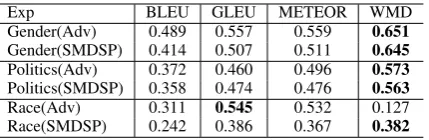
Firstly, we ask human annotators to evaluate lin-guistic quality of Back Trans, Adv (α = 1) and SMDSP (α = 1), based on the rewriting results from 300 test samples, with regard to fluency (Flu) and relevance (Rel)3. We calculate the Pearson Correlation between human and automatic eval-uation metrics. Table 2 shows the correlation of semantic relevance between human and automatic evaluation. WMD is clear winner among all auto-matic metrics across the three datasets. According to Table 3, GLEU is the measure that most cor-related to human judgement in terms of fluency, though METEOR falls slight short on the gender corpus. Unsurprisingly, the widely used BLEU is the relatively less correlated to human percep-tion, which was also observed in machine transla-tion (Wu et al.,2016;Callison-Burch et al.,2006). Secondly, we compare the performance of pre-dicting sensitive information between human an-notators and automatic classifiers. We ask hu-man annotators to classify the sensitive attributes of 300 original sentences in test set. The accu-racy of the annotations are illustrated in Table4.
3We refer readers to AppendixAwith more details on
Exp BLEU GLEU METEOR WMD Gender(Adv) 0.489 0.557 0.559 0.651 Gender(SMDSP) 0.414 0.507 0.511 0.645 Politics(Adv) 0.372 0.460 0.496 0.573 Politics(SMDSP) 0.358 0.474 0.476 0.563 Race(Adv) 0.311 0.545 0.532 0.127 Race(SMDSP) 0.242 0.386 0.367 0.382
Table 2: Correlation between semantic relevance and automatic evaluation metrics onGender,Politics
andRace. The most correlated automatic metrics are bold.
Exp BLEU GLEU METEOR WMD Gender(Adv) 0.265 0.287 0.222 0.297 Gender(SMDSP) 0.192 0.231 0.186 0.361 Politics(Adv) 0.180 0.260 0.277 0.200 Politics(SMDSP) 0.149 0.236 0.236 0.231 Race(Adv) 0.168 0.403 0.433 0.333 Race(SMDSP) 0.068 0.150 0.124 0.046
Table 3: Correlation between fluency and auto-matic evaluation metrics onGender,Politicsand
Race. Top two correlated automatic metrics arebold.
To our surprise, human judgments are more than 10% worse than our classifiers on all the experi-ments. For Politics, we ask one more anno-tator for additional annotation and the accuracy of the annotation is still lower than 65%. After in-vestigating the datasets, we found that a large pro-portion of samples are difficult for human anno-tators while our classifier can predict them cor-rectly. For example, in Gender, human strug-gled in deciding whether “the food is delicious” and “the people were nice” are posted by male or female authors. ForPolitics, we observe sev-eral cases that human tends to annotate them with the opposite political slant when the sentences are in negative sentiment, while actually the speaker and the mentioned people support the same party, e.g., “Patty Murray couldn’t be any more dishon-est than this!”. Other examples like “today is such a wonderful day!” and “God bless you guys” are neutral to our annotators. Correctly annotating these samples might require extensive background in American politics4. To sum up, human annota-tors fail to incorporate subtle indicaannota-tors into their decision, however, the classifiers manage to detect them.
The human evaluation studies conclude that i) we can rely on sensitive attribute classifiers for obfuscation evaluation, and ii) we should look at WMD for semantic relevance and GLEU for
flu-4The top weighted words of male or female forGender,
democratic or republican forPolitics, and SAE forRace
are listed in AppendixB to show the difficulty for human annotators to capture subtle indicators.
Gender Politic Race Automatic 77.3 93.7 82.7
[image:6.595.76.291.61.131.2]Human 66.0 60.3 71.0
Table 4: Comparison of human and automatic judg-ments onGender,PoliticsandRace.
ency.
4.2 Adversarial Learning vs. SMDSP
We conduct automatic evaluation on text gener-ated by Back Trans, Adv and SMDSP. The over-all observations are i) Back Trans provides a pre-liminary baseline for our task; ii) both Adv and SMDSP are able to reduce the leakage of sensi-tive information; and iii) SMDSP retains better linguistic quality, while Adv manages to preserve sensitive information.
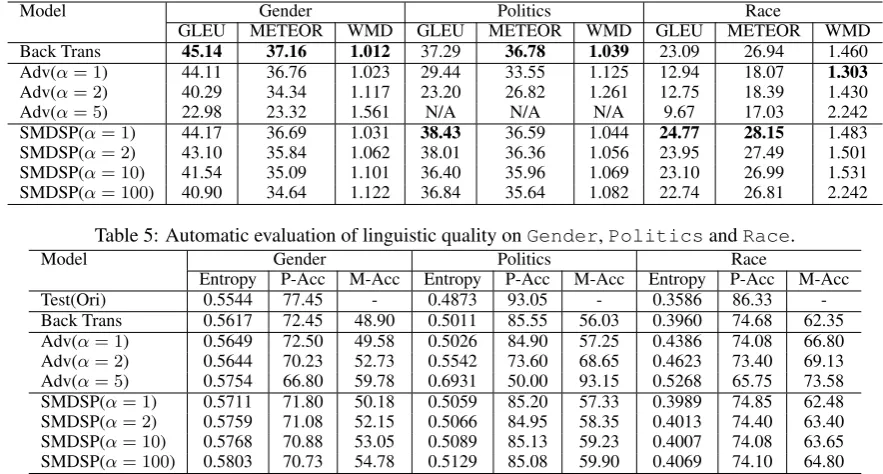
We first compare the linguistic quality of the results in Table 5. The Back Trans outperforms both Adv and SMDSP on average because it does not cope with sensitive attributes in training. The performance of Adv model with the highestα ob-tains less than half GLEU than that of Back Trans. Although SMDSP with higherα also shows per-formance reduction, the quality of generated text are still competitive with Back Trans, with less than 10% score reduction. In particular, SMDSP with (α= 1) achieves even higher GLEU on both
PoliticsandRace than the baseline. We at-tribute this to the regularization effect of SMDSP on language modeling. Results of human evalu-ation are coherent to automatic evaluevalu-ation, in Ta-ble7. SMDSP achieves highest fluency results and competitive relevance results.
Then, we show the obfuscation performance in Table6. Back Trans is a competitive baseline that obfuscates the classifiers to some extent. Adv and SMDSP are able to further reduce the obfusca-tion score on all three datasets. Generally, models with higher α achieve better obfuscation perfor-mance. Adv tend to be more aggressive on pri-vacy preservation than SMDSP. However, we ob-serve that Adv acquires better privacy preserva-tion by sacrificing the linguistic quality, e.g., Adv (α = 5) basically chooses to ‘keep silent’ (pro-duces almost no words) to protect the sensitive in-formation onPolitics5. We believe that gen-erating totally non-sense sentences is too conser-vative for our task. On the other hand, SMDSP manages to protect sensitive attribute while keep-ing the semantic meankeep-ing as much as possible. For
Model Gender Politics Race
GLEU METEOR WMD GLEU METEOR WMD GLEU METEOR WMD Back Trans 45.14 37.16 1.012 37.29 36.78 1.039 23.09 26.94 1.460 Adv(α= 1) 44.11 36.76 1.023 29.44 33.55 1.125 12.94 18.07 1.303
Adv(α= 2) 40.29 34.34 1.117 23.20 26.82 1.261 12.75 18.39 1.430
Adv(α= 5) 22.98 23.32 1.561 N/A N/A N/A 9.67 17.03 2.242
SMDSP(α= 1) 44.17 36.69 1.031 38.43 36.59 1.044 24.77 28.15 1.483
SMDSP(α= 2) 43.10 35.84 1.062 38.01 36.36 1.056 23.95 27.49 1.501
SMDSP(α= 10) 41.54 35.09 1.101 36.40 35.96 1.069 23.10 26.99 1.531
[image:7.595.76.518.62.299.2]SMDSP(α= 100) 40.90 34.64 1.122 36.84 35.64 1.082 22.74 26.81 2.242
Table 5: Automatic evaluation of linguistic quality onGender,PoliticsandRace.
Model Gender Politics Race
Entropy P-Acc M-Acc Entropy P-Acc M-Acc Entropy P-Acc M-Acc Test(Ori) 0.5544 77.45 - 0.4873 93.05 - 0.3586 86.33 -Back Trans 0.5617 72.45 48.90 0.5011 85.55 56.03 0.3960 74.68 62.35 Adv(α= 1) 0.5649 72.50 49.58 0.5026 84.90 57.25 0.4386 74.08 66.80
Adv(α= 2) 0.5644 70.23 52.73 0.5542 73.60 68.65 0.4623 73.40 69.13
Adv(α= 5) 0.5754 66.80 59.78 0.6931 50.00 93.15 0.5268 65.75 73.58
SMDSP(α= 1) 0.5711 71.80 50.18 0.5059 85.20 57.33 0.3989 74.85 62.48
SMDSP(α= 2) 0.5759 71.08 52.15 0.5066 84.95 58.35 0.4013 74.40 63.40
SMDSP(α= 10) 0.5768 70.88 53.05 0.5089 85.13 59.23 0.4007 74.08 63.65
[image:7.595.71.291.328.382.2]SMDSP(α= 100) 0.5803 70.73 54.78 0.5129 85.08 59.90 0.4069 74.10 64.80
Table 6: Automatic evaluation of Obfuscation onGender,PoliticsandRace.
Model Gender Politics Race Flu Rel Flu Rel Flu Rel Back Trans 4.68 4.09 4.60 4.31 4.31 3.88 Adv 4.66 4.13 4.42 4.01 3.84 3.53 SMDSP 4.73 4.14 4.60 4.21 4.37 3.98
Table 7: Human evaluation of fluency (Flu) and rele-vance (Rel) onGender,PoliticsandRacebased on the results of Back Trans, Adv (α= 1) and SMDSP (α= 1) with the scales of 1-5.
example, SMDSP (α = 1) achieves both higher relevance score and better obfuscation score than Adv (α= 1) onGenderandPolitics.
Finally, we demonstrate the training stability of our models. The reconstruction losses of each model on validation set ofGender, Politics
andRaceare shown in Figure1. We pre-train the back translation model for 10 epochs onGender
and 20 epochs on PoliticsandRace. Then, we train Adv model and SMDSP model based on the pre-trained model. We also include the pre-trained model with the same total number of training epochs in Black lines. After pre-training, Back-Trans models start to overfit and get slightly worse results on validation set. In most cases, the losses of Adv are higher than Transformer, and higher adversarial training intensity α de-creases the performance of translation model. Adv (α = 5) is not included in the plots, because their losses are out of the range. In contrast, SMDSP achieves better performance than Adv. The perfor-mance of SMDSP is even better than Back Trans onGenderandRace.
4.3 Target Task Performance
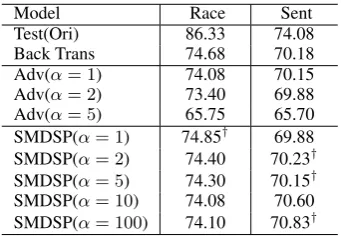
We evaluate sentiment classification (Sent) as the target task and racial (Race) as sensitive attribute on the Race. As shown in Table 8, the pre-diction performance of both Race and Sent us-ing Adv models decrease as the hyperparame-ter α increases. Such trend shows that Adv im-proves privacy preservation by obfuscating the se-mantic meaning of the original text. In contrast, Risk models successfully decrease the accuracy on Race, while preserving the accuracy on Sent, showing the robustness of the model on preserv-ing semantic meanpreserv-ings of the text.
4.4 Case Study
We demonstrate generated examples in Figure26. For Gender, Back Trans generates the words with clear tendency of gender, such as ‘yummy’ and ‘girlfriend’, while privacy-aware models use ‘delicious’, ‘amazing’ and ‘friend’ instead. For
Politics, Adv and SMDSP skip the name af-ter Sir to hide the political affiliation of the person. In the second example, Adv and SMDSP replace ‘love you’ with ‘help’ to reduce the political slant.
5 Related Work
Achieving fairness or preserving privacy through removing sensitive information from text has been explored by adversarial training (Li et al., 2018;
6Because the samples inRaceare full of porny and
1 3 5 7 9 11 13 15 17 19 21 23 25 27 29 31 33 35 37 39 Epoch
2.0 2.1 2.2 2.3 2.4 2.5 2.6
PPL (Log)
Back Trans Adv α = 1 Adv α = 2
SMDSP α = 1 SMDSP α = 2 SMDSP α = 5
(a) Gender
1 3 5 7 9 11 13 15 17 19 21 23 25 27 29 31 33 35 37 39 41 43 Epoch
1.4 1.5 1.6 1.7 1.8 1.9 2.0 2.1 2.2 2.3 2.4 2.5 2.6 2.7 2.8
PPL (Log)
(b) Politics
1 3 5 7 9 11 13 15 17 19 21 23 25 27 29 31 33 35 37 39 41 43 45 47 49 Epoch
2.3 2.4 2.5 2.6 2.7 2.8 2.9 3.0 3.1 3.2 3.3 3.4 3.5
PPL (Log)
[image:8.595.81.499.72.188.2](c) Race
Figure 1: Log perplexity(PPL) on valid set ofGender,PoliticsandRace. Red areas indicate pre-training epochs and Blue areas represent the epochs for privacy-aware training.
Figure 2: Sample of original text, with sensitive attribute labels, and corresponding rewritten text using Back Trans, Adv (α= 1) and SMDSP (α= 1) onGenderandPolitics.
Model Race Sent Test(Ori) 86.33 74.08 Back Trans 74.68 70.18 Adv(α= 1) 74.08 70.15
Adv(α= 2) 73.40 69.88
Adv(α= 5) 65.75 65.70
SMDSP(α= 1) 74.85† 69.88
SMDSP(α= 2) 74.40 70.23†
SMDSP(α= 5) 74.30 70.15†
SMDSP(α= 10) 74.08 70.60
SMDSP(α= 100) 74.10 70.83†
Table 8: Prediction accuracy (P-Acc) of classifica-tion results of race and sentiment classificaclassifica-tion task onRace. The results with higher accuracy than Back Trans are marked with daggers (†).
Elazar and Goldberg,2018;Coavoux et al.,2018) and differential privacy (Fernandes et al., 2018). These work considers text classification as the target task and avoid data leakage by learning privacy-preserving latent representations. In con-trast, our work aims to generate text in string form to protect sensitive information for data producers, which can be viewed as a special form of fair rep-resentation learning.
Paraphrase generation and text simplification are two tasks closely related to privacy-aware rewriting. Most models are based on monolingual machine translation (Ibrahim et al., 2003; Zhao et al.,2010;Wubben et al.,2012;Xu et al.,2012,
2016;Nisioi et al.,2017;Wang et al.,2016). Our work focuses on generating obfuscated text in or-der to conceal sensitive attribute.
There is a fast growing body of work on stylis-tic language generation, which focus on gener-ating text with particular styles (e.g., humour or romantic) while trying to retain the meaning of text (Mathews et al., 2016; Fu et al., 2018; Su et al.,2018;Xu et al.,2019). Style transfer is also considered as text rewriting, which adds style in-formation to text (Shen et al.,2017;Prabhumoye et al.,2018). In contrary, our work tries to elimi-nate the additional sensitive information.
6 Conclusion
[image:8.595.96.267.394.512.2]Acknowledgement
We gratefully acknowledge Philip Cohen for his insightful advice and encouragement on this project, as well as Alasdair Tran and Dawei Chen for their suggestions on the paper.
References
Alekh Agarwal, Alina Beygelzimer, Miroslav Dud´ık, John Langford, and Hanna Wallach. 2018. A reduc-tions approach to fair classification. arXiv preprint
arXiv:1803.02453.
Satanjeev Banerjee and Alon Lavie. 2005. Meteor: An automatic metric for mt evaluation with improved correlation with human judgments. In Proceed-ings of the ACL workshop on Intrinsic and Extrin-sic Evaluation Measures for Machine Translation
and/or Summarization, pages 65–72.
Su Lin Blodgett, Lisa Green, and Brendan O’Connor. 2016. Demographic dialectal variation in social media: A case study of african-american english.
In Proceedings of the 2016 Conference on
Empiri-cal Methods in Natural Language Processing, pages
1119–1130.
Ondrej Bojar, Rajen Chatterjee, Christian Federmann, Barry Haddow, Matthias Huck, Chris Hokamp, Philipp Koehn, Varvara Logacheva, Christof Monz, Matteo Negri, Matt Post, Carolina Scarton, Lucia Specia, and Marco Turchi. 2015. Findings of the 2015 workshop on statistical machine translation.
InProceedings of the 2015 Workshop on Statistical
Machine Translation.
Giorgio Calcagnini, Germana Giombini, and Elisa Lenti. 2015. Gender differences in bank loan ac-cess: an empirical analysis. Italian Economic Jour-nal, 1(2):193–217.
Chris Callison-Burch, Miles Osborne, and Philipp Koehn. 2006. Re-evaluation the role of bleu in ma-chine translation research. In11th Conference of the European Chapter of the Association for
Computa-tional Linguistics.
Flavio Calmon, Dennis Wei, Bhanukiran Vinzamuri, Karthikeyan Natesan Ramamurthy, and Kush R Varshney. 2017. Optimized pre-processing for dis-crimination prevention. InProceedings of Advances
in Neural Information Processing Systems, pages
3992–4001.
Alexandra Chouldechova and Aaron Roth. 2018. The frontiers of fairness in machine learning. arXiv
preprint arXiv:1810.08810.
Maximin Coavoux, Shashi Narayan, and Shay B Co-hen. 2018. Privacy-preserving neural representa-tions of text. In Proceedings of the 2018 Confer-ence on Empirical Methods in Natural Language
Processing, pages 1–10.
Yanai Elazar and Yoav Goldberg. 2018. Adversarial removal of demographic attributes from text data.
In Proceedings of the 2018 Conference on
Empiri-cal Methods in Natural Language Processing, pages
11–21.
George Farkas. 2003. Racial disparities and discrimi-nation in education: What do we know, how do we know it, and what do we need to know? Teachers
College Record, 105(6):1119–1146.
Natasha Fernandes, Mark Dras, and Annabelle McIver. 2018. Generalised differential privacy for text docu-ment processing. arXiv preprint arXiv:1811.10256.
Zhenxin Fu, Xiaoye Tan, Nanyun Peng, Dongyan Zhao, and Rui Yan. 2018. Style transfer in text: Ex-ploration and evaluation. InProceedings of the 32nd
AAAI Conference on Artificial Intelligence.
Yaroslav Ganin and Victor Lempitsky. 2015. Un-supervised domain adaptation by backpropagation.
InProceedings of International Conference on
Ma-chine Learning, pages 1180–1189.
Ian Goodfellow, Jean Pouget-Abadie, Mehdi Mirza, Bing Xu, David Warde-Farley, Sherjil Ozair, Aaron Courville, and Yoshua Bengio. 2014. Generative ad-versarial nets. In Advances in neural information
processing systems, pages 2672–2680.
Moritz Hardt, Eric Price, Nati Srebro, et al. 2016. Equality of opportunity in supervised learning. In
Proceedings of Advances in neural information
pro-cessing systems, pages 3315–3323.
Ali Ibrahim, Boris Katz, and Julie Qiaojin Lin. 2003. Extracting structural paraphrases from aligned monolingual corpora.
Mohit Iyyer, John Wieting, Kevin Gimpel, and Luke Zettlemoyer. 2018. Adversarial example generation with syntactically controlled paraphrase networks.
InProceedings of the 2018 Conference of the North
American Chapter of the Association for Computa-tional Linguistics: Human Language Technologies,
Volume 1 (Long Papers), pages 1875–1885.
Guillaume Klein, Yoon Kim, Yuntian Deng, Jean Senellart, and Alexander M. Rush. 2017. Opennmt: Open-source toolkit for neural machine translation.
In Proceedings of the 55th Annual Meeting of the
Association for Computational Linguistics.
Philipp Koehn, Hieu Hoang, Alexandra Birch, Chris Callison-Burch, Marcello Federico, Nicola Bertoldi, Brooke Cowan, Wade Shen, Christine Moran, Richard Zens, et al. 2007. Moses: Open source toolkit for statistical machine translation. In Pro-ceedings of the 45th Annual Meeting of the Associa-tion for ComputaAssocia-tional Linguistics Demo and Poster
sessions, pages 177–180.
Matt Kusner, Yu Sun, Nicholas Kolkin, and Kilian Weinberger. 2015. From word embeddings to docu-ment distances. InInternational Conference on
Yitong Li, Timothy Baldwin, and Trevor Cohn. 2018. Towards robust and privacy-preserving text repre-sentations.arXiv preprint arXiv:1805.06093.
Sunghwan Mac Kim, Qiongkai Xu, Lizhen Qu, Stephen Wan, and C´ecile Paris. 2017. Demographic inference on twitter using recursive neural networks.
InProceedings of the 55th Annual Meeting of the
As-sociation for Computational Linguistics, pages 471–
477.
Alexander Mathews, Lexing Xie, and Xuming He. 2016. Senticap: Generating image descriptions with sentiments. InProceedings of the 30th AAAI
Con-ference on Artificial Intelligence, pages 3574–3580.
Mary L McHugh. 2012. Interrater reliability: the kappa statistic. Biochemia Medica, 22(3):276–282.
Roslyn Arlin Mickelson. 2003. When are racial dis-parities in education the result of racial discrimina-tion? a social science perspective. Teachers College
Record.
Arnfinn H Midtbøen. 2016. Discrimination of the sec-ond generation: Evidence from a field experiment in norway. Journal of International Migration and
Integration, 17(1):253–272.
Sergiu Nisioi, Sanja ˇStajner, Simone Paolo Ponzetto, and Liviu P Dinu. 2017. Exploring neural text sim-plification models. In Proceedings of the 55th An-nual Meeting of the Association for Computational
Linguistics, volume 2.
Kishore Papineni, Salim Roukos, Todd Ward, and Wei-Jing Zhu. 2002. Bleu: a method for automatic eval-uation of machine translation. InProceedings of the 40th Annual Meeting on Association for
Computa-tional Linguistics, pages 311–318.
Fabian Pedregosa, Ga¨el Varoquaux, Alexandre Gram-fort, Vincent Michel, Bertrand Thirion, Olivier Grisel, Mathieu Blondel, Peter Prettenhofer, Ron Weiss, Vincent Dubourg, et al. 2011. Scikit-learn: Machine learning in python. Journal of Machine
Learning Research, 12(Oct):2825–2830.
Dino Pedreshi, Salvatore Ruggieri, and Franco Turini. 2008. Discrimination-aware data mining. In Pro-ceedings of the 14th ACM SIGKDD International Conference on Knowledge Discovery and Data Min-ing, pages 560–568.
Shrimai Prabhumoye, Yulia Tsvetkov, Ruslan Salakhutdinov, and Alan W Black. 2018. Style transfer through back-translation. In Proceedings of the 56th Annual Meeting of the Association for
Computational Linguistics, pages 866–876.
Sravana Reddy and Kevin Knight. 2016. Obfuscating gender in social media writing. InProceedings of the First Workshop on NLP and Computational
So-cial Science, pages 17–26.
Tianxiao Shen, Tao Lei, Regina Barzilay, and Tommi Jaakkola. 2017. Style transfer from non-parallel text by cross-alignment. In Proceedings of the 31st In-ternational Conference on Neural Information
Pro-cessing Systems, pages 6830–6841.
Jinyue Su, Jiacheng Xu, Xipeng Qiu, and Xuanjing Huang. 2018. Incorporating discriminator in sen-tence generation: a gibbs sampling method. In Pro-ceedings of the 32nd AAAI Conference on Artificial
Intelligence.
Christian Szegedy, Vincent Vanhoucke, Sergey Ioffe, Jon Shlens, and Zbigniew Wojna. 2016. Rethinking the inception architecture for computer vision. In
Proceedings of the IEEE Conference on Computer
Vision and Pattern Recognition, pages 2818–2826.
Ashish Vaswani, Noam Shazeer, Niki Parmar, Jakob Uszkoreit, Llion Jones, Aidan N Gomez, Łukasz Kaiser, and Illia Polosukhin. 2017. Attention is all you need. InProceedings of Advances in Neural
In-formation Processing Systems, pages 5998–6008.
Rob Voigt, David Jurgens, Vinodkumar Prabhakaran, Dan Jurafsky, and Yulia Tsvetkov. 2018. Rtgender: A corpus for studying differential responses to gen-der. In Proceedings of the Eleventh International
Conference on Language Resources and Evaluation.
Tong Wang, Ping Chen, John Rochford, and Jipeng Qiang. 2016. Text simplification using neural ma-chine translation. InProceedings of AAAI.
Yonghui Wu, Mike Schuster, Zhifeng Chen, Quoc V Le, Mohammad Norouzi, Wolfgang Macherey, Maxim Krikun, Yuan Cao, Qin Gao, Klaus Macherey, et al. 2016. Googles neural machine translation system: Bridging the gap between hu-man and machine translation. arXiv preprint
arXiv:1609.08144.
Sander Wubben, Antal Van Den Bosch, and Emiel Krahmer. 2012. Sentence simplification by mono-lingual machine translation. InProceedings of the 50th Annual Meeting of the Association for
Compu-tational Linguistics.
Qiongkai Xu, Chenchen Xu, and Lizhen Qu. 2019. Alter: Auxiliary text rewriting tool for natural language generation. arXiv preprint
arXiv:1909.06564.
Wei Xu, Courtney Napoles, Ellie Pavlick, Quanze Chen, and Chris Callison-Burch. 2016. Optimizing statistical machine translation for text simplification.
Transactions of the Association for Computational
Linguistics, 4:401–415.
Wei Xu, Alan Ritter, William B. Dolan, Ralph Gr-ishman, and Colin Cherry. 2012. Paraphrasing for style. InProceedings of the 24th International
Rich Zemel, Yu Wu, Kevin Swersky, Toni Pitassi, and Cynthia Dwork. 2013. Learning fair representa-tions. InProceedings of the 30th International
Con-ference on Machine Learning, pages 325–333.