Original Article
The assessment of mid-urethral sling on the
sexual function of patient’s spouse using
a new self-administered questionnaire
Wei-Qing Qian1, Zheng-Wang Zhang1, Mao-Fei Ye1, Wei-Ling Fang1, Jye-Chyi Lok2
1Department of Urology, Huadong Hospital Affiliated to Fudan University, Shanghai 200040, China; 2Department
of Family Medicine, Shanghai Delta West Clinic, Shanghai 201103, China
Received October 24, 2015; Accepted January 21, 2016; Epub March 15, 2016; Published March 30, 2016
Abstract: The aim of the study is to investigate the impact of mid-urethral sling (MUS) on the sexual function of stress urinary incontinence (SUI) patient’s spouses. We enrolled 32 sexually active couples from the database of 283 SUI patients underwent MUS. The couples were further stratified by pre-operative leakage during sex, sling material and surgical approach. For data acquisition from the male part, we designed a non-validated questionnaire adapted from previous questionnaire and named it as Incontinence Patient’s Spouse Sexual Questionnaire (IPSSQ-12) to investigate sexual function of the SUI patient’s spouse. The IPSSQ score, IPSSQ score change (ΔIPSSQ) and the sexual improvement rate were indexes to compare the pre- and post-operative functions of different groups. The post-operative IPSSQ score was significantly higher than pre-operative score (32.4±7.7 vs. 20.2±4.7, P=0.0075). Increase of score occurred both in the behavioral/emotive domain and the physical domain with statistical signifi-cance (P<0.0001), but not in the partner-related domain. The mean value of ΔIPSSQ was statistically higher in the leakage group than non-leakage group (15.2±0.7 vs. 11.4±3.4, P=0.0018). When stratified by sling material and surgical approach, no significant improvement was found. Whereas physical domain score of the delayed-absorb-able sling group was significantly higher than two non-absorbdelayed-absorb-able groups. MUS showed in general positive impacts on the sexual function of SUI patient’s spouses. Our results might be helpful for urologists to carry out pre-operative psychosexual counseling for SUI couples.
Keywords: Male, questionnaires, sexual behavior, suburethral slings, urinary incontinence Introduction
Stress urinary incontinence (SUI) is the most common non-fatal pelvic-floor dysfunctional disease in adult women [1, 2]. For SUI patients, psychological impairment and deterioration of one’s quality of life (QOL) could be more harm-ful than urinary disorders [3-5]. Comorbidities such as female sexual dysfunction (FSD) could be seen in over 50% SUI patients [6, 7]. Factors that cause FSD include: vaginal relaxation and genital prolapse, fear of sex due to leakage and loss of attraction due to unpleasant odor and wet pad [8]. As the golden standard in the surgi-cal treatment of SUI, mid-urethral sling (MUS) procedure brings positive impacts on patient’s post-operative quality of life [9]. In published reports studying sling surgery and sexual life quality, female SUI patients are absolutely the major respondents [10]. Obviously, their spous-es (or partners) who are actually the dominant part in sexual activity have been
over-neglect-ed. To our knowledge, there is currently no self-administered questionnaire specially designed for the investigation of partner’s sexual func-tion including the well-known “Pelvic Organ Prolapse/Urinary Incontinence Sexual Que- stionnaire” (PISQ-12) [11]. In the present study, we designed a non-validated condition-specific questionnaire adapted from PISQ-12, and named it as Incontinence Patient’s Spouse Sexual Questionnaire (IPSSQ-12). We used IPSSQ-12 to investigate the impact of MUS on the sexual function of SUI patient’s spouses. Materials and methods
Recruitment of sex-active couples
2008 to December, 2014. The institutional review board waived the need for signing con-sent form, because the questionnaire was anonymous. After each family returned the vol-untary commitment letter, the couples initially completed a screening form, which included a self-reporting of sexual activity. A total of 32 couples stated that they still had sex at least once within the last three months. They were then informed to complete an additional PISQ-12 form (for SUI patient) and a non-validated sexual questionnaire IPSSQ-12 (for patient’s spouse) designed by our department. The questionnaires and an instruction letter were all in Chinese and were mailed to the partici-pants. Eventually, none of them failed to com-plete questionnaires.
Among the qualified couples, the patient’s age was 36-52 year; their spouse’s age was 36-62 year. The mean time to resume sexual life after the sling procedure was 98±7 days. We then stratified them according to pre-operative leak-age during sex, sling material and surgical approach. The surgical approaches included retro-pubic approach (TVT: tension-free vaginal tape) and trans-obturator approach (TVT-O: tension-free vaginal tape-obturator or TOT: trans-obturator tape). The sling materials included two non-absorbable slings (PP: Poly- propylene, Gynecare® and PVDF: Polyvinylidene Fluoride, DynaMesh®) and a delayed-absorb-able sling (TS-05, Herniamesh®). The
charac-teristics of qualified sex-active couples were shown in Table 1.
Questionnaire and scoring system
The IPSSQ-12 was a self-designed question-naire based on PISQ-12 and consultation con-clusions with urogynecologists and andriatric clinicians in our hospital. The total 12 ques-tions were labeled as three domains: behavior-al/emotive, physical, and partner-related. Each domain had four questions. The behavioral/ emotive domain contained questions 1, 2, 11 and 12; physical domain contained questions 7-10 and partner-related domain contained questions 3-6. Each question was scaled from 0 (choice 1) to 4 (choice 5) (see Appendix). After institutional review board approval, IPSSQ-12 was the only questionnaire to mea-sure sexual function of the patient’s spouse. Total IPSSQ score was calculated by totaling the score for each question.
Data processing and statistical analysis
The total IPSSQ score and the score of each domain were expressed as mean ± standard error of mean (s.e.m). IPSSQ score change (ΔIPSSQ) is calculated as the value of post-operative IPSSQ score minus pre-post-operative score and expressed as mean ± s.e.m. The sexual improvement rate is the percentage of patient’s spouse whose total IPSSQ increased after surgery. The IBM SPSS for Windows ver-sion 21.0 computer software was used for data management and statistical analysis. Com- parisons of preoperative and postoperative IPSSQ score and ΔIPSSQ between two groups were performed using the two-sample t-test or Wilcoxon rank sum test. For the comparison of ΔIPSSQ between three groups, data were ana-lyzed using one-way ANOVA followed by Student-Newman-Keuls multiple comparisons test as post test. The comparisons of sexual improve-ment rate were performed using the Chi-square test or Fisher’s exact test. P values <0.05 were considered statistically significant.
Results
The pre- and post-operative IPSSQ score of SUI patient’s spouse
[image:2.629.98.297.103.276.2]The total post-operative IPSSQ score was sig-nificantly higher than pre-operative score (32.4±7.7 vs. 20.2±4.7, P=0.0075). Increase of Table 1. Characteristics of qualified sex-active
couples
Range of patient’s age 36-52 year Range of spouse’s age 36-62 year Mean time to resume sex 98±7 days Pre-operative leakage during sex Patient No.
Yes 19
No 13
Sling material Patient No.
PP 12
PVDF 12
TS-05 8
Surgical approach Patient No.
TVT 12
TOT/TVT-O 20
score occurred both in the behavioral/emotive domain (10.8±0.7 vs. 5.5±0.6) and the physical domain (10.1±3.0 vs. 2.9±1.2) with statistical significance (P<0.0001), but not in the partner-related domain (Table 2).
The impact of pre-operative leakage during sex on post-operative sexual function
The mean value of ΔIPSSQ in the leakage group was statistically higher than non-leakage group (15.2±0.7 vs. 11.4±3.4, P=0.0018). Significant increase of ΔIPSSQ was found in the partner-Related domain (8.9±5.2 vs. 6.0±2.2, P=0.0081) but not in the behavioral/emotive and the physical domains (Table 3).
The impact of surgical approach on post-operative sexual function
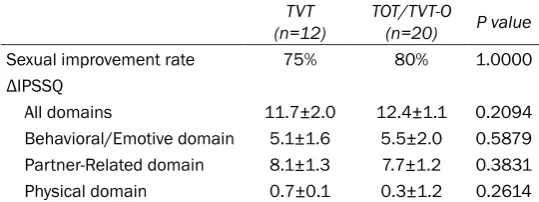
The sexual improvement rate was found 75% (9/12) and 80% (16/20) in TVT and TOT/TVT-O groups respectively, whereas the mean values of ΔIPSSQ in two groups were 11.7±2.0 and 12.4±1.1. However, no significant difference in the sexual improve-ment rate was shown between the two groups, and neither was the ΔIPSSQ (Table 4).
The impact of sling material on post-operative sexual activity
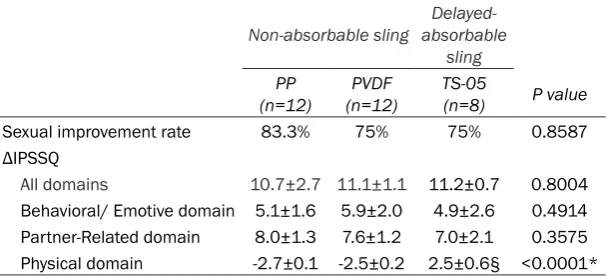
Stratified by sling material, 32 men were subdivided into three groups (two non-absorbable groups PP and PVDF, a delayed-absorbable group TS-05). Both sexual improvement rates and ΔIPSSQ scores in three groups were very similar and had no sig-nificant difference, whereas the physical domain score in TS-05 group was significantly higher than the other two (PP and PVDF) (P<0.001) (Table 5).
Discussion
Sexual dysfunction is prevalent in urinary incontinence (UI) women, affecting nearly 50% of the patients [12, 13]. Severity of UI may play an important impact fac-Table 2. Changes of IPSSQ score in all and each domain of the
patient’s spouse at baseline and after MUS surgery (n=32) Pre-operative Post-operative P values
All domains 20.2±4.7 32.4±7.7 0.0075
Behavioral/Emotive domain 10.8±0.7 5.5±0.6 <0.0001 Partner-Related domain 2.9±1.2 10.1±3.0 <0.0001 Physical domain 11.7±2.8 11.5±3.1 0.7874
[image:3.629.95.371.107.174.2]The values are presented as mean ± standard error of mean (s.e.m).
Table 3. Comparison of ΔIPSSQ in all and each domain strati-fied by pre-operative leakage during sexual activity
Leakage
(n=19) Non-leakage (n=13) P value
All domains 15.2±0.7 11.4±3.4 0.0018
Behavioral/Emotive domain 5.5±6.6 4.8±0.7 0.7074 Partner-Related domain 8.9±5.2 6.0±2.2 0.0081
Physical domain 0.7±0.6 -1.1±3.8 0.0684
ΔIPSSQ is calculated as the value of post-operative IPSSQ score minus pre-operative score and expressed as mean ± s.e.m.
Table 4. Comparison of the sexual improvement rate and the ΔIPSSQ in all and each domain stratified by surgical approach
TVT
(n=12) TOT/TVT-O (n=20) P value
Sexual improvement rate 75% 80% 1.0000
ΔIPSSQ
All domains 11.7±2.0 12.4±1.1 0.2094
Behavioral/Emotive domain 5.1±1.6 5.5±2.0 0.5879 Partner-Related domain 8.1±1.3 7.7±1.2 0.3831 Physical domain 0.7±0.1 0.3±1.2 0.2614
The sexual improvement rate is the percentage of patient’s spouse whose total IPSSQ increased after surgery. TVT: tension- free vaginal tape; TOT: trans-obturator tape. TVT-O: tension-free vaginal tape-trans-obturator.
tor as the women who avoid sexual activity have higher ‘incontinence pad weights’ than those who do not [14]. Negative impacts of UI on sexu-al life include embarrassment, low desire, and arousal difficulty, leakage during intercourse and dysphonia [15].
[image:3.629.98.368.231.309.2] [image:3.629.98.368.380.481.2]deterio-ration or no change, which were speculated by mesh erosion, pain during coitus and de novo urgency [12, 13, 18]. Thus, the impact of MUS on FSD remains controversial.
In common sense, male usually plays the domi-nant role in sexual activity. Partners of the UI patients have statistically significantly dimin-ished sexual function with less satisfaction, lower frequency of intercourse and more erec-tile dysfunction [19]. The effect of MUS on the partner’s sexual function has never been inves-tigated except one recent study [20]. However, in this study the assessment was accomplished using the International Index of Erectile Function (IIEF-5) questionnaires, which narrow-ly focused on penile rigidity rather than emo-tional and funcemo-tional changes in sexual activity.
We noticed that PISQ was a validated question-naire internationally accepted for evaluating sexual function of women with UI and pelvic prolapse. The Chinese version of PISQ had already been validated [21]. Obviously, PISQ was not designed for their partners. The cur-rent available questionnaire for patient’s spouse or partner sexual function evaluation is only generic sexual questionnaire such as IIEF-5.
In the present study, we used a non-validated self-administered questionnaire called IPSSQ-12. It was adapted from PISQ-12, which also reserved 3 domains: Behavioral/Emotive, Physical, and Partner-Related. But it was
designed specially for SUI patient’s spouse or part-ner. The scoring system was identical to PISQ-12. We thought it was suit-able to use IPSSQ-12 together with PISQ-12 for each part of the couple; therefore score of each domain from both parts could be parallel com-pared. To our knowledge, it was the first time that the effect of MUS on the partner’s sexual function had been assessed using a disease-specific self-administered question-Table 5. Comparison of the sexual improvement rate and the ΔIPSSQ in
all and each domain stratified by sling material
Non-absorbable sling absorbable Delayed-sling
PP
(n=12) (n=12)PVDF TS-05(n=8) P value
Sexual improvement rate 83.3% 75% 75% 0.8587
ΔIPSSQ
All domains 10.7±2.7 11.1±1.1 11.2±0.7 0.8004 Behavioral/ Emotive domain 5.1±1.6 5.9±2.0 4.9±2.6 0.4914 Partner-Related domain 8.0±1.3 7.6±1.2 7.0±2.1 0.3575 Physical domain -2.7±0.1 -2.5±0.2 2.5±0.6§ <0.0001*
PP: Polypropylene; PVDF: Polyvinylidene Fluoride; TS-05: the product code of a delayed-absorbable sling. *Comparison of ΔIPSSQ between three groups, §Comparison of ΔIPSSQ with other two groups, P<0.001.
naire. Although it was a non-validated question-naire, its structure and main contents basically followed PISQ-12. We believe that the results from the present study are reliable.
Our study showed the sexual function of the SUI patient’s spouse was significantly improved in general, and was more obvious in those whom suffered from leakage during sexual inter-course pre-operatively. Scores in three domains indicated that such improvement mainly occurred in the behavioral/emotive domain (increased sexual desire and frequency of sex and decreased fear or depression of coital incontinence) rather than the physical domain. When stratified by sling material and surgical approach, no significant improvement was found post-operatively. Whereas the physical domain score in the group of central-absorb-able sling (TS-05) was significantly higher than the other two non-absorbable groups (PP and PVDF), indicating that absorbable sling might lead to smaller or less scar tissue and conse-quently less incidence of dyspareunia second-ary to the sensation of tape under the vaginal epithelium [22].
[image:4.629.100.404.106.244.2]whereas no change occurred in both physical and partner domains (data not shown).
There were several major limitations in the present study: the self-designed IPSSQ-12 needs to be further validated, the sample size was relatively small, and the data had not been stratified by post-operative time.
Conclusions
MUS showed in general positive impacts on the sexual function of SUI patient’s spouses. It was the first time that the partner had been sur-veyed using a disease-specific questionnaire. We believe that data acquisition derived from such questionnaire could provide information closer to the nature about sexual life of patient’s partner than any generic questionnaire. Our results might be helpful for urologists to carry out pre-operative psychosexual counseling for the couples who are willing to undergo UI surgery.
Disclosure of conflict of interest
None.
Address correspondence to: Dr. Zheng-Wang Zhang, Department of Urology, Huadong Hospital Affiliated to Fudan University, 221 West Yan’an Road, Shanghai 200040, China. Tel: 86-21-62483180; Fax: 86-21-62498628; E-mail: [email protected]
References
[1] Thomas TM, Plymat KR, Blannin J, Meade TW. Prevalence of urinary incontinence. Br Med J 1980; 281: 1243-1245.
[2] Barber MD, Visco AG, Wyman JF, Fantl JF, Bump RC. Sexual function in women with uri-nary incontinence and pelvic organ prolapse. Obstet Gynecol 2002; 99: 281-289.
[3] Broome BA. The impact of urinary inconti-nence on self efficacy and quality of life. Health Qual Life Outcomes 2003; 1: 35.
[4] Shaw C. A review of the psychosocial predic-tors of helpseeking behaviour and impact on quality of life in people with urinary inconti-nence. J Clin Nurs 2001; 10: 15-24.
[5] van der Vaart CH, de Leeuw JR, Roovers JP, Heintz AP. The effect of urinary incontinence and overactive bladder symptoms on quality of life in young women. BJU Int 2002; 90: 544-549.
[6] Shaw C. A systemic review of the literature on the prevalence of sexual impairment in
wom-en with urinary incontinwom-ence and the preva-lence of urinary leakage during sexual activity. Eur Urol 2002; 42: 432-440.
[7] Sen I, Onaran M, Aksakal N, Acar C, Tan MO, Acar A, Bozkirli I. The impact of urinary inconti-nence on female sexual function. Adv Ther 2006; 23: 999-1008.
[8] Pace G, Vicentini C. Female sexual function evaluation of the tension-free vaginal tape and transobturator suburethral tape incontinence surgery: Results of a prospective study. J Sex Med 2008; 5: 387-393.
[9] Nilsson CG, Palva K, Rezapour M, Falconer C. Eleven years prospective follow-up of the ten-sion-free vaginal tape procedure for treatment of stress urinary incontinence. Int Urogynecol J 2008; 19: 1043-1047.
[10] Jha S, Ammenbal M, Metwally M. Impact of in-continence surgery on sexual function: A sys-tematic review and meta-analysis. J Sex Med 2012; 9: 34-43.
[11] Rogers RG, Coates KW, Kammerer-Doak D, Khalsa S, Qualls C. A short form of the pelvic organ prolapse/urinary incontinence sexual questionnaire (PISQ-12). Int Urogynecol J 2003; 14: 164-168.
[12] Salonia A, Zanni G, Nappi RE, Briganti A, Dehò F, Fabbri F, Colombo R, Guazzoni G, Di Girolamo V, Rigatti P, Montorsi F. Sexual dysfunction is common with lower urinary tract symptoms and urinary incontinence: Results of a cross-section study. Eur Urol 2004; 45: 642-648. [13] Rogers RG, Kammerer-Doak D, Darrow A,
Murray K, Olsen A, Barber M, Qualls C. Sexual function after surgery for stress urinary incon-tinence and/or pelvic organ prolapse: A multi-center prospective study. Am J Obstet gynecol 2004; 191: 206-210.
[14] Brubaker L, Chiang S, Zyczynski H, Norton P, Kalinoski DL, Stoddard A, Kusek JW, Steers W; Urinary Incontinence Treatment Network. Urinary Incontinence Treatment Network. The impact of stress incontinence surgery on fe-male sexual function. Am J Obstet Gynecol 2009; 200: 562, e1-7.
[15] Handa VL, Harvey L, Cundiff GW, Siddique SA, Kjerulff KH. Sexual function among women with urinary incontinence and pelvic organ pro-lapse. Am J Obstet Gynecol 2004; 191: 751-756.
[16] Petros P, Ulmsten U. An integral theory of fe-male urinary incontinence: experimental and clinical considerations. Acta Obstet Gynecol Scand 1997; 166: 3-8.
[18] Shah SM, Bukkapatnam R, Rodríguez LV. Impact of vaginal surgery for stress urinary in-continence on female sexual function: is the use of polypropylene mesh detrimental? Urology 2005; 65: 270-274.
[19] Bekker MD, Beck JJ, Putter H, van Driel MF, Pelger RC, Weijmar Schultz WC, Lycklama à Nijeholt GA, Elzevier HW. Sexual experiences of men with incontinent partners. J Sex Med 2010; 7: 1877-1882,
[20] Narin R, Attar R, Narin MA, Koyuncu D, Yencilek E. Impact of transobturator tape procedure on female and their partner sexual function: it im-proves sexual function of couples. Arch Gynecol Obstet 2014; 290: 913-917.
[21] Zhu L, Yu S, Xu T, Yang X, Lu Y, Lang J. Validation of the Chinese version of the Pelvic Organ Prolapse/Urinary Incontinence Sexual Ques- tionnaire short form (PISQ-12). Int J Gynaecol Obstet 2012; 116: 17-19.
Appendix
Incontinence Patient Partner Sexual Questionnaire
(IPPSQ-12)
Following is a list of questions about your sexual life. All information is strictly confidential and will only be used to help doctors understand your sexual life. Please tick the best answer of each question. While answering the questions, consider your sexuality during the past 6 months. Thank you for your help. 1. How frequently do you desire to have sexual intercourse?
□never □seldom □sometimes □usually □nearly daily 2. How frequently do you have sexual intercourse or activity? □never □ < once/month □1~3/month □1~3/week □ once/day
3. Does your sexual interesting ever been interrupted by unpleasant urine odor from your partner? □never □seldom □sometimes □usually □always
4. Is your partner incontinent of urine with sexual activity? □never □seldom □sometimes □usually □always
5. Does your sexual activity been interrupted by your partner incontinent of urine? □never □seldom □sometimes □usually □always
6. Does your partner’s incontinent of urine affect your erection? □never □seldom □sometimes □usually □always 7. Do you need lubrication help you insert?
□always □usually □sometimes □seldom □never
8. Does your sexual activity ever been interrupted by pains or discomforts during intercourse? □always □usually □sometimes □seldom □never
9. Do you climax during sexual intercourse?
□never □seldom □sometimes □usually □always 10. How do you feel when you climax?
□bad □common □moderate □good □perfect 11. What’s your overall feeling about your sexual activity? □bad □common □moderate □good □perfect 12. What about your overall satisfaction of your sexual activity? □bad □common □moderate □good □perfect