A B S T R A C T
We examine the combined effects of winds and photoionizing radiation from O-type stars on embedded stellar clusters formed in model turbulent molecular clouds covering a range of masses and radii. We find that feedback is able to increase the quantities of dense gas present, but decreases the rate and efficiency of the conversion of gas to stars relative to control simulations in which feedback is absent. Star formation in these calculations often proceeds at a rate substantially slower than the freefall rate in the dense gas. This decoupling is due to the weakening of, and expulsion of gas from, the deepest parts of the clouds’ potential wells where most of the star formation occurs in the control simulations. This results in large fractions of the stellar populations in the feedback simulation becoming dissociated from dense gas.
However, where star formationdoesoccur in both control and feedback simulations, it does so
in dense gas, so the correlation between star formation activity and dense gas is preserved. The
overall dynamical effects of feedback on theclusters are minimal, with only small fraction
of stars becoming unbound, despite large quantities of gas being expelled from some clouds. This owes to the settling of the stars into virialized and stellar-dominated configurations before the onset of feedback. By contrast, the effects of feedback on the observable properties of the
clusters – theirU-,B- andV-band magnitudes – are strong and sudden. The time-scales on
which the clusters become visible and unobscured are short compared with the time-scales which the clouds are actually destroyed.
Key words: stars: formation – ISM: bubbles – HIIregions.
1 I N T R O D U C T I O N
Star formation occurs inside giant molecular clouds (GMCs) in an hierarchical fashion. At the largest scales, clouds convert a small fraction, typically a few per cent, of their gas reservoir to stars be-fore dispersing on time-scales of∼10 Myr. Most stellar groupings dissolve into the field on a similar time-scale, but several classes of identifiable objects, such as open clusters, OB associations, scaled OB associations and globular clusters, survive for much longer times. What it is that governs which of these paths a given young stellar population takes is not clear.
There are many processes acting on different time-scales which can disperse a group of stars into the field, recently reviewed and discussed by Kruijssen (2012). The mechanism most intimately connected with the star formation process itself, and acting on the shortest time-scales, is referred to as ‘infant mortality’ or ‘infant weight-loss’ (Lada & Lada2003; Bastian & Goodwin2006). These authors gathered together observations of embedded clusters and
E-mail:[email protected]
showed that the rate at which embedded clusters are formed is 10– 20 times higher than what would be expected from the rate at which gas-free open clusters are formed, if all embedded clusters were to evolve into open clusters. They therefore inferred that∼90 per cent of embedded clusters do not evolve to become open clusters, but are instead dispersed on the same time-scale (5–10 Myr) as that on which they evolve from the embedded to the exposed or open phase. This implies that the expulsion of gas that makes the clusters visible is also what destroys them.
Fall, Chandar & Whitmore (2005) and Whitmore, Chandar & Fall (2007) use the large number of clusters visible in the Antennae galaxies to plot mass–age diagrams in which they also deduced that ∼90 per cent of clusters are lost in each logarithmic age bin, but that the cluster mass function was unaffected. The dispersal mechanisms acting on each time-scale seem therefore to be mass independent.
This issue was revisited by Gieles & Bastian (2008) who instead examined the most massive clusters in logarithmic age bins in the Antennae, M51, the Large and Small Magellanic Cloud, M33 and M83. Their results for the Antennae were in agreement with those of Fall et al. (2005) and Whitmore et al. (2007), and they also found evidence of mass-independent cluster disruption in M51, but
at University of St Andrews on August 13, 2015
http://mnras.oxfordjournals.org/
not in the other systems studied. Bastian et al. (2009) corrected for the non-constancy of star formation in the Antennae merger system and found evidence for cluster disruption taking place on time-scales <10 Myr, but not on longer time-scales. The obser-vational picture of clusters at very young ages is thus somewhat murky.
From the theoretical point of view, there are two potential ways of ensuring that a recently formed cluster disperses on a similar time-scale to that on which star formation goes to completion and the cluster becomes exposed. The first is gas expulsion and this has been extensively investigated. Most such studies have relied on ana-lytic models orN-body simulations where the gas is represented, in one way or another, as an external potential which is removed over some time-scale (e.g. Tutukov1978; Hills1980; Lada, Margulis & Dearborn1984; Boily & Kroupa2003a,b; Goodwin & Bastian2006; Baumgardt & Kroupa2007; Pfalzner & Kaczmarek2013). These simulations have generally found that gas removal while the po-tential is still gas-dominated unbinds large fractions of the stars. However, hydrodynamic simulations call into question whether the potential in which the stars are situated is ever gas-dominated (e.g. Offner, Hansen & Krumholz2009; Girichidis et al.2012; Kruijssen et al.2012).
With improvements in algorithms and increases in computing power, it has become possible to model both star formation and stel-lar feedback self-consistently in hydrodynamic simulations. Some authors have concentrated on the effects of thermal accretion feed-back (e.g. Bate2009b; Urban, Martel & Evans2010) or jets/outflows from low-mass stars (e.g. Li & Nakamura2006; Cunningham et al.
2011; Krumholz, Klein & McKee 2012; Federrath et al. 2014; Myers et al.2014). These works have generally concentrated on the effects of feedback on setting the masses of individual stars, the determination of the stellar initial mass function and the set-ting of the overall star formation efficiency (SFE). These feedback processes are expected to have limited influence the large-scale dy-namics of the clouds or the clusters, except insofar as they reduce the rate at which gas is converted to stars.
At larger scales, modelling of the destructive effects of HII
re-gions on whole GMCs has been popular, since an HIIregion can
in principle expand and clear out a large fraction of the volume of a molecular cloud on a relative short time-scale. These simu-lations have produced somewhat mixed results, depending on the clouds under investigation. Walch et al. (2012) modelled the effect of ionizing radiation from central O-stars on clouds with various fractal dimensions and find it to be highly destructive, dispersing their 6.4 pc radius, 104M
clouds in a few Myr. Similar disruption time-scales in clouds formed by colliding flows were reported by Col´ın, V´azquez-Semadeni & G´omez (2013). However, Dale et al. (2005), who modelled ionizing radiation emanating from an O-star at the hub of a network of filamentary accretion flows, Peters et al. (2010, modelling irradiation from O-stars forming near the centre of a massive disc) and Dale & Bonnell (2011, simulating the influence of massive stars on a 106M
cloud with a high escape velocity) all observed their H II regions to flicker as they were swamped
by neutral gas delivered by accretion flows. In these calculations, the dynamical influence of photoionization on the scales of whole clouds was much more modest. Dale, Ercolano & Bonnell (2012,
2013a) examined this issue in a suite of simulations spanning a GMC mass–radius parameter space ranging from 104to 106M
in mass and 5–180 pc in radius. They confirmed that accretion flows restrict the ability of HIIregions to disrupt clouds. However, they
also showed that the clouds’ escape velocities were crucially impor-tant (as predicted by Matzner2002for example), since HIIregions
cannot expand at speeds much exceeding the (roughly constant) sound speed in gas photoinized by O-stars of≈10 km s−1.
Walch & Naab (2014) investigated the combined influence of photoionization and supernova explosions, building on the work of Walch et al. (2012). They found that the effect of the photoionization phase before the supernova explosion was to delay somewhat the transition of the supernova remnant from the Sedov–Taylor phase to the radiative phase, by reducing the density of the gas encountered by the remnant. This allows the supernova to deposit≈50 per cent more momentum into the cold gas.
Instead of photoionization, Pelupessy & Portegies Zwart (2012) model the effects of winds and supernova explosions from massive stars on an embedded cluster. They do not model star formation, but they do investigate the influence of feedback on an admixture of stars and gas. They find that the influence of feedback depends very strongly on the efficiency with which the clouds retain the injected energy (which they choose to parametrize), but that SFEs as low as 5 per cent can result in bound systems surviving gas expulsion.
The second possible explanation for the apparent poor survival chances of embedded clusters, investigated by Clark et al. (2005), is that the clusters are never bound in the first place. This seems plausible on the face of it, since GMCs exist with a variety of virial ratios (e.g. Dobbs, Burkert & Pringle2011). However, two problems exist. First, star formation in unbound clouds tends to result in flat stellar mass functions (Clark, Bonnell & Klessen2008). Secondly, since the stars are able to decouple from the gas dynamics at early ages, the cloud being unbound does not guarantee that the stars will be so.
As a counterpoint to the foregoing discussion, there has been a resurgence of the idea that the space distribution of stars should more properly be thought of ashierarchical, rather than merelyclustered (e.g. Elmegreen & Elmegreen2001; Bonnell, Bate & Vine2003; Bastian et al.2007). This is partly driven by the difficulty of defining observationally what is and is not a cluster. Bressert et al. (2010) highlighted this particularly strongly in their survey of the surface density of nearby YSO’s in which they were unable to identify any distinctive scales which could be used for such a definition. While Gieles, Moeckel & Clarke (2012) showed that this result does not necessarily imply that stars are not formed in bound clusters, it does show that observationally defining and identifying clusters is non-trivial. Bastian et al. (2007) obtained similar results at much larger size scales in their study of M33, in which they were unable to identify any preferred size scale for young stellar systems. We do not discuss our simulations in this context (Parker & Dale in preparation).
This paper forms part of a series of studies of the effects of photoionization and/or winds from O-type stars on a parameter space of model GMCs constructed to reflect the gross properties of the Milky Way clouds documented in Heyer et al. (2009). In the first six papers, we performed controlled experiments involving ionizationorwinds with the object of disentangling their individual effects.
In Dale et al. (2014), we combined the two forms of feedback and computed quantities global to our model clouds, such as the SFE, average star formation rate (SFR) and unbound gas mass, to see how they varied across the parameter space. The results of the study can be briefly summarized as follows: the additional effect of winds on the dynamics of the cold gas was minimal, although the structure of the ionized gas was strongly altered in many of the simulations, being compressed by the winds into a thin shell lining the inner walls of the feedback-blown bubbles. The overall influence of feedback was strongly dependent on the clouds’
at University of St Andrews on August 13, 2015
http://mnras.oxfordjournals.org/
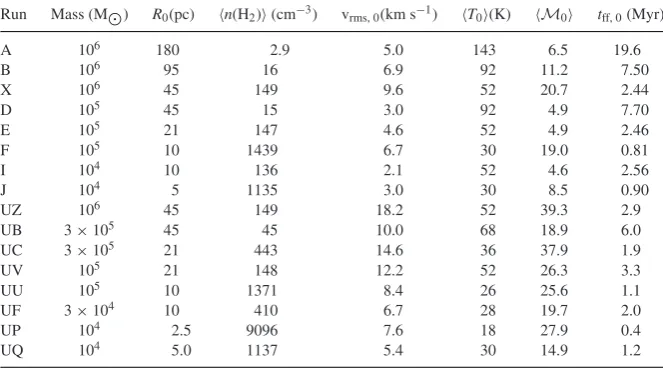
J 10 5 1135 3.0 30 8.5 0.90
UZ 106 45 149 18.2 52 39.3 2.9
UB 3×10⁵ 45 45 10.0 68 18.9 6.0
UC 3×10⁵ 21 443 14.6 36 37.9 1.9
UV 105 21 148 12.2 52 26.3 3.3
UU 105 10 1371 8.4 26 25.6 1.1
UF 3×10⁴ 10 410 6.7 28 19.7 2.0
UP 104 2.5 9096 7.6 18 27.9 0.4
UQ 104 5.0 1137 5.4 30 14.9 1.2
escape velocities, with the lower mass 104M
clouds having large fractions of their gas reserves unbound or expelled, whereas the 106M
clouds were much less severely damaged. SFRs and SFEs followed a similar trend, being reduced by factors up to≈2 in the low-mass clouds, but scarcely changing in the larger objects. Feedback left the clouds substantially permeable to ionized gas, ionizing photons and supernova debris.
We previously focused largely on the gas content of the clouds, mentioning the stars only as sources of feedback and sinks of gas. In this paper, we redress the balance by considering in more detail the properties of the stellar populations and clusters formed by the clouds. We examine the interplay of stars and gas in more detail and compare our results with more nuanced observational diagnostics than blunt instruments such as global SFEs.
This paper proceeds as follows: Section 2 contains a brief reca-pitulation of our numerical methods. Section 3 describes the results derived from our simulations, and our discussion and conclusions follow in Sections 4 and 5.
2 N U M E R I C A L M E T H O D S
We have investigated the formation of embedded clusters under the influence of stellar feedback using a set of smoothed particle hydrodynamics (SPH) simulations of turbulent GMCs covering a mass–radius parameter space running from 104to 106M
in mass and 2.5–180pc in radius. The clouds initially have shallow Gaus-sian density profiles, with the density contrast between the centres and edges of the clouds being approximately 3. The clouds were given divergence-free turbulent velocity fields satisfying the scaling relationP(k)∝k−4, scaled to give them initial virial ratios of either
0.7 (which we refer to as ‘bound clouds’) or 2.3 (which we refer to as ‘unbound clouds’).
The thermal properties of the neutral gas are governed by a piece-wise Larson (2005) equation of state defined byP=kργ with a density-dependent adiabatic exponent given by
γ =0.75; ρ≤ρ1
γ =1.0; ρ1≤ ρ≤ρ2 γ =1.4; ρ2≤ ρ≤ρ3
γ =1.0; ρ≥ρ3,
(1)
and ρ1 = 5.5 ×10⁻¹⁹g cm−3, ρ2 = 5.5 ×10⁻¹⁵gcm−3, ρ3 =
2×10⁻¹³g cm−3. The initial properties of the clouds are given in
Table1.
The clouds are allowed to evolve, with the turbulence freely decaying, until they have formed a few massive stars or a few subclusters massive enough to host such stars. Stars and subclusters are represented by sink particles. The mass resolution of the 104
and 3×10⁴M
clouds are 1 and 3 M, respectively, and sinks are taken to represent stars. Their accretion radii are 5×10⁻³pc and
their minimum creation densities are set to 7×107cm−3. In the 105,
3×10⁵and 106M
clouds, the mass resolutions are 10, 30 and 100 M, and the sinks represent subclusters. Their accretion radii are set to either 0.1 or 0.25pc, whichever is less than 1 per cent of the host cloud’s initial radius. The minimum creation density of these objects is set to 4×105cm−3We then enable photoionization and
wind feedback using the algorithms presented in Dale, Ercolano & Clarke (2007), Dale et al. (2012) and Dale & Bonnell (2008). In the 104and 3×10⁴M
clouds, sinks above 20 Mare assigned an ionizing luminosity according to
log(QH/S)=48.1+0.02(M∗−20 M). (2)
For the more massive clouds, sinks are treated as small clusters with Salpeter mass functions between 0.5 and 100 M. The total mass contained in stars more massive than 30 M,M30is computed and
the ionizing luminosity of the sinks is set to (M30/30)×Q30s−1
withQ30being the ionizing luminosity of a 30 Mstar from the
above equation.
Wind momentum fluxes are set in a similar manner from mass-loss rates given by
˙ M(M∗)=
0.3 exp
M
∗
28
−0.3
×10−6Myr−1, (3)
and terminal velocities by
v∞(M∗)=103(M∗−18)0.24+600km s−1. (4)
The clouds are then evolved for a further 3 Myr (or as close to this as possible) to establish the combined effects of ionization and winds in the interval between the formation of the first O-stars and the first supernova explosions.
at University of St Andrews on August 13, 2015
http://mnras.oxfordjournals.org/
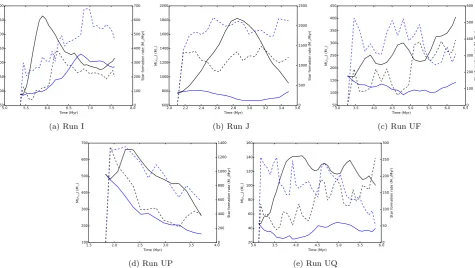
[image:3.595.131.463.94.278.2]Figure 1. Comparison of the dense gas mass (left-hand axis and solid lines) and SFRs (right-hand axis and dashed lines) in the control (blue) and dual-feedback (black) Runs I, J, UF, UP and UQ simulations.
The global effects of pre-supernova feedback were discussed in Dale et al. (2014). Here, we focus more on the detailed properties of the stellar clusters and the smaller scale interplay between stars and gas with reference to recent observations.
3 R E S U LT S
3.1 Dense gas depletion times
Lada, Lombardi & Alves (2010) infer a linear relationship be-tween the SFR and the mass of gas above a density threshold ρcritof 104cm−3. We examine this relationship in our simulations
in Fig. 1where we plot M(ρcrit) as a function of time as solid
lines using the left-hand axis scale.M(ρcrit) in the control
simu-lations (blue solid lines) varies by moderate factors of a few over the simulation durations. In the feedback runs, there is generally more dense gas than in the companion control simulation by fac-tors of a few, and again with variations over time by facfac-tors of a few.
SFRs (dashed lines and right-hand axis scale in Fig.1) are gener-ally higher in the control simulations by factors of up to 3 compared to the corresponding feedback calculation. In both sets of calcu-lations, the SFRs vary non-monotonically with time by factors of approximately 2.
Since stars form from dense gas,M(ρcrit)/SFR can be thought
of as the depletion time of the dense gas due to star formation. If there are no forces present to resist gravity and gas exhaustion has not yet occurred, the depletion time would be expected to be close to the freefall time atρcrit,tff(ρcrit) ≈0.35 Myr. There are
no magnetic fields present in our calculations and only one of our simulations, Run F, comes anywhere near gas exhaustion, so we expect the control simulations to form stars at the freefall rate. In Dale et al. (2014), we showed that star formation in the control simulations indeed proceeds at close to the freefall rate defined by
the freefall times of the entire clouds, whereas star formation in the feedback simulations was generally slower by factors up to 2. In both sets of simulations, the SFRs also vary with time, although also only by factors of approximately 2 over the time-scales shown here.
In Fig. 2, we show the depletion times of gas with ρ > ρcrit
(defined as the instantaneous quantity of material satisfying this condition divided by the instantaneous SFR) in units oftff(ρcrit)
as functions of time in the control (blue lines), and dual-feedback (black lines) Runs I, J, UF, UP and UQ. The red-dashed line indicates a depletion time oftff(ρcrit). The depletion times in the control
simulations are within a factor of 2 of this value for the virtually the whole duration of all simulations.
The depletion times in the feedback runs in contrast are substan-tially longer, since the SFRs in these models are slower and the dense gas masses are generally larger. The depletion times are al-most always at least a factor of 2 longer than those in the control runs at the same epoch. Depletion times in the feedback runs also vary much more strongly with time, sometimes being more than an order of magnitude higher than in the corresponding control calculation, although the variation is often strongly non-monotonic.
Overall, the roughly constant depletion times in the control runs indicate that star formation in these simulations proceeds quite steadily at the freefall rate in the dense gas. Since tff(ρcrit) is a
constant, and the SFRs also do not vary greatly, the invariance of the depletion times in the control simulations implies that the masses of gas aboveρcrit,M(ρcrit) are also nearly constant.
In general, the depletion times in the feedback simulations are longer thantff(ρcrit), sometimes by factors approaching 10,
indicat-ing a decouplindicat-ing of the SFR from the freefall time in the dense gas. There are two extremal possible explanations for this; star forma-tion at densities at or aboveρcrit(i) proceeds efficiently but more
slowly (ii) proceeds at the same rate but less efficiently. In reality, the explanation may be a combination of these factors.
at University of St Andrews on August 13, 2015
http://mnras.oxfordjournals.org/
Figure 2. Dense gas mass depletion times in units of the freefall time atρcrit(≈0.35 Myr) in the control (blue) and dual-feedback (black) Runs I, J, UF, UP and UQ simulations. The red-dashed line corresponds to a depletion time oftff(ρcrit), which would indicate star formation proceeding at the freefall rate in gas of this density.
3.2 Production of dense gas
We investigate the issue of the long dense gas depletion times in the feedback simulations by first examining how much dense gas the simulations actually produce. We identify, in all the above sim-ulations, every SPH particle whose densityeverexceedsρcrit, and
determining the status of these particles at the end of each run. There are either three or four possibilities, depending on the calculation: (a) the material has been involved in star formation; (b) the material has been ionized; (c) the material is neutral and denser thanρcrit;
(d) the material is neutral and less dense thanρcrit. In Fig.3, we
plot bar charts for showing the results of this analysis, with the
four categories of gas being shown as black, red, blue and green, respectively.
Runs I and J are globally bound clouds whose radii and there-fore mean densities change little when undisturbed by feedback. In the control simulations of these clouds, the majority of gas whose density at some point in the simulations comes to exceedρcrit is
involved in star formation by the ends of the simulations. A small amount is still in gaseous form and denser thanρcrit, and an even
smaller amount has fallen to lower densities. In the feedback runs, it is evident that more dense gas is produced in total, but that less of it is eventually involved in star formation. However, the difference is not due to large quantities of dense gas being subsequently ionized,
Figure 3. Bar charts recording the final fate of all gas whose density comes to exceedρcritin Runs I, J, UF, UP and UQ simulations at the ends of each calculation. Left-hand columns are from simulations, and right-hand columns from dual-feedback calculations. Black: involved in star formation. Red: ionized. Blue: acquires higher density. Green: acquires lower density.
at University of St Andrews on August 13, 2015
http://mnras.oxfordjournals.org/
[image:5.595.64.534.527.695.2]or to gas remaining at high densities but not forming stars. Instead, large quantities of gas are elevated over the density threshold, but later fall back below it, while remaining neutral.
Runs UF, UP and UQ are globally unbound and thus expand substantially whether feedback is acting or not. Consequently in the control simulations of these clouds, a substantial fraction (the ma-jority in Runs UP and UQ in fact) of the gas whose density is raised aboveρcritby turbulence (or gravity) subsequently re-expands and
is never involved in star formation. We reiterate that this is nothing to do with feedback and is just a result of the initial supervirial states of these clouds. In the simulations in which feedbackisactive, the fraction of dense gas involved in star formation again drops and the total quantities of dense gas produced again increase, although only marginally in the case of Run UP. The fraction of dense gas which is ionized is once more very modest, although the ionized gas is the chief difference between the control and dual-feedback Runs UP. In Runs UF and UQ, feedback results in more dense gas being pro-duced but much of it falls back below the density threshold without being ionized.
These plots support several general conclusions.
(i) The total quantity of sometime-dense gas in dual-feedback simulations is larger than in the control simulations. Feedback aids these clouds in generating dense gas.
(ii) The fractions of dense gas which finishes simulations with densities lower thanρcritis always greater in the feedback
calcula-tions than in the corresponding control run.
(iii) The quantities of dense gas which are ionized in the dual-feedback calculations are in all cases small fractions of the totals. Dense gas in these simulations is therefore mostly not prevented from forming stars by being ionized.
(iv) The final SFEs are always lower in the dual-feedback simu-lations. Feedback restrains the clouds from forming stars.
The obvious question arising from these observations is, if the feedback-affected clouds are better at forming dense gas, why are they worse at making stars?
3.3 Conversion of dense gas to stars
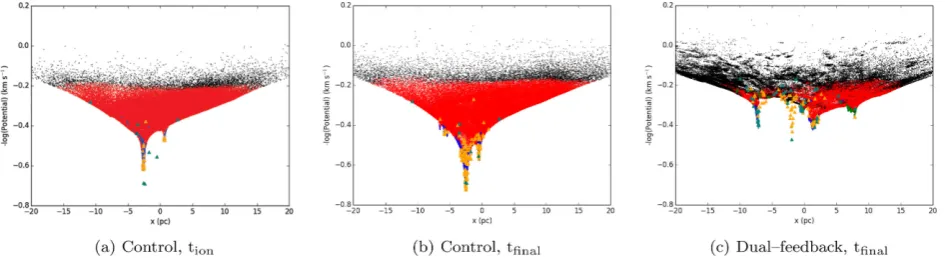
The answer to the question of why the feedback calculations are not efficient at converting their gas to stars lies in the fact that dense gas is anecessary but not sufficientcondition for the production of stars. The gas must also be gravitationally bound and collapsing. In Fig.4, we show the potential wells from the pre-feedback (left) and
final (centre) states of the control Run I simulations, together with the final state of the dual-feedback simulation (right). Equivalent plots from runs J, UF, UP and UQ are very similar and are not shown to save space. Gas particles are shown as small dots. Only non-ionized gas particles are shown and, for reasons of clarity, only every tenth particle is plotted. Bound particles whose densities exceedρcrit are shown in blue, unbound particles exceeding this
density in green, and other unbound and bound particles as black or red, respectively. Sink particles are shown as triangles, with orange indicating bound sinks and teal unbound sinks. Several points are immediately apparent.
(i) The potential well in the control simulation becomes deeper and broader with time as more gas falls into it and more stars are formed. The stars generally congregate in the deepest part of the well. In the final states of the control and dual-feedback simulations, there are a few unbound sink particles deep within the respective potential wells. These are low-mass sinks that have become unbound by dynamical interaction with more massive partners.
(ii) Unbound gas particles in the control simulation are rather uniformly distributed at values of the logarithm of the potential (expressed in kilometres per second) close to zero. In the ionized run, by contrast, unbound gas particles exist at substantially greater depths in the potential well, due to local acceleration of gas to velocities higher than the cloud escape velocity.
(iii) Gas whose density is larger thanρcritresides almost
exclu-sively in the deepest troughs in the potentials. This is particularly obvious in the control run.
(iv) In the control simulation, the densest gas is coincident with the densest groups of stars in the deepest potential troughs. However, in the dual-feedback simulation, the deepest potential well is devoid of gas and contains only stars. This well is substantially shallower than its counterpart in the final state of the control simulation. The dual-feedback simulation instead possesses several smaller shal-lower potential wells containing mixtures of gas and stars, and not all of the material in these wells is bound in the cloud centre-of-mass frame.
Our interpretation of these observations is as follows. The cloud’s primary potential well in the control run is the main engine for the production of dense gas and for the conversion of gas to stars. The depth and dominance of this well ensures that gas continually flows into it and that this gas is bound and has little option but to form stars. In the feedback run, the reversal of the accretion flows feeding the central cluster and the expansion of the cluster itself has
Figure 4. The potential wells of the control simulation attion(left) andtfinal(centre), and the dual-feedback simulation attfinal(right) in Run I. Black dots are particles that are unbound in the cluster centre-of-mass frame and red dots are unbound particles. Bound particles with densities aboveρcritare shown in blue, and unbound particles exceeding this density are shown in green. Orange and teal triangles represent bound and unbound sink particles, respectively. Unbound, in all cases, means having positive total energy in the system centre-of-mass frame. Note that only one tenth of all particles in each class are plotted.
at University of St Andrews on August 13, 2015
http://mnras.oxfordjournals.org/
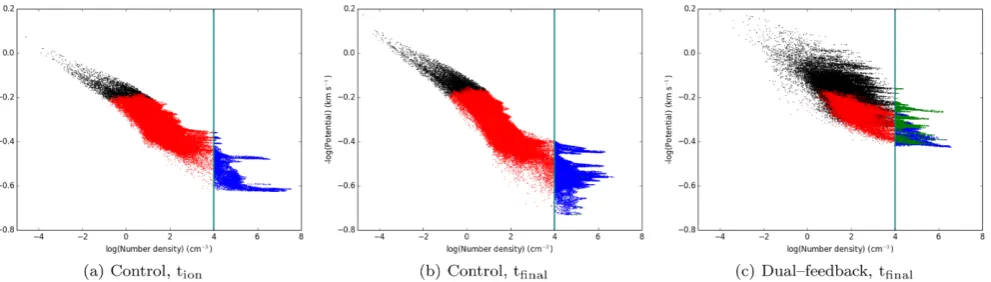
[image:6.595.60.533.556.686.2]Figure 5. Gravitational potential against density attion(left) andtfinal(centre) in the control run, and in the dual-feedback simulation attfinal(right) in Run I. Black dots are particles that are unbound in the cluster centre-of-mass frame and red dots are unbound particles. Bound particles with densities aboveρcrit are shown in blue, and unbound particles exceeding this density are shown in green. Unbound, in all cases, means having positive total energy in the system centre-of-mass frame. The vertical teal line isρcrit. Note that only one tenth of all particles in each class are plotted.
prevented the potential well acquiring the depth it achieves in the control simulation. Additionally, the deepest potential well in the feedback simulation has been completely emptied of gas, so it is not able to contribute to star formation. Compression of gas on the peripheries of the cleared-out bubbles has instead produced several less massive and shallower potential troughs. There is thus no large and efficient central star factory in the dual-feedback simulation, and none of the gas has access to a potential as deep as that in the control simulations.
The expansion of the HIIregions/wind bubbles into the outer regions of the clouds in the dual-feedback simulations does create additional gas whose densities exceedρcritfor some time, but this
gas never becomes gravitationally bound. We illustrate this in Fig.5, which depicts the potential of the gas as a function of density for the control run at the time of the initiation of feedback (left-hand panel) and the end of the simulation (centre panel), compared to the end of the dual-feedback run (right-hand panel). Black and red particles are unbound and bound particles, respectively, with densities below ρcrit, while green and blue particles are unbound and bound particles
with densities aboveρcrit.
In the control simulations at both epochs, all gas aboveρcritis
bound in the centre-of-mass frame, and thus highly likely to form stars. In the dual-feedback run, by contrast, there are large quantities of unbound gas whose density exceedsρcrit. Although this gas is
unbound in the frame of the cloud centre of mass, this does not necessarily imply that none of it will become locally self-bound. However, as discussed in Dale et al. (2013), because of the steep mean radial density profiles (∼r−2) of the clouds, the surface density
of swept-up material declines with time and radius and this gas becomes more gravitationally stable as the simulation progresses. We find that large quantities of gas which become denser thanρcrit
fail to become bound and eventually fall back below this density as they are driven to larger radii. This argues against a strict density threshold for star formation in these calculations.
3.4 Stellar and SFR surface densities
In Dale et al. (2014) and in the preceding subsections, we discussed chiefly the global properties of the model clouds, such as their final SFEs and mean SFRs. Here we examine the relations between resolved quantities, namely the stellar mass surface density or SFR surface density, and the gas mass surface density.
Gutermuth et al. (2011) used resolved observations of eight nearby molecular clouds to examine the correlation between the stellar mass surface density and gas mass surface density. Gas sur-face densities are computed from near-IR dust extinction mapping, and the cloud total masses are computed from summing the mass at extinctions above detection thresholds peculiar to each cloud. The most massive system examined was Orion at 33 200 M, and the least massive was Serpens at 2590 M, with a mean of ≈14 500 M, comparable to our low-mass runs I, J, UP, UQ and UF. TheAVthresholds used for these determinations varied from −1.0 (for Orion) to 3.7 (for Serpens), with a mean of≈0.7, or ≈0.3 if Serpens is excluded. These figures illustrate the problem of computing the mass of a GMC observationally. Gutermuth et al. (2011) computed stellar surface densities by drawing a circle of radiusRNaround each star cutting through the position of theNth nearest neighbouring star, and computing the surface density as (N−1)/πR2
N, usingN=10.
We replicate these techniques as closely as possible. We use the same method as Gutermuth et al. (2011) to estimate the stellar density at the sink particle locations. We also note that typically 80–90 per cent of the mass of our model clouds exists atAV>0.5, so that their actual masses are close to what would be measured by extinction mapping with the typical thresholds used by Gutermuth et al. (2011).
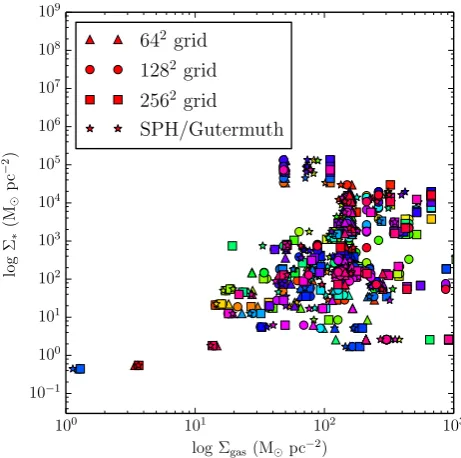
However, it is not immediately obvious how to best compute the gas mass surface densities, so we employ two techniques which are compared in Fig.6, using the control Run I simulation as a test. The results plotted in this figure are from thez-axis projection of the simulation, but we confirmed that observing along thex- ory-axes did not produce substantially different results. We first measured the gas surface density at the position of every sink particle by integrating through the smoothing kernels of every gas particle which overlaps in projection the position of the sink, to compute the projected mass as viewed along thez-axis. The same technique is used over a uniform grid to generate the column density images in our other papers. This technique is in some sense scale-free, since no grid is imposed on the density field. Alternatively, we placed uniform grids of 642, 1282
and 2562on the clouds and computed the
column density in each pixel by performing an SPH column density sum at the location of each pixel centre. We then assign column densities to the sink particles using the value of the pixel in which the sink is projected to lie. Fig.6shows that these four different estimations of the gas surface density agree tolerably well over the
at University of St Andrews on August 13, 2015
http://mnras.oxfordjournals.org/
Figure 6. Stellar mass surface density plotted against gas mass surface density for the final state of the control Run I simulation, at the location of each sink particle. Four points in a randomly chosen colour are shown for each sink particle. In all cases, thestellarmass surface density is computed using the method of Gutermuth et al. (2011), withN=10. For the star symbols, thegasmass surface density has been computed by evaluating an SPH surface density sum at the locations of each sink particle. For the triangle, circle and square symbols, a uniform grid of pixels has been placed on a 15 pc×15 pc box and the surface density computed by performing an SPH surface density sum at location of the pixel centres. Each sink particle has then been assigned the surface density of the pixel in which it is projected. Triangles represent results for a 642grid, circles a 1282grid and squares a 2562grid.
range of grid resolutions tried. The 642grid is not able to capture
the highest column densities, greater than∼3×10² M
pc−2,
but otherwise the forms of the plots are rather similar. Since we are only going to use them for making qualitative judgements, we consider either of the techniques used adequate, and we adopt the first one, in which the column densities are computed at the sink particle positions.
In Fig.7, we plot stellar surface densities against gas surface densities for Runs I, UF and E, comparing the results at the epoch when feedback is enabled (red triangles) to those from the ends of the control runs (blue circles) and the ends of the dual-feedback runs (black squares).
In all three pairs of simulations, the stellar surface densities grow in the control simulations relative to the epochs when feedback is enabled, by almost five orders of magnitude in the case of Run UF. The maximum gas surface densities, by contrast, are generally somewhat lower at the ends of the control simulations, reflect-ing consumption of gas. The dual-feedback simulations all exhibit lower maximum stellar surface densities, due to the general result of feedback that the stellar systems have lower volume and surface densities, due to weakening of the local potential and decreases in the SFEs. The maximum gas surface densities are somewhat higher in the dual-feedback simulations and tend not to be associated with high stellar surface densities, reflecting the relative inability of feed-back to trigger star formation discussed in Dale, Ercolano & Bonnell (2013b).
We compare our results to those of Gutermuth et al. (2011, their fig. 9)). Included in Fig.7are coloured polygons delineating ap-proximately the areas of parameter space occupied by Ophiuchus (orange), Mon R2 (purple), Cepheus OB2 (teal) and Orion (red). The control simulations, particularly of Runs I and UF, resemble most informOphiuchus and Mon R2, in that generally higher stellar surface densities correspond to higher gas densities. This correla-tion is quite tight in the case of the observacorrela-tions, as illustrated by the orange and purple polygons, and the relation between stellar mass and gas mass surface density follows approximately∗∝1.87 gas
and∗∝gas2.67.
The control Run I simulation initially exhibits a tight correlation between∗andgas, but the relations at the ends of the control runs
all show more substructure and considerably weaker correlations. The formal fitted slopes for the final states of the control runs I, UF and E are 0.99, 2.58 and 1.70, respectively, so that the slopes of the∗/gasrelations for runs UF and E are similar to those of
Ophiuchus and Mon R2. However, we also observe substantially higher maximum stellar mass surface densities in the control sim-ulations than are shown by Gutermuth et al. (2011). This likely has several causes. Resolution limitations in the observations un-derestimate the surface densities of the densest regions in the real clouds, but Ophiuchus, being a low-mass star-forming region is not expected to exhibit very high stellar surface densities in any case. However, probably more importantly, our control simulations where star formation is entirely unrestrained produce too many stars in configurations which are very compact, leading to very high stellar surface densities.
The feedback simulations, in contrast, produce substantially lower stellar surface densities more similar to those observed by Gutermuth et al. (2011), particularly in the case of Runs I and UF, where the maximum stellar densities are reduced by approximately two orders of magnitude relative to the control runs at the same epoch. The feedback calculations resemble more Gutermuth et al. (2011)’s Cepheus OB3 and Orion data, illustrated by the teal and red polygons, respectively. The simulations and observations ex-hibit large horizontal spreads, corresponding to regions with high stellar densities that have been partially or largely cleared of gas. Termination of accretion flows, stifling of cluster growth, and spatial separation of stars and gas in the feedback simulations produce stel-lar surface densities and correlations between stelstel-lar and gas mass surface densities closer to those from Gutermuth et al. in systems where feedback active.
Heiderman et al. (2010) instead plotted the SFR surface density for 20 nearby c2d and Gould’s Belt clouds with masses ranging from 189 M(Lupus IV) to 24 400 M(Serpens–Aquila). They also use extinction mapping, complemented with12CO and13CO
observations. They divide the clouds into regions enclosed between extinction contours and compute gas and SFR surface densities for each contour for each cloud. They compute the SFR surface densities from YSO surface densities, assuming a mean YSO mass and age.
We also partition our clouds into contours based on extinction. We choose a minimumAVof 4 mag and a contour spacing of 4 mag, with a maximum number of contours of eight. Within each region defined by two contours, we compute the mean gas surface density. Since our sink particles are not all of the same mass and we have time information available, we obtain SFR surface densities in each region by locating all sink particles within that region and referring back to previous dumps 0.5 Myr in the past to compute the total gain in stellar mass in each region.
at University of St Andrews on August 13, 2015
http://mnras.oxfordjournals.org/
Figure 7. Stellar mass surface densities versus gas mass surface densities at the locations of all sink particles for Runs I (104M
bound cloud, left-hand panel), UF (3×10⁴M
unbound cloud, centre panel) and E (105M
bound cloud, right-hand panel). Red triangles are from times when feedback is initiated, blue circles are from the end of the control runs and black squares are from the end of the dual-feedback runs. Hatched areas haveAV<1, where observational
results are likely to become unreliable. The polygons are from Gutermuth et al. 2009’s results; orange is Ophiuchus, purple is Mon R2, teal is Ceph OB2 and red is Orion.
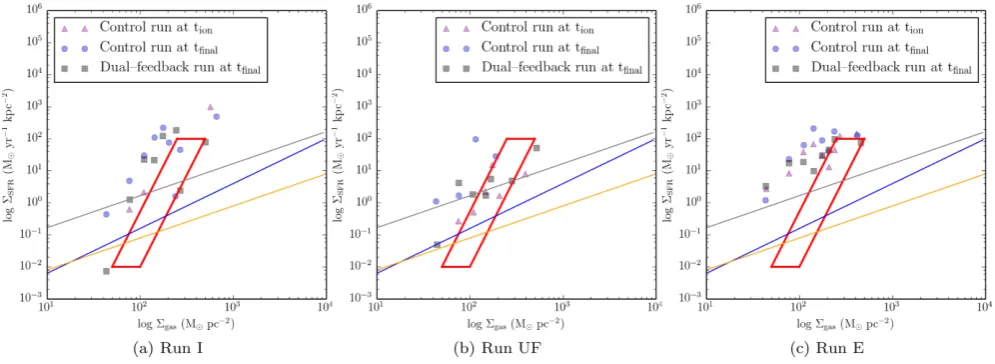
We plot the results in Fig.8, again for Runs I, UF and E, with pink triangles from times when feedback is initiated, blue circles from the end of the control runs and black squares from the end of the dual-feedback runs. As did Heiderman et al. (2010), we also include the SFR surface density versus gas surface density relations from Wu et al. (2005), Kennicutt (1998) and Bigiel et al. (2008) to guide the eye. Note, however, that the Kennicutt (1998) and Bigiel et al. (2008) relations are derived at much larger size scales and thus effectively smear out star formation activity over large areas. They are thus not expected to give an accurate representation of star formation at the level of individual molecular clouds. The results from Heiderman et al. (2010), however, are derived at mass and scales similar to our simulated clouds or to subregions of them, so we plot red polygons which approximately delineate the area occupied by their c2d and Gould’s Belt results (see their fig. 3).
Comparing our results to the models of Wu et al. (2005), Kennicutt (1998) and Bigiel et al. (2008), we find that our SFR densities are almost always substantially higher at a given density than predicted by the Kennicutt (1998) or Bigiel et al. (2008) rela-tions. Again, this is likely due in part to the fact that these relations are derived from observations at scales of∼100 pc and above, so that star formation is not well resolved. At gas surface densities close to 102 M
pc−2, the agreement with Wu et al. (2005) is
rather better, but at higher gas surface densities, we again recover much larger SFR surface densities in Runs I and E, although the agreement in Run UF is rather closer.
Our results are in fact much closer in form to those of Heiderman et al. (2010)’s fig. 3, exhibiting a much steeper relationship between SFRandgas. Runs I and E have substantially higher SFR surface
densities at a given gas surface density than reported by Heiderman
Figure 8. SFR surface densities versus gas mass surface densities in Runs I (104M
bound cloud, left-hand panel), UF (3×10⁴M
unbound cloud, centre panel) and E (105M
bound cloud, right-hand panel). Pink triangles are from times when feedback is initiated, blue circles are from the end of the control runs and black squares are from the end of the dual-feedback runs. The black line shows the relation form Wu et al. (2005), the blue line is the Kennicutt et al. (1998) relation and the orange line is from Bigiel et al. (2008). The red region delineates approximately the region covered by the c2d and Gould Belt clouds as reported by Heiderman et al. (2010, see their fig. 3).
at University of St Andrews on August 13, 2015
http://mnras.oxfordjournals.org/
[image:9.595.49.547.493.675.2]Figure 9. Unbound gas mass fractions (left-hand panel), stellar number fractions (centre panel) and stellar mass fractions (right-hand panel) plotted against cloud escape velocities normalized to the ionized sound speed (11 km s−1) for all simulations. Colours denote cloud masses, circles are for initially unbound clouds and squares are initially bound clouds. In all cases, the relevant fractions from the control simulations have been subtracted, so not all simulations appear on all plots.
et al. (2010), but Run UF is rather closer. This is likely due to Run UF being an unbound cloud with, on average, lower SFRs than the two bound clouds.
In all three simulations (which are representative of the others), we see that the differences between the control simulation at either tionortfinal and the dual-feedback simulations attfinal are modest.
All three sets of points occupy broadly the same region in the plots and there are no clear features to distinguish the control and dual-feedback calculations. It is thus difficult to discern the influence of feedback simply by analysing correlations between SFR surface density and gas surface density in this manner. This is in contrast to the results presented earlier where there is a clear effect of feedback on the correlation between stellar surface density and gas surface density. Star formation occurs in dense gas regardless of whether feedback is active or not but, as we saw in earlier sections, not all the dense gas in the feedback simulations is active in forming stars. Dense gas which isnotforming stars is obviously going to be poorly represented in plots constructed in the manner of Fig.8, based on YSO counts.
3.5 Unbinding of stars and clusters
In Fig.9, we show the gas mass fraction and mass and number fractions of stars unbound at the ends of our feedback calculations as a function of cloud escape velocities, expressed in units of the sound speed inside the HIIregions (11 km s−1). The relevant
un-bound fractions from the control simulations have been subtracted to isolate the effects of feedback, so the plots effectively show the quantities of material unboundby the action of feedback. In the case of clouds where the mass or number fractions of stars unbound is very small, the mass or number fractions unbound in the control simulations may be slightly greater than in the feedback simulation. Therefore, not all simulations appear in the centre and right-hand panels of the figure.
There is a tight correlation between the unbound gas mass and the cloud escape velocity, as discussed in Dale et al. (2013a). The correlation between the unbound stellar numbers and the cloud escape velocity is weaker with more scatter, and several clouds absent, from having greater numbers of stars unbound in the control simulations that in the dual-feedback run. There appears to be no
correlation at all between the unbound stellarmassand the cloud escape velocity. We check this in Fig. 10, where we show that the unbound stellar mass fraction is apparently uncorrelated with but generally lower than, the unbound gas mass fraction, so that combined photoionization and wind feedback is generally much less effective at unbinding stars than it is in unbinding gas. We explore the reasons for this lack of correlation in the Discussion section.
Fig.9suggests that neither the disruption of the clouds nor that of the clusters is mass independent. In the case of the clouds, one important cause of this, as discussed in Dale et al. (2013a), is likely
Figure 10. Unbound stellar mass fractions plotted against unbound gas mass fractions. Colours again denote cloud masses, circles are for initially unbound clouds and squares are initially bound clouds. In all cases, the relevant fractions from the control simulations have been subtracted, so not all simulations appear in this plot.
at University of St Andrews on August 13, 2015
http://mnras.oxfordjournals.org/
[image:10.595.306.545.435.677.2]Figure 11. Final SFEs (leftmost panel), fraction of simulation mass in O-stars (centre-left panel), numbers of ionizing photons per 104M
(centre-right panel) and final global ionization fraction (rightmost panel) for the final state of all simulations, with initially bound clouds shown as teal squares and initially unbound clouds as purple circles
to be the cloud escape velocity, or binding energy. In order to unbind the clouds, one must either supply sufficient momentum pcrit to accelerate the whole cloud beyond its escape velocity or
energyEcrit in excess of its binding energy. Since the clouds all
have roughly the same surface densities,M∼R2, sov
ESC∼M0.25,
pcrit ∼M1.25andEcrit ∼M1.5. However, as also mentioned in our
earlier paper, the ability of the feedback-driven bubbles to explore the cloud volume also strongly affects their ability to destroy the clouds. At the ionized sound speed, an HIIregion can expand at
most≈30 pc in the 3 Myr time window we have allowed here before the detonation of supernovae, which is greater than or comparable to the radii of the lower mass clouds, but much smaller than the radii of the more massive clouds.
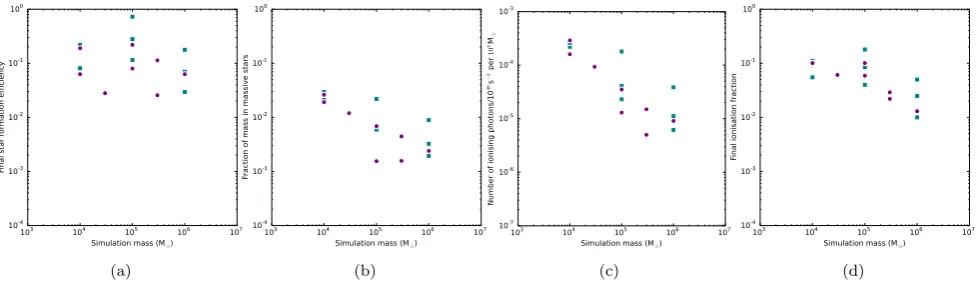
The vulnerability of clouds to feedback should also depend on their stellar content. As discussed in Dale et al. (2014) and shown in the leftmost panel of Fig.11, with the exception of the nearly gas-exhausted Run F, the final SFEs of the simulations span about one decade from 1.3 to 11 per cent. Computing for each simulation, the fraction of the cloud mass in stars above 20 M (by simply counting in the 104and 3×10⁴M
clouds and by assuming each subcluster in the more massive clouds has a Salpeter mass function between 0.5 and 100 M and integrating for the more massive clouds) reveals a similar spread across the parameter space (centre-left panel of Fig.11).
From the point of view of feedback, a more important quantity is the ionizing luminosity per unit mass of the clouds (since ionization dominates over winds), shown in the centre-right panel of Fig.11, which hints that the more massive clouds have smaller ionizing luminosities per unit mass, although again with large dispersions, which is partly accounted for by the unbound clouds having gen-erally lower SFEs. However, it may also be due to the simplistic method used to assign feedback luminosities to the clouds of masses 105M
and above necessitated by our inability to resolve individ-ual stars in these runs. This underestimates the luminosities of the most massive subclusters because it treats 30 Mstars as the ba-sic unit of feedback, ignoring possible contributions from rare but much brighter more massive objects.
However, we showed in Dale et al. (2012) that the results of simulations are not sensitive to changes of factors of several in the ionizing luminosity. As we show in the rightmost panel of Fig.11, the dispersion in the fraction of clouds which are ionized is quite small with all calculations (save Run F) having between 1 and 12 per cent of their mass ionized. Inspired by this, we presented in Dale et al. (2013a) a simple model treating the HIIregions as pistons
and considering what fraction of the cloud mass could be raised by their expansion to the appropriate escape velocity, finding a strong dependence of this fraction on the escape velocity itself.
3.6 Cluster emergence
The observed emergence of stellar clusters from their embedded phase occurs as a result of gas being cleared from the clusters, re-gardless of whether the loss of gas dynamically impacts the clusters. A detailed numerical study of this phenomenon strictly requires ad-vanced radiation transport calculations which are beyond the scope of this work. However, some insight can be gained by a simple analysis.
Open clusters and stellar associations are generally easily visible in the optical (e.g. theVband), whereas embedded clusters typically lie behind 5–100 mag of extinction in theVband (Lada & Lada
2003) and are rendered nearly invisible at optical wavelengths. It is the transition between these states which is generally referred to as ‘emergence’. Infrared (e.g.K-band) extinctions are around eight times smaller than optical extinctions for a given column density, so embedded clusters obscured in the optical may be easily visible in the infrared.
Protostars and pre-main-sequence objects are very bright in the infrared thanks to their accretion luminosities and the reprocess-ing of radiation by their dust-laden gaseous envelopes. Modellreprocess-ing the K-band luminosities of such objects is very difficult and we will not attempt it here. The visible and ultraviolet light, however, should be dominated by the bright massive stars, which become well settled on the main sequence while still embedded. We there-fore choose to treat the massive stars in our clouds as having main-sequence colours and luminosities and examine the extinction of their UV/visible light by the remaining gas in the simulations. We then sum the contribution of the massive stars to estimate the total visible magnitude of the whole stellar population, as it would appear if it were an unresolved cluster.
We utilize tabulated colours computed for stars inHubble Space Telescopefilters from Lejeune & Schaerer (2001). We choose solar metallicity and 1 Myr isochrones as a reasonable average age for our stars. We concentrate on theF336W(approximating theU-band), F439W(theB-band) andF555W(theV-band) filters. We include contributions from all stars more massive than 10 M. We compute the intrinsic magnitude of each star from its mass only and obtain the extinction in front of each star from the column density between the star and an observer at infinity in thex-,y- orz-directions. The
at University of St Andrews on August 13, 2015
http://mnras.oxfordjournals.org/
Figure 12. Foreground extinctions in Vmagnitudes for all stars in the control (blue) and dual-feedback (grey) as a function of stellar mass in Run I at the ends of the simulations, at times of 7.56 Myr when viewing the system along thez-axis.
column densities are converted to extinctions by assuming thatU-, B- andV-band extinction laws apply, so thatAV=NH/1021cm−3,
AB=1.322AV(this corresponds to the canonical mean extinction law (e.g. Fitzpatrick1999), but we note that values as low asAB= 1.322AVmay be appropriate for dense regions of the interstellar medium) andAU=1.581AV(Savage & Mathis1979).
Fig.12shows, for the final timesteps of the control (blue) and dual-feedback (grey) Run I simulations, the values ofAVforallstars when viewing the system along thez-axis, plotted as a function of stellar mass. The extinctions in the control run are sharply peaked atAV≈ 10 mag and extend up to≈50 mag. Those in the dual-feedback run fall into two clear groups. One, comprising roughly half the stars and corresponding to the population of stars embedded in or near the bubble walls, has a mean extinction also close to 10 mag. The other half have extinctions less than 1 mag and often
negligible, corresponding to the exposed cluster inside the cleared out feedback-driven bubble. Apart from the few very most massive stars in the feedback simulation, whose extinctions are very low, there is little dependence of extinction on stellar mass in either simulation. In particular, in the feedback simulation, a star of any mass can have its environs completely evacuated of gas by the few massive stars present in the system.
To compute the magnitudes of theclusters, we first convert the magnitudes of each star to fluxes in arbitrary units using
Fclus,U,B,V =
stars
F∗,U,B,V =
stars
F0×10−(MU,B,V−AU,B,V)/2.5, (5)
then sum over all sources and convert back to magnitudes using
Mclus,U,B,V = −2.5 log
Fclus,U,B,V F0
. (6)
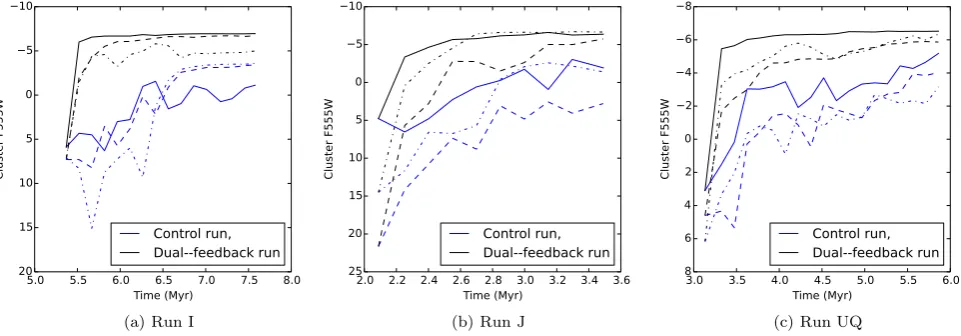
In Fig. 13, we plot the total magnitude in the F555Wfilter as a function of time for the control (blue lines) and dual-feedback (black lines) Runs I (left), J (centre) and UQ (right) simulations. In each case, we plot results looking down thex- (dash–dotted lines), y- (dashed lines) andz-axis (solid lines) to gain an idea of how projection effects may influence the results.
The initial magnitudes for the three clusters are in the range 5– 25. There is substantial variation in the results depending on the viewing angle. In Run J in particular, changing the viewing angle results in variations of almost 20 mag in the cluster brightness. This is purely due to the highly anisotropic nature of the dense gas in which the majority of the stars are initially embedded. However, the same qualitative conclusions may be drawn from all three viewing angles.
[image:12.595.56.537.529.697.2]In both the control and dual-feedback simulations, the clusters generally become brighter with time, often quite rapidly. In the control simulations, this is due largely to unabated accretion pro-ducing brighter and brighter stars. The increase in brightness is not smooth, however, with considerable jumps visible. These features are a result of the non-steady delivery of gas to the core regions of the cloud by accretion flows along the filaments, leading to large excursions in extinction. In the dual-feedback simulations, by con-trast, the increase in cluster brightness is generally much more abrupt, with all three of these simulations producing exposed clus-ters with brightnesses of−6 to−7 mag in theF555Wfilter, with differences in viewing angle resulting in spreads of about 1 mag.
Figure 13. AbsoluteV-band magnitudes of clusters as a function of time in Runs I (left-hand panel), J (centre panel) and UQ (right-hand panel). Control simulations are shown as blue lines and dual-feedback runs as black lines. Each cluster is observed along thex- (dash–dotted lines),y- (dashed lines) andz-axis (solid lines).
at University of St Andrews on August 13, 2015
http://mnras.oxfordjournals.org/
Figure 14. Evolution of the CMD of the clusters from the control (blue-green colour map and circles) and dual-feedback (yellow-red colour map and triangles) Run I calculations in theF555WversusF439W−F555W
space. The elapsed time since the point when feedback is enabled in the dual-feedback run is given in the colour bars at bottom left.
However, the time-scales on which the clusters are revealed also depend somewhat on viewing angle. In Run J, the cluster as viewed along thez-axis appears to achieve a magnitude brighter than zero only≈105yr after ionization is enabled, whereas this time-scale is
≈4×10⁵yr for an observer on they-axis. The greater variation
of this time-scale in Run J is due to the less effective clearing out of the cluster volume by feedback in this calculation relative to the other two shown.
Fig.14shows the evolution of the cluster colour–magnitude di-agram (CMD) in theF555Wversus F439W − F555W space of the control (blue-green colour map and circles) and dual-feedback (yellow-red colour map and triangles) Run I, as viewed along thez -axis, with the colour bar at bottom left giving the elapsed time since feedback was enabled in the dual-feedback calculation. The control simulation becomes brighter and bluer but, at later times, oscillates about a colour of≈1.5 and a magnitude of≈0. By contrast, the dual-feedback simulation moves very rapidly from the bottom right to the top left of the CMD, quickly acquiring a stable colour of ≈−0.3 and stable magnitude of≈−7.
[image:13.595.307.550.58.299.2]Fig.15shows a CMD for the individual stars (>10 M) in the control and dual-feedback Run I simulations at the ends of the runs. All of the stars in the control simulation are strongly reddened and control run stars of a given colour are several magnitudes brighter than stars of the same colour from the dual-feedback simulation. The stars from the control simulation are intrinsically brighter, since they are able to acquire larger masses, but are buried in much larger extinctions, so appear redder. The population embedded in the bubble walls in the dual-feedback simulation is visible at a colour of 2–3 and a magnitude of≈5. The exposed population is visible at the top left as a vertical grouping characteristic of massive stars on the main sequence, whose colours vary little but whose magnitudes vary substantially.
Figure 15. CMD of individual stars in the control (blue circles) and dual-feedback (black squares) Run I calculations in theF555WversusF439W− F555Wspace at the endpoints of the two calculations.
The time-scale on which clusters become observable is of crucial observational importance and can be estimated using the above analysis. In Table2, we give, for Runs I, J, UF, UP and UQ the time at which star formation began (tSF), the time at which feedback
was enabled (τFB), the time at which the clusters became brighter
thanV= −5 (t-5), chosen in part because no cluster in any control
simulation achieves this brightness) and the time of the end of the simulations (tend). We use these figures to compute, at the endpoints
of the simulations, the total duration of star formationτSF, the time
since feedback was enabledτFB, the time for which the cluster in
the feedback run has been brighter than aVmagnitude of−5τ-5, the
fraction of the star-forming lifetime for which the cluster is brighter thanV= −5,fSF, and the fraction of the time for which the O-stars
have been active for which the cluster is brighter thanV= −5,fFB.
It is clear from Fig.14 thatt-5varies substantially with viewing
angle. We show this crudely by giving for each cloud the median value oft-5from thex-,y- andz-projections, with the other two as
rough upper and lower limits.
As alluded to previously, the variation with viewing angle in the times at which the clusters become brighter thenV= −5 can be substantial, with variations up to almost 1 Myr in the case of Run UQ. However, the time delay between the onset of star for-mation and the forfor-mation of the first few O-stars, defining when feedback is enabled, is also approximately 1 Myr in all simula-tions, and the star formation time-scales are in the range 2–4 Myr in total (and would be longer in the case of Runs J and UP if it had been practical to continue the simulations for the full 3 Myr after the initiation of feedback). The fractions of the star formation time-scales for which the clusters are brighter than V= −5 are in the range 39–54 per cent with typical variations of≈15 per cent and absolute maxima and minima 69 and 23 per cent, respectively. Clusters should thus be bright for about half the time interval be-tween the onset of star formation and the detonation of the first supernovae, but the scatter in this quantity is significant. Naturally, the fraction of time since the O-stars formed for which the clusters
at University of St Andrews on August 13, 2015
http://mnras.oxfordjournals.org/
Table 2. Comparison of the times (all in Myr) at which star formation begins (tSF), the time at which feedback is enabled (tFB), the time at which the clusters reachV= −5 (t-5), the end time of each simulation (tend), the total duration of star formationτSF, the time since feedback was enabled τFB, the time for which the cluster in the feedback run has been brighter than aVmagnitude of −5τ-5, the fraction of time since star formation began for which the clusters have been brighter thanV= −5 (fSF) and the fraction of the time since feedback was enabled for which the clusters have been brighter thanV= −5 (fFB), for Runs I, J, UF, UP and UQ.
Run tSF tFB t-5 tend τSF τFB τ-5 fSF fFB
I 4.18 5.37 5.73+−00..6835 7.58 3.40 2.21 1.85−+00..3568 0.54−+00..1120 0.84+−00..1531 J 1.34 2.09 2.66+−00..3416 3.49 2.15 1.40 0.83−+00..1634 0.39−+00..0716 0.59+−00..1224 UF 2.08 3.28 4.43+−00..1381 6.23 4.15 2.95 1.80−+00..8113 0.43−+00..2003 0.61+−00..1704 UP 0.92 1.83 2.60+−00..4672 3.71 2.69 1.88 1.11−+00..7246 0.41−+00..1715 0.59+−00..3824 UQ 1.94 3.13 3.78+−00..9964 5.86 3.92 2.73 2.08−+00..6499 0.53−+00..1626 0.76+−00..2437
are this bright is higher, between 59 and 84 per cent with absolute maxima and minima of 100 and 25 per cent. The variations in this quantity are thus even larger. These variations imply that substan-tial fractions of cluster in magnitude-limited surveys may be missed purely through inhomogeneities in the intracluster gas.
4 D I S C U S S I O N
4.1 Disruption of clouds and clusters
We found that the disruption of the clouds by feedback is not mass independent and that the disruption of the stellar clusters is also not mass independent, and is substantially less severe. This result differs from previous work on this issue (e.g. Tutukov1978; Boily & Kroupa 2003b; Goodwin & Bastian2006; Baumgardt & Kroupa
2007; Pfalzner & Kaczmarek2013). These authors model the effects of gas expulsion by implicitly or explicitly allowing an N-body system to come into equilibrium with an artificial potential, and then removing that potential instantaneously or on a prescribed time-scale. The stellar system modelled is initially smooth, often in the form of a Plummer sphere, and the background potential is also smooth. The contribution of the stellar mass to the total mass density (the ‘star formation efficiency’) is taken to be the same at all radii.
These are tempting simplifications, but hydrodynamic simula-tions in which star formation is self-consistently modelled have shown that they are not correct. Offner et al. (2009), Kruijssen et al. (2012) and Girichidis et al. (2012) all find that the stellar and gaseous components of embedded clusters areneverin virial equilibrium with each other, and that the stars tend to be subvirial in both the absolute sense of having a virial ratio less than 0.5, and a relative sense in having a smaller virial ratio than that of the gas. The stars and gas thus form two largely decoupled systems.
We find that the same is true in our simulations. Fig.16depicts, for Run I, the virial ratio of all cold gas (solid lines), the cold gas occupying the same volume as the stars (defined by the smallest sphere centred on the most massive star which contains all the stars, dotted lines), and of all stars (dashed lines) in the control (blue lines) and dual-feedback (black lines) calculations.
We here define the virial ratio as a simple ratio of kinetic energy to gravitational potential energyEkin/|Egrav|. The kinetic energy for
each component (e.g. cold gas, stars) is computed by summing the kinetic energies of each individual star or gas particle in the centre of mass frame of the whole simulation. The potential energy is computed by summing over all star or gas particles the total potential
energy generated by all mass components of the simulation on each particle.
The stellar virial ratio is always less than that of the gas in both calculations. In the control simulation, the virial ratios of both com-ponents change only modestly over the course of the calculation, the stars becoming more subvirial, while the gas slowly approaches a virial ratio of unity, likely due to the slow expansion of the outer regions of the cloud. In the feedback simulation, the virial ratio of the cold gas increases strongly and rapidly, but that of the stars increases much more slowly.
If only gas inside the volume occupied by the stars is considered, the picture is slightly more complex. Initially, the virial ratios of the stars and cospatial gas are very similar. When feedback is enabled, the virial ratio of this gas in the dual-feedback simulation rises very sharply, since it is quickly and directly affected by feedback. As time progresses, the virial ratio of this material initially drops, before rising again at late times as the second-generation feedback sources become active. However, at all times after feedback is enabled, this
Figure 16. Virial ratios of all cold gas (solid lines), the gas occupying the volume defined by the location of the most massive star and the furthest star from this point (dotted lines), and of all stars (dashed lines) in the control (blue lines) and dual-feedback (black lines) Run I calculations.
at University of St Andrews on August 13, 2015
http://mnras.oxfordjournals.org/
[image:14.595.306.544.448.681.2]