ISSN Print: 2162-5336
DOI: 10.4236/ojn.2019.911086 Nov. 28, 2019 1173 Open Journal of Nursing
Concept Analysis of Ethical Competence of
Nursing Students and Nurses
Emi Yoshioka
*, Sayuri Kaneko
Nagano College of Nursing, Komagane City, Japan
Abstract
[Aim] This study aimed to conduct a concept analysis and clarification of ethical competence of nursing students and nurses, and further clarify the components. [Method] Rodger’s concept analysis method was used. A litera-ture search was conducted using the ICHUSHI database, MEDLINE, and CINAHL databases. The keywords included in the search were ethical com-petence. A total of 24 published articles were analyzed. [Results] As a concept of ethical competence among nursing students and nurses, five categories of [ethical sensitivity], [ethical reasoning], [ethical decision making], [ethical practice], [ethical reflection], obviously became. As a component, two catego-ries of antecedent factors and three categocatego-ries of consequences were identi-fied. I defined ethical competence in nursing students and nurses, “including nursing students and nurses thinking processes and nursing practice and ref-lection to solve ethical problems Behavioral characteristics”. [Conclusion] Review of nursing practice from an ethical perspective [ethical reflection] is indispensable for clarifying self-tasks and deepening better nursing practice.
Keywords
Ethical Competence, Nursing Student, Nurse, Concept Analysis
1. Introduction
With the rapid advancement and increasing complexity of medical care and de-velopment, as well as the establishment of comprehensive community care sys-tems, nurses are now facing various new ethical issues. To address these issues, ethical judgment is required. In the “Code of Ethics for Nurses”, the Japan Nursing Association clearly specifies guidelines for nurses’ behavior and the scope of nurses’ professional responsibilities [1]. In particular, for nurses to pos-sess the ability to respond to ethical issues, the nurses’ code of ethics suggests How to cite this paper: Yoshioka, E. and
Kaneko, S. (2019) Concept Analysis of Ethical Competence of Nursing Students and Nurses. Open Journal of Nursing, 9, 1173-1187.
https://doi.org/10.4236/ojn.2019.911086
Received: October 28, 2019 Accepted: November 25, 2019 Published: November 28, 2019
Copyright © 2019 by author(s) and Scientific Research Publishing Inc. This work is licensed under the Creative Commons Attribution International License (CC BY 4.0).
http://creativecommons.org/licenses/by/4.0/
DOI: 10.4236/ojn.2019.911086 1174 Open Journal of Nursing that all necessary knowledge should be provided during basic nursing education [1]. Many nursing students participate and practice in clinical settings; thus, such individuals require sufficient ethical competence even before their qualifi-cation as nurses. In response to this situation, the Ministry of Eduqualifi-cation, Cul-ture, Sports, Science and Technology’s (2011) bachelor’s course in basic nursing education emphasizes ethics-related skills such as “the ability to defend the dig-nity and rights of patients” and “the ability to explain and obtain consent for nursing” as target abilities for nursing practice [2]. If nursing students begin working as nurses before learning ethical competence, they may encounter situ-ations that they are unprepared to address; this can lead to a sense of helpless-ness, burnout, and career turnover. Thus, it is necessary for such students to systematically accumulate ethical competence, beginning in basic nursing educa-tion, and proceeding through continuing education.
Ethical competence has been defined as “the ability to appropriately resolve issues through applying ethics-related thinking and decision-making” [3], and also as “nurses implementing, based on subjective recognition, actions they feel to be most appropriate for the situation” [4]. Thus, ethical competence has been defined in different ways by researchers, and there remains no clear definition of its concepts and components. Therefore, in order to improve the ethical compe-tence of nursing students and nurses by providing systematic nursing-ethics education, and to develop associated scientific and empirical research programs, it is first necessary to clarify the concept. Considering this, the present study aims to clarify the definition of ethical competence for nursing students and nurses, as well as its associated concepts and components.
2. Methods
2.1. Research Method
The approach used in the present study involves Rodgers’ evolutionary concept analysis [5]. Rodgers’ analysis is based on a philosophical perspective, suggesting that concepts are fluid and change with context, such as the passage of time and social background [5]. In the present study, we consider “ethical competence” to represent a concept that changes with alterations in medical and social environ-ments; thus, we considered Rodger’s approach to conceptual analysis to be suit-able for this study.
2.2. Data-Collection Method
In educational psychology, behavior is considered an “competence,” and in be-havioral science knowledge and judgment are regarded as bebe-havioral characte-ristics. For this reason, in the present study, we considered behavior to be based on knowledge and judgment, and chose as our keyword “ethical competence.”
DOI: 10.4236/ojn.2019.911086 1175 Open Journal of Nursing as the keyword, and without placing any limitation on the year of publication. Among the extracted documents, we read the abstracts and excluded reviews, ar-ticles concerning scale development, and documents that did not concern nurs-ing students and nurses. Meanwhile, a search for overseas literature was per-formed using EBSCO (MEDLINE, CINAHL), again using “ethical competence” as the keyword and without limiting the year of publication. Among the ex-tracted documents, we read the abstracts and excluded papers that were reviews, scale-development articles, and those that were not related to nursing students and nurses.
2.3. Data-Analysis Method
Based on Rodgers’ evolutionary concept analysis method [5], we began by creating a data sheet to extract attributes that form the concept, the require-ments necessary for the concept to exist, and descriptions of the consequences of the concept. Then, the extracted contents were coded and categorized.
Next, we examined the relationships between the categories relating to nurses and nursing students. Below, categories are presented by enclosing them in square brackets ([ ]).
3. Results
After performing, through a literature review, a conceptual analysis of ethical competence among nurses and nursing students using Rodgers’ evolutionary concept analysis [5], we found that there were two categories of requirements, five categories of attributes, and three categories of consequences.
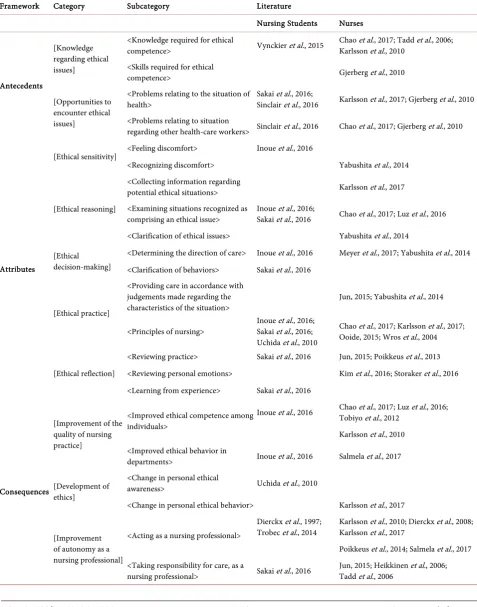
Below, the categories extracted as attributes, requirements, and consequences are presented by enclosing them in square brackets ([ ]), subcategories are en-closed in angle brackets (< >), and the described literature is classified into whether it relates to nursing students or nurses (Table 1).
3.1. Result of the Literature Search
Through our keyword search, 28 domestic studies were initially returned; then, after applying the exclusion criteria, a total of six studies were extracted: three concerning nurses and three concerning nursing students. On the other hand, 87 nondomestic papers were returned, with 18 remaining after applying the exclu-sion criteria. These comprised 12 papers concerning nurses and six concerning nursing students.
Thus, in total we analyzed 24 cases.
3.2. Antecedents
DOI: 10.4236/ojn.2019.911086 1176 Open Journal of Nursing <problems relating to situations regarding other health-care workers>, respec-tively.
Table 1. Antecedents, attributes, and consequences regarding nursing students and nurses’ ethical competence.
Framework Category Subcategory Literature
Nursing Students Nurses
Antecedents
[Knowledge regarding ethical issues]
<Knowledge required for ethical
competence> Vynckier et al., 2015 Chao et al., 2017; Tadd et al., 2006; Karlsson et al., 2010 <Skills required for ethical
competence> Gjerberg et al., 2010
[Opportunities to encounter ethical issues]
<Problems relating to the situation of
health> Sakai et al., 2016; Sinclair et al., 2016 Karlsson et al., 2017; Gjerberg et al., 2010 <Problems relating to situation
regarding other health-care workers> Sinclair et al., 2016 Chao et al., 2017; Gjerberg et al., 2010
Attributes
[Ethical sensitivity] <Feeling discomfort> Inoue et al., 2016
<Recognizing discomfort> Yabushita et al., 2014
[Ethical reasoning]
<Collecting information regarding
potential ethical situations> Karlsson et al., 2017
<Examining situations recognized as
comprising an ethical issue> Inoue et al., 2016; Sakai et al., 2016 Chao et al., 2017; Luz et al., 2016
<Clarification of ethical issues> Yabushita et al., 2014
[Ethical decision-making]
<Determining the direction of care> Inoue et al., 2016 Meyer et al., 2017; Yabushita et al., 2014 <Clarification of behaviors> Sakai et al., 2016
[Ethical practice]
<Providing care in accordance with judgements made regarding the
characteristics of the situation> Jun, 2015; Yabushita et al., 2014
<Principles of nursing> Inoue et al., 2016; Sakai et al., 2016; Uchida et al., 2010
Chao et al., 2017; Karlsson et al., 2017; Ooide, 2015; Wros et al., 2004
[Ethical reflection]
<Reviewing practice> Sakai et al., 2016 Jun, 2015; Poikkeus et al., 2013
<Reviewing personal emotions> Kim et al., 2016; Storaker et al., 2016
<Learning from experience> Sakai et al., 2016
Consequences
[Improvement of the quality of nursing practice]
<Improved ethical competence among individuals>
Inoue et al., 2016 Chao et al., 2017; Luz et al., 2016; Tobiyo et al., 2012
Karlsson et al., 2010 <Improved ethical behavior in
departments> Inoue et al., 2016 Salmela et al., 2017
[Development of ethics]
<Change in personal ethical
awareness> Uchida et al., 2010
<Change in personal ethical behavior> Karlsson et al., 2017
[Improvement of autonomy as a nursing professional]
<Acting as a nursing professional>
Dierckx et al., 1997;
Trobec et al., 2014 Karlsson et al., 2010; Dierckx et al., 2008; Karlsson et al., 2017 Poikkeus et al., 2014; Salmela et al., 2017 <Taking responsibility for care, as a
DOI: 10.4236/ojn.2019.911086 1177 Open Journal of Nursing More specifically, [knowledge regarding ethical issues] was defined as learning the skills that serve as a foundation for ethical nursing practice. Sources of ethi-cal-nursing-related information are lectures and exercises, which provide know-ledge concerning ethical principles, the nursing code of ethics [6] [7], and ethical concepts [8]. Such sources also provide a means of continuing education and debate [9], and case studies allow students to familiarize themselves with the practices applied in decision-making [10].
Meanwhile, [opportunities to encounter ethical issues] was defined as expo-sure to situations in which nurses and nursing students encounter ethical prob-lems during interaction with patients or with other health-care professionals. Ethical issues relating to patients include patient privacy and dignity [3], confi-dentiality [11], and communication [9]. Further, administering cardiopulmo-nary resuscitation to patients has also been reported to create an issue in this re-gard [10]. Meanwhile, ethical issues related to health-care workers include wit-nessing colleagues perform unsafe (or premature) medical practices [11] and the insufficient administering of care as a result of a lack of nurses [6] [9].
3.3. Attributes
Categories concerning attributes included [ethical sensitivity], [ethical reason-ing], [ethical decision-makreason-ing], [ethical practice], and [ethical reflection].
From these categories, 12 subcategories were extracted: <feeling discomfort> and <recognizing discomfort> (for [ethical sensitivity]); <collecting information regarding potential ethical situations>, <examining situations recognized as comprising an ethical issue>, and <clarification of ethical issues> (for [ethical reasoning]); <determining the direction of care> and <clarification of beha-viors> (for [ethical decision-making]), <providing care in accordance with judgements made based on the characteristics of the situation> and <principles of nursing> (for [ethical practice]), and <reviewing practice>, <reviewing per-sonal emotions>, and <learning from experience> (for [ethical reflection]).
[Ethical sensitivity] was defined as developing an ability to notice, during dai-ly nursing, aspects that are out of the ordinary and patient discomfort. This in-cludes noticing incongruities (e.g., finding certain situations “strange” [12]), and recognizing discomfort, such as moistening [13].
[Ethical reasoning] was defined as collecting information related to unusual situations and clarifying the ethical issue by interpreting the needs and behaviors of each party involved (patients, family members, other health-care profession-als, etc.). Examples from the extracted literature include: gathering information by applying a four-step approach [14], discussing why the nurse/nursing student felt a situation was “strange” [13], discussing the situation with others [3] [12], learning about the situation [3] [6] [15], and highlighting the relevant ethical is-sues.
re-DOI: 10.4236/ojn.2019.911086 1178 Open Journal of Nursing solving ethical problems. In the papers we examined [12], feasible nursing [12] [13], utilizing ethical principles [13], and choosing approaches that are beneficial for patients [3] were mentioned. Additionally, one paper reported that deci-sion-making was influenced by a lack of awareness of ethical issues [16].
[Ethical practice] was defined as providing planned and principles-based care in order to resolve ethical problems. The nurse provided the content discussed at the conference and the care deemed necessary for the patient [3] [13] [17]. In addition, we practice nursing according to the nursing code of ethics: respect and protect the human rights of patients [12] respond to patient needs [6] [18] [19]; communicate with patients and understand their issues [3] [12] [20]; pro-vide explanations to patients and their families and, with their consent, help them [3]; be mindful of how information is managed [3] [14] [18]; and seek to provide safe and comfortable assistance for patients [3] [17].
[Ethical reflection] was defined as learning by considering personal feelings regarding ethical issues and reviewing ethical practices in terms of the ethical reasoning and ethical decision-making involved. Such consideration can include whether a judgment was correct [3], whether an action that was performed was based on ethical guidelines [21], and whether the action benefitted the patient [17]. In addition, sharing and discussing problems can alleviate mentally com-plex feelings [22] and help nurses/nursing students reconsider their related atti-tudes [18]. Furthermore, as a nurse, he learned seriously about the patient, re-viewed the nursing provided, made an ethical decision, and learned to act with knowledge and skills [3].
Based on these five categories, the ethical competence of nursing students and nurses can be expressed as comprising the following: “The thinking process (ethical sensitivity, ethical reasoning, ethical decision-making) used to resolve ethical problems and to adopt appropriate behaviors, which include performing appropriate nursing practice and reflection.”
3.4. Consequences
Categories concerning consequences comprised: [improvement of the quality of nursing practice], [development of ethics], and [improvement of autonomy as a nursing professional]. Here, six subcategories were extracted: <improved ethical competence among individuals> and <improved ethical behavior in depart-ments>; <change in personal ethical awareness> and <change in personal ethical behavior>; and <acting as a nursing professional>, <taking responsibility for care, as a nursing professional>, respectively.
DOI: 10.4236/ojn.2019.911086 1179 Open Journal of Nursing [Development of ethics] was defined as a state in which ethics were trans-formed and refined through clinical experience. Through experience, I began to realize the appropriate attitudes for nurses and the importance of knowledge [20]. I also realized that I was able to think about ethics in the context of my nursing behavior [14].
[Improvement of autonomy as a nursing professional] was defined as practic-ing nurspractic-ing in accordance with the code of ethics, and takpractic-ing responsibility for personal actions. I thought I had to act as a member of nursing staff, adhering to established guidelines [21] [25] [26] [27], maintaining ethical-competence stan-dards [24], and acting as a supporter of decisions [10] [14]. In addition, to as-sume responsibility for people’s health, he had a responsibility to provide ap-propriate practice [3] [17] and thought he had to maintain high standards of ethical ability [7] [28].
3.5. A Conceptual Model of Ethical Competence for Nursing
Students and Nurses
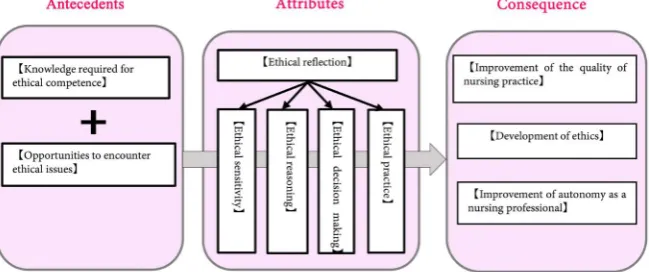
Based on the concepts identified through analysis of the requirements, attributes, and consequences, we developed a conceptual model (Figure 1).
First, as a pre-requisite, nursing students must learn ethical nursing through lectures and exercises; this relates to the category of [knowledge regarding ethi-cal issues]. Knowledge [8], learning knowledge necessary for decision making [10]. In addition, in order to resolve ethical problems, nurses require a forum for discussion [9] and should strengthen their skills by conducting case studies [10]. Additionally, nursing students and nurses have opportunities to encounter ethi-cal problems during their nursing practice, such as issues regarding patient pri-vacy and dignity [3], a lack of confidentiality [11], and communication with pa-tients [9].
DOI: 10.4236/ojn.2019.911086 1180 Open Journal of Nursing
Figure 1. Model of ethical competence among nursing students and nurses.
nurses should perform reviews after each process in order to determine whether their judgments were correct [3], and whether they acted in accordance with ethical guidelines [21]. Moreover, they should also objectively consider whether their actions benefited the patient [17].
Through such an approach, [improvement of the quality of nursing practice] (for example, by fostering ethical sensitivity and ethical reasoning) is developed. Further, the ability to grasp the overall relationships related to such problems is enhanced and patients’ feelings are improved; in particular, by considering pa-tients’ feelings, a closer nurse-patient relationship is fostered [2] [3] [15]. Meanwhile, ethical-reasoning ability is developed through reflection [6]. Changes also occur in regard to workplace culture, as departments more readily consider ethical issues [12] [24]. I felt that ethics was nurtured through expe-rience, such as being able to consider ethics based on my nursing actions [14], this reflects the [development of ethics]. Furthermore, nursing professors should provide instruction that accords with existing guidelines [21] [25] [26] [27], emphasize ethical-competence standards [24], act as a supporter of decision support, etc. This relates to the category of [improvement of autonomy as a per-son].
3.6. Commonalities and Differences between Nursing Students
and Nurses Regarding Ethical Competence
There were commonalities and differences between the nursing students and nurses regarding ethical competence.
Of the two subcategories of [ethical sensitivity], <discomfort> applied only to nursing students, while <recognizing discomfort> applied only to nurses.
Of the three subcategories of [ethical reasoning], <collecting information re-garding potential ethical situations> and <clarifying ethical issues> applied only to nurses, while <examining situations recognized as comprising an ethical is-sue> applied to both nursing students and nurses.
DOI: 10.4236/ojn.2019.911086 1181 Open Journal of Nursing Of the two subcategories of [ethical practice], <providing care in accordance with judgements made regarding the characteristics of the situation> applies only to nurses, while <principles of nursing> applies to nursing students and nurses.
Of the three subcategories of [ethical reflection], <reviewing practice> applied to both nursing students and nurses, <reviewing personal emotions> applied only to nurses, and <learning from experience> applied only to students.
4. Discussion
4.1. Characteristics of the Concept of Ethical Competence among
Nursing Students and Nurses
Through the concept analysis conducted in the present study, we determined that the ethical competence of nursing students and nurses can be expressed as follows: “The thinking process (ethical sensitivity, ethical reasoning, ethical deci-sion-making) used to resolve ethical problems and to adopt appropriate beha-viors, which include performing appropriate nursing practice and reflection.”
Waithe [29] stated that ethical competence comprises 1) ethical sensitivity, 2) ethical reasoning, 3) attitudes, and 4) realization. However, in this conceptual analysis, we found the concept of “ethical reflection” to be an important feature of the concept of “ethical competence among nursing students and nurses.” Schon [30] divides reflection into two categories: “reflection in action” and “ref-lection on action.” Ref“ref-lection in action” occurs in practice and affects deci-sion-making and the provision of care. For the present study, this relates to nurses/nursing students considering whether a judgment is correct or whether ethical considerations have been implemented [3]. He looked back and forth and changed his subsequent behavior. In addition, he said that “reflection on ac-tions” occurs after the event and contributes to the development of practical skills. In the present study, the actions to be taken were identified, and this led to concrete actions. Today, as medical care becomes more complex, various new ethical issues arise. For this reason, “ethical reflection,” which involves reviewing nursing practice from an ethical perspective, is indispensable for clarifying issues relating to personal approaches and for improving nursing practice.
educa-DOI: 10.4236/ojn.2019.911086 1182 Open Journal of Nursing tion, constructing and providing nursing-ethics education that particularly em-phasizes introspection, both for individuals and organizations, regarding ethical issues is suggested. The importance of constructing and providing nursing ethics education tailored to the latter stage was also suggested.
4.2. Application of Ethical Competence for Nursing Students and
Nurses, and Points to Note
To illustrate how nursing students and nurses can practically demonstrate the concept of ethical competence defined in this analysis, in this section we provide example cases, and also list points that should be considered when applying eth-ical competence.
4.2.1. Examples of the Application of Ethical Competence, Using Model Cases
1) Nursing student case
Nursing student A is a fourth-year student at a nursing university [1]. In the second year of university, students were given instruction regarding ethical competence, which involved an explanation of nurses’ ethical principles and the conducting of case studies using analytical tools to resolve ethical problems. In the third year of geriatric nursing practice, nursing student A witnessed nurse C apply a wheelchair restraint to patient B.
Nursing student A felt that nurse C’s restraining of the patient was unusual, and felt discomfort regarding the incident. After examining the patient’s elec-tronic medical record, nursing student A found that patient B had dementia and a history of falls, and also that the patient had osteoporosis, meaning there was a high risk of fracture from falls. Nursing student A now understood nurse C’s de-cision to restrain the patient. However, nursing student A still felt that the phys-ical restraint limited patient B’s activities and motion, and could also cause physical and mental pain; consequently, nursing student A sought to find a less restrictive method of protecting patient B. In particular, nursing student A thought that patient B must have a reason for trying to leave the wheelchair, so he asked the patient where he wanted to go, and helped him reach his goal. As a result of this approach, patient B ceased trying to leave the wheelchair. Nursing student A objectively reviewed his judgments and actions at each stage of the process, examining whether his judgments were correct, whether ethical consid-eration was implemented, and whether the best assistance was being imple-mented. In addition, by discussing at a meeting whether patient B was safe after the care was administered, it was possible to identify the approaches that most benefitted the patient.
regard-DOI: 10.4236/ojn.2019.911086 1183 Open Journal of Nursing ing the situation, clarified the relevant care policy, and confirmed whether pa-tient B’s safety could be protected in a less restrictive manner. As a result of the discussions at the health-care team’s meeting, the nursing student felt that not only his own ethical competence, but that of all students present, was streng-thened. Nursing student A felt that it was important for nurses to consider solu-tions and act ethically instead of ignoring situasolu-tions that caused them discom-fort. In the future, when I feel a sense of incongruity, I plan to act independently.
2) Nurse’s case
Nurse D is a nurse with three years of experience. At university, he was taught the knowledge necessary for ethical competence, such as the code of ethics and ethical principles for nurses, and attended ethics conferences during nursing practice. Furthermore, during the training he received as a new employee at the hospital, he learned of ethical problems that are likely to occur in hospitals, and examined real cases of ethical problems, applying a four-step approach to resolve them.
One day, during practice, Nurse D noticed that a colleague, Nurse E, left an electronic medical record in the hospital room.
DOI: 10.4236/ojn.2019.911086 1184 Open Journal of Nursing Nurse D thought it was unusual that a patient’s personal information was not protected. By raising and discussing the problem at the ward meeting, the policy was consequently clarified and individual nurses were given instruction regard-ing how to act autonomously to protect personal information. He felt that not only his own ethical competence, but that of the entire ward was strengthened. When Nurse D felt discomfort regarding the practice he had witnessed, he felt that it was important for nurses to consider solutions and to act ethically. In the future, when I felt a sense of incongruity in my daily practice, I wanted to work actively with the organization and act ethically.
4.2.2. Points to Note When Applying the Concept Model
The characteristics of nursing ethics cause the commonalities and differences that exist between nursing students and nurses regarding ethical competence.
Ethical ability develops continuously over time rather than remaining at a mere minimum standard, and even students need to possess a comprehensive degree of ethical ability. In other words, both students and nurses continue to develop their ethical competence, and students should receive training in this behavioral characteristic. Varying levels of competence may be the reason nurs-ing students and nurses are perceived as havnurs-ing differnurs-ing ethical competencies. There are three types of behaviors in this regard: action-based (skill-dependent), rule-based, and knowledge-based. These three performance levels are influenced by both psychological (conscious, hybrid, automatic) and situational factors (novel problems, problems for which nurses have received training, routines). An overview of ethical competence in regard to these three behavior types shows that nursing students transition from a skill base based on conscious action to a mixed-rule base, while nurses are moving from a mixed rule base, which resem-bles an automated knowledge base. Indeed, in [ethical practice], students are consciously thinking of and acting to address novel problems based solely on knowledge and rules they have learned, because they have little experience; this is considered to be a mixed-rule base from a knowledge base that acts in accor-dance with. On the other hand, because nurses have experience of various situa-tions, they act not only according to rules, but also provide <care in accordance with judgements made regarding the characteristics of the situation>, which can be considered to represent an automated knowledge base.
Based on the above, we believe that this concept model should only be applied after considering the commonalities and differences between nursing students and nurses.
4.3. Limitations to This Study
DOI: 10.4236/ojn.2019.911086 1185 Open Journal of Nursing whether the ethical competence of nurses and nursing students is promoted through nursing ethics education and the application of specific measures for nursing ethics education.
5. Conclusion
Ethical competence among nursing students and nurses is defined as “the thinking process (ethical sensitivity, ethical reasoning, ethical decision-making) used to resolve ethical problems and to adopt appropriate behaviors, which in-clude performing appropriate nursing practice and reflection”. The ethical beha-vior of nurses and nursing students comprises five attributes: [ethical sensitivi-ty], [ethical reasoning], [ethical decision-making], [ethical practice], and [ethical reflection]. It also comprises two preceding requirements: [knowledge regarding ethical issues] and [opportunities to encounter ethical issues]. As a consequence, three were shown, in other words, [Improvement of quality of nursing practice] [Development of ethics] and [Improvement of autonomy as a nursing profes-sional].
Funding
This research was conducted with the assistance of a Grants-in-Aid for Scientific Research, Grant C (general number 17K12134).
Conflicts of Interest
The authors declare no conflicts of interest regarding the publication of this pa-per.
References
[1] Japan Nursing Association (2003) Code of Ethics for Nurses.
https://www.nurse.or,jp/home/publication/pdf/rinri/code_of_ethics.pdf
[2] Ministry of Education, Culture, Sports, Science and Technology (2012) Nursing Practice Skills and Goals to Be Achieved at the Time of Graduation, Which Represent the Core of the Undergraduate Program.
http://www.mext.go.jp/b_menu/shingi/chousa/koutou/47/siryo/__icsFiles/afieldfile/
2011/11/04/1312488_5.pdf
[3] Sakai, M., Kawai, T. and Koide, E. (2016) The Attitudes of Nurses Who Can Per-form Ethical Behavior, as Captured by Students Learning from Case Analyses of Ethical Problems. Co-CreationWelfare, 11, 37-46.
[4] Chichi, A. and Kimiko, N. (2017) Characteristics of Organizational Culture in which Nurses Show High Levels of Ethical Behavior. Bulletinof MiePrefectural CollegeofNursing, 21, 1-9.
[5] Rodgers, L. and Knafl, A. (2000) Concept Development in Nursing: Foundations, Techniques, and Applications. 2nd Edition, Saunders, Philadelphia, PA.
[6] Chao, S., Chang, Y., Yang, C. and Clark, J. (2017) Development, Implementation, and Effects of an Integrated Web-Based Teaching Model in a Nursing Ethics Course. NurseEducationToday, 55, 31-37.
DOI: 10.4236/ojn.2019.911086 1186 Open Journal of Nursing
[7] Tadd, W., Clarke, A., Lloyd, L., Leino-Kilpi, H., Strandell, C., Lemonidou, C., Hey-mans, R., et al. (2006) The Value of Nurses’ Codes: European Nurses’ Views. Nurs-ingEthics, 13, 376-393. https://doi.org/10.1191/0969733006ne891oa
[8] Vynckier, T., Gastmans, C., Cannaerts, N. and Casterle, B. (2015) Effectiveness of Ethics Education as Perceived by Nursing Students: Development and Testing of a Novel Assessment Instrument. NursingEthics, 22, 287-306.
https://doi.org/10.1177/0969733014538888
[9] Gjerberg, E., Forde, R., Pedersen, R. and Bollig, G. (2010) Ethical Challenges in the Provision of End-of-Life Care in Norwegian Nursing Homes. Social Science & Medicine, 71, 677-684. https://doi.org/10.1016/j.socscimed.2010.03.059
[10] Karlsson, M., Roxberg, A., Silva, A. and Berggren, I. (2010) Community Nurses’ Experiences of Ethical Dilemmas in Palliative Care: A Swedish Study. International JournalofPalliativeNursing, 16, 224-231.
https://doi.org/10.12968/ijpn.2010.16.5.48143
[11] Sinclair, J., Papps, E. and Marshall, B. (2016) Nursing Students’ Experiences of Eth-ical Issues in ClinEth-ical Practice: A New Zealand Study. NurseEducationPractice, 17, 1-7. https://doi.org/10.1016/j.nepr.2016.01.005
[12] Inoue, N., Yoshidome, A., Wakamatsu, M., et al. (2016) Recognition of Ethics Con-ferences in Nursing Practice. AnalysisofEthicsConferenceRecordsin Maternity NursingPractice, 8, 3-15.
[13] Yabushita, Y., Takekawa, Y. and Mochimochi, C. (2014) Evaluation of Trials of Ethical Nursing Practice Support for Nurses Specializing in Chronic Disease Nurs-ing. BulletinofFacultyofNursing, OsakaPrefectureUniversity, 20, 77-83.
[14] Karlsson, M., Karlsson, N. and Hilli, Y. (2017) Ethical Dilemmas during Cardiac Arrest Incidents in the Patient’s Home. NurseEthics, 26, 625-637.
https://doi.org/10.1177/0969733017709337
[15] Luz, K., Vargas, M.A., Barlem, L., Schmitt, P., Ramos, F. and Meirelles, B. (2016) Coping Strategies for Oncology Nurses in High Complexity. RevistaBrasileira En-fermagem, 69, 59-63. https://doi.org/10.1590/0034-7167.2016690109i
[16] Meyer-Zehnder, B., Albisser Schleger, H., Tanner, S., Schnurrer, V., Vogt, D.R., Reiter-Theil, S. and Pargger, H. (2017) How to Introduce Medical Ethics at the Bed-side—Factors Influencing the Implementation of an Ethical Decision-Making Mod-el. BMC Medical Ethics, 18, 16. https://doi.org/10.1186/s12910-017-0174-0 [17] Jun, O. (2015) Relationship between Nurses’ Behavioral Choices in Conflict
Situa-tions and PercepSitua-tions of Ethical Behavior. JournalofFujiedaCityGeneralHospital, 21, 15-20.
[18] Storaker, A., Naden, D. and Saeteren, B. (2016) From Painful Busyness to Emotion-al Immunization: Nurses’ Experiences of EthicEmotion-al ChEmotion-allenges. NursingEthics, 24, 556-568.https://doi.org/10.1177/0969733015620938
[19] Wros, P., Doutrich, D. and Izumi, S. (2004) Ethical Concerns: Comparison of Val-ues from Two Cultures. Nursing&HealthSciences, 6, 131-140.
https://doi.org/10.1111/j.1442-2018.2004.00184.x
[20] Uchida, F., Nishioka, M., Tamura, M., et al. (2010) Self-Image About the Human Nature as a Health Care Professional that Students Perceive in Basic Nursing Prac-tice II. JournalofHealthScience, 10, 176-182.
[21] Poikkeus, T., Leino-Kilpi, H. and Katajisto, J. (2014) Supporting Ethical Compe-tence of Nurses during Recruitment and Performance Reviews-The Role of the Nurse Leader. JournalofNursingManagement, 22, 792-802.
DOI: 10.4236/ojn.2019.911086 1187 Open Journal of Nursing
[22] Kim, S., Seo, M. and Kim, D. (2016) Unmet Needs for Clinical Ethics Support Ser-vices in Nurse: Based on Focus Group Interviews. NursingEthics, 25, 505-519.
https://doi.org/10.1177/0969733016654312
[23] Tobiyo, T. and Sakai, K. (2012) Nurses’ Awareness of Ethics Conferences. Journalof JapanSocietyforNursingEthics, 4, 15-22.
[24] Salmela, S., Koskinen, C. and Eriksson, K. (2017) Nurse Leaders as Managers of Ethically Sustainable Caring Cultures. JournalofAdvancedNursing, 73, 871-882.
https://doi.org/10.1111/jan.13184
[25] Dierckx, B., Izumi, S., Godfrey, N. and Denhaerynck, K. (2008) Nurses’ Responses to Ethical Dilemmas in Nursing Practice: Meta-Analysis. Journal of Advanced Nursing, 63, 540-549. https://doi.org/10.1111/j.1365-2648.2008.04702.x
[26] Dierckx, B., Grypdonck, M., Vuylsteke-Wauters M. and Janssen, P.J. (1997) Nurs-ing Students’ Responses to Ethical Dilemmas in NursNurs-ing Practice. NursingEthics, 4, 12-28. https://doi.org/10.1177/096973309700400103
[27] Trobec, I. and Starcic, A.I. (2015) Developing Nursing Ethical Competences Online Versus in the Traditional Classroom. NursingEthics, 22, 352-366.
https://doi.org/10.1177/0969733014533241
[28] Heikkinen, A., Lemonidou, C. and Petsios, K. (2006) Ethical Codes in Nursing Practice: The Viewpoint of Finnish, Greek and Italian Nurses. JournalofAdvanced Nursing, 55, 310-319. https://doi.org/10.1111/j.1365-2648.2006.03912.x
[29] Waithe, E. (1989) Developing Case Situations for Ethics Education in Nursing.
JournalofNursingEducation, 28, 175-180.