A Simulation Scenario Based Mixed Integer
Programming Approach to Airline Reserve Crew
Scheduling Under Uncertainty
Christopher Bayliss · Geert De Maere · Jason Atkin · Marc Paelinck
Abstract Airlines operate in an uncertain environment for many reasons, for example due to the effects of weather, traffic or crew unavailability (due to delay or sickness). This work focuses on airline reserve crew scheduling under crew absence and journey time uncertainty for an airline operating a single hub and spoke network. Reserve crew can be used to cover absent crew or delayed connecting crew. A fixed number of reserve crew are available for scheduling and each requires a daily standby duty start time. Given an airline’s crew schedule and aircraft routings we propose a Mixed Integer Programming ap-proach to scheduling the airline’s reserve crew. A simulation of the airline’s operations with stochastic journey time and crew absence inputs and with-out reserve crew is used to generate disruption scenarios for the M IP SSM formulation (Mixed Integer Programming Simulation Scenario Model). Each disruption scenario corresponds to a record of all of the disruptions in a simula-tion for which reserve crew use would have been beneficial. For each disrupsimula-tion in a disruption scenario there is a record of all reserve crew that could have been used to solve or reduce the disruption. This information forms the input to the M IP SSM formulation, which has the objective of finding the reserve schedule that minimises the overall level of disruption over a set of scenarios. Additionally, modifications of the M IP SSM are explored, and a heuristic solution approach and a reserve use policy derived from the M IP SSM are introduced. A heuristic based on the proposed Mixed Integer Programming Simulation Scenario Model orM IP SSM outperforms a range of alternative
Christopher Bayliss·Geert De Maere·Jason Atkin ASAP, University of Nottingham, UK
E-mail: cwb,gdm,[email protected]
Marc Paelinck
KLM Decision Support, Information services department KLM Royal Dutch Airlines
approaches. The heuristic solution approach suggests that including the right disruption scenarios is as important as ensuring that enough disruption sce-narios are added to theM IP SSM.
Keywords Airline Reserve Crew Scheduling · Simulation ·Mixed Integer Programming
1 Introduction
An airlines primary product is its schedule, due to operating costs airlines maximise the utilisation of resources (crew and aircraft) resulting in schedules with little slack. This makes each resource a critical component of an airlines network and if a component is missing all flights related to that component may be disrupted. Crew can be absent or delayed on connecting flights, in such circumstances airlines may call on reserve crew. This work focusses on reserve crew scheduling, using simulation generated disruption scenarios added to a Mixed Integer Programming model to schedule reserve crew.
2 Related work
TheM IP SSM has similarities to Recoverable Robustness [4]. In [4] Liebchen provides a framework for timetabling problems with the objective that the schedule must be feasible in each of a limited set of disruption scenarios given limited availability of recovery from disruptions. The approach reduces to strict robustness (feasible in all outcomes without recovery actions) if the feature of limited available recovery is removed. The similarity between Recoverable ro-bustness and the M IP SSM lies in the idea of solving a scheduling problem over a limited number of realistic disruption scenarios. TheM IP SSM is in-fluenced by stochastic programming, which optimises over a set of explicit independent possible outcomes as opposed to optimising over the expected outcome, which may not even correspond to a possible outcome.
In [7], Bailey et al. present an airline reserve crew scheduling model that takes training days and bidline conflicts into account. Such conflicts arise when crew bid for rosters which overlap with recurring training and this leads to open time (flights without scheduled crew) which have to be covered with reserve crew. In [6], Shebalov tackles the robust airline crew pairing problem using the concept of move-up crews. Move-up crews refers to crews who can swap pairings in the event of delay (the available crew can adopt the delayed crew’s pairing). Their objective is to maximise move-up crews. Shebalov measures the robustness of schedules/quality of the scheduled move-up crews in compu-tational experiments in terms of the number of deadheads (crew transported as passengers to the origin of their next flight leg), reserve crew used, num-ber of uncovered flight legs and the cost of crew schedule. For the interested reader other work carried out previously on the problem of airline reserve crew scheduling includes [2, 3, 5].
3 Deriving and formulating the M IP SSM
3.1 Schedule notation
Dh: Scheduled departure time of flighth
Ch: Crew team number scheduled to flighth
Ah: Aircraft number scheduled to flighth
cdh: Crew related delay at departurehthat occurs in disruption scenario generating
simulation
rdh,l: Delay when reserve crew with start time indexlused to cover disrupted crew of
flighth
tdh: Total delay at departureh
crewSizeh: number of crew in crew team scheduled to flighth
cetah: Estimated time of arrival of crew scheduled to flighth
aetah: Estimated time of arrival of aircraft scheduled to flighth
CT : Cancellation threshold over which delayed flights are cancelled
M S: Minimum sit or minimum rest time required by crew between consecutive flights within a duty shift
T T: Minimum turn/ground time required by aircraft between consecutive flights
|Pn|: Length of crew pairingnin terms of hub departures
Pn,m: Departure number of themthhub departure of crew pairingn
3.2 Cancellation measure of a delay
To retain the simplicity of a single objective problem Equation 1 converts delay into a measure of cancellation. The simulation cancels flights with a delay over the cancellation threshold so the maximum cancellation measure of a delay is 1. cmh is the cancellation measure of flighth,tdh (Equation 2)
is the total delay of flight h, cdh (Equation 3) is the delay of flighthdue to
crew over and above delay due to the aircraft, i.e. the delay which could be absorbed by using reserve crew. Equation 4 gives the delay due to waiting for reserve crew with start time indexl (start time=Dl as reserve start times are
discretised according to scheduled departure times) to begin their duty shift, counting only delay over and above delay due to the aircraft assigned to the same flight.
cmh=
tdh−cdh
CT
n
(1)
tdh= max (0, max (aetah+T T, cetah+M S)−Dh) (2)
cdh= max (0, cetah+M S−max (Dh, aetah+T T)) (3)
rdh,l = max (0, Dl−max (Dh, aetah+T T)) (4)
giving lower weight to delays below the cancellation threshold. Using the de-lay cancellation measure function means that the objective measures of using reserve crew teams to cover delayed connecting crew and using reserve crew to cover absent crew are both in the same units, that of cancellations. In the followingn= 2 is used.
3.3 Simulation
The simulation of a single hub airline is used without reserve crew to generate disruption scenarios which contain information on the possible benefit of using reserve crew scheduled at specified times in response to the given disruption. These disruption scenarios form the input for theM IP SSMformulation (Sec-tion 3.7).
Simulation takes as input the airline’s scheduled flights, the crew and air-craft scheduled to each of those flights. The simulation’s stochastic inputs are journey times and crew absence, each of which have corresponding statistical distributions derived from real data. Crew and aircraft were scheduled using first in first out scheduling. In the crew schedule 30% of crew connections at the hub involve a change of aircraft. The scheduled journey times correspond to a 0.6 probability of early arrival.
A single run of the simulation proceeds by considering each scheduled depar-ture in depardepar-ture time order. If a depardepar-ture corresponds to the start of a crew duty then the number of crew absent is instantiated from the cumulative sta-tistical distribution of possible numbers of absent crew. If reserve crew are not available then the flight has to be cancelled. At this point in the simulation, in-formation on the possible benefit of scheduling reserves at different start times is collected (Section 3.5). If reserve crew are available (as is the case in the validation simulation used in Section 5 to validate reserve crew schedules cre-ated using the methods proposed herein) they are considered for use in earliest start time order. If a departure is delayed by more than the delay threshold (15 minutes) all combinations of single crew and aircraft swaps are considered. Swaps are only considered feasible if the swap can take place without invoking additional delay on the flights affected by the swap, the crew must be able to complete each other’s duties without violating maximum working hours and it must be possible to undo the swap in the overnight break (same overnight station).
3.4 Disruption scenario notation
W : Number of disruption scenarios
Wi: Number of disruptions in scenarioi
Ni,j: The number of reserve crew required to cover disruptionjin scenarioi
CMi,j: Cancellation measure contribution when no reserves are used to cover disruptionj
in scenarioi
Ni,j: Number of crew required to cover disruptionjin scenarioi
Fi,j: Set of feasible reserve instances for disruptionjin scenarioi
Fi,j,k:kthinstance of a reserve feasible to cover disruptionjin scenarioi
Fi,j,kV :kthreserve use variable index feasible for disruptionjin scenarioi
Fi,j,kU :kthindex of reserve use variable first used at disruptionjin scenarioiwhich can subsequently be used to absorb crew related delay propagated to a following flight
Fi,j,kCM : Cancellation measure that occurs as a result of using thekthfeasible reserve for disruptionjin scenarioi
Fi,j,kRD : reserve delay corresponding to feasible reserve use instancekfeasible for disruptionj
in scenarioi
Gi,j: Set of feasible reserve instances corresponding to reserve crew first used to absorb
delay on a preceding flight that also have the knock-on effect of preventing or reducing delay disruptionjin scenarioi
Gi,j,k:kthinstance of a reserve feasible corresponding to a reserve first used to absorb crew
delay on a preceding flight that also has the knock-on effect of reducing delay disruptionjin scenarioi
GVi,j,k:kthreserve use variable index corresponding to a reserve first used to absorb delay on a preceding flight that has the knock-on effect of reducing delay disruption
jin scenarioi
GCMi,j,k: Cancellation measure corresponding to thekthfeasible reserve use instance first used to absorb delay on a preceding flight that also has the knock-on effect of reducing delay disruptionjin scenarioi
Ri,k: Set of feasible reserve use variable instances corresponding to reservekin scenarioi
Ri,k,l: Reserve use variable index corresponding to thelthreserve use variable
corresponding to reservekin scenarioi
3.5 Simulation derived scenarios
Simulation is used to derive disruption scenarios that are used as input for the M IP SSM. This section explains how simulation is used to derive the infor-mation for disruption scenarios. A given disruption scenarioicorresponds to a single run of the simulation.
In disruption scenarioi, a disruption j is a flight which has a delay over the delay threshold after the consideration of swap recovery or has to be can-celled due to crew absence. Such disrupted flights have a positive cancellation measure, whereCMi,jdenotes the cancellation measure of disruptionjin
In a given run of the simulation, when a disruption occurs with a positive cancellation measure, data is collected regarding all of the possible feasible reserve start times that, could be used to reduce the disruption. For each such beneficial reserve start time, feasible reserve use instances are generated. A feasible reserve use instance corresponds to a possible scheduled reserve crew duty start time and subsequent use to cover a given crew disrupted flight in a given scenario. The number generated is equal to the number of reserve crew required to cover the given disruption, which is the number of crew absent in the event of a crew absence disruption or the size of the crew team assigned to flighth (crewSizeh) in the event of a delay. For each feasible reserve use
instance (b) there is a corresponding cancellation measure (bCM) that replaces
the cancellation measure (CMi,j) of the disruption if the reserve is used, a
unique reserve use variable index (bV), a unique knock on effect reserve use
variable index (bU) (if applicable) and a reserve delay (bRD). LetF
i,j denote
the set of feasible reserve use instances corresponding to possible reserve start times that could be used to solve or reduce disruptionjof disruption scenario i.
For the specific case of delay disruptions it is also possible that if there was crew delay on the preceding flight then the delay on the current flight might possibly be prevented or reduced by reserve crew used to absorb the initial delay. For this purpose the setGi,j is introduced and denotes the set of
feasi-ble reserve use instances corresponding to reserves used to cover crew related delay propagated from a previous previous flight. These feasible reserve use instances only apply if the corresponding feasible reserve use instances are used to cover the root crew related delay.Gaccounts for reserve crew that can have the effect of absorbing knock on crew delays. Algorithms 1 and 2 outline the procedure of collecting information for the disruption scenarios from the single hub airline simulation.
Algorithm 1 Pseudocode for deriving disruption scenario information for a crew absence disruption occurring at simulation runideparturek
1: During simulation runithekthscheduled flight is disrupted resulting in thejth
disrup-tion for which reserve crew use could potentially be beneficial 2: ifCrew absence disruptionthen
3: Create new disruption (j) for scenario (i), store the size of the disruption if not absorbed by utilising reserve crew, i.e. The number of flights cancelled=size of pairing (|PCk|) and store the number of crew absent (Ni,j)
4: foreach hub departure (m) in the crew absence disrupted pairingdo
5: foreach reserve duty start time (l) feasible to cover the absence disrupted pairing at themthhub departure of the disrupted pairingdo
6: AddNi,jnew feasible reserve use instances toFi,j, each with a unique variable
number index (V), compute the associated cancellation measure (CM), Add the generated feasible reserve use instances toRi,lfor the constraints regarding
reserves only being used once per scenario.
7: end for
8: end for
Algorithm 1 is used in the simulation when a crew absence occurs. The number of reserves required to cover this disruption is the number of absent crew (line 3). The cancellation measure of the absence disruption (CMi,j) is
the number of hub departures in the disrupted crew pairing that would have to be cancelled if reserves are unavailable to cover the absent crew (line 3), with no delay cancellation measure contribution. The algorithm then considers each possible reserve start time (line 5) which can be used to cover absent crew at each hub departure in the disrupted crew pairing (line 4). If reserve start time l is feasible, Ni,j new instances of feasible reserve use instances
are created with unique reserve use variable indices and cancellation measures equal to the number of flights that have to be cancelled before crew absence is covered at themth hub departure in the disrupted crew pairing plus a delay
cancellation measure contribution from any delay caused by the reserve start
time (lines 6). cm = m−1 +rdf,l
CT n
is the equation for the cancellation
measure associated with reserve crew with start time index l being used to cover crew absence disrupted pairing at the mth flight in the crew pairing,
wheref =PCk,mis the departure number of the flight the reserve crew are used to cover the absence disrupted crew pairing. The newly generated instances of feasible reserve use are also stored from a reserve perspective (R) (line 6), which is useful later on when creating constraints for feasible reserve use in theM IP SSM formulation.
Algorithm 2 Pseudocode for deriving disruption scenario information for a crew delay disruption occurring at simulation runideparturek
1: During simulation runithekthscheduled flight is disrupted resulting in thejth
disrup-tion for which reserve crew use could potentially be beneficial 2: ifcrew delay disruptionthen
3: Store the number of delayed connecting crew that need to be replaced (Ni,j =
crewSizek) and the cancellation measure of the delayCMi,j=
tdk CT
n
4: forEach reserve start time indexlthat if scheduled could feasibly reduce the crew related delay of departurekdo
5: GenerateNi,j reserve use instances with unique reserve use variable indices (V),
store the corresponding cancellation measure that applies if the reserves with start timeDlare used, add the reserve use instances toRi,l
6: end for
7: if Current crew delay is crew delay propagated from the crew’s previous flight q, disruptionothen
8: forl= 1 to|Fi,o|do
9: Create new reserve use instance, with unique reserve use variable index (V) and store in Gi,j, store the corresponding cancellation measure that applies if the
root crew delay is absorbed using the reserve associated with the reserve use instanceFi,o,l
10: FU
i,o,l=G V
i,j,a, wherea=|Gi,j|
11: end for
12: end if
Algorithm 2 is used in the simulation when a crew related delay occurs, the number of reserves required to cover this disruption is the number of crew in the delayed crew team (line 3). The cancellation measure of the delay disruption if reserve crew are not available to cover the delayed crew is also computed (line 3). The algorithm then considers each feasible reserve start time (line 4) used to cover the delay, and for each generatesNi,j new feasible
reserve use instances with unique reserve use variable indices and cancellation measures calculated using Equation 1 with Equation 4 added to the numerator. Lines 7 to 12 of Algorithm 2 apply if the given delay originated from a crew delay in the scheduled crew’s previous flight. In this case it’s possible that reserve use instances generated for that previous flight may have the effect of preventing delay propagating to the given delayed flight. For such feasible reserve use instances (line 8)U denotes new unique reserve use variable index for the reserve first used earlier, used to reduce the knock-on delay. For the current disruption j the set G stores the same newly generated reserve use variable index and a cancellation measure (line 9) that depends on the amount of delay that would have propagated if the reserve use instance feasible to cover the root crew delay is utilised. TheM IP SSM has constraints ensuring that the beneficial knock on effects can only apply if the reserve is actually used to absorb the root crew delay that propagated in the simulation. After the disruption scenarios have been created they can be used to create the constraints and objective of theM IP SSM.
3.6M IP SSM notation
X: Reserve crew schedule
xk: Number of reserves with start time indexk
Y : Set of reserve use variables
ym: Reserve use instance variablem
δi,j: Binary variable describing whether or not disruptionjin scenarioi
is left uncovered (1) or covered (0) by reserve crew
γi,j: Real valued variable which takes on the cancellation measure of disruptionj
in scenarioigiven the reserve recovery decision made by the model
Z: Variable that takes on a value equal to the cancellation measure total of the scenario with the maximum cancellation measure
T R: Total reserve crew available for scheduling
N D: Total flights in reserve crew scheduling time horizon
Rtq: Reserve use policy, the minimum threshold number of reserve crew remaining
for using a team of reserve crew to cover a delayed connecting crew to be considered acceptable
obsq: Number of times reserve teams are used to cover delayed connecting crew
at flightqin reserve use policy derivation
The reserve scheduleXspecifies the number of reserves which are scheduled to begin duties at a given time indexk. γi,j is a real valued variable, which
equals the cancellation measure of disruptionj in scenarioigiven the reserve use decisions (y). Eachy variable corresponds to an individual reserve with a given start time index being used to cover a given disruption.
3.7 Mixed Integer programming formulation
Minimise:
W X
i=1
Wi
X
j=1
γi,j (5)
s.t.
|Fi,j|
X
k=1
yFV i,j,k+
|Gi,j|
X
k=1
yGV
i,j,k+δi,jNi,j=Ni,j,∀i∈1..W,∀j ∈1..Wi (6)
N D X
i=1
xi=T R (7)
|Ri,k|
X
l=1
yRV
i,k,l ≤xk,∀k∈1..N D, ∀i∈1..W (8)
yRU
i,k,l ≤yRVi,k,l,∀l∈Ri,k|∃yRUi,k,l,∀i∈1..W,∀k∈1..N D (9)
δi,jCMi,j≤γi,j,∀i∈1..W,∀j∈1..Wi (10)
yFV i,j,kF
CM
i,j,k ≤γi,j,∀i∈1..W,∀j∈1..Wi,∀k∈Fi,j (11)
yGV i,j,kG
CM
i,j,k≤γi,j,∀i∈1..W,∀j∈1..Wi,∀k∈Gi,j (12)
ym∈ {0,1},∀m∈Y (13)
δi,j∈ {0,1},∀i∈1..W,∀j ∈1..Wi (14)
Xk∈ {0,1...maxCAi−1, maxCAi},∀k∈1..N D (15)
used for the given disruption. Constraint 6 forces δi,j to 1 when no reserve
recovery can be applied to disruptionjin scenarioiand to 0 otherwise. Con-straint 6 means that it is acceptable to cover a crew delayed departure with a combination of reserves used now and reserves used to cover a preceding crew delay that propagated, which may be useful if some of the reserves used to cover the root delay are not feasible to cover the following flight. Constraint 7 ensures that no more than the total number of reserves available (T R) are scheduled. Constraint 8 ensures that in each disruption scenario the number of reserves used with the same start time index does not exceed the number of reserves which are scheduled to that start time index. Constraint 9 ensures that disruptions can only be absorbed by reserves which were first used to ab-sorb delay on the preceding flight if the reserve is used to cover that preceding flight. Constraints (10 to 12) ensure that the cancellation measure associated with a given disruption is the maximum of that associated with the recov-ery actions used for the given disruption. If no reserves are used for a given disruption that disruption gets the cancellation measureCMij, the same as
oc-curred in the simulation in which the disruption ococ-curred. If reserves are used the cancellation measure corresponds to the reserve used for that disruption that invokes the largest cancellation measure (as the flight can’t take off before all the crew are present). Constraints 13 to 15 are integrality constraints.
4 Variants and Modifications
This section firstly considers 2 alternative formulations of the basicM IP SSM formulation given in equations 5 to 15. Then a scenario selection heuristic designed to address the question of whether the types of scenarios or the number of scenarios included in the formulation has the greatest effect on solution quality. The final part in this section introduces an approach for deriving an optimal reserve use policy for a given reserve schedule, by repeated solving of the M IP SSM for a single disruption scenario and fixed reserve schedule and learning the circumstances in which reserve use is beneficial in the long run.
4.1 Alternative objectives for theM IP SSM
Several alternative objectives are suggested in this section.
M iniM ax1
Objective 5 with Objective 16 and adding Constraint 17. Information on im-plementing minimax objectives in linear programs can be found in [8]. This approach will have the effect of finding a reserve crew schedule that minimises the extent of the worst case scenario as opposed to minimising the average cancellation measure. In Table 1 theprobability of delay over 30 minutes per-formance measure is most relevant to theM iniM ax1 formulation.
min:Z (16)
Wi
X
j=1
γi,j ≤Z,∀i∈1..W (17)
M iniM ax2
Instead of minimising the total cancellation measure of the disruption sce-nario with the largest cancellation measure, the same principle can be applied to individual scenarios with the alternative ObjectiveM iniM ax2. I.e. find the reserve crew schedule that minimises the single largest disruption. To imple-ment this approach replace Constraint set 17 with Constraint set 18. In Table 1 there is no performance measure which is directly relevant to theM iniM ax2 formulation because in the reserve crew schedule validation simulation the worst single disruption is a cancellation and these will inevitably occur in each method. However in theM iniM ax2 formulation the worst single disruption is leaving an absence disruption uncovered which would result in all flights on the absent crew’s line of flight being cancelled.
γi,j≤Z,∀i∈1..W,∀j∈1..Wi (18)
4.2 Alternative solution approach
Scenario Selection Heuristic
disruption scenario cannot be found for which the incumbent solution (overall reserve schedule) performs worse than in the worst disruption scenario al-ready added to the model. The heuristic is analogous to column generation in which the master problem and pricing problem are solved iteratively. Repeti-tion ceases when a specified iteraRepeti-tion limit (itLim) is reached (in which case the whole algorithm terminates and returns a final solution), or, alternatively, when no new scenario with a sub problem (subObj) objective value can be found that is larger than the scenario already in the master problem with the largest objective contribution (maxj(masterObjj)), afterrptLimattempts. In
summary this scenario selection approach focusses on finding a reserve sched-ule that can cope with a wide variety of difficult scenarios as opposed to a random set of scenarios representing the average outcome. An outline of the scenario selection heuristic is given in Algorithm 3.
Algorithm 3Psuedocode for the scenario selection heuristic 1: newScenarioF ound=true
2: its= 0
3: whilenewScenarioF ound∧its≤itLimdo 4: newScenarioF ound=f alse
5: rpts= 0
6: while¬newScenarioF ound∧rpts < rptLimdo
7: Run simulation to generate disruption scenarionewScenario 8: Solve new scenario subproblem
9: if subObj >maxj(masterObjj)then
10: newScenarioF ound=true
11: add new scenario to the master problem 12: else
13: rpts=rpts+ 1
14: end if
15: if newScenarioF oundthen 16: resolve master problem
17: end if
18: end while
19: its=its+ 1
20: end while
21: return solution
4.3 Optimal reserve use policy derivation
In this section an algorithm for deriving an optimal reserve use policy is de-scribed. The policy is based on reserve use decisions in response to delayed crew, where a team of reserve crew could be constructed and used to ab-sorb the delay. The policy consists of threshold minimum numbers of reserve crew remaining for each departure for which using reserve teams to absorb crew related delay is deemed globally beneficial. The threshold numbers of reserves remaining are derived from the simulation by solving for the reserve use variables of the M IP SSM model for the given reserve schedule over the disruptions that occur in the given run of the simulation and then averaging the number of reserves remaining at times when the M IP SSM model uses reserve crew to cover for delayed crew.
The default policy is used for reserve crew use in response to crew absence since the penalty for not replacing absent crew with reserves is far too high (cancellation) to consider a crew absence reserve holding policy, and the cost of using teams of reserves to cover delayed crew is too high if this leaves too few reserve crew to cover subsequent absences. In general using teams of re-serve crew to cover delayed connecting crew is expensive as it solves a smaller disruption (a delay compared to a cancellation) using more reserves than are usually required to cover absent crew.
5 Experimental results
The reserve crew scheduling approachesM IP SSMof Section 3.7,M iniM ax1 andM iniM ax2 of Section 4.1 andSSHof Section 4.2 are tested and compared to one another. IBM CPLEX Optimization Studio version 12.5 with Concert technology is used as the MIP solver, on a desktop computer with a 2.79GHz Core i7 processor. These methods are also compared to a range of alternative methods for reserve crew scheduling (described below).
5.1 methods
Probabilistic reserve crew scheduling under uncertainty
time is no later than the scheduled departure time of the disrupted flight has been relaxed so that some reserve delay is permitted, just as in theM IP SSM. Reserve delays in the probabilistic approach are accounted for using the delay cancellation measure function (Equation 1).
Area Under the Graph
The Area Under the graph (Area) method is based on running a number of simulations and recording the cumulative demand for reserve crew with respect to time in the form of a bar chart (in terms of the cancellation measure that could be avoided if reserve crew were available). Reserve crew are then scheduled at equal area intervals under the reserve demand graph over the whole scheduling time horizon. The Area approach is based on a simulation without reserve crew to find reserve demand independent of the effects of a reserve crew schedule.
Uniform start rate
The Uniform Start Rate method (U SR) schedules reserve crew at equal time intervals.
Zeros
The Zeros method (Zeros) schedules all reserve crew to begin standby duties at the first departure of the first day.
5.2 Experiment design
The methods stated in Section 5.1 are each solved for a synthetic airline sched-ule, synthetic in that the schedule is designed to increase the chance of delays due to delayed connecting crew. Other than this the schedule is fully detailed in terms of crew pairings and aircraft routings. Journey time uncertainty is mod-elled by statistical distributions based on real data, crew absence uncertainty is modelled as each individual scheduled crew member having a 1% chance of being absent and missing their entire crew pairing. All teams of crew consist of 4 individuals with identical rank (primarily aimed at cabin crew, but ex-tending also to technical crew). The schedule is based on a 3 day single hub airline schedule with 243 flight legs a day with half being from the hub station. The schedule uses 148 teams of crew scheduled and 37 aircraft (single fleet). The schedule was generated using a first in first out approach with stochastic parameters controlling the rate of crew aircraft changes (0.3) and the 60th
solution approach, and for the M IP SSM based approaches the effect of the number of input disruption scenarios on solution time and solution quality.
5.3 Investigating the effect of varying the number of reserve available for scheduling
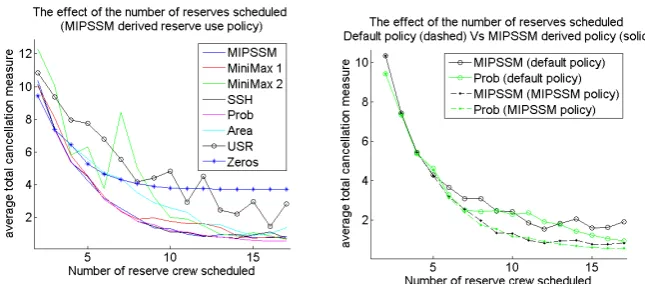
Fig. 1 The effect of the number of reserves which are scheduled on the solution quality of different solution approaches
Fig. 2 The effect of theM IP SSM derived reserve use policy
The results in Figure 1 show the effect on the average cancellation measure of varying the number of reserve crew available for scheduling, using 20000 re-peat validation simulation tests for each reserve crew schedule for each solution approach. TheM IP SSM based approaches are restricted to 50 input disrup-tion scenarios and a maximum of 1 hour to find a soludisrup-tion.
Figure 1 shows how the various reserve crew scheduling approaches compare for different numbers of reserve crew available for scheduling.
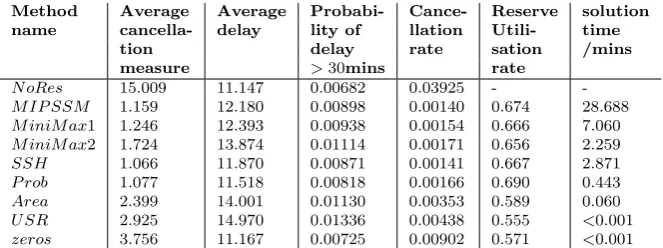
[image:16.595.78.401.195.337.2]Method Average Average Probabi- Cance- Reserve solution
name cancella- delay lity of llation Utili- time
tion delay rate sation /mins
measure >30mins rate
N oRes 15.009 11.147 0.00682 0.03925 -
-M IP SS-M 1.159 12.180 0.00898 0.00140 0.674 28.688
M iniM ax1 1.246 12.393 0.00938 0.00154 0.666 7.060
M iniM ax2 1.724 13.874 0.01114 0.00171 0.656 2.259
SSH 1.066 11.870 0.00871 0.00141 0.667 2.871
P rob 1.077 11.518 0.00818 0.00166 0.690 0.443
Area 2.399 14.001 0.01130 0.00353 0.589 0.060
U SR 2.925 14.970 0.01336 0.00438 0.555 <0.001
[image:17.595.75.407.88.212.2]zeros 3.756 11.167 0.00725 0.00902 0.571 <0.001
Table 1 Performance measure averages from 20 repeats
occur and is not to minimise the average cancellation measure. This fluctua-tion is due to the resultant schedules being designed for worst case disrupfluctua-tions as opposed to the average outcomes. The Area under the graph approach lead to average cancellation measures similar to those from the M iniM ax2 modification without the fluctuations. TheU SRapproach lead to the highest average cancellation measures when 10 or fewer reserve crew are available for scheduling, for more than 10 reserve crew thezerosapproach gave the highest cancellation measures. The zeros approach also gave the best results when fewer than 4 reserve crew were available for scheduling, this is because most crew absences are realised at the start of the first day, so scheduling reserve crew at that time prevents cancellations due to crew absence from the outset. The difference between the various solution approaches is clearest when there are around 10 to 12 reserve crew available for scheduling, which also appears to be the most sensible number of reserve crew to schedule (due to diminish-ing returns). Between 10 and 12 reserve crew, Figure 1 shows that the best performing solution approach was the SSH. 10 to 12 reserves for the given problem instance is approximately proportionate to the number of reserve crew scheduled in reality.
Figure 2 shows the effect of using the M IP SSM derived reserve use policy described in Section 4.3 compared to the default policy of using reserve crew as demand occurs. Using theM IP SSM derived policy had the effect of reducing the average cancellation measure.
5.4 Other performance measure and solution stability comparison of methods
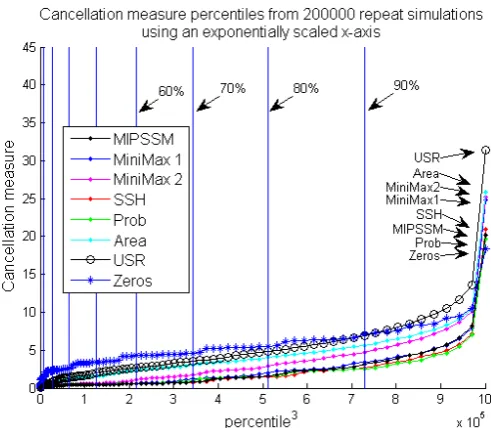
Fig. 3 Percentile cancellation measures
day simulation, but this also includes delays which have been converted to a cancellation measure using Equation 1 of Section 3.2. In terms of all round performance the SSH is a highly efficient approach with the lowest cancella-tion measure and also, a low average delay, theSSH is also much faster than the M IP SSM with an average solution time of just under 3 minutes. The solution time of the SSH is a result of the termination criteria being satis-fied before more than 10 disruption scenarios are added to the master problem. TheP robapproach has the second highest average cancellation measure, good average delay performance and a solution time much quicker the those of the M IP SSM based approaches.
The results in Table 1 suggest there is merit in both the probabilistic and M IP SSM approaches to scheduling airline reserve crew under uncertainty. Table 1 also includes performance measures when no reserve crew are sched-uled at all as a point of reference. Counter to expectation the probability of delay over 30 minutes is lower without reserve crew, as is the average delay, however this can be attributed to the high cancellation rate, since cancelled flights do not count as delays. The ObjectivesM iniM ax1 andM iniM ax2 are aimed at minimising worst case scenarios, however if the probability of delay over 30 minutes is treated as a measure of worst case scenarios, it does not support this. Reserve utilisation rates are also given in Table 1 and are loosely correlated with the cancellation measures.
Figure 3 displays cancellation measure percentiles, the 100th gives the worst
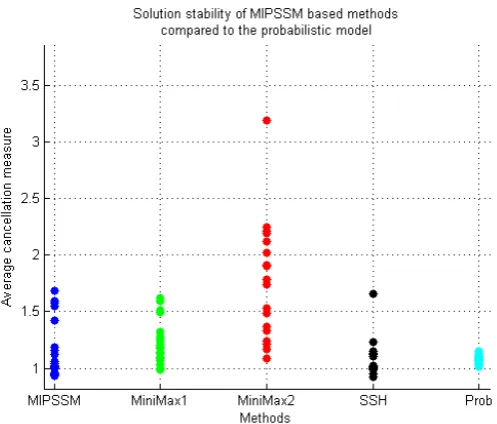
[image:18.595.114.360.87.301.2]Fig. 4 Solution stability ofM IP SSMbased methods compared toP rob
so it appears that this modification does not achieve its objective. Figure 3 shows the spread of cancellation measures corresponding to each method over the 20 repeats of each method, with each being tested in 20000 repeat vali-dation simulations. Figure 3 demonstrates that for each given percentile the ordering of the methods supports the results given in Table 1 except for the zeros approach which has the lowest worst case cancellation measure. This result suggests that the worst scenario is, for a very large number of crew to be absent at the start of each day, which is precisely the situation the zeros approach can cope with. Figure 4 shows that theM IP SSM based methods have a solution stability issue. Each point on Figure 4 represents a solution to the given method starting from a different random seed in the simulation used to generate the set of disruption scenarios over which the method is solved. Figure 4 shows that the M IP SSM based methods have the poten-tial to give solutions of higher quality that the Probabilistic method, but this depends on the selection of disruption scenarios which used as input for the givenM IP SSM based method.
6 Conclusion
[image:19.595.112.361.87.299.2]delay and cancellation that was related to disrupted crew would have been minimised. The M IP SSM formulation also took potential knock-on delays into account.
Another feature of the general approach is that it does not depend on the de-tails of the simulation of the airline (i.e. the simulation is almost a black box). In the example problems the simulation had the capability to recovery from delays using airline resource swaps, such swaps were applied before disruption scenario data was derived. In effect the approach would work with any airline schedule simulator, provided the assumption that the use of reserve crew is a last resort recovery action is valid.
TheSSH approach showed that the individual scenarios included in the model is at least as important as the number of scenarios, as this heuristic scenario selection approach yielded solutions of higher quality on average compared to theM IP SSM approach, with only a fraction of the input disruption scenar-ios. The Probabilistic model (P rob) represented an entirely different approach to the M IP SSM and gave comparable results, suggesting both approaches have their own merits. In general it was found that the M IP SSM, SSH andP rob approaches gave results that were very similar on average, however theM IP SSM based approaches had lower solution stability from one run to the next due to the stochastic nature of these approaches, but significantly outperformed theP robapproach in some cases.
7 Future work
The M IP SSM based approaches rely on stochastic inputs, this is both the greatest strength and weakness of these approaches. Future work includes investigating how to increase solution stability by improving the process of selecting which disruption scenarios to include in the solution phase of the M IP SSM based approaches.
References
1. Christopher Bayliss, Geert De Maere, Jason Atkin, and Marc Paelinck. Probabilistic Airline Reserve Crew Scheduling Model. In Daniel Delling and Leo Liberti, editors, 12th Workshop on Algorithmic Approaches for Transportation Modelling, Optimization, and Systems, volume 25 ofOpenAccess Series in Informatics (OASIcs), pages 132–143, Dagstuhl, Germany, 2012. Schloss Dagstuhl–Leibniz-Zentrum fuer Informatik.
2. Alexandre Boissy. Crew reserve sizing. InAgifors syposium.
3. Jeffrey E. Dillon and Spyros Kontogiorgis. Us airways optimises the scheduling of reserve flight crews. Interfaces, 29(5):pp123, September/October 1999.
4. Christian Liebchen, Marco Lubbecke, Rolf H. Mohring, and Sebastian Stiller. Recoverable robustness. Technical report, August 2007.
5. Marc Paelinck. KLM cabin crew reserve duty optimisation. InAgifors proceedings, 2001. 6. Sergey Shebalov and Diego Klabjan. Robust airline crew pairing: Moveup crews.
Trans-portation science, 2006.
7. Milind G. Sohoni, Ellis L. Johnson, and T. Glennn Bailey. Operational airlines reserve crew scheduling. Journal of Scheduling, 2006.