https://www.scirp.org/journal/jcc ISSN Online: 2327-5227 ISSN Print: 2327-5219
DOI: 10.4236/jcc.2019.711009 Nov. 29, 2019 121 Journal of Computer and Communications
Evaluation of a Cloud Management System for
Live Migrations
Md Israfil Biswas
*, Philip Morrow, Sally McClean
School of Computing, Ulster University, Coleraine, Northern Ireland, UK
Abstract
IT infrastructures have been widely deployed in datacentres by cloud service providers for Infrastructure as a Service (IaaS) with Virtual Machines (VMs). With the rapid development of cloud-based tools and techniques, IaaS is changing the current cloud infrastructure to meet the customer demand. In this paper, an efficient management model is presented and evaluated using our unique Trans-Atlantic high-speed optical fibre network connecting three datacentres located in Coleraine (Northern Ireland), Dublin (Ireland) and Halifax (Canada). Our work highlights the design and implementation of a management system that can dynamically create VMs upon request, process live migration and other services over the high-speed inter-networking Data-centres (DCs). The goal is to provide an efficient and intelligent on-demand management system for virtualization that can make decisions about the mi-gration of VMs and get better utilisation of the network.
Keywords
Cloud Computing, Virtual Machine, Live Migration, Network Management
1. Introduction
With the incredible growth of both Cloud and wireless networks, new resource management and routing techniques have been proposed to cope with high- bandwidth applications and improve the Quality of Service (QoS) [1]. Cloud computing has unprecedented advantages like on-demand resource provision-ing, usage-based network access, remote resource management with ultra-resilience flexibility, universal data access with independent geographical locations and avoidance of capital expenditure on resources, etc. that consider cloud as a next generation technology [2]. Hence, this has resulted in the establishment of large- scale datacentres across the world centralising or outsourcing into the Cloud, How to cite this paper: Biswas, M.I.,
Morrow, P. and McClean, S. (2019) Evalua-tion of a Cloud Management System for Live Migrations. Journal of Computer and Com-munications, 7, 121-137.
https://doi.org/10.4236/jcc.2019.711009
Received: September 6, 2019 Accepted: November 26, 2019 Published: November 29, 2019
Copyright © 2019 by author(s) and Scientific Research Publishing Inc. This work is licensed under the Creative Commons Attribution International License (CC BY 4.0).
http://creativecommons.org/licenses/by/4.0/
DOI: 10.4236/jcc.2019.711009 122 Journal of Computer and Communications consisting of millions of servers. One of the current cloud computing paradigms is Virtualization that provides VM migration among physical servers in cloud datacentres with benefits like load balancing, server consolidation, online main-tenance and proactive fault tolerance among datacentres [3]. To extensively as-sist large-scale data analytics and rapid big data innovation, virtualisation also provides large scale on-demand and elastic computation and storage capabilities. Hence, the resources are partitioned into VMs through virtualisation with ad-vantages such as isolation, consolidation and multiplexing of resources. The re-sources on the same physical machine in the virtual machine environments are shared by multiple VMs. An application can run in multiple VMs whereas each VM can run one or more applications.
Resource management is becoming a fundamental concern for resource opti-misation with this exceptional growth in the cloud computing paradigm. Live Migration (LM) is a key feature for continuous management and maintenance of datacentres that attracts considerable interest in datacentre management and cluster computing. In cloud management, many techniques have been proposed over the last years to solve the migration strategy available for a variety of appli-cation cases concerning the issues of live VM migration. The migration problems for cloud management have been investigated but these techniques are more re-stricted for live VM migration. Assuming no consideration for multiple users that may be connected to VMs locally or remotely, also not considering the number of users during the live VM migration that may result in increasing the network overload, and an increase in service downtime of the network.
This paper proposes and evaluates an efficient on-demand management model for inter-datacentre virtualization that checks CPU utilisation status for live mi-gration then contacts a suitable host to submit a job e.g., mimi-gration request. Any VM migration is done based on a policy manager or Service Level Agreement (SLA). Our evaluation of the model found benefits showing reasonable utilisa-tion of all hosts between datacentres through experimental results. The model also provides benefit by supporting flexible management access for remote hosts with reduced migration time and latency. In summary, the paper is unique for the following aspects:
An on-demand virtualization architecture is designed and evaluated for in-ter-datacentre networks considering live migrations;
Provides performance improvement i.e., CPU utilization, SLA violation, etc using the proposed VM management system;
Shows an efficient VM management technique using various VM loads in-cluding remote locations.
DOI: 10.4236/jcc.2019.711009 123 Journal of Computer and Communications
2. Cloud Management
The high demand for cloud computing-based resources introduces complex data-centre architectures that require highly efficient and optimised operating and monitoring applications, which is the main goal of cloud management software design. Services residing in the cloud require efficient management and man-agement tools help ensure cloud computing-based resources are working opti-mally and properly interacting with users and other services.
2.1. Cloud Management Policies
Cloud management policies are vital as cloud computing grows more complex and a wide variety of cloud-based systems and infrastructure (e.g., private, hy-brid, public, etc) exist. The policies may include various aspects including secu-rity, monitoring and emergency plans. Hence, cloud management tools need to be flexible and scalable within a cloud computing strategy. Cloud management software must have the following features for users [4]:
A common and similar understanding of virtualized resources irrespective of the virtualization platform;
Full life cycle management of VMs: this includes dynamic network setup, storage requirements, etc.;
Provision of resource allocation: able to configurable policies to achieve goals like high availability, server consolidation to minimize power usage, etc.; Resource management: acclimate to an organization’s resource needs
(chang-ing resources, includ(chang-ing addition or failure of physical resources), especially in critical hours.
2.2. Service Level Agreement (SLA)
The guarantee of the Service Level Agreement (SLA) for cloud and large-scale applications is the key to the dynamic workload of applications and sharing the resources in datacentre networks. VMs receive the resources requested by users and are then placed in different hosts based on resource utilization or SLA quirements. The cloud facilitates such resource virtualisation with flexible re-source utilisation that dynamically regulates the rere-source allocation for a VM to support the application resource demands. Meeting the SLA requirements be-tween cloud providers and users also enables improved resource consumption, power energy efficiency and reducing the number of VM migrations in popular places.
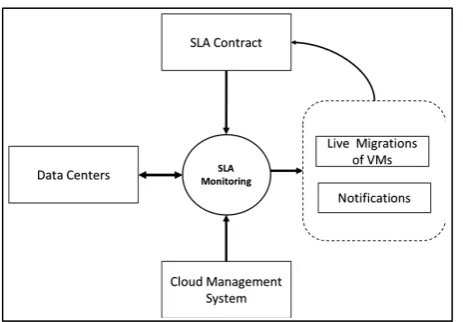
An SLA includes the management of various integrated process at different levels i.e., SLAs from the business level to service level and network level man-agement [5]. The SLA consists of several functions starting with SLA creation, contract, provisioning, monitoring, maintenance, notifications and assessment, which is shown in Figure 1.
DOI: 10.4236/jcc.2019.711009 124 Journal of Computer and Communications
Figure 1. Illustration of cloud-based SLA architecture.
including CPU, memory, I/O and network bandwidth on the physical resources to become overloaded. However, the performance of all the VMs is often de-graded due to overloading and hence increases the job completion time (i.e., for batch data processing and the response time of interactive applications). Any overloading must be migrated from the overloaded physical machines to under-utilised ones in order to eliminate such hotspots. VM migration is a complicated and challenging problem for resource management like CPU, memory, I/O and network for individual VMs and physical machine management.
Hence, the resource requirement of the VM has to be considered and matched with the available resources on the physical machines to decide to which physi-cal machine a VM should be migrated. Another issue for VM management is the overhead of VM migration itself that can severely affect application performance and should be optimised. Reducing the overhead of VM migrations reduces the performance degradation caused by the migrations. Moreover, dynamic VM man-agement is necessary, which is difficult in an environment where workload dy-namically changes. Hence, it is not efficient to make the migration decision only based on the current state of the system.
3. Related Work
A number of methods have been proposed to address VM management issues in the context of the rapid growth of cloud computing. Cloud providers now are paying more attention to this by providing high quality services. Therefore, many researchers have begun to study VM management methods.
DOI: 10.4236/jcc.2019.711009 125 Journal of Computer and Communications Another method of allocating VM resources dynamically is based on resource utilisations of VMs and physical machines [7]. The problem in this approach is over-estimation or under-estimation regarding resource allocation that may cause waste of resources leading to significant SLA violations [8].
T. Maoz et al. proposed a VM migration approach that helps in the migration of groups of processes and parallel jobs among different clusters in a multi- cluster or a Grid in [9]. They evaluated their proposed technique called Jobrun in real HPC applications and presented detailed measurements of the perform-ance.
An adaptive energy-efficient and threshold-based heuristic algorithm is sug-gested in [10][11], which controls virtual machine migration by monitoring the resource utilization rate. However, threshold-based migration strategies have a problem in predicting the possible workload. Hence, this may trigger unneces-sary and wasteful migrations for the host machine.
A load balancing VM migration framework based on a new metric for quan-tifying virtualized server load is presented in [12] based on the variation in load measured on the machines. The load balancing algorithm chooses the VM mi-gration that achieves the greatest improvement on this imbalance metric in this framework. The migration process is considered as a multi-objective problem and a novel migration policy is proposed [13]. To evaluate different objectives simultaneously, it utilises a new elastic multi-objective optimisation strategy.
A model for intelligent decision over migration time of VMs across heteroge-neous physical nodes of a cluster server is presented in [14]. The method pro-vides an algorithm for making a multi criteria decision method to migrate VMs between cluster nodes and improve performance. To reduce the time and cost to achieve load balance, Chen et al. propose RIAL [15] in which different weights are dynamically assigned to different resources based on their usage intensity in the physical machines to determine the destination of the VM to migrate.
A system named Sandpiper is proposed in [16], which automates the detection of hotspots and management of VMs including live migrations. The resource utilisation on the physical machine and comparison is done by Sandpiper and a threshold is used to determine an unbalanced location. The volume, defined as the product of CPU, network and memory loads to capture the combined load on multidimensional resources, is used in this system. Volume-to-size ratio (VSR) is used to measure the volume per unit byte moved.
The live migration strategy of multiple virtual machines with different re-source reservation methods is presented in [17]. Considering the communica-tion dependencies among VMs of a multi-tier enterprise applicacommunica-tion, the under-lying datacentre network topology, as well as the capacity limits of the physical servers in datacentres, an application aware virtual machine migration scheme is proposed in [18].
DOI: 10.4236/jcc.2019.711009 126 Journal of Computer and Communications However, this work is unique to the following aspects:
It proposes and evaluated an efficient approach that not only shows improve utilisation of the resources but also reduces migration time and latency, which is absent from most previous works in Cloud computing environments; This work evaluates SLA violation to manage customer satisfaction, which is
also not found in many previous works;
The proposed system evaluates overall networks performance, which is very important for customer satisfaction;
This work proposes a dynamic management system that adopts resource pool e.g., LM with remote datacentres and evaluates the proposed system, while most previous work deal with fixed size of the resource pools with simula-tions.
4. The Proposed Approach
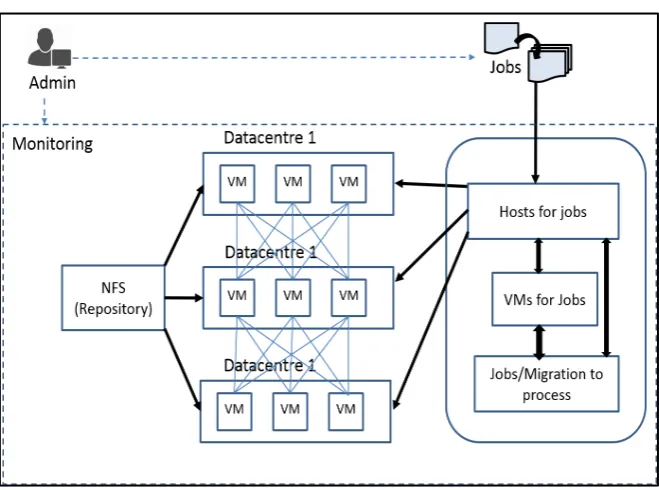
The proposed cloud management model for LM is a managed system that is connected to remote but inter-networking datacentres and is based on two proc-esses: 1) VM-Request process and 2) Migration process. Service: The VM-Request allows users to submit or receive a VM creation request, specifying the details e.g., VM identification number, memory requirements, remote host to be used, etc. For a VM creation, the system has shared storage facilities within a Network File System (NFS).
[image:6.595.208.538.463.708.2]In the second step, the Migration process migrates a VM to a local or remote. In the system, the users can specify a path to a directory containing files needed for the request to avoid file access through NFS or to avoid NFS enslavement.
Figure 2 illustrates the Management System and its interaction with Host VMs.
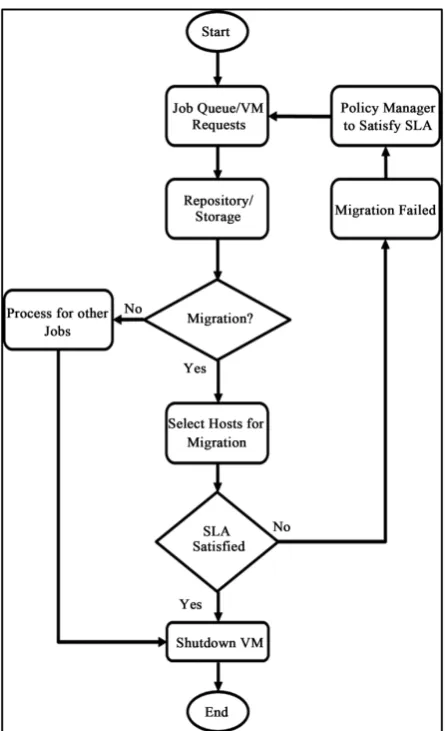
DOI: 10.4236/jcc.2019.711009 127 Journal of Computer and Communications The system checks all the possible hosts’ CPU utilisation status for LM, contacts a suitable host and submits the LM request. Once the VM has been launched by the system, it sends the VM to the Migration process for migration and receives the confirmation of an accepted destination host. When the associ-ated VM is migrassoci-ated, the running system is also informed, so that it can track the status of the CPU during the migration. As soon as a VM is created and launched, a Policy Manager inside the management system runs the LM sub-mitted request and track the migration status as well. The Policy Manager is able to edit or modify the migration rule or the SLA that will be performed from the source host to the targeted destination host.
The management system also able to replicate the VM image in a cache pository attached to a local disk in order to optimise the performance and re-duce the overall run-time for future migrations. This is really helpful to avoid network congestion in a network although any high storage systems like the proposed model have the ability to load several VM images or associated files to the memory cache. As the developed architecture is connected to a repository service on NFS, the files can be decompressed directly to the disk when creating a new VM by eliminating redundant duplications. This also can reduce disk performance or avoid extra strain on network resources. The cached VM mem-ory image is also used when the system instructs the Migration process to create a new VM locally and send it to a remote host prior to its execution. The re-quired VM image can be taken directly from the memory cache and sent com-pressed to the remote host, where it is uncomcom-pressed directly to the disk. More-over, the goal is to reduce the creation time by eliminating the usage of the local disk and reducing the transfer time of the files to the remote host.
During the Migration process, it can inform the management system to create a VM and migrate it to a remote host before execution. This is required as a re-mote host may not support the creation of VMs but may be able to host guest VMs or if some user specified files are not accessible from the remote host. The Migration process is in charge of contacting the host for the live migration and relay the request. Furthermore, it migrates VMs to other hosts by dumping the VM to the disk and sending the resulting files to the Migration process running on the remote host, when requested by the management system.
DOI: 10.4236/jcc.2019.711009 128 Journal of Computer and Communications about to migrate and resume these processes when the migration is completed.
Figure 3 illustrates the flowchart for a live migration process.
The System Configuration and Setup
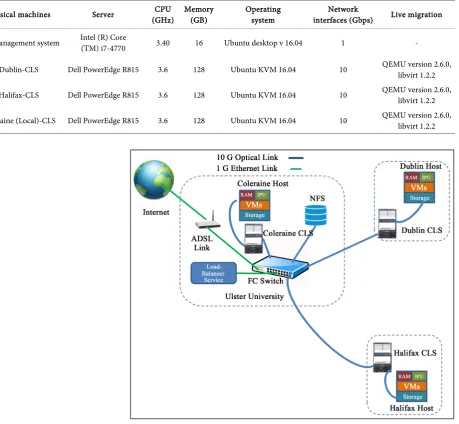
[image:8.595.262.486.337.703.2]We have developed a testbed that connects three Cable Landing Stations (CLS), designed and implemented three simulated datacentres with a dynamic man-agement system for resource provisioning between the datacentres, specifically for live VM migrations. The cloud testbed is designed around a fibre optic ring network connecting Coleraine (Northern Ireland), Dublin (Ireland) and Halifax (Canada) CLSs [20], [21]. The proposed management system with inter-datacentre networking provides a direct high-speed fibre optic interface connecting the Ul-ster University at Coleraine through a fibre patch panel, where the other two datacentres in Dublin CLS and Halifax CLS are also connected with the ring network.
Figure 4 represents the architecture of the developed testbed used for the management system. The details of the management system and the datacentre configuration are given in Table 1.
DOI: 10.4236/jcc.2019.711009 129 Journal of Computer and Communications
Table 1. The cloud management system and datacenter configuration.
Physical machines Server (GHz) CPU Memory (GB) Operating system interfaces (Gbps) Network Live migration
The management system Intel (R) Core (TM) i7-4770 3.40 16 Ubuntu desktop v 16.04 1 -
Dublin-CLS Dell PowerEdge R815 3.6 128 Ubuntu KVM 16.04 10 QEMU version 2.6.0, libvirt 1.2.2
Halifax-CLS Dell PowerEdge R815 3.6 128 Ubuntu KVM 16.04 10 QEMU version 2.6.0, libvirt 1.2.2
Coleraine (Local)-CLS Dell PowerEdge R815 3.6 128 Ubuntu KVM 16.04 10 QEMU version 2.6.0, libvirt 1.2.2
Figure 4. The architecture of the interconnected datacentre testbed.
The management system is at the Ulster University NetCom lab is connected with a Fibre Channel (FC) switch to manage the three physical machines in Cole-raine, Dublin and Halifax. An ADSL connection for Internet access between the CLSs is also provided with the developed testbed. This is to provide a gateway to the outside world for secure software development and updates between the CLSs without interfering with the academic JANET network. Hence, this is not an extension of the high-speed network and the interface is only installed to op-erate at around 76 Mbits/sec, which is purely for server firmware updates and to comply with UK JISC rules.
DOI: 10.4236/jcc.2019.711009 130 Journal of Computer and Communications up and mounted on all the available hosts during the LM.
Migration only transfers in-memory state of a running domain for example memory, CPU state, etc. by default. The NFS server with its shared storage ex-ports a directory that is mounted at a common place on all hosts. We consider that all the hosts are running in the same network i.e., a LAN environment con-necting remote datacentres and the DNS configuration for the consistency of associated files across all the hosts are confirmed.
libvirt [22] is an open-source API, daemon and management tool that is popular for cloud virtualization management and supports various virtualization technologies including KVM. In this work, we have used libvirt for live migra-tion by developing a Linux based tool to manage the network and configured this by enabling associated files to make the hypervisor listen for TCP commu-nication with authentication. For cloud security, the firewall configuration and associated files are also configured to allow libvirt to listen on a TCP port and to allow a record accepting KVM communication on the TCP port within the sync range. The SSH keys for authentication are strongly recommended as authenti-cation is set to NONE. By default, pre-copy is enabled for live migration in Ub-untu 16.04. However, we have configured libvirt with post-copy live migration capability and used it for VM migrations in this work as our previous works show that post-copy live migration results in lower downtime.
VM host detection is very important as underutilization of a host can be used to migrate all the VMs unless the host goes to sleep or in shutdown mode. How-ever, if any migrated VMs are over-utilized, the under-loaded host can be used. Hence, any over-utilized host can be considered as a destination host during the migration process. In this paper we have used CPU utilization based “averaging threshold-based algorithm (THR)” [23] that computes the mean of the n last CPU utilization values and compares it to the previously defined threshold. In this algorithm a threshold is specified, and an underload state is detected if the average of the n last CPU utilization measurements is lower than the specified threshold.
5. Evaluation of the System and Experiment Results
We have measured the real throughput during LM over high-speed 10Gbps fibre optical links using the iperf tool [24] and Table 2 provides some of the test re-sults. In this section, we evaluate the performance of the proposed management approach during live migration of VMs. The performance metric used for the experiments is the CPU utilisation (as a percentage).
DOI: 10.4236/jcc.2019.711009 131 Journal of Computer and Communications
Table 2. The initial tests results between data centres.
Datacentres Average speed (Gbps) Average latency (ms)
Coleraine-CLS to Dublin-CLS 7.4 5.5
Coleraine-CLS to Halifax-CLS 3.5 52.5
Coleraine (Local)-CLS 8.0 0.68
calculated the average statistics for an overall period of time and have considered the fact that the CPU usage during any VM migrations is dependent on the ac-tivity of the VM. If the VM is very active or fully loaded, the CPU usage is higher. Hence, this work analyses the system performance to determine the im-pact for host CPU utilisation over the high-speed network.
The first step in the migration process is to determine and classify the load for the hosts. Considering CPU utilization, we have classified two kinds of loads, where a stress tool is used to generate a stable memory load during migration based on the threshold value. The size of stressed memory is tuned with the VMs so that the stress tool can consume the threshold values for calculation:
Lightly loaded VMs: VMs were running Ubuntu 16.04 LTS and not consuming more than 20% of the VM’s memory.
Fully loaded VMs: when VMs with high memory-intensive load or, VM run-ning in Ubuntu 16.04 LTS and consumes more than 75% of the VM’s memory.
5.1. Evaluation
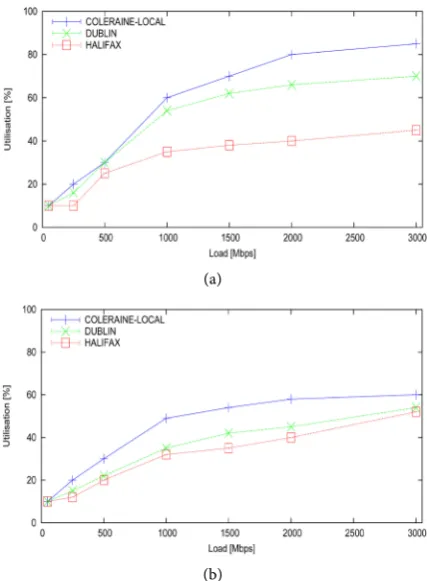
In this subsection, we have evaluated our proposed system comparing it against when the system is not used. Figure 5(a) shows LM between the datacentres without the proposed management system for lightly loaded VMs. We found not much difference in utilisation while the network load is less than 500 Mbps. However, for a higher network load i.e. 3Gbits/s, the remote host with higher tency shows up to 20% lower utilisation of its CPU compared to other low la-tency or local hosts (e.g., the CPU utilization during live migration between Coleraine and Halifax host shows lower utilisation compared to the utilization among local hosts in Coleraine). Figure 5(b) shows the improvement using our proposed management system that is using lightly loaded VMs during LM be-tween datacentres. The figure clearly indicates only less than 5% difference in CPU utilization during the LM.
For experiments with fully loaded VMs, we found better results using our pro-posed system. LM between datacentres shows better utilization regardless of the latency. Figure 6(a) shows that without using the proposed system local hosts in Coleraine highly utilize their CPU during LM compared to LM between high la-tency hosts. For example, LM between local ColeraineVMs utilizes 40% more than LM between Coleraine and Halifax.
DOI: 10.4236/jcc.2019.711009 132 Journal of Computer and Communications (a)
[image:12.595.266.480.69.360.2](b)
Figure 5. Lightly loaded VM migration (a) without the management system, (b) with the management system
(a)
(b)
[image:12.595.262.485.405.692.2]DOI: 10.4236/jcc.2019.711009 133 Journal of Computer and Communications
5.2. SLA Violation Metrics
Managing resources for optimised results and deals at various service levels are very important requirements where SLA plays an important role. A SLA con-tains the information for optimised capacities of CPU, RAM, storage and band-width. The service provider will be responsible for any breach of the SLA and charged to pay to the other contracted provider. For example, the CPU usage fluctuates over time and the usage could be agreed through an SLA for a host. The host has to pay a fine when it is oversubscribed (i.e., maximum allowed CPU usage is requested by all the VMs of the host and hence the total CPU de-mand will exceed the capacity of the CPU). Therefore, the violation of the SLA is caused between the service provider and the customer while the CPU perform-ance is exceeding the total capacity.
In order to evaluate the proposed system, we consider SLA violation metric used in [11]. This is to evaluate the level of SLA violation caused by the system defined as follows:
(
)
1 1SLA violations SLAv 1 nh Tf 1 Vmi Ei
n = Ta Vm = Ci
=
∑
∗∑
Here, n is the number of hosts, Tf is the total time considering 100% utilisa-tion of host h experience leading to an SLA violation. Ta is the total active time of the host h while serving the VMs. The number of VMs is denoted by Vm; Ei is the estimate of the performance degradation of the VMi caused by migrations and Ei is estimated by 10% of the CPU utilization in MIPS during all migrations of the VMi; Ci is the total CPU requested by VMi during its life time.
VM selection algorithms are important as once a host overload has been de-tected, it is necessary to determine what VMs are the best to be migrated from the host. In our experiments, we have used two types of VM selection algo-rithms: 1) Minimum Migration Time (MMT)[10] and 2) Random Choice (RC)
[23] to compare our proposed system.
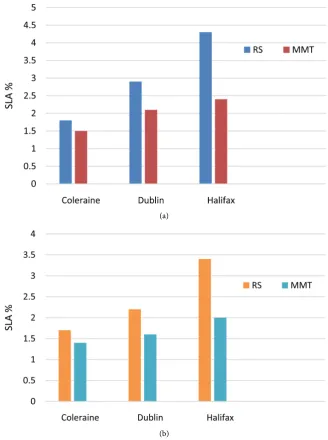
Figure 5(a) shows that mmtVM selection outperforms rc in term of SLA vio-lation with all the host detection algorithms without the proposed system. How-ever, using the proposed system as shown in Figure 7(b), the VM selection algo-rithms show more improvement in term of SLA violation with all the host detec-tion algorithms.
5.3. Overall Network Performance
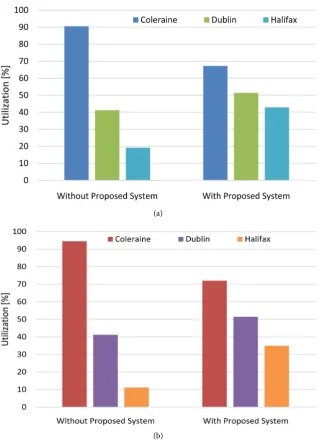
In this subsection, we have analysed the experimental results to evaluate the per-formance of the high-speed network using the proposed system with a network load of 3 Gbps considering lightly and fully loaded VMs.
DOI: 10.4236/jcc.2019.711009 134 Journal of Computer and Communications (a)
[image:14.595.208.537.70.511.2](b)
Figure 7. SLA violation (a) without and (b) with the proposed management system.
effectively uses the threshold that found less than 70% between local servers and more than 40% utilisation between Coleraine and Halifax.
Similar performance was observed for fully load VMs as shown in Figure 8(b), where without our proposed system live migration within Coleraine local servers can have overutilization for more than 95% (with some packet drops) and less than 20% for Coleraine to Halifax VM migrations. The proposed system found less than 75% utilization during live migration between local servers in Coleraine and more than 30% utilisation for live migration between Coleraine to Halifax VMs.
DOI: 10.4236/jcc.2019.711009 135 Journal of Computer and Communications (a)
[image:15.595.214.535.67.515.2](b)
Figure 8. Overall network performance with and without the proposed system (a) lightly loaded, (b) fully loaded.
6. Conclusions
This work proposed and evaluated a cloud management framework that dynami-cally provides live migration to remote datacentres considering various types of load. Our results with the developed management system show improvement in CPU utilisation during VM migrations. The management model can be improved by introducing new techniques considering a multi-domain environment.
DOI: 10.4236/jcc.2019.711009 136 Journal of Computer and Communications
Acknowledgements
This research is partly supported by the “Agile Cloud Service Delivery Using In-tegrated Photonics Networking” project funded under the US-Ireland Programme NSF (US), SFI (Ireland) and DfE (N. Ireland). The authors would also like to acknowledge support from the BT-Ireland Innovation Centre (BTIIC).
Conflicts of Interest
The authors declare no conflicts of interest regarding the publication of this pa-per.
References
[1] Al-Dubai, A.Y., Zhao, L., Zomaya, A.Y. and Min, G. (2015) QoS-Aware In-ter-Domain Multicast for Scalable Wireless Community Networks. IEEE Transac-tions on Parallel and Distributed Systems, 26, 3136-3148.
https://doi.org/10.1109/TPDS.2014.2365190
[2] Biswas, M.I., Parr, G., McClean, S., Morrow, P. and Scotney, B. (2014) SLA-Based Scheduling of Applications for Geographically Secluded Clouds. 1st Workshop on Smart Cloud Networks & Systems (SCNS’14), Paris, France, 3-5 December 2014, 1-8. https://doi.org/10.1109/NOF.2014.7119800
[3] Yi, B., Wang, X., Das, S.K., Li, K. and Huang, M. (2018) A Comprehensive Survey of Network Function Virtualization. Computer Networks, 133, 212-262.
http://www.sciencedirect.com/science/article/pii/S1389128618300306
https://doi.org/10.1016/j.comnet.2018.01.021
[4] Sotomayor, B., Montero, R.S., Llorente, I.M. and Foster, I. (2009) Virtual Infra-structure Management in Private and Hybrid Clouds. IEEE Internet Computing, 13, 14-22.https://doi.org/10.1109/MIC.2009.119
[5] Lee, H.J., Kim, M.S. and Hong, J.W. (2002) Mapping between Qos Parameters and Network Performance Metrics for SLA Monitoring. Asia-Pacific Network Opera-tions and Management Symposium (APNOMS) Conference.
http://dpe.postech.ac.kr/papers/APNOMS/02/sla-monitoring.pdf
[6] Zhang, F., Liu, G., Fu, X. and Yahyapour, R. (2018) A Survey on Virtual Machine Migration: Challenges, Techniques, and Open Issues. IEEE Communications Sur-veys & Tutorials, 20, 1206-1243.https://doi.org/10.1109/COMST.2018.2794881
[7] Herrera, J.G. and Botero, J.F. (2016) Resource Allocation in NFV: A Comprehensive Survey. IEEE Transactions on Network and Service Management, 13, 518-532.
https://doi.org/10.1109/TNSM.2016.2598420
[8] Xiao, Z., Song, W. and Chen, Q. (2013) Dynamic Resource Allocation Using Virtual Machines for Cloud Computing Environment. IEEE Transactions on Parallel and Distributed Systems, 24, 1107-1117.https://doi.org/10.1109/TPDS.2012.283
[9] Maoz, T., Barak, A. and Amar, L. (2008) Combining Virtual machine Migration with Process Migration for HPC on Multi-Clusters and Grids. 2008 IEEE Interna-tional Conference on Cluster Computing, Tsukuba, Japan, 29 September-1 October 2008, 89-98. https://doi.org/10.1109/CLUSTR.2008.4663759
[10] Beloglazov, A. and Buyya, R. (2015) OpenStack Neat: A Framework for Dynamic and Energy-Efficient Consolidation of Virtual Machines in OpenStack Clouds. Con-currency and Computation: Practice and Experience, 27, 1310-1333.
DOI: 10.4236/jcc.2019.711009 137 Journal of Computer and Communications
[11] Beloglazov, A. (2013) Energy-Efficient Management of Virtual Machines in Data Centers for Cloud Computing. Ph.D. Thesis, The University of Melbourne, Mel-bourne.
[12] Arzuaga, E. and Kaeli, D.R. (2010) Quantifying Load Imbalance on Virtualized En-terprise Servers. In: Proceedings of the First Joint WOSP/SIPEW International Conference on Performance Engineering, ACM, New York, 235-242.
https://doi.org/10.1145/1712605.1712641
[13] Sallam, A. and Li, K. (2014) A Multi-Objective Virtual Machine Migration Policy in Cloud Systems. The Computer Journal, 57, 195-204.
https://doi.org/10.1093/comjnl/bxt018
[14] Tarighi, M., Motamedi, S.A. and Sharifian, S. (2010) A New Model for Virtual Ma-chine Migration in Virtualized Cluster Server Based on Fuzzy Decision Making. arXiv Preprint arXiv:1002.3329.
[15] Chen, L., Shen, H. and Sapra, K. (2014) RIAL: Resource Intensity Aware Load Bal-ancing in Clouds. IEEE INFOCOM 2014-IEEE Conference on Computer Commu-nications,Toronto, 27 April-2 May 2014, 1294-1302.
https://doi.org/10.1109/INFOCOM.2014.6848062
[16] Wood, T., Shenoy, P., Venkataramani, A. and Yousif, M. (2009) Sandpiper: Black- Box and Gray-Box Resource Management for Virtual Machines. ComputerNetworks, 53, 2923-2938.https://doi.org/10.1016/j.comnet.2009.04.014
[17] Ye, K., Jiang, X., Huang, D., Chen, J. and Wang, B. (2011) Live Migration of Multi-ple Virtual Machines with Resource Reservation in Cloud Computing Environ-ments. 2011 IEEE 4th International Conference on Cloud Computing, Washington DC, 4-9 July 2011, 267-274. https://doi.org/10.1109/CLOUD.2011.69
[18] Shrivastava, V., Zerfos, P., Lee, K.-W., Jamjoom, H., Liu, Y.-H. and Banerjee, S. (2011) Application-Aware Virtual Machine Migration in Data Centers. 2011 Pro-ceedingsIEEEINFOCOM, Shanghai, 10-15 April 2011, 66-70.
https://doi.org/10.1109/INFCOM.2011.5935247
[19] Chen, K.-T., Chen, C. and Wang, P.-H. (2014) Network Aware Load Balancing via Parallel VM Migration for Data Centers. 2014 23rd International Conference on Computer Communication and Networks,Shanghai, 4-7 August 2014, 1-8.
https://doi.org/10.1109/ICCCN.2014.6911748
[20] Biswas, I., Parr, G., McClean, S., Morrow, P. and Scotney, B. (2016) An Analysis of Live Migration in Openstack using High Speed Optical Network. 2016 SAI Com-puting Conference, London, UK, 13-15 July 2016,1267-1272.
https://doi.org/10.1109/SAI.2016.7556142
[21] Biswas, I., Parr, G., McClean, S., Morrow, P. and Scotney, B. (2016) A Practical Evaluation in Openstack Live Migration of VMs Using 10Gb/s Interfaces. 2016 IEEE Symposium on Service-Oriented System Engineering, Oxford, UK, 29 March-2 April 2016,346-351.https://doi.org/10.1109/SOSE.2016.35
[22] Libvirt Wiki (2019). https://wiki.libvirt.org/page/Main_Page
[23] Beloglazov, A. and Buyya, R. (2012) Optimal Online Deterministic Algorithms and Adaptive Heuristics for Energy and Performance Efficient Dynamic Consolidation of Virtual Machines in Cloud Data Centers. Concurrency and Computation: Prac-tice and Experience, 24, 1397-1420.https://doi.org/10.1002/cpe.1867
[24] iPerf (2019) iPerf—The Ultimate Speed Test Tool for TCP, UDP and SCTP.