Energy and Power Engineering, 2009, 94-99
doi:10.4236/epe.2009.12015 Published Online November 2009 (http://www.scirp.org/journal/epe)
A New Multi-Method Combination Forecasting
Model for ESDD Predicting
Haiyan SHUAI, Qingwu GONG
1School of Electrical Engineering, Wuhan Technical College of Communications,
Wuhan University, Wuhan, China
2School of Electrical Engineering, Wuhan University, Wuhan, China
Email: wdshy@126.com, whdxgqw@163.com
Abstract: Equal Salt Deposit Density (ESDD) is a main factor to classify contamination severity and draw pollution distribution map. The precise ESDD forecasting plays an important role in the safety, economy and reliability of power system. To cope with the problems existing in the ESDD predicting by multivariate linear regression (MLR), back propagation (BP) neural network and least squares support vector machines (LSSVM), a nonlinear combination forecasting model based on wavelet neural network (WNN) for ESDD is proposed. The model is a WNN with three layers, whose input layer has three neurons and output layer has one neuron, namely, regarding the ESDD forecasting results of MLR, BP and LSSVM as the inputs of the model and the observed value as the output. In the interest of better reflection of the influence of each single forecasting model on ESDD and increase of the accuracy of ESDD prediction, Morlet wavelet is used to con-struct WNN, error backpropagation algorithm is adopted to train the network and genetic algorithm is used to determine the initials of the parameters. Simulation results show that the accuracy of the proposed tion ESDD forecasting model is higher than that of any single model and that of traditional linear combina-tion forecasting (LCF) model. The model provides a new feasible way to increase the accuracy of pollucombina-tion distribution map of power network.
Keywords: equal salt deposit density, multivariate linear regression, BP neural network, least squares support vector machines, combination forecasting, wavelet neural network
1. Introduction
Exposed to dirty environment, surfaces of insulators will be polluted. After being wetted, the polluted layers will deduce insulators’ insulation capability which often in-vites pollution flashover. According to the operation ex-periences of power sectors, pollution flashover is one of the main factors causing power accidents. In recent years [1,2], there have happened several large area pollution flashovers in some locals or the whole country, which resulted in large area power blackout. Among all the causes resulting in pollution flashover, the lag and the inaccuracy of pollution distribution map of power net-work is a primary one. Equal Salt Deposit Density (ESDD) is the equivalent amount of NaCl that would yield the same conductivity at complete dilution [3], which is the dominant factor to classify contamination severity and draw pollution distribution map. At present, the methods of ESDD forecasting are mainly traditional multivariate linear regression (MLR) technique [4,5], back propagation (BP) neural network [6,7], and least squares support vector machines (LSSVM) [8,9]. Com-bination forecasting integrates the useful information of
all single forecasting models and generally considers each forecasting result; hence it can more systemically and comprehensively reflect the changes of an object than a single model does. J. M. Bates and C. J. W. Granger proved the combination of two or more than two agonic single forecasting models can produce the result better than that of each single model, which showed combination forecasting method can increase prediction accuracy [10].
traditional linear combined forecasting (LCF) model. The model provides a new doable way to boost the pre-cision of pollution distribution map of power network.
2. Brief Introductions of MLR, BP, LSSVM,
and LCF
2.1. MLR Model
If y is a random variable predicted through x x1, , ,2 xp and there is a linear relationship between them, then a
-variable linear regression equation can be constructed as follow [11]:
p
0 1 1 p p
y x x
(1)
where is the number of independent variables. p
Considering the groups of data observed are as followings respectively:
n
1 2
( ,x xi i , , x yip; )i i 1, 2, , n Put (x xi1, i2,,xip; )yi i 1, 2,,n
n
into (1), one can get
1 0 1 11 2 12 1 1
2 0 1 21 2 22 2 2
0 1 1 2 2
p p p p
n n n p np
y x x x
y x x x
y x x x
(2)
where 0, ,1,andp
,and n
are the parameters
being estimated, called overall regression parameters; (p1)
1, ,2
(0,
i N
are random errors independent with
each other, and 2
)
.The task of multivariable linear regression is to solve the following three problems according to (2).
1) Determine 0,1, ,a n dp
m
and the regression equation.
2) Carry out significant test to the regression equation. If the equation is representative, it is significant and can be used; otherwise, it can not be adopted.
3) Use the regression equation to predict or control the dependent variable under significant condition.
2.2. BP Model
BP [6,7] is a kind of feed forward neural network. Sup-posing a BP network has layers, and each layer has several neurons. The neuron of layer has such an input-output relationship being described as:
m
j k
1
( ) ( ) ( 1) ( )
1
1, 2, , 1, 2, ,
k
n
k k k k k
j j ij i j
i
k
x f x b
j n k
(3)where ( )k ij
is the connection weight between neuron
of layer
i
(k1) and neuron j of layer ; is the threshold of neuron
k ( )k
j
b j; the activation function (k)
j
f is a sigmoidal function, i.e., ( ) 1
( ) f x (1 exp( k j )) x
k
; and is the number of neurons of layer .
k
n
2.3. LSSVM Model
LSSVM [12,13] is described as following:
Considering a given training set of m data points
k, k m kx y 1
where n k
x R is the kth input vector and k
y R is the output. In the feature space SVM models take the form:
kth
( )
y x T ( )x b
ω (4) where the nonlinear mapping ( ) maps the input data into a higher dimension feature space. The term b is a bias term. In least squares support vector machines for func-tion estimafunc-tion the following optimizafunc-tion problem is formulated: 2 , , min . . b e 1 ( ( ) m T k i T
k k k
1 1
2 2
, )e
1, ...,
s t y e k
e b m
Jω ω
x ω
ω
(5)
where is a positive real constant and should be con-sidered as a tuning parameter in the algorithm.
The Lagrangian is given by
k y
T 1 ( , ( ( ) m k k k , , )b e , )e
b e k Lω Jω x (6)
where k are Lagrange multipliers, which can be either positive or negative due to the equality constraints as from the Kuhn-Tucker conditions.
The conditions for optimality are
1 ( ) 0 ( 0 0 k k x 1 0 1, .., T k k m k k i m k
b e k
b e m e k
ω L x ω L2, 3, ...
) 1, 2, y 0 0 k k k L L 3. k m (7)
After elimination of
ande , one can get1 0 T m y 1
y Z I
0 T Z b
α (8) where 1 1 2 1,1,. ,
), ( m)
y
x
1, 2,...,
( ), ( y y z x 2,..., , ..., m m y 1 x
From application of the Mercer condition one can ob-tain ( , ) ( )T ( ), , 1, 2,...,
i j i j
K i j m
Ω x x x x . This finally
results into the following LS-SVM model for function estimation
1
( , )
m
k k
k
y K
x x b (9)2.4. LCF Model
Linear combination forecasting model [14] takes the form:
1 1 2 2 3 3
1 2 3 1 ( 0, 1, 2, 3)
t t t t
i
g k g k g k g
k k k k i
(10)
where gt is the value of the linear combination fore-casting model; g1t , g2t and g3t are the forecasting values of the single forecasting models respectively, namely, MLR, BP and LSSVM; and , and are the weighted coefficients of the three single models re-spectively. To the linear combination forecasting method, its main task is to adopt optimization measures to obtain the optimal weighted coefficients which can make the error sum of squares of the combined forecasting be least.
1
k k2 k3
3. WNN Combination Forecasting Model for
ESDD Predicting
Supposing , and are the ESDD
pre-dicting values of MLR, BP and LSSVM respectively, is the measured value. One can use , and
to construct a nonlinear combination function [15] 1i
z z2i z3i ith
i
h
ith z1i z2i
3i
z
1 2 3 ( ) ( , , )
i i i i i i
h Z z z z (11) where, is the nonlinear function and is the com-bined forecasting value. In this paper, WNN is used to design the nonlinear function
i
h
.
It is known the nature of wavelet transform [16] is an integral transform between different parameters.
, ( ) ( , , )
ab
w a b f x g a b x dt
(12)where, ( , , ) 1 ( )
| | x b
g a b x g
a a
is called wavelet basis
and g x( )
, )
called mother wavelet. and are
termed as scaling factor and translation factor of
a b
( ,
g a b x respectively. To f x
, the resolution of its local structure can be realized through adjusting 、 , namely, gearing the scale and position of wavelet basiswindow.
a b
WNN [17] is a model which, based upon wavelet analysis, possesses neural network thread. In other words, WNN adopts nonlinear wavelet basis to replace com-mon-used Sigmoid function in traditional neural network. Through linear superposition of nonlinear wavelet basis selected, the combination of the ESDD data of all single forecasting models is realized. The nonlinear combina-tion funccombina-tion in (11) can be fitted as follow, by adopting wavelet basis g a b x( , , ):
1 1
ˆ ( ) ( )
L
ji jk k m
j
i i k
k k
v z b
h Z g
a
(13)where i( )Z
3 L
is the ESDD value of nonlinear combina-tion forecasting corresponding to the measured one ;
expresses the prediction value of the model,
i
h jth
ji
z ith
; Z( ,z z z1i 2i, 3i); k、 、 、 are the weighted coefficient between output terminal and the
hidden layer node, the weighted between the input and the hidden layer node, the translation factor and scaling factor of the wavelet basis re-spectively; the number of wavelet basis is 7, ac-cording to the empirical formula . Considering Morlet wavelet possessing relatively good localization and smoothness, it will be selected in (13).
jk
v
2n
k
b
m
k
a
kth jth
kth
kth
1
2 ( ) cos(1.75 ) exp( )
2 x
g x x
i
(14)
Figure 1 shows the structure of WNN. There are input nodes- and one output
node-3
1i, 2i, 3
z z z i( )Z .
The objective of using WNN to carry out regression analysis is to determine the network parameters-
k、、 and by which
jk
v bk ak i( )Z can be fitted optimally
with hi. k、 、 and can be optimized via Minimum Mean Square Error (MMSE) energy function as follow.
jk
v bk ak
1 2
1 1
1
[ ( ) )
2
L
jk ji k I m
j k
i k k
v z b
E g
a
] i h
(15)where, I is the number of training samples and is the observed value.
i
h ith
To gain the optimal k、 、 and is to
minimize (15). In this article, gradient descent algorithm is used as WNN learning principle. The details are as followings:
jk
v bk ak
1) Set the objective error function value;
2) Initialize k、 vjk、 bk and between ak [ 1 ,1] by using Genetic Algorithm [18];
3) Select randomly a training mode, and input the learning samples zji and corresponding output ; hi
4) Work out the predicting value of the network , the followings are the details:
ˆ i
h
a) Calculate the gradient of each parameter;
Let * ,
1 L jk ji j z v
z* k k z b S a
, then the gradients of (15) are respectively:
1 * [ ( ) ] [ ] I i i i k k k E
Z h g z b
a
2 1 2 2 1 2 1[ ( ) ] [ cos(1.75 ) exp( ) 2 1
1.75 sin(1.75 ) exp( ) ] 2
[ ( ) ] [cos(1.75 ) exp( ) 2
1 1.75 sin(1.75 ) exp( ) ]
2
[ ( ) ]
I
i i k i
jk k
ji k I
i i k i
jk k
k I
i i k i
k
E
Z h S
v
S
S z
a
E
Z h S
b S S a E Z h a S S a S S a 2 2 2
[cos(1.75 ) exp( ) 2
1.75 sin(1.75 ) exp( ) ] 2 k k S S S a S S S a
b) Introduce momentum factor to amend each pa-rameter;
( 1) ( ) ( )
( 1) ( ) ( )
( 1) ( ) ( )
( 1) ( ) ( )
k k k
k
jk jk jk
jk
k k k
k
k k k
k
E
t t t
E
v t v t v t
v E
b t b t b t
b E
a t a t a t
a
where, is the learning ratio and is the momen-tum factor.
c) Compute current output of WNN: put current pa-rameters into (13) to get current output of the network;
d) Numerate error function value. When the error is less than the set one, the learning process is terminated; otherwise, turns to step (3).
4. Appraisal of Forecasting
In order to evaluate the prediction effects of the combi-nation model comprehensively, according to the practice and principle, the paper uses relative error and aver-age relative error to evaluate the accuracy of the prediction. 100% ˆ i i i y y y
(16)
1 i 100% ˆ 1 y I i i i y y I
(17)where are the observed values and are the pre-dicted ones. These values reflect comprehensively the prediction results. The smaller
i
y yˆi
and are, the better the generalization of the model and the corresponding parameters are.
5. Experimental Results
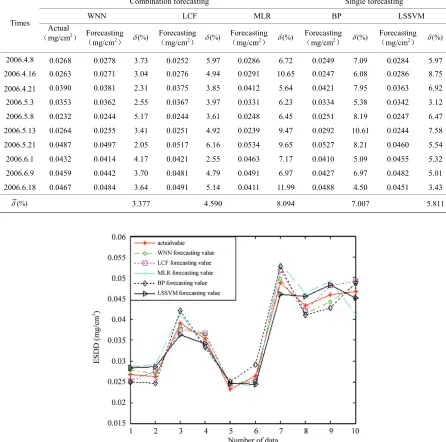
[image:4.595.352.493.532.692.2]On the basis of the model principles and modeling steps in the text, Matlab 7.0 is adopted to write the ESDD pre-diction programs based on WNN. References [4–7,9] show there is a close relationship between insulators ESDD and meteorological factors. So, for each single model, 120 samples of the historical meteorological data and ESDD data provided by “Optical Sensor System for the ESDD Monitoring of Transmission Equipment” (de-veloped by Wuhan High Voltage Research Institute and Wuhan Kangpu Changqing Software Company) installed on the ESDD monitoring spot of Qingshan District, Wu-han ,from April to June in 2006, are regarded as training set and forecasting set, where 90 samples belong to training set, and the rest 30 samples to test set. Table 1 shows the comparisons between WNN combination forecasting model and LCF, MLR, BP and LSSVM.
Table 1. Comparison of forecasting results of ten ESDD
Combination forecasting Single forecasting
WNN LCF MLR BP LSSVM
Times Actual
(mg/cm2) Forecasting
(mg/cm2) (%) Forecasting(mg/cm2) (%)
Forecasting
(mg/cm2) (%)
Forecasting
(mg/cm2) (%) Forecasting (mg/cm2) (%)
2006.4.8 0.0268 0.0278 3.73 0.0252 5.97 0.0286 6.72 0.0249 7.09 0.0284 5.97
2006.4.16 0.0263 0.0271 3.04 0.0276 4.94 0.0291 10.65 0.0247 6.08 0.0286 8.75
2006.4.21 0.0390 0.0381 2.31 0.0375 3.85 0.0412 5.64 0.0421 7.95 0.0363 6.92
2006.5.3 0.0353 0.0362 2.55 0.0367 3.97 0.0331 6.23 0.0334 5.38 0.0342 3.12
2006.5.8 0.0232 0.0244 5.17 0.0244 3.61 0.0248 6.45 0.0251 8.19 0.0247 6.47
2006.5.13 0.0264 0.0255 3.41 0.0251 4.92 0.0239 9.47 0.0292 10.61 0.0244 7.58
2006.5.21 0.0487 0.0497 2.05 0.0517 6.16 0.0534 9.65 0.0527 8.21 0.0460 5.54
2006.6.1 0.0432 0.0414 4.17 0.0421 2.55 0.0463 7.17 0.0410 5.09 0.0455 5.32
2006.6.9 0.0459 0.0442 3.70 0.0481 4.79 0.0491 6.97 0.0427 6.97 0.0482 5.01
2006.6.18 0.0467 0.0484 3.64 0.0491 5.14 0.0411 11.99 0.0488 4.50 0.0451 3.43
(%)
[image:5.595.76.521.97.547.2] 3.377 4.590 8.094 7.007 5.811
Figure 3. Comparison between the predicted and the measured
compared with linear combination model, WNN combi-nation model presented in the paper is more stable and practical, and can improve efficiently forecasting preci-sion. Using the ESDD predicted by WNN combination forecasting model to divide pollution area can effectively increase the accuracy of pollution distribution map. From Table 1, it can be seen that the average relative
error of MLR is 8.09 which is the biggest one among those of the five forecasting models, and that of WNN is , the least one , and each relative error of WNN is less than . The average relative error of LCF is which is only bigger than that of WNN. Besides, the maximum relative error of LCF, MLR, BP
and LSSVM are 6.16 , , and
respectively; while that of WNN is only . This indicates that the prediction accuracy of combina-tion model is higher than that of each single model, and
4%
6%
% 3.377%
4.590%
11.99% 10.61% 5.1
7.58% 7%
6. Conclusions
[image:5.595.73.519.106.548.2]distribution map, and further affects the insulation capa-bility of power system.
The WNN combination forecasting model combined with multivariable linear regression technique, BP neural network and least squares support vector machines avoids the limitations of linear combination model and single forecasting model, so it can boost the forecasting accu-racy, especially deduce maximum relative error, in other words, it can decline predicting risk. The simulation re-sults in Table 1 show in the five models, the prediction accuracy of WNN combination model is the highest one, namely, the values of WNN are closest to the observed ones. The ESDD values produced by WNN combination forecasting model can better meet the request of drawing pollution distribution map of power network. The model proposed by the paper is an effective and doable way for ESDD forecasting and provides a new thinking for the computerization of drawing pollution distribution map.
REFERENCES
[1] Y. Hu, “The analysis of ‘2.22 pollution flashover of net-work’ and measure for anti-pollution flashover,” High Voltage Engineering, Vol. 27, pp. 30–32, April 2001. [2] Y. Liu and J. K. Wang, “Analysis of large area pollution
flashover occurred in Shaanxi power network on Dec.18, 2000 and preventative measures for similar accidents,” Power System Technology, Vol. 26, pp. 82–85, June 2002.
[3] Pollution Classification and External Insulation Selection for Electrical Power System, State Grid Standard Q/ GDW152-2006, December 2006.
[4] A. S. Almad, H. Ahmad, M. A. Salam, and Saad Ahmad, “Regression technique for prediction of salt contamina-tion severity on high voltage insulators,” in Annual Re-port Conference on Electrical Insulation and Dielectric Phenomena, pp. 218–221, 2000.
[5] A. S. Almad, H. Ahmad, M. A. Salam, T. Tamsir, Z. Bun-tat, and M. W. Mustafa, “Prediction of salt contamination on high voltage insulators in rainy season using regres-sion technique,” Proceedings of TENCON, Vol. 3, pp. 184–189, 2000.
[6] M. A. Salam, S. M. Ai-Alawi, and A. A Maqrashi, “Pre-diction of equivalent deposit density of contaminated glass plates using artificial neural networks,” Journal of Electrostatics, Vol. 66, pp. 526–530, May 2008.
[7] A. S. Almad, P. S. Ghosh, H. Ahmad, and S. A .K. Aljunid, “Assessment of ESDD on high-voltage insulators using artificial neural network,” Electric Power System Re-search, Vol. 72, pp. 131–136, December 2004.
[8] S. B. Jiao, D. Liu, G. Zheng, and Q. Zhang, “Forecasting the ESDD of insulator based on least squares support vector machine,” Proceedings of the CSEE, Vol. 26, pp. 149–153, January 2006.
[9] F. H. Shu and W. X. Zhang, “A prediction model for in-sulator’s ESDD based on least square support vector ma-chine,” High Voltage Apparatus, Vol. 44, pp. 420–423, October 2008.
[10] J. M. Bate and C. W. J. Granger, “The combination of forecastings,” Operational Research Quarterly, Vol. 20, pp. 451–468, 1969.
[11] Y. Liu. “Mathematical model of multivariable linear re-gression,” Journal of Shenyang Institute of Engineering, Vol. 1, pp. 128–129, Junuary 2005.
[12] J. A. K. Suykens and J. Vandewalle. “Least squares sup-port vector machine classifiers,” Neural Process Letters, Vol. 9, pp. 293–300, 1999.
[13] J. A. K. Suykens, L. Lukas, P. Van Dooren, B. Demoor, and J. Vandewalle, “Least squares support vector machine classifiers: A large scale algorithm,” ECCTD’99 Euro-pean Conference on Circuit Theory and Design, pp. 293–300, 1999.
[14] Y. K. Ma and X. W. Tang, “Research on the problem of optimizing linear combination forecasting model,” Sys-tem Engineering – Theory & Practice, Vol. 9, pp. 110– 123, September 1998.
[15] X. H. Wen and M. J. Niu, “A new nonlinear combined forecasting method on the basis of neural networks,” Sys-tem Engineering-Theory & Practice, Vol. 12, pp. 66–72, December 1994.
[16] S. X. Li, “Wavelet transform and its applications,” Higher Education Press, Beijing, pp. 11–15, 1997.
[17] Q. X. Cuo and L. Liu, “Driving force prediction for in-clusion complexation of 2-cyclodextrim with benzene de-rivatives by a wavelet neural network,” Chemical Physics Letters, Vol. 290, pp. 514–518, 1998.