J. Software Engineering & Applications, 2009, 2: 209-220
doi:10.4236/jsea.2009.23029 Published Online October 2009 (http://www.SciRP.org/journal/jsea)
An Exploratory Case Study in Designing and
Implementing Tight Versus Loose Frameworks
Manjari GUPTA1, Ratneshwer GUPTA2, A. K. TRIPATHI3
1
Department of Computer Science, Faculty of Science, Banaras Hindu University, Varanasi, India; 2Department of Computer Science, MMV, Banaras Hindu University, Varanasi, India;3Department of Computer Engineering, Institute of Technology, Banaras Hindu University, Varanasi, India.
Email: {manjari, ratnesh, anilkt}@bhu.ac.in
Received May 5th, 2009; revised June 20th, 2009; accepted June 24th, 2009.
ABSTRACT
Frameworks provide large scale reuse by providing skeleton structure of similar applications. But the generality, that a framework may have, makes it fairly complex, hard to understand and thus to reuse. Frameworks have been classified according to many criteria. This paper proposes two types of framework (based on the concept of ‘generality’) named as: tight framework and loose framework. A case study is done by developing loose and tight frameworks for the appli-cation sets of Environment for Unit testing (EUT) domain. Based on the experience that we got by during this case study, we tried to find out the benefits of one (tight or loose) framework over the other. This work attempts to provide an initial background for meaningful studies related to the concept of ‘Design and Development of Framework’.
Keywords: Framework Reuse, Environment for Unit Testing, Condition Coverage Criteria
1. Introduction
“Frameworks are reusable designs of all or part of a software system described by a set of abstract classes and the way instances of those classes collaborate”. It is al-ways the result of domain analysis [1]. Frameworks may be classified according to many criteria such as manner of deployment in different applications, level of support that provides to applications, type of services they have (entity framework, control framework), level of abstrac-tion they have (white box framework, black box frame-works) etc. Frameworks are normally developed by keeping in mind requirements of multiple similar appli-cations. Frameworks should be developed and delivered in such a manner so that problems in instantiation (like determining the applicability of a framework, under-standing and modifying if necessary, architectural mis-match etc. [2]) do not arise and overheads (requirements that are not required in a particular application), do not get transported with the framework. In order to develop a framework, its scope must not be an afterthought and it should be considered at the beginning i. e. at the time of designing frameworks. When one talks about frame-works, its scope and generality are necessary to consider. Here, we classify frameworks by considering the gen-erality they have. In software engineering literature, we could not find the formal categorization of frameworks
based on ‘generality’ concept. We classify frameworks in two categories by considering their generality as follows.
A loose framework is a framework that does not fix the way of performing many activities (that may be per-formed differently in similar applications in a domain) in the framework itself. It only provides the control abstrac-tion and thus may need to work together with other frameworks for some activities that will extensively in-teract with it.Such frameworks may be useful for those applications that have many possible variations in their requirements for example business application systems, E-governance systems etc.
A tight framework fixes the way of performing most of such activities in the framework itself. Thus, these frameworks are highly useful for (only) those similar applications that require performing those activities in a particular way as defined and implemented in the framework. Such frameworks may be useful for those applications that have very few variations in their proper-ties like embedded systems, pervasive systems etc.
thus “whether a tight or a loose framework development would be beneficial for that domain?”
To the best of our knowledge, there is lack of such study/work in which tight and loose frameworks, for a same domain, are compared so that one can list the cases in which one (tight or loose framework) would be better than the other. In this paper, a tight and a loose framework for ‘Environment of Unit Testing’ have been developed and a comparative study has been made between the two types of frameworks. Based on the observations of this study, we tried to answer the following questions:
1) Which framework (tight or loose) is more reusable in terms of “ease of reuse”?
2) Which one is more reusable in terms of “number of reuses”?
3) Which one is easy to develop?
4) Which one is heavier in terms of size? 5) Which one is more complex?
Reminder of this paper is organized as follows. The section 2 attempts to present, in a concise manner, the research efforts related to the topic of discussion. In sec-tion 3, we briefly describe the domain ‘EUT’ for which frameworks have been developed. Designs of a loose and a tight framework for “EUT” have been described in sec-tion 4 and 5 respectively. A comparative study of loose and tight frameworks has been discussed in section 6. Finally, we conclude in section 7.
2. Related Work
Software engineering, over the last decades, has been promoting the development of software systems with software frameworks. Researchers and practitioners have been considering various aspects of framework devel-opment and related issues. Software frameworks are classified according to several criteria.
There are two styles of frameworks that are commonly used: called and calling frameworks. Sparks et al. [3] showed the reuse with Called and calling frameworks.
Called frameworks are very much like traditional librar-ies in that the application code calls the framework when some framework service is needed. Calling frameworks on the other hand, reverse the role of the framework and the application, because the framework calls the applica-tion code, rather than the other way around. Some au-thors defined frameworks according to domain depend-ency: vertical and horizontal frameworks [4]. A frame-work dependent on specific domain is referred to as ver-tical framework. A framework independent on specific domain is referred to as horizontal framework. Accord-ing to Taligent, Inc (now IBM) [5]) the problem domain that a framework addresses can encompass application functions, domain functions, or support functions. Ap-plication frameworksencapsulate expertise applicable to a wide variety of programs. These frameworks encom-pass a horizontal slice of functionality that can be applied
across client domains. Current commercial graphical user interface (GUI) application framework, which supports the standard function required by all GUI applications, is one type of application frameworks. Domain frameworks encapsulate expertise in a particular problem domain. These frameworks encompass a vertical slice of func-tionality for a particular client domain. Examples of do-main frameworks include: a control systems framework for developing control applications for manufacturing, securities trading framework, multimedia framework, or data access framework. Support frameworks provide system-level services, such as file access, distributed computing support, or device drivers. Several authors defined Frameworks based on the techniques used to extend them: White-box, Black-box and gray-box frameworks [4]. In a white box framework, the frame-work user is supposed to customize the frameframe-work be-haviour through sub-classing of framework classes. On the other hand, a black box framework user does not have access to framework code. Gray-box frameworks lie between white and black box framework. Frameworks are also classified by their scopes: System infrastructure frameworks, Middleware integration frameworks and
Enterprise application frameworks. System infrastructure frameworks simplify the development of portable and efficient system infrastructure. Communication frame-works, proposed by Schmidt [6],also belong to System infrastructure frameworks. Middleware integration frameworks are commonly used to integrate distributed applications and components. Common examples include ORB frameworks, message-oriented middleware, and transactional databases. Enterprise application frame-works, proposed by Fayad et al. [7],address broad appli-cation domains such as telecommuniappli-cations, avionics, manufacturing, and financial engineering.
However, no such study has been done till now to de-velop different types of frameworks for a domain and compare them to show in which situation which one is more applicable for reuse. We had earlier done risk analysis in framework development and its reuse [8]. This paper attempts to extend the above contributions further by considering the comparative differences of loose and tight frameworks.
3. Environment for Unit Testing
We briefly explain the domain “EUT” for which frame-works are developed in the next sections. To develop a framework, it is necessary to understand the domain for which it is to be developed. Thus, first we briefly de-scribe the unit testing process.
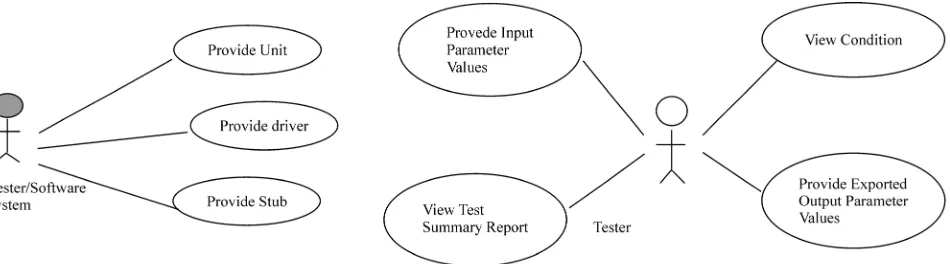
Figure 1. Use case diagram for tight framework
of a component [9]. As the focus of this testing level is on testing the code, structure testing is best suited for it. Unit testing commences with generating test drivers and stubs for the unit. Next, test cases are generated. A test case is a set of test inputs, on which the unit code, to be tested, is executed. The output of the program for each test case is evaluated to verify compliance with the cor-responding requirement using test oracles. During unit testing several test deliverables (test case specification, error report and test log etc.) are generated. At last, test summary report is generated that specify the result of testing process.
To test the structure of a program, structure testing aims to achieve test cases that will force the desired cov-erage of different structures. Various criteria have been proposed for this. Most common structure based criteria
are based on the control flow of the program for example statement coverage, branch coverage, decision/condition coverage and path coverage.
We developed both of these (tight and loose works) for the domain of ‘EUT’. Both of these frame-works test a unit written in C language. In the tight framework we fixed the test case generation activity (based on condition coverage criteria). Because of that, this framework can only be used if the unit testing crite-ria is ‘condition coverage’. For rest of the unit testing criteria, this reusable framework is useless. However, the test case generation activity was not fixed in the loose one and thus any test case generator (developed by con-sidering any unit testing criteria) that can generate test cases to test a C unit can be integrated with the loose framework. Both the frameworks (tight and loose) have been developed in C++ language.
4. The Proposed Tight Framework for ‘EUT’
We first describe the design and implementation of tight framework for ‘EUT’.
The tight framework is developed by considering the test cases generation based on the condition coverage
criterion. Thus, this framework supports the development
of a family of applications that would test a unit based on the condition coverage criteria but differ in the way of getting unit, driver, stubs. For example, a system devel-oped by using this framework may accept these from a human being while others may get these from software systems (that will be generating these automatically).
As we know, any object oriented software and in par-ticular any object oriented framework is a collaboration of domain, control logic, utility and interface classes. In this remaining section and in the next section, we iden-tify these classes for both tight and loose framework for ‘EUT’ and show how they collaborate with each other.
4.1 Analyzing the Requirements of Tight Framework for ‘EUT’
By studying the above problem statement, we specify how a user will interact with this tight framework in the
use case diagram shown in Figure 1. Gray ovals show the functionalities that are needed to be customized and black ovals show functionalities that are prefixed in the framework. Way to provide unit to be tested, drivers and stubs (if any) to the framework (manually by the tester or automatically using a software system) may be different for different applications that will be developed by using this framework. Thus, in the use case shown on the left hand side of Figure 1, actor may either be a human being or a software system and that’s why has shown as gray (as per the convention usually used to describe a frame-work). As shown in the use case on the right hand side of Figure 1, each condition, to be tested, is displayed to the tester and then a tester provides test cases corresponding to each condition. These test cases are run and test sum-mary report is delivered to the tester after the completion of the testing process.
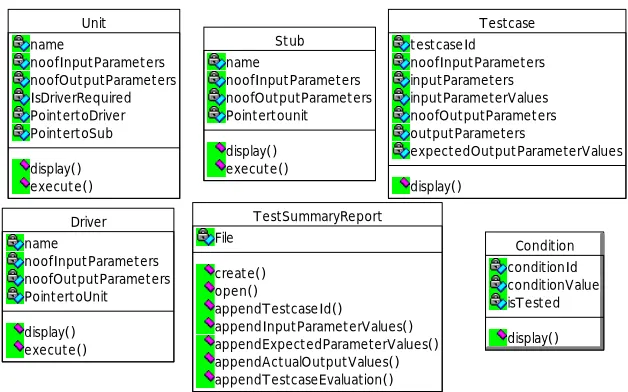
From the problem specification, described above, we can identify the following classes:
Unit – is an important class that would be tested using this framework,
Driver – would invoke and provide environment for he execution of the unit (if required),
Unit name
noofInputParameters noofOutputParameters IsDriverRequired PointertoDriver PointertoSub
display() execute()
Testcase testcaseId
noofInputParameters inputParameters inputParameterValues noofOutputParameters outputParameters
expectedOutputParameterValues
display()
TestSummaryReport File
create() open()
appendTestcaseId()
appendInputParameterValues() appendExpectedParameterValues() appendActualOutputValues() appendTestcaseEvaluation() Driver
name
noofInputParameters noofOutputParameters PointertoUnit
display() execute()
Stub name
noofInputParameters noofOutputParameters Pointertounit
display() execute()
Condition conditionId conditionValue isTested
[image:4.595.141.455.82.278.2]display()
Figure 2. Domain classes for tight framework
Stub – would be called by the unit during its execution (if required),
Test case – is a class that would represent a test case, Condition – is a class that represents a condition to be tested and
Test summary report – represents the test summary report delivered to the tester after testing. These domain classes along with their attributes and methods are shown in Figure 2.
4.2 Designing the Tight Framework for ‘EUT’
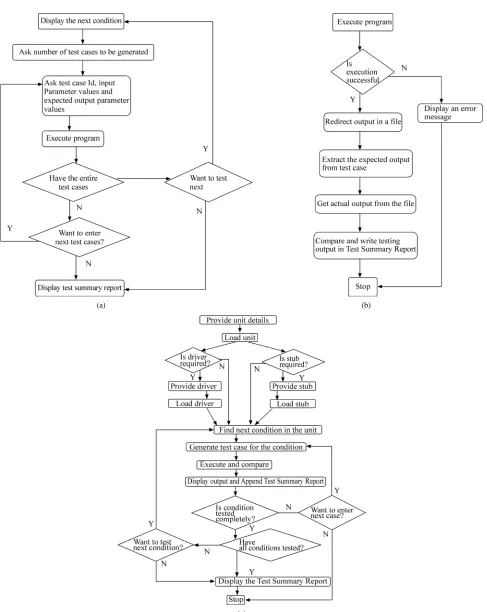
To represent the abstract dynamic behavior of the system developed as a tight framework, we first describe sce-narios.
The success scenario is as follows:
1) Unit is provided (way would be specific to the ap-plication) to the system.
2) If driver is needed, it is provided (way would be specific to the application) to the system.
3) If stubs are needed, these are provided (way would be specific to the application) to system.
4) Until all the conditions, in the unit, are tested a) Next condition is identified.
b) System displays this condition to the tester and asks the number of test cases (N) that need to be gener-ated to test this condition.
c) For this number (N) of times i) System asks the next test case. ii) Tester inputs the test cases.
iii) System executes this test case and redirects the output value of the execution to a file.
iv) The actual output value is compared with the expected output value and is shown to the tester.
v) System appends the testing result of this test case (condition, corresponding test case, actual output
value, execution status of the test case (success-ful/unsuccessful, executed or not) etc.) in the test sum-mary report.
vi) System asks whether to proceed further or quit. vi) If tester wants to quit (in case of getting wrong result to correct the unit), the path and name of the Test Summary Report is displayed to the tester and sys-tem stops.
d) System asks whether to proceed further or quit. e) If tester wants to quit, the path and name of the Test Summary Report is displayed to the tester and sys-tem stops.
5) A message “all the conditions have been tested” and the path and name of the Test summary report is dis-played to the tester.
An exception scenario could be: if the format of any of the information related to the program (unit, driver or stub) is unacceptable by the system, for example if the values of the input parameters, needed as a string con-taining all these values separated by a space, is not pro-vided in the required format. In all these types of situa-tions, system would display different error messages ac-cording to the situation.
Another abnormal scenario could be: if a test case cannot be run successfully and thus the execution fails. System will display an error message to show this situa-tion.
(a) (b)
(c)
[image:5.595.56.543.73.685.2]DriverLoader PointertoCurrentDriver
askDriverName() setDriverName() askNoofInputparameters() setNoofInputParameters() askNoofOutputParameters() setNoofOutputParameters() loadDriver()
getDriver()
TestSummaryReportGenerator PointertoTestcase
PointertoComprator
generateReport()
TestcaseGenerator PointertoTestSummaryReportGen PointertoExecutor
PointertoCurrentTestCase PointertoComparator NoofTestCasesPerCondition PointertoGUIforGettingTestcase
generateTestcase()
Comprator PointertoTestcase actualOutput
compare() UnitLoader
PointertoCurrentUnit
askUnitName() setUnitName()
askNoofInputParameters() setNoofInputParameters() askNoofOutputParameters() setNoofOutputParameters() loadUnit()
getUnit()
ConditionFileGenerator PointerToUnit
scanNextCondition() generateConditionFile() Executor
pointertoProgram pointertoCurrentTestcase
executeProgram()
StubLoader PointertoCurrentStub
[image:6.595.134.466.81.308.2]askStubName() setStubName() loadStub() getStub()
Figure 4. Control logic classes for tight framework
TestcaseInputGetter PointerToTestcase
getTestcaseInput() setTestcase()
UnitGetter isDriverRequired isStubRequired pointertoCurrentDriver pointertoCurrentStub
askIsDriverRequired() askIsStubRequired() askPointertoCurrentDriver() askPointertoCurrentStub()
DriverGetter PointertoCurrentUnit
askPointertoCurrentUnit()
StubGetter pointertoCurrentUnit
askPointertoCurrentUnit()
Figure 5. Graphical user interface class for tight framework
Scenarios and activity diagram, described above, hint for the following control logic classes:
UnitLoader – responsible for loading the unit to be tested,
DriverLoader – responsible for loading a driver (if any),
StubLoader – responsible for loading a stub (if any), TestcaseGenerator – responsible for generating test cases with the help of tester,
ConditionFileGenerator – responsible for identifying all the conditions, in the unit, to be tested,
Executor – responsible for executing the unit (if there is no driver) or driver,
Comparator – responsible for comparing the actual output from the expected output parameter values for a given test case and
TestSummaryReportGenerator – responsible for generating test summary report.
These control logic classes along with their attributes and methods are shown in the Figure 4.
Following are the interface classes that are designed for this tight framework. These classes with their attrib-utes and methods are shown in Figure 5.
UnitGetter – responsible for providing unit, to be tested, to the rest of the system.
DriverGetter – responsible for providing driver, if any, to the rest of the system.
StubGetter – responsible for providing stubs, if any, to the rest of the system.
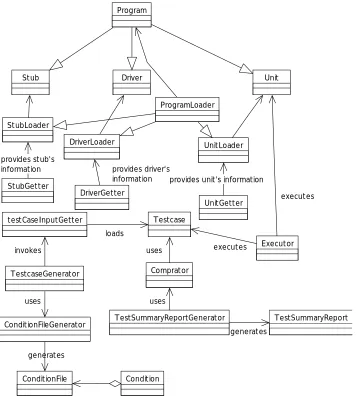
[image:6.595.187.408.342.501.2]In this framework Unit, Driver and Stub classes share several attributes and methods thus we take a class Pro-gram from which all these three classes will inherit properties and operations. Similarly, UnitLoader, Driver Loader and StubLoader also share several properties and operations and we have taken a class ProgramLoader that have all the common properties and operations of these classes and these classes are taken as sub class of ProgramLoader class. Further, UnitLoader, DriverLoader, StubLoader are kept as abstract classes because we don’t fix in this framework how the unit, drivers or stubs are generated. Thus, these classes are hot spots of the frame- work. At the time of instantiation of this framework one needs to refine these subclasses according to the applica-tion using the framework. The object diagram, that sho- ws the relationships among all the types of classes identi-fied during analysis and design, is shown in Figure 6.
4.3 Instantiation
We have instantiated this framework by adding three classes UnitLoader_Sub of UnitLoader, Driver-Loader_Sub of DriverLoader and StubLoader_Sub of
StubLoader. These sub classes allow us to provide unit, drivers and stubs (if required) manually using graphical user interface. Thus in this instantiation, we assume the application need is to provide these manually. In any other instantiation, some other method of providing a unit, drivers and stubs can be used for example as a result of some automation process that will generate them etc. Further one more class GUI is added that helps in im-plementation of these other classes added during instan-tiating. GUI class has a method that displays a string, passed it as a parameter, to the user. Thus, at the time of instantiation of this tight framework for ‘EUT’ only four additional classes were needed to be added.
loads
generates uses
executes
TestSummaryReport
Stub Driver
Program
ProgramLoader
TestSummaryReportGenerator
Unit
executes
uses
Condition generates
ConditionFile ConditionFileGenerator
uses invokes
TestcaseGenerator Comprator
Executor Testcase
testCaseInputGetter StubGetter StubLoader
DriverGetter DriverLoader
UnitGetter UnitLoader provides stub's
information provides driver's
[image:7.595.123.480.306.705.2]information provides unit's information
Figure 7. Use case diagram for loose framework
Figure 8. Activity diagram for loose framework
5. Loose Framework for ‘EUT’
In the loose framework, for the same ‘EUT’ domain, we do not restrict the method of drivers, stubs or test case generation as we did in the above tight framework. However, in this loose framework the test oracle is also not fixed. That is, this framework would accept the driv-ers, stubs (if required for a unit) and test cases from somewhere else as the tight one did. These would be
[image:8.595.185.413.240.586.2]5.1 Analyzing the Loose Framework Requirements
By studying the problem statement, we specify the func-tionalities that the framework will support in the use case diagram in Figure 7. Gray ovals show functionalities that are needed to be customized and black ovals show func-tionalities that are prefixed in the framework. Unit, to be tested, drivers and stubs (if any) and test cases can be provided to the system either manually or can be loaded automatically using any software.
After analysis, here also, we get the same domain classes as we obtained in tight framework described above: Unit, Driver, Stub, Test case, and test summary report. Only the domain class ‘condition’ that was iden-tified during development of the tight framework, de-scribed above, is not a domain class for this framework. Rests of the classes are all same.
5.2 Designing the Loose Framework
To represent the dynamic behavior of a system that would be developed using this loose framework, we de-scribe the following scenarios that explain how the sys-tem behaves when it performs some of its functions. The success scenario is as follows:
1) Unit is provided to the system.
2) If driver is needed, driver is provided to the system. 3) If stubs are needed, these are provided to the sys-tem.
4) Test data is given to the system.
5) Test oracle provides the correct output for a given test data.
6) System executes the test case and compares the
ac-tual output with the expected output parameter values. 7) System generates a test summary report.
Abnormal scenarios are as follows: 1) Unit is given to the system.
2) If driver is needed, driver is given to the system. 3) Test data is given to the system.
4) Test oracle provides the correct output for the test case.
5) System could not execute the test case and gener-ates an error message “execution failed”.
Similarly other abnormal scenarios would be if the unit and driver cannot be provided in the form used by the system. At that time system again generates error messages corresponding to the error occurred.
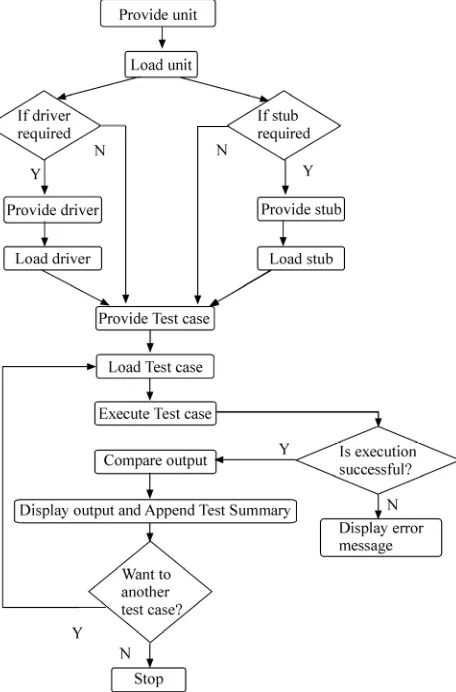
As we mentioned above, in this loose framework, we do not restrict the method of generating drivers, stubs or test case generation. Similarly the test oracle is also not fixed. That is, drivers and stubs (if required for a unit to be tested) and test cases can be provided manually or generated automatically and are supplied to this frame-work. This loose framework will accept and load these drivers, stubs and test cases into their respective classes defined in the framework. As the actual output would need to be compared with the expected output, these output variables would need to be stored in a file and then compared with the expected output. To redirect execution output of the unit it is required to add code in the unit for the purpose. Activity diagram (Figure 8) shows all the activities in this ‘EUT’ framework in brief.
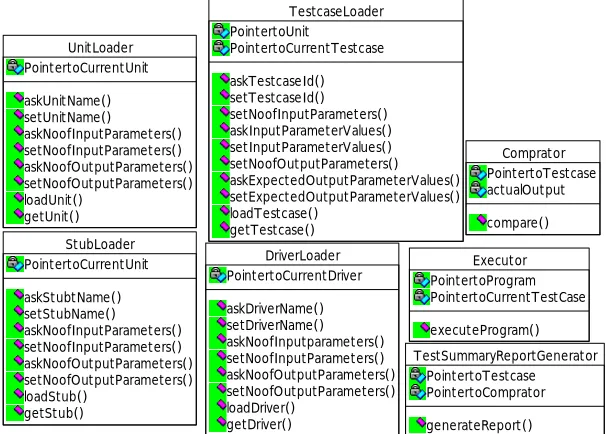
Activity diagram hints some application logic classes: UnitLoader, DriverLoader, StubLoader, TestcaseLoader, Executor, Comparator, TestSummaryReportGenerator. These classes are shown in Figure 9.
[image:9.595.146.449.486.703.2]DriverLoader PointertoCurrentDriver askDriverName() setDriverName() askNoofInputparameters() setNoofInputParameters() askNoofOutputParameters() setNoofOutputParameters() loadDriver() getDriver() TestSummaryReportGenerator PointertoTestcase PointertoComprator generateReport() TestcaseLoader PointertoUnit PointertoCurrentTestcase askTestcaseId() setTestcaseId() setNoofInputParameters() askInputParameterValues() setInputParameterValues() setNoofOutputParameters() askExpectedOutputParameterValues() setExpectedOutputParameterValues() loadTestcase() getTestcase() Comprator PointertoTestcase actualOutput compare() StubLoader PointertoCurrentUnit askStubtName() setStubName() askNoofInputParameters() setNoofInputParameters() askNoofOutputParameters() setNoofOutputParameters() loadStub() getStub() UnitLoader PointertoCurrentUnit askUnitName() setUnitName() askNoofInputParameters() setNoofInputParameters() askNoofOutputParameters() setNoofOutputParameters() loadUnit() getUnit() Executor PointertoProgram PointertoCurrentTestCase executeProgram()
loads
generates uses
executes
uses
TestSummaryReport
Stub Driver
Program
ProgramLoader
TestSummaryReportGenerator TestcaseLoader
Comprator
Executor
Testcase
Unit
TestOracle executes
uses
uses StubGetter
StubLoader
provides stub information
DriverGetter DriverLoader
provides driver information
UnitProvider UnitLoader
[image:10.595.146.454.83.401.2]provides unit information
Figure 10. Object diagram of a loose framework
The user interface classes for this loose framework are same as they were in the above tight framework. Only the TestCaseInputGetter class is not included in this framework.
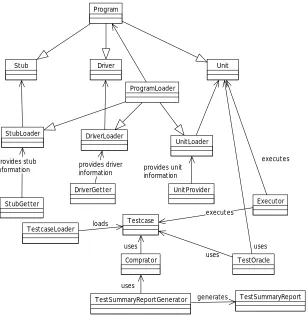
In this framework also, we take Program as an ab-stract class from which Unit, Driver and Stub classes would inherit properties and operations for the same rea-son as described in tight framework. Similarly, Pro-gramLoader is taken as an abstract class of which Unit-Loader, DriverLoader and StubLoader are be imple-mented as sub classes for the same reason. Further,
UnitLoader, DriverLoader, StubLoader and Test-caseLoader are also kept as abstract classes because we don’t fix in this framework how the unit, drivers, stubs or test cases are generated. Thus, these classes are hot spots of the framework. At the time of instantiation of this framework one needs to refine these in subclass accord-ing to the application usaccord-ing the framework. After identi-fying the attributes and methods of these applica-tion-logic classes along with relationship among these and problem domain classes we get the object diagram (Figure 10).
5.3 Instantiation
We have instantiated this framework by adding five
classes UnitLoader_Sub a sub class of UnitLoader,
DriverLoader_Sub a sub class of DriverLoader and
StubLoader_Sub a sub class of StubLoader Test-CaseLoader_Sub a sub class of the class TestCaseLoader
and a class GUI. Except the TestCaseLoader_Sub rest of the classes have the same role and responsibilities that they have in the earlier described tight framework for ‘EUT’. Since activities concerning with these classes were not fixed in the above tight framework also. Using this loose framework since the generation of test cases is not fixed in the framework there is a need to customize this activity also and thus the TestCaseLoader_Sub sub class is also added in the instantiation of this loose framework.
6. Observations
Table 1. Comparison of tight and loose frameworks at code level
S.N. Code Characteristics of frameworks Tight framework Loose framework
1. Total number of methods 74 68
2. Number of virtual functions 4 8
3. Total Number of classes 18 13
4. Number of abstract classes 4 5
5.
Size (Total number of non-commented lines
of code ) 624 485
A comparative table 1 shows different characteristics for loose and tight frameworks are drawn below.
By comparing frameworks at code level, we can an-swer the questions discussed above at some extent.
1) If a software framework has more number of ab-stract classes and virtual functions, the possibility of its reuse will be higher. As we know, the abstract classes and virtual functions give freedom (flexibility) to de-signers to instantiate a framework according to the re-quirements of a specific application. So such a frame-work can be reused in more number of applications. It can be shown from the table that loose framework for ‘EUT’ have 8 virtual functions and 5 abstract classes while tight framework has 4 virtual functions and 4 ab-stract classes. It shows the loose framework would be more reusable in terms of “number of reuses” because it can be used in more number of application developments than the tight one.
In a software framework, the abstract classes and vir-tual functions have to be customized at the time of in-stantiation of that framework. A designer/implementer would have to extend abstract classes and virtual func-tions according to the requirements of any specific ap-plication. If a software framework has more number of abstract classes and virtual functions then more effort would be needed to customize them at the time of instan-tiation. However, as autonomous, in terms of its service providing responsibilities, a framework would be that better contribution it can make in functioning of the sys-tem. It is shown in the table that loose framework for ‘EUT’ have 8 virtual functions and 5 abstract classes while tight framework has 4 virtual functions and 4 abstract classes. As identified in the definition of tight framework that it fixes the way of performing most of such activities in the framework itself, it is our conjecture that tight framework would be more reusable in terms of “ease of reuse”. As shown in Figure 9 ‘TestcaseLoader’ is an abstract class in the loose framework that is to be implemented according to the application specific re-quirements and hence requires extra effort. Whereas the tight framework has a concrete ‘TestcaseGenerator’ class that has all the implementation and hence it can be di-rectly used in the application.
2) As given in the definition of loose framework that it is a framework that does not fix the way of performing most of the activities in the framework itself. During design of loose framework one need not to write semi-code for the portion that is not concretely defined in the framework. As shown in section 4, we did not fix the unit testing criteria in loose framework so we need not to develop code for generating test cases (based on any criteria) in this framework; only the interface that would connect the test case generator is needed to be developed. However, in the case of tight framework, one has to collect all the requirements for a specific applica-tion. Since, in tight framework, we fix the way of per-forming most of the activities so we have to write semi-code for all the activities. As shown in section 5, for the tight framework, where we fixed the testing crite-ria as condition testing, we required to develop whole code for generating test cases, satisfying this condition coverage criterion, as part of the framework itself. Based on our design and development experience regarding both type of frameworks, it is our conjecture that a loose framework would always be easier to develop than a tight one.
3) Unlike a loose framework, in a tight framework we fix most of the activities, so we have to write semi-code for them. It can be shown from the table that size of tight framework (total number of non-commented line of code) is 624 while size of loose framework is 485. And thus, the tight framework will be heavier, in terms of size, as compare to loose framework.
interact-ing with each other. As in our case, loose framework for ‘EUT’ interact with any of the test case generator framework and perform the unit testing. Thus whenever we need to modify in test case generator framework there is no need to understand the ‘EUT’ framework and vice-versa. Thus we can say a loose framework would always be less complex than a tight framework for the same domain. In short, we can say that the complexity of the tight framework would be high because several ac-tivities considered in that framework may result in tightly coupled implementation of them. However, the loose framework that contains only the abstract code would be less complex since no detailed implementation is there in its code.
One can consider the basic guiding principles for de-signing a software framework based on the above obser-vations.
7. Conclusions
For some situations a tight framework would be better than a loose framework for same domain if the ways of performing the activities, fixed in the tight framework, are exactly those that are required in the needed applica-tion. In this paper, we suggested some scenarios, which type of framework would be more appropriate as com-pared to other one. These observations will be useful at the time of selection of frameworks. We have focused on limited parameters. Results would be more visible for industrial applications. One can extend this study by considering other quality criteria.
REFERENCES
[1] D. Roberts and R. Johnson, “Evolving frameworks: A pattern language for developing object-oriented frame-works,” in Pattern Languages of Program Design 3. Ad-dison-Wesley, Illinois, USA, 1997.
[2] J. Bosch, P. Molin, M. Mattsson, and P. Bengtsson, Ob-ject-Oriented Frameworks – Problems & Experiences, 1997.
[3] S. Sparks, K. Benner, C. Faris, and S. Consulting, “Man-aging object-oriented framework reuse,” IEEE 1996, pp. 52–61, 1996.
[4] Y. J. Yang, S. Y. Kim, G. J. Choi, E. S. Cho, C. J. Kim, and S. D. Kim, “A UML-based object-oriented frame-work development methodology,” Software Engineering Conference, Proceedings. 1998 Asia Pacific, pp. 211–218, 1998.
[5] IBM, “Building Object-Oriented Frameworks”, http: //www.ibm.com/java/education/oobuilding/index.html. [6] D. C. Schmidt, “Applying design patterns and
frame-works to develop object-oriented communication soft-ware,” Handbook of Programming Languages, Volume I, edited by Peter Salus, MacMillan Computer Publishing, 1997.
[7] M. E. Fayad and D. S. Hamu “Object-oriented enterprise frameworks: Make vs. buy decisions and guidelines for selection,” The Communications of ACM, 1997.
[8] A. K. Tripathi and M. Gupta, “Risk analysis in re-use-oriented software development,” International Journal of Information Technology and Management, Vol. 5, No. 1, pp. 52–65, 2006.