Full Terms & Conditions of access and use can be found at
http://www.tandfonline.com/action/journalInformation?journalCode=zgha20
Global Health Action
ISSN: 1654-9716 (Print) 1654-9880 (Online) Journal homepage: http://www.tandfonline.com/loi/zgha20
Does the Structured Operational Research and
Training Initiative (SORT IT) continue to influence
health policy and/or practice?
Jaya Prasad Tripathy, Ajay MV Kumar, Nathalie Guillerm, Selma Dar Berger,
Karen Bissell, Anthony Reid, Rony Zachariah, Andrew Ramsay & Anthony D
Harries
To cite this article: Jaya Prasad Tripathy, Ajay MV Kumar, Nathalie Guillerm, Selma Dar Berger, Karen Bissell, Anthony Reid, Rony Zachariah, Andrew Ramsay & Anthony D Harries (2018) Does the Structured Operational Research and Training Initiative (SORT IT) continue to influence health policy and/or practice?, Global Health Action, 11:1, 1500762, DOI: 10.1080/16549716.2018.1500762
To link to this article: https://doi.org/10.1080/16549716.2018.1500762
© 2018 The Author(s). Published by Informa UK Limited, trading as Taylor & Francis Group.
Published online: 06 Aug 2018.
Submit your article to this journal
Article views: 39
ORIGINAL ARTICLE
Does the Structured Operational Research and Training Initiative (SORT IT)
continue to influence health policy and/or practice?
Jaya Prasad Tripathy a,b, Ajay MV Kumara,b, Nathalie Guillermb, Selma Dar Bergerb, Karen Bissellb, Anthony Reidc, Rony Zachariahc, Andrew Ramsayd,eand Anthony D Harriesb,f
aInternational Union Against Tuberculosis and Lung Disease, South-East Asia Office, New Delhi, India;bInternational Union Against
Tuberculosis and Lung Disease, Paris, France;cMédecins Sans Frontières, Medical Department, Operational Centre Brussels,
Luxembourg;dSpecial Programme for Research and Training in Tropical Diseases, World Health Organization, Geneva, Switzerland; eSchool of Medicine, University of St Andrews, Fife, UK;fLondon School of Hygiene & Tropical Medicine, London, UK
ABSTRACT
Background: The Structured Operational Research and Training Initiative (SORT IT) is a successful model of integrated operational research and capacity building with about 90% of participants completing the training and publishing in scientific journals.
Objective: The study aims at assessing the influence of research papers from six SORT IT courses conducted between April 2014 and January 2015 on policy and/or practice.
Methods: This was a cross-sectional mixed-method study involving e-mail based, self-admi-nistered questionnaires sent to course participants coupled with telephone/Skype/in-person responses from participants, senior facilitators and local co-authors of course papers. A descriptive content analysis was performed to generate themes.
Results: Of 71 participants, 67 (94%) completed the course. A total of 67 papers (original research) were submitted for publication, of which 61 (91%) were published or were in press at the censor date (31 December 2016). Among the 67 eligible participants, 65 (97%) responded to the questionnaire. Of the latter, 43 (66%) research papers were self-reported to have contributed to a change in policy and/or practice by the course participants: 38 to a change in government policy or practice (26 at the national level, six at the subnational level and six at the local/hospital level); four to a change in organisational policy or practice; and one study fostered global policy development.
Conclusion: Nearly two-thirds of SORT IT course papers contributed to a change in policy and/or practice as reported by the participants. Identifying the actual linkage of research to policy/practice change requires more robust methodology, in-depth assessment and inde-pendent validation of the reported change with all concerned stakeholders.
ARTICLE HISTORY
Received 13 October 2017 Accepted 6 July 2018
RESPONSIBLE EDITOR
Isabel Goicolea, Umeå University, Sweden
KEYWORDS
Operational research; policy; The Union; Médecins Sans Frontières; TDR; SORT IT
Background
Operational research (OR), from a public health per-spective, has been defined as the search for knowledge on interventions, strategies or tools that can enhance the quality, coverage, effectiveness or performance of the health system, specific health services or disease control programmes in which the research is being conducted [1]. OR is gaining recognition and impor-tance in public health, guiding national research agen-das and programme implementation to achieve desired results [1,2]. Despite this, the implementation of OR is poor, especially in low- and middle-income countries (LMICs) where it has a vital role to play. One of the main reasons for this short-coming is the lack of capa-city in conducting OR [1,3]. The International Union Against Tuberculosis and Lung Disease (The Union), Médecins Sans Frontières (MSF) and the Special Programme for Research and Training in Tropical Diseases (TDR) at the World Health Organization (WHO), have pioneered a programme of integrated
OR and capacity building known as the Structured Operational Research and Training Initiative (SORT IT). The aim of the SORT IT programme is to teach the practical skills of conducting and publishing research, and to impact policy and/or practice. The end expected result is improved health care delivery and programme performance [4].
Measuring the impact on policy and/or practice is a crucial element in assessing the success of OR conducted through the SORT IT programme. To achieve this, a systematic follow-up is done 18 months after course completion to assess whether research conducted by the course participants has had any impact on policy and/or practice. Two previous studies revealed 56% and 74% of the course publications had contributed to changes in policy and/or practice within that timeframe [5,6]. In the meantime, scale-up of SORT IT has contin-ued globally; new geographic regions have been included and there is a deliberate effort to decentralize training to regional and national levels. As policy and/or practice
CONTACTJaya Prasad Tripathy [email protected] Senior Operational Research Fellow International Union Against Tuberculosis and Lung Disease, The Union South-East Asia Office, C-6, Qutub Institutional Area, 110016, New Delhi, India
GLOBAL HEALTH ACTION 2018, VOL. 11, 1500762
https://doi.org/10.1080/16549716.2018.1500762
© 2018 The Author(s). Published by Informa UK Limited, trading as Taylor & Francis Group.
change may be affected by the above factors, assessing if new SORT IT courses continue to influence change in policy and/or practice is vital. In this paper we describe the self-reported contribution to policy and/or practice from six SORT IT courses completed between April 2014 and January 2015.
Methods
Study design
This was a mixed-methods study with a cross-sectional quantitative and a descriptive qualitative design.
Setting
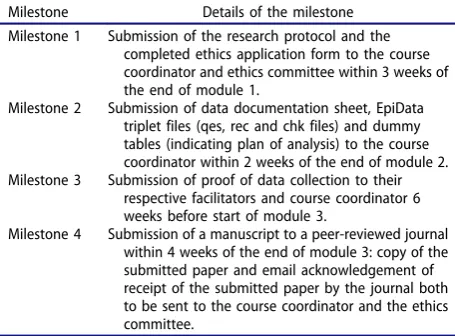
The structure and organization of the SORT IT courses have been described elsewhere [4]. Briefly, the course is conducted over a period of 10–12 months, and there are three modules: module 1 (OR protocol development); module 2 (data capture and analysis); and module 3 (paper writing), with four clearly defined milestones and expected outputs (Table 1). A maximum of 12 participants are selected per course. Individuals working in routine pro-gramme settings are preferred, with particular atten-tion placed on the relevance of the OR quesatten-tion and use of routinely collected programme data. Participants receive a full scholarship, which includes course fee, accommodation and full meals, transport, and per-diems. Each module takes around 6–7 days and includes formal lectures, one-to-one mentoring of participants and group plenary sessions. The mile-stones have to be achieved for participants to remain on the course. Failure to meet any of the first three milestones results in non-eligibility of the participant to attend module 3, while failure to meet the final milestone (i.e. submission of the final paper to a
peer-reviewed journal within 4 weeks of completion of module 3) results in the participant being declared a
‘course failure’.
Although these courses revolve around conducting and publishing OR within a certain time frame, there is a considerable focus on translating the evidence generated into policy and/or practice. On the very first day of the course there is a lecture on
‘Translating OR into policy and practice’ which dis-cusses enablers and challenges to evidence transla-tion, case studies on research impacting policy and/ or practice, and what worked and what did not. The importance of choosing a policy-relevant research question, identifying and engaging policy makers/ influencers from the beginning, and effective disse-mination of research findings are all strongly empha-sized early on in module 1.
Study participants
The study population included all participants and senior facilitators of six SORT IT courses started between April 2014 and January 2015. The courses were run in Chennai, India; Kathmandu, Nepal; Luxembourg city, Luxembourg; Addis Ababa, Ethiopia; Nadi, Fiji; and Tallinn, Estonia.
Sources of data, variables and data collection
[image:3.595.60.288.602.770.2]Self-administered, structured questionnaires were e-mailed to the course participants 18 months after course completion and responses were emailed back to the Union headquarters in Paris, France. The questionnaire included closed ended quantitative and open ended qualitative variables. The quantitative variables included demographic details of the participant, affiliation and designa-tion, details about the OR project s/he was involved in during the course, and its publication status. The qualitative variables included an open ended ques-tion assessing the effect of the research project on policy and/or practice. If the research was reported to have affected policy/practice change, the partici-pants were contacted and a detailed explanation was sought, and if the research was not reported to affect policy/practice change, reasons were asked. Wherever required, senior facilitators and other local co-authors who were involved in the study, and other relevant stakeholders, were contacted over the telephone or Skype or in-person for further clarifications and to confirm the facts pre-sented by the participants, and their responses were transcribed. The effect of any research project was considered ‘yes’ if it contributed to any change in policy and/or practice or scale up of an existing intervention at any level, be it national, subna-tional, local or organizational. Contribution to
Table 1.Milestones for SORT IT operational research and capacity-building programmes in Europe, Africa, Asia and the South Pacific starting from April 2014 to January 2015a.
Milestone Details of the milestone Milestone 1 Submission of the research protocol and the
completed ethics application form to the course coordinator and ethics committee within 3 weeks of the end of module 1.
Milestone 2 Submission of data documentation sheet, EpiData triplet files (qes, rec and chk files) and dummy tables (indicating plan of analysis) to the course coordinator within 2 weeks of the end of module 2. Milestone 3 Submission of proof of data collection to their
respective facilitators and course coordinator 6 weeks before start of module 3.
Milestone 4 Submission of a manuscript to a peer-reviewed journal within 4 weeks of the end of module 3: copy of the submitted paper and email acknowledgement of receipt of the submitted paper by the journal both to be sent to the course coordinator and the ethics committee.
aThis includes six courses in India (1), Nepal (1), Luxembourg (1), Fiji (1),
change in policy and/or practice was based on self-reports backed by documentary evidence and vali-dated by other local or senior co-authors who were involved in the study. In order to maximize objec-tivity, the final decision about whether policy and/ or practice change occurred was taken through consensus by a team of co-authors (JPT, AMVK, RZ, ADH). We took a conservative approach in determining whether a study contributed to the policy/practice – meaning. if there was any doubt, the study was considered not to have contributed to policy and/or practice.
The impact was assessed at global, government (which includes national, subnational or local/public hospital level) and organizational level, which includes non-governmental organizations (NGOs) and private sector hospitals.
Data entry and analysis
The data (both quantitative and qualitative) were captured in an MS Excel format. Quantitative vari-ables were summarized using proportions. For quali-tative data, a descriptive content analysis of responses was performed. The content was analysed manually by two authors (JPT, AK), who are experienced in qualitative research methods. Themes were generated in consensus using standard procedures [7]. Any disagreement between the two authors was resolved by consensus after consultation with two senior authors (ADH, RZ). The following broad themes emerged from the responses: changes in government policy and/or practice (subdivided into national, sub-national and local/hospital level depending on the level of impact) and changes in organizational policy and/or practice (when decisions were made by an organization such as the MSF or The Union to improve their performance). Themes were generated by two authors (JPT, AK) together to remove sub-jective bias and enhance interpretive credibility. The participants/senior facilitators were contacted again through e-mail/Skype/telephone in case any clarifica-tion was required.
Ethics
Ethics approval for the study was obtained from the Ethics Advisory Group of The International Union Against Tuberculosis and Lung Disease (The Union), Paris, France. Since the 18 month assessment is per-formed routinely as part of the SORT IT pro-grammes, the ethics advisory group waived the need for written informed consent for questionnaires. Participants were free not to respond to the ques-tionnaires. Verbal informed consent of individuals who were interviewed was obtained.
Results
Quantitative findings
Characteristics of SORT IT participants
Of 71 (45% female) participants in the six courses, 67 (94%) successfully completed the course and submitted a paper each to a peer-reviewed scientific journal. Among 67 eligible participants, 65 (97%) responded to the questionnaire. The participants came from 36 coun-tries across four continents (26 from Asia among which 12 were from India, 15 from Africa, 12 from the South Pacific, 13 from Europe and one from Latin America). The majority of the participants were medical doc-tors (29), followed by public health specialists (14), research officers/programme managers (7), nurses (7), monitoring and evaluation officers (5), data man-agers/biostatisticians (2) and other paramedical staff (3). Most of them were working in the government sector (20), followed by NGOs (17), academia (9), hospitals (8), WHO (7) and research institutes (6).
Manuscript submissions, publications and self-reported changes in policy and/or practice
A total of 67 papers (original research) were submitted for publication, of which 61 (91%) were published or in press as of December 2016. The topics covered included 36 (54%) in tuberculosis (TB), 10 (15%) in non-communic-able diseases, six (9%) in human immunodeficiency virus (HIV) infection, three (4%) in maternal and child health, three (4%) in neglected tropical diseases and nine (14%) in other subject areas (antibiotic prescribing, nosocomial infections, drug resistance, and other issues related to clinical care, health services and health systems).
Of the 65 papers assessed, 43 (66%) reportedly con-tributed to a change in policy and/or practice (Figure 1). Of the 43 papers that reported an impact, 38 contrib-uted to a change in government policy or practice (26 at the national level, six at the subnational level and six at the local/public hospital level), four supported a change in organizational (NGOs, including private sector hos-pitals) policy and/or practice and one study contributed to global policy development. The changes could be classified into the following major themes: new policy decisions (n= 13); incremental changes in the existing policy strengthening the practice (n= 5); redrafting of national programme guidelines or clinical management protocols (n = 3); improved programme monitoring and reporting (n = 10); strengthening of information/ surveillance systems or patient databases (n = 5); and strengthening of existing evidence leading to scale up of existing interventions (n= 7).
Table 2gives examples of original research studies conducted within the SORT IT courses and their reported effect on policy and/or practice at national/ subnational, local/hospital and organizational level. Other examples in varied contexts are given below
with verbatim quotes from the course participants. All the examples given below and the citations pro-vided are from the studies undertaken by the partici-pants of the SORT IT programme.
Qualitative findings
Self-reported contribution to national policy and/or practice change
There were several examples of contribution to change in national policy/practice. Alikhanova et al. did the first national survey of anti-tuberculosis drug resistance in Azerbaijan and demonstrated a clear need for third-line anti-tuberculosis medicines [8]. The results of the study contributed to a new policy decision by the Ministry of Health. She [the author] said:
Based on the results of this study, the Ministry of Health took a decision to procure TB medicines, which were not used before in the country like beda-quiline, linezolid, imipenem, cilastatin etc.
A study by Atia et al. in Sudan generated evidence to influence changes in the national management protocol for visceral leishmaniasis (VL) and monitoring of adverse effects of the first-line VL treatment regimen [9]:
Yes, now the first line for visceral leishmaniasis treat-ment (sodium stibogluconate/paromomycin) is under focus and the new national protocol (2016) addressed the study recommendations in term of uses of this regi-men for relapse and in elderly; the VL programme added a pharmaco-vigilance component in the new VL patient
card to monitor this regimen; use of new drugs like miltefosine and amphotericin-B is now promoted.
A countrywide evaluation of decentralized TB clinics in Armenia [10] showed that some clinics performed very poorly in terms of TB case notifications and treatment success which contributed to a major pol-icy decision:
The research evaluated TB outpatient services in decentralised facilities and confirmed that 12 outpa-tient services have no efficiency in terms of TB detec-tion and treatment. As a result these 12 TB outpatient services were optimised and merged with the nearest TB outpatient services, improving the financial and service delivery capacity of the joint TB outpatient services.
A study on adverse drug events among a nationwide cohort of multi-drug resistant tuberculosis (MDR-TB) patients in Nigeria [11] impacted practice at the national level:
The National Tuberculosis Programme used the find-ings of the study to mobilize greater focus on pharma-covigilance activities, which include detection, reporting and management of adverse drug reactions among patients with MDRTB. Prior to the study, Nigeria had no documented evidence of the most prevalent adverse reactions of second line anti-tuber-culosis medications. This limited government efforts at drug regulatory activities as well as managing the affected patients. But with the findings of the study, Nigerian health workers now know the Adverse Drug Reactions to expect when people living with the MDRTB are placed on therapy.
Some studies had an impact on the routine monitor-ing mechanism or recordmonitor-ing and reportmonitor-ing system, such as those in Fiji [12,13] which contributed to improved reporting and recording of information of patients especially treatment outcomes of tuberculosis patients. A participant from Fiji said:
Yes, there was a need to correctly carry out data entry especially when recording the treatment outcome and this was put into practice immediately after the research results were disseminated.
Self-reported contribution to change in policy and/ or practice at organizational level
[image:5.595.67.283.50.255.2]Some research projects contributed to a change in organizational level policy or practice. In a project run by the MSF in Kibera, Kenya, a study by Some et al. showed that nurses were able to adhere to protocols for managing stable non-communicable disease (NCD) patients based on a clear standardized protocol [14]. This contributed to a major revision in the Kibera project guidelines which changed the way NCD patients are managed in those facilities. MSF also plans to implement the recommendations from this study in a proposed new project in a rural setting in Kenya:
Figure 1.Programme outputs from six completed SORT IT courses conducted in Europe, Africa, Asia and the South Pacific during 2014–2015.
Outputs from six completed SORT IT operational research courses run in
Europe, Africa, Asia and the South Pacific during 2014–2015. The six
courses were run in Chennai, India (n= 1); Tallinn, Estonia (n = 1);
Luxembourg (n= 1); Addis Ababa, Ethiopia (n= 1); Nadi, Fiji (n= 1) and
Kathmandu, Nepal (n= 1).
Table 2. Examples of operational research and their effect on policy and/or practice from six completed courses during 2014 – 2015. First author and country Study description Main findings and recommendations Effect on policy and practice Change in national policy and/or practice Narayan N. et al. (2014), Fiji [ 27 ] A retrospective cohort study of all TB patients registered with the National Tuberculosis Programme (NTP) in Fiji between January 2011 and June 2013. To determine anti-tuberculosis treatment outcomes, stratified by method of treatment supervision (i.e. self-administered treatment [SAT] versus supervised treatment). TB treatment outcomes were more likely to be successful in patients who were supervised than in SAT patients. ‘ TB patients are now not given an option of self-supervision. They are rather assigned to a DOT provider supported by the Ministry of Health. ’ Ciobanu A. et al. (2014), Moldova [ 28 ] Retrospective cohort study using data from the national electronic patient database and incentive registers. The study objective was to compare treatment outcomes among new drug-susceptible TB patients registered for treatment before 2008 and after the 2011 introduction of incentives. Provision of incentives to TB patients significantly improved treatment success rates and needs to continue. ‘ The published study was the basis for the National Tuberculosis Program to mobilize financial sources both from the national budget sources as well as the Global Fund to fund incentives for TB patients. ’ Mahajan R. et al. (2015), India [ 29 ] This retrospective analysis included all patients with confirmed HIV-visceral leishmaniasis (VL) coinfection receiving combination treatment for VL at a MSF treatment centre between 2012 and 2014. Combination therapy appeared to be well tolerated, safe and effective, and may be considered as an option for treatment of VL in HIV co-infected patients. Not initiating ART was associated with increased mortality. ‘ The study results strengthened emerging evidence that typical VL should be considered as a clear entry criterion to the stage IV definition of HIV and also support the need to offer Provider Initiated Counselling and Testing (PICT) to all patients diagnosed with VL. In the core group meeting between national programs for VL and HIV/AIDS, consensus was made on developing clearer recommendations and convergence between WHO ART guidelines and VL guidelines. Furthermore MSF is planning to do a clinical trial in collaboration with national health authorities to generate further robust evidence for best treatment options for HIV-VL co-infected patients in India. ’ Kyaw N. et al. (2015), Myanmar [ 30 ] The study used routinely collected programme data on all patients aged ≥ 15 years starting first-line tenofovir-based ART between 2012 and 2013. Creatinine clearance was assessed at base line and 6 monthly and incidence of renal dysfunction was calculated. The low incidence of renal toxicity in the patient cohort suggests that routine assessment of creatinine clearance may not be needed and could be targeted to high risk groups if resources permit. ‘ The national program adopted the alternative low cost screening method (urine protein testing) for screening of renal dysfunction in patients taking tenofovir and now uses the creatinine test only in high risk patients. ’ Contributed to existing evidence leading to scale up of interventions Dave P. et al. (2015), India [ 31 ] This was a retrospective cohort study involving a review of electronic patient records maintained routinely under the National Tuberculosis Programme, Gujarat, India in 2013. Offering rapid drug susceptibility testing (DST) at diagnosis improved the treatment outcomes among patients with pulmonary tuberculosis. ‘ The study findings strengthened the evidence of the effect of rapid DST at diagnosis on treatment outcomes of TB patients, which reinforced the national policy and has contributed to scale up of rapid DST facilities in the country. ’ Change in policy and/or practice at subnational level Shewade H. et al. (2014), India [ 32 ] Mixed-methods study, quantitative component consisted of retrospective cohort study reviewing records of all presumptive MDR-TB patients between October 2012 and September 2013. The qualitative component included in-depth interviews with key informants involved in programmatic management of drug-resistant tuberculosis services. High pre-diagnostic and pre-treatment attrition with 46% and 29%, respectively. Improving mechanisms for tracking patients referred for culture, developing a mechanism of sputum transport and training of health staff were recommended. ‘ All the recommendations proposed were implemented by the state authorities. Pre-diagnostic and pre-treatment attrition were reduced to 24% and 0%, respectively. ’ Repetto E.C. et al. (2015), Italy [ 33 ] Retrospective cohort study involving review of patient data in an outpatient unit providing care for Chagas disease. Among 210 patients eligible for treatment, 49% were lost-to-follow-up before treatment. The median delay from diagnosis to treatment was 4 months. Among 108 patients started on treatment only 58% completed treatment. The high prevalence of the disease and significant drop-outs along the care pathway require better access to care. ‘ In Bergamo, the local MoH started a structured OPD care unit for Chagas disease. ’ Local change in policy and/or practice Ganga Devi et al. (2015), India [ 34 ] Retrospective cohort study reviewing records of all HIV-infected children (aged < 15 years) registered from 2005 to 2012 at an ART centre in Madurai, South India. The study aimed to assess the proportion of loss-to-follow up (LTFU) among children in pre-ART care. LTFU was alarmingly high (63%), indicating poor clinical and programmatic monitoring among children in pre-ART care. A system for active tracing of those missing with intensified supervision and monitoring, along with further qualitative research to explore the reasons for such high rates of LTFU was recommended. ‘ This study proved to be an effective advocacy tool for intensification of supervision and monitoring of children on pre-ART care eventually leading to the introduction of an indicator to monitor pre-ART LTFU in the monthly reports. It also led to the conception of a similar study in the whole state of Tamil Nadu, India to document LTFU among children on pre-ART. ’ ( Continued )
The study results led to the revision of patient flow in the clinics which enabled the nurses to see and man-age stable NCD patients who initially had to see the doctor.
Self-reported contribution to hospital level policy and/or practice change
A study in a naturopathy hospital in South India [15] had a profound impact on the research environment within the facility. Following this study, a new study was initiated addressing the limitations of the earlier study with a longer follow-up and a control group. A new department of research has been set up within the hospital with newly recruited staff. Other initia-tives include capacity building of the existing staff, renaming of the hospital by including the phrase
‘research centre’, constituting an ethics committee and enhancing the infrastructure to conduct research. The hospital information system has been restruc-tured to efficiently capture and store data from patient records to facilitate future research.
Another study in a hospital in Fiji about nosoco-mial infections in an adult intensive care unit [16] contributed to the strengthening of infection surveil-lance within the facility:
Yes, the surveillance system at the infection control department has improved.
Additional documentation supporting evidence-to-policy linkage
It is always challenging to find direct linkage between evidence and policy decisions. In the present study there were some instances where additional docu-mentary evidence was available to support that link, although it is not possible to solely attribute the policy decisions to the studies themselves.
A study by Kelly et al. in Kenya, which is an output from the 2015 OR course held in Africa, demonstrated the feasibility of using Medication Adherence Clubs for patients with chronic diseases (HIV or NCDs) in a resource-limited setting [17]. This reinforced the need to adopt a differentiated care model for patients on chronic care. The study results supported the uptake of the idea by the National AIDS programme and inclusion in the national guidelines: A Practical Handbook for HIV Managers and Service Providers on Differentiated Care.
Vogt et al. demonstrated a high retention rate in a decentralized community care model of HIV care through PODIs (poste de distribution communautaire), which are community-based drug refill centres to decentralize antiretroviral therapy (ART) distribution for stable patients. This evidence facilitated the adop-tion of the decentralized community HIV care model in the Country Operational Plan (COP) of the Democratic Republic of the Congo (DRC), 2016 [18]. There is a plan to install 10 PODIs that will be linked to high volume
[image:7.595.80.269.58.792.2]clinical sites (> 200 patients on ART) in 2016 which is available in the COP at http://www.pepfar.gov/docu ments/organization/257652.pdf [19]. The link given here is the COP of the DRC which outlines strategies to improve access and uptake of HIV prevention, care and treatment. This document strongly endorses the PODI model for improving retention under ART care and better community management of HIV+ patients. The participant shared the following:
Now this model (PODI) is included in the national HIV policy as an innovative way to sustain ART programs. PEPFAR (The President’s Emergency Plan for AIDS Relief) has recommended to all its agencies and implementing partners to support this model in DRC. The CDC and USAID operational plan for 2016 will support the implementation of five PODIS in Kinshasa and Lubumbashi.
This study influenced a major shift in HIV care even before the publication of the study findings. The uptake of research findings started in 2016, as men-tioned in the COP of the DRC, whereas the study findings were published in 2017 [18].
Another study from Belarus on TB among healthcare workers supported a change in the national policy [20]. It was decided by the Ministry of Health that all TB cases among medical workers should be represented on the Republican TB Consilium (Board of TB experts). The participant made a reference to the official letter from the Ministry of Health Board in this regard: (Decision of the Board of MoH No. 28.3, 26.11.2014, p. 2.3).
Reported lack of policy and/or practice change
A total of 17 participants out of 65 had reported no impact on policy and/or practice. Of these, seven did not mention a reason and the remaining 10 described their reasons which were classified into the following themes: ‘need more time to demonstrate any such impact’;‘study not yet or recently published’;‘left the job and moved out’; and ‘policy change already hap-pened, unrelated to the study’. Another five participants responded to the question on impact of research on policy and/or practice saying‘yes’; however, their argu-ments were not convincing and their studies were deemed to have no influence on policy and/or practice. These decisions were made after obtaining further clar-ifications from the participants. Wherever required, the senior facilitators and local stakeholders were contacted via Skype/e-mail/telephone to confirm the facts pre-sented by the participant and to gain some information about the context in which the change happened.
A participant from India on being asked the rea-son for not being able to influence change in policy and/or practice, said:
I have lost the rapport with State TB Cell due to certain issues and challenges; another reason was that I have completed MPH studies and have moved back to my native state.
Another study from South Africa advocated that all patients with rifampicin-resistant TB–HIV co-infec-tion should be initiated on ART regardless of CD4 count [21]. However, there had been a national policy change to start ‘all TB–HIV co-infected on ART regardless of CD4 count’ and this happened before the study was completed.
Some of the participants cited‘manuscript not yet published/recently published/still under considera-tion’as the reason for lack of policy/practice change. However, there have been instances where crucial policy decisions have been made even before the publication of the findings [18,22]. (Table 2)
Discussion
In this study, two-thirds of the research which was completed and submitted for publication under a structured OR and capacity building programme was associated with reported changes in policy and/ or practice more-or-less similar to those from two previous publications [5,6]. This is encouraging as it shows that SORT IT continues to impact policy and practice after embracing a decentralized regional and national focus. We followed the journey of each par-ticipant from course enrolment to completion to the effect on policy and/or practice. Nine out of every 10 participants completed the course (i.e. submitted the manuscript to a peer-reviewed journal) and an equal proportion among those submitted have been pub-lished already. These outputs are quite impressive considering that the majority of participants were programme implementers with little or no prior research experience. These outputs are in stark con-trast to another study which assessed all participants attending a similar capacity building course between 2001–2007 at the Research Institute of Tuberculosis in Japan. The study found that less than 40% of enrolled participants started a research project and none published a scientific paper [23]. Besides impact on policy and/or practice, previous studies have also shown that a significant proportion of participants who completed SORT IT training courses continue to engage in OR projects and publish papers [24,25]. This provides encouraging evidence of the long-term value and self-sustainability of this capacity building model. This paper outlines the impact of research on policy and/or practice which is seldom reported by researchers, thus adding to the limited body of knowledge in the literature and strengthening the reproducibility and consistency of evidence.
A study by Morris et al. has reported a lag of 17 years for research to impact clinical practice, with some public health research evidence even requiring more than half a decade to impact policy [26,27]. In contrast,
we have reported effect on policy and/or practice within 2–3 years of the completion of the project.
In this study, we did not explore the specific rea-sons why the research undertaken contributed to changes in policy and practice. Indeed, policy and/ or practice change is a complex phenomenon as various factors could contribute to change. While it is practically difficult to decipher the contribution of specific factors, we speculate on the following reasons for this positive linkage: (1) some participants were working in programme settings in close liaison with the key policy stakeholders that enhanced their direct role in fostering change; (2) the identification of programme relevant research questions right at the start; and (3) early engagement of policy makers and programme managers from the stage of formulation of the research question until it was published [28,29]. These are favourable factors in englobing research results within a conducive environment for fostering absorption of study findings and eventual contribution towards policy/and or practice change.
We acknowledge that a single paper is unlikely to change policy and/or practice by itself, although we do not rule this out completely. Strong evidence from a multi-centric study involving multiple stakeholders might well bring about a policy change by itself [30]. However, it is possible that, in a given context with favourable background evidence, a single study may precipitate the final decision for policy change. But generally speaking, policy and/or practice change is a complex process involving many players and should take all the available evidence into consideration. Thus, each piece of evidence could contribute towards the process of policy making. But the challenge here has been to find documentary evidence linking the research to policy decisions which requires more robust methodology, in-depth assessment and inde-pendent validation of the reported change with all concerned stakeholders. This calls for further research. Another challenge that we encountered was deciding whether the research contributed to policy or practice changes. For example, the study by Kyaw et al. in Myanmar contributed to the decision of adopting an alternative low cost screening method (urine protein testing) by the national programme for screening of renal dysfunction in patients taking tenofovir. A detailed understanding of the existing policy guidelines and the program-matic context would be required to answer whether policy or practice changed in this situa-tion; perhaps both. Therefore, we have presented the results in terms of any change in ‘policy and/ or practice’ rather than disaggregating them. Again, there were some studies which contributed to the scale up of the existing interventions with-out actually fitting into any of the two categories mentioned above.
Strengths and limitations
Two authors (JPT, AK) analysed the content and generated themes. Another two senior authors (ADH, RZ) were consulted for resolution of any dis-agreement. This helped minimize subjective interpre-tation of responses. The primary author/any other co-author, including the local co-authors who were involved in the study, were also contacted if any clar-ification was needed. The major limitation in this study was the self-reporting of change in policy and/ or practice by the authors of the papers. As the respon-dents themselves were the primary investigators of the study, the self-reporting of a favourable change due to social desirability bias is a concern. Although we also tried to verify the responses by asking for more clar-ification from the authors, or by going through official policy documents/notifications/minutes of meetings/ government orders, responder bias cannot be ruled out. A conservative approach was adopted in assessing policy impact. When in doubt, a study was deemed not to have had any impact on policy/practice. In addition to self-reporting we are currently working on developing an independent framework for impact evaluations that should improve the overall objectivity of future evaluations of evidence to policy. Further, the reasons as to why the research undertaken led to policy and/or practice change could not be system-atically explored in this study.
Another limitation was that many participants did not give reasons as to why their study had no influ-ence on policy and/or practice, and this is an area that merits further evaluation.
Despite these limitations, the study provides useful insights on the long-term impact of the research con-ducted in the decentralized SORT IT courses. There are few published studies looking at the impact of research conducted as part of a capacity building pro-gramme on policy and/or practice [5,6]. Although two-thirds of the studies were associated with changes in policy and/or practice, one-third was not. There is no defined threshold or standard to assess if this is high enough, but since policy and/or practice change is often a complex process we feel this is acceptable. Furthermore, it is difficult to predict at the outset which studies may be able to influence policy and/or practice. Keeping a keen eye for relevant research questions that have a greater likelihood of influencing change and engaging policy makers early may increase
‘value for money’invested in SORT IT.
Conclusion
areas with a regional or country-level focus. This model may be considered for replication elsewhere, especially in LMICs where policy making is often not informed by evidence [35]. However, identifying the actual research to policy/practice linkage is challen-ging and requires more robust methodology, in-depth assessment and independent validation of the reported change with all concerned stakeholders.
Acknowledgments
The authors thank facilitators of all courses for their motiva-tion and dedicamotiva-tion to teaching and mentorship; all course organizers in Africa, Asia, Europe and the Pacific; the Department for International Development (London, UK), Médecins Sans Frontières (Brussels, Luxembourg), the Special Programme for Research and Training in Tropical Diseases at the WHO (TDR), the USA Agency for International Development (USAID), the WHO Regional Office for Europe and the International Union Against Tuberculosis and Lung Disease (Paris, France) for support-ing various courses. We also thank the Department for International Development (DFID), UK, for funding the Global Operational Research Fellowship Programme at the International Union Against Tuberculosis and Lung Disease (The Union), Paris, France in which Jaya Prasad Tripathy works as a Senior Operational Research Fellow.
This paper is an output of the Structured Operational Research and Training Initiative (SORT IT), a global part-nership led by the Special Programme for Research and Training in Tropical Diseases at the World Health Organization (WHO/TDR), Geneva, Switzerland.
Author contributions
All the authors were involved in the conception of the study. JPT, AKMV, NG, ADH, RZ were involved in data collection and analysis. JPT wrote the first draft of the paper. All the other co-authors reviewed the draft, pro-vided critical inputs and helped in revision of the manu-script. All authors approved the final version.
Disclosure statement
No potential conflict of interest was reported by the authors.
Ethics and consent
Ethics approval for the study was obtained from the Ethics Advisory Group of The International Union Against Tuberculosis and Lung Disease (The Union), Paris, France. Verbal informed consent of individuals who were interviewed was obtained.
Funding information
The activities described in this paper were conducted under routine programme settings and did not require separate funding. La Fondation Veuve Emile Metz-Tesch and Department for International Development (DFID), UK supported open access publication costs. The funders had
no role in study design, data collection and analysis, deci-sion to publish or preparation of the manuscript.
Paper context
The Structured Operational Research and Training Initiative (SORT IT) is a successful model of integrated operational research and capacity building. The aim of the SORT IT programme is to teach the practical skills of conducting and publishing research and influence policy and/or practice. The study aims at assessing the influence of research papers from six SORT IT courses conducted between April 2014 and January 2015 on policy and/or practice.
ORCID
Jaya Prasad Tripathy
http://orcid.org/0000-0002-2626-5977
References
[1] Zachariah R, Harries AD, Ishikawa N, et al. Operational research in low-income countries: what,
why, and how? Lancet Infect Dis.2009;9:711–717
[2] Malhotra S, Zodpey SP. Operations research in public
health. Indian J Public Health.2010;54:145–150.
[3] Zachariah R, Reid T, Srinath S, et al. Building leader-ship capacity and future leaders in operational research in low-income countries: why and how? Int
J Tuberc Lung Dis.2011;15:1426–1435, i
[4] Ramsay A, Harries AD, Zachariah R, et al. The
Structured Operational Research and Training
Initiative for public health programmes. Public
Health Action.2014;4:79–84.
[5] Zachariah R, Guillerm N, Berger S, et al. Research to policy and practice change: is capacity building in operational research delivering the goods?. Trop Med
Int Health.2014;19:1068–1075.
[6] Kumar AMV, Shewade HD, Tripathy JP, et al. Does research through Structured Operational Research and Training (SORT IT) courses impact policy and
prac-tice? Public Health Action.2016;6:44–49.
[7] Saldana J. The coding manual for qualitative research.
Los Angeles, CA, USA: SAGE Publications;2010.
[8] Alikhanova N, Akhundova I, Seyfaddinova M, et al. First national survey of anti-tuberculosis drug resis-tance in Azerbaijan and risk factors analysis. Public
Health Action.2014;4:S17–23.
[9] Atia AM, Mumina A, Tayler-Smith K, et al. Sodium stibogluconate and paromomycin for treating visceral leishmaniasis under routine conditions in eastern
Sudan. Trop Med Int Health.2015;20:1674–1684.
[10] Davtyan K, Zachariah R, Davtyan H, et al.
Performance of decentralised facilities in tuberculosis case notification and treatment success in Armenia.
Public Health Action.2014;4:S13–6.
[11] Avong YK, Isaakidis P, Hinderaker SG, et al. Doing no harm? Adverse events in a nation-wide cohort of patients with multidrug-resistant tuberculosis in
Nigeria. PLoS One.2015;10:e0120161.
[12] Mahadeo R, Gounder S, Graham SM. Changing from single-drug to fixed-dose combinations: experience
from Fiji. Public Health Action.2014;4:169–173.
[13] Alo A, Gounder S, Graham SM. Clinical characteris-tics and treatment outcomes of tuberculosis cases
hospitalised in the intensive phase in Fiji. Public
Health Action.2014;4:164–168.
[14] Some D, Edwards JK, Reid T, et al. Task shifting the management of non-communicable diseases to nurses in Kibera, Kenya: does it work? Griffiths UK, editor.
PLoS One.2016;11:e0145634.
[15] Bairy S, Kumar AMV, Raju M, et al. Is adjunctive naturopathy associated with improved glycaemic control and a reduction in need for medications among type 2 diabetes patients? A prospective cohort study from
India. BMC Complement Altern Med.2016;16:290.
[16] Naidu K, Nabose I, Ram S, et al. A descriptive study of nosocomial infections in an adult
inten-sive care unit in Fiji: 2011–12. J Trop Med.
2014;2014:545160.
[17] Khabala KB, Edwards JK, Baruani B, et al. Medication Adherence Clubs: a potential solution to managing large numbers of stable patients with multiple chronic diseases in informal settlements. Trop Med Int Health.
2015;20:1265–1270.
[18] Vogt F, Kalenga L, Lukela J, et al. Decentralizing ART supply for stable HIV patients to community-based distribution centres: programme outcomes from an urban context in Kinshasa, DRC. J Acquir Immune
Defic Syndr.2017;74:326–331.
[19] Democratic Republic of Congo Country Operational Plan (COP/ROP) Final Strategic Direction Summary
[Internet].2016 [cited 2018 Feb 11]. Available from:
https://www.pepfar.gov/documents/organization/ 257652.pdf.
[20] Klimuk D, Hurevich H, Harries AD, et al.
Tuberculosis in health care workers in Belarus.
Public Health Action.2014;4:S29–33.
[21] Daniels JF, Khogali M, Mohr E, et al. Time to ART initiation among patients treated for rifampicin-resis-tant tuberculosis in Khayelitsha, South Africa: impact on mortality and treatment success. Roques P Editor
PLoS One.2015;10:e0142873.
[22] Nanjebe D, Wilkinson E, Reid T, et al. Is bacterial culture and sensitivity testing of value in treating
infections in HIV+ patients in Uganda?
(Unpublished manuscript).
[23] Ohkado A, Pevzner E, Sugiyama T, et al. Evaluation of an international training course to build programmatic capacity for tuberculosis control. Int J Tuberc Lung Dis.
2010;14:371–373.
[24] Guillerm N, Tayler-Smith K, Berger SD, et al. What happens after participants complete a Union-MSF structured operational research training course?
Public Health Action.2014;4:89–95.
[25] Guillerm N, dar Berger S, Bissell K, et al. Sustained research capacity after completing a Structured
Operational Research and Training (SORT IT) course.
Public Health Action.2016;6:207–208.
[26] Morris ZS, Wooding S, Grant J. The answer is 17 years, what is the question: understanding time lags in
trans-lational research. J R Soc Med.2011;104:510–520.
[27] Narayan N, Viney K, Varman S. Comparison of tuber-culosis treatment outcomes by method of treatment supervision in the fiji islands. Public Health Action.
2014;4:174–178. DOI:10.5588/pha.14.0020
[28] Ciobanu A, Domente L, Soltan V, et al. Do incentives improve tuberculosis treatment outcomes in the
republic of moldova?. Public Health Action. 2014;4:
S59-63.
[29] Mahajan R, Das P, Isaakidis P, et al. Combination treatment for visceral leishmaniasis patients coinfected with human immunodeficiency virus in india. Clin
Infect Dis.2015;61:1255–1262.
[30] Kyaw NTT, Harries AD, Chinnakali P, et al. Low incidence of renal dysfunction among hiv-infected patients on a tenofovir-based first line antiretroviral
treatment regimen in myanmar. Plos One. 2015;10:
e0135188.
[31] Dave P, Vadera B, Kumar AMV, et al. Has introduc-tion of rapid drug susceptibility testing at diagnosis impacted treatment outcomes among previously trea-ted tuberculosis patients in Gujarat, India? Plos One.
2015;10:e0121996.
[32] Shewade HD, Govindarajan S, Sharath BN, et al. MDR-TB screening in a setting with molecular
diag-nostic techniques: who got tested, who didn’t and
why?2015;5
[33] Repetto EC, Zachariah R, Kumar A, et al. Neglect of a neglected disease in Italy: the challenge of access-to-care for chagas disease in bergamo area. Rodrigues
MM, Editor. Plos Negl Trop Dis. 2015;9:e0004103.
[34] Ganga Devi NP, KM V Ajay, Palanivel C, et al. Implementation and operational research: high loss to follow-up among children on pre-art care under national aids program in madurai, South India. J
Acquir Immune Defic Syndr.2015;69:e109-14.
[35] Bajis S, Van den Bergh R, De Bruycker M, et al. Antibiotic use in a district hospital in kabul, afghani-stan: are we overprescribing?. Public Health Action.
2014;4:259–264.
[36] Nanjebe D, Wilkinson E, Reid T, et al. Is bacterial culture and sensitivity testing of value in treating
infections in HIV+ patients in Uganda?
(Unpublished manuscript).
[37] Nsabuwera V, Hedt-Gauthier B, Khogali M, et al. Making progress towards food security: evidence from an intervention in three rural districts of