8
thInternational Conference on Photonic Technologies LANE 2014
Effect of Q-switched laser surface texturing of titanium on osteoblast cell
response
K.T. Voisey*, C.A. Scotchford, L. Martin, H.S. Gill
Faculty of Engineering, The University of Nottingham, Nottingham NG7 2RD, UK.
Abstract
Titanium and its alloys are important biomedical materials. It is known that the surface texture of implanted medical devices affects cell response. Control of cell response has the potential to enhance fixation of implants into bone and, in other applications, to prevent undesired cell adhesion. The potential use of a 100W Q-switched YAG laser miller (DMG Lasertec 60 HSC) for texturing titanium is investigated. A series of regular features with dimensions of the order of tens of micrometers are generated in the surface of titanium samples and the cell response to these features is determined. Characterisation of the laser milled features reveals features with a lengthscale of a few microns superposed on the larger scale structures, this is attributed to resolidification of molten droplets generated and propelled over the surface by individual laser pulses. The laser textured samples are exposed to osteoblast cells and it is seen that cells do respond to the features in the laser textured surfaces.
© 2014 The Authors. Published by Elsevier B.V.
Selection and blind-review under responsibility of the Bayerisches Laserzentrum GmbH.
Keywords:cell response; laser surface texturing;
Introduction
Titanium and its alloys are important biomedical materials and are widely used in applications such as implants where they come into direct contact with the body. It is well known that surface texture affects cell response (Kononen, Hormia et al. 1992, Park and Davies 2000, Bachle and Kohal 2004, Charest, Bryant et al. 2004, Nebe, Luethen et al. 2007). Contact guidance, where topological features affect cell orientation and/or migration, has been reported for features such as extended grooves (Walboomers, Croes et al. 1999). Control of cells via contact guidance can help avoid problems related to encapsulation, a phenomenon where the body’s reaction to an implant is to encase it in a fibrous cellular growth which can lead to implant loosening and failure (Hu, Neoh et al. 2013). In other cases surface modification is aimed at enhancing cell adhesion to ensure proper functioning of cardiovascular devices and similar equipment (Potthoff, Franco et al. 2014). There is also significant interest in surface modification to optimize bone intergrowth so that implants such as replacement hips are well integrated into the host body.
Since the typical diameter of a spread cell is 30-50 μm (Charest 2007) surface features with at least one dimension of this approximate length scale or smaller are of interest.
Numerous techniques including sand blasting (Kononen, Hormia et al. 1992, Szmukler-Moncler, Testori et al. 2004), electro-polishing (Kononen, Hormia et al. 1992), acid etching (Szmukler-Moncler, Testori et al. 2004) and grinding (Eisenbarth, Meyle et al. 1996) as well as laser treatment (Soboyejo, Nemetski et al. 2002, Mirhosseini, Crouse et al. 2007, Chen, Ulerich et al. 2009) have been used to modify the texture of the surfaces of titanium and titanium alloys. An advantage of laser based methods is that they are non-contact, clean processes that are highly controllable and are well suited to automation and on-line monitoring.
Laser surface treatment has previously been shown to affect cell response (Walboomers, Croes et al. 1999). Elongation of fibroblasts in the direction of machined grooves has been reported (Walboomers, Croes et al. 1999). Some dependence on groove dimensions has been seen, in one case with finer groove widths, less than 5 µm, resulting in alignment whilst no alignement was observed for larger grooves (den Braber, Jansen et al. 1998). The contact guidance effect of laser machined grooves has been observed to become more extensive during the first few hours of exposure to cells (Chen, Ulerich et al. 2009).
This work investigates whether a 100W Q-switched YAG laser miller, designed for precision manufacture of macroscopic components, can also be used to produce textures in titanium surfaces that influence cell behaviour.
Experimental methods
Materials
Commercially pure titanium (ASTM grade 1) samples were used in this work. Circular discs 10 mm in diameter were punched from as received sheets of both materials. These discs were ground and polished on one side using SiC papers, p200-p4000, ending with a colloidal silica final polishing stage.
Laser surface texturing
A Q-switched YAG laser miller (DMG Lasertec 60 HSC) with a wavelength of 1064 nm and an average power of 100 W was used for all laser surface texturing in this work. The work was carried out in normal air under atmospheric pressure, no assist or shielding gases were employed. The titanium samples were cleaned in acetone prior to laser surface texturing.
Various different parameter settings for this pulsed laser were used with pulse widths of the order of µs and with pulse repetition rates of tens of kHz. In each case the texture was produced by rastering the laser across the sample surface once, i.e. a single layer process was used.
[image:2.595.32.516.309.384.2]Rhinoceros software was used to convert files detailing the target surface texture into instruction files for the laser miller. For the groove arrays all grooves nominally had a depth of 10 µm and a ridge width of 20 µm. Three different groove widths, 40 µm, 50 µm and 100 µm were used. Samples are referred by their groove dimensions, 100-10-20 with groove width first.
Table 1 Details of the DMG Lasertec 60 HSC system used in this work
Parameter Value
Wavelength 1064 nm
Focussed spot diameter 40 µm
Maximum average output power 100 W
Pulse frequency 0.1 – 50 kHz
Pulse width 0.1 µs to 25 µs
Surface characterisation
Reflective high energy electron diffraction (RHEED) was carried out using a JEOL JEM-2000 FXII SEM. The diffraction patterns were captured on photographic film. The developed negatives were scanned to file using an Epson Perfection scanner 4870. ImageJ a public domain, Java-based image processing program was used to measure the spacing between diffraction events on the scanned pictures in pixels. The d-spacing is given by: λL=Rd where λ is the wavelength, L is the camera length (or the distance of the sample from the photographic film) and R is the radius of a given ring. The (002) plane from a GaN reference sample, where a=0.453 nm, was used to calibrate the results.
SEM work was done using a JEOL JSM-6400 SEM. Profilometry of laser textured samples was carried out using a Fogale nanotech profilometer. Roughness measurements were made for ten grooves and ten ridges for each Ra result reported. For Ra the measurement direction parallel to the groove length. Sa measurements were made over an approximately 1mm x 1 mm area covering numerous individual grooves in each case.
Cell culture
Human osteosarcoma cell media was prepared by adding 75 mg of ascorbic acid, 5 ml of L-glutamate, 50 ml of FBS, 10 ml of antibiotics-antimycotics, 10 ml of HEPES buffer and 5 ml of non-essential amino acids to 500 ml DMEM media (all from Invitrogen). Osteoblast-like MG63 cells, derived from osteosarcoma cell lines, were added to 10 ml of HOS media, placed in a 75 cm2 flask, and kept in an incubator at 37°C. The cells were maintained by feeding and passaging techniques, and the media was changed every 48 hours. Passaging involved the use of trypsin-EDTA and centrifuging.
Before cell seeding samples were placed into the well plate and washed with PBS. Both sides of the samples were sterilized using 30 minutes uv exposure. MG63 cell seeding took place 24 h after sterilization.
For cell seeding a confluent flask of cells waa centrifuged at 4000 rpm for 4 minutes. After adding 1 ml of fresh media to the cell suspension, 50 μl of it was added to an Ependorff tube containing 50 μl of trypan blue for cell counting. A seeding density of 22,000 cells per well was used. The seeded samples, in the well plate, were place in the incubator.
Analysis of cell response to surface topology
For each set of parameters and time point six discs were analysed. For each disc, five SEM micrographs with a x300
are the average results from the six discs for the percentage population of cells in each orientation range. The error bars indicate the standard deviation of the results from the six individual discs. Each cell measured was labelled as “groove”, “ridge” or “wall” according to its location on the surface.
Results
General characterisation of the laser textured surfaces
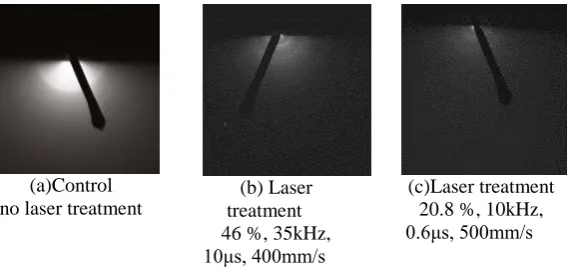
RHEED diffraction patterns of the laser treated surfaces indicate the presence of a very fine grained structure (Figure 1). This is consistent with rapid solidification of a thin melted surface layer and is a typical feature of laser processed metallic materials. There was no indication of the laser treatment having produced any significant oxidation of the surface.
(a)Control no laser treatment
(b) Laser treatment 46 %, 35kHz, 10μs, 400mm/s
[image:3.595.110.397.199.336.2](c)Laser treatment 20.8 %, 10kHz, 0.6μs, 500mm/s
Figure 1 RHEED diffraction patterns.
Initial work investigated the range of features that could be generated using the laser miller. The textures shown in Figure 2
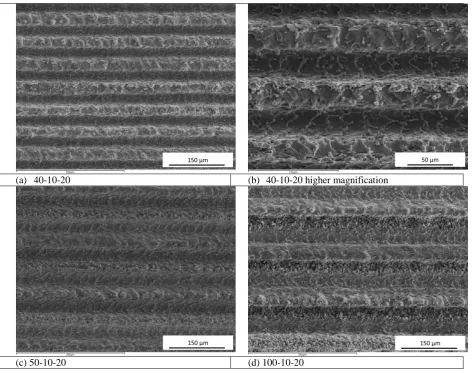
were generated using a stepped target profile (Figure 2d). The lower magnification micrographs in Figure 2 clearly demonstrate that highly reproducible, regular surface textures can be generated with features of the desired length scale. However higher magnification examination reveals a more chaotic, irregular surface (Figure 2c). Surface melting occurred during laser treatment. Regions of the surface clearly consist of resolidified droplets that have been ejected from grooves by laser processing, generating a chaotic, irregular, morphology. Due to the complexity of the surfaces produced, the remaining work was done with simpler profiles consisting of arrays of single grooves (Figure 3).
Figure 3 shows an example of the regular arrays of single grooves that were generated. The large scale regular grooved structure is again combined with finer scale surface details arising from individual laser pulses. The overall surface texture is therefore a combination of several different features: the machined grooves; the resolidified droplets superposed on the ridges between the grooves; ripples indicating the edge of the craters generated by each individual laser pulse superposed on the bottom of the grooves. With the surface are three distinct areas: the bottom of the grooves, the ridges between the grooves and the side walls of the grooves.
The profilometry results (Table 2) show a consistent variation in Ra values between the material within the grooves and on the ridges, with the ridges having a markedly higher roughness attributed to the presence of many small resolidified droplets.
(a) 46 %, 35kHz, 10μs, 400mm/s
(d) cross-section of the target profile
Figure 2 SEM images of laser textured commercially pure titanium. In (c) the extended features are fibroblast cells, seen 2h after seeding.
(a) 40-10-20 (b) 40-10-20 higher magnification
[image:4.595.33.506.177.551.2](c) 50-10-20 (d) 100-10-20
Figure 3 SEM micrographs of groove arrays, in each case an average power of 100W was used with a 10 kHz pulse frequency and 10 µs pulse width.
Table 2 Profilometry results.
Groove type Sa (µm) Ra (µm)
[image:4.595.30.351.622.706.2](a)1 day (b)3 days
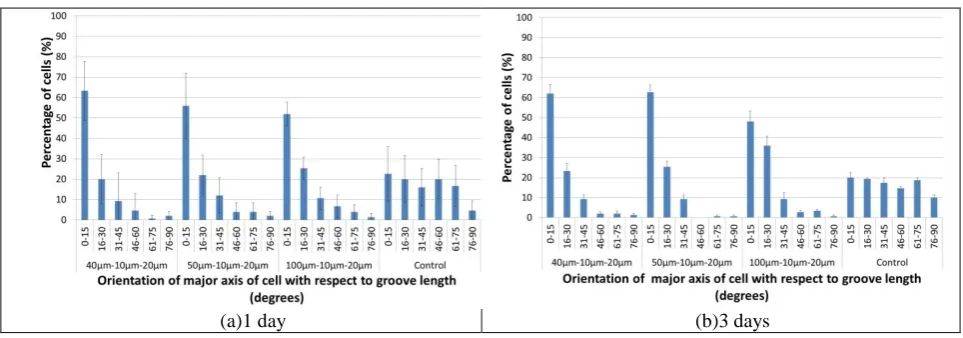
Figure 4 Cell alignment results.
The results in Figure 4 indicate that cell alignment occurred in the laser treated samples within 1 day. For the control samples the orientation distribution was more uniform. A perfectly random distribution of cell orientations would produce identical populations in each measurement range, that is true of five of the six ranges but fewer cells fell in the 76-90⁰ range for the control samples than would be expected in a perfectly random distribution. It is clear that the laser textured surface has influenced cell orientation, with all three laser textured samples sharing a very similar profile: for all three groove geometries used there was marked preferential alignment with groove direction after 1 day (Figure 4a). This preferred alignment along the groove direction is also present after three days (Figure 4b).
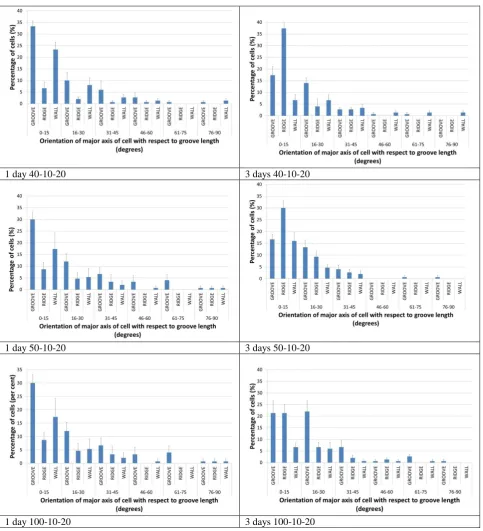
In Figure 5 the cell alignment results are broken down according to cell location. For all three groove geometries the
preferential orientation of cells parallel to the groove length is seen for cells within the grooves as well as for cells on the ridges between cells and for cells on the groove walls. This is true both after 1 and 3 days, however the spread of the alignment is increased after 3 days, with the populations in the 0-15⁰ and 16-30⁰ ranges being more similar to each other than is seen after 1 day where the population of all categories in the 0-15⁰ range are larger than those in the 16-30⁰ range, indicating more precise alignment with groove direction after 1 day compared to 3 days.
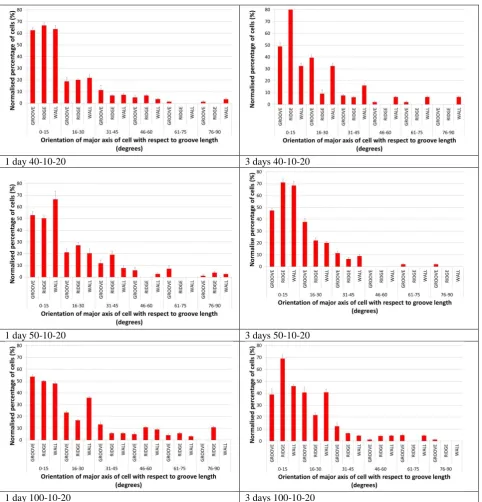
It must be noted that different numbers of cells in grooves, ridge and wall locations have been measured for each sample type. Therefore, in order to determine which areas are responsible for cell alignment the results in Figure 5 need to be normalised, such results are presented in Figure 6.
As well as confirming that cells in all three surface areas prefer to orientate in alignment with the groove direction the normalised results reveal that there is little difference in behaviour between cells in the three different areas (Figure 6). A
1 day 40-10-20 3 days 40-10-20
1 day 50-10-20 3 days 50-10-20
[image:6.595.32.516.53.585.2]1 day 100-10-20 3 days 100-10-20
1 day 40-10-20 3 days 40-10-20
1 day 50-10-20 3 days 50-10-20
[image:7.595.32.515.54.557.2]1 day 100-10-20 3 days 100-10-20
Figure 6 Normalised cell alignment results as a function of cell location.
Conclusions
Whilst further work is required to fully elucidate how the different surface features produced affect contact guidance, the following conclusions can be drawn from this work:
The Q-switched YAG laser miller (DMG Lasertec 60 HSC) is capable of generating surface textures on titanium alloys which elicit a cell response.
Cells preferentially align parallel to the groove direction.
The optimal groove geometry to promote cell orientation in this study was the 40-10-20 m format. The trend for increased alignment with reduced groove width and evidence from other studies(Wojciak et al. 1995) would suggest that cell alignment may be optimised further by a reduction in width of grooves and ridges. However this would prove challenging for the current laser miller technology.
alignment would be lost. It is suggested that this would be likely to occur at feature widths in excess of spread cell diameters, typically in excess of 150m. However some alignment would still be expected for cells in contact with groove and ridge edges.
The observation of enhanced alignment on ridges rather than in grooves may be explained due to ridge widths being narrower than groove width in all cases. Examples of ‘ridge walking’ by cells on grooved substrates has been described previously (Curtis and Wilkinson 1997).
References
Bachle, M. and R. J. Kohal (2004). "A systematic review of the influence of different titanium surfaces on proliferation, differentiation and protein synthesis of osteoblast-like MG63 cells." Clinical Oral Implants Research 15(6): 683-692.
Charest, J. L. (2007). Topographical and chemical patterning of cell-surface interfaces to influence cellular functions.
Charest, J. L., L. E. Bryant, A. J. Garcia and W. P. King (2004). "Hot embossing for micropatterned cell substrates." Biomaterials 25(19): 4767-4775.
Chen, J., J. P. Ulerich, E. Abelev, A. Fasasi, C. B. Arnold and W. O. Soboyejo (2009). "An investigation of the initial attachment and orientation of osteoblast-like cells on laser grooved Ti-6Al-4V surfaces." Materials Science & Engineering C-Biomimetic and Supramolecular Systems 29(4): 1442-1452.
Curtis ASG, Wilkinson C (1997). Topographical control of cells. Biomaterials 18: 1573-1583
den Braber, E. T., H. V. Jansen, M. J. de Boer, H. J. E. Croes, M. Elwenspoek, L. A. Ginsel and J. A. Jansen (1998). "Scanning electron microscopic, transmission electron microscopic, and confocal laser scanning microscopic observation of fibroblasts cultured on microgrooved surfaces of bulk titanium substrata." Journal of Biomedical Materials Research 40(3): 425-433. Eisenbarth, E., J. Meyle, W. Nachtigall and J. Breme (1996). "Influence of the surface structure of titanium materials on the adhesion of fibroblasts." Biomaterials 17(14): 1399-1403.
Hu, X. F., K. G. Neoh, Z. L. Shi, E. T. Kang and W. Wang (2013). "An In Vitro Assessment of Fibroblast and Osteoblast Response to Alendronate-Modified Titanium and the Potential for Decreasing Fibrous Encapsulation." Tissue Engineering Part A 19(17-18): 1919-1930.
Kononen, M., M. Hormia, J. Kivilahti, J. Hautaniemi and I. Thesleff (1992). "EFFECT OF SURFACE PROCESSING ON THE ATTACHMENT, ORIENTATION, AND PROLIFERATION OF HUMAN GINGIVAL FIBROBLASTS ON TITANIUM." Journal of Biomedical Materials Research 26(10): 1325-1341.
Mirhosseini, N., P. L. Crouse, M. J. J. Schmidth, L. Li and D. Garrod (2007). "Laser surface micro-texturing of Ti-6Al-4V substrates for improved cell integration." Applied Surface Science 253(19): 7738-7743.
Nebe, J. G. B., F. Luethen, R. Lange and U. Beck (2007). "Interface interactions of osteoblasts with structured titanium and the correlation between physicochemical characteristics and cell biological parameters." Macromolecular Bioscience 7(5): 567-578. Park, J. Y. and J. E. Davies (2000). "Red blood cell and platelet interactions with titanium implant surfaces." Clinical Oral Implants Research 11(6): 530-539.
Potthoff, E., D. Franco, V. D'Alessandro, C. Starck, V. Falk, T. Zambelli, J. A. Vorholt, D. Poulikakos and A. Ferrari (2014). "Toward a Rational Design of Surface Textures Promoting Endothelialization." Nano Letters 14(2): 1069-1079.
Soboyejo, W. O., B. Nemetski, S. Allameh, N. Marcantonio, C. Mercer and J. Ricci (2002). "Interactions between MC3T3-E1 cells and textured Ti6Al4V surfaces." Journal of Biomedical Materials Research 62(1): 56-72.
Szmukler-Moncler, S., T. Testori and J. P. Bernard (2004). "Etched implants: A comparative surface analysis of four implant systems." Journal of Biomedical Materials Research Part B-Applied Biomaterials 69B(1): 46-57.
Walboomers, X. F., H. J. E. Croes, L. A. Ginsel and J. A. Jansen (1999). "Contact guidance of rat fibroblasts on various implant materials." Journal of Biomedical Materials Research 47(2): 204-212.