warwick.ac.uk/lib-publications
Manuscript version: Author’s Accepted Manuscript
The version presented in WRAP is the author’s accepted manuscript and may differ from the published version or Version of Record.
Persistent WRAP URL:
http://wrap.warwick.ac.uk/106977
How to cite:
Please refer to published version for the most recent bibliographic citation information. If a published version is known of, the repository item page linked to above, will contain details on accessing it.
Copyright and reuse:
The Warwick Research Archive Portal (WRAP) makes this work by researchers of the University of Warwick available open access under the following conditions.
Copyright © and all moral rights to the version of the paper presented here belong to the individual author(s) and/or other copyright owners. To the extent reasonable and
practicable the material made available in WRAP has been checked for eligibility before being made available.
Copies of full items can be used for personal research or study, educational, or not-for-profit purposes without prior permission or charge. Provided that the authors, title and full
bibliographic details are credited, a hyperlink and/or URL is given for the original metadata page and the content is not changed in any way.
Publisher’s statement:
Please refer to the repository item page, publisher’s statement section, for further information.
LEARNING BY SECONDING: EVIDENCE FROM NSF ROTATORS
Christos Kolympiris Warwick Business School
University of Warwick
Sebastian Hoenen
Rotterdam School of Management Erasmus University
Peter G. Klein
Hankamer School of Business Baylor University
Forthcoming Organization Science
Abstract: We study knowledge flows between organizations through secondments, short-term em-ployee assignments at an organization different from the home institution. Secondments allow the sending organization to capture knowledge and network resources from the receiving organization without an organization-level contract, alliance, or co-location, a process we term learning by second-ing. We focus on the National Science Foundation’s rotation program, under which the NSF employs academics, called rotators, on loan from their university, to lead peer reviews. We ask how rotators af-fect the behavior of their academic colleagues after returning from a secondment. Using difference-in-difference estimations we show that rotators’ colleagues raise considerably more research funds than similar scientists who do not have a rotator colleague. Additional quantitative and qualitative evidence implies that the treatment effect occurs via knowledge transfer, as rotators help generate ideas, frame proposals, and explain processes, rather than rent-seeking on the part of the rotator. Overall, the results suggest that strong ties and shared social identity play an important role in organizational knowledge acquisition.
Keywords: secondments, National Science Foundation, rotator, organizational learning, knowledge flows, coarsened exact matching
Acknowledgements
Introduction
Knowledge acquisition is a key source of competitive advantage. How do organizations
ac-quire knowledge? Arrow (1971) provided a classic answer: individuals and groups become more
effi-cient with experience—they learn by doing (see also Romer 1990; Young 1991). Organizations
de-velop capabilities over time (Penrose 1959) as individuals learn and share that knowledge with
col-leagues. Tacit knowledge diffuses easily among employees of the same organization because they tend
to have strong ties, have similar characteristics, and, as such, share a common social identity (Kane et
al. 2005). However, internal knowledge diffusion can be uneven (Dahlander et al. 2016) and, because
knowledge is gained on the job from insiders, it is difficult to incorporate new, non-overlapping
knowledge into the organization (Molina‐Morales and Martínez‐Fernández 2009).
But, new knowledge is critical for organizational growth and improvement (Inkpen and Tsang
2005), and organizations may acquire it by hiring workers from organizations already possessing the
relevant knowledge, the phenomenon of learning by hiring (Jain 2016; Slavova et al. 2016). As Simon
(1991: 125) notes, an organization learns not only “by the learning of its members,” but “by ingesting
new members with knowledge the organization didn’t previously have.” New employees bring
reputa-tions, network ties, and tacit knowledge acquired from previous work experience. These employees
may also model certain behaviors, including ways of learning, that help current employees learn faster
and better (March 1991; Slavova et al. 2016). However, new employees typically lack (social) ties
with existing employees, are often dissimilar to them, and may appear as outsiders, hindering the
transfer of tacit knowledge (Gruenfeld et al. 2000; Hargreaves Heap and Zizzo 2009; Inkpen and
Tsang 2005; Phelps et al. 2012), a potential drawback of learning by hiring (Agrawal et al. 2017;
Szulanski 2000).
We propose an alternative mechanism for acquiring and incorporating new knowledge without
the need to overcome social barriers, what we call learning by seconding. Secondment is the practice
of sending employees of one organization to short-term assignments in another to learn new practices
Hannah 2002). Secondment is common among technology companies, law firms, consulting firms,
and government agencies. Examples include the US Council of Economic Advisers, composed of
aca-demics on short-term leaves from universities, the SEMATECH consortium of scientists in
semicon-ductor firms and the US government (Beyer and Hannah 2002), and the Royal Academy of
Engineer-ing’s Industrial Secondment scheme in the UK.
We combine insights from the literatures of knowledge transfer, employee mobility and social
identity to theorize that learning by seconding can be a promising mechanism by which organizations
can acquire valuable knowledge, network, and similar resources from other organizations. Seconded
employees are insiders (the main advantage of learning by doing and what learning by hiring lacks)
who can infuse the home organization with new, non-overlapping knowledge (the main advantage of
learning by hiring and what learning by doing lacks). This infusion is possible because unlike existing
employees and new hires, returning seconded employees are “double embedded” (Baker and Faulkner
2009; Wang 2015), both in the home institution and in the temporary host organization.
As an employee of the home organization, seconded individuals have ties with non-seconded
employees that allow tacit knowledge to transfer within an organization, share similar knowledge
ba-ses and a common identity (Reagans et al. 2015; Tortoriello et al. 2012). At the same time, unlike
learning by doing, secondments allow the focal individual to fuel her knowledge depository with new
knowledge which does not overlap with the knowledge of the non-seconded employees. Seconded
em-ployees are embedded in the host organization, giving them access to tacit knowledge about processes,
routines, and practices. Because they are also insiders in the home organization, they can pass this
new, non-overlapping knowledge to employees who never moved. Seconded employees can also be
described as “boundary spanners”—individuals with ties to multiple organizations (the sending and
the receiving organization).
Earlier work has established that the presence of boundary spanners increases organizational
productivity, partly through effective knowledge transfer (Ancona and Caldwell 1992; Tortoriello et
al. 2012; Tushman and Katz 1980). To our knowledge, however, no one has looked systematically at
the knowledge flows that can result from secondments. We ask the questions, do secondments
To study secondments we exploit the rotation program at the National Science Foundation
(NSF). Under the rotation program, in place since 1970, NSF employs academics, called rotators, who
step out of their academic institution for typically 1 to 2 years to lead the review process and exercise
decision makings at the agency as Program Directors (PDs). After their secondment these scientists
return to their academic homes armed with experience and unique knowledge of the NSF. As a rotator
put it during one of our interviews, “I came back knowing how funding decisions were made, and the
various ways the institution works. There’s so much more that goes into how they’re balancing
deci-sions. Knowing this really helped in mentoring junior but also senior faculty.”
Besides being a fertile template to study secondments, the rotation program is important in
it-self. Knowledge flows in and out of government agencies such as the NSF are particularly relevant for
scientific research, both at the societal and individual level (Feldman et al. 2014; Stephan 2012).
Exist-ing studies of government’s role in science focus mainly on direct fundExist-ing (Diamond Jr 1999;
Lichtenberg 1987; Muscio et al. 2013). However, as with other sectors such as energy, transportation,
and financial services in which government plays a large role, there are many channels other than
di-rect funding for government action to benefit particular organizations, regions, or industries.
Knowledge flows through public-private partnerships are one example (Kivleniece and Quelin 2012).
Seconding academics to government agencies, as the NSF rotator program is doing, represents a
not-yet-studied example.
Following convention, we infer knowledge transfer from changes in output which we measure
with increases in NSF funding for rotator’s colleagues and for comparable academics (Argote and
Ingram 2000). A key means of acquiring new resources such as research funding is through
knowledge transfer from new mobile colleagues (Slavova et al. 2016). Mobility in this sense includes
not only moving between universities (Slavova et al. 2016) but also taking temporary editorial
posi-tions (Brogaard et al. 2014)1, the (forced) move of academics from one country to another (Borjas and
1 Brogaard et al. (2014) examine journal editor rotations, in which an academic takes a temporary position as a
Doran 2012; Waldinger 2010; Waldinger 2012), and academic inbreeding where PhD graduates of a
focal university are employed as faculty members in the same academic institution without being
em-ployed elsewhere in the meantime (Horta et al. 2010). However, we know surprisingly little about the
effects of scientist mobility outside academia such as employment spells in industry or government
secondments. These moves are increasingly popular (Geuna 2015) and could prove important in
gen-erating knowledge flows towards colleagues as they can equip the focal mobile academic with unique
knowledge and insights from outside her core profession, and hence difficult to acquire when mobility
is bound to academic circles. And a colleague returning from a stint at a peer or a complementary
or-ganization is likely to be viewed as a particularly accessible source of new knowledge.
Our research design takes advantage of the fact that academics within disciplines but across
universities are trained in similar ways, have common experiences, and work on similar problems. For
this reason, we can compare an NSF rotator’s colleagues with academics in the same fields at other
universities who do not have a returning rotator in their academic units. As such, our identification
strategy features a difference-in-difference estimation in which the dependent variable is the amount of
NSF funding for each scientist in academic units (what most universities call departments) with and
without a returning rotator. By carefully matching the characteristics of academics with rotator
col-leagues to those without, we can estimate a treatment effect of bringing an NSF officer back from
rota-tion. Moreover, because rotators typically return to their previous academic institution (hence the
deci-sion to return is largely independent to the existing colleagues needing help), we address the
endoge-neity problem that typically plagues cross-sectional studies of employee mobility (Singh and Agrawal
2011).
at knowledge flows between editors and their current colleagues during the editor rotation (and find a strong ef-fect—the colleagues publish much more in the editor’s journal and the papers are high quality, suggesting knowledge transfer rather than favoritism). We look at knowledge transfer between NSF rotators and former col-leagues after they return from rotation. Another relevant literature deals with international assignments of em-ployees among subsidiaries of the same multinational corporation (e.g. Criscuolo 2005; Lyles and Salk 1996); because these are internal transfers, however, they do not address non-overlapping knowledge acquisition which is central to our work. Several papers analyze how academics with industry ties impact their colleagues
The results suggest that secondments do result in knowledge transfer. We find that scientists
exposed to their seconded colleague raise considerably more research funding from the NSF when
compared to similar scientists in similar academic units who did not have a rotator as a colleague in
the ex-post period. Using additional empirical tests and a series of interviews, we trace these
improve-ments in funding records to knowledge transfer from the rotator. Based on theories about similarity
and strong ties between seconded employees and their colleagues who do not move we identify three
main mechanisms: rotators a) help generate ideas by directing colleagues to areas with significant
funding opportunities (i.e. focusing), b) assist with framing proposals in ways they are appealing to
reviewers and c) provide processual knowledge by clarifying the instructions and the process of
sub-mitting a proposal (i.e. formatting).
As with other forms of secondment, acquiring new knowledge that can be transferred back to
the originating institution is the main gain of rotation. For this reason, we see these three mechanisms
as representative of the more general process of knowledge transfer that underpins secondments.
Along the same lines, while the key feature of double embeddedness in the home and the host
organi-zation holds across secondments, the NSF rotation setting is a form of secondment that requires the
seconded employee to perform tasks that are partially outside her core roles in the home organization.
While not all secondments share this feature, it can also be seen in cases such as temporary moves of
clinical nurse specialists to university lecturers (Dryden and Rice 2008) and short-term assignments of
public sector engineers to small firms (Ho et al. 2016).
Our work makes two main contributions. First, we contribute to the literature on knowledge
transfer between and within organizations by means of worker mobility. Departing from the current
literature, we theorize that the double embeddedness of the seconded employee in the home and the
host organization allows secondments to alleviate some shortcomings of learning by doing and
learn-ing by hirlearn-ing while retainlearn-ing their advantages. Specifically in the context of academic researchers,
prior work has shown that scientists who move within academia bring benefits to their colleagues
(Borjas and Doran 2012; Brogaard et al. 2014; Horta et al. 2010; Slavova et al. 2016). By examining
then back to the home institution. This is important as it allows for a better understanding of the
ori-gins of knowledge acquisition.
Second, we contribute to the literature on inter and intra organization employee mobility
(Almeida and Kogut 1999; Argote et al. 2000; Singh and Agrawal 2011; Song et al. 2003; Summers et
al. 2012; Tambe and Hitt 2013). By analyzing a hybrid case in which the rotator works outside her
in-stitution, and partly outside of her profession, and then moves back to the original inin-stitution, we offer
new evidence on how employee mobility outside one’s core profession can induce gains for colleagues
that never moved. Specifically, the knowledge and insights rotators gain during their temporary
as-signments are different than those gained via moves within academia, because the rotators are exposed
to complementary, but not overlapping, knowledge bases while on secondment. More generally, we
address the lack of work in the knowledge literature at the micro level (Foss et al. 2010).
Setting: the NSF rotation program
The National Science Foundation supports research in all nonmedical sciences. Each of the seven
di-rectorates focuses on a different scientific field: biological sciences, computer and information
sci-ence, engineering, geosciences, mathematical and physical sciences, social, behavioral, and economic
sciences, and education and human resources. The grant process is supervised by Program Directors
(PDs), subject-matter experts who oversee the review process. Program directors coordinate with the
approximately 40,000 external experts who review proposals, as well as reviewing proposals
them-selves, chairing review panels, managing program budgets, exercising discretion in making funding
decisions, communicating with other PDs, providing formal and informal feedback to applicants,
com-municating decisions, attending internal and external NSF meetings, and generally navigating the daily
internal workings of the NSF (Gorman 2011; McCullough 1994; Muller‐Parker 2007; Stephan 2012).
To encourage cross-fertilization, maintain quality control, and increase coordination, PDs also
sit in panels in directorates other than their own. As such, they are aware of funding opportunities and
the state of scientific progress across directorates. Indeed, during our interviews rotators consistently
reported that they spent a substantial amount of their time at NSF on discussing broad issues about
Since the 1970 passage of the Intergovernmental Personnel Act the NSF has employed
aca-demics, called rotators, on loan from their academic institution (rarely from industry) as PDs. These
seconded academics serve up to 4 years (typically 1 or 2), working along with permanent NSF PDs
(Mervis 2013). Rotators join the NSF to participate in a rigorous and unbiased review system while
bringing in fresh ideas and perspectives to the permanent staff (e.g Duce et al. 2012). Before joining
the agency as temporary employees, most rotators had received NSF grants, served as ad hoc
review-ers, and participated on review panels. This experience sparked their interest in the rotation program.
As became clear during our interviews the main reasons prompting academics to join the rotation
pro-gram were a desire to learn more about the NSF and its internal operations and a more general
aspira-tion of having an impact on the profession in part by shaping the direcaspira-tion of science and exercising
professional leadership.
In 2016, rotators comprised 28% of the agency’s scientific workforce (Mervis 2016a). During
their secondments rotators cannot submit a proposal to the NSF, are subject to restrictions when
apply-ing for non-NSF fundapply-ing, cannot review or process proposals of recent collaborators, and in general
are subject to strict rules even after their tenures at NSF are over. These restrictions are designed to
avoid conflicts of interests and minimize any chances of favoritism in the review process. From 2004
to 2014 the NSF employed nearly 800 rotators from around 400 academic institutions, mostly as PDs.
As we discuss later in the paper rotators come from nearly every academic discipline, have diverse
backgrounds, vary in their scholarly records, work at small and big universities of different rankings
and status, come from every state, and are of different age and gender.
Literature and hypotheses
The transfer of knowledge from one unit of an organization to another is a key input to
im-provements in organizational performance (Chang et al. 2012). But, the process of knowledge transfer
is challenging and often fails (Szulanski 2000). Its success hinges, in large part, on the properties of
knowledge (Simon 1991). Specifically, tacit knowledge is more difficult to be transferred than
codi-fied knowledge while similarity and strong social ties between the sender and the receiver of
knowledge facilitate knowledge transfer (Phelps et al. 2012).
Not surprisingly, learning by doing is a primary means of diffusing knowledge within
organi-zations: as individuals learn, they are interacting regularly with local colleagues, facilitating the flow
of tacit knowledge. 2Strong ties between group members foster a common social identity in which
fel-low employees, as insiders, are seen as trustworthy and prone to reciprocity and hence more influential
than outsiders (Gruenfeld et al. 2000; Zahra and George 2002). For sourcing tacit knowledge, people
tend to rely on those with unique experiences and insights (Gray and Meister 2004) but, because
knowledge search processes are often confined locally, co-workers possessing unique knowledge often
become the key knowledge source (Borgatti and Cross 2003; Singh 2005; Stuart and Podolny 1996).
For these reasons, knowledge transfer among individuals in the same group or subunit is typically
more effective than that between individuals in different groups or subunits (Cohen and Levinthal
1990; Tortoriello et al. 2012).
However, while learning by doing facilitates the transfer of tacit knowledge, it is less useful
for bringing new, non-overlapping knowledge to the organization. Because new knowledge drives
per-formance improvements (Inkpen and Tsang 2005), organizations often hire workers from outside
(Rosenkopf and Almeida 2003). This provides workers of the recipient organization the opportunity to
integrate outside knowledge to their current context (Allen 1977), reposition their search processes
(Tzabbar 2009), and develop new capabilities that improve performance (Jain 2016). Because
knowledge is embedded in individuals and individuals often rely on others’ experience to learn (Levitt
and March 1988), individuals who move from one context to another can act as knowledge conduits
(Argote and Ingram 2000). However, as noted above, new hires lack social ties with incumbents, are
often dissimilar, and therefore do not typically share a common social identity with existing
employ-ees, hindering the absorption of new tacit knowledge. Indeed, Agrawal et al. (2017) find that hiring a
2 Vicarious learning in which employees learn from other employees by observing them is an alternative means
star employee does not bring noticeable benefits to incumbents. Organizations thus face a trade-off
be-tween encouraging internal collaboration, where individuals have a greater ability to learn (from
shar-ing a common social identity), and encouragshar-ing external collaboration, where individuals have a
greater chance to acquire new, non-overlapping knowledge.
One way to mitigate this trade-off is outward mobility, the practice of sending employees to
other organizations while remaining in contact with their former colleagues. Losing valuable
employ-ees is generally costly but does provide potential access to the new firm’s knowledge and capabilities,
as the outwardly mobile employees become insiders in the host organization and acquire new tacit
knowledge which they can pass back to their previous coworkers. Importantly, this knowledge is
likely to diffuse within the organization because its source is a former insider with ties to other
em-ployees sharing a common social identity. Looking at the fashion industry which—like academia—
thrives on novelty and creativity, Godart et al. (2014) show that moderate levels of outward mobility
are associated with higher levels of creativity inside the sending organization. Wang (2015) finds that
skilled immigrants returning to their countries transfer organizational practices to the countries of
origin.
We argue that secondments represent an even more valuable form of outward mobility
be-cause the movement is temporary. The seconded employee goes to the new organization, acquires new
knowledge, and then returns for daily, face-to-face interaction with her former colleagues.3 The main
advantage of secondments, we propose, is the double embeddedness of the seconded employees
(Baker and Faulkner 2009; Wang 2015). These employees are insiders of both the home (sending)
or-ganization and the host (receiving) oror-ganization, and this allows them to tap into tacit knowledge
ac-quired by immediate access to routines, decision making processes, and practices that would otherwise
be difficult to acquire, and to pass these to their colleagues after returning home. Indeed, because
dou-ble embeddedness is unique in the case of secondments, there is a need to develop more fine-grained
3 Importantly, while ties between employees ameliorate competitive concerns about sharing knowledge, moves
arguments on the conditions under which knowledge transfer following seconding is more likely to
occur—a task we undertake when we present the moderating factors of the main effect.
The NSF rotation program provides an ideal setting for studying the effects of secondments on
the sending organization. Specifically, we expect returning rotators to improve their colleagues’ ability
to secure research funding by transferring to them tacit knowledge about the funding process that can
address their lack of experience and judgment (Borgatti and Cross 2003). Specifically, former rotators
can provide a) hints on research areas NSF is keen on funding (what we term focusing), b) help with
framing research proposals in ways that are appealing to reviewers and c) tacit knowledge about the
grant process (what we term formatting). Hence having a rotator as a colleague should encourage more
submissions while also improving the quality of submitted proposals, thus leading to increased
fund-ing.
Developing a successful NSF proposal is not easy. As described by Custer et al. (2000), the
most frequent challenge is conceptualization and visioning of the project, followed by coordination
with collaborators, help from the home institution, budget development, and understanding of NSF
guidelines and expectations. Rotators can exploit their NSF experience and address all these
chal-lenges. Because rotators have hands-on experience with numerous proposals and applicants from
dif-ferent institutions, they can transmit tacit knowledge on designing and producing a successful
applica-tion (Muller‐Parker 2007). Indeed, as mentioned above, providing leadership is a prime reason for a
given academic to become a rotator. We expect this motivation to prompt rotators to be particularly
interested in helping their colleagues upon returning.
As an example of focusing, one rotator explained to us that rotators “demystify NSF . . . and
generally open the door to opportunities that are outside one’s radar.” Another told us he “learned
val-uable lessons about how NSF communicates intentions about funding priorities.” Referring to the
mechanism of framing, another rotator said: “I talked to many colleagues, even when they were
out-side my field, on general aspects regarding what makes a strong proposal at the NSF.” Another
de-scribed framing and formatting: “People would show me proposals, say “can you tell me what you
think? I would say ‘well, maybe you should aim it a little different or maybe you should pick a
Faculty with a rotator colleague can increase their odds of getting funding both by writing
bet-ter proposals and by submitting more proposals. Indeed, obtaining funding is the most frequent topic
of discussion in mentoring relationships (Feldman et al. 2010), and such mentoring tends to pay off in
terms of increasing funding success rates (Blau et al. 2010). While the relationship and transmission of
knowledge from rotators to colleagues is not necessarily a mentor-mentee relationship, there are
paral-lels and as such the abovementioned results strengthen our theoretical expectations. Thus, we advance
the following hypothesis:
Hypothesis 1. Faculty members in academic units with a seconded returning rotator will im-prove their NSF grant acquisition record after the rotator returns from the NSF, compared to similar academics without a rotator colleague.
We expect the relational properties between the sender and the recipient of knowledge about NSF
grants to influence the effect of the rotator on the funding records of colleagues (Argote and Ingram
2000; Singh and Agrawal 2011). Relational properties should influence how various colleagues of a
returning rotator perceive the rotator’s experience, accessibility, and specialized expertise.
As noted above, strong ties between the sender and the receiver improve the transfer of tacit
knowledge (Levin and Cross 2004; Simonin 1999). Moreover, strong ties are more likely to develop
when the two parties interact over time, as longer relationships help form social cohesion and a
com-mon social identity (Kane et al. 2005). Individuals with longer tenure at an organization are more
deeply embedded and tend to develop better communication channels with colleagues (Gruenfeld et al.
1996; McFadyen and Cannella 2004; Paruchuri et al. 2006). Those with longer tenure in an institution
are also more familiar with organizational routines and practices (Gruenfeld et al. 1996).
In the case of NSF rotators, tenure at the host institution is the prime determinant of the double
embeddedness of the seconded employee in the home and the host organizations. While the majority
of rotators work at the NSF for approximately 2 years, and therefore the embeddedness at the NSF is
nearly fixed, embeddedness at the academic home institution varies widely. Moreover, given our focus
on experienced colleagues who might gain from the knowledge held by the seconded employee, the
tenure of the seconded employee before rotation also captures tenure overlap between seconded
facil-itate the transmission of tacit knowledge. Individuals with longer tenure are more likely to be
ap-proached for advice that is tailored to the focal environment because they share a common identity
with their colleagues, have developed communication channels with them, and are a priori expected to
provide content-specific feedback. This leads to the following hypothesis:
Hypothesis 2a. The effect of the seconded rotator on the grant acquisition record of her col-leagues is positively moderated by her tenure in her academic unit.
A second relational property that should influence knowledge transfer between the rotator and
her colleagues is similarity. Even within an academic field there is substantial variation in the specific
topics and problems researchers study, the theories and methods they consider appropriate, the
jour-nals and communities in which they disseminate their work, and so on (Cole and Cole 1972).
Re-searchers also differ by scientific skill and research productivity: those who are highly productive and
whose work is influential will enjoy a strong scholarly reputation, while others will be less well
estab-lished in their specific fields or in the profession. Both similarity in the specific knowledge base and
similarity in research productivity or impact should affect the quantity and quality of knowledge
trans-fer.
As noted above, knowledge transfer is costly both for sender and receiver. The sender must
devote time and effort to helping the recipient to understand (Reagans and McEvily 2003), and the
re-cipient must integrate the new knowledge into her knowledge depository. When these costs are lower,
senders are more likely to invest time in transmitting knowledge and recipients are more likely to
ap-proach senders for help. Importantly, a common knowledge base makes knowledge transfer easier
(Black et al. 2004; Reagans and McEvily 2003), so we expect the effectiveness of knowledge transfer
between rotators and their academic colleagues to be greater among those working on similar research
topics and potentially using similar methods.
Similarity in scientific productivity, influence, and reputation between sender and receiver can
also lower the cost of knowledge transfer. More productive individuals have more and newer
knowledge and, hence, have more to transmit (Azoulay et al. 2010; Chan et al. 2014; Lacetera et al.
2004; Mas and Moretti 2009). Accordingly, they are more likely to be approached for help. But, they
capabilities, and experiences are more likely to form strong ties, trust each other, and work together
(Gompers et al. 2016; Kretschmer 1997, 1999; Kundra and Kretschmer 1999). For instance, highly
ac-complished researchers are more likely to connect with other scholars with similar research
experi-ence, impact, and reputation who can assimilate the new knowledge (Black et al. 2004; Salomon and
Martin 2008). Jha and Welch (2010), for example, find that research collaboration is more common
among mature academics who attended the same PhD program. More generally, within organizations,
birds of a feather tend to flock together (Tsui et al. 1992). This suggests that returning rotators are
more likely to spend time, exchange ideas, and develop close relationships with their more similar
col-leagues.4 This implies that knowledge transfer is facilitated by the sender and receiver being similar in
research productivity.
Subsequently, we advance the following two hypotheses:
Hypothesis 2b. The effect of the seconded rotator on the grant acquisition record of a league is positively moderated by similarity in knowledge between the rotator and the col-league.
Hypothesis 2c. The effect of the seconded rotator on the grant acquisition record of a col-league is positively moderated by similarity in research productivity between the rotator and the colleague.
Research design and estimation
We use a difference-in-differences research design in which the dependent variable is the
inflation-adjusted sum of funds raised by each scientist before and after having a rotator as a colleague. We
match “treated” academics with a rotator colleague to similar academics without one. We find matches
because academics are not randomly assigned to academic units with and without a rotator colleague.
The post period is the 5 years after the rotator returns to her academic unit and, equivalently, the
ex-ante period is the 5 years before the rotator started her tenure at NSF.
4 Researchers who are similar to their returning rotator colleagues are likely to be higher in absorptive capacity,
The research design offers two main advantages. First, selection into rotation is independent of
the need of one’s colleagues for mentoring on how to raise funds. As already discussed, most
academ-ics become rotators because their prior experience at the NSF—serving in discussion panels and
com-munication with the NSF—prompted them to want to learn more about the NSF and its internal
opera-tions, not because ex-ante they recognize colleagues that need assistance with grant acquisition. Two,
where rotators go after the NSF is also independent to existing colleagues. Almost all rotators return to
the school where they previously worked. The fact that the return decision is exogenous to the
treat-ment group is important: if the movetreat-ment of labor to new organizations is endogenous to the
antici-pated effects of that new labor on existing labor, it is hard to estimate a treatment effect of mobility
(Singh and Agrawal 2011).
To make sure the results measure knowledge transfer rather than reciprocal learning (Manski
1993), we include only academics who in the ex-ante period had no funds from the NSF. These faculty
members have limited (or no) experience in attracting grants and this implies that a) they are less
likely to share insights specific to NSF funding with each other and b) they are more likely to gain
from the rotator’s advice as faculty with established funding records may be of less need (or even
de-sire) for additional help (Laband and Tollison 2000). Accordingly, focusing on this cohort of scientists
we expect to be able to unravel the potential effects that rotators may have on the ability of their
col-leagues to attract research resources.
To build our control sample we use Coarsened Exact Matching (CEM), a multivariate
tech-nique that matches on covariate values not exactly, but based on different strata built on the joint
dis-tribution of the matching variables.5 CEM features a number of desirable statistical properties
includ-ing the reduction of model dependence, estimation error, and bias (Iacus et al. 2011). In our case,
CEM allows us to address heterogeneity at both the level of the individual scientist and the level of her
5 Following Iacus et al. (2008) our estimation weights the observations according to the size of the stratum they
belong. This is required when, as in our application, the number of control and treatment observations within a stratum are not equal (Blackwell et al. 2009; Iacus et al. 2008). But weighting does not allow us to cluster the
standard errors at the observation level. Given that each scientist enters the analysis twice (one in the ex-ante
pe-riod and one in the ex-post period) in unreported results we also run the regressions with clustered standard
academic unit. We also address heterogeneity at the university level (without using CEM). We build
different samples which address different forms of heterogeneity. Specifically, in matching scheme 1
we focus on reducing heterogeneity at the academic unit level, identifying academic units in different
universities similar to the academic unit of the rotator based on overlap on science field, faculty size,
and average H-index across faculty members ex-ante.6 We then populate the sample we analyze with
a) the faculty members in the academic unit with a rotator without NSF funding in the ex-ante period
and b) the faculty members in the matched academic units that have also not attracted funds from NSF
ex-ante.
In matching scheme 2 we use the same matching criteria but match at the individual level,
such that members of the same academic unit with a rotator could be matched with scientists
belong-ing to different academic units. For example, assume that the University of Maryland (with a rotator)
has professors X, Y, and Z without NSF funding in the ex-ante period. Each professor, in this
hypo-thetical scenario, has a single match; professor X’s match is at the University of Illinois, professor Y’s
at the University of Wisconsin, and professor Z’s at the University of Florida. Under the individual
matching scheme, the matched scientists from Illinois, Wisconsin, and Florida enter the analysis as
controls for the three faculty members at Maryland.
Matching scheme 3 combines schemes 1 and 2 to reduce individual-level and
academic-unit-level heterogeneity simultaneously. In a nutshell, in matching scheme 3 we first find similar academic
units and then find similar scientists only within them. Similar to matching scheme 1, the first step in
matching scheme 3 is to identify comparable academic units based on science field, average H-index,
and faculty size. Within those units, we then match at the scientist level (i.e. matching scheme 2). The
6 We expect these factors to influence the accumulation of funds for a given academic as, for instance, some
sci-ence fields tend to attract more research funds than others. As robustness checks, shown in a later section, we match on different characteristics and find qualitatively similar estimates. On a more technical note, as Singh and Agrawal (2011) explain, with CEM a trade-off must be made between the similarity of the matched sample and the number of observations that are matched. CEM divides variables in bins within certain ranges and then popu-lates the bins with observations that fall within these ranges. Matching observations on variables divided in more bins creates smaller samples that are more similar in the chosen characteristics. The opposite, larger bins, match more observations that are then on average less similar to each other. For matching schemes 1, 2 and 3, we were stricter on science field and index by enforcing that every science field gets its own bin and dividing the
H-index in 12 bins covering 0 to 75 in increments of 6.81. We determine the FacultySize bin boundaries at 30 and
key here is that the pool of potential controls for a scientist in an academic unit with a rotator is limited
to the scientists of the matched academic unit revealed in the first step. For instance, if the first stage
matching reveals that the biochemistry department at the University of Iowa (with a rotator) is similar
to the biochemistry department at the University of Missouri (without a rotator), then we do not look
for matches for the Iowa scientists outside the Missouri faculty. Specifically, the analysis will include
as controls only those academics at Missouri who do not have NSF funds and are close matches to
ac-ademics without NSF funding ex-ante in Iowa. If no match is found among the acac-ademics in Missouri
(or in Missouri and say the University of Illinois if the latter is also identified as a match to Iowa), then
the treatment group academics from Iowa are not included in the analysis.
Finally, in matching scheme 4 we address heterogeneity at the university level (without using
CEM) to account for institution-specific incentives, norms, and other factors that can a) condition
one’s fund raising record and b) potentially prompt a given academic to become a rotator. We select
controls who are employed at the rotator’s university but in a different academic unit. To choose this
unit we imposed two criteria. First, the academic unit must be in the same, immediately larger division
or school as the treatment unit. Typically, the immediately larger division was, say, the School of
En-gineering or the School of Public Policy. In few cases, there were subdivisions within these Schools;
there we choose controls from those subdivisions. Two, the control unit must be in a broadly similar
scientific field to the treatment unit. For example, the treatment unit is Industrial Engineering, we
choose controls from Civil Engineering and not, say, Chemical Engineering.
To identify rotators we first posed a Freedom of Information (FOI) request to the NSF asking
for rotator names and affiliations across all agency directorates from 2004 to 2014. We limit our
analy-sis to academics who served as NSF rotators from 2004 to 2009 so that we can observe changes in
funding for their colleagues 5 years before and 5 years after rotation. Next, we visited the website of
each rotator’s academic unit and sourced the list of faculty members including the rotator. For every
faculty member we a) collected data from the latest version of her CV, LinkedIn, and other sources, b)
downloaded from the bibliographic database SCOPUS a list of her publications over time including
co-authors, citations, keywords, and the like and c) recorded her accumulation of NSF funds using
Using this information, we built a profile of each scientist with a rotator colleague describing
her tenure at her institution, research productivity, co-authors, and so on. We sum these profiles to
build the profile of each rotator’s academic unit. To construct the profile of potential control groups
we repeat the steps described above for academic units ranked one position higher and one position
lower than the rotator’s academic unit in the science-field-specific Shanghai ranking.7 Whenever
in-sufficient information was available for these units (usually occurring when the majority of academics
in the unit did not maintain an updated professional history online), we moved to academic units two
or three ranking positions up and down. We opted for this “one up, one down” approach under the
premise that academic units in similar rankings are, at least in broad strokes, comparable to each other.
As a final step, the pool of potential matches upon which we implement CEM, for matching schemes
1,2 and 3 contains a) the academics collected via the “one up, one down approach” and b) the
scien-tists belonging to academic units in the rotator’s university which, in matching scheme 4, we identified
as comparable to the rotator’s academic unit. For example, assume that for matching scheme 4 we
identify that, within Cornell University, the Materials Science and Engineering Department (with a
ro-tator) is a match to the Physics Department (without a roro-tator). Then, the Physics Department at
Cor-nell (and its faculty members) enter the pool of potential matches, under matching schemes 1,2 and 3,
for academic units with a returning rotator at, say, Carnegie Mellon and Harvard.8
To test H1 we interact the variable Rotator Group which takes the value of 1 for scientists
be-longing academic units with a rotator and the variable Ex-Post which takes the value of 1 for
observa-tions corresponding to the ex-post period and 0 otherwise. In support of H1 we expect a positive sign
7 For instance, the Texas A&M University’s Department of Mathematics, had a rotator returning in 2007. On the
Academic Ranking of World Universities, in the field of Natural Sciences and Mathematics in 2007, Texas A&M had a ranking of 43. For this year Georgia Institute of Technology was ranked 42 in Natural Sciences and Mathematics and University of California, Davis was ranked 44. Accordingly, we populate the pool of controls for the Texas A&M Department of Mathematics with academics in the Departments of Mathematics at Georgia Institute of Technology and the University of California, Davis.
8 For the example at hand, the fact that we match on science field ensures that the Physics Department at Cornell
for the Ex-Post * Rotator Group interaction. Following Meyer (1995) we test the moderating effects
under H2a, H2b, and H2c using three-way interactions of the Ex-Post * Rotator Group interaction and
variables we construct to measure tenure and similarity.
We measure tenure (Tenure) in the institution as the number of years the rotator has been
em-ployed at the focal university. We capture knowledge similarity (Knowledge Similarity) by recording
the number of top-10 keywords of the rotator’s ex-ante articles that are also among the top-10
key-words of her focal colleague’s ex-ante articles. We use the ex-ante period under the expectation that
the relationships that strengthen knowledge transfer take time to develop.9 We measure similarity of
research productivity (Productivity Similarity) using the absolute value of the difference between the
H5-index of the rotator and the H5-index of the focal colleague (multiplied by -1 so that increasing
values correspond to higher productivity similarity). The H5-index is a measure of scientific
produc-tivity: in the last 5 years, a scientist with an index of h has published h papers, each of which has been
cited in other articles h times or more.
In support of H2a, H2b, and H2c we expect positive signs for the three-way interactions
Ex-Post * Rotator Group * Tenure, Ex-Ex-Post * Rotator Group * Knowledge Similarity, and Ex-Ex-Post *
Ro-tator Group * Productivity Similarity. For scientists in the control groups we use the values of the
moderators corresponding to academics we estimate to be similar to the rotators (Appendix 1 presents
the details of how we identify those individuals). To capture variation in the moderators that is shared
among academics in treatment and control groups, and among all observations in the ex-post period,
we also include in the analysis interactions between Rotator Group and the moderators and between
Ex-Post and the moderators.
In testing our hypotheses, we also include explanatory variables that can affect an academic’s
ability to get NSF funds. To account for the possibility that other funding crowds out NSF funds we
measure the amount of non-NSF funds raised in the ex-post period by the focal scientist (OtherFunds).
We also incorporate a dummy variable taking the value 1 if the academic had attracted funds from the
NSF before the ex-ante period (NSFBefore). To account for potential effects of career experience on
9 Because keywords change only slightly throughout our time period, we obtain nearly identical estimates when
NSF funding we measure the elapsed years from the receipt of an academic’s PhD until the start of the
ex-post period which is the end of the rotation year both for those academics who served at the NSF
and for those we identified as “could be rotators” (Years). Along the same lines, we include a variable
that takes the value of 1 if the focal scientist is assistant professor at the start of the ex-post period, 2 if
she is associate professor, and 3 if she is full professor (Position). Serving in an administrative
posi-tion may take up time that could be spent in writing grant proposals, so we include a dummy indicator
(Administrator) that takes the value of 1 for academics who are department heads, PhD studies
coordi-nators, and similar positions at the start of the ex-post period. We also include controls for gender
(Male), scholarly output (Publications), and cumulative citations (Citations). The latter two variables
are time varying as they assume different values for the ex-ante and ex-post period when the
publica-tions and citapublica-tions record of the focal academic has changed.10
Academics with extended professional networks may benefit more strongly than others by
having a rotator colleague as they have access to larger pool of knowledge and relationships. To
ac-count for such effects we include a time-varying variable that ac-counts the number of unique co-authors
across time for each focal scientist (Coauthors). Scientists in higher-ranked universities may be
of-fered more institutional support when crafting their proposals and may receive a status effect from the
NSF, so we include the Shanghai ranking quartile of each academic’s university on a given year and
field of science (UniversityQuartile). The size of one’s academic unit may also influence the growth of
NSF funds as smaller groups may reflect more intense knowledge flows among faculty members due
to elevated familiarity, whereas in larger academic unit the pool of potential knowledge sources is
typ-ically larger. We include the number of faculty members in the academic unit (FacultySize) to control
for these effects. Finally, we include year- and science-field-fixed effects to account for changes in
funding trends across years and across scientific fields.
10 These variables are time-varying which ameliorates concerns of endogeneity arising from the fact that
Data
Appendix Table 1 describes the data sources and construction of variables we use for the empirical
analysis. Appendix Table 2 presents the correlation coefficients for the variables from the sample
cre-ated with matching scheme 3. To guide the selection of the rotators’ academic units we started with
the 778 scientists who served as rotators under the Intergovernmental Personnel Act (IPA) program
from 2004 to 2014. To fully measure the potential changes in funding for rotators’ colleagues in the
ex-post period we focused on the 203 scientists who worked at the agency from 2004 to 2009 and for a
period of up to 2 years (which is the most common length of stay).11 Using the abovementioned data
sources we were able to source comprehensive information and build full professional histories for 50
rotators.
We then searched for professional histories of more than 14,000 scientists belonging to a) the
50 academic units with a rotator, b) the approximately 150 academic units ranked one to three
posi-tions higher and one to three posiposi-tions lower than the academic unit with a rotator, and c) the
approxi-mately 100 academic units in the same university of the academic unit with a rotator. We succeeded
for about a third of these, 5,120, employed at 89 universities reflecting 37 units with a rotator and 160
units without a rotator.12 Subsequently, we manually read more than 5,000 CVs and went through
more than 3,000 LinkedIn pages, 12,000 university and laboratory websites, and 2,000 personal
web-sites. Following this search, we identified 1,515 faculty members in academic units with and without a
rotator who met the following criteria: a) their available information was updated and comprehensive
enough to build a full professional history (including for instance the PhD graduation date and
infor-mation on present position), and b) they were in the same academic unit both in the ex-ante and in the
ex-post period. For these 1,515 academics, who compose our original sample, we then downloaded
11 352 academics served as rotators under IPA from 2004 to 2009 with 203 serving up to two years (the
mini-mum stay for this cohort was 8 months). To illustrate why we limit the search to these 203 scientists, for the rota-tors whose tenure at the agency lasted 4 years we would have to eliminate those that started rotation in 2007,
2008 and 2009 as the ex-post period ends after 2016.
12 The main reason we could not collect data on the colleagues of 13 rotators was that these scientists were
their more than 110,000 articles included in SCOPUS (including different versions of the first name
and searching by university) which were cited by close to 3,000,000 articles to build the Publications,
Citations, Knowledge Similarity, Productivity Similarity, and Coauthors variables.
The distance statistic L1 shows that using CEM has given us control and treatment
observa-tions that are more comparable to the original sample than those collected with the one-up, one-down
approach. Specifically, the L1 distance between the treatment and control group decreased from 0.754
to 0.629 for matching scheme 1, from 0.641 to 0.619 for matching scheme 2 and from 0.830 to 0.796
for matching scheme 3. Table 1 offers an additional way to check the ex-ante comparability of
aca-demics in the treatment and control groups. It compares the treatment and control scientists under
matching scheme 3, the most restrictive as it addresses heterogeneity both at the scientist and at the
academic unit level (descriptive statistics of samples formed with remaining matching schemes are
similar).
[Table 1 about here]
Overall, we observe only small differences among the academics in the control and treatment
groups. These differences are, for the most part, not statistically significant. For instance, the size of
the academic unit for treatment and control groups is on average 33.67 and 33.12 respectively, the
number of publications and citations are nearly identical, and so is the presence of females, the tenure
of the rotator, and all remaining variables. In sum, the scientists in the control and treatment groups are
observationally identical ex-ante. Where we do observe significant differences is on the accumulation
of NSF funds ex-post. Supporting our expectations, academics in groups with a rotator raise on
aver-age $201,505 after the rotator returns to her academic unit while academics in groups without a rotator
raise on average $69,169 during the same period. Note that these sums reflect new grant(s) raised
ex-post and not continuations or extensions of existing grants.
As shown at the bottom of Table 2, the sample includes rotators from all 7 NSF directorates
(and 1 rotator from the office of the Director) with the number of rotators from each directorate being
roughly proportional to the funding amounts the focal directorate awards over time. For instance, 21.6
while over the time period we study this directorate awarded 21 percent of all NSF grants. Note that
this proportionality is also reflected in the funding amount received from each Directorate among the
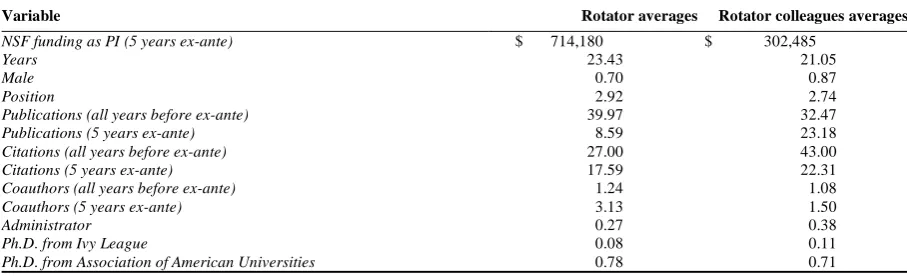
sample academics. Compared to their colleagues (including those with NSF funding ex-ante) rotators
have similar characteristics such as having received their PhD training from institutions of similar
ranking but they differ in two main respects. First, in the ex-ante period their publication and citation
records are below those of their colleagues (e.g. 8.59 versus 23.18 articles). Interestingly, the
corre-sponding figures before the ex-ante period are comparable between rotators and their colleagues, with
the rotators having somewhat more articles (i.e. 39.97 versus 32.47).
[Table 2 about here]
Taken together, these comparisons suggest that rotators, on average, publish less than they
usually do just before joining the NSF. On the other hand, their funding from the NSF is considerably
higher than the NSF accumulation of their colleagues both in the ex-ante period and before. Therefore,
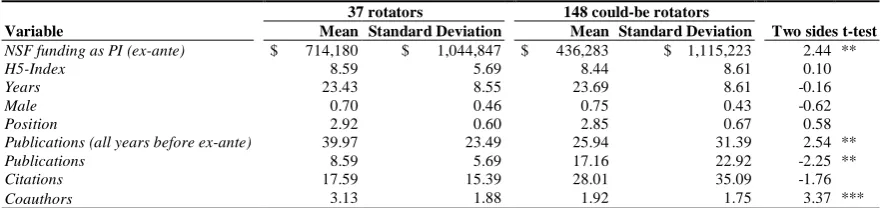
as expected, rotators are typically more successful in raising NSF funds than their colleagues.
Simi-larly, as Table 3 demonstrates, NSF rotators are similar to those we identify as “could-be” rotators. For
instance, for both cohorts the elapsed time since PhD graduation until the end of the rotation (and the
equivalent period for “could be” rotators) has been 23 years and they are mostly men with H-indices
around 9.13 In line with the discussion above, the main difference is that the NSF funding records of
rotators are higher than the funding records of those academics we have identified as comparable to
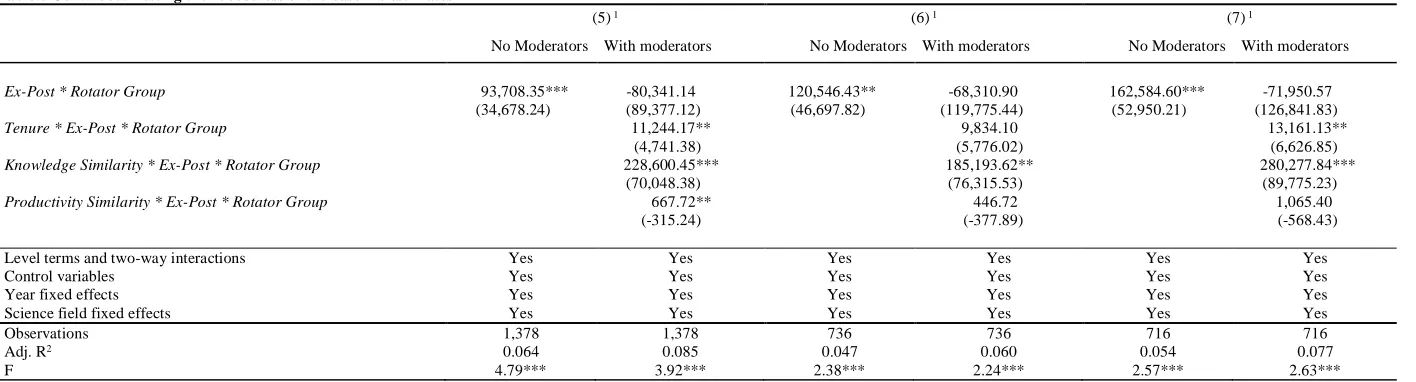
rotators. As shown in robustness test 7 in Table 8 (below), this difference does not impact our
esti-mates in any material way. Not shown in Table 3, the rotators (and the scientists that match them) are
employed at both private and public universities of different size and prestige and from nearly every
state. In general, we do not identify trends in terms of the type of institution that rotators come from.
[Table 3 about here]
13 The majority of our academics are in the natural sciences, where multiple postdocs are common. On average,
having 21 years of experience post PhD at the start of the rotation corresponds to about 13 years since holding a faculty position (i.e., running one’s own lab). Our average faculty member is thus tenured, and about 20% had
received NSF funding before the ex-ante period (five years before a colleague becomes a rotator). During the
Figure 1 plots the average yearly ex-ante and ex-post funding for rotator colleagues versus
sci-entists employed in the academic units we collected via the one-up, one-down approach. It zooms in
on the 431 scientists that did not have NSF grants ex-ante (making up our sample), identified using
matching scheme 3. While the two groups are similar ex-ante (by design), we observe large changes in
the ex-post period. Figure 1 shows that scientists in the treatment group increase their average funding
at a substantially higher rate than scientists in academic units without a rotator. The increase
material-izes in year 2 and in year 3 after the return of the rotator with year 3 being the pick of the increase.
[Figure 1 about here]
The timing of this increase fits a recurring theme that came up during our interviews: namely,
that the rotators helped their colleagues put together their NSF applications in the second and third
funding round after their return to their academic unit. In other words, as expected, the rotator effect is
pronounced after the rotator has transmitted knowledge for about a year to her colleagues. In line with
the interview findings, the decline in funding we observe after year 3 is likely driven by the fact that
the majority of academics who were awarded grants in years 2 and 3 did not submit additional
applica-tions in years 3 and 4, as they were still working from the earlier grants. Overall, the figure strengthens
our expectation of an impact from rotators to their colleagues.
Analysis and results
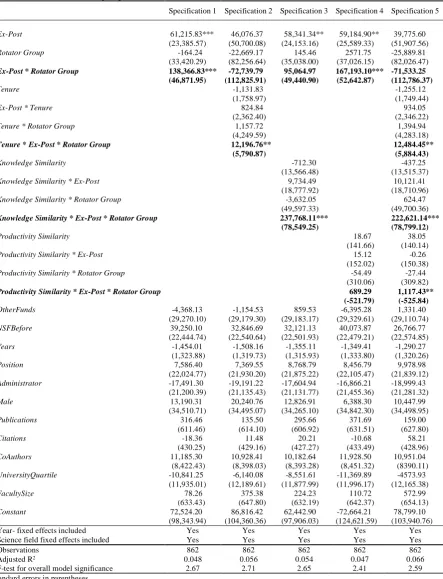
Table 4 presents the baseline estimates using matching scheme 3, the one we expect to better capture
the counterfactual as it is the most restrictive. The results are qualitatively similar when using the other
matching schemes (available as Online Appendix Tables 1 to 3). We present 5 specifications.
Specifi-cation 1 tests the main effect under H1. Then we include separately the moderators we hypothesize in
H2a, H2b, and H2c in specifications 2, 3, and 4. Specification 5 is the full specification including all
moderators.
[Table 4 about here]
We find strong support for H1 as shown in specification 1. We also fail to reject H2a and H2b
not change the main results when included, likely because of the matching procedures we have
fol-lowed which, by design, minimize the differences between control and treatment groups.
Regarding H1, the Ex-Post * Rotator Group interaction in specification 1 provides strong
sup-port for our theoretical expectation that rotators induce funding improvements for their colleagues.
The order of the effect is $138,367. This figure is significant as it demonstrates that rotators have an
effect that is economically meaningful: rotator’s colleagues with no NSF funding in the ex-ante period
raise close to $140,000 more than similar scientists in similar academic units who do not have a rotator
as a colleague in the ex-post period. Given that this increase is attributed to the rotator and not to
per-sonal characteristics, time-variant factors, or other reasons we conclude that the gains arising from
knowledge transfer are material. To put the figure in perspective, as shown in Table 1, we note that in
the ex-post period academics without NSF funding ex-ante belonging to groups without a rotator,
raised, on average, $69,168 from the NSF. These $69,168 can be attributed to a host of factors such as
personal improvements and increased effort but they cannot, by definition, be attributed to the rotator.
Still, as our estimates reveal the rotator effect leads to an increase that is twice as large as the increase
from all the other potential contributing factors combined.
The estimates in specifications 2 and 5 provide support for H2a. The main rotator effect
be-comes stronger when the rotator has a longer tenure in her academic unit: the Tenure*Ex-Post*Rotator
Group variable is statistically significant, while the Ex-Post*Rotator Group interaction term ceases to
be. Indeed, a one-unit increase in the tenure variable corresponds to an increase of the main rotator
ef-fect of around $13,000. This is consistent with Dahlander and McFarland (2013) who found that even
when not working together (i.e. no co-authorship in our case), same-academic-unit colleagues are
ex-posed to each other (and hence can learn from each other). We also fail to reject H2b. When the rotator
shares similar knowledge with her colleague the main effect becomes stronger: in specifications 3 and
5 the interaction of the main effect and the Knowledge Similarity variable is positive while the level
term of the main effect is no longer statistically significant. On the other hand, based on specifications
4 and 5 we find only partial support for H2c; Productivity Similarity has a moderating effect on the
while unsuccessful in previous grant applications, have accumulated enough knowledge and expertise
to be successful going forward, even without the assistance of the rotator.
Regarding the managerial implications and generalizability of our results, we conducted
sev-eral tests to understand better the conditions in which learning by seconding creates value (tables and
additional details included in the Online Appendix Tables 4 and 5). We first split the sample according
to the length of the secondment to see if this affects knowledge transfer. Consistent with our
expecta-tions, we find that longer tenure at NSF appears to give the rotator more knowledge to transmit to
col-leagues. Next, we looked to see if the nature of the project (here, the grant application) impacts the
value of secondments. Specifically, we limited the analysis to scientific fields a) with high rejection
rates, b) that evolve fast, and c) which require multidisciplinary approaches. Grant acquisition is
po-tentially more challenging in such fields, so a rotator’s insights would be particularly helpful. We find
that the rotator effect is indeed stronger in cases b) and c) than in the baseline model (but not for case
a)). This shows that the organizations should consider the nature of the project at hand when
consider-ing sendconsider-ing an employee on a secondment.
To make sure our quantitative findings are reasonable we conducted a series of telephone
in-terviews in 2016 with 10 rotators and 15 academics (10 without NSF funding ex-ante and 5 with
fund-ing) employed in academic units with a rotator. The interviews lasted between 15 and 30 minutes. To
select these rotators and rotator colleagues we randomly selected rotators who served at the agency
be-tween 2009 and 2012 so that they would all have recent experience and recollection with the NSF and
with the ex-post period. The interviews focused on three main themes: 1) the rotator’s experience with
the NSF prior to becoming a rotator, her reason for applying to the position and her thoughts on who
becomes a rotator, 2) the experience of being a rotator and her position within the NSF, and 3) how
returning to the home institution has affected her and her faculty.
As mentioned above, prior experience with the agency lead academics to apply so that they
could learn more about the NSF’s internal operations. This is particularly relevant because it
amelio-rates any endogeneity concerns in the empirical analysis as it demonstamelio-rates that selection into a
rota-tion posirota-tion is exogenous to local colleagues needing help in raising funds. It also informs the
knowledge transfer from an external organization such as membership in external committees and
government task forces. The scientists at hand had experience with the NSF previously largely by
par-ticipating in the selection process as an external reviewer. But, such experience did not translate to
gains for colleagues. Instead, the secondment in the NSF boosted the colleagues’ ability to secure
re-search funding.
All rotators indicated that upon returning to their home institutions, they tried to make their
colleagues more knowledgeable about the NSF. Some consulted with the heads of their academic units
to identify colleagues working on the NSF’s priority issues who could benefit from mentoring. Others
assisted faculty members with exploring less-known NSF funding possibilities. Such assistance came
from open seminars but also, and more frequently, via one-on-one meetings.
When interviewing rotator colleagues, we refrained from mentioning the rotator but after
ask-ing about experience with NSF, we asked if they had ever received help from colleagues with NSF
ap-plications. All 5 interviewees who had NSF funds ex-ante said they did not receive substantial help
from the rotator ex-post because they did not need it. The 10 interviewees without NSF funds ex-ante
identified the rotator as providing valuable assistance in six cases (where, in line with the empirical
estimates, there was an overlap in the research topics between the rotator and the focal colleagues).
The interviewees mentioned several ways rotators helped them including feedback and direction
to-wards certain funding opportunities. The following is representative of the type of knowledge rotators
transfer “[The rotator] organized a day for us to informally talk about opportunities and proposals. He
would read the documents we were working on and gave feedback on what could be improved…. [The
rotator helped] when trying to figure out what the NSF actually wants to have in a proposal.”
Testing the mechanism and examining alternative explanations
The baseline estimates reported above could reflect not only knowledge transfer, but also political
in-fluence—that is, the returning rotator could privately lobby NSF officials on the part of a local