•
22i6
£12
2
BY
£11~6
IlJ 3S0r NilS
OLZIO*
is
SOl~VJ
NVS M 081
~O~~
A~V~811
land
3S0r NvS
~
SlVJIO
I~3d
---co
~~Tapestry
J"
SCl:
:"
'C;:
&
TECHNOLOGY
August, 1970
The 3330
Disk Storage Facility.
Punch.
The 1403 Printer. The 3211 Printer.
This is IBM's new System/370.
If s designed to give you a lot more
computing.
Yet ifs compatible
with
System/3()()'
Which means you can ins tall
System/370 and still keep using most of the
same programs your programmers have
written. And still keep using the same
ter-minals. And the same instruction set.
Which also means
if
you're now
using System/360, you can easily make the
move up to System/370.
More work, less time.
The key idea behind System/370 is
speed and throughput. We've speeded up
the computing process. And not just a little
bit, either.
Compared to System/360's central
processing unit, System/370's is 2 to 5 times
faster internally.
The result is you get more
com-puting.
AUCUST
1J70
~G5
',370
50,
,Vz
ill)
rer
{s-75,
)5
els
)re
fer
:es
e,
}
-le
k
bytes) than our current files. And it can
transfer it up to two and a half times faster.
This file alone can significantly increase
performance.
Then there's a fixed-head,
high-speed file (previously available with
System/360, Models 85 and 195). It's for
people who want fast access to even more
data than the large memory can store.
In its own way, it's an inexpensive
extension of your computer's memory.
It,
too, can feed data into your computer at
incredible speeds.
Finally, there's a high-speed train
printer (the 3211). It prints letters and
num-bers at the rate of 2000 lines per minute.
It'
s
the fastest printer we've ever made.
Easy installation.
We've already told you that with
System/370 you don't have to convert most
existing programs. Or develop new sets of
instructions.
All of which makes System/370 easy
to install.
But there's another reason why
System/370 is easy to install. We're using
monolithic circuit families. You get more
computing per cubic foot.
Certain Model 155 configurations
actually take up less space than Model 50.
We support the system.
We realize our job isn't only making
computers. But also making sure you get
the most out of them.
So we intend to make available the
best possible services to support
System/370.
Our systems engineers are
avail-able to help you get ready for System/370.
They can work with your own
people to smooth the way for its arrival.
And at the same time, tailor the system to
solve your particular problems.
Our computer programs for
System/370 are, by and large, the same as
those we offer for System/360.
The same holds true for our
educa-tion courses. There are over 70 to choose
from.
Editor
Vol.
19,
No.8
August,
1970
/l.r.rocictle Editor
Edmund C. Berkeley
Sharry langdale
linda ladd lovett Neil D. Macdonald
Assistallt Editors
Software Editor AdlJeftising Director
Art Directors
Contributing Editors
Stewart B. Nelson
Bernard lane
Ray W. Hass Daniel T. langdale
John Bennett Moses M. Berlin Andrew D. Booth John W. Carr III Ned Chapin Alston S. Householder Peter Kugel leslie Mezei Rod E. Packer Jean E. Sammet Ted Schoeters Richard E. Sprague
/ldl'isorJ Committee T. E. Cheatham, Jr. James J. Cryan Richard W. Hamming Alston S. Householder Victor Paschkis
Fulfillment Mallager William J. McMillan
/ld l'ertisill,fi RelJl'esentatives
BOSTON 02116, Phillip E. Nutting
1127 Statler Office Bldg., 617-542-7720
NEW YORK 10001 Bernard lane
254 West 31 St., 212-279-7281
ELSEWHERE, The Publisher Berkeley Enterprises, Inc.
815 Washington St., 617-332-5453 Newtonville, Mass. 02160
Editorial Offices
BERKElEY ENTERPRISES, INC. 815 WASHINGTON STREET, NEWTONVILLE, MASS. 02160
CIRCULATION AUDITED BY AUDIT BUREAU OF CIRCULATIONS
Computers and Automation is published monthly (except two issues in September) at 815 Wash-ington St., Newtonville, Mass. 02160, by Berkeley Enterprises, I nco Printed in U.S.A. Subscription rates: United States, 11 monthly issues and two issues in September (one of which is a directory issue) - $18.00 for 1 year, $36.00 for 2 years; 12 monthly issues (without directory issue in September) - $9.50 for 1 year; $18.00 for 2 years. Canada, add 50¢ a year for postage; foreign, add $3.50 a year for postage. Address all U.S. subscription mail to: Berkeley Enterprises, Inc., 815 Washing-ton St., NewWashing-tonville, Mass. 02160. Second Class Postage paid at Boston, Mass.
Postmaster: Please send all forms 3579 to Berkeley Enterprises, Inc., 815 Washingt1ln St., Newtonville, Mass. 02160. iD Copyright 1970, by Berkeley Enter. prises, Inc.
Change of address: If your address changes, please send us both your new address and your old address
CDI-..puters
and automation
The magazine of the design, applications, and implications of information processing systems.
Computer Art
1 1 13 14 15 16 17 18 20 20 20 21 21 22
22
23
24 24EIGHTH ANNUAL COMPUTER ART CONTEST
Tapestry I Tapestry II Stairways In Wilderness City Painting The Field
Source Pattern - and Three Transformations Fossil II
Spirals Firebird Crosses Mask Landscape Crystallization Evolution Entropy
Names and Addresses 1970' Contest
Lillian Schwartz and Ken Knowlton Lillian Schwartz and Ken Knowlton Manfred Mohr
Lloyd Sumner Grace C. Hertlein Grace C. Hertlein Sozo Hashimoto
Goran Sundqvist Goran Sundqvist Goran Sundqvist Leonard Kilian Leonard Kilian
Robert Venn and Leonard Kilian Leo Geurts and Lambert Meertens Donald K. Robbins
Leigh Hendricks
of Computer Artists Who Entered the
25 THE ARTIST VIEWS DISCOVERY THROUGH COMPUTER-AIDED
GRAPHICS [A]
by Grace C. Hertlein, Asst. Prof., Chico State College
The methods - and motivations - of a traditional artist who became a computer artist.
Computer Graphics
27 INTERACTIVE COMPUTER GRAPHICS IN ARCHITECTURE [A] by Sheldon Lee Anonsen, Mgr., Syst. and Dev. Div., Ellerbe Architects
A successful experiment in which computers assisted architects in determining the. functional design of a building.
Computer Programming Languages
39 A PROSE GLOSSARY OF APL (A Programming Language) [A] by Harry Katzan, Jr., Asst. Prof., Pratt Institute
The important terms of APL are defined in context in con-tinuous prose, with an accompanying alphabetical index.
Computer Professionals
34 THE DILEMMA OF THE SYSTEMS ANALYST by Elias M. Awad, Asst. Prof., DePaul Univ.
Why systems analysts often encounter conflicts between their commitments to the organization which employs them, and their commitments to their profession - with some suggestions for ways to resolve these conflicts.
8 ACM COUNTER CONFERENCE - STATEMENT OF PURPOSE [F] by David E. Burmaster
Computers and Society
31 COMPUTERS AND SOCIAL CHANGE: USES - AND MISUSES [A] by David F. Foster
This prize-winning essay in C&A's Martin Luther King Memorial Prize Contest tells why computer scientists and technologists must learn to understand the subtle and complex nature of social processes in order to solve the problems of change in society.
43 THE CROSSROADS OF DECISION [A]
by Thomas J. Watson, Jr., Chrmn. of the Board, IBM Corp.
A personal statement, given to a committee of the United States Senate, of why the dissatisfaction of young people and the un-acceptable costs of war require us to promptly end the war in Southeast Asia.
46 A PROPOSAL TO WITHHOLD PRODUCTS FROM THE GOVERN·
MENT - PRO AND CON [F]
by Edward Webster and Thomas J. Watson, Jr.
47 ENGINEERING FACULTY FOR A RESPONSIBLE CONGRESS [F] A report from the Academic and Professional Alliance for a Responsible Congress (APARC)
6 COMPUTERS AND TRUTH [E]
by Edmund C. Berkeley, Editor, Computers and Automation How the computer professional may correlate "what the com-puter says" with the real world.
9 liTHE HOUSE IS ON FIREII - MORE COMMENT, PRO AND CON [F] by Robert D. McConnell, E. C. Mclrving, and the Editor
9 THE WINNERS OF THE 1970 MARTIN LUTHER KING MEMORIAL PRIZE CONTEST OF COMPUTERS AND AUTOMATION [F]
10 CANADIAN CONFERENCE CONCLUSION: CONTROLS ON COM· PUTERS ARE NEEDED TO PROTECT INDIVIDUALS [F] A report from The Financial Times of Canada
Computers and Assassinations
48 THE ASSASSINATION OF SENATOR ROBERT F. KENNEDY: [A] 48 Preface, by Edmund C. Berkeley
50 Two Men With Guns Drawn at Senator Kennedy's Assassination: Statement to the Press, by Theodore Charach
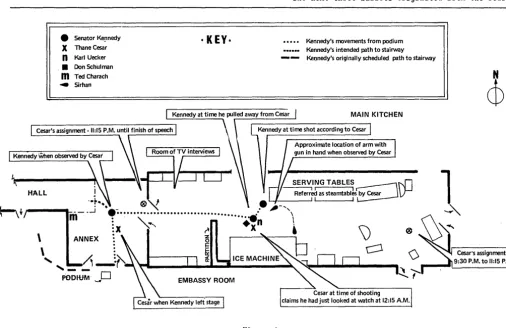
50 Map of the Scene of the Assassination of Senator Robert Kennedy
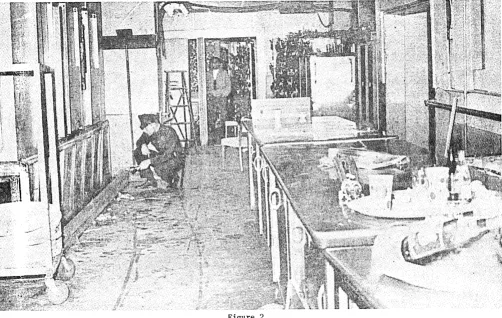
51 The Pantry Where Senator Robert Kennedy Was Assassinated 52 Bullet Hole in the Frame of a Door
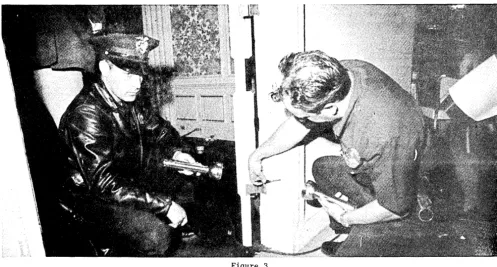
53 Two Bullet Holes in the Center Divider of the Pantry Door 53 Complaint for the Disclosure of Information: Suit, Theodore Charach vs. the Los Angeles Police Department, June 4, 1970
Computers Abroad
56 REPORT FROM GREAT BRITAIN [C]
by Ted Schoeters
Some speculations about the fate of International Computers Limited (lCL) in the new political climate of Great Britain.
Computers and Fun
This Month's Cover
The front cover drawing is the winner of the first prize in C&A's Eighth Annual Computer Art Con-test. The drawing, named "Tapes-try I", is taken from a computer-generated film, "Pixillation", pro-duced for American Telephone and Telegraph Co. at Bell Telephone Laboratories, Murray Hill, N.J. The artists are Lillian Schwartz and Ken Knowlton. For more in-formation, see page 13 ft.
Depart1nents
70 Advertising Index
59 Application News
70 Book Reviews
71 Calendar of Coming Events
70 Classified Advertisements
60 Education News
4 Letters to the Editor
69 Monthly Computer Census
67 New Contracts
68 New Installations
64 New Product:> and Services
57 Punch Lines .•.
EDITORIAL
Computers'and Truth
Sooner or later every computer professional is required to correlate the results of computer operations, "what the computer says", with the real world.
Suppose "the computer says" that J. Jones should be paid (and should be credited for withheld taxes) for the period June 6 to June 22 as follows:
Gross pay:
Federal withholding tax: Social security tax:
Massachusetts withholding tax: Net pay:
$111.04 16.10 5.33 4.00 $ 85.61 Is this true?
The inspection, the comparison with the real world, shows that J. Jones is a "student", and so no Mass. withholding tax should be deducted for him, and so the computer's results are partly wrong, and the program inside the computer was imperfect, and should be corrected.
Here in this case, the case of payroll calculations, we have of course two general conditions operating in our favor:
D No Disagreement. The facts and principles in this field of knowledge are completely agreed upon by all informed persons; and
D No Hiding. No deliberate efforts at hiding or concealing information are being made. (Nature may hide -truth from scientists, but Nature is not using deliberate concealment and lying.)
These two general conditions for factual knowledge and computing are today so widespread for many fields of knowledge that we forget that these conditions are not universal.
There are a number of important areas of factual knowledge where these conditions do not apply, and
instead:
-D -Disagreement. The facts and principles may be subject to widespread disagreement; or
D Hiding. A great many deliberate efforts to conceal (and to tell lies) may be occurring.
An example of the first area (disagreement) is the conflict going on in 1970 between the state of Israel and the Arab states, Egypt, Syria, Jordan, etc. In this case no more than a small portion of the facts or the principles could, I believe, be agreed upon by both sides. Any application of computers to problems in this area would be very seriously interfered with by this extensive disagree-ment. In such an area as this, apparently, computers could only be successfully applied to produce second approxima-tions to a solution in cases where human beings have agreed on the first approximation to solutions.
The second area is still more complicated. In the case of crime, political assassinations, lies by vested interests, the activities of secret police, lies by governments, and similar conflicts between parts of a society and the whole society, there is often little doubt about many of the important facts and principles. One of those principles is that it is wrong to lie. The main defense of the deviant part of society is concealment; the fact of concealment in itself implies there is something needing concealment. Part of the application of computers to problems in this area consists
of techniques to strip off concealment, and enable the whole society to know the facts and to judge.
I have just finished reading a horrifying story, Murder to
Order, by Karl Anders, published 1967 by Devin-Adair Co.,
23 E. 26 St., New York, 127 pp. This is reportedly the account of a secret agent of the Soviet Union, Bogdan Stashinsky, who on orders of the Soviet espionage system, in 1957 and 1959 assassinated two Ukrainian emigre leaders (Rebet and Bandera) living in West Germany, using a special weapon spraying cyanide gas into the victim's face; and Stashinsky reportedly received an Order of the Red Banner in November 1959 for his "successful contribution to the solution of an important problem." In 1961 Stashinsky fled to the West, confessed, was tried in a German court, and sentenced to six years at hard labor.
How true is this story? I never heard before of many of the persons mentioned as actors in this story. I never heard of the author, Karl Anders. The book has no index. There is no bibliography. Someone presumably translated all that is here reported from Russian and German into English; yet the translator is not identified. How am I to evaluate this story?
Probably the main purpose of the publication of this book is to fill its readers with horror at the Soviet Union KGB - but certainly many of the secret cloak and dagger operations of all nations having them, including certainly France, West Germany, and the United States, are likely to be just as horrifying.
What about the areas of knowledge where wide disagree-ment and extensive hiding are the rule? In spite of the difficulties, computer professionals can make important contributions by assuming, as part of the profession of information engineer, the task of development of computer techniques which help to discover the truth and discover grounds for agreement. These include techniques for:
1. The analysis of evidence;
2. The preparation of indexes, correlations, and concordances;
3. The pinpointing of questions to be answered; 4. The pinpointing of weak spots in the evidence; 5. The demonstration of lies and their correction; 6. The evaluation of evidence;
7. The derivation of reasonable judgments and conclusions.
Would it be hard to program reasonable judgment? Maybe not. The programming of reasonable judgments has been accomplished in chess and checkers programs, when a computer program evaluates a situation, in order to decide upon a move.
In essence, therefore:
1. Computer people need to recognize the areas of knowledge where proffered computer input is full of departures from truth;
2. They need to become experts in removing errors from proffered computer input;
3. They need to participate actively in removing "gar-bage" from the input.
~~Q.~
Letters To The Editor
Some Positive Reactions to May Issue Article by Sprague
have just finished reading your article in the May issue, "The Assassi-nation of President John F. Kennedy: The Application of Computers to the Photographic Evidence". I found it extremely interesting, although it is too bad that a mass circulation maga-zine did not publish your article, since unfortunately the impact of Compu-ters and Automation is so small com-pared to the giants of the publishing world.
For the past three years I have studied virtually everything available on the assassination of President Ken-nedy, including the 26 volumes of the Warren Commission Report. I believe that I have the same feelings about the subject as you and others who have researched the case - outrage and frustration that the public is constant-ly being misled by the news media regarding the assassination, and espe-cially the Garrison investigation. Best wishes for further success in your research.
MICHAEL GERACE 47 Centre Lane Milton, Mass. 02186
I recently had access to one copy of your magazine, and was fascinated by the article on President Kennedy's Assassination. After reviewing that is-sue, I would appreciate information on how I might obtain my personal sub-scription to this highly informative publication.
J. E. LA WSON, Design Engineer Data Corp.
7500 Old Xenia Pike Dayton, Ohio 45432
reached me. Please use the money for my subscription premium in any way which will support your magazine and/ or the exposure of covert activities which appear to be counter to the interests of America and our future. A great deal of exposure would be re-quired to get through the smokescreen of the TV to the voter.
JAYHART 1961 Oldham Austin, Tex. 78705
You are to be congratulated on the fascinating array of articles in your May issue. Of particular interest to me was the excellent article by Dick Sprague on the application of
compu-Sound
enclosure
fora
sound
printer
ters to the photographic evidence of Kennedy's assassination.
ALDER M. JENKINS Director of Public Relations SofTech
391 Totten Pond Rd. Waltham, Mass. 02154
A Word of Thanks
Thank you for your fine magazine, professional articles, and stimulating puzzles.
DA VID C. NIVEN Systems Supervisor, DSD Honey"vell Inc. EDP 1320 Dublin Rd. Columbus, Ohio 43212
READERS' FORUM
ACM COUNTER CONFERENCE - STATEMENT OF PURPOSE
David E. Burmaster Room 803
545 Main St. Cambridge, Mass.
A group within the Association for Computing Machinery (ACM), unhappy with the ACM's decision to hold its 1971 conference in Chicago, has scheduled a simultaneous "Counter" Conference to be held Aug. 3-5, 1971, at the Harvest House Motel, Boulder, Colorado. We who organized the Counter Conference have received several inquiries as to the nature of the conference. Following is our statement of purpose.
Statement of Purpose
We who organized the Counter-Conference were drawn together by various overlapping concerns. We now recog-nize these as concerns for various aspects of professional-ism. We understand this latter term as follows:
(1) A distinguishing mark of a professional, in any field, is his acceptance of responsibility for the consequences of his activities, including indirect and remote consequences. We believe that the
ACM does not adequately emphasize this aspect of professionalism. For example, we believe that the ACM's decision to hold the 1971 National Conference in Chicago was particularly irrespon-sible, since Chicago is an established symbol for the repressive side of current American life. (2) Another distinguishing mark of a professional is
his maintenance of standards of technical work in his field.
(3) The final distinguishing mark of a professional is the technical excellence of his own work.
We do not assert that a high level of professionalism is unachievable within the ACM. Most of us are ACM mem-bers, and many of us hold responsible positions in that organization. We are working within the ACM, and we expect to continue to do so. We have no plans for organization of a competing society. If, however, we were merely to abstain while the ACM is in Chicago, we would ~hare responsibility for the ACM's action. This we cannot do.
The Counter-Conference will emphasize all of the as-pects of professionalism. The timing of our meeting is intentional, as is its location away from Chicago. It is our further intention that an exemplary standard of technical quality will be maintained at our sessions. 0
COMPUTERS OFFER NEW OPPORTUNITIES FOR THE BLIND - COMMENT
Dr. Charles E. Hallenbeck Dept. of Psychology Univ. of Kansas La~ence,Kan.66044
In your February 1970 issue you printed an article entitled "Computers Offer New Opportunities for the Blind" [page 37] which was of considerable interest to me as Associate Editor of the A.C.M.'s Newsletter for Blind Computer Programmers. The article described the special techniques used by four programmers at the Los Angeles County Data Processing Center, techniques which enable these blind programmers to perform their tasks produc-tively. I would like to point out, however, that some of your readers may be misled by what I believe to be an undue emphasis on the need for sighted assistance to provide on-the-job help to blind programmers. I do not contend that the best way for a blind programmer to perform his work is to avoid help where it is useful and appropriate, but many techniques other than those referred to in the article cited have enabled scores of other blind programmers to perform their tasks with far less reliance on
sighted assistance than indicated.
The article listed four procedures unique to blind pro-grammers. The third was identified as "compilation for Syntax", and begins with the statement, "An assistant is required at this point to read the programmer the error messages in the program listing, and insert the corrected statement cards in the source deck after he has typed the corrections and had them key-punched." As the article continues, the fourth item, "Program Testing", contains the following statement, "Test results will need to be described by an assistant, who will also document the program".
blind programmers use this technique to obtain 80-80 listings, compiler diagnostics, and test runs for programs being de-bugged. Most computer manufacturers maintain their manuals on magnetic tapes, and some (most notably I.B.M.) even release such tapes to blind programmers for embossing directly into Braille by this method. Sighted assistance is sometimes faster, but not at all indispensable. As for correcting source decks, once again most blind programmers have a simple mechanical card reader by which the contents of any column on the card can be examined to determine its contents. "Reading" punched cards this way is very slow and wasteful of skilled man-power, but searching through sequence numbers on a card's margins is quick, and permits the blind programmer to handle his cards independently. The cut corner must surely have been suggested by a blind programmer on Hollerith's original staff.
One final comment refers to the implication that blind programmers cannot document their work without sighted assistance. It is certainly true that flow-charting is a prob-lem with which many programmers do need help, but automatic flow-chart generating software does exist, and the many other details of documentation require no partic-ular assistance. I am afraid that the article may have inadvertently combined two facts about the four mers whom it described. First, that they are blind program-mers, and second, that they are relatively newcomers on their jobs. It is neophyte programmers, whether blind or sighted, who often benefit most from the assistance and advice of their co-workers and supervisors. Blind program-mers often progress to supervisory positions of responsi-bility, a fact which clearly disproves the necessary connec-tion between blindness and the need for help with
docu-mentation. 0
liTHE HOUSE
IS ON FIREII - MORE COMMENT, PRO AND CON
I. From Robert D. McConnell IBM-GEM Pacific Support Center APO San Francisco, Calif. 96331
Please discontinue my subscription and refund the un-paid balance. My reasons are expressed by the letters in the May issue from Messrs. Beus, Mleko, and Parker ["The House is on Fire" - Comments, page 8]. I subscribe to technical publications, with my own money, to keep abreast of the technological changes in this industry. I subscribe to other more qualified and better balanced publications for political commentary. The dearth of tech-nical information in your magazine of late demonstrates your intention to use a technical format for personal editorializing.
II. From E. C. McIrvine, Manager Technical Analysis
Xerox Corp.
P.O. Box 1540, Bldg. 105 Rochester, N.Y. 14604
As I am sure many of your readers do, I tend to run about three months behind in my periodical reading. Consequently, I just read your February editorial, "The House is on Fire".
I could not agree more with the sentiments expressed. The overlap of computational linguistics with natural lin-guistics, along with the observed philosophical implications of linguistic analysis, give the computing field an opportu-nity to playa key role in humanizing society. If we fail to step up to that role, we perform a disservice to humanity. To date, I have always followed your journal through library reading. With this letter I enclose a check for a personal subscription, as a small token of support for your editorial policy.
III. From the Editor
It is very pleasing to an editor and publisher to receive a letter like Mr. McIrvine's, and to have our editorial point of view supported to the extent of his becoming a subscriber.
It is, of course, not pleasing to an editor and publisher to receive cancellations of subscriptions in opposition to our editorial point of view. But we cannot be all things to all people. We feel a strong responsibility to use the editorial freedom which our status as a paid circulation magazine grants us. And our objective is to use
Computers and
Automation
as a way to help develop not only the better use of computers, but also better input into computers. 0WINNERS OF 1970 MARTIN LUTHER KING MEMORIAL PRIZE CONTEST
The winners of the Second Annual Martin Luther King Memorial Prize Contest have been announced. They are: David F. Foster, 3233 M St. N.W., Washington, D.C.; and
I I
'INSTANT
INSANITY' FAILS TO FRUSTRATE COMPUTER
I I -COMMENTS
I. From John Bieler 3 Dogwood Lane Turnersville, N.J. 08012
In the "Applications" section of your June issue [page 50] you described the use of a computer to solve the "In-stant Insanity" puzzle. The object of the puzzle is to arrange four cubes in a stack so that each side of the stack has exactly one face of each of four colors.
Elementary analysis reveals several errors in the calcula-tions:
1. Each cube has 24, not 64 possible combinations. Its orientation is uniquely determined by a selec-tion of one of six possible choices for its bottom face, and then a selection of one of four possible choices for its "south" (or "east", or "north" or "west") side.
2. Because there are four cubes, each with 24 possi-ble orientations, and there are 24 permutations of the four cubes, there are clearly 245, or 7,962,624 total combinations, not 16,777,216.
3. It is obvious that any solution gives rise to a class of 192 related solutions. These solutions are ar-rived at by the 24 permutations of the cubes, four possible orientations resulting from rotations about a vertical axis, and two selections based on an arbitrary top-bottom inversion (24x4x2=] 92). In January, 1969, I solved the problem on Temple University's Control Data Computer, and determined that there is essentially one class of related solutions - 192 solutions in all.
II. From James E. Renouf UNIVAC DP Services 300 N. State St. Chicago, Ill. 60610
Many of your readers have taken the opportunity to question some of the statements I made pertaining to the solution of the Parker Bros., Inc. game, "Instant Insanity". I sincerely appreciate their interest, but I cannot really dispute or affirm any of the facts and counter claims sent to me, as I am not a mathematician. I would like, however, to relate some of the assumptions I made when writing the FORTRAN V program for the Univac] 108 computer: (1) I am rotating all four cubes on three axes, inclusively expos-ing all four sides of each plane for each iteration of each rotation - (4x4x4) = 64 rotations per cube.
f2)
I am rotating all 4 cubes in the same manner - (64x64x64x64x) = 644 = 224 = 16,777,216 rotation iterations. The end result of this is 256 solutions which are all unique in that each solution requires a different number of rotations on 1 or more of the 3 axes for 1 or more of the 4 cubes.The 256 solutions are not all unique in the turns of color combination, in fact many of them are duplicates.
One other point worth mentioning is that I have come across at least two "Instant Insanity" games that do not match in the terms of having the same adjacent sides containing the same colors. Thus it may be that our puzzles
differ. D
CANADIAN CONFERENCE CONCLUSION: CONTROLS ON COMPUTERS ARE
NEEDED TO PROTECT INDIVIDUALS
(Based on a report in the Financial Times of Canada, 1061 St. Alexander Street, Montreal, Quebec, Canada, June 1, 1970)
Delegates from government, industry, and universities, at a conference on computers, privacy and freedom of infor-mation held recently at Queen's University, concluded that controls are needed to avoid potential abuses of the large information systems predicted for the future. The 150 delegates participated in three days of heated discussion, and their consensus was reached only after lengthy argument, particularly from representatives of credit bureaus and private service companies. There were strong initial fears expressed by some delegates that the controls designed to prevent abuses might in fact limit freedom of information and communication.
But as opinions converged, there was general agreement that a system of licensing data banks will eventually be necessary. Among the recommendations of the delegates were:
-Lesiglation to provide for the right to privacy and the right to freedom of information.
- Criminal penalties for breaches of legislation; special, general and, where necessary, puni tive damages for abuses of privacy.
- An independent commission to investigate specific
complaints against operators of computer data banks or other information systems.
- Comprehensive licensing of data banks, including different levels of licenses for information of varying sensitivity.
- A public fund to pay for individual losses in cases where there has been damage but where legal recourse is impossible.
- Bonding of personnel working with data files. Legal guarantees that an individual may see and correct his own file at any time; provisions to make individuals aware that files exist on them.
The conference emphasized that credit bureaus are merely the most visible area where abuses of privacy could occur. Any organization - including government - which systematically compiles information about identifiable in-dividuals was seen as a potential source of trouble.
Mr. A. E. Gotlieb, Deputy Minister of Communications, warned that the gap between technological development and legal regulation could result in complete separation of the "manipulators" of information and the rest of society. The conference was organized by the Department of Communications and the Department of Justice. The rec-ommendations of the delegates are expected to play a significant part in the formulation of government policy
~
..
~
COMPUTER ART CONTEST
The first prize in our 1970 Computer Art Contest has been awarded to Lillian Schwartz and Ken Knowlton of Bell Telephone Laboratories, Murray Hill, N. J. Their winning entry, "Tapestry I", has been published on the front cover of this issue. A second entry, "Tapestry II", is shown above.
These pictures were frames from a computer-generated film, "Pixillation", produced for American Telephone and Telegraph Co. as follows:
Each original 35mm frame of film was produced as a 240 X 340 array of dots and blanks by a Stromberg-DatagraphiCs 4060 microfilm printer controlled by an IBM 360/50 computer. The programming system used was a special one for performing global and local operations on two-dimensional internal arrays of alphanumeric characters, which are ultimately out-put as black, white, or frame-by-frame random dots.
TAPESTRY II
- Lillian Schwartz and Ken Knowlton
honorable mention. For some of the drawings, the explanation is obvious or can be inferred easily; for others, explanations are given. In it number of cases, the computer and the peripheral equipment which pro-duced the drawings have not been specified as much as we would like, because that information did not reach us by the close of the contest. We would, of course, like to identify the equipment that produced the art. Supplementary information of this kind should be sent to us for publication in a future issue.
n
o
$:
"'U
C
-t m
;:0
(fl Qj
:::J
0...
:t>
c
-t
o
$:
:t>
-t
a
z ...
~
:t>
c
(Q
,~
-0
' I
o
IN WILDERNESS - Lloyd Sumner
CITY PAINTING - Grace C. Hertlein
THE FIELD
SOURCE PATTERN - AND THREE TRANSFORMATIONS
- Sozo Hashimoto
FOSSIL II
- Goran Sundqvist The three drawings on this page are taken from a Tektronix 611 display terminal connected to a SAAB D22 computer. The pictures are made from a simple program to produce a circle, with different and varying parameters for radius, center coor-dinates, and angles.
FIRE BIRD
CROSSES
- Leonard Kilian
A cross was described as a planar function of two varia-bles. A second cross was described as the negative of the first function. These were plotted using a perspec,... tive from the front and above. This drawing and the two below were programmed in FORTRAN and run on a Uni-vac 1107 computer using a CalComp plotter.
MASK
- Leonard Kilian
A linear outline based on a picture representing an Afri-can mask was input. A spiral was drawn so that when-ever it intersected any of the input lines, the pen position reversed. A second spiral interlocking with the first one was drawn in the same way so that the picture could be drawn in two colors.
LANDSCAPE
- Robert Venn and Leonard Kilian The outline of a landscape was sketched, breaking it down into various areas (trees, grass, road, etc). In each area points were chosen at ~andom at a specified density, lengths were random within limits, and angles were either controlled or random.
CRYSTALLIZATION
- Leo Geurts and Lambert Meertens
These four drawings were made from a program to design patterns that combine regularity and irregu-larity in a natural way. The process is not unlike that of crystallization, where a regular structure grows out of chaos. The program starts by generating a random pattern of black and white squares, and then step by step a specified regularity is imposed upon it. In the upper lefthand corner, for ex-ample, the desired regularity was that the color of a square must be the same as the color of its neighbor in any of the four principal directions. This regularity is achieved by determining the color of a square from those of its four neighbors. Color is determined in this way for all squares of the field, taken in a random order. After the first "sweep" over the field, additional sweeps are made, until one of the following conditions is met: (1) none of the squares has changed color; or (2) the num-ber of color changes was greater than that in the previous sweep over the field. Different regularities were imposed on the other three drawings. The program was written in ALGOL 60 and run on an Electrologica X8 computer.
II
II IT.--
,I
31?.]
.
__
...
..
~...
~,.---I i
rn
• •
~~~~)m)m
• • • • • • • •
• • • • • • • •
••
EVOLUTION
- Donald K. Robbins Programmed for a Univac 1106 com-puter, and drawn on a Stromberg-DatagraphiX 4020 plotter.
•
•
g
I
ENTROPY
- Leigh Hendricks
The program for these drawings was run on an IBM 7090 computer and plotted on a Stromberg-DatagraphiX S-C 4020.
COMPUTER ARTISTS The following is an alphabetical listing of all persons who
submitted entries in the Eighth Annual Computer Art Contest of Computers and Automation. The names of persons whose drawings are published in this issue are marked with an asterisk (*). We are planning to publish in the future some of the drawings we were not able to include in this issue.
Caulkins, David, 11934 Currituck Dr., Los Angeles, CA 90049
Dayhoff, Ruth, National Biomedical Research Founda-tion, 11200 Lockwood Dr., Silver Spring, MD 20901 Dempsey, James G., Proctor & Gamble, 6090 Center
Hill Rd., Cincinnati, OH 45224
Derby, steve, 2411-B W. Orangewood, Phoenix, AZ 85021
DiLeonardo, D. J., Westinghouse Electric Corp., Bettis Atomic Power Lab., Box 79, West Mifflin, PA 15122 Elenbaas, J. A., Dow Chemical Co., Barstow Bldg. ,
2020 Dow Center, Midland, MI 48640
Eschbach, Darel, University of Toledo, Manager, Compu-tation Center, Toledo, OH 43606
*
Geurts, Leo J. M., Mathematisch Centrum, Tweede Boerhaavestraat 49, ·Amsterdam, Holland*
Hashimoto, Sozo, 28-2 2-chome Komazawa, Setagaya-Ku, -Tokyo, Japan*
Hendricks, Mrs. Leigh, Sandia Corp., Sandia Base, P. O. Box 5800, Albuquerque, NM 87115*
Hertlein, Grace C., Computer Science Dept., Chico State College, Chico, CA 95926*
Kilian, Leonard, University of Notre Dame, Notre Dame, IN 46556Klein, Charles, Box 6 RR 1, Sugar Grove, IL 60554
*
Knowlton, Ken, Bell Telephone Labs, Murray Hill, NJ 07974Lecci, Auro, via Pagnini 31, 50134 Firenze, Italy Lerman, Harvey N., 921 Thistle Lane, Maitland, FL
32751
Lipscomb, James S., 26 Woodfall Rd., Belmont, MA 02178
Mattox, Charles, 820 Hermosa Dr. N. E., Albuquerque, NM 87110
*
Meertens, Lambert, Mathematisch Centrum, Tweede Boerhaavestraat 49, Amsterdam, Holland*
Mohr, Manfred, 58 BId. Latour- Maubourg, Paris 7, FrancePass, E. M. , Georgia Institute of Technology, Rich Elec-tronic Computer Center, 225 North Ave. N. W. , Atlanta, GA 30332
Radford, T., 10 Forest Dr., Pinelands, Cape Town, South Afric a
*
Robbins, Donald K •• Advanced Techniques Div., Sandia Corp., P. O. Box 5800, Albuquerque, NM 87115 Salecker, .Anton G., Bureau of E. D. P., New York StateDept. of Transportation, 1220 Washington Ave., state Campus, Albany, NY 12226
Sandoval, Abad E., 3511 B Arizona, Los Alamos, NM 87544
*
Schwartz, Miss Lillian, Bell Telephone Labs, Murray Hill, NJ 07974Seeley, Richard W., 234 Ximeno Ave., Long Beach, CA 90803
Shah, Bharat K., Dept. 178, Cessna Aircraft Co. , Wichita, KS 67201
Sperry, A. B., Hewlett Packard, Calculator Products Div., P. O. Box 301, Loveland, CO 80537
*
Sumner, Lloyd, Computer Creations, P. O. Box 1842, Charlottesville, VA 22903*
Sundqvist, Goran, Kraftdata AB, Box 3118, 103 62 Stockholm 3, Sweden*
Venn, Robert, University of Notre Dame, Notre Dame, IN 46556Walker, Dr. Evan Harris, 1507 Bay View Drive, Havre de Grace Heights, MD 21078
AN ARTIST VIE,WS DISCOVERY THROUGH
COMPUTER-AIDE,D GRAPHICS
Grace
C.Hertlein
Chico State College
Chico, Calif. 95926
"The limits of the computer artistically are the limits of the artist's
imagination, and the degree to which the artist accepts the computer as an
aid to his creation. "
Today we find ourselves in the midst of a technical revolution in art. The fusion of art and technology has grown dominant; there is a growing and more complex use of machines as creative tools. For me, the computer has become a symbol of man's creative, affirmative use of science and technology for constructive, creative purposes. But what prompts a traditional artist to enter the domain of technology in order to find new tools to express his crea tivity?
Understanding Contemporary Art
In order, to understand the contemporary approach to art, the artist needs to know something about contempo-rary uses of materials and tools. I became aware of this need several years ago when, after having taught art and painted for several years, I began graduate study to prepare myself to work at a college level. In retrospect, I find that through love of the classics, I had developed a "mental set" regarding- the past, in an attempt to define enduring thought and creation. I affirmed the past - but not the present. I waited until an author was a dead master to read him; I affirmed artists whose reputations were securely considered a part of the "sacred" art heritage. In so doing, I unconsciously ignored today; I made no attempts to under-stand what my contemporaries were doing and creating. I had had no first-hand experience of attempting to create art using a complex machine.
Grace Hertlein is an Assistant Professor at Chico State College. She is one of the few artists working in the field of computer graphics who was formerly engaged in fine art painting and sculpture. Mrs. Hertlein began national exhibi-tion in major museums in this country in 1956. She began
But slowly I began to look at the computer as an artistic tool, which might serve as a foundation for technological works in many areas. I could see a clean, precise, highly intellectual dimension in works with a technological empha--sis. I began to perceive what our machine-age society was
attempting to do, affirmatively and creatively, within to-day's vernacular.
Of course, to read of machines and art is one thing; to see illustrations of it is another - but direct experience of producing art with machines was the challenge I decided to accept. I encountered many difficulties, including the need to learn computer programming, and the need to think in more precise scientific, mathematical terms. I had to learn to accept the discipline and demands of the computer. I found it disconcerting to be "always wrong" and the machine "always right". I learned to be more exact, and soon took strong delight in attempting to keypunch a perfectly accurate, very long program.
My first work with the computer came through a seminar on "Computer-Aided Graphics". I had no grand ideas; my work was merely an experiment - an experiment through which I discovered that the machine was indeed an artist's tool.
Media Dictates Form
crea-First Experiments
My first experiments consisted of a simple component design repeated in variation in scale and color. Theoretic-ally, I knew that the plotter was suited to the linear style that I had developed through working for prolonged periods of time with egg tempera as a painting vehicle. Egg tempera requires the artist to use fine lines, one applied directly over the other, or slightly offset, until a fine pattern is achieved and a texture is built up. Thus my natural inclination to linear patterns was ideally suited to the computer.
I continued my experimentation for six months, but the results of my work was stiff, limited, and unsatisfactory. Theoretically, I felt that a component design, repeated in variation, could be the building block for endless creation. Yet if the simple component was not satisfying, what would a more complex component reveal?
But as more computer time - and more ideas - came to me, I persisted. Using the IBM Drafting System, I pro-grammed a city facade of four buildings, keypunched the large deck of cards, proofread them, and ran the program. The results of this effort were much more satisfying, yet the program was planned inefficiently. I reprogrammed it and reduced the machine time by 50%. Through' this drawing, which I called "The City" ,I felt I had projected the symbolic representation of the complexity within tech-nology which I had hoped to achieve.
Running the component programs brought forth further experimentation. "The City" could be subdivided into four SUb-components. Each component could be run indepen-dently, or in varying combinations with other sub-compo-nents. Color overlays on mylar could be used. The drawing could be repeated in variant scale on mylar with several changes in pen and ink color. Borrowing from my pre-com-puter painting and graphics experiences, I experimented with transparent, opaque inks. Methods were devised to attach fine art papers to the drum-mounted perforator papers, and accurate registration was attained. Radiograph and KOH-I-NOOR pens of different sizes afforded other dimensions. Brushes were found to fit the flow-pen assem-bly.
"What if ... ?"
The dominant question, "What if ... ?", brought forth continuously new ideas. "The City" could be run in seemingly endless variation and scale, with mirroring images, etc. constantly revealing new ideas for further experimentation. Module, miniature (scale/.25) variants proved satisfactory. This suggested serialization of compo-nents, with variations in color and ink. A technique resem-bling block printing resulted. This was attained by loading the deck with fifteen or more identical components, and manually placing the components where desired. When satisfactory results were achieved, the entire program could be converted to the pre-planned mode to achieve exact duplication. Presently, pre-planned module repetitions in color are being laminated within transparent acrylics in dimensional form. Mylar is printed on both sides with special inks in patterns using from three to five colors.
Perhaps the most satisfying method of creating art with the machines which I found was that of free painting. This
began with the use of tlle elements of "The City" compo-nent. A more radical version of block printing (loaded deck programming) was used. The computer started and stopped more frequently, with only portions of the component design placed manually. The remainder of the component was placed on the paper in a manner resembling free painting. Thus the pen had now become a free drawing/ painting tool. The results of this method are individual works that cannot be duplicated exactly, whereas the pre-planned and loaded-deck modes are repeatable. But I found that by using my first component design on water-color paper with changes in pen width and transparent and opaque inks, I could finally produce technical results which strongly resembled my prior paintings - and which were very satisfying to me.
The use of different kinds of art papers with different pens and inks produced highly individualistic effects. Ex-periments were made on papers ranging from rice paper to parchment, all with unique - and satisfactory - results.
The "Joyous" Machine
I "played" with the machine from that time on - eleven months after my first experiments. I relied heavily on my previous experiences in printing, painting, and the teaching of art. Techniques and ideas from all of these areas were successfully applied, and I finally achieved a sense of freedom. The machine became my subordinate, and I was free to esthetically play. I even experienced a sense of joy, and was reminded of Tinguely's ideas of a "joyous ma-chine", which previously had seemed far too exaggerated to me:
For me, the machine is above all an instrument that permits me to be poetic. If you respect the machine, if you enter into a game with the machine, then perhaps you can make a truly joyous machine - by joyous I mean free. That's a marvelous thing, don't you think? 1
After a year and a haIrs experimentation, I now feel that computer-aided graphics is a valid art form. I know frem first-hand experience that a personal style can be achieved by an artist who uses this technical tool as an aid in creation. I believe that in the very near future, computer-aided graphics will occupy an accepted position in the graphics field, much 'as the recent acceptance of the collograph has made it a common media in graphics. In addition, theoretically '\t this point, computer paintings should become more complex technically and esthetically. The limits of the computer artistically are the limits of the artist's imagination, and the degree to which the artist accepts the computer as an aid in creation. If an artist can absorb technology, learn to think in new ways and become liberated within such technical usage, he can transcend the conditions of using a complex machine and express his vision poetically, in a personal way. Thus ultimate freedom for the artist within technology can be achieved through acceptance, discipline, excellence in technology, and
artistry. D
INTERACTIVE COMPUTER
GRAPHICS IN ARCHITECTURE
Sheldon Lee Anonsen Ellerbe Architects 333 Sibley St. St. Paul, Minn. 55101
"Can the architect effectively exchange his drawing board for a CRT and his
pencil for a light pen?"
A few Architectural/Engineering (A/E) firms have been using the computer to a limited extent in the design of buildings for as long as a dozen years. Many other A/E firms have acquired computing capability, either with their own in -house computer or through time sharing, over the past several years. However, with relatively few exceptions, the computer design applications have been only in the several fields of engineering commonly involved in the design process - structural, civil, mechanical and electrical - and, of these, applications in structural and civil engi-neering have dominated.
Some architecturally oriented computer applications are available but these are fairly few in number. Examples are routines for calculating such things as Sight-lines in the design of stadia or auditoriums, elevator requirements for the design of office buildings, and fire exit code restrictions for the size and relative locations of stairways. Architects have not to any appreciable degree utilized the computer directly in the design process, such as in the arrangement of spaces and in the form development of a building. Nor, for that matter, have they even prepared programs that might assist them in design, with the exception of some elemen-tary development work going on in several academic institu-tions and in a handful of architectural offices.
The Job of the Architect
It is necessary to understand the nature of the practice of architecture in order to appreciate the apparent
reluc-are, of course, numerical. As a result, the computer can fairly easily assist in determining anticipated construction costs by functioning essentially as a high speed calculator, multiplying material and unit labor costs times the quantity of materials involved. Architects are beginning to use the
computer as an aid in cost estimating, and several indepen-dent service companies have been organized to provide computer-aided cost estimating to architectural firms as well as to building contractors.
Determining Aesthetic Qualities
It is in the functional and aesthetic design of buildings where most architects have been hesitant to think in terms of computers. In fact, a few have been actually fearful of the employment of computers in architectural design! This has resulted from a fear that the computer will perhaps dictate the aesthetics in a design, and therefore will essen-tially remove this important function from the domain of the architec,t. This reasoning is, of course, unjustified and has resulted from a lack of understanding on the part of these architects. The computer cannot consider aesthetics -at least until such time th-at the quality of an aesthetic has been defined in quantitative terms. Balance, symmetry, form, scale and other qualitative attributes of architectural design have frequently been taught, discussed and defined, but they have not been quantified into a general aesthetic. And, as they most probably will not be quantified, the architect need not fear that the computer will perform his function of aesthetic design.
"What architects are now beginning to realize is
that the computer can perhaps actually enhance
their own capabilities to determine aesthetic
qualities . ... "
Rather, what architects are now beginning to realize is that the computer can perhaps actually enhance their own capabilities to determine aesthetic qualities by assisting them in or relieving them from many of the other design tasks which consume a great deal of their talent and time. These other tasks primarily involve the functional aspects of a building design, and it is here that the computer will be able to play a most important role in the architectural design process.
The Architectural Program
Prior to starting the design of a building, the architect usually prepares an architectural program. This architec-tural program defines, frequently in narrative format, the detailed space requirements, the relative relationship of each space to the others, material distribution require-ments, the impact of existing site conditions, and many other considerations that will or may have a direct bearing on the proper functioning of this building for its intended use. The architect then uses this architectural program, along with other pertinent documents such as building codes and zoning ordinances, as his guide in the actual design of the building.
Many of these functional attributes are not directly susceptible to numerical calculations and therefore are not readily applicable to computer operations. However, if
"The computer cannot consider aesthetics -
at
least until such time that the quality of an
aes-thetic has been defined in quantitative terms. "
these functional attributes could be properly coded accord-ing to some systematic procedure, then the detailed infor-mation contained in the architectural program could con-ceivably be stored in the computer's data base. There it could be used either to assist the architect in the design process, or to test and evaluate his design solutions against the architectural program criteria. This should be accom-plished more quickly and accurately than by his traditional manual methods.
Coding Functional Attributes
This then, was the approach taken by Ellerbe Architects. About two years ago, we began experimenting with various techniques of coding the functional attributes of the archi-tectural program. In reality, we attempted to translate the architectural program data into a code language which could be easily interpreted by an individual and which
Our approach was to place these coded functional attributes in the computer's data base and then let them guide or monitor our aesthetic design development in an interactive mode using a Cathode Ray Tube (CRT). We still, however, had to test the validity of this direct man-machine interaction in the architectural design process. Could the architect function in real time, designing a building on the face of a CRT while being assisted and guided by the computer's data base containing the coded architectural program? Could the architect effectively exchange his drawing board for a CRT and his pencil for a light pen? We felt the architect must be able to easily interact with the computer in a manner such that he can maintain aesthetic freedom while being guided by the computer in handling functional attributes and in maintaining control of building costs.
Hardware
To answer these questions, Ellerbe Architects com-menced an experimental project to determine the applica-bility of current computer hardware to the architectural design process. Arrangements were made in September of 1969 to buy computer time and professional services from the Hybrid Computer Laboratory at the University of Minnesota. The equipment available for our use consisted of a CDC 274 Digigraphics CRT connected to a CDC 1700 digital computer with disk and tape drives, card reader and teletype console. We didn't use any of the analog computer capabilities of this hybrid computer laboratory. For hard-copy output, two CalComp 12 inch drum plotters were also available.
This research effort was labeled Operation GREAT (Graphics Research with Ellerbe Architects Technology) and it was oriented towards developing the software re-quired for very elementary interactive manipulations of simple architectural space components used during the initial design stage. There were three specific objectives for Operation GREAT:
1. To determine whether, with appropriate software, current computer hardware could be effectively utilized in the design process of architectural practice;
2. To determine if this interactive approach could be simply and easily applied by architects with no prior experience or understanding of computers; and
3. To determine if this computer-assisted design ap-proach could be employed without increasing the architect's total design costs for a project.
Software
The software developed at the Hybrid Computer Lab for this CDC 274 Digigraph~cs system provided us with a number of routines for developing and manipulating various architectural shapes. These were limited to plan drawings
-reason was that three-dimensional perspective drawing rou-tines already exist, complete with "hidden line" capability, for presentation on the CRT or by computer plotter. We were familiar with these routiiles and were aware of their potential for the architectural design process and, therefore, felt that nothing of significance would be gained for our current purpose by incorporating a three-dimensional ca-pab iii ty a t this time.
"The software routines provided for nearly all
interaction with the computer through the light
pen. "
The routines developed provided for nearly all interac-tion with the computer through the light pen. Excepinterac-tions were scale factors, which determined the drawing size, and space labels, such as room numbers, which were inserted using the alphameric keyboard. The light pen control was used to move the tracking cross and to activate light buttons presented on the face of the CRT.
One line drawings of architectural spaces were produced by moving the tracking cross on the screen. Two modes were available - perpendicular and oblique - and the option was made by the designer activating his selected light button. These light buttons were the actual words, "PERPENDICULAR" and "OBLIQUE" presented on the CRT screen. To determine his drawing mode, the designer would simply position the light pen over one of these words and depress the switch on the end of the light pen with his finger. If he selected the perpendicular mode, all lines drawn would be either true horizontal or true vertical, irrespective of the accuracy of the designers hand move-ments. The oblique option connected straight lines between points established by movement of the tracking cross whether vertical, horizontal or diagonal.
To start the process for drawing spaces (which we called "macros") on the CRT, the designer would first make a light pen selection of the word "BUILD" from a list of light button words presented as a menu on the right hand side of the CRT screen. This. menu would then disappear from the screen and the two words PERPENDICULAR and OBLIQUE would appear. Upon making a light pen selection of the desired mode, these words would disappear from the screen and the tracking cross would appear at the center of the screen. This tracking cross would then be moved about on the face of the screen with the light pen and these movements would determine the shape of the macro. If the macro represented the plan view of a room, for example, the computer would calculate the area of this room im-mediately upon completion of drawing it and would pre-sent this area on the left hand side of the CRT screen.
Manipulating Drawing Spaces (Macros)