o
Who delivers wide-temp cores that cost no more?
AMPEX
Ampex has developed a new core-a Lithium
core. It's a wide-temp core that costs no more
than ordinary cores-far less than the
conven-tional wide-temp core. Here's what you get for
your money: A 75° C temperature range with
no current compensation. Drive requirements
as low as 600 mao Switching times less than
450 ns. And outputs as high as 56 mv. The new
Ampex cores are 30 mil in size. They can be
CIRCLE 1 ON READER CARD
o
o
-Advertisement-50S's Borgers
Discusses
Software Packages
Los Angeles - According to Emil Borgers, Manager of Programming for Scientific Data Systems, Inc., "the 'comprehensive software packages' available from computer manufacturers seldom live up to advertising claims. This is particularly evident with smaller computers where the 'package' may consist of little more than a simple octal loader, a sketchy assembler and a few subroutines based on reference book equations:'SORGERS
The SDS spokesman continued, "right from the start,· we were determined to lick the software problem before we put the first SDS ·computer out the door. ·We ran our hardware and soft-ware programs in parallel, with each program- dictating design criteria for the other. That way-refusing to simply tack software development onto the tail-end of our computer design pro-gram .:..- we were able to offer the rpost efficient and comprehensive software
pack~ge in the small computer field, right off the bat. That's why- the $98,000 cost of an SDS 920 includes a four-level package of utility programs, assembly programs, mathematical sub-routines and Fortran II, plus a con-tinued program of refinement, improve-ment and software extension:'
Borgers stressed the SDS Fortran capability: "Fortran II is a subset in our SDS 900-Series cqmpiler. The SDS 920 is the only computer- that, without magnetic tape _ units, can process Fortran II programs in one pass. Right now, considerably less than a year after our' first computer- was installed, SDS
c~stomers are· solving a wide range of production problems using our Fortran. CO!llparative.tests have already proved it to be a superior Fortran processor. And our unique diagnostic capability, effiCiency and compilation speed are impossible to achieve with any other computer near our size:'
Borgers concluded, "We at SDS feel. that we've provided the efficient type of- programs that users want but are frequently left to write for themselves:'
"We take our software seriously:'
NOTE: Complete detailed literature on the SDS software package is available, on request from Dept. S, 1649 Seven-teenth Street, Santa Monica, California.
September 1963
SEVEN REASONS WHY THE
UPPER RIGHT HAND CORNER
OF YOUR NEXT GENERAL PURPQSE
DIGITAL COMPUTER WILL LOOK LIKE
CIRCLE 4 ON READER CARD
• Reliability increased by an order of magnitude
• The only high speed, low cost computer with Fortran II • Add time: 16 ILsec. Multiply
time: 32 ILsec.
• Silicon semiconductors used throughout
• Fioating point and multi-pre-cision operations
• Built in buffers; five integral input/output systems
• Priced up to $50,000 under comparable machines
In scientific/engineering applica-tions, SDS 900-Series computers give more answers per dollar, more reliably, than 'comparable ma-chines; The SDS 920 cdsts $98,000. The smaller SDS 910\ costs' only $48,000. Although both are new from the ground up (the first unit shipped in August,' 1962), alert users such as JPL, Bell Labs., NASA, Motorola, G.E., Honey-well and RCA are already on the customer list. Care to join them?
&1'.1&
SCIENTIFIC DATA SYSTEMS
This New RCA MicroferriteMemory Stack
Completes A Full Cycle In 300 Nanoseconds With Only 350 ma Drive
Now, a major advance in Ferrite Stack Design and Construction by RCA makes 65-Nanosecond Switching a reality.
Here is the industry's first commercially available Microferrite Memory Stack with complete read! write cycle time of 300 nanoseconds at drive current levels below 350 rna-bit outputs of 50 mv. This revolutionary two-core-per-bit word-address system bypasses today's experimental memory tech-niques by using proved, reliable ferrite cores in a high-density array of advanced design. Check these important benefits:
• High Packing Density ... 1,000 to 2,000 bits per cubic inch.
--.-Superior Stability and Ruggedness ... Printed wiring assures positive; rigid contact to each core. Planes designed to meet Military Mechani-, cal and Environmental Specifications.
• Precision Uniformity ... Mechanized fabrication eliminates many hand-assembly variables. '
• Outstanding Reliability ... Mechanized production techniques permit more precise control of each fabrication step-produce a rugged, high-relia-bility structure.
• Broad Capacity Range ... Available in 32 word x 32 bit size, and in any multiple of this size.
• Plug-tn-Convenience ... Each stack incorporates standard plug connections for fast; easy installa-tion.
• Complete Service ... Whatever your require-ments, custom or RCA standard, your local RCA Semiconductor and Materials Division Field Rep-resentative is prepared to provide a 'completely coordinated application service for all RCA
Com-puter~Memory Products. Call him today at your nearby RCA Field Office.
'For complete technical information on new RCA Microferrite Memory Stacks, write department FD-8, RCA Memory Products Department, 64 "A" Street Needham Heights 94, Mass,
. .
THE MOST TRUSTED NAME
I~
ELECTRONICS
CIRCLE 5 ON READER CARD 2
TENTATIVE DATA TYPICAL DRIVE REQUIREMENTS AT 25"C
Amplitude Rise Time Duration (ma) (nsec) (nsec)
Read Pulse 350 30 100
Partial
250 20 45
Write Pulse
Digit Pulse 70 15 85
BIT OUTPUT (Two·Core/Bit Word·Address)
Undisturbed Undisturbed '" (mY) 'O'(mY)
~
Amplitude60 12
Bit Sensing Out· Puts BiPo[ar
+50 -50
Sensing
Bit Switching Time 70 nsec
RCA FIELD OFFICES
'" EAST: 32 Creen Street, Newark 2, N, J" HU 5·3900 • 731 James St., Room 402, Syracuse 3, N, y" GR 4·5591 • 605 Marlton Pike, Erlton, N, J., HA 8,4802 • Greater Baltimore Area, 1725 "K" St., N,W., Washington 6, D. C., FE 7·8500 • NORTHEAST: 64 "A" St., Needham Heights 94, Mass., HI 4·7200 • SOUTHEAST: 1520 Edgewater Dr., Suite No, 1, Orlando, Fla., GA 4·3768 • CENTRAL: Suite 1154, Merchandise Mart Plaza, Chicago 54, III., 527·2900 • 2132 East 52nd St., Indianapolis 5', Ind., CL 1'1405 • 5805 Excelsior Blvd" Minneapolis 15, Minn., WE 9·0676 • 714 New Center Bldg;, Detroit 2, Mich., TR 5·5600 • 7905 Carpenter Freeway, Dallas 7, Texas, ME 1·9720 • Continental Terrace Bldg., 2785 North Speer Blvd., Room 346, Denver 11, Colo .• 477·1688 • WEST: 6801
E. Washington Blvd., Los Angeles 22, Calif., RA 3·8361 • 1838 EI Camino Real, Burlingame, Calif., OX 7·1620 • 2250 First Avenue, South, Sellttle 4, Wash., MA 2·8816 • GOVERNMENT: 224 North Wilkinson Street, Dayton 2,' Ohio, BA 6·2366 • 1725 "K" Street, N.W., Washington 6, D. C" FE 7·8500 • RCA INTERNATIONAL DIVISION; 30 Rockefelier Plaza, New 'fork 20, New 'fork, Cable Address; RADIO INTER. New York
DATAMATION
o
·
.o
..
_
.... _ .... __ ._-_ .._-
-~-(but it takes
a rare talent
to marry them)
A hybrid worth its salt - with real power, efficiency, and flexibility - should include more than mere side-by-side operation of your digital and analog machines. It should have the touch of Adage expertise in system integration. 0 Call on us to help build your hybrid facility. We provide unbeatable hardware (all of it) ..• experience sec-ond to none ... a design inventiveness demonstrated again and again. 0 Dubious? Ask the people at Grumman Aircraft. Or McDonnell Automation Center. Or· Digital Equipment Corpora~ion. Computers we've worked with over the years include the REAC 400, IBM 7090, EA231, PDP-1 and UNIVAC 1218 ..• to name-drop a few.
o
Write today for detailed information. Better yet, callI. R.
Schwartz, Sales Manager.September 1963
292 Main St., Cambridge, Mass.
1145 East Ash Ave., Fullerton, Cal.
Adage, Inc. welcomes employment inquiries from professional engineers.
CIRCLE 6 ON READER CARD
4
MIDWESTERN'S
M3000 DIGITAL
TAPE TRANSPORT
ALSO HAS
conapc.tibility
plus'
•
CIRCLE 7 ON READER <;ARD
DATAMATION
o
volume9,
number~
o
Staff
President FRANK D .. THOMPSON
Publisher
GARDNER F. LANDON
Editor ROBERT B. FOREST
Managing Editor & Art Director
CLEVE MARIE BOUTELL
Assistant Editor EDWARD YASAKI
News Editor VALERIE ROCKMAEL
Editorial Advisers
DANIEL D. McCRACKEN ROBERT L. PATRICK
Contributing Editor
H. R. J. GROSCH
Technical Consultant DON B. PRELL
Production Manager
MARILEE PITMAN
Circulation Mgr. ALGENE TRAINA
Eastern District Manager
JAY S. MARTIN
141 E. 44th St., New York 17, N.Y. MUrray Hili 7.5180
New England District Manager
WARREN A. TIBBETTS
112 West Haven Rd., Manchester, N.H., NAtional 5·9498
Midwest District Manager
JOHN BRENNAN
201 N. Wells St., Chicago 6, III. Financial 6.1026
Western District Manager & Vice President
HAMILTON S. STYRON
1830 W. Olympic Blvd., Los Angeles 6, Cal.
• 385·0474
EDITORIAL OFFICES
1830 WEST OLYMPIC BLVD. LOS ANGELES 6, CALIF.
Microfilm copies of DATAMATION may be ob-tained from University Microfilms, Inc., 313 No. First St., Ann Arbor, Mich.
September 1963
the automatic handling of information.
Feature Articles
24 The Impact of Non-Impact Printing, by Edward Webster
31 34 36 39 45
47
The Programmer Encounters Auditing, by Harold Weiss
Northwest Computing Conference The RCA 3301: Something.for Everyone
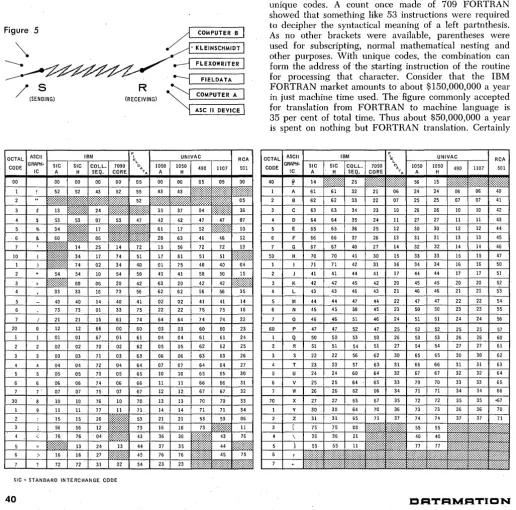
The American Standard Code for Information Interchange: Part Two, by R. W. Berner
Fall Joint Preview
Programmer's Primer & Coloring Book, by Paul Desjardins, drawings
by David F. Graves
Departments
9 13 17 23 53 59 61 71 77 ·81 83Datamation Calendar Letters to the Editor
Datamation in Business and Science The Editor's Readout
News Briefs in Datamation People in Datamation
New Literature in Datamation New Products in Datamation Component Products in Datamation
Book Capsules in Datamation Advertisers' Index
THIS ISSUE:--;-46,428 COPIES
Cover
This month's cover design, by pen and ink out of free-association, is prompted by our feature article: a hardware survey and examination of factors which affect the acceptance of non-mechanical printing techniques. The hardcopy art output is by Art Director Cleve Boutell.
Circulation audited by Business Publications Audit
Member, National Business Publications
I:J:tU
DATAMATION is published monthly on or about the tenth day of every month by F. D. Thompson Publications, Inc., Frank D. Thompson, president. Executive, Circulation and Advertising offices, 141 East 44th St., New York 17, N.Y. (MUrray Hill 7-5180). Editorial offices, 1830 W Olympic Blvd., Los Angeles, 6. Published at Chicago, III. Con-trolled Circulation paid at Columbus, O. Form 3579 to be sent to F. D. Thompson Publications, Inc., 201 N. Wells St., Chicago 6, III. Copyright 1963, F. D. Thompson Publications, Inc. Printed by Beslow Associates, Inc.
ANSWERS
o •provided
by
the
NCR 315
Computer
System
REQUEST INVENTORY STATUS ITEM 121,684
. LOCATION CODE" 12$ ON HAND 62 ON ORDER 48
AVERAGE HONl'HLY USAGE 50
ECONOMIC ORDER QUANTITY 125
VENDOR CODE 16
. with CRAM and Remote Inquiry
The NCR 315 CRAM (Card Ran-dom Access Memory) Computer. System is more than just another back-office electronic accounting machine.
In industry, for example, Inquiry Units can be located at dozens of remote locations, enabling people to communicate with the computer files ... even from hundreds of miles away. With the NCR 315 you will be able to keep a "current finger"
on the pulse of your business ... to get immediate answers to questions about inventories, production, sales ... and a host of other timely facts people must have to effectively manage . . . and to act while the '.'iron is hot."
For more information, call your nearby NCR representative or write to The National Cash Register Company, Data Processing Systems and Sales, Dayton 9, Ohio.
NCR PROVIDES TOTAL SYSTEMS - FROM ORIGINAL ENTRY TO FINAL
REPORT-THROUGH ACCOUNTING MACHINES, CASH REGISTERS OR ADDING MACHINES, AND DATA Il'ROCESSING The National Cash Register Co .• 1,133 offices in 120 countries' 79 years of helping bUSiness save money
CIRCLE 8 ON READER CARD
o
NeVI heavy-duty printer for
8~level
systems
Here is the new Teletype Model 35 printer. It offers a range of features that will bring new flexibility and improved effiCiency to your com-mun'ications and data handling systems:
D
8-level permutation code is compatible with many computers and data handling systems. It also provides extra code combinations for· pro-gramming purposes.D
4·row keyboard eliminates shifting for figures and common punctuation marks. This saves key strokes, cuts errors, and makes every typist a potential. operator.D
available automatic character generator can serveas
a station identification device-or print out 20 characters of other repetitive data at the touch of a single key;In addition, the Model 35 is equipped with the Teletype "stunt box," a versatile remote control
device. Optional features include a sprocket-feed platen for handling continuous business forms, vertical and horizontal tabulators, automatic feed-out for completed forms, and many others. Speed is 10 char / sec. Input is from local keyboard or line signals.
The "35" is available as a send-receive printer (shown), as a receive-only printer, or as an auto-matic send-receive set with facilities for punch-ing and readpunch-ing paper tape.
For additional information, contact: Teletype Corporation, Dept. 81J, 5555 Touhy Avenue, Skokie, Illinois.
This type of equipment is made for the Bell System and others who require dependable communications at the lowest possible cost.
II
We'll demonstrate .
our computers
any
time-· t
k "
.
JUs as us
Right in your office or laboratory . .. we'll show you that PACE®TR-70 and TR-48 Analog Computers are the answer to your complex design engineering problems - providing infinitely flexible electronic models to simulate your most sophisticated designs. Solutions are presented simultaneously with changes in input parameters-giving you a real "feel" for the problems-short-cutting lengthy 'slide-rule manipulations. You'll discover yourself programming and operating these analog computers with ease. PACE TR-1O and TR-48 computers are fully transistorized-providing the portable ruggedness and compactness that permits us to demonstrate anytime, anywhere. They can be set ori your desk and plugged into any 71O-volt outlet. A free training course is provided with every TR-48.0
Ask for a demonstration at a place and time convenient for you. We'll do the rest.EAI'ELECTRONIC ASSOCIATES, INC., Long Branch, New Jersey
ADVANCED SYSTEMS ANALYSIS AND COMPUTATION SERVICES/ANALOG COMPUTERS/HYBRID ANALOG· DIGITAL COMPUTATION EQUIPMENT/SIMULATION SYSTEMS/ SCIENTIFIC AND LABORATORY INSTRUMENTS/INDUSTRIAL PROCESS CONTROL SYSTEMS/PHOTOGRAMMETRIC EQUIPMENT/RANGE INSTRUMENTATION SYSTEMS/TEST AND CHECK·OUT SYSTEMS/MILITARY AND INDUSTRIAL RESEARCH AND DEVELOPMENT SERVICES/FIELD ENGINEERING AND EQUIPMENT MAINTENANCE SERVICES.
CIRCLE 10 ON READER CARD
8 DATAMATION
o
o
DDD
DDDDDDD
• The 26th annual meeting of the American Documentation Institute will be held October 6-11 at the Pick-Congress Hotel, Chicago, Ill.
• The fourth annual Symposium on Switching Circuit Theory and Logical Design will be held Oct. 7-11 in Chi-cago, Ill. Sponsor is the AlEE sub-committee on Logic and Switching Circuit Theory.
• The International Systems Meeting will be held October 14-16 at the Hotel Schroeder, Milwaukee, Wisc. Sponsor is the Systems and Procedures Assn. • The annual meeting of the Users of Automatic Information Display Equip-ment will be held October 15-17 at the Carillon Hotel, Miami Beach, Fla. • The U. of Maryland and the Wash. D.C. Chapter of the ACM are sponsor-ing a one-day technical symposium at the University Oct. 17, 1963.
• The BEMA (Business Equipment Manufacturers Assn.) Exposition/Con-ference will be held Oct. 28 to Nov. 1 at the Coliseum, New York, N.Y. • The DPMA International Electronic Business Systems Conference will be held in Phoenix Nov. 7:8 .
... The 1963 Fall Joint Computer
Con-ference will be held in the Las Vegas, Nev., Convention Center, Nov. 12-14 . • ' The American Bankers Assoc. first national Automation Conference will be held in Chicago Nov. 13-15. • The 11th Annual Electronics Semi-nar, co-sponsored by the EDP com-mittees of the American Gas Assoc. and the Edison Electric Institute, takes place Nov 18-20 in Chicago.
• The annual meeting of the Ameri-can.Mathematical Society will be held January 20-24, 1964, in Miami, Fla.
• The 1964 Spring Joint Computer Conference will be held at the Shera-ton Park Hotel, WashingShera-ton, D.C., April 21-23.
September 1963
REJECTS ARE A COSTLY PROBLEM
SOLVE IT WITH COLUMBIAEDP RIBBONS
Getting the most out of your character reader-optical or magnetic
-depends largely on the ribbon that prepares the input documents.
Columbia EDP, ribbons deliver sharp, unmistakably clear characters
... to a degree of uniformity that
r---..,
is yoUr assurance of highest
read-out and lowest rejection rates.
Protect that sizeable investment
with the ribbons that read best.
There's a Columbia Ribbon for
every electronic data processing
application and machine.
~
DATA PROCESSING RIBBONS
FREE DEMONSTRATION
Columbia Ribbon & Carbon Mfg. Co., Inc.303-9 Herbhill Road, Glen Cove, New York
Please have your representative arrange demonstra· tion of Columbia EDP ribbons at our convenience. Name ____________________________________________ _____ Title' _____________________ _ Company' _ _ _ _ _ _ _ _ _ _ _ Street _ _ _ _ _ _ _ _ _ _ _ _ City _ _ _ _ _ _ State' _ _ _ _ _ _
L ________________
~CIRCLE 11 ON READER CARD
' " t ,
!
.. An entirely
new breed
of computer
o
RCA 3301 REAlCOM
The 3301 Realcom isn't just a new computer. It's a new kind of computer. It is the industry's first all purpose, real-time communications data processor. It brings users functional modularity . . . an innovation which allows enhancement by function as well as by capacity and speed . . . eliminates costly conversion and reprogramming. Never before has such a wide range of computer capabili-ties been offered in one package . . . and the 3301 is in the medium price range.
A Super-Fast Business Data Processor . . . efficient batch processing ... large volume, fast random access ... fast, versatile input/output devices . . . buffered where advantageous ... memory cycle of 1.75 microseconds ... fastest in the commercial field.
A Real-Time, On-Line System . . . with an extremely flexible priority interrupt system . . . keeps management aware of important events as they occur . . . permits closer control, more centralized processing.
A Communications Processor . .. for management control of dispersed operations . . . performs message switching, message-in-transit editing and priority transmission . . . receives and transmits data over 160 conventional com-munications lines ... accepts variety of speeds and codes ... can be connected memory-to-memory with local or remote computers.
A Scientific System . .. performs complicated scientific calculations . . . provides high-speed fixed and floating point arithmetic in addition to inherent high perform-ance features . . . optio~al circuitry capable of 148,000 additions or subtractions, 32,000 multiplications or 18,300 divisions per second .
Provides up to Five Levels of Simultaneity . .. offers the efficiency of performing five operations simultaneously ... buffered input/output devices give extra dimensions of simultaneity ... never any featherbedding.
Compatible with RCA 301 and Other Systems . .• saves user's investment in tape files through tape compatibility.
New Scope and Concepts in Software . .. to make the 3301 work harder . . . operating system for efficient· execution of real-time communications and data processing . . . problem oriented languages, including COBOL and FORTRAN, to minimize programming expense.
Two Memories . . . for faster, more flexible' operation . . . ferrite core scratch pad (250 nanosecond cycle) . . . large magnetic core (1. 75 microsecond cycle).
All this capability in a single EDP system inaugurates a new level of efficiency for computer operations:
Dimensional Data Processing. Can one medium-priced com-puter provide such scope ? Yes-and more! Call us and see.
RCA ELECTRONIC DATA PROCESSING, CHERRY HILL, N.J.
Most Trusted Name in Electronics
One QI a series briefly describing 6~I~s researcll in depth
HOT
o
Don't touch. At 650°C a red-hot metal is transforming
from one solid state to another. And careful observation of
its change in phase can tell us more about the influence
of thermal history on the mechanical properties of
metals. Strength. Hardness. Toughness.
Here at the General Motors Research Laboratories,
our understanding of metals and the ancient art of heat
treating is being extended by basic studies of solid state
transformations at elevated temperatures.
Aiding the experimental side of these investigations is
the thermionic emission microscope. With it, our
metal physicists can study dynamic processes
in metals as they occur.
Here's how. Electrons "boiling off" a heated metal
sample serve as the image source in this special electron
microscope. Changes in the metal-phase transformations,_
recrystallization, and grain growth -are
recorded by motion picture camera.
Results are being analyzed in several ways. For one,
rates of micro-structural changes are being directly
measured-some for the first time. For another,
observa-tions of the nucleation and growth of annealing twins
have suggested a way of measuring the stacking fault
energy of the austenite phase in plain carbon steels.
These studies, of scientific import today, will provide
information helpful in fabricating the materials of
tomorrow. They typify General Motors' continuing
search for a better way.
General .Motors Research Laboratories
Warren, Michigan
Austenite transforming to pearlite in steel over a 3-second interval.
CIRCLE 13 ON READER CARD
o
I(
·0
o
the living machine
SiT:
Reference was made to the RIm, "The Living Machine," shown at the '63 Spring Joint .(July, p. 45). Could you tell us where it can be procured in this country?
WILLIAM M. O'CONNOR
I nternal Revenue Service U.S. Treasury Department Lawrence, Massachusetts
Editor's Note: In answer to numerous other similar requests, the film may be obtained from Sterling Educational Films, 241 E. 34th St., New York 16, N. Y. Costs: $130 for each half-hour part; $250 for both parts. Rental rate is $15 per single showing.
stand corrected
Sir:
There was an error in your July issue (p. 58). Carl H. Reynolds is manager of Programming Systems for the IBM Data Systems Div. The manager of Systems Planning and Development is Maxwell O. Paley.
ROBERT W. SLADE
IBM Data Systems Division Poughkeepsie, New York
Editor's Note: Thanks. And, in our haste, we failed to mention that Don Madden was named manager of Programming Technology.
improved compiling in English
Sir:
Jerry Schwalb's "Compiling in Eng-lish" (July, p. 28) reflects experience with GECOM up to December 1962. Subsequently, improved and extended compiler systems were released, and a new comprehensive system is at field test sites now. Significant im-provement has been made in object running speeds, and 80-90 per cent of the speed of comparable hal)d-coded programs is more common than Mr. Schwalb's 60-70 per cent. In particular, maximum or near-maximum card reader and printer speeds are now realized.
The Report Writer, mentioned under "future expectations," has been re-leased for over six months. Available also are "compile" and "go" operating characteristics, overlay segmentation, and use of disc files.
JOAN V. CANNON
Programming Research &
Develovment
General Electric Computer Department
Phoenix, Arizona
September 1963
paper dolls automated
Sir:
The Dura Business Machines ad (July, p. 6) proved provocative. The enclosed listing of characters, punched into a paper tape doll using the
stand-Code Character
36 K
22 D
64 3
33 8
17 V
45 Carriage Return
47 Upper Case
01 T
30 A
77 Code Delete.
77 Code Delete
36 K
20 E
04 Space
07 M
20 E
04 Space
01 T
03 0
75 Carriage Return
+
W (illegal)04 Space
25 y
03 0
34 U
12 R
04 Space
12 R
20 E
30 A
22 D
20 E
12 R
73 6
+
T (illegal)77 Code Delete
70 2
33 8
03 0
46
+
17 V
12 R
54 (
24 S
72 6
06 N
ard Control Data code, will cause a Flexowriter . to print TAKE ME TO YOUR READER.
AL VIN NELSON
George Washington High School Denver, Colorado
Editor's Note: Readers may recognize doli-cut-ter Nelson as one of the protagonists in Albrecht's article, "A Modern-Day Medicine Show," (July, p. 31).
Press a button ...
find a card
Press ...
Presto with Electrofile!
Here at last is automatic filing. You can quickly find a card, either alphabetically or numerically, simply by pressing a key, much as on a typewriter. And the card can be refiled at random. That's right. There's no need to file cards in any sequence order. Misfiling? Impossible! File an entire card group at random, too. And find it instantly by pressing a button. One card or one hun· dred ... file at random; find at once!
Use Electrofile for personnel, purchasing, sates, customer, inventory, production, in-stallment, collection, many other records.
mEb,gVISIBLE
Acme Visible Records, Inc.
7509' West Allview Drive, Crozet, Va. Please have your sales representative call to explain how an Electrofile can save time and money on my _ _ _ _ _ _ card records.
NAME _ _ _ _ _ _ _ _ _ _ _ _ TITLE _ _ _ _ _ _ _ _ _ _ _ _ COMPANY _ _ _ _ _ _ _ _ _ _ _ ADDRESS _ _ _ _ _ _ _ _ _ _ __
'-_~I~~ _________ ~O_~~-=:.~A_T~==_J CIRCLE 14 ON READER CARD
What every
DP department head
should have!
We mean our colorful new 36-page Datacase book. In it you'll find over 50 different Datacase auxiliary units - some of which you may need right now . • A computer con-sole, perhaps? See page 24. Card handling and storage units? There are several pages of these. Tape storage equipment, key punch desks and trans-port trucks, too. • We could go on, but space won't permit. Anyway, we think you should send for our book. It's yours, free. Just fill in and mail the coupon. You'll get your copy promptly.
'--~--~~~--~--~---r---V'I/~h ... !otJr .... fre~f?Py .... or~he .... D~tacase .. ~oo~1
V(~JIIS~?~ ••.. t~e.~arr1e.()ryou; l()f~I[2ataca~e~
S~e~/case.~f!aler .. fle: ?alT!~nro.tJ .... sh()tJ'dJ<no.w
befatJ.~e.he>cat! ... · .... tilke sar~pt!()ur.atJxlliary
eq~l,!trrel!t(e~Uirerne?tsquiC~/ya~delficlenl7 ly~inc/udin glnstal/ationand.· serviCe ... Local
f?rvfcei~/fst~nepata~~~erxclusive; .There .
arern()r~y'o~s~ouldl<now about Why not see foryourself?
Steelcase Inc., Dept. 0, Grand Rapids, Michigan Gentlemen:
Please rush me a copy of your new 36-page Datacase book. Name __________________________________________ __ Company ________________________________________ _ Title ________________________________________ __ Address ________________________________________ __ City _____________________________ State _ _ _ _ _ _
'---'----
---
-
---
-
-- -
----
---CIRCLE lS ON READER CARD
14 DRTRMRTION
I~
I
Mechanical simplicity ... which yields a degree of reliability unattainable by any other paper tape reader! Simplicity made possible through the utilization of the revolutionary
PMI
printed motor direct drive servo. Movement of the tape through the read head is achieved by merely start-ing and stoppstart-ing a printed motor. The brakes, clutches and pinch rollers that cause big trouble and down time in conventional tape transports are completely eliminated.Line by line cycle: movement of tape (A) over read head (B) is controlled by drive capstan (C)-attached directly to shaft of PMI printed motor* (D); spring-loaded rollers (E) hold tape gently against capstar1, keeping tape movement in exact accord 'with capstan rotation; advance command pulse accelerates motor, capstan, and tape; as read head detects next sprocket hole, a reverse pulse to motor halts capstan and tape with next character perfectly aligned in read head. *U.5. Patents of Printed j\fotors) Inc. Pending.
CIRCLE 16 ON READER CARD
PHONE~ WIRE OR WRITE FOR CO~IPLETE INFOR~IATION
' . , ," ·1
I ) , .. ) ) . " I ' f f J II
J~
J
J
~I ~
I
:'J
'J .' 1 ,";
IL,~J
:J
~jL;
I
.. !
'J! J
I i ,
J
I',J
( ' jC O R P O R A T I O N
•
U-i~~\CO:>
[= L~[,:
i.~ [) [~~71 [)D
i'\]a
S D
'l)
L':~JTHE FIRST
REAL
SYSTEMS
COMPUTER
•
WE THINK SO, but we put the question mark in so yo"u wouldn't accuse us of un-abashed arrogance. What we mean is we have a computer that isn't restricted by the fixed logic wired in by the manufacturer. ThePB440 has a separate logic memory-distinct from its conventional memory-and commands and word formats are specified by information stored in this. logic memory and can be readily changed. In other words, commands and word formats can betailored by the user to fit the systems problem at hand. Packard Bell provides several com-mand sets and the user can create addi-tional commands as required.
A single PB440 can, in the fraction of a sec-ond it takes to reload logic memory, switch from one command set to another and thus from one application to another. No other computer can do this, and that's why we think it is the first real systems computer. Now, the system designer can adaptthe com-puter to the problem, not the problem to a fixed command list and format.
FOR THE SYSTEMS ENGINEER the PB440 can be a special-purpose computer de-signed (to his specs) for his specific system. But he still has the reliability, versatility, ex-pandability and speed of the PB440 as a general purpose computer. This is all made possible by the Dual-Memory Stored-Logic organization of the PB440.
SPECIFICALLY, the systems engineer should consider the following features:
/1 I
10PAY
YO'l!(#' AN. APo'-LP GC/fOANC£coI1Pt.j1£1l'/
SOFTWARE. More than 100 systems-ori-ented commands written, more every day
170 scientific commands FORTRAN compatible with 7090
MEMORY ACCESS
Direct memory access from external devices Simultaneous computation&I/O data transfer Shared memory feature that permits
multi-ple processor configurations ,\
" ,-0
.~,'-• -0- 'f
:,:.
_.o
110 "
'00 1110 I 0 , ,',11l.l.l.\llll~, '
o~
PRIORITY INTERRUPT. Multi-level, mini-mum response time
SPEEDS. Memories:
1 J.L sec non-destructive logic memory (256 to 4096 words)
5 J.Lsec main memory (4096 to 32,512 words) I/O rate to 9.6 million bits per second Typical execution times,with memory access:
Compare data against upper & ·Iower limits-13 J.L sec, including two memory references
Floating point multiply 8 bit exponent, 16 bit mantissa-36 J.L sec
24 bit mantissa-42 J.L sec 39 bit mantissa-110 J.L sec Fixed point add-3 J.L sec
Relocate data withi n memory-1 0 J.Lsec/wcird Polar to rectangular coordinate conversion
-435 J.L sec
SOME TYPICAL PB440 SYSTEMS APPLICATIONS • Telemetry data reduction
• Communications switching and data formatting
• Hybrid analog/digital computing • Real-time data acquisition • Command and control • Automatic checkout • Launch control • Antenna steering • Nuclear reactor control • Process control
'I/O VERSATILITY. Unique I/O bus design means more flexible arrangement of peri-pheral equipment. User need only add inter-face electronics as needed; does not pay for hardware capability he will never use. I/O system designed to accept next generation of higher speed peripheral equipment. GENERAL CHARACTERISTICS .Parallel data handling mode ... 24 bit word length, can be programmed for12&48 bits .. .400KC I/O character transfer rate, 800KC optional . .. 1/0 bus handles up to 64 controllers.
$111)1(
DR!Y~c5
/T
A~Y!
PRICE· Basic computerwith 256word logic memory, 4096 word main memory: $110,000. PERIPHERAL EQUIPMENT. Magnetic tape at 83.4,41 or 25KC ... punched cards at 800/min. in and 250/min. out ... 1000 Ipm alphanumeric printer ... paper tape at 500 char/sec read, 110 char/sec punch ... Selec-tric typewriter. Also Packard Bell A to D and D to A converters, multiplexers, commu-tators, and other data systems equipment.
THERE'S MUCH MORE to be said about the PB440 and its unique concept of Dual-Memory Stored~Logic. We have shelves of technical literature that cali handle most of your qJestions, representatives who should be able to take care of the rest. If you are in Los Angeles, try and drop in for a demon-stration. We might even pop for lunch. MICROPROGRAMMING the logic memory
provides ability to duplicate command lists and formatsofother computers. Forexample, digital guidance computer command struc-ture and format can be developed before hardware prototypes are built. Similarly, you can duplicate the guidance computer in a hybrid simulation of a missile guidance and control system.
P a c k a r d Bell
{1;:fftPttte~
A DIVISION OF PACKARD BELL ELECTRONICS
. .
1905 Armacost Avenue' Los Angeles 25, Calif.' Dept. C-18-7 CIRCLE 17 ON READER CARD
16 DATAMATION
o
-v.
80 86 92 98
303 307
*TPM-
TAPE PREVENTIVE
MAINTENANCE
Wise tape users are learning that pre-cision magnetic tapes require sched-uled preventive maintenance ... equal to that given all
other components in computer or Instrumentation systems.
Tape Testers
Complete tape preventive maintenance (TPM) systems are NOW available from General Kinetics Incorporated (GKI), pioneer in magnetic
tape research.
Kinesonic Tape Cleaners TPM systems from GKI will sharply re-duce tape errors ... save data and rere-duce re-run time ... and
increase tape life.
Tape Winders
Tape Erasers
Call or write GKI
for more details.
IGKll
GENERAL KINETICS
INCORPORATED
C/
2611 Shirlington Rd., Arlington, Va. Phone: (703) 671-4500 CIRCLE 39 ON READER CARD
ASCII ABOUT FACE
FOR IBM
-BUSINESS
&
SCIENCE
After leading last-ditch fights to derail ASCII
(p. 39), IBM has completely about-faced. In a special
issue of "The Data Processor," its magazine for
"customer management," the company says, "We as a
corporation are determined to move ahead with ASCII
at the most rapid pace possible so that our customers
can gain the benefits of standardization across the
industry."
Another interesting statement: "This new standard
can make intercommunications between all
manufac-turers' equipment and, ultimately,
interchangeabilit~of different manufacturers' equipment a reality."
IBM is also reportedly pushing for the implied
collating sequence of ASCII, calling for letters
higher than digits, the direct opposite of the IBM
code. This may mean a bill of between $15-30 million
. for the reconversion of existing IBM customer files.
This undoubtedly means the new IBM gear will
incorpo-rate the new code. Three cheers for IBM,
standardi-zation and interchangeability.
ARPA, MAC
AND TIME SHARING
Still pretty much of a blue sky idea, time sharing
--simultaneous use of a single computer by many people
at remote consoles -- is getting concentrated
atten-tion at a handful of universities and research
organizations.
Best known so far is MIT's Project MAC
(Machine-Aided Cognition/Multiple-Access Computer), an
18-month study funded by the Office of Naval Research
"on behalf of" DOD's ARPA (Advanced Research Projects
Agency). Headed by Prof. Robert M. Fano, MAC has
wound up a six-week summer study involving some 60
people ••• will swing into high gear with the
instal-lation of a 7090 which will have 20-25 remote inquiry
stations initially, over 100 eventually. MAC is
con-sidered the first phase of a really big effort.
ARPA, through its Behavioral Sciences
&
Info
Processing group -- headed by time sharing expert Dr.
J.C.R. Licklider -- is also sponsoring TS work, the
bulk of it under the direction of Jules Schwartz at
SDC, where a PDP-l joined a Q-32 this month.
Licklider's two-man operation says it doesn't
O
break down its contracts, so there's no way of telling
the value of current TS research. But here's a list
of current contracts from his office, founded
last October: SDC: $4,352,000; U. Cal.: $797,000;
High Speed Printers and typewriters would never be
in direct competition, but this is one way of showing the capability of
Anelex equipment. Actually, if 500 girls could type without rests or
breaks, errors or corrections, their 5,000 fingers couldn't keep up with
one Anelex High Speed Printer ... not at the rate of 10,000,000 words
in an 8-hour day. What's more, once the start button is pressed, the
Anelex Printer operates automatically until each job is done.
It is this large capacity and maximum reliability that has led almost
every leading computer manufacturer to specify Anelex High Speed
Printer Systems ... first choice for important installations since 1950.
Shouldn't your next system include an Anelex Printer? We invite your
inquiry.
AN E
LE~c
A~10I'!ji1li;*0©mE~:~ 155 CAUSEWAY STREET, BOSTON 14, MASSACHUSETTS
SYMBOL OF QUALITY
CIRCLE 18 ON READER CARD
18 DRTRMRTION
For a better impression, write
~'ANELE~
A..
155 CAUSEWAY ST.h.:s;t:~~::~OSTON
14,MASS.
SYMBOL OF QUALITYCIRCLE 38 ON READER CARD
•
I-.
-
NA TITICO,
AD
CIT
--
PROI1 :
10 1: 19 2(
)
)
o
DU51NI!SS r, SCIEtJCr:: .... r _ _ _ _ -_-'_ ... --_-.--_-.-._.---_~---... "' .. -.. ' ... -.. ---... ~.-..
BIDDERS SHUDDER
AT lO-MEGABUCK CONTRACT
BIG PLANS
FOR LITTLE CLARY
REQUIEM FOR
~BANTAMWEIGHT
UCLA: $675,000; Stanford: $420,000; SRI: $195,000.
Carnegie Tech, doing limited TS research, has a
$397,000 contract. The SDC contract covered FY '63;
Cal, UCLA and Stanford hold three-year contracts;
the others are for one year. Excluding MAC,
Lick-lider's computer research contracts add up to
$6,S36,000.
Bids are out for an on-line, real-time information
system for the L.A. County Sheriff's Dept., and the
specs are enough to frighten all but the most
hardened salesman and promise-maker. Among them: 100%
accuracy for file conversion (five million records),
and 100% uptime, seven 24-hour days a week. The
Il winner
llmust foresee a 10-year growth, post a
$2-mil-lion bond for faithful
performanc~,agree to a
10-year lease -- with the coupty able to pullout at any
time -- and face an lS-month implementation period
during which he collects no rent.
The specs, drawn up by Computer Usage Co.,
follow perforce departmental and local laws and
regulations which are stiff and, in some cases,
anachronistic. Some of the county's caution stems
from past edp Ilburnings,1l inclriding a recent
$135-million duplication error in printing assessments.
Reportedly real eager for the real-time job
is Hughes Dynamics, which
wa~tsto prime it with
a Univac 490. H-D, by the way, gallantly offered
the county a free study of its edp systems, an offer
which was graciously accepted. One noteworthy absentee
from the bidder's conference: CDC.
Clary Corp. says its DE-60, admittedly more a
glorified desk calculator than a computer, is moving
well enough to
encour~geit to o'pen new offices
--10 of them in the last 14
months~First produced
early in '61, the DE-60 now claims a little' over 100
installations (40% of them lease), with some 60% of
them in civil engineering. The company offers some
10 pre-wired CE programs at around $200 ea. for the
machine, which sells for $20K.
Clary vp Ed Small says the company is in the black
~n
the 60 for the first half of '63. He estimates
a production rate of 100 machines a year within six
months, and an increase after that.
The ALWAC computer facility, source of many a
colorful tale, called it quits late last month, the
third this year. In mid August, five unordered
computers remained on the floor; about 40 were
installed. Users haye been referred to the
nation-wide Techniserv Corp., Los Angeles, which was
recom-mended as Ilmost able to maintain
llALWAC's.
Only 10 years ago, Logistics Research Inc., under
the late Swedish
industrialis~Axel L. Winner-Gren,
built the first ALWAC (A.L. Winner-Gren Automatic
Computer), and the company's' name was changed to Alwac
Corp~
The one-only model I was iollowed by the II and
III, production of which was counted on one hand.
'
Since 1955, 42 III-E's were built. The firm was
pur-chased in 1957 by EI-Tronics Inc., Warren, Pa., which
halted production more than a year ago to concentrate
on the solid-state IV.
THE PROCESSOR IDLE LIGHT:
On other computers it
shows you're wasting
hundreds of dollars
per hour
On the Burroughs
B 5000 it shows
you're wasting 90¢ for
an unused lightbulb
In the vital area of
economical
computer operation, the B 5000 shines. Or, to put it another way, it has the only processor idle light that almostnever
shines. The B 5000 is busy processing right through those periods when comparable computers (which are all higher priced, inciqentaJly) are temporarily out of breath. And, based on operating costs for computers the size of the B 5000, every hour's worth of expense that goes to work instead of to waste means a saving of around $250.To start with, there's the B 5000's unique way of handling interrupts. To all outward appearances, it simply ignores them. What real}y happens, though, is this: Through interrupt detection that's built right into the hardware, interrupt conditions are fielded arid electronically tossed to the MCP (Master Control Program) 'for appropriate handling. Meanwhile, the cu rrent prog ram go'es rig ht alon g, u ni nterru pted.
Or, if preferred, another program is run instead. Either way, it all happens so fast that the processor idle light is left completely in the dark.
Then there's multiple processing, B 5000 styleO-which is
real
multiple processing. Several different programs run at the same time, all time-sharing the processor and the input-output facilities-and all do so without a single bit of advice from a human programmer as to sequencing and scheduling. For all that is handled automatically by the MCP. No hitches, no running' up of expenses and no chance for human errors.Parallel processing is another advantage that
con-tribu~es to system operating efficiency. In fact, the B 5000 is the only computer that can take, without costly reprograming, the second central processor required for true parallel processing. It's also the on'Iy system that can uti'/ize ALGOL and COBOL without resorting to some form of spoon feeding. "
For complete details, send for a copy of our booklet liThe B 5000 Concept." It will tell you all the other things the B 5000 does to make sure nothing about the system is idle-except, of course, the processor idle light. Burroughs Corporation, ~etroit 32, Michigan.
Burroughs- TM
Burroughs Corporation
~·i
,
CIRCLE 19 ON READER CARD
20 DRTRMRTION
)
o
)
o
Your instrumentation
tape supplier should be
a complete source.
Soundcraft . is!
With Soundcraft Instrumentation
Tapes; you can meet every data
re-cording need. Sixteen combinations
of coatings and base materials are
available to fulfill
t~erecording time,
resolution, wear-life and output
char-acteristics required by your data
re-cording equipment.
Common to each instrumentation
tape is Soundcraft's technical
com-petency. This is demonstrated by the
uniq ue oxides and binder' systems
which are engineered to provide
su-perior physical and magnetic
quali-ties for all recording applications. The
Soundcraft plant is one of the newest
and best-equipped in the
industry-where advanced manufacturing
proc-. esses and control methods produce
, superior instrumentation tapes.
Reli-able data recording is assured.
In military and space facilities ...
among industry leaders ...
Sound-craft Instrumentation Tapes are
meet-. ing the most exacting performance
standards. They can meet yours, too.
Soundcraft Instrumentation Tapes
are available from stock for
immedi-ate delivery. Write for literature.
REEVES SOUNDCRAFT
Division of Reeves Industries, Inc., Danbury, Conn •• New York· Chicago· Los Angeles • Foreign Division: 25 Warren St, N.Y.C •• Canadian Reps: Vancouver. Toronto
YOU DON'T HAVE TO SAY A WORD
to send great masses
of business data to any location by telephone. New Bell System
DATA-PHONE
service is the reason why.
Mach~nes
do the talking - 16 times faster than people can talk.
Almost any kind of word or figure data in any amount can be
transmitted immediately any time you want-at regular telephone rates.
There's no faster, safer and more economical way to
ship data than by
DATA-PHONEservice. Have a talk with
one of our Communications Consultants about it. Just
call your Bell Telephone Business Office and ask for him.
c
c
CIRCLE 21 ON READER CARD)
)
o
DATAMATION
o
~
.
a
~
EDITOR'S READOUT
September 1963
IT'S THE LITTLE THINGS
In the course of his somewhat relatively brief but tempestuous stay on earth, man has conquered and survived disaster, disease, and his own inventions. As any reader of the Bible or Li'l Abner knows, it isn't the big problems that make life difficult. It's the little things.
This profound truth has somehow escaped the information processing com-munity, which continues its blind, hurried scramble to solve monumentally huge problems: simulating entire economies, controlling vast weapons systems, catching tax evaders, etc. Oh, there's been some tic-tac-toe and chess playing, true. But these are usually self-consciously explained as first inroads into under- . standing the processes of the human mind. .
In an effort to overcome this strange oversight, Datamation herewith offers
a partial beginning list of applications and research topics representing truly significant trivial problems so far neglected.
For instance, we'd like to know the frequency of appearance of the word "heartwarming" on the covers of certain women's magazines. What percentage
of Playboy readers have ever been out with a girl? How many Datamation
read-ers have ever seen a computer? Do blondes really have more fun? How many
women are really blondes? And how many men care?
In the world of transportation, we'd like, to see an airlines system which re-jects all reservations for Rights before 9:30 a.m.; a built-in automobile computer which will accurately diagnose and predict failures, as well as accurately inter-pret the strange signals of the fellow ahead. Everybody will agree upon the need for more efficient baggage-smashing equipment at airline terminals.
There ought to be research to find a number small enough to express the chances that a New York taxi driver will say "Thank youse" when tipped. A compilation of the xnth
meanings of the word "system" is desperately needed. Hardware needs include a means of getting· black coffee at a NY automat; a telephone which will tell you if it will ring long enough to warrant getting out of bed to answer it; a phone which tells you if it's just another salesman calling; a telephone which rings only for calls you want to receive.
Someday we've got to create a program which will translate the statements . of politicians, military brass, bureaucrats and computer manufacturers into meaningful-ese. Another program should simulate the American League pen-nant "race" so the Yankees can save their strength for the World Series.
And so it goes. There are so many things to be done. And they will be done ... if people will only remember to Think Trivial.
TH E
vaulting the
mecha~ical
barrier
IMPACT OF
NON-IMPACT PRINTING
by EDWARD 'WEBSTER
[
---, Technology tends to run its course from
mechan-. mechan-.
I'
ical activity, through electro-mechanical, and ____ finally to pure electronics. Computation has its bead-counters, its tabulators, and now electronic com-puters. But where documents' are involved· it seems inevitable that some mechanics remain, if only to move the paper, and that printer-bound processors shall remain with us. The question, then, is simply: How far can we go in minimizing the gap?In pursuit of electronics, or at least tape character transfer rates, mechanical printers have accelerated from the 100 lpm of the IBM 402 or UNIVAC Tabulator to speeds approaching 1500 lpm. With reduced character selection, the best of today's on-the-Ry printers can at-tain over 2000 lpm. Printer people' themselves admit that this seems to be close to the absolute limit for machines which require that the paper be at rest at the moment of impact. Impressive though these speeds may be, clear-ly the control unit and tape transport which feeds the con-ventional line printer is not working to capacity.
Techniques other than mechanical for optically resolv-ing variable information have been known for a long time. Photography is over a hundred years old. Electro-static principles were first exploited by Xerox more than a decade ago. And television, child of the war, became common in the late 1940's. In the search to find ways of printing without whacking the paper with metal type, one or more of these elemeJ}ts has been invariably used. First of the "non-impact" or "electronic" printing de-vices appeared circa 1956 in the form of the Burroughs Whippet. Since that time techniques have improved to the point that speed is of~en limited by problems in paper handling. Should the fastest printers image paper from roll to roll, the bottleneck will then be in processing the rolls after they are removed from the machine.
The development and acceptance of input equipment such as scanners has been somewhat parallel to non-impact printers. The scanner has been much publicized and is generally recognized in one form or the other to be the computer input of the future. In contrast, elec~
tronic printing systems seem to be veritable wall Rowers;
little is heard of them, and few placed into operation. This is stilI more surprising when one considers the early date of their introduction and the wealth of equipment now on the market.
More than a score of non-impact systems have been developed since 1956. Although differing widely in speed, cost, and function, most fall into three rather well defined groups.
matrix-electrostatic/ electrosensitive printers
Perhaps the eldest, and certainly the simplest, matrix printers are produced by Burroughs, Motorola, Radiation, Omnitronics (Borg-Warner), and Hogan Faximile. 24
Characters are formed on the paper by an arrangement of dots created by charges emitted by wire styli. When certain types of electrosensitive papers are used, the charge forms a black dot without further processing. Al-ternately, in electrostatic systems, the charge forms a latent image which is developed by passing the paper through a cloud of ink particles which are attracted only to the charged areas, then bonded by heat and pressure.
According to R. H. Jones, a Burroughs engineer who helped develop the Whippet, electrostatic printing offers the highest potential of any system, since its speed is limited only by the ionization rate of a gas. "In theory," he states, "an electrostatic printing process could theoret-ically print, in one minute, a quantity of material equivalent to 500 copies of the New York Times!"
Burroughs electrostatic printers were first introduced in 1956 and have been variously called· the Whippet (Weather HIgh-speed PC}.ge Printer Electrostatic Tech-nique) or Electrographic. Models S202 and S203 are in the field at this time, functioning primarily within military communications systems. A few have been applied com-mercially in such areas as bank bookkeeping operations. Speeds are usually geared to the communications system within which they operate, the maximum being around 360 lines per minute.
Printing is by means of a bank of 72 five-by-seven ar-rays of styli, one for each printing position. Although in speed and operation the device appears to be a true line printer, chanicters are actually formed serially, individual styli being pulsed and the charge attracted to the paper because of its special conductive rear coating. The paper, bearing a latent image, then passes successively through a chamber containing- a cloud of toner which is
Presently manager of Editorial Services for Management,
Con-cord, Mass., Mr. Webster for-merly was a systems and
pro-cedures man, programmer, and systems analyst. For sev-eral years, he has been in-volved in the comparison and evaluation of hardcopy output
equipment for the Printing In-dustry of America Inc.,
Wash-ington, D.C. He was awarded
a liberal arts degree magna
cum laude from Gettysburg College, and has had papers published by several computer publications.
DATAMATION
o
(
~.,---)
o
) 0
attraded to the charged areas, over a heating element which softens the plastic surface coating, and finally through a set of bonding rollers. '
In terms of units delivered, the Whippet may be re-garded as the most successful such device to date: nearly one hundred have been taken by various branches of the military. As might be expected of a truly pioneer device, users have reported several problems, especially with the first few models delivered. Among these were a some-what whimsical paper advance assembly and a tendency for the paper· to stick to the bonding roller when too hot. Burroughs has been rather incommunicative about any future designs for this series of printers and production is believed to have been discontinued.
Motorola entered the arena with its TP3000 in 1962 (Fig.l). Again applications have been confined primarily to military communications. The system goes at up to 200 lpm and costs just $9500 for the printing unit alone. Using an ingenious technique which offers high reliability, the device probably holds the record for dearth of moving parts. Printing is by three heads mounted on a continuous belt which rotates across the page. Paper motion is continuous; characters are printed serially. The paper also moves at a steady speed and to compensate for its motion, the belt holding the print heads is inclined at the proper angle. Characters are formed in the usual five-by-seven dot matrix. A minute spark from the stylus destroys the white surface of what the manufacturer describes as a "highly conductive, carbon-loaded electromarking paper," revealing a black layer ~eneath (and reportedly at the same time generat-ing a noticeable burngenerat-ing plastic odor).
At the other end of the scale from the modest tele-printers stands Radiation, Inc. of Melbourne, Florida. Since its inception around 11 years ago, this firm has been active in the development and application of electrosensitive recording. Their printers are all built around a patented plug-in stylus module which accord-ing to the manufacturer is capable of adjustment-free re-cording over literally miles of paper. Among the Radiation hardware is the Radicorder printer-plotter, Model 6110 Strip Printer, a 16,800 lpm High Speed Alpha-Numeric Printer, and the High-Speed Printer-Plotter.
For their newest printer (Fig. 2), which to date marks the culmination of matrix-electrostatic printing, Radiation felt' it had outrun the term "high-speed."
Figure 1
September 1963
Destined for Lawrence Radiation Lab is the Radiation Series 690 "Super Speed" Alphanumeric Page Printer which achieves 31,250 120-character lines per minute, with a 64-characterselection. (Datamation, June, 1963, p. 38.)
Printing is performed by a single row of 600 individual wire styli arranged across the paper in groups of five. Characters are printed in the normal five-by-seven ma-trix, the selected styli being pulsed at seven: timing func-tions to produce each line of printing. The Lawrence system is designed for off-line operation in a configura-tion . consisting of two IBM tapes, a control unit, and the printer itself. Two tapes are required to maintain continuous printing. The printer controls tape unit selec-tion. Input is in six-bit IBM code, arranged in records of up to 7,200 characters which form a full page of 67 lines. Alternating from one 120-character buffer to the other, data is ingested at 62,500 characters per second. In order to get full utilization without information loss, the printer's skip over the paper perforation must coin-cide with the inter-record gap on tape.
In appearance the system is closer to a continuous web press than the box-shaped unit normally associated with digital computer printout. At the feed end are two large rolls of paper, either of which can be active while the other is being loaded. Apparently heavy enough to require a small lift truck to position, each roll holds enough paper for forty-five minutes of printing at top speed. The paper is 11 inches wide with perforations every 12 inches. At the receiving end the form is zig-zag folded arid ac-cumulations of convenient thickness easily removed manually. for binding as is without bursting. .
Omnitronics, Inc. of Philadelphia (pad of Borg Warner) , markets a fast little strip printer which produces a single string of characters at up to 2400 per second. The device works on the electrostatic principle. Paper is a tape with a black,.conductive layer behind and a plastic coating for the printing surface. Powdered ink is . attracted to the surface where charged by the styli and bonded into the plastic by pressure (no heat required in this case). Omnitronics is marketing their printer, among other areas, as an on-line message printer for computers. If one is considering simply cost in dollars/ characters per second, it is tough to beat the ATR-Ts 600 cps for $9950. Using the same basic print head but rotat~ng
each character ninety degrees, Omnitronics has a strip or page printer. Line length can be from five to 72 characters; since the price for units with the longer line length gets very steep, the manufacturer is not actively marketing in this area.
Hogan Faximile, now a subsidiary of Telautograph Corporation, has been marketing for a number of years "multiple stylus recorders" which produce an image by means of an electrolytic process. Special Hogan "Fax-paper" is dampened then passed between a row of styli
Figure 2