© 2019, IRJET | Impact Factor value: 7.211 | ISO 9001:2008 Certified Journal
| Page 4720
ANALYSIS & DEVELOPMENT OF FLAT DIE OF BIOMASS PELLET
MACHINE
Ravikumar Rajbhar
1, Saloni sapate
2, Neha Sarawade
3, sheetal wankhede
4,
Prof A. S. Bongade
51,2,3,4
Sudent, Department of Mechanical Engineering, Bharti Vidyapeeth’s College of Engineering, Navi Mumbai,
Maharashtra, India – 400 614
5
Professor, Department of Mechanical Engineering, Bharti Vidyapeeth’s College of Engineering, Navi Mumbai,
Maharashtra, India – 400 614
---***---Abstract:
Pellets are biomass fuel made by organic matter. They are formed by the pelletization process in which raw materials crushed in powdered form are fed through hopper into the roller die assembly. The feed gets compressed between roller and die and pellets are formed. Die is defined as the solid perforated metal part that act as a mould for extrusion of material. The flat die present in the pellet mill have cylindrical holes drilled radially. Pellets formed through this die were of moderate quality. So to improve the quality of pellets, the design of flat die was modified. The design of die starts with a counterbore angle at top for easy flow of biomass material followed by effective length and two step relief for easy removal of pellets. Compression ratio of the pellets is taken into consideration as it plays a major role in formation of pellets. Compression ratio depends upon the type of material used for making pellets. Low compression ratio leads to increased productivity and reduces abrasion of die, thus increasing the life of flat die. Due to low compression ratio, denser pellets are formed. The pellet strength is increased having smoother surface, low moisture content and homogenous size and shapeKey Words: Organic Material, Flat Die, Pressure, Dried Leaf, etc
1.1
INTRODUCTION
In today's world, the use of fossil fuel is being increasing day by day. Due to its extreme usage fossil fuels like coal, natural gas etc is being depleted day by day. As a solution to this emerging problem, biomass is considered as an alternative to it. Biomass can be used as a fuel by the process of pelletization. It is the process of mechanically increasing the bulk density by compressing the raw material. Pellets are biofuels compressed cylindrical form of organic matter. The pellet mill consists of components such as hopper, barrel, roller, die and motor. Dies are classified into two dies. Ring dies and Flat dies. Ring dies are used on a commercial level in industries while flat dies are used in small scale industries. The die acts as a mould for the extrusion of pellets when the powdered material is fed through the hopper and being compressed between the roller and die. The friction between the material and roller and the pressure exerted by the roller leads to the creation of pellets. The pellets formed are of smooth surface, low moisture content, cost efficient and dust free. The transportation was made easy.
2.1 EXISTING LITERATURE
The die roller mechanism plays an important role in deciding thickness of flat die. The general arrangement of flat type die roller is shown in above fig. 1 and fig. 2. This parameter helps to study the force acted by the roller on the die and eventually the pellets formed by these forces. The testing of the pellets can be determined by parameters such as moisture content, particle size, calorific value, type of flame such as oxidizing blue flame.
© 2019, IRJET | Impact Factor value: 7.211 | ISO 9001:2008 Certified Journal
| Page 4721
The various design parameters of die are listed below,F = radial force
Fr = tangential friction force r = radius of roller
d = diameter of hole
Table-1: Existing Literature
D = Dd = diameter of die t = thickness of die
P = compressive pressure of fee N = revolving speed
3. MANUFACTURING OF FLAT DIE & TESTING
This die plate is made up of MS (mild steel) of 200mm diameter,16mm thickness & consists of 117holes of 6mm diameter each - -step relief is provided of 2mm each respectively as shown in fig, which allows the biomass to be compacted under extreme pressure. Die can be manufactured with one as well as two steps. As we have taken two step die, with thickness 16mm (usually between 16-18mm) based on the compression ratio as 1.667. This compression ratio should be same for each step and effective length of hole. Hence by keeping the compression ratio same we got 8.5 mm diameter for first step and 9.5 mm for second step. The cross – section of hole is shown in fig below
Calculation: -
Sr. no. Parameters Description Result
1 diameter pressure
moisture content
They made a simple pellet machine
using saw dust or wood Wood as raw material shavings and saw dust Diameter of die hole 6mm
High pressure helps in binding of pellets Good quality pellets 97.5% considered as good grade pellets
2 t thickness diameter pressure yield stress die material(S.S.)- stainless steel
They have used the process of pelletization as their material was sawdust.
Thickness of die -73mm
Inlet of die hole was countersunk with taper top.
Diameter of die-500mm
Compressive pressure of feed through die hole less than 150 Mpa
3
F Fr P N
Solid model of biomass plane die briquetting was made by UG software and with the help of ADAMS software. Its dynamic characteristic parameters were analyzed.
Tangential and Radial forces are considered on flat die.
© 2019, IRJET | Impact Factor value: 7.211 | ISO 9001:2008 Certified Journal
| Page 4722
D: - Diameter of bigger pulleyd: - Diameter of smaller pulley N: - RPM of bigger pulley
n: - RPM of smaller pulley (motor speed)
rpm (Theoretical) 90 rpm (Actual)
Fig-4 Cad Drawing
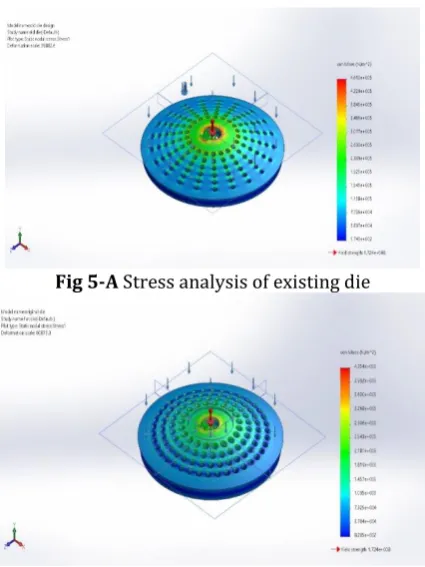
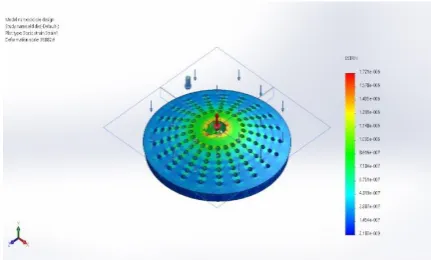
[image:3.595.51.502.75.369.2]The creation & analysis of 3D solid model of existing die and modified die is done with the help of solidworks. There are two types of load applied for checking of stress, displacement & strain, first is gravitational force and second is die plate load. The result is shown in figure 3.5-A, 3.5-B, 3.2-A, 3.2-B, 3.3-A, 3.3-B respectively and values of which are shown in below table3.1
Fig-3 cross-section of hole
[image:3.595.174.418.129.366.2]3.1 STRESS ANALYSIS
Fig 5-A Stress analysis of existing die
[image:3.595.191.404.468.752.2]© 2019, IRJET | Impact Factor value: 7.211 | ISO 9001:2008 Certified Journal
| Page 4723
[image:4.595.189.405.134.274.2]3.2 DISPLACEMENT ANALYSIS
[image:4.595.191.404.344.480.2]Fig 6-A Displacement analysis of existing die
Fig 6-B Displacement analysis of modified die
3.3 STRAIN ANALYSIS
[image:4.595.189.405.576.706.2]© 2019, IRJET | Impact Factor value: 7.211 | ISO 9001:2008 Certified Journal
| Page 4724
Fig 7-B Strain analysis of existing die3.4 TESTING
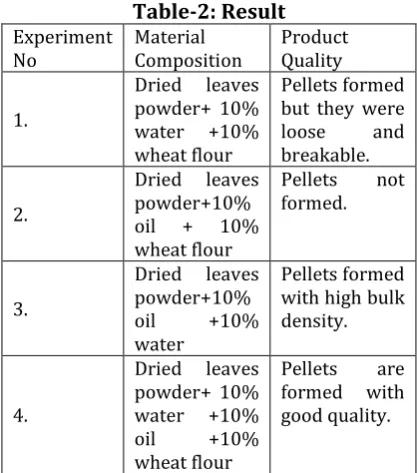
After experimentation and visual inspection of pellet formed, the results are tabulated as shown in the following table: -
Table-2: Result
Experiment
No Material Composition Product Quality
1.
Dried leaves powder+ 10% water +10% wheat flour
Pellets formed but they were
loose and
breakable.
2.
Dried leaves powder+10% oil + 10% wheat flour
Pellets not
formed.
3.
Dried leaves powder+10%
oil +10%
water
Pellets formed with high bulk density.
4.
Dried leaves powder+ 10% water +10%
oil +10%
wheat flour
Pellets are
formed with good quality.
5 CONCLUSION
For small scale manufacturing of pellet, flat die is used. The die holes with counter bore for easy flow of material, proper length and relief angle for easy removal of pellet aid in producing consistent quality of pellet. It also improves the life of die. The strength, deflection analysis of die plate with 117 no. of holes, with required geometry of holes are carried out. It is found that pellets produced by flat die of diameter 200mm having no. of holes 117 each of diameter 6 mm produced good quality pellets. When easily available dried leaves were used. The pellet formed with the modified dies are found to be satisfactory. It was also found that the pellet formed with dried leaves with binder element as water, oil & wheat flour 10% each produce higher bulk density of pellet.
ACKNOWLEDGEMENT
[image:5.595.193.402.332.569.2]© 2019, IRJET | Impact Factor value: 7.211 | ISO 9001:2008 Certified Journal
| Page 4725
We also take this opportunity to express a deep sense of gratitude to our head of department Prof. Sandhya Jadhav for cordial support, valuable information, resources & guidance which helped us in completing the task through various stages.We are grateful to our college for valuable resources provided by him. We are grateful for their co-operation during the period of our course.
REFERENCES
[1]https://www.bioenergyconsult.com [2]https://www.renewableenergyworld.com
[3]Prof. Nilesh R. Pathare, P . C. K.T k ( 6)” F p k ”. I J s Innovations in Engineering and Science. Vol 1.
[4]T M s P s M C s M . ( 7). "D s s s p ”. I conference on Industrial Engineering and Operations Management.