Manuscript version: Author’s Accepted Manuscript
The version presented in WRAP is the author’s accepted manuscript and may differ from the published version or Version of Record.
Persistent WRAP URL:
http://wrap.warwick.ac.uk/117745
How to cite:
Please refer to published version for the most recent bibliographic citation information. If a published version is known of, the repository item page linked to above, will contain details on accessing it.
Copyright and reuse:
The Warwick Research Archive Portal (WRAP) makes this work by researchers of the University of Warwick available open access under the following conditions.
Copyright © and all moral rights to the version of the paper presented here belong to the individual author(s) and/or other copyright owners. To the extent reasonable and
practicable the material made available in WRAP has been checked for eligibility before being made available.
Copies of full items can be used for personal research or study, educational, or not-for-profit purposes without prior permission or charge. Provided that the authors, title and full
bibliographic details are credited, a hyperlink and/or URL is given for the original metadata page and the content is not changed in any way.
Publisher’s statement:
Please refer to the repository item page, publisher’s statement section, for further information.
For Peer Review
theory
development phase in theory-driven
evaluation: PARTNERS2 collaborative care
for people who have experienced psychosis
in England
Abstract
In this paper we present an exemplar of the initial programme theory
(IPT)
development
phase of Theory-driven Evaluation (TDE) for the PARTNERS2 project, a collaborative care
intervention for people with experience of psychosis in England.
Our
IPT was based on
analysis of the literature, interviews with key leaders, and focus groups with service users.
The IPT was developed from these sources in an iterative process between researchers and
stakeholders (service users, practitioners, commissioners) involving four activities:
articulation of 442 explanatory statements systematically developed using realist methods;
debate and consensus; communication; interrogation.
We refute two criticisms of TDE of complex interventions. We demonstrate how the process
of IPT made a meaningful contribution to our complex intervention in five ways. Although
time consuming, it was possible to develop an internally coherent and well documented
intervention.
This study and the lessons learnt provide a detailed resource for other researchers wishing to
employ TDE.
Keywords: Programme theory development; theory-driven evaluation; complex
interventions; collaborative care; personal recovery; psychosis
Abstrait
Dans cet article, nous présentons un exemple de la phase de développement de la théorie du
programme initial (TPI) de l’évaluation basée sur la théorie (TDE) pour le projet
PARTNERS2, une intervention de soins en collaboration pour les personnes ayant une
expérience de la psychose en Angleterre. Notre IPT était basé sur une analyse de la
littérature, des entretiens avec des leaders clés et des groupes de discussion avec des
utilisateurs de services. Le TPI a été développé à partir de ces sources dans le cadre d'un
processus itératif entre chercheurs et parties prenantes (utilisateurs de services, praticiens,
commissaires) comprenant quatre activités: articulation de 442 déclarations explicatives
systématiquement développées à l'aide de méthodes réalistes; débat et consensus; la
For Peer Review
Nous réfutons deux critiques du TDE d’interventions complexes. Nous montrons comment le
processus de TPI a apporté une contribution significative à notre intervention complexe de
cinq manières. Bien que prenant beaucoup de temps, il était possible de développer une
intervention interne cohérente et bien documentée.
Cette étude et les leçons apprises fournissent une ressource détaillée aux autres chercheurs
souhaitant utiliser le TDE.
Keywords: Développement de la théorie du programme; évaluation théorique; interventions
complexes; soins en collaboration; récupération personnelle; psychose
Introduction
Evaluations of complex interventions have expanded from a focus on ‘what works?’ to
asking ‘how and why does an intervention work, for whom, in what context?’.
Theory-driven evaluation (TDE) is one approach to answering complex questions about complex
interventions. In this paper we focus on the initial programme theory (IPT) development
phase of TDE for the PARTNERS2 project, a collaborative care intervention for people with
experience of psychosis in England.
Complex interventions can be understood to be complex because of intervention content, for
example because of number of components, number of social levels targeted, diversity and
variability of outcomes, and level of skill required to deliver the intervention (Craig et al.,
2008). Interventions are often introduced to re-align existing systems in an attempt to solve
problems, and so complexity also follows from the extent of change required in different
contexts and the amenability of individual systems to the changes required (Hawe et al.,
2009). According to recent guidance from the Medical Research Council, complex
interventions are characterised by unpredictability and non-linear outcomes (Moore et al.,
2015).
One approach to addressing such aspects of complexity in the evaluation of interventions
involves TDE.
TDE involves the development of programme theory to hypothesise how and
why an intervention will work by identifying relationships between intervention components
and how they relate to contexts, the actions and decision-making processes of the people who
deliver and receive the intervention, and outcomes. The programme theory can then be used
to inform evaluation design, make sense of evaluation findings and to tailor interventions to
specific contexts; evaluation processes and findings can also inform refinement of
programme theories (Coryn et al., 2011; Weiss, 1995; Funnell and Rogers, 2011; Moore et al.
2015). Thus programme theory complements
randomised controlled trials (RCTs) which
provide estimates of aggregate effects but are not able to generate adequate explanations for
why and how interventions work or not, and do not account for context (Bonner, 2003).
The
initial programme development phase in TDE involves creating a programme theory that can
later be tested and then refined in response to evaluation findings.
In their review of the use of theory in interventions reported by the journal
Evaluation
,
Leeuw and Donaldson (2015) suggest the meaning of ‘theory’ in evaluation can be complex
and potentially confusing. To begin to clarify fragmented approaches
they identify two
helpful typologies of theory. Typology 1 consists of theories of policy makers, stakeholders
and evaluators underlying their professional work in making policies and doing evaluations.
Typology 2 consists of scientific theories capable of contextualizing and explaining the
consequences of policies, programmes and evaluators’ actions.
For Peer Review
which researchers are not privy. Developing programme theory from stakeholder knowledge
is therefore considered an important means of linking theory and context (Moore and Evans,
2017).
Leeuw and Donaldson (2015) detail numerous potential aspects of TDE within
Typology 1 to include, in addition to programme theory: theories of change, theories in use,
logic models, logical frameworks, theory/anti-theory and evaluation/implementation theories.
These all have in common their origin in the perceptions about how the intervention works of
the stakeholders, researchers and evaluators involved.
By contrast, Typology 2 represents existing, more abstract social science theory. These
provide theoretical explanation at the social and institutional level. Medical Research Council
guidance suggests drawing on existing evidence and theory, and supplementing this with
primary data (Craig et al., 2006). This corresponds to findings by Leeuw & Donaldson (2015)
where almost half of the studies they reviewed synthesised both stakeholder/researcher theory
and existing scientific theory to create a ‘plausible’ programme theory.
The authors suggest
that combining the two typologies represents the most robust approach.
However, not all evaluation scientists are convinced that TDE is beneficial. Two objections
to TDE summarised by Coryn et al. (2011) surmise that: 1) explication of programme theory
is unnecessary because it is often not used in any meaningful way, and 2) since developing
high quality programme theories is often not feasible, and poor quality programme theories
can be counter-productive, conducting TDE is a waste of valuable resources. Although there
is a growing body of work in the field of TDE that debates what should be done to develop a
useful programme theory, there are few examples that explore the role of this approach
within specific projects. Coryn et al. (2011) conclude their review of projects employing TDE
by calling for “exemplars, including reports of successes and failures, methods and analytic
techniques” (p216) after finding a paucity of evidence either to support or contradict claims
made by both critics of or advocates for TDE.
Inquiry into the method of using theory during
evaluation of interventions is rare (Brand et al. 2018), however scrutiny of IPT development
is perhaps even more so. We were only able to find a few detailed accounts of IPT
development (Pearson et al. 2015; Shearn et al 2017), both of which discussed IPT
development specifically in relation to realist approaches. In this paper, although we draw
from realist approaches as one aspect of theory development (see ‘Articulation drawing from
realist approaches’), we present an exemplar of IPT development that is more generally
relevant to TDE.
The PARTNERS2 project is funded by a UK National Institute of Health Research
Programme Grant for 5 years to include stages of
IPT
development, formative evaluation and
RCT with process evaluation.
The PARTNERS project involved a stage of IPT development
in order to design an intervention that would later be evaluated at pilot and trial stages.
Although we test our programme theory during later stages of the project, this paper focuses
on the IPT development stage only. In creating IPT we aimed
to define and develop the key
components of collaborative care for people with a diagnosis of schizophrenia or bipolar in
an English
primary care
context. In doing this we aimed to conserve fundamental principles
of collaborative care, including components and elements for which there was evidence of
likely
benefit, and adapting other components to make them optimal for people with
experience of psychosis.
We adopted a theory-driven approach to support evaluation of a number of elements of
complexity in the intervention, including multiple components, two targeted levels for
change, multiple outcomes, tailoring of the intervention to individual recipients, and
For Peer Review
in this paper is to provide a worked example and to contribute to the debate about the value of
TDE approaches, by describing the activities we engaged in related to
IPT
development, and
by reflecting on how these activities impacted its creation and content.
Developing the PARTNERS2
IPT
We developed the
IPT
in an iterative process from April 2014 to October 2015.
This IPT
involved collaborative care approaches such as a multi-professional approach to care (an
experienced mental health professional called a ‘care partner’ sited within primary care),
appropriate psycho-social intervention (sign-posting/referral and a coaching approach to
individualized care), regular/systematic monitoring and improved inter-professional
communication (see Figure 1 for a graphic representation of the IPT). We framed these
approaches using the concept widely used in mental health care in England of ‘personal
recovery’, and coaching principles in order to support service users to be more active in
managing their mental health, and to orientate care around service user priorities.
To set the programme theory in context, we describe here its progress over the time of the
PARTNERS2 grant period, although we only detail development of IPT in this paper. The
IPT was
operationalised in our pilot intervention
that was formatively evaluated from
November 2016 to April 2017. The formative evaluation contributed to further refinement of
the IPT (reported elsewhere) and we drew from the refined programme theory to design the
RCT which is currently taking place. We anticipate that findings from the RCT and process
evaluation will inform further refinement, representing overall a continuing, gradual and
iterative process across the project that may potentially continue should other researchers
draw from the theory in future.
The IPT development was conducted by the same members of the PARTNERS2 team later
conducting formative and then process evaluation, although we purposely integrated
discussion about development of the IPT content across the wider programme evaluation
team during the IPT development stage. One researcher [researcher’s initials] acted as ‘the
keeper of the theory’; she supported coherence by involvement with, communication about
and integration of the different IPT sources and activities. Critical evaluation and questioning
of proposed theory was encouraged within the team and with stakeholders as an approach to
minimizing bias.
We view the in-depth familiarity with the intervention content across the
team as a strength that later supported particularly relevant formative and process evaluation
designs, though for the full RCT we separated trial and process evaluation team members.
In the sections below we describe the range of sources that we drew from
to develop the IPT
,
only some of which had been specified in our original protocol. We then describe four
activities which the PARTNERS2 team engaged in: articulation
drawing from realist
approaches
; debate and consensus; communication; and interrogation. While the formal data
sources contributing to the synthesis were planned in advance, the four activities contributing
to synthesis represent our post hoc understanding of how we developed the model from these
and knowledge held by stakeholders (service users, primary and secondary practitioners and
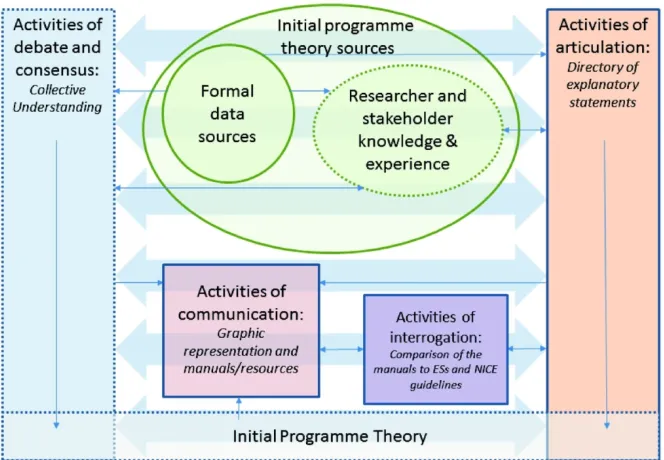
policy makers). Figure
2
depicts the overall process of
IPT
development. Figure
3
shows
sources and activities. Although a collective understanding of the
IPT
was complete by
October 2015, we continued to articulate and interrogate it after this time. Due to space
constraints, in this paper we are only able to give an overview of methods in relation to data
sources (additional detail can be requested from the authors).
Description of
IPT
sources
For Peer Review
Formal data sources
Formal data sources included literature on collaborative care and personal recovery, twelve
interviews with key leaders in collaborative care and personal recovery, and six focus groups
with service users. Ethical consent was granted by NRES Committee West Midlands –
Edgbaston (REC reference number 14/WM/0052).
Research literature on collaborative care and personal recovery provided the foundational
structure for components and key content of the
IPT
. Social science theory, including the
Chronic Care Model (Wagner et al., 1996) and a conceptual framework for personal recovery
in mental health (Leamy et al., 2011), with research evidence about collaborative care (Reilly
S, 2013; Druss et al., 2001; Bauer et al., 2006; Kilbourne, 2008; van der Voort et al., 2015;
Waxmonsky et al., 2014; Meadows et al., 2007; Chatterjee et al., 2014) supported our aim to
follow fundamental principles of collaborative care optimised for people with experience of
psychosis, where there was evidence of potential benefit.
Additional literature on personal recovery was surveyed and selected to represent views of
service users, practitioners and policy makers (Bird et al., 2014; Bora et al., 2010; Brown and
Kandirikirira, 2007; CSIP et al., 2007) about how and why personal recovery approaches
were beneficial. One hundred and forty-four explanatory statements (ESs – see the section
describing “articulation drawing from realist approaches” below) were written from this
literature.
Eleven key experts were interviewed in order to explore their experience of how and why
collaborative care and personal recovery approaches work.
Because we drew from realist
approaches to articulate the IPT (see the section ‘Articulation drawing from realist
approaches’)
, it was agreed in keeping with realist principles of building on prior theory to
formally draw from expertise on collaborative care in the researcher team, so [authors’
initials] were invited to interview. Those who agreed (total 11; collaborative care: 10
researchers from the US (5), UK (3), Australia (1) and the Netherlands (1); personal
recovery: 1 researcher from the UK) were emailed information about the study, details of our
preliminary ideas for model components and documents for obtaining
their
consent. Where
consent was given, we interviewed
these
experts between October 2014 and February 2015
by telephone (9) or in person (2) about their experiences of intervention approaches,
exploring how and why they thought the PARTNERS2 intervention might or might not work.
Interviews lasted 30-60 minutes. Two hundred and nine ESs were written from this data.
Focus groups with service users were held to explore current experiences of care. These were
jointly held by two to three researchers from the PARTNERS2 team but were led by
researchers with lived experience of mental health services. Service users who were not
currently in crisis and had received care for psychosis in the previous two years were
recruited through third sector organisations. At each of the three sites of the study, 1 focus
group was held with participants with a diagnosis of schizophrenia (SZ) and 1 was held with
participants with a diagnosis of bipolar (BP). A total of six focus groups involving 33
participants (13 women, 20 men) were conducted between January and March 2015, in
Devon, Birmingham and Lancashire. Participants gave written consent, travel expenses were
paid and each participant received a £10 voucher. Focus groups were audio recorded and
transcribed. Transcriptions were coded in qualitative coding software (
Nvivo
10), to collate
data about processes of care, positive and negative experiences of care, and recommendations
for care. Eighty nine ESs were written from this data.
For Peer Review
Although researcher and stakeholder knowledge and experience was usually a less explicit
basis for developing the
IPT
compared to the formal data sources, it implicitly provided a
further source by contextualising, shaping and providing a referent from which to prioritise
and evaluate the other data sources, as well as informing the writing of ESs.
Researchers, for example, brought additional ideas rather than just acting as ‘neutral’
programme theory builders. A number of researchers were purposely recruited to the project
because they had experience of receiving mental health services, and they contributed
expertise across the programme theory development phase, but particularly during focus
groups with service users, analysis of focus group data and writing and providing feedback
about explanatory statements from focus groups and personal recovery literature. Clinician
researchers each brought relevant knowledge and experience about collaborative care and
methodology. For example, [Author’s initials] brought particular experience about
supervision in collaborative care from her experience with other projects (Coventry et al.,
2015; Richards et al., 2013). [Author’s initials] was involved in a separate collaborative care
intervention for offenders (Lennox et al., 2018) which involved a realist review and evidence
synthesis (Pearson et al., 2015). We also drew from the collaborative care expertise of
[Authors’ initials] more formally by interviewing them as key leaders (see ‘Formal data
sources’ above).
We recruited Lived Experience Advisory Panels (LEAPs) that met four times a year from
third sector organisations in each of the three study sites. Meetings rotated by site so
researchers had one LEAP to consult every month of the year for advice and guidance. The
main role of the LEAPs were to provide expert input into the PARTNERS2 research study
based upon experiential knowledge of psychosis, schizophrenia or bipolar. We recruited both
service users and family members and each LEAP had up to 10 members. In each site,
potential members attended an information gathering meeting in 2014 to assess what was
involved and meet staff as well as other potential members. Criteria to join a LEAP were:
interest in mental health research; understanding of secondary mental health and primary care
services for people who experience psychosis and/or had a diagnosis of schizophrenia or
bipolar; ideally experience of previous committee membership. We sought to build the panels
with diverse perspectives through variations in gender, age, ethnicity and diagnostic label.
The LEAP members gave feedback about explanatory statements, focus group topic guides
and manual wording and content.
Description of activities to develop
the IPT
Our
IPT
was developed through four activities: articulation drawing from realist approaches,
debate and consensus, communication and interrogation.
Realist approaches specifically
guided the activity of articulation, however, the other activities we engaged in to create our
IPT – debate and consensus, communication and interrogation – are relevant to TDE
processes more generally.
Articulation
drawing from realist approaches
The activity of articulation involved identifying potential theories proposed within the formal
data sources described above.
Because realist approaches
(Pawson, 2006; Pawson and Tilley,
1997) draw from a generative theory of causation that accounts for complexity and change
over time in open systems, and so can be a useful approach within TDE
, we adopted a realist
approach in articulating our IPT.
From a realist perspective, change due to an intervention
does not only follow from the addition of intervention resources to a context, but is
contingent on internal decisions by individuals. Such reasoned responses by individuals to
For Peer Review
predicting how, why and for whom an intervention works. Realist approaches create
mid-level theory (Pawson, 2010) that evaluators can draw from and adapt for use in other
interventions that share similar aims.
The sources from which we drew to articulate the
IPT
include existing social science theory
and medical research to identify broad structures and evidenced components, and we
synthesised this with literature and stakeholder/researcher-level expertise to further elaborate
and explain the intervention (for more detail of sources see below, Table 1). As is an aim
within realist approaches, we were able to draw from relevant aspects of the programme
theory of a project running in parallel, but ahead of, the PARTNERS2 project, the
ENGAGER
project (
http://clahrc-peninsula.nihr.ac.uk/research/engager
). Overlap of a
co-applicant investigator ([Author’s initials]) between PARTNERS2 and
ENGAGER
bolstered
this sharing.
Our methods for articulating the
IPT
involved adaptation of an approach to realist review
adopted in the
ENGAGER
project (Pearson et al., 2015). We wrote explanatory statements
(ESs) in the format ‘If… then…’, for example, “
If
the care partner acts as a three-way liaison,
a conveyor of information between service user, general practitioner & community mental
health team,
then
communication improves” [ES162]. Each ES describes a potential causal
relationship within the intervention. We numbered the statements, recorded the data source
and type of stakeholder, then categorised and consolidated ESs. We further drew from the
Engager project by applying the macro, meso and micro levels they identified (Pearson et al.,
2015) as an initial framework for consolidation. We adapted these to be relevant to our data,
identifying 9 categories: 1. Practitioner organisational, social and cultural context (macro); 2.
Practitioner—practitioner interactions (meso); 3. Practitioner engagement and acceptability
(meso); 4. Practitioner perceptions, understanding and skills (micro); 5. Service user—
practitioner interactions (meso); 6. Service user experiences of care (meso); 7. Service user
perceptions, understanding, skills and mental/physical health (micro); 8. Research aspects
(intervention content, trial practicalities and approach to fidelity/process evaluation -- macro);
9. Carer perceptions, understanding and skills (micro). Researcher teams met repeatedly to
discuss ES writing and consolidation. The directory of PARTNERS2 Consolidated ESs can
be found in
Supplementary figure S1
.
Debate and consensus
While activities of articulation identified potential content and causal pathways for the
PARTNERS2
IPT
, activities of debate and consensus between researchers and stakeholders
determined the detail of what was and was not included in the
IPT
, and how it would be
implemented.
Activities of debate and consensus were conducted during regular researcher telephone
conferences, consultation with our LEAPs, stakeholder workshops where researchers, LEAP
members and practitioners met, and face to face researcher meetings (see the timeline in
Figure 2). The PARTNERS2 research team included a number of co-applicant investigators
([Author’s initials]) with a range of specialisations including primary care, secondary care
(clinical psychology and psychiatry) and Patient & Public Involvement. Research Fellows,
Associate Research Fellows, Service User Researchers and Researcher Consultants
([Author’s initials]) also varied in their experience and knowledge of methodologies and
mental health. The research team spanned seven universities (University of Birmingham,
Lancaster University, University of Manchester, University of Warwick, University of
Exeter, University of Plymouth and the London School of Economics and Political Science)
For Peer Review
distributed nature of the team meant that face to face meetings and workshops were
particularly important, though limited for
practical and
financial reasons.
We drew from the knowledge and experience of stakeholders by consulting with LEAP
service users and carers, primary and secondary health and mental health practitioners, and
health commissioners recruited from our three intervention sites in Lancashire, Birmingham
and Devon.
Finally, processes of discussion and negotiation with local Trusts circumscribed or shaped the
application of the
IPT
. In some instances, we were unable to adopt aspects of the intervention
because of local research site contexts. For example, personal recovery literature, the
interview with a key leader in personal recovery, focus group data and input from stakeholder
workshops suggested employing peer support workers to carry out the care partner role to
support egalitarian relationships. However, there were not adequate numbers of peer support
workers within the local Trusts at our research sites to enable this. In preparing for both
formative and process evaluations, negotiations and discussions with Trusts about how the
IPT
and/or local context could be adapted in order for the two to work together was a crucial
and often complex prior stage to recruitment.
Communication
Aspects of the
IPT
were made explicit in order to communicate PARTNERS2 to others
through a graphic representation (see Figure
1, the PARTNERS2 initial model
) and manuals
(available on request to the authors).
The graphic representation is a visual summary of the PARTNERS2 intervention, and
highlights the main types of intervention resources that include structures, information and
people. Change occurs primarily at two levels; practitioner change following training,
resources and supervision, and service user change following interactions with a care partner
including engagement and retention, coaching, care coordination and review. We also
communicated the
IPT
by writing manuals for care partners and their supervisors, service
users, carers and GPs. We adapted some of the resources from the
ENGAGER
intervention
(Pearson et al., 2015) and part of its manual framework and content where its aims were
similar to the aims within PARTNERS2. The manuals were initially written by a few
researchers based on the collective understanding, and subsequently debated across the
research team and LEAPs, and revised at length.
Interrogation
We interrogated the
IPT
by comparing content between different representations of the
intervention, and by comparing the practitioner manual to clinical guidelines for best practice.
The practitioner manual was compared to the directory of 442 ESs, in order to check
consistency and identify gaps. The two representations of the model were highly consistent,
although a few gaps, where the manual did not completely represent ESs were identified, for
example, responsibilities of the care partner and supervisors in relation to liaison with
primary care staff needed further clarification. These gaps were discussed across the
researcher team, and the manual was adapted to more fully reflect the ESs.
The manual was compared to relevant NICE clinical guidelines (NICE, 2006; NICE, 2014;
NICE, 2012) in order to explore how consistent it was with current guidelines for good
practice, and to identify any gaps. The comparison showed the manual and guidelines to be
mostly consistent. The gaps identified related to issues that had been agreed within the
research team, but that had been postponed due to lack of capacity (e.g. creating a
Carers/Friends and Family manual and directories of local resources; manualising preparation
for the end of PARTNERS2) or were identified in the ESs but not the manual (e.g. being
sensitive to service users’ multiple identities). These gaps were discussed across the research
team, and we adapted our ESs and/or the manual to address them.
For Peer Review
The four activities described above worked interactively in a non-linear manner. Activities of
debate and consensus evaluated, circumscribed, structured and/or guided the impacts of
articulation, communication and interrogation. Articulation provided evidenced content for
debate and consensus. Activities of communication created public representations of the
IPT
from processes of articulation, debate and consensus, and interrogation. Interrogation
established consistency and robustness of the processes of articulation, debate and consensus,
and communication
and helped reduce the risks of bias from any one source.
Through ongoing dialogue about the intervention, a collective and increasingly explicit
understanding was created between PARTNERS2 researchers and LEAP members about
what the intervention involved. In an ongoing iterative process, all four activities both
contributed to, and were tailored by, the developing collective understanding. Inevitably
individual researchers and LEAP members understood the model in slightly different ways,
but the collective understanding represented distributed meanings across the PARTNERS2
team.
Below we reflect on each of the activities in turn, then discuss a particularly beneficial aspect
of the interaction between activities of articulation, and debate and consensus.
Lessons learnt about articulation
The activities of articulation created a foundation and process for establishing content of the
IPT
. From social science theory (Wagner et al., 1996; Leamy et al., 2011) we established core
components of the model. The PARTNERS2 directory of ESs explicated in detail a number
of potential causal patterns that provide a transparent record of explanation for the content of
the intervention and how we anticipated it would work. Organising ESs into
macro-meso-micro levels clarified content at different levels within the intervention, and supported
understanding about relationships between them.
Different formal data sources provided detail for different categories and levels of ESs (see
Table 1). This demonstrated how important it was to draw across sources chosen in order to
illuminate different aspects of the complex PARTNERS2 intervention. Drawing from a range
of sources was also beneficial because information from one source often provided support
for or challenge to the relevance and meaning of issues flagged in other sources. Where
sources supported each other, this substantiated potential ESs; where sources challenged each
other, this highlighted areas requiring debate and consensus.
Through these processes we
were able to reduce the risks of bias from any one source.
There were also a number of difficulties related to ESs. Originally, our intention was for the
directory of ESs to represent the
IPT
as fully as possible. However, because of project
financial constraints and long term illness of more than one researcher, capacity was limited
during the first three years of the study. The time needed for this process was already lengthy
due to unfamiliarity with realist approaches for most of the researcher team and its
time-consuming nature. Our process of writing ESs was adapted as a result.
Initially, we intended to write ESs systematically not only in response to literature and
primary data, but also researcher discussions, citing each meeting as a source. Instead, during
identification and consolidation of ESs, we adapted the original text of data sources to be
relevant to our PARTNERS2 collective understanding. We also intended to refine ESs
further, for example by consolidating the individual-level service user theory around personal
recovery by mechanism as well as outcome, because the relationships tended to be
bi-directional. This process was curtailed, along with intentions to write narratives for each of
For Peer Review
process of identifying and consolidating ESs continued on through the formative evaluation.
In effect, the collective understanding, graphic representation and manuals represented our
IPT
that was tested during formative evaluation, while the ESs were more slowly explicated.
Eventually we moved on to the needs of conducting process evaluation of the upcoming
RCT, rather than developing the ESs further. The time-consuming nature of the process of
identifying and consolidating ESs was problematic, though it provided a robust basis for
developing our
IPT
.
Lessons learnt about debate and consensus
A particular benefit to the intervention resulting from activities of debate and consensus was
the identification of, and work to prevent, unintended consequences. For example, there was
an awareness from the focus groups with service users that in changing healthcare providers
(the intervention requires relocating service users’ care from secondary mental health care
services to primary care) there was the risk we would destabilise existing, supportive
relationships between practitioners and service users. In addition, until agreements had been
negotiated with local Trusts who provided the secondary mental health care, we did not know
how service users would be re-integrated into existing mental health services when the
PARTNERS2 intervention concluded,
or if the collaborative care model might continue
locally beyond the trial
. Through ongoing consultation with the PARTNERS2 LEAPs,
service users and carers reiterated transfer in and out of PARTNERS2 as a crucial aspect of
the intervention, and developed recruitment materials and intervention resources and content
to support transfer back into usual care after leaving PARTNERS2. While the intervention’s
approaches to transfer have not yet been fully tested, the input from LEAPs enabled more
nuanced, sensitive and complete resources to be developed.
Lessons learnt about communication
The graphic representation of the model was used during recruitment to explain the
intervention to local Trusts and GP surgery staff, and was included in the Care
Partner/Supervisor Manual. Although of perhaps limited use in isolation, it provided a
shorthand for the contents of the intervention, and a reference for ongoing discussion about
what the intervention involved.
The manuals were highly important during the lead up to the pilot phase and formative
evaluation; they described how the intervention was to be carried out in practice. The content
of the practitioner manuals included aspects of the model that we anticipated might not
already be part of usual care, in order to focus on areas of change. Service user and Friends
and Family manuals explained the support they would receive and clarified roles of
practitioners and the service user, in order to inform and direct expectations. Because of the
extended time period necessary to complete the directory of ESs
and because of its
complexity
, the PARTNERS2 manuals acted as the primary means of communication about
the
IPT
during the formative evaluation and
after adaptation in the main trial
.
Lessons learnt about interrogation
The activities of interrogation represented self-checking exercises for the
IPT
. They allowed
us to systematically identify and remedy gaps. The consistency established by these two
activities of interrogation supported our confidence in the rigour and quality of the
IPT
for
PARTNERS2.
For Peer Review
A beneficial but unanticipated aspect of activities of articulation involved their effect of
specifying and grounding what might have otherwise been more abstract concepts, which
facilitated activities of debate and consensus. The level of the ESs (relating to specific
circumstances and issues) reduced perceptions that the theory was over-abstract or removed
from practice. The process of developing ESs therefore seemed to create a structure and
bridge for researchers and stakeholders to meaningfully move back and forth between
practice and theory. The process of realist synthesis supported the development of
IPT
not
only as a method for articulating causal patterns and synthesising these, but perhaps as
importantly, by creating a structure and focus for negotiating understanding across
researchers and stakeholders with widely divergent experience and knowledge.
Processes of data collection and analysis framed multiple potential aspects of the intervention
with a focus on ‘why’ and ‘how’. This brought to discussion many topics and initiated face to
face meetings between researchers and stakeholders that might not have occurred otherwise,
and created a context for discussion that naturally moved beyond ‘this is what I think we
should do’, to ‘we could do this because’. In other words, it encouraged focus on the reason
behind
choices that was less influenced by status, expert opinion and/or gestalt meanings.
One example involves two of the co-applicant investigators who were practitioner researchers
from primary ([Author’s initials]) and secondary ([Author’s initials]) care and who had
extensive experience working with collaborative care interventions (Lennox et al., 2018;
Coventry et al., 2015; Richards et al., 2013). Their input carried particular weight in the
theory-building process though their experiences and perspectives were quite different.
[Author’s initials] tended to think and communicate on a more conceptually abstract basis,
whereas [Author’s initials] tended to prioritise a more grounded, pragmatic approach. The
two researchers’ different styles, combined with different practitioner emphases, could
sometimes create barriers to understanding and/or consensus between them. Initially,
[Author’s initials] expressed reservations about framing collaborative care with principles of
personal recovery, because its meaning could be misunderstood by practitioners and service
users (Slade et al., 2014) and because it was often discussed in highly abstract terms. There
was also concern across the team that inclusion of such principles mistakenly suggested the
focus of collaborative care was as much about care partner—service user collaboration as
about primary—secondary care collaboration. These differences were resolved through open
discussion and debate
as there were found to be few if any substantive differences of view
once differences related to language had been understood
.
Through activities of articulation such as reviewing research on collaborative care and
psychosis, interviews with key leaders and writing and consolidating ESs from literature on
personal recovery, we were able to distinguish implicit aspects of personal recovery in
existing collaborative care interventions and convincing beneficial aspects of a personal
recovery approach in relation to psychosis, which led to consensus. We operationalised these
for practice through adoption of coaching principles (Bora et al., 2010) to guide interactions
between the PARTNERS2 case managers and service users. Explicit incorporation of
recovery principles is a distinguishing feature of PARTNERS2 collaborative care for people
who experience psychosis.
Discussion
In this paper we have provided a worked example of the
IPT
development phase of TDE for
PARTNERS2 collaborative care for psychosis, a complex intervention. We have described
For Peer Review
intended to be a guide, we hope that our post hoc ‘warts and all’ description of the four varied
activities we ended up engaging in to create the
IPT
, and our discussion of the interactions
between these activities, will be helpful to others developing complex interventions.
We drew
from similar activities again during our formative evaluation (reported elsewhere), and
anticipate these activities will support us in evaluating the intervention during our RCT and
process evaluation. Although we only report the activities in detail for the IPT development
phase, we posit that they are beneficial within evaluation as well as theory development
phases of TDE.
We would now like to draw on our experience during this process to contribute to the debate
on the value of
IPT
development in a TDE approach. We return to the two objections (Coryn
et al., 2011) to TDE raised in the Introduction to this paper, that 1) explication of programme
theory is unnecessary because it is often not used in any meaningful way, and 2) since
developing high quality programme theories is often not feasible, and poor quality
programme theories can be counter-productive, conducting TDE is a waste of valuable
resources. In contrast to the first objection, the process of
IPT
development contributed
meaningfully to our complex intervention in a number of ways, including: a) detailed
clarification of the intervention rationale; b) establishing a high level of internal consistency
between
IPT
and communications of the model such as the intervention manuals; c)
highlighting issues that prepared us to better train practitioners; d) creating a framework for
thorough evaluation including hypotheses about why the intervention might or might not
work; and e) providing a structure that fostered dialogue and understanding amongst
researchers, service users, carers and practitioners, allowing more egalitarian and thorough
exploration of the issues around collaborative care for people who experience psychosis.
With regards to the second objection, our experience both supported and refuted it in
different ways. In accordance with the charge that high quality programme theory
development is not feasible, we found
the activities of articulation drawing from realist
approaches as well as the activity of debate and consensus to be particularly
time consuming,
and we could easily have spent additional time in developing
the IPT
further. Other projects
have reported similar difficulties (Lloyd et al., 2017). As recipients of a 5-year Programme
Grant from the UK National Institute of Health Research, we were able to expend extensive
resources on
IPT
development, but smaller research projects may not be able to do so, and
this is a limitation of the approach. Finding the right amounts of time and resources to
develop a programme theory robust enough for the purposes of each project remains a matter
of judgment and fine balance.
In refutation to the second objection, although we were obliged to follow Coryn’s (2011)
recommendation for the need to prioritise and balance
IPT
development in the face of
pragmatic limitations, we
were
able to develop an internally coherent complex intervention
that is documented in detail.
We found the realist approach of tabulating and consolidating
hypothetical relationships, although time consuming, supported high quality activities of
debate and consensus, and particularly in-depth conceptualisations about how the
intervention might work.
And, having expended these resources, other researchers and
healthcare practitioners can now draw from the study as a resource.
A further question concerning the programme theory at this time is that its utility and efficacy
have yet to be tested in a full trial. A further strength is the large number of collaborators
involved in the
IPT
development, which guards against individual biases or idiosyncrasies.
We have contributed to the cumulation of research around collaborative care, by drawing
from existing theory and strengthening this with primary data and further development.
Because the
IPT
is mid-range, it is likely to be generalisable to other interventions with
similar aims applied within similar contexts.
For Peer Review
more severe mental health problems, and support for mental health from primary care. In
future, UK Healthcare Trusts may therefore be likely to work on the implementation of
models with aims similar to PARTNERS2. The
IPT
that we have built is deeply rooted in
existing literature and theory on collaborative care and personal recovery as well as the
experience of many experts. We hope others will build it further and use this as a resource for
evaluation work in the future.
References
Bauer M, McBride L, Williford W, et al. (2006) Cooperative Studies Program 430 Study Team. Collaborative care for bipolar disorder: part 1 intervention and implementation in a randomized effectiveness trial. Psychiatric Services 57: 927-936.
Bird V, Leamy M, Tew J, et al. (2014) Fit for purpose? Validation of a conceptual framework for personal recovery with current mental health consumers. Aust N Z J Psychiatry.
Bonner L. (2003) Using theory-based evaluation to build evidence-based health and social care policy and practice. Critical Public Health 13: 77-92.
Bora R, Leaning S, Moores A, et al. (2010) Life coaching for mental health recovery: the emerging practice of recovery coaching. Advances in Psychiatric Treatment 16: 459-467.
Brand S, Quinn C, Pearson M, et al. (2018) Building programme theory to develop more adaptable and scalable complex interventions: Realist formative process evaluation prior to full trial. Evaluation. Epub ahead of print DOI: 10.1177/1356389018802134.
Brown W and Kandirikirira N. (2007) Recovering mental health in Scotland. Report on narrative investigation of mental health recovery. Glasgow: Scottish Recovery Network.
Chatterjee S, Naik S, John S, et al. (2014) Effectiveness of a community-based intervention for people with schizophrenia and their caregivers in India (COPSI): a randomised controlled trial. Lancet 383: 1385-1394.
Coryn CLS, Noakes LA, Westine CD, et al. (2011) A Systematic Review of Theory-Driven Evaluation Practice From 1990 to 2009. American Journal of Evaluation 32: 199-226.
Coventry P, Lovell K, Dickens C, et al. (2015) Integrated primary care for patients with mental and physical multimorbidity: cluster randomised controlled trial of collaborative care for patients with depression comorbid with diabetes or cardiovascular disease. BMJ : British Medical Journal 350.
Craig P, Dieppe P, Macintyre S, et al. (2006) Developing and evaluating complex interventions: new guidance. Medical Resource Council.
Craig P, Dieppe P, Macintyre S, et al. (2008) Developing and evaluating complex interventions: the new Medical Research Council guidance. BMJ 337.
CSIP, RCPsych and SCIE. (2007) A common purpose: Recovery in future mental health services. London: SCIE (Social Care Institute for Excellence).
Druss B, Rohrbaugh R, Levinson C, et al. (2001) Integrated medical care for patients with serious psychiatric illness: a randomized trial. Archives of General Psychiatry 58: 861-868.
Farmer P and Dyer J. (2016) The Five Year Forward View for Mental Health. The Independent Mental Health Taskforce to the NHS in England.
Funnell SC and Rogers PJ. (2011) Purposeful Program Theory: Effective use of theories of change and logic models, San Francisco, CA: Jossey-Bass.
Hawe P, Shiell A and Riley T. (2009) Theorising Interventions as Events in Systems. Am J Community Psychol 43: 267-276.
For Peer Review
Kilbourne AM. (2008) Improving medical and psychiatric outcomes among individuals with bipolar disorder: a randomized controlled trial. Psychiatr Serv 59: 760-768.
Lacouture A, Breton E, Guichard A, et al. (2015) The concept of mechanism from a realist approach: a scoping review to facilitate its operationalization in public health program evaluation. Implementation Science 10.
Leamy M, Bird V, Le Boutillier C, et al. (2011) Conceptual framework for personal recovery in mental health: systematic review and narrative synthesis. The British Journal of Psychiatry 199: 445-452.
Leeuw FL and Donaldson SI. (2015) Theory in evaluation: Reducing confusion and encouraging debate. Evaluation 21: 467-480.
Lennox C, Kirkpatrick T, Taylor R, et al. (2018) Pilot randomised controlled trial of the [name of project] collaborative care intervention for prisoners with common mental health problems, near to and after release. Pilot and Feasibility Studies 4.
Lloyd HM, Pearson M, Sheaff R, et al. (2017) Collaborative action for person-centred coordinated care (P3C): an approach to support the development of a comprehensive system-wide solution to fragmented care. Health Research Policy and Systems 15: 98.
Meadows GN, Harvey C, Joubert L, et al. (2007) The Consultation-Liaison in Primary-Care Psychiatry Program: A structured approach to long-term collaboration. Psychiatr Serv 58: 1036-1038. Moore GF, Audrey S, Barker M, et al. (2015) Process evaluation of complex interventions. UK
Medical Research Council.
Moore GF and Evans RE. (2017) What theory, for whom and in which context? Reflections on the application of theory in the development and evaluation fof complex population health interventions. SSM - Population Health 3: 132-135.
NICE. (2006) Bipolar Disorder: the Management of Bipolar Disorder in Adults, Children and Adolescents, in Primary and Secondary Care. National Institute for Health and Care Excellence.
NICE. (2012) Service User Experience in Adult Mental Health: Improving the Experience of Care for People using Adult NHS Mental Health Services. National Institute for Health and Care Excellence.
NICE. (2014) Psychosis and Schizophrenia in Adults: The NICE Guideline on Treatment and Management. National Institute for Health and Care Excellence.
Pawson R. (1996) Theorizing the Interview. The British Journal of Sociology 47(2): 295-314. Pawson R. (2006) Evidence-based Policy: A Realist Perspective, London: Sage.
Pawson R. (2010) Middle range theory and program theory evaluation: From provenance to practice. In: Vaessen J and Leeuw FL (eds) Mind the Gap: Perspectives on Policy Evaluation and the Social Sciences. New Brunswick, NJ: Transaction Publishers, 171-202.
Pawson R and Tilley N. (1997) Realistic Evaluation, London: Sage Publications.
Pearson M, Brand SL, Quinn C, et al. (2015) Using realist review to inform intervention development: methodological illustration and conceptual platform for collaborative care in offender mental health. Implement Sci 10.
Reilly S PC, Gask L, Hann M, Knowles S, Druss B, Lester H. (2013) Collaborative care approaches for people with severe mental illness (Review). The Cochrane Library.
Richards DA, Hill JJ, Gask L, et al. (2013) Clinical effectiveness of collaborative care for depression in UK primary care (CADET): cluster randomised controlled trial. BMJ : British Medical Journal 347.
Shearn K, Allmark, P Piercy H, et al. (2017) Building Realist Program Theory for Large Complex and Messy Interventions. International Journal of Qualitative Methods 16: 1-11.
Slade M, Amering M, Farkas M, et al. (2014) Uses and abuses of recovery: implementing recovery-oriented practices in mental health systems. World Psychiatry 13: 12-20.
van der Voort TYG, van Meijel B, Goossens PJJ, et al. (2015) Collaborative care for patients with bipolar disorder: randomised controlled trial. The British Journal of Psychiatry 206: 393-400.
For Peer Review
Disorder: Results From a Randomized Controlled Implementation Trial. Psychiatr Serv 65: 81-90.
Weiss CH. (1995) Nothing as Practical as Good Theory: Exploring Theory-Based Evaluation for Comprehensive Community Initiatives for Children and Families. In: Connell JP (ed) New Approaches to Evaluating Community Initiatives. Concepts, Methods, and Context.
Roundtable on Comprehensive Community Initiatives for Children and Families. Queenstown, MD: Aspen Institute Publications Office.
Tables
Formal data
source
Contribution
Notes
Social science
theory
Source for foundational
theory underpinning the
Initial Model
(Leamy et al., 2011; Wagner et al., 1996)
Systematic
review and/or
studies on
collaborative
care for
psychosis
Provided evidence and
detail about
foundational
components for the
Initial Model
(Bauer et al., 2006; Chatterjee et al., 2014;
Druss et al., 2001; Kilbourne, 2008;
Meadows et al., 2007; Reilly S, 2013; van der
Voort et al., 2015; Waxmonsky et al., 2014)
Personal
recovery
literature
ESs* detailing content
and approach to
implementation at
primarily meso and
micro levels
Contributed mostly to ES* categories:
5. Service user – practitioner interactions;
7. Service users’ perceptions, understanding,
skills and/or physical and mental health.
Interviews with
key leaders
ESs* detailing content
and approach to
implementation at
primarily macro and
meso levels
Contributed mostly to ES* categories:
1. Organisational, social and cultural context;
2. Practitioner—practitioner interactions;
3. Participant engagement/acceptability;
4. Practitioner perceptions, understanding
and skills;
5. Practitioner—service user interactions;
Table 1. Contribution of each formal data source to the Initial Model.
6For Peer Review
*ES: Explanatory statement
Figures
Figure 1. Graphic representation of the PARTNERS2 IPT.
Figure 2. Diagram depicting the process of Initial Model development. Representations of the Model are shown with rectangles; sources of the Model are shown with ovals; explicit elements have solid boundaries; more implicit elements have dotted boundaries. Outlines and arrows in blue represent the overlapping role of debate and consensus with other activities.
Figure 3.Timeline showing sources and activities. Key ESs: Explanatory statements; LP: LEAP meeting; RC: researcher consensus meeting; RM: face to face researcher meeting; RW: researcher workshop; SW: stakeholder workshop; TC: researcher telephone conference. Representations of the Model are shown with rectangles; sources of the Model are shown with ovals; explicit elements have solid boundaries; more implicit elements have dotted boundaries.
8. Research aspects.
Focus groups
with service
users
ESs* detailing content
and approach to
implementation
primarily at the meso
and micro level
Contributed mostly to ES* categories:
6. Service users’ experience of care
7. Service users’ perceptions, understanding,
skills and/or physical and mental health.
Current perspectives of local service users
substantiated literature on personal recovery.
For Peer Review
Figure 1. Graphic representation of the PARTNERS2 IPT.
121x91mm (300 x 300 DPI)
For Peer Review
Figure 2. Diagram depicting the process of Initial Model development. Representations of the Model are shown with rectangles; sources of the Model are shown with ovals; explicit elements have solid boundaries;
more implicit elements have dotted boundaries. Outlines and arrows in blue represent the overlapping role of debate and consensus with other activities.
134x100mm (300 x 300 DPI)
For Peer Review
Figure 3. Timeline showing sources and activities. Key ESs: Explanatory statements; LP: LEAP meeting; RC: researcher consensus meeting; RM: face to face researcher meeting; RW: researcher workshop; SW: stakeholder workshop; TC: researcher telephone conference. Representations of the Model are shown with
rectangles; sources of the Model are shown with ovals; explicit elements have solid boundaries; more implicit elements have dotted boundaries.
247x146mm (300 x 300 DPI)
For Peer Review
Directory of PARTNERS2 Consolidated Explanatory Statements
Abbreviations
CES: Consolidated Explanatory Statement; ES: Explanatory Statement; CP: Care Partner; SU: Service user; MH: mental health
Source number references
1 Selected recovery literature (Bird, V, Leamy, M, Tew, J, et al. Fit for purpose? Validation of a conceptual framework for personal recovery with current mental health consumers. The n and New Zealand journal of psychiatry 2014.
2 Selected recovery literature (Bora, R, Leaning, S, Moores, A, et al. Life coaching for mental health recovery: the emerging practice of recovery coaching. Advances in Psychiatric Treatment 2010; 16: 459-67.
3 Selected recovery literature (CSIP, RCPsych, SCIE. A common purpose: Recovery in future mental health services. London: SCIEW (Social Care Institute for Excellence), 2007.
4 Selected recovery literature (Brown, W and Kandirikirira, N. Recovering mental health in Scotland. Report on narrative investigation of mental health recovery. Glasgow: Scottish Recovery Network, 2007.
5 Birmingham LEAP mtg October 2014 6 Recovery workshop August 2014 7 Key leader interviews
8 Focus groups with SUs
Macro/Meso/Micro level
Outcome (then) category Context/Mechanism (if) category CES No. Consolidated Candidate Theory ES No.
ESs stakeholder,
source number
1. Practitioner:
organisational, social and cultural context (Macro)
Organisational culture Recovery principles for practitioners 1 If a central aim within PARTNERS is towards personal recovery, then there may need to be attitude change towards this aim, because established expectations within mental health care, for practitioners and potentially service users, can revolve around symptom reduction.
If recovery principles are adopted by organisation leaders in their interactions with health care staff, then the cultural change needed to bring about recovery-oriented practice will be supported.
S3 If recovery principles are adopted by organisation leaders in their interactions with health care staff, then cultural change needed to bring about recovery-oriented practice will be supported
practitioners, 2; MH policy makers, 3
General improvement for SUs: wellbeing
Focus on attitude change towards personal recovery
204 If a central aim within PARTNERS is towards personal recovery, eg., helping the service user find his way in life beyond symptoms of severe mental illness, then there needs to be
key leader, 7
For Peer Review
a real focus on bringing about an attitude change towards this aim, because
established expectations within mental health care, for practitioners and potentially service users, revolve around symptom reduction.
Increased system capacity
Practitioners given responsibility to vary intensity of input by need
2 If practitioners (are given responsibility to) vary intensity of input by need, then the system can cope with more people.
If intensity of input is restricted by availability of resources, then SUs may be redefined as having fewer needs or thresholds for access may change as a means to reduce demand for services.
255 If practitioners (are given responsibility to) vary intensity of input by need, then system can cope with more people.
key leader, 7
Changing access criteria (decreased system capacity)
Reduced access to care 371 If there are reduced resources then SUs may
be redefined as having fewer needs or thresholds for access may change
SU, 8
Team-based care Roles are clearly defined 3 If practitioners who have contact with Partners (for example those within primary and secondary care) have a clear
understanding of the role of the CP, then this prevents gaps and overlap.
163 If roles [across practitioners] are clarified, then work doesn’t overlap
If roles are clarified, then this prevents gaps
key leader, 7
Team-based care Roles are clearly defined 233 If roles are clear and agreed, then care can
be team based.
key leader, 7
Team-based care Organisational clarity that CP is responsible for care coordination
307 If confusion around who is in charge of
service users individual care is to be avoided then there needs to be clarity that (from an organisational perspective) the case manager/CP is responsible for coordinating care around the individual goals.
key leader, 7
Smoother transitions when stepping up
CPs with mh training & qualifications support development of crisis plan
4 If CPs have experience of mental health practice (eg. medication) and prepare crisis plans that are detailed and clear, and Partners emergency protocols are available, then this will support quick, smooth and appropriate transitions in response to acute harm risk
246 If case managers with some experience of mental health and practitioner training, particularly medication, such as nursing can support development of crisis plan, then this could ensure smooth transitions of change in intensity with need.
key leader, 7
For Peer Review
Macro/Meso/Microlevel
Outcome (then) category Context/Mechanism (if) category CES No. Consolidated Candidate Theory ES No.
ESs stakeholder,
source number
Smoother transitions when stepping up
Emergency protocols detailed and clear 164 If emergency protocols are detailed and
clear, then instances of acute harm risk can be responded to immediately and
appropriately
key leader, 7
Shared care Range of individuals see role to support crisis
5 If specialist mental health practitioners are based in primary care and provide care coordination, support for medication, psycho-social intervention, and crisis management then genuinely shared care can be delivered.
250 If a range of individuals (eg GP, nurse, Psychiatrist etc) are in primary care and see their role to support a crisis, then stepped up intensive care during a crisis can be created without need to transition to new service or team.
key leader, 7
Shared care MH worker in primary care providing medication & PSI
229 If mental health specialist support covered medication and psycho-social interventions for mental health, then team based care without need for referral can be put in place.
key leader, 7
Shared care Primary and secondary care less constrained by defining who manages each condition
238 If primary and secondary care are less constrained by defining who manages which conditions, then a model can work more flexibly sharing responsibility for different groups of patients.
key leader, 7
Shared care MH practitioners co-located and accessible to primary care
257 If specialist practitioners are co-located and directly accessible to primary care, then this increases chance of both gaining specialist input and doing genuinely shared care through a combination of face to face and written communication.
key leader, 7
Shared care Interactions between primary and secondary care
212 If PARTNERS created better structures for collaboration between primary and secondary care, for example by improving the quality of information available about service user needs through coordination of care by the CP, and by providing improved relationships between GPs and psychiatrists, then the GP’s role would be to support the physical health of the service user, and the mental health of the service user in liaison with, and supported by, a psychiatrist. (Discussed in Nov 2015 as being about GP engagement & what will help them in
key leader, 7