..
Take a close look
at the big three
in small computers.
At Varian, we consider the 620 series as a kind of computer molecule, bonded by the same standard software: FORTRAN IV, MOS, BASIC, RPG, and others. This 620 family also offers the largest line of peripherals available in the industry.
620/i: one of the most popular ever built
- over 1300 sold worldwide - this systems-oriented digital computer features ease of interface and programing, full array of options required in today's multi-application environment and up to 32,768 words of memory, 16- or 18-bits.
R-620/ i: a ruggedized version of the 620/i, it's a general-purpose computer that's designed to withstand environ-mental extremes. For truck, shipboard, or other military/industrial applications. The 620/i's large software library works with the R-620/i.
620/t: latest in the series, the 620/f has a 750-nsec cycle time, meaning it executes 2112 times faster than the 620/i. It is 100% upward compatible from the
620/i. And, this new computer also uses the 620/i's field-proven software. The 620 series gives you three more good reasons for talking to the big company in small computers.
u. S. Sales Offices: Downey, San Diego, San Francisco, Calif.; Washington, D.C.; Atlanta, Ga.; Chicago, III.; Waltham, Mass.; Ann Aroor: Mich.; Albuquerque, N. Mex.; New Rochelle, Syracuse, N.Y.; Fort Washington, Pa.; Dallas, Houston, Tex. Other offices worldwide.
Varian Data Machines, a Varian subsidiary, 2722 Michelson Dr., Irvine, Calif. 92664 . . Telephone 714/833-2400.
~varian
~
data machines
The Big Company in Small Computers
Computer
compatibility,
a hang-up
we understand
To move bits by the billions between
your offices, Tally's computer
com-municators are your answer.
To gather remote batch data and put
it into your CPU in the easiest way
imaginable, consider the Tally
Sys-tem 403 1. This efficient magnetic
tape data terminal receives your
incoming data on computer
compat-ible
112 "tape, 9 track or 7 track. Full
error control routines during
trans-mission are standard.
To increase the. efficiency of your
sys-tem, the 4031 offers you code
con-version between terminals during
transmission. Now, the 4031 can help
you solve your 2400 or 4800 Baud requirements too.
Ifyour CPU
likes paper tape input, the Tally System 311 is the most versatile
perforated tape data station ever offered. Standard features include
automatic error control, unattended answer capability, and off-line
tape editing or duplication.
So if you are responsible for the movement of bits by the billions, we
invite your inquiry. The informed Tallyman from your nearest regional
office will be glad to help you.
Please address Tally Corporation, 8301 South 180th Street, Kent,
Washington 98031. Phone (206) 251-5500.
Regional offices:
Atlanta: 3785 Northeast Expressway, Atlanta, Georgia 30340. (404)
457-1624.
Chicago: 33 North Addison Road, Addison, Illinois 6010
I.(312)
279-9200.
Los Angeles: 501 N. Golden Circle Drive, Santa Ana, Calif. 92705.
(714) 542-1196.
New York: 45 North Village Avenue, Rockville Centre, Long Island,
N.Y. 11570. (516) 678-4220.
San Francisco: 420 Market Street, 94111. (415) 989-5375.
England: Tally, Ltd., Tally House, 7 Cremyll Road, Reading RG 1
8NQ, Berkshire. Reading 580-142.
It would be niceto sell a Sigma 5 sometime without having to undergo a rigorous analysis by a hard-nosed customer who knows exactly what he wants and what he wants to pay for it. .
No such luck. When we install a Sigma 5 it's invariably because all the elements of the system-hardware, software, service - combine to give supe-rior price/performance in a difficult, sophisticated application.
Most of these applications involve routine batch processing concurrently with critical foreground tasks. Like interactive time-sharing. Or real-time process control. Or store-forward message switch-ing. Or remote data collection and concentration. Or nuclear reactor monitoring and experiment analysis. Or on-line telemetry data conversion, compression and display. Or multiphasic health screening and
2
Sigma 5
CIRCLE 45 ON READER CARD
hospital patient monitoring.
It's not just Sigma 5's foreground/background architecture, its flexible I/O system, and its tre-mendous throughput capacity that make it so cost efficient in areas like these. It's also the wide range of powerful, proven software that comes with the machine.
Bit for bit, Sigma 5 hardware isn't the cheapest around. But in the environments it was designed for, Sigma 5 almost always
delivers far more perform-
XI'
J
II
i
ance per dollar than anybodyelse can.
No sophisticated,
analyti-cal, demanding cheapskate Xerox Data Systems should be without one. EI Segundo, California
SEPTEMBER
"J
.,970
volume 16 number 10
departments
Letters to the Editor 9 Look Ahead 17
Perspective 38 News Scene 63 Hardware 87 Software 91
Washington Report 97 People 99 Index to Advertisers
1 02
September 1,1970
IMiANAGEMENT
28
MIS planning
High cost and complicated relationships demand that :MIS management establish a highly systematic and analytic approach. This is how the AEC is experimenting with a modification of the plan developed by ESSO Standard of New Jersey.
32
Decision Models, Part I
Models can be helpful in MIS optimization decisions-but not all problems allow their use. Here's how to tell when to use them.
I
I
I
ECHNICA~
42
Can COBOL Cope?
Third generation reprogramming demands reawaken busi-ness applications' interest in modular programming- but can COBOL be made compatible? Here are some ways.
48
External Control
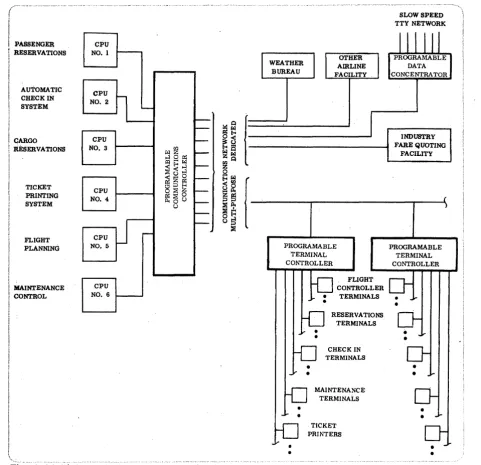
With the increased use of on-line systems, it is necessary that performance be as cost-effective as possible. An ex-ternal programmable communications controller, designed for a specific system, can improve throughput and provide flexibility.
I'; ]ENERAL
22 The Elusive MIS
Although there are still more problems than solutions, questions than answers, interest in MIS continues to in-crease. This article looks at the state of the art, with em-phasis on design and utilization. .
59
Mapping for Survival
A conference repprt.
[.: jOMMENTARV
38
Perspective
IBM's European strategy begins to unfold with the 370 announcement ... The State of California is clamping down on computer waste ... NASA's software distribution program gets a face-lifting ... and Gordon Smith pumps new life into ACM.
About
t he Cover
4
Perlormance
Evalualion
Seminar
The new tools and techniques for computer per-forman·ce evaluation will significantly improve the efficiency of your present or future comput-ing requirements.
If you are concerned with computer system performance measurement or prediction, make plans. to attend this highly acclaimed program in:
San Francisco
October 15 and 16
What does the program cover? State of the art in hardware and software performance measurement systems; computer simulation systems; criteria for selection of performance measurement and prediction techniques; performance evaluation as a management and design tool; personnel requirements; and the role of performance measurement and simulation in over-all systems management problems.
Who should attend? The seminar is designed ex-clusively for experienced data processing managers and hardware, software and operations systems spe-cialists. The program presents outstanding authorities in industry and government who have developed and used these tools. The program is sponsored by Com-puter Learning and Systems Corporation.
The cost of the seminar is $250, including all course materials and lunches. Enrollments are limited; prompt registration is advised. Call (301) 652-9220 or clip and mail this coupon.
•••••••••••••••••••••••
• Registrar •
• Computer Learning & Systems Corporation •
• 5530 Wisconsin Avenue •
• Washington, D.C. 20015 • • Please enroll the following participants in the • • Computer Performance Evaluation Seminar, Octo- • • ber 15 & 16 in San Francisco. Send acknowledge- • • ment and complete details. •
•
•
• Name... • • Name... •
•
• Organization... ... ...•
• • Street... • • City ... State ... Zip.. •• 0 Check here if hotel reservations desired •
•
•
• 0 Check enclosed 0 Bill my organization •
•••••••••••••••••••••••
CIRCLE 97 ON READER CARD
DATAMATION®
SEPTEMBER 1. 197D
volume 16
number 10
This issue
105,577
copiesEDITOR
ROBERT B. FOREST
EDITORIAL STAFF
Managing Editor Senior Associate Editors Associate Editors
Copy Editor Assistant Editors Special Features Editor Eastern Editors New England Editor Washington Editor Midwestern Editor European Editor Australian Editor Contributing Editors
Editorial Adviser Technical Consultant
EDWARD K. YASAKI WILLIAM J. ROLPH, TOM McCUSKER AUBREY DAHL, RICHARD A. McLAUGHLIN, EDITH D. MYERS, JOHN T. WATERHOUSE JANET EYLER ANNE WILKS, MICHAEL WILLIAM CASHMAN ANGELINE PANTAGES JOHN WESSLER, F. BARRY NELSON W. DAVID GARDNER PHIL HIRSCH LAWRENCE RAGAN PEARCE WRIGHT FREDERICK A. BLAND HOWARD BROMBERG, ROBERT V. HEAD, PHILIP H. DORN, LOUIS B. MARIENTHAL, DANIEL D. McCRACKEN, F. G. WITHINGTON, PAUL ARMER, ROBERT P. BIGELOW ROBERT L. PATRICK LOWELL AMDAHL
EDITORIAL OFFICES
HEADQUARTERS: 94 S. Los Robles Ave., Pasadena, Calif. 91101, Phone: (213) 681·8486; EASTERN: 35 Mason St., Greenwich, Conn. 06830, (203) 661·5400; 9805 Singleton Dr., Bethesda, Md. 20034, (301) '365·8671; MIDWESTERN: 407
S. Dearborn St., Chicago, III. 60605, (312) 922·8245. FOREIGN: 65, Hill Road, Chelmsford, Essex, England; 322, Park Regis, Park St., Sydney, NSW 2000,
Australia.
GRAPHIC DESIGN
AND PRODUCTION
Art & Production Director CLEVE MARIE BOUTELL
Production Manager MARILEE PITMAN
Production Assistants GLORIA CASTAGNA, LOUISE T. O'CONNOR
CIRCULATION
35 Mason Street Greenwich, Conn. 06830
Director of Circulation Circulation Manager Marketing Research Director
PUBLISHER
GARDNER F. LANDON
ASSISTANT PUBLISHER
JAMES M. MORRIS
Circulation audited by ~ Business Publications Audit
IiiiIIIiJ
FRANK DeCARLO . MAE VAN RENNES DOUGLAS DeCARLO
It:.
--AS"'"
Member, American~~ Business Press, Inc. DATAMATION is published twice monthly on or about the first and fifteenth day of every month by Thompson Division, Technical Publishing Company, 1301 South Grove Ave., Barrington, Illinois 60010; Arthur L. Rice Jr., President; Gardner F. Landon, Executive Vice President. Executive, Circulation and Advertising offices, 35 Mason Street, Greenwich, Conn. 06830 (203) 661-5400. Editorial offices, 94 So. Los Robles Avenue, Pasadena, California 91101. Published at Chicago, III.
DATAMATION is circulated without charge by name and title to certain qualified individuals who are employed by companies involved with automatic information handling equipment. Available to others by subscription at the rate of $25
annually in the U.S. and Canada. Reduced rate for qualified students. Foreign subscriptions are on a paid basis only at a rate of $38 annually. No subscription agency is authorized by us to solicit or take orders for subscriptions. Controlled circulation paid at Columbus, O. and Form 3579 to be sent to Technical Pub-lishing Company, P.O. Box 2000, Greenwich, Conn. 06830. Copyright 1970, Tech-nical Publishing Company. Microfilm copies of DATAMATION may be obtained from University MicrOfilms, Inc., 313 No. First St., Ann Arbor, Michigan. Printed by Beslow ASSOCiates, Inc.
New
beats out its closest
competitor:
old
-Autoflow
September 1,1970
Old Autoflow is not so old. It was introduced in 1967. It's installed in over 1,100 computer systems.
But we continually change and improve it. The first Autoflow, for instance, had one language and 5 listings. Today, 14 languages and 12 listings are incorporated.
In all, the 1970/360 system is three times more comprehensive than the original.
Right now Autoflow is at work in more computer systems than any comparable software system. By far.
For one simple reason: Autoflow does more. It flowcharts. Debugs. Documents. Cross references. Helps in desk checking and training. Saves time and money in program development, corrections, and maintenance.
If you haven't seen Autoflow in a while, call us. We'll arrange for a demonstration.
Applied Data Research, Inc. Route 206 Center
Princeton, New Jersey 08540 609921-8550
Offices in Atlanta, Boston, Chicago, Cincinnati, Cleveland, Dallas, Denver, Detroit, Hartford, Houston, Kansas City, Los Angeles, Milwaukee, Minneapolis, New York, Philadelphia, Pittsburgh, Rochester,51. Louis, San Francisco,
6
data
bits
from
Jeletype
knowing
who's
gOing
where,
en
and
ight mani-Operations.
ex;
one carrier1 , thatiUrtdn~ds of flights and Ie daily; recently re-llced s6meoft~~r>toblems involved by integratinghigh':'speed Teletype® equipment into its system~
Computerized manifestdata, com-piled in the airline's central office, is senttodepartingterminals two hours prior to each flight. It's used in a vari-ety of ways: As a boarding checklist. In ,'computing aircraft weights and balances. For meal' details. To., meet special requests for wheelchairs,etc.
At the, time of, departure,Ynoshow" passengers are deleted frOm the man-ifest, standby names on. board are added, and the list resubmitted via ' Teletype equipment to central office computer for updating. The computer then generates the "official" manifest and sends it to both departure and arrival terminals involved, at 1050
wpm. The send-receive operation us-ually is complete before the flight gets into the air.
TE;3letype's Stuntronic™, electronic selective calling, station controllers, also helped reduce computer portre~
quirementsof this system by 900/0 .
total on-line time:
divide
by twelve
If you have a number of low-speed terminals in your time-sharing system that generate heavy loads of on-line time, it may pay dividends to do' the above arithmetic. The Teletype Inktronic terminal is about twelve times faster.
This electronic, solid-state ter-minal will generate 128 ASCII combinations. Print 93 alphanu-merics in upper and lower case. It achieves 1200 wpm printing capability. Charged ink droplets are drawn to the page through a series of electrodes that form the character called for. The ink supply and guidance system has only one moving part. So the Inktronic terminal requires little. maintenance. And it's really qu iet.
It has more than on-line opera-tional economy, too. Usesordi-nary teleprinter paper. And inexpensive ink. Like most equip-ment in the Teletype line,you won't find a more capable termi-nal on a price! performance basis.
on track
with 80,000 cars
Numbers: important in every business. But, no one has to contend with more of them than a railroad. Keeping the digits straight that identify rolling stock alone, staggers the imagination. These numbers represent big money to railroad and customers alike.
One major railroad uses over 500 high and low speed Teletype terminals in its system to pro-vide the type of ca( utilization that means busi-ness and profitable operation. The terminals are linked to a computer by communications
channels.
The Teletype equipment has parity error de-tection capabilities. Important in keeping the
identity and location of over 80,000 cars straight. Teletype solid-state terminal logic permits the computer to poll stations and
terminals to respond automatically.
Data generated includes immediate car availability, projected car
avail-ability in 1 to 3 days, condition of cars, what type of goods· each can handle. Locomotive· power avail-able. Enabling the railroad to
provide shipper customers the equipment they need for
load-ing, when needed. The data system handles over 30
mil-lion data bits daily.
,
Teletype has a number of brochures on equipment, applications, and case history data: Ashort
description of what isavana~IElis contained in: "HoW to get answers· to yourquestions.aboutTeletype equipment." Write ror your copy.
Teletype datacommunicatibn equipment is available in send-receivecapabilities .. otuptQ·2400 words per minute. Included are ha·rd-copy f magnetic-tcipe·. and
paper-taPEl terminals, error~ontrol devices,.options ... and· .. accessory equipment to fit mqst cjata communication system
requirements •. For irlforinatipn write:
Dept. 81;.13,5555 Touhy Ave;, Skokie;·I1//S0076
machines that make data move
Thats how much DATATILETM can cut
access floor surfacing costs
and still provide
.
the static dissipating properties
your computer room needs. .
DATATILE is Armstrong's new anti-static vinyl-as-
costs approximately 40%
less per square foot.
bestos surfacing for access floor systems. When
For the complete DATATILE performance
compared to other surfacing materials providing
story, write for our DATATILE booklet. Armstrong,
similar static-dissipating properties, DATATILE
8309 Indian Road, Lancaster, Pa. 17604.
CIRCLE 82 ON READER CARD
~
LETTERS
follow a "scientific systems approach" just take us for a ride. It is too easy to and conclude that only negative feedback provides stability, forget-ting that the human system is not to be treated so simple-mindedly. The carrot is still preferable to the stick.Denigrates on him
Sir:
Even assuming that Mr. Granken-huis' comments (July 15, p. 27) on lanuzzo's article on computing in Brazil (May, 1970) are correct, I must object to his denigration of sci-entific and sophisticated applications in the Brazilian, and by implication in all developing countries, context. It is precisely in countries experienc-ing rapid population growth and vast excesses of demand over supply that such applications have the most po-tential. Where resources are scarce relative to needs, they must be man-aged efficiently if economic and so-cial development are to succeed within a reasonable period.
A. \VILLIAMS
University Park, Pennsylvania
Spiro mania
Sir:
I fed just like Mr. Agnew and other great men of our time. I've been mis-quoted.
On page 176 of your June issue Miss Edith Myers credits me with saying: " ... the system has been on the air only 17% of the time . . . " VVhat I really said was: " . . . we've been down 17% of the time."
I further explained that the down time was due to several factors, the least of which, as it turned out, was the software package. Our down time now is 5% or less and getting better.
We can and will do better, but we are satisfied with the progress we are making and the software package we bought.
JOE F. BALDRIDGE, JR.
Fort \Vortlz National Bank Fort Worth, Texas
Give the nut a wrench
Sir:
In reference to the March Editor's Readout: People seem inclined to be either absolutely silent or violently disruptive. But certainly there is a middleground where effective action can he taken. This middle ground,
1,
however, has two aspects, positive and negative. Lt. Sora's reply (May, p. 43) stresses the positive side. Let me stress that again, with a word of caution: Most of us will say, "All this is obvious," and then go about our way, forgetting to apply what is so obvious, forgetting that knowledge not applied is of no credit to us.
How can we be positive? In two ways. We can be positive within our data processing profession. We can be positive in the sense that we try to be pleasant and helpful, that we give praise as well as correction; and we can be positive in the sense that we actively work to be positive, that we take some part in destiny, not let it
Keyboarder line
Sir:
In Robert Stender's article (June, p. 60) "The Future Role of Keyboards in Data Entry," it was stated that, while the cost-effectiveness of the computing power of computers has increased over 1000% since 1951 and that of computer output over several hundred % during the same period, that the best modern keyboard entry device is only 50% better in "throughput" than the original card punch keyboard devices.
It might be of interest to note that another 30 to 50% increase would be possible with the keyboard as illus-trated. This keyboard, the Dvorak
Secondly, we can be positive in our community and on broader issues that affect the nation and the world. I contend that here, too, positive ac-tion is not only more decorous, but that it is also more effective. 'A hand-ful of "Nader's raiders" will accom-plish more than a street full of mobs. vVe must be patient in that the mills of orderly action grind slowly, but that they grind exceedingly fine; that our sincere and carefully reasoned efforts will ultimately bear some good fruits. I conclude that "A monkey wrench applied to the right nut is
(Continued on p. 11)
Simplified Keyboard (DSK) was sci-entifically designed to reduce finger movement and minimize awkward strokes and the result is faster speeds, reduced errors, and reduced fatigue. Typewriter speeds of 190 to 200 words per minute have been re-corded using the DSK. (The world's record for the standard keyboard is somewhere near 150 words per minute. )
The question is, when does the bottleneck overrun the need for com-patibility?
BOB MCCAULEY
St. Paul, Minnesota
DVORAK SIMPLIFIED KEYBOARD
LEFT HAND
SPACE BAR
Maxi-memory: mini-price
10
, "_ 1M '_".. '.::..' • • • ' . ' . 'r£0 ' . ' • • ' . ' . ' .
II II
g •
II
CJ'm a
CI
DATUM's Series 6000 Drum Controller System was designed for Hewlett-Packard computer owners caught in a storage squeeze. You can add from 32K to 262K words of storage ca-pacity to HP 2114, 2115, and 2116 mini-computers at a cost-to-core ratio that's hard to beat. Systems start under $6,000.
A system includes from one to four drum memory units, a controller (which plugs into two adjacent
i/O
card slots within the com-puter), and connecting cables.With a single-drum system, you can add storage capacities, depending on the drum selected, of 32,000, 64,000, 131,000, or 262,000 words. Transfer rates also vary with the drum: 88,000, 120,000 or 130,000 words per second. Data
DATUM, INC., 170 East Liberty Avenue,
Anaheim, California 92801 (714) 879-3070
transfers directly to memory via Direct Memory Access (DMA) Channel, or, optionally, inter-laced transfer can be made over the
I/O
bus for HP computers not equipped with DMA capability.Under DMA control, the system is compatible with the Hewlett-Packard Model 1261 OA Drum Memory software.
The rugged, head-per-track drums offer high performance characteristics, combined with the maximum reliability derived from flying-head techniques.
For complete information on the Series 6000 way out of your storage squeeze, write or phone
DATUM -
the mini-peripheral people.
.
InC.
Letters ...
more effective than one thrown askew into the gears." If we don't keep them busy turning nuts, the wrenches may find their ways into the gears.
ARCH C. DAVIS
Princeton, New Jersey
Make a batch of it
Sir:
In regard to the article entitled "Evaluation of Keyboard Data Entry Systems" (June '70), I would like to make the following comments:
Having worked extensively in the keyboard data entry system area, I found this article to be extremely well written and complete. The only area I would criticize as lacking is the one of verification. Visual verifi-cation is mentioned very briefly and given extremely bad reviews. I feel that visual verification, as well as in-termixed, key and visual verification, has its place. Textual data or any data which can be verified on a word or phrase (series of words) basis as opposed to a character by character basis is. open to visual verification
procedures.
Another interrelationship which is not mentioned is the one between increased validation/ checking tech-niques of the new keyboard-to-tape equipments and the possible de-crease in amount of verification re-quired. For example, let's look at the feature of batch totalling provided by some of the new equipments. One can enter a batch of reoords with several numeric fields being constant-ly sub totalled by the keyboard data entry system. When the batch is
completely entered, then the batch totals which were provided with each batch can be entered in the system. A batch total function, which consists of a comparison between both the internally and externally computed batch totals, is then per-formed. If the comparison matches (=) then no verification of this batch data is required. If no match is ob-tained, then the field (s) in error will be specified. Verification can pro-ceed, record by record for only the field (s) in error. Whenever a field is changed, the internally computed batch total is modified accordingly and a new batch total comparison is made. Therefore, the amount of veri-fication of numeric fields which are batch totalled is minimized. Since verifica tion increases the effective volume of input data, any decrease in this effort adds to increased data en-try system throughput.
BENNET A. LANDSMAN
Cherry Hill, N ew Jersey
Matchless article
Sir:
Since our own organization, in affili-ation with Adaptive Systems, Inc., is very much involved in computerized job-matching, I was especially inter-ested in the content of the excellent article, "Head-hunting by Computer"
(May, p. 169).
However, firstly, under the cap-tion, "For the Disadvantaged," it mentions the fact that Information Sciences, Inc., developed a system under contract to The North Caro-lina Manpower Development Cor-poration, which is now in use in
Charlotte, matching the hard-core unemployed to job and training op-portunities. I must advise you that that system is not in use at present and, in fact, has not been in use since at least May, 1969.
Currently, the North Carolina Man Power Development Corpora-tion is using the Cleff Job-Matching System, developed by Dr. Samuel Cleff of Adaptive Systems, Inc., our affiliated company.
What that article essentially deals with, as you pointed out, are a vari-ety of systems which might be more properly labeled job location sys-tems, skills inventories or job retrieval systems. Job-matching is a far differ-ent concept. Typically, the retrieval systems are in use as an employment technique, which first locate indi-viduals whose qualities then must be
matched into job requirements. On the other hand, the Cleff Job-Matching System is a way for de-scribing jobs and people with a common language based upon tasks or activities which are actually in-volved in the proper performance of a job. It also takes into account those tasks which must be avoided in order to prevent failure on the job. It then allows the computer to search for the best match between the two.
In short, a bona-fide job matching system, and the only one we know of is the Cleff Job-Matching System, first evaluates and describes the ac-tivities experiences and preferences of applicants. It also evaluates and describes jobs in exactly the same terms. It then allows the computer to search objectively and quantitatively for the best correlation between peo-ple and jobs.
ROBERT M. HECHT
Personnel Testing Service, Inc. New York, New York
A hex on decimals
Sir:
A nuisance that plagues computer users is the manner of thinking and writing and speaking of hexadecimal numbers, as mentioned before in DATAMATION (e.g., the confusion of AA with 88). A simple solution that avoids these difficulties, and from which it is easy to revert to the present inoonvenience when neces-. sary: to think and read "ten" for hex-adecimal "A," "eleven" for hexadec-imal "B," "twelve" for hexadechexadec-imal
"C," "fifteen" for hexadecimal "F." Had the manufacturer devised new symbols, like:
(b~~~~~
for ten, eleven, etc., much confusion would have been avoided, but we are saddled with the current system. I find the changes suggested quite
help-fuL
DAVID M. FINE
Seattle, Washington
News seen
Sir:Why, oh why, did you have to pick on News Briefs for your economy drive? Surely, there are many more news-worthy items that deserve to see the light of day than your slim column
(July 15) would indicate. J. F. PLATUS
12
Mimix.
A sight for sore eyes.
The coating technologists at 5t. Regis developed and per-fected a new carbon less paper called Mimix.
Designed to run on high- speed computer printers, Mimix can reproduce eight or more of the sharpest copies
SlO~1 you've ever seen.
~~,,,- Mimix feeds, prints, punches, perforates and delivers with the speed and ease of forms bond.
If you have customers that work in the back room, chances are they read smudged, illegible, daily computer print-outs. The day of the blurred and hard to read print-out has come
to its end. ' , ,
Made not to rub off or smudge, each Mimix copy is so clear and precise its readability is superb from beginning to end. With Mimix, the pesty task of disposing carbons doesn't exist,
simply because it's carbon less.
50, when you're in the market, buy from the professionals, 5t. Regis. Innovators for better business forms. Give us a call
or write: 5t. Regis, Laminated & Coated Products Division, Troy, Ohio 45373. Tel. (513) 332-1271. sr~
LAMINATED & COATED PRODUCTS DIVISION I~EGIS
, ,
I
",.
---~
---. - ,
, ,
" I
' " I
--=---
. .,,- -, , ...' .
~-:';-.---PDP-IS is a Jaguar
at a soap box derby.
Lots of companies make medium size computers. Too many. But a lot of them
are obsolete, and some of them never'did have any horsepower. PDP-I5 is
different. Half the price of some of the competition. But better than that,
software proven in 400 field installations, full monitor control, four versions
that fit most applications specifically, andall budgets. Write.
COMPUTERS' MODULES
Digital Equipment Corporation Maynard, Mass. (617) 897-5111
Roll in one or more National Control-Rack(TM) units for convenient floor data
National has a print-out storage
system that's building-block Simple.
It's called the National Data Refer-ence Control System. But if that gets to be a hang-up in your mind, think of it as "The Building Block
Approach" to computer print-out storage and reference control. It makes things easier all around.
It's also a beautiful way to put together a print-out control system that puts it all together for you. You get a total housing system including data binders and hanging devices
plus a complete selection of modu-lar floor and desk-top referral and retention units. Meaning you can add-a-unit-here-add-a-unit-there and, literally, block out a record-keeping system that meets your exact requirements.
Get the full story now in our new free color brochure. (Needless to say, it's a block-buster!) Ask your National representative or mail the coupon.
National Blank Book Company, Inc. Dept. D
Holyoke, Massachusetts 01940
Please send me your new free Data Refer-ence Control System brochure.
Name _ _ ~. _ _ _ _ _ _ ~.
Title
Company __
Street
City_ _ _ _ _ State Zlp _ _
Simplify binding and hanging of burst and unburst print-outs with National Hang-A-Ref(TM) Data Binders~ Hook slides out to hold binder in suspension, retracts for carrying and reference.
Top off your complete housing system with handyControl-Rack(TM) units for convenientdesk data referral at desk, table or modular stations .
..&
I· NATIONAL BLANK BOOK COMPANY, INC.16
Burroughs new
DC 1000 SERIES
Data Communications Systems
*Remote Peripheral Controllers
*Remote Terminal Concentrators
Burroughs
LOOK AHEAD
RCA HAS DESIGNS ON IBM LUSTER
PENN CENTRAL AFFILIATE DROPS COMPUTER INTERESTS
VIATRON CLAMS UP ON MERGER RUMORS
September 1, 1970
IBM's System 370 is looming as the potential king of
the communications-oriented lines, observers say.
But if RCA has met its design objectives (its new
line is due out soon), the industry may see a more
serious competitive attack on IBM than any of the
other dwarfs has been able to muster in recent years.
An internal design report espoused the RCA line's
suitability for computer utility use, with features
as potent as those of Multics (GE-645s). It is also
said to have an open-ended design that can carry it
up to supercomputer size some day.
Here are more claims about the RCA design besides
abandoning 360 and Spectra 70 compatibility in favor
of emulation of those systems and a new stack
architecture (see Aug. 1, p. 17): paging and
segmentation is more efficient than that of the
360/67 and GE 645--no associative memory is needed
because of a new addressing scheme; emulation, as on
the 370, can be multiprogrammed with other tasks;
also like the 370, a single operating system is the
aim for all models that are upward compatible;
unlike the Spectra 70 and 360, I/O instructions are
not privileged, so any peripheral device can be used
without modifying standard software; no ad hoc limits,
at least in original design, were placed on the
number of processors in a system, according to the
design report. "We might, for instance, someday have
a thousand 106-bit cryoelectric memories using the same
refrigerator and serviced by perhaps 50 processors."
Great Southwest Corp., Texas land developer
which took over control of ailing Scientific Control
Corp. of Dallas last January at a bargain-basement
$1 a share, is now considering pulling out. Strapped
for cash after banks became nervous over GSC's
position as an 80%-owned affiliate of Penn Central,
it also has abandoned plans to open a service bureau
in Newport Beach, Calif., which was to be called GSC
Computer Services and have access to a 360/40 in
Newport, a 35 in Dallas and two 20s in Atlanta and
St. Louis. It had recruited a staff and was about
to announce the new service this summer when the
financing problem arose.
Meanwhile in Dallas, GSC Scientific Control
officers weren't returning calls from reporters,
but it was learned negotiations to sell the Scientific
Control interest were under way with three prospects.
Viatron officials declirie to comment on rumors that
it is holding merger talks with Martin-Marietta and
Motorola, but admit they're taking a long, hard look
at their en'tire operation and add that anything can
happen. What's happening: production of the System 21
terminal has dropped sharply. Despite earlier
predictions that shipments would reach 6K/month by
mid-'70, and although production did reach 600/month
last spring, the volume is "nowhere near that now,"
a Viatron spokesman says.
LOOK AHEAD
18
LOGICON
LOOKING COMMERCIAL WITH NEW T-S MACHINE
CON ED IN THE DARK
BREAKING OUT ... AND HANGING IN
RUMORS AND RAW RANDOM DATA
Many look for production of the terminals to go
to outside vendors, although the firm will probably
retain its MOS facilities. In addition, there could
be more price increases in the works. As for the
low-cost computer, Viatron says it will begin
delivery this month.
Turning its marketing attention to the commercial
arena is a software and systems engineering firm in
L.A., Logicon Inc., 90% of whose revenue has been
coming from the government. Bill Lee, ex-president
of Scientific Control, has been brought in as
vp-marketing to make this change, and the first major
product is a $20K/month t-s machine, the 2+2.
Simulation runs show it'll provide 2-second response
times while serving 128 terminals, Lee says, with
first deliveries due next March. More than a
mainframe supplier, Logicon will install entire
systems, a virtual turnkey operation.
NYC's Consolidated Edison should be blushing as well
as blacking and browning out. The power supplier is
looking into "uninterruptible power supplies" (UPS)
for its own data processing center. It doesn't know
too much about UPS, understandably, and it's trying
to find out on the QT, but everybody laughs when the
situation is explained. Which is also understandable
in Sun City. (UPS, for those still in the dark, is
provided by battery stored and/or diesel generated
power. )
Dr. William Jacobi resigned last month from
three-year-old Jacobi Systems Corp., Van Nuys, Calif., a
systems and software firm he founded, leaving behind
a work force which had dwindled to 46 from 100 in May
and only two of his half-dozen co-founders---W. J.
Hanna, head of the firm's data center, and Victor
Mayper, a senior scientist. His resignation followed
closely that of Jack K. Weinstock, vp, finance and
administration, who has turned to consulting. Jacobi's
plans were unknown at presstime. Hanna said the
company began losing money in May when two major
contracts ran out and still is, although his data
center is "hanging in and growing," bringing in $140K
per month compared to $90K last year. The company has
"temporarily shelved" its MINITS (mini t-s) system
for economic reasons but doesn't count it out because
"we put a lot of money into it." Richard Reinhardt,
exec vp under Dr. Jacobi, has assumed the reins.
Brewing at IBM in the S/3 department: a slightly
smaller version of the machine, probably for
terminal use, will be announced this fall ••• A
restaurant franchise is using the GE t-s service to
control construction costs. They've stored
building information on their standard-design
restaurant in a GE file, and at each new franchise
site contractors are requested to obtain a terminal
and use the file not only for configuring their
bids but also for scheduling construction. No room
for padding or goldbricking here ••• Unreachable by
phone (where are they?) are Computers Unlimited
(Rochester, N.Y., t-s operation), APL-Manhattan
(t-s), Conley Corp. (Edina, Minn., software house),
and EDP Central (Portland, Ore., bureau), among
others.
SA 7000
DRUM MEMORI ES
Our SA 7000 drum memories are fast, with aver--:::::\1
age access rates of 8.7 ms. Single-drum capacities
I
range from 10 million to 150 million bits, with 256,
.s
12, 1024 or 1536 tr(lcks -each with its own read/I
write flying head. SA 7000's are reliable, too. You
l
can expect less than one error in 1011 bits under normal
operating conditions. Nor did we forget the human
factor. Our drums feature stand-alone design, turntable
t
mounted to give full 3600
access to all circuits and check- /"'-points from the front. And data electronics are part of the package, including a bit serial interface that matches
the drum to your controller. Optionally, controller logic can be provided to interface with a central processor.
These a, re just some of the features. They, add up to
I
low bit cost and high throughput. Which is what drum memories are all about. At least ours. '=:-.:' '
SYSTEMATICS / MAGNE-HEAD DIVISION,
GENERAL INSTRUMENT CORPORATION 13040 So. Cerise Ave., Hawthorne, Calif. 90250. (213) 679-3377. TWX 910-325-6203.
=========-=- .'.
----SA 8000
DRUM MEMORIES
diHO
- . )except
the'SA 8000
i$ twice a$ fast'
Average access:
4.4 milliseconds!!
This is the
model 816/716
Disc Drive System from
Peripherals General. It interfaces
IBM compatible disc drives directly
to non-compatible c9mputers.
No other hardware is needed.
The drives use 1316 disc packs and a
thoroughly proven design.
The sixteen bit controller can
handle two drives, and we
tailor it to your interface.
The basic system
is in the $20,000 range. In OEM quantities
are
it is considerably less.
We
~elivering
them.in'
~
Now.
*
Peripherals General, Inc.
22
Difficult to define, design,
and justify, MIS remains
a shimmering grail on
management's horizon
The Elusive MIS
In the computer age, perhaps no other
G
system concept has been talked about so enthusiastically by computer professionals and management men alike and yet been so frustrating in its realization than that of manage-ment information systems. If a latter-day Mark Twain were somehow to find himself embroiled with com-puter technology, he might justifiably be expected to observe that an MIS is something like. the weather:Everyone talks about it but nobody does very much about it.
In seeking to gain perspective on the current state of the art in MIS, several questions should be posed:
(1) Just what is an l\us? (2) Who has one? and (3) Why do they have it?
1. What is an MIS? Our troubles begin when we
confront the question of what is an MIS. Definitions
abound, but there is no consensus among the nu-merous contributors to the literature as to what really constitutes an MIS.l Consequently, nearly every paper written on the subject, nearly every article in the trade or business press, begins either diffidently or belligerently with the author's prized definition. None of these definitions will be repeated here, nor will this paper contribute to the confusion by essaying yet another. It may provide a useful insight, though, to note that most attempts at definition are couched in terms of either (1) hardware, (2) software, or (3) management usage.
The hardware approach seeks to pin down the concept by associating it with such devices as mass random access storage, on-line terminals, and com-munications networks. This is by far the easiest kind of definition to derive, and also the least meaningful since the hardware componentry of an MIS is also applicable to numerous other systems having nothing whatever to do with management information.
The software approach to MIS emphasizes
tech-niques for structuring the company data base and endeavors to define an MIS according to volumes of
information that should be included, methods of data base organization, languages for information retrieval,
1. An MIS bibliographic project, jointly sponsored by the Soc-iety for Management Information Systems and the MIS Research Center of the School of Business Administration of the University of Minnesota, has thus far compiled some 2,000 citations of MIS literature.
by Robert V. Head etc. Also subsumed under this definition is the soft-ware necessary to provide access to the data base, e.g., programs for communications control and con-versational processing, software that usually repre-sents a significant extension of the manufacturer's operating system.
Definition or description of an MIS in terms of
management usage is the most difficult to achieve. Here, one must be concerned with the purposes for which an MIS is designed and endeavor to take into
account management needs for information and man-agement usage of the information. Those who have delved into the MIS problem from a management viewpoint soon discover that the "classical" systems methodology for identifying output requirements simply doesn't work in an MIS environment. Conven-tional requirements analysis as a prelude to system design is based on the assumption that user needs can be adequately defined in advance whereas experience has shown that management's need for information is largely ad hoc in nature and cannot be predicted
even by the most thoughtful and articulate of man-agers. We shall have more to say about this problem later in this paper.
Before proceeding, it should be mentioned that there is a sizable-and highly vocal-band of skeptics who assert that there is no such thing as a manage-ment infonnation system, that it is a concoction put together by overenthusiastic technologists seeking new outlets for their creative energies now that the routine data processing applications in large compa-nies have been computerized. This might be called the "ostrich approach" to definition, in that it requires its adherents to ignore the growing body of literature and the underlying system concepts that have co-alesced around the term MIS, however ill-defined.
2. Who has an MIS? Turning to the question of
who has an MIS, the answers are equally bleak and
confusing. An organization may have all the hard-ware attributes commonly associated with an ad-vanced information system and may possess the req-uisite software packages, but still not have anything resembling a true MIS. Consider an airline reservation
system, possessing all the hardware and software trappings, including remotely distributed crts, mass random access files, real-time response capability, etc. Most MIS practitioners would agree that such a
tem, though advanced technologically, is dedicated to the recording of individual transactions of a well-defined type, i.e., passenger reservations, and hence does not qualify as an MIS. Yet, as a by-product of such a system, management information is indeed generated. Airline top management is interested in timely information about the "load factor," that is, the percentage of seat capacity utilized each operating day, and is dependent on computer-generated reports produced as a by-product of the transaction-oriented reservation system. Thus the issue becomes cloudy as to whether this system is, at least in part, a manage-ment information system. This lends credence to those who object to the term MIS on grounds that an MIS is parasitic in that it merely taps transaction-oriented operational systems to produce management reports.
Crossing organizational lines
Another school of thought insists that one does not have a true MIS unless it cuts across organizational lines. Thus, a system that provides only marketing infOlmation, even though used by top management in the company, would not qualify. Others insist that there can be no real MIS unless the information pro-duced is used in a meaningful way by the chief executive officer of the company. If this is not the case, they assert, the system masquerading as an MIS is actually only an advanced version of a traditional management control system.
But despite this lack of benchmarks for determin-ing who really has an MIS, there is growdetermin-ing evidence that many companies have systems that, according to most definitions and points of view, would qualify as management information systems. For example, the preliminary results of a research project on on-line managers being conducted by the Society for Man-agement Information Systems reveal that of some 600 respondents to a questionnaire, almost 350 replied affirmatively to the question, "Has your organization installed any type of terminal device, connected to an on-line system, for use by management level people?" This is an impressive percentage, even when one concedes that the respondents, being drawn from the society's membership, doubtless have a stronger in-terest in this technology than the business community
at large.
3. Why have an MIS? Acknowledging, then, that
there is a high level of interest and activity in MIS, despite the spongy nature of the subject, the question remains, "why?" To go from conventional transaction type processing to something beyond, usually with a real-time connotation, can be horrendously expensive, especially when one adds to the cost of the requisite hardware that of the software necessary to make all the pieces work. How can all this be justified?
Of all the questions posed, this is by far the most troublesome. For we have left behind the kind of "hard dollar" cost justification we have been accus-tomed to applying in the past. \Vhen, 10 years ago, we replaced a battery of clerks with a data processing system we reduced the per-transaction cost to process, say, customer accounts or passenger reservations, and achieved a demonstrable economy. But what we are concerned with now is the benefit to be derived from providing infOlmation which makes management de-cision making more effective, and we have yet to derive realistic cost/effectiveness formulas for MIS.
One difficulty, of course, is that there is no really objective way of comparing the efficaciousness of decision making in the past-the pre-MIS era-with that which is abetted by an MIS. The same problems may not arise in a way that permits comparison and, even if they do, the personalities of the executives in two comparable situations may be so different, or the business environment so altered, as to make the com-parison meaningless.
At a lower and more specific level of executive decision making which lends itself to quantitative approaches, such as new product introduction deci-sions, selection of new warehouse locations, or evalu-ation of changes in plant capacity, evidence can be accumulated to help justify computer-supported de-cisions. But much remains to be done to make the justification of an MIS a more disciplined exercise.
Most systems today are being supported by man-agement, and company resources allocated to MIS development are based largely on an "act of faith" with respect to system payout potential. The stated or unstated managerial motivation is often based on the systems accomplishments-or lack thereof-of the competition. The company that foregoes a venture in-to MIS may lose ground in-to its more ambitious business
24
The Elusive MIS ...
adversaries. Or, if a successful MIS effort can be
mounted, the company may gain a competitive advantag·e.
The vital data base
As any MIS enthusiast will aver, be he lowly pro-grammer or company president, the componentry and gadgetry associated with these systems is abundantly available-and zestfully employ~d. Indeed, today, the culprit in ~ns development is usually not the tradi-tional stereotype of the overzealous computer sales-man; rather, the technological push frequently origi-nates within the company.
In most management information systems worthy of contemporary interest, there must, of course, be one or more computers of adequate capacity to ac-commodate multiple on-line tenninals as well as, per-haps, to perform batch updating in a background mode. And there must be system software that en-hances the efficiency of the hardware, rather than hindering it through diversion of system resources to nonproductive overhead operations. That the selec-tion of the appropriate hardware and software con-figuration is today an enormously difficult task is evidenced by the growth in the usage of system simulators to (1) aid in initial equipment selection and (2) monitor performance of the system once it becomes operational.
But central to the successful design of any man-agement information system is the approach taken to structuring the company data base. For the design of the data base will dictate, or conversely in some situations be constrained by, the type of storage de-vices to be used, the data management package chosen to manipulate information in the data base, the degree of security that must be built into the system to protect the data base, and the rapidity of the responses that must be made to management inquiries.
As has been mentioned, it is no longer possible to structure the data base by performing a requirements analysis to determine what management's infonnation needs are. System designers have had to abandon this time-honored approach. At the opposite extreme lies what might be termed the "kitchen sink" approach whereby every possible element of information that could conceivably be relevant to management's in-formation needs at some future time is stored in the data base. This is equally impractical due to the size of the resultant data base and the hopelessness of trying to efficiently retrieve data elements which have not in some way been organized according to their anticipated usage. Further, mass storage, while be-coming less expensive, is still a significant cost com-ponent of an information system, forcing the designer to be selective in what he includes in the data base. Inevitably in a situation like this, the result is compromise.
Here the compromise is between organizing some information in a prestructured manner, usually into records and files, and making other infonnation avail-able only as a result of a special search.2 In this context, prestructured information might be no more than a reworking of existing files and printed reports
2. This distinction corresponds closely to Dr. Olle's usage of the terms "predefinable" and "unpredefinable" in his paper in this issue.
in such a way that they are conveniently available on-line. In a marketing system, for instance, sales figures might be made available summarized according to salesman in each branch office, according to branch office within a product, and according to product performance by salesman. Within such a relatively simple classification, it would be easy for a manager to obtain a variety of information about product and salesman performance by geographic area. But sup-pose now that management wishes to obtain informa-tion about shipments to a particular cllstomf'r, say all products shipped to this customer during a certain period, or the value of shipments from a certain warehouse by product. Since this type of information accumulation had not been prestructured into a con-veniently accessible fOlmat, it would be necessary to search, say, an entire file of invoice records looking for the· particular elements of data in those records per-taining to a certain customer number or warehouse number (assuming of course that the system designer had been sufficiently astute to include these data elements in the invoice records in the first place) .
Another way of saying this is that the information in the prestructured report has been indexed for easy retrieval on the assumption that demand for it will be frequent, whereas the information called for by the second type of request, while available, will require the search of a complete file before it can be com-piled. Thus, the data base design problem can be viewed as one of tradeoff between ease of retriev-al and rapidity of delivery of information versus redundancy in the data base, since data elements, like accumulations by product or by individual salesman, must be repeated in each prestructured record. There is a growing body of literature dealing with optimum search strategies in information retrieval, but the practical effectiveness of an MIS depends largely on the good judgment (and intuition) of the system designer in anticipating the nature and pattern of requests for information.
Generic classification
There have been numerous attempts to achieve a generic classification of the infOlmation in a data base. A popular approach is to classify data according to its usage, that is, whether it is intended for day-to-day operational usage, for control purposes, or for planning. Operational data, such as the current status of inventory or current balances in depositor ac-counts, is transaction oriented. While information pertaining to individual customers or accounts is needed for maintenance of the records of the com-pany, operational data is of little interest to manage-ment. Management control data consists of informa-tion on excepinforma-tion condiinforma-tions, usually triggered by operational level systems. It includes summades, recaps, comparisons, etc., generally for use by middle management in controlling the company's operations on a short-term basis. Planning information is in-tended for usage by top management ill exercising its broad responsibilities for determining the long range programs and objectives of the organization. This attempt to specify infOlmation according to its usage within the company hierarchy may be useful, but it is only one way of gaining insight into the data basco
Another approach is to distinguish between