© 2019, IRJET | Impact Factor value: 7.211 | ISO 9001:2008 Certified Journal
| Page 8079
OPTIMIZATION MACHINING PARAMETERS IN A TURNING OPERATION OF
STEELS TO MINIMIZE SURFACE ROUGHNESS AND TEMPERATURE
B. Baskar, B. Shanmugasundaram, P. Lakshmanan, K. Balakannan
Faculty, Department of Mechanical Engineering, Adhiparasakthi College of Engineering, Vellore, Tamilnadu, India
---***---
Abstract -
The present work concerned an experimental study of turning on Steel grade of EN8, Mild steel and OHNS by a Tungsten and cemented coated carbide insert tool. The primary objective of the ensuing study was to use the Taguchi Methodology in order to determine the effect of machining parameters viz. cutting speed, feed, and depth of cut, On the Temperature, Hardness and Surface roughness of the machined material. The objective was to find the optimum machining parameters so as to minimize the surface roughness and Temperature for the work materials in the chosen domain of the experiment. Temperature was measured using a digital thermometer; Surface Roughness was measured using a Mitutoyo surface tester and hardness with the help of a Brinell hardness tester. The data was compiled into MINITAB 18 for analysis. Taguchi and Analysis of Variance (ANOVA) were used to investigate the significance of these parameters on the response variables with the machining parameters as the independent variables, with the help of a MINITAB. Results showed that cutting speed is the most significant factor affecting the surface roughness and hardness, closely followed by feed and depth of cut, while the only significant factor affects the temperature was found to be the depth of cut.Key Words: Surface roughness, ANOVA and Taguchi method.
1.
INTRODUCTION
The turning operation is a basic metal machining operation that is used widely in industries dealing with metal cutting [1]. The selection of machining parameters for a turning operation is a very important task in order to accomplish high performance [2]. By high performance, we mean good machinability, better surface finish, lesser rate of tool wear, hardness, lower temperature, higher material removal rate, faster rate of production etc. The surface finish of a product is usually measured in terms of a parameter known as surface roughness. It is considered as an index of product quality [3]. Better surface finish can bring about improved strength properties such as resistance to corrosion, resistance to temperature, and higher fatigue life of the machined surface [4, 5].
In addition to strength properties, surface finish can affect the behaviour of machined parts too, as in friction, light reflective properties, heat transmission, ability of distributing and holding a lubricant etc. [6, 7]. Surface finish also affects production costs [3]. For the aforesaid reasons, the minimization of the surface roughness is essential which in turn can be achieved by optimizing some of the cutting parameters.
2. LITERATURE REVIEW
The ensuing chapter covers published work of researchers pertaining to the turning process in order to optimize parameters. Specifically, theory and information relating to the experiment and the turning process is presented. The scope of the review also extends to various optimization techniques that are used to obtain optimal solution mainly focusing on the Taguchi’s Method.
3. WORK MATERIALS
3.1EN8 CARBON STEEL:
© 2019, IRJET | Impact Factor value: 7.211 | ISO 9001:2008 Certified Journal
| Page 8080
increased through carburizing. Low-carbon steels contain less carbon than other steels and are easier to cold-form, making them easier to handle.
3.3 OHNS (OIL HARDENIND AND NON- SHRIKING STEEL):
The material used for this work is OHNS steel. OHNS steel is a general purpose tool steel that is typically used in application where alloy steel cannot provide sufficient hardness, strength and wear resistance. OHNS steel is a non shrinking steel. This term refers to steels which show little change in volume from the annealed state when hardened and temperature at low temperature. Such steels are required for master tools, gauges and dies which must not change size when hardened after machining in the annealed condition.
4. PROBLEM IDENTIFICATION
The identification of turning problem for OHNS Steel rods which cannot be tackled using conventional technique because of following problems occurs in turning process. High surface roughness. Difficult to achieve Close tolerance Machining distortion. Poor Chip Breaking. Need more cutting pressure for machining. Need high hardness cutting tool for machining.
5. TOOL MATERIALS
5.1 CEMENTED CARBIDE TOOL:
Cemented carbide is a hard material used extensively as cutting tool material as well as other industrial application. Most of the time carbide cutting tool leave a better surface finish. Carbide tool withstand high temperature.
Fig-1: Cemented Carbide Tool Insert
5.2 TUNGSTEN CARBIDE:
© 2019, IRJET | Impact Factor value: 7.211 | ISO 9001:2008 Certified Journal
| Page 8081
Fig-2: Tungsten Carbide Tool Insert
6. Turning Process:
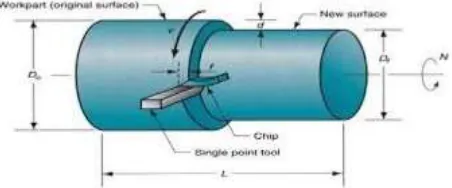
Turning process is a form of machining a material removal process which is used to create rational parts by cutting away unwanted materials. Turning process requires a turning machine or lathe, work piece and cutting tool. The cutter is typically a single point cutting tool that is also secured in the machine although some operations make use of multipoint cutting tool.
Fig-3: Turning Operation
7. METHODOLOGY
There are two types of methods:
Taguchi Analysis
ANOVA (Analysis of Variance)8. TOOL WORK COMBINATION OF CEMENTED CARBIDE AND TUNGSTEN CARBIDE
[image:3.612.199.425.295.389.2]© 2019, IRJET | Impact Factor value: 7.211 | ISO 9001:2008 Certified Journal
| Page 8082
[image:4.612.200.410.253.387.2]The analysis of variance (ANOVA) was used to study the significance and effect of the cutting parameters on the response variables of the various Tool work combinations for Table i.e. Temperature (0C), Hardness (BHN) and Surface Roughness (RA).
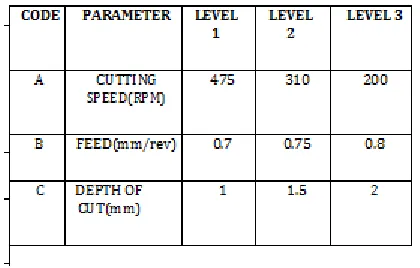
Table 2: Factors and levels for the Response Surface
9.
RESULT AND DISCUSSION
The Taguchi method uses a special design of orthogonal array (OA) in order to study the entire parameter space with a small number of experiments. The full factorial design could require 3 x 3 = 27 experimental runs, which would make the effort and experimental cost prohibitive and unrealistic. However, the experimental design of an OA can be of nine experiments.
Table 3: orthogonal Array Columns of L9 (3^4) array: 1 2 3
Taguchi Array L9(3^3) Factors: 3
Runs: 9
10. TAGUCHI ANALYSIS: RA (EN8-TC) VS CUTTING SPEED, FEED, DEPTH OF CUT
Table 4: Response Table Signal to Noise Ratios
Level CUTTTING SPEED FEED OF CUT DEPTH
© 2019, IRJET | Impact Factor value: 7.211 | ISO 9001:2008 Certified Journal
| Page 8083
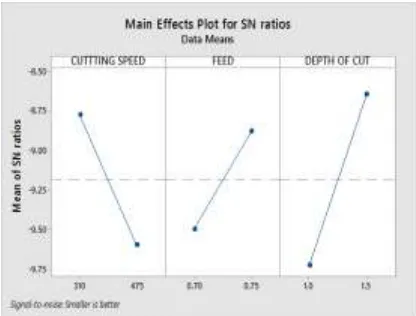
In the main effects plots, if the point is near the average horizontal line has less significant effect and the one which has highest inclination will have most significant effect on the responses. Therefore depth of cut is having the most significant effect on surface roughness.
[image:5.612.210.418.87.245.2]One-way ANOVA: RA (EN8-TC) versus CUTTING SPEED:
Table 5: Response Table for Means
Level CUTTTING SPEED FEED OF CUT DEPTH
1 2.748 3.002 3.075 2 3.034 2.779 2.705 Delta 0.286 0.223 0.370 Rank 2 3 1
© 2019, IRJET | Impact Factor value: 7.211 | ISO 9001:2008 Certified Journal
| Page 8084
One-way ANOVA: RA (EN8-TC) versus FEED:
Source DF Seq SS Contribution Adj SS Adj MS F-Value P-Value
FEED 1 0.04973 18.53% 0.04973 0.04973 0.45 0.570
Error 2 0.21870 81.47% 0.21870 0.10935
Total 3 0.26843 100.00%
One-way ANOVA: RA (EN8- TC) versus DEPTH OF CUT:
Source DF Seq SS Contribution Adj SS Adj MS F-Value P-Value
DEPTH OF CUT 1 0.1369 51.00% 0.1369 0.13690 2.08 0.286
Error 2 0.1315 49.00% 0.1315 0.06576
Total 3 0.2684 100.00%
Results of analysis of variance indicate that feed is the most significant machining parameter followed by depth of cut affecting the surface roughness.
11.
CONCLUSION
Taguchi method was successfully applied in optimizing the temperature, hardness and surface roughness for the chosen best tool-work combination and for the selected domain of the input machining parameters. So the best tool-work combination is EN8-TC. ANOVA analysis was carried out and it is observed that cutting speed is the most significant factor affecting the hardness and surface roughness, closely followed by Feed and depth of cut, while the only significant factor affecting the temperature was found to be the depth of cut. The optimum running condition was found to be at V c (475 rpm), f (0.75 mm/rev) and d (1.5 mm).
REFERENCE
1. Kumar, G., (2013), “Multi Objective Optimization of Cutting and Geometric parameters in turning operation to Reduce Cutting forces and Surface Roughness,” B.Tech. Thesis, Department of Mechanical Engineering, National Institute of Technology, Rourkela.
2. Yang W.H. and Tarng Y.S., (1998), “Design optimization of cutting parameters for turning operations based on Taguchi method,” Journal of Materials Processing Technology, 84(1), pp.112–129.
3. Makadia A.J. and Nanavati J.I., (2013), “Optimisation of machining parameters for turning operations based on response surface methodology,” Measurement, 46(4), pp.1521-1529.
© 2019, IRJET | Impact Factor value: 7.211 | ISO 9001:2008 Certified Journal
| Page 8085
5. Bouacha K., Yallese M.A., Mabrouki T. and Rigal J.F., (2010), “Statistical analysis of surface roughness and cutting forces using response surface methodology in hard turning of AISI 52100 bearing steel with CBN tool,” International Journal of Refractory Metals and Hard Materials, 28(3), pp. 349-361.
6. M.S. Lou, J.C. Chen and C.M. Li, (1999), “Surface roughness prediction technique for CNC end-milling,” Journal of Industrial Technology, 15(1).
7. M.S. Lou and J.C. Chen, (1999), “In process surface roughness recognition system in end-milling operations,” International Journal of Advanced Manufacturing Technology, 15(1), pp. 200–209.
8. Faisal, M.F.B.M., (2008), “Tool Wear Characterization of Carbide Cutting Tool Inserts coated with Titanium Nitride (TiN) in a Single Point Turning Operation of AISI D2 Steel,” B.Tech. Thesis, Department of Manufacturing Engineering, Universiti Teknikal Malaysia Mekala.
9. Sharma V.K., Murtaza Q. and Garg S.K., (2010), “Response Surface Methodology and Taguchi Techniques to Optimization of C.N.C Turning Process,” International Journal of Production Technology, 1(1), pp. 13-31.
10. Montgomery D.C., Design and Analysis of Experiments, 4th ed., Wiley, New York, 1997.
11. Noordin M.Y., Venkatesh V.C., Chan C.L. and Abdullah A., (2001), “Performance evaluation of cemented carbide tools in turning AISI 1010 steel,” Journal of Materials Processing Technology, 116(1), pp. 16–21.
12. Trent, E. and Wright, P. Metal Cutting, 4th ed., Butterworth-Heinemann, Woborn, MA, Chap 2.
13. Dash, S.K., (2012), “Multi Objective Optimization of Cutting Parameters in Turning Operation to Reduce Surface Roughness and Tool Vibration,” B.Tech. thesis, Department of Mechanical Engineering, National Institute of Technology, Rourkela.
14. Halim, M.S.B., (2008), “Tool Wear Characterization of Carbide Cutting Tool Insert in a Single Point Turning Operation of AISI D2 Steel,” B.Tech. thesis, Department of Manufacturing Engineering, Universiti Teknikal Malaysia Mekala.