© 2019, IRJET | Impact Factor value: 7.211 | ISO 9001:2008 Certified Journal
| Page 6386
Comparative Analysis of Aluminium Formwork Building and
Conventional Formwork Building based on Duration by using Line of
Balance (LOB) Technique
VIJAY ANIL SONAWANE
1, HARSHITA AMBRE
21
M.Tech. Student, Dept. of Civil Engineering, SOET, Sandip University, Nashik, Maharashtra, India.
2Assistant Professor, Dept. of Civil Engineering, SOET, Sandip University, Nashik, Maharashtra, India.
---***---Abstract – India is the developing country where rapid development in infrastructure sector is more important. For that purpose using advance construction technique over the old or traditional construction techniques is important. For that purpose use of aluminium formwork by replacing conventional formwork system in the construction of mass housing projects like multi storey buildings, row houses projects etc. Aluminium formwork system not only save the money but also save time and complete project as early as possible. So, the aim of this paper is to prove that aluminium formwork system not only save money but also save lots of time. For that purpose we are going to use line of balance technique to compare aluminium formwork system and conventional formwork system for multi storey building.Key Words: infrastructure, conventional, aluminium, housing, LOB.
1. INTRODUCTION
The construction of formwork takes time and involves expenditure up to 20 to 25% of the cost of the structure or even more. There are many types of formwork like timber formwork, aluminium formwork, tunnel formwork. Aluminium formwork system is use in mass housing projects like multi storey building, row house projects. And will use in develop country like USA, RUSSIA etc. but in developing country like India its use is to rare and generally adopted conventional formwork which is made from woods which not environment friendly as well as not speedy construction technique. So to compare the both formwork system there are many criteria’s like its cost, time, its reuse etc. for comparing this criteria’s there are many techniques like CPM method , life cycle cost calculation, estimation, LOB. Line of balance technique can use to calculate completion time of the given project for both the methods.
1.1 Aluminium formwork
Aluminium formwork is also known as MIVAN formwork system. The Aluminium formwork system was developed by W.J. Malone, a Canadian Engineer in the late 1970’s as a system for constructing low-cost housing units in the developing countries. Aluminium Formwork System is a construction system for forming cast in place concrete structure of a building. It is also a system for scheduling and controlling the work of other construction trades such as steel reinforcement, concrete placement and mechanical and electrical conduits. Its speed of construction is high, good finishing, re-use of this formwork is 250 to 300 times, and scrap value is more. But its initial investment is more and economical only for mass housing projects.
1.2 Convectional formwork
It is traditional formwork which is made up by timber and plywood which is not ecofriendly. It can be used in concreting work like beam, column, slab etc. this is traditional method and in India it is mostly use in all type of construction works. But it is time consuming method, reuse max. 50 times, finishing not good, need plastering, skill labour required, scrap value is also low. Its initial cost is less and only suitable for small construction works.Timber is the most common material used for formwork. The disadvantage with timber formwork is that it will warp, swell and shrink. Application of water impermeable cost to the surface of wood mitigates these defects.
1.3 line of balance technique
© 2019, IRJET | Impact Factor value: 7.211 | ISO 9001:2008 Certified Journal
| Page 6387
1) Determine activity involve in the project and its completion time.2) Prepare a logic diagram which shows different activities such as earthwork, foundation, etc. and its duration.
3) Select a buffer time for each activity against the risk of interference between operations and draw the logic diagram with buffer time.
4) Draw the duration on X-axis and project no. like no. of buildings on Y- axis 5) complete the ‘line of balance’ (LOB) scheduling
After drawing the LOB scheduling for both aluminium formwork and conventional formwork compare both with each other.
3. LOB SCHEDULING
3.1 LOB scheduling for aluminium formwork
Following activities carried out in aluminium formwork EARTHWORK
Site clearance Line out Excavation FOUNDATION
Foundation reinforcement fixing Formwork erection
concreting plinth work plinth filling
SUPER STRUCTURE
wall, column and slab reinforcement fixing- formwork erection
© 2019, IRJET | Impact Factor value: 7.211 | ISO 9001:2008 Certified Journal
| Page 6388
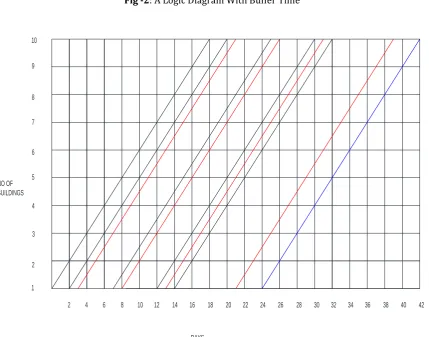
Fig -1: A Logic DiagramFig -2: A Logic Diagram With Buffer Time
Chart -1: Lob Graph For Alu-Form Technology
Table -1: Duration Calculation For Each Activity For Aluform
Activity START OF ACTIVITY(DAY) END OF ACTIVITY(DAY)
Earthwork 1 21
RCC Erection 7 26
Formwork Erection 12 31
Concreting 21 37
Flooring 24 42
2 4 6 8 10 12 14 16 18 20 22 24 26 28 30 32 34 36 38 40 42
1 2 3 4 5 6 7 8 9 10
DAYS NO OF
© 2019, IRJET | Impact Factor value: 7.211 | ISO 9001:2008 Certified Journal
| Page 6389
Following activities carried out in conventional formworkEARTHWORK Site clearance Line out Excavation FOUNDATION
Foundation reinforcement fixing Formwork erection
concreting plinth work plinth filling
SUPER STRUCTURE
column reinforcement fixing , formwork erection and concreting beam and slab reinforcement fixing , formwork erection and concreting wall brickwork
Curing & DE shuttering after FINISHING
Flooring
External and internal Plastering Wall putty
Coloring
Fig -3: A Logic Diagram
© 2019, IRJET | Impact Factor value: 7.211 | ISO 9001:2008 Certified Journal
| Page 6390
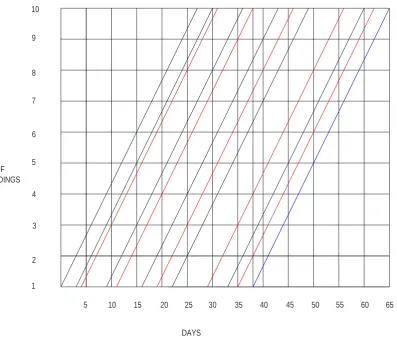
Chart -2: LOB Graph For Conventional Formwork TechnologyTable -2: Duration Calculation For Each Activity For Conventional Formwork
ACTIVITY START OF ACTIVITY(DAY) END OF ACTIVITY(DAY)
Earthwork 1 31
Plinth And Foundation Work 9 38
Brickwork 16 46
Slab 24 56
Plastering 33 62
[image:5.595.55.540.539.628.2]Flooring 36 65
Table -3: Duration Comparison Between Aluform And Conventional Formwork
No. of buildings to be
constructed Completion time in days
Aluminium formwork 10 42 days
Conventional formwork 10 65 days
5 10 15 20 25 30 35 40 45 50 55 60
1 2 3 4 5 6 7 8 9 10
DAYS NO OF
BUILDINGS
© 2019, IRJET | Impact Factor value: 7.211 | ISO 9001:2008 Certified Journal
| Page 6391
Formwork system plays a very important role in successful and timely completion of construction project. From the above comparative analysis it’s clear that, Aluminium formwork is not only Cost effective but also time saving technology in comparison with Conventional Formwork. Aluminium formwork is better for use in the constructions, where Time saving formwork is necessary, than Conventional Formwork (specially mass housing projects). It can be useful in the developing country like India where repetitive type of mass housing projects is constructed.So, from above table we identify that aluminium formwork complete the 10 houses project in 42 days and conventional formwork takes about 65 days. From above analysis it’s clear that use of aluminium formwork is more time saving than the conventional formwork system.
REFERENCES
[1] Raymond W. W. M.,“Application of formwork for high rise and complex building structures- Hongkong cases”, Division of building science & technology, city university of Hongkong, pp 446-451.
[2] A. D. Kulkarni, D. D. Sarode, Supriya Sarode; “Innovative Formwork Systems For Mass Housing Projects”, paper presentation on ‘Construction Management: Latest Trends and Developments’ held at C. M. E. Pune (March 2004), pp. 41-49.
[3] Y.B. Sangale, Prof. R.V. Devalkar “Construction cost Comparison between Conventional and Industrialised Building System in Nashik”, International Journal of Modern Trends in Engineering and Research, 720 -725,2014
[4] Prathul U1 , 2Leeladhar Pammar 1PG student, 2 Assistant Professor 1, 2Department of Civil Engineering, NMAMIT, Nitte “Analysis of Productivity by Comparing Mivan and Conventional Formwork“
[5] Ganar A.S, Patil S.D “Comparative analysis on cost and duration of MIVAN formworkbuilding and Conventional Formwork building”, International Journal on Recent and Innovation Trends in Computing and Communication, Vol.3 Issue 12
[6] N. Tarun and N. Lokeshwaran , A Case Study on Assessing Energy Efficiency of Existing Residential Building and Recommendations Ensuring Green Efficiency in Building Construction Projects . International Journal of Civil Engineering and Technology, 8(3), 2017, pp. 921–927.
[7] M. Dulaimi, “The challenge of innovation in construction” Bulding research and information pp. 106-109 [8] Tejas D. Aradhye1 , Emeritus M. R. Apte2“STUDY OF ADVANCED TUNNEL FORMWORK SYSTEM IN
HIGH RISE BUILDING”IJRET: International Journal of Research in Engineering and Technology eISSN: 2319-1163 | pISSN: 2321-7308
BIOGRAPHIES
NAME: VIJAY ANIL SONAWANE Education: Diploma, BE, M.Tech (construction management)