
Creating and Validating Multilingual Semantic Representations for Six
Languages: Expert versus Non-Expert Crowds
Mahmoud El-Haj, Paul Rayson, Scott Piao and Stephen Wattam School of Computing and Communications, Lancaster University, Lancaster, UK
Abstract
Creating high-quality wide-coverage mul-tilingual semantic lexicons to support knowledge-based approaches is a chal-lenging time-consuming manual task. This has traditionally been performed by linguistic experts: a slow and expensive process. We present an experiment in which we adapt and evaluate crowdsourc-ing methods employcrowdsourc-ing native speakers to generate a list of coarse-grained senses un-der a common multilingual semantic tax-onomy for sets of words in six languages. 451 non-experts (including 427 Mechan-ical Turk workers) and 15 expert partic-ipants semantically annotated 250 words manually for Arabic, Chinese, English, Italian, Portuguese and Urdu lexicons. In order to avoid erroneous (spam) crowd-sourced results, we used a novel task-specific two-phase filtering process where users were asked to identify synonyms in the target language, and remove erroneous senses.
1 Introduction
Machine understanding of the meaning of words, phrases, sentences and documents has challenged computational linguists since the 1950s, and much progress has been made at multiple levels. Differ-ent types of semantic annotation have been devel-oped, such as word sense disambiguation, seman-tic role labelling, named entity recognition, senti-ment analysis and content analysis. Common to all of these tasks, in the supervised setting, is the requirement for a wide coverage semantic lexicon acting as a knowledge base from which to select or derive potential word or phrase level sense an-notations.
The creation of large-scale semantic lexical re-sources is a time-consuming and difficult task. For new languages, regional varieties, dialects, or do-mains the task will need to be repeated and then revised over time as word meanings evolve. In this paper, we report on work in which we adapt crowdsourcing techniques to speed up the creation of new semantic lexical resources. We evaluate how efficient the approach is, and how robust the semantic representation is across six languages.
The task that we focus on here is a particularly challenging one. Given a word, each annotator must decide on its meaning[s] and assign the word to single or multiple tags in a pre-existing seman-tic taxonomy. This task is similar to that under-taken by trained lexicographers during the process of writing or updating dictionary entries. Even for experts, this is a complex task. Kilgarriff (1997) highlighted a number of issues related to lexicog-raphers ‘lumping’ or ‘splitting’ senses of a word and cautioned that even lexicographers do not be-lieve in words having a “discrete, non-overlapping set of senses”. V´eronis (2001) showed that inter-annotator agreement is very low in sense tagging using a traditional dictionary. For our purpose, we
use the USAS taxonomy.1 If a linguist were
un-dertaking this task, as they have done in the past with Finnish (L¨ofberg et al., 2005) and Russian (Mudraya et al., 2006) USAS taxonomies, they would first spend some time learning the seman-tic taxonomy. In this experimental scenario, we aim to investigate whether or not non-expert na-tive speakers can succeed on the word-to-senses classification task without being trained on the tax-onomy in advance, therefore mitigating a signifi-cant overhead for the work. In addition, further motivation for our experiments is to validate the applicability of the USAS taxonomy (Rayson et 1The UCREL Semantic Analysis System (USAS), see
http://ucrel.lancaster.ac.uk/usas/
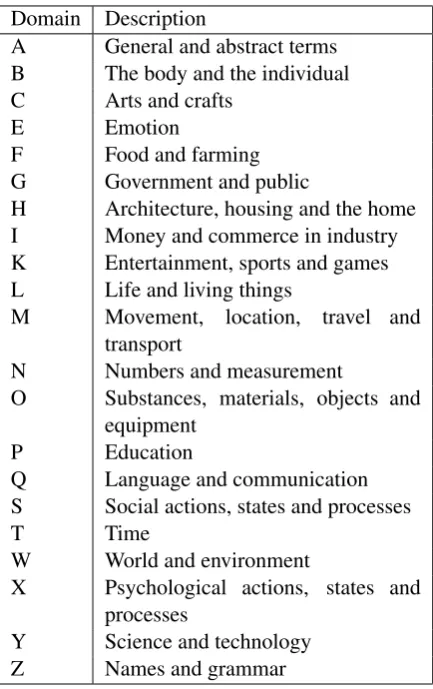
al., 2004), with a non-expert crowd, as a frame-work for multilingual sense representation. The USAS taxonomy was selected for this experiment since it offers a manageable coarse-grained set of categories that have already been applied to a number of languages. This taxonomy is distinct from other potential choices, such as WordNet. The USAS tagset is originally loosely based on the Longman Lexicon of Contemporary English (McArthur, 1981) and has a hierarchical structure with 21 major domains (see table 1) subdividing into three levels. Versions of the USAS tagger or tagset exist in 15 languages in total and for each language, native speakers have re-evaluated the applicability of the tagset with some specific extensions for Chinese (Qian and Piao, 2009) but otherwise the tagset is stable across all languages. For each language tagger, separate linguistic re-sources (lexicons) have been created, but they all use the same taxonomy.
Domain Description
A General and abstract terms
B The body and the individual
C Arts and crafts
E Emotion
F Food and farming
G Government and public
H Architecture, housing and the home
I Money and commerce in industry
K Entertainment, sports and games
L Life and living things
M Movement, location, travel and
transport
N Numbers and measurement
O Substances, materials, objects and
equipment
P Education
Q Language and communication
S Social actions, states and processes
T Time
W World and environment
X Psychological actions, states and
processes
Y Science and technology
[image:2.595.73.290.346.691.2]Z Names and grammar
Table 1: USAS top level semantic fields
In terms of main contributions, our research goes beyond the previous work on crowdsourc-ing word meancrowdsourc-ings which requires workers to pick
a word sense from an existing list that matches provided contextual examples, such as a concor-dance list. In our work, we require the partici-pants to define the list of all possible senses that a word could take in different contexts. We also see that our two-stage filtering process tailored for this task helps to improve results. We compare inter-rater scores for two groups of experts and non-experts to examine the feasibility of extracting high-quality semantic lexicons via the untrained crowd. Non-experts achieved results between 45-97% for accuracy, between 48-92% for complete-ness, with an average of 18% of tasks having er-roneous senses being left in. Experts scored 64-96% for accuracy, 72-95% for completeness, but achieve better results in terms of only 1% of erro-neous senses left behind. Our experimental results show that the non-expert crowdsourced annotation process is of a good quality and comparable to that of expert linguists in some cases, although there are variations across different languages. Crowd-sourcing provides a promising approach for the speedy generation and expansion of semantic lex-icons on a large scale. It also allows us to validate the semantic representations embedded in our tax-onomy in the multilingual setting.
2 Related Work
shown (Aker et al., 2012) that the use of radio but-ton design seems to lead to better results compared to the free text design. Particularly important in our case is the language demographics of MTurk (Pavlick et al., 2014), since we need to find enough native speakers in a number of languages.
There is a growing body of crowdsourcing work related to semantic annotation. Snow et al. (2008) applied MTurk to the Word Sense Disambiguation (WSD) task and achieved 100% precision with simple majority voting for the correct sense of the word ‘president’ in 177 example sentences. Rumshisky et al. (2012) derived a sense inven-tory and sense-annotated corpus from MTurkers comparison of senses in pairs of example sen-tences. They used clustering methods to iden-tify the strength of coders’ tags, something that is poorly suited to rejecting work from spammers (participants who try to cheat the system with scripts or random answers) and would likely not transfer well to our experiment.
Akkaya et al. (2010) also performed WSD us-ing MTurk workers. They discuss a number of methods for ensuring quality, accountability, and consistency using 9 tasks per word and simple ma-jority voting. Kapelner et al. (2012) increased the scale to 1,000 words for the WSD task and found that workers repeating the task do not learn with-out feedback. A set-based agreement metric was used by Passonneau et al. (2006) to assess the validity of polysemous selections of word senses from WordNet categories. Their objective was to take into account similarity between items within a set, however, this may not be desirable in our case due to the limited depth of the USAS taxonomy.
Directly related to our research here are the experiments reported in Piao et al. (2015). A set of prototype semantic lexicons were auto-matically generated by transferring semantic tags from the existing USAS English semantic lex-icon entries to their translation equivalents in Italian, Chinese and Portuguese via dictionaries and bilingual lexicons. While some dictionar-ies involved, including Chinese/English and Por-tuguese/English dictionaries, provided high qual-ity lexical translations for core vocabularies of these languages, the bilingual lexicons, including FreeLang English/Italian, English/Portuguese
lex-icons2 and LDC English/Chinese word list,
con-tain erroneous and inaccurate translations. To re-2http://www.freelang.net/dictionary/
duce the error rate, some manual cleaning was car-ried out, particularly on the English-Italian bilin-gual lexicons. Because of the substantial amount of time needed for such manual work, the rest of the lexical resources were used with only minor sporadic manual checking. Due to the noise intro-duced from the bilingual lexicons, as well as the ambiguous nature of the translation, the automati-cally generated semantic lexicons for the three lan-guages contain errors, including erroneous seman-tic tags caused by incorrect translations, and inac-curate semantic tags caused by ambiguous trans-lations. When these automatically generated lexi-cons were integrated and applied in the USAS se-mantic tagger, the tagger suffered from error rates of 23.51%, 12.31% and 10.28% for Italian, Chi-nese and Portuguese respectively.
The improvement of the semantic lexicons is therefore an urgent and challenging task, and we hypothesise that the crowdsourcing approach can potentially provide an effective means for address-ing this issue on a large scale, while at the same time allowing us to further validate the representa-tion of word senses in the USAS sense inventory (i.e. the semantic tagset) for these languages.
3 Semantic Labeling Experiment
We test the wisdom of the crowd in building lexicons and applying the same multilingual se-mantic representation in six languages: Arabic, Chinese, English, Italian, Portuguese and Urdu. These languages were selected to provide a range of language families, inflectional and derivational morphology, while covering significant number of speakers worldwide. For each language, we ran-domly selected 250 words. All experiments pre-sented here use the USAS taxonomy to describe
semantic categories3(Rayson et al., 2004).
3.1 Gold Standard Semantic Tags
To prepare gold standard data we asked a group of linguists (up to two per language) to manu-ally check 250 randomly selected words for each of the six languages, starting from the data pro-vided by Piao et al. (2015). For additional lan-guages (those not in Piao et al. (2015)), the Arabic and Urdu gold standards were completed manu-ally by native speaker linguists who translated the 250 words, and we instructed the translators to opt for the most familiar Arabic or Urdu equivalents
of the English words. This was further confirmed by checking the list of words by two other Arabic and Urdu native speakers. Here the base form of verbs in Arabic is taken to be the present simple form of the verb in the interest of convenience and because there is no part of speech tag for ‘present tense of a lexical verb’. Hence, the three-letter past tense verbs are tagged as ‘past form of lex-ical verb’, rather than as base forms. Also, while present and past participles (e.g., ‘interesting’, ‘in-terested’) are tagged as adjectives in English, these are labeled in Arabic as nouns in stand-alone po-sitions but they can also function as adjective pre-modifying nouns. Linguists then used the USAS semantic tagset to semantically label each word with the most suitable senses.
3.2 Non-expert Participants
Non-expert participants are defined as those who are not familiar with the USAS taxonomy in ad-vance of the experiment. We selected Amazon’s
Mechanical Turk4 – an online marketplace for
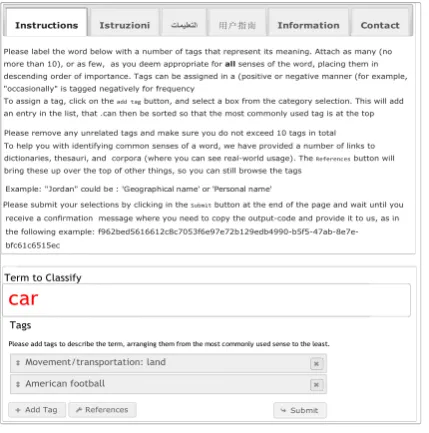
[image:4.595.308.523.434.651.2]work that requires human intelligence – and pub-lished “Human Intelligence Tasks” (HITs) for En-glish, Chinese and Portuguese only. For Ara-bic, Italian, and Urdu initial experiments using MTurk showed that not enough native speakers are available to complete the tasks. Therefore, we employed 12 non-expert participants directly with four native speakers for each of the three lan-guages. All participants used the same interface (Figure 1).
On MTurk, we paid workers an average of 7 US dollars per hour. We paid Portuguese workers 50% more to try and attract more participants due to the lack of Portuguese native speakers on MTurk. We paid the other directly contacted participants an average of 8 British pounds per hour. Those
payments were made using Amazon5 and Apple
iTunes6vouchers.
3.3 Expert Participants
Expert participants are defined as those who were already familiar with the USAS taxonomy before the experiments took place. For four languages (Arabic, English, Chinese and Urdu) we asked a total of 15 participants (3 for English and 4 for the other languages) to carry out the same task as
4http://www.mturk.com 5https://www.amazon.co.uk 6http://www.apple.com
the non-experts. All expert and non-expert partici-pants (whether MTurk workers or direct-contact) used the same user interface (Figure 1) as de-scribed in section 3.5.
3.4 Experimental Design
Obtaining reliable results from the crowd remains a challenging task (Kazai et al., 2009), which requires a careful experimental design and pre-selection of crowdsourcers. In our experiments, we worked on minimising the effort required by participants through designing a user-friendly
in-terface.7 Aside from copying the final output code
to a text-box everything else is done using mouse clicks. Poorly designed experiments can nega-tively affect the quality of the results conducted by MTurk workers (Downs et al., 2010; Welinder et al., 2010; Kazai, 2011).
Feedback from a short sample run with local testers helped us update the interface and provide more information to make the task efficient. Fig-ure 1 shows a sample task for the word ‘car’. The majority of the testers were able to complete the task within five minutes. In response to feedback by some of the testers we provided the “Instruc-tions” section in the six languages under consider-ation.
Term to Classify
car
Tags
Please add tags to describe the term, arranging them from the most commonly used sense to the least. Please label the word below with a number of tags that represent its meaning. Attach as many (no more than 10), or as few, as you deem appropriate for all senses of the word, placing them in descending order ofimportance. Tags can be assigned in a(positive or negative manner (for example,
"occasionally" is tagged negatively for frequency
To assign a tag, click on the add tag button, and select a box from the category selection. This will add an entry in the list, that.can then be sorted so that the most commonly used tag is at the top Please remove any unrelated tags and make sure you do not exceed 10 tags in total To help you with identifying common senses of a word, we have provided a number of links to dictionaries, thesauri, and corpora (where you can see realworld usage). The References button will
bring these up over thetop of other things, so you canstill browse the tags Example: "Jordan" could be : 'Geographical name' or 'Personal name'
Please submit your selections by clicking in the Submit button at the end of the page and wait until you receive a confirmationmessage where you need to copy the outputcode and provide it to us, as in
the followingexample: f962bed5616612c8c7053f6e97e72b129edb4990-b5f5-47ab-8e7e-bfc61c6515ec
Instructions Istruzioni ﺕﺎﻣﻳﻠﻌﺗﻟﺍ 用户指南 Information Contact
Movement/transportation: land American football
Submit Add Tag References
Figure 1: Sample Task for the word “Car”
3.5 Online Semantic Labeling
As shown in Figure 1, we asked the participants to label each word presented to them with a number 7Our underlying code is freely available on GitHub at
References
Click on any of the following links for more information about the word: happy
dictionary.com
thesaurus.com
British National Corpus
[image:5.595.73.244.61.204.2]hide
Figure 2: Dictionary and Thesauri References
of tags that represent the word’s possible mean-ings. The participants were asked to attach as many, or as few, as they deemed appropriate for all senses of the word, placing them in descending order of likelihood.
To assign a tag, the participants click on the
Add Tagbutton, and navigate to a box from the
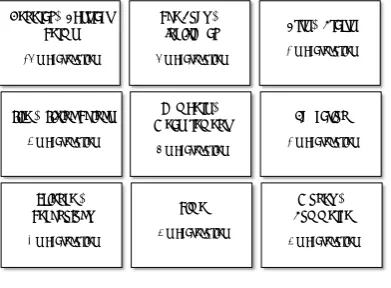
category selection where they can select a subcat-egory (Figures 3 and 4). By following these steps the participants add an entry in the list, that can then be sorted by dragging and dropping the se-lected tags so that the most commonly used tag is at the top. We asked the users to remove any un-related tags and make sure they do not exceed 10 tags in total.
General & Abstract
Terms
15 subcategories
The Body &
Individual
5 subcategories
Arts & Crafts
1 subcategories
Life & Living Things
3 subcategories
Numbers &
Measurement
6 subcategories
Education
1 subcategories
Science & Technology
2 subcategories
Time
4 subcategories
Money & Commerce
[image:5.595.308.505.62.205.2]4 subcategories
Figure 3: Categories
To help them when identifying common senses of a given word, we provided a number of links to dictionaries, thesauri, and corpora (where they can see real-world usage) for each language. The Ref-erences are displayed alongside the interface, so they can still browse the tags (Figure 2). Partici-pants are free to use other resources as they see fit. The participants then needed to submit their
selec-tions by clicking theSubmitbutton at the end of
Anatomy and physiology
Terms relating to the (human) body and bodily processes
Health and disease
Terms relating to the (state of the) physical condition
ClRWKHV and personal
EHORQJLQJV
Terms relating to FORWKHV DQGother personal EHORQJLQJV
Cleaning and personal care
Terms relating to domestic/personal hygiene
+ Select ‒ Select + Select ‒ Select
+ Select ‒ Select + Select ‒ Select
Figure 4: Subcategories
the page and wait until they receive a confirmation message where they need to copy the output-code and provide it to us.
For each word we targeted a total of four non-expert participants and four non-expert participants to allow measurement and comparison of the agree-ment within each group to investigate the variabil-ity of task results and participants, rather than to take a simple weighted combination to produce an agreed list.
3.6 Filtering
Even though crowdsourcing has been shown to be effective in achieving expert quality for a va-riety of NLP tasks (Snow et al., 2008; Callison-Burch, 2009), we still needed to filter out work-ers who were not taking the task seriously or were attempting to manipulate the system for personal gain (spamming).
In order to avoid these spamming crowdsourced results, we designed a novel task-specific two stage filtering process that we considered more suitable for this type of task than previous filtering approaches. Our two stage process encompasses filters that are appropriate for experts and non-experts, and is applicable whether participants are using MTurk or not.
[image:5.595.74.270.467.611.2]non-expert participants were directly contacted and we knew that they were native speakers and would not submit random results. The synonyms were vali-dated by linguists in each of the three languages and choices were randomly shuffled before be-ing presented to the workers. Stage one filterbe-ing removed 12% of English HITS, 2% of Chinese, and 6% of the Portuguese submissions. In our re-sults presented below, we only considered tasks by workers who chose the correct synonyms and re-jected the others.
For the stage two filter, we injected random er-roneous senses for each of the 250 words into the initial list of tags and the participants were ex-pected to remove these in order to pass. We de-liberately injected wrong and unrelated semantic tags in between ‘potentially’ correct ones before shuffling the order of the tags. For example, ex-amining the pre-selected tags for the word ‘car’ in Figure 1 we can see that the semantic tag ‘Ameri-can Football’ is unrelated to the word ‘car’ and in fact does not exist in the USAS semantic taxon-omy. The potentially correct tag such as ‘Move-ment/transportation: land’ does exist in the se-mantic lexicon. Results where participants fail to pass stage two are still retained in the experiment and we report on the usefulness of this filter in section 4. All participants (MTurk workers and directly-contacted; experts and non-experts) un-dertook stage 2 filtering. Our experimental design did not reveal to the participants any details of the two stage filtering process.
4 Results and Discussion
To evaluate the results8 we adopted three main
metrics (inspired by those used in the SemEval procedures): Accuracy, Completeness, and Corre-lation.
Accuracy: measure the accuracy of the
partic-ipant’s selection of tags (WT ags) by counting the
matching tags between the worker’s selection and
the gold standards (GT ags). To compute
Accu-racy we divide the number of matching tags by the number of tags selected by the participants.
Accuracy= WT agsW∩GT ags
T ags
Completeness: measure the completeness of the
participant’s selection of tags (WT ags) by finding
8All expert and non-expert results are available as
CSV files on https://github.com/UCREL/Multilingual-USAS/tree/master/papers/eacl2017 sense workshop
whether the gold standard tags (GT ags) are
com-pletely or partially contained within the worker’s selection. To compute Completeness we divide the number of matching tags by the number of gold standard tags.
Completeness= WT agsG∩GT ags
T ags
Correlation: To test the similarity of tag selec-tion between workers and gold standards we used Spearman’s rank correlation coefficient.
In addition to the three metrics mentioned above we used three factors that work as indicators of the quality of the tagging process:
• Strict: Whether worker’s tags are identical to the gold standard (same tags in the same or-der);
• First Tag Correct: Whether the first tag se-lected by the worker matches the first tag in the gold standard;
• Fuzzy: Whether tags selected by a worker are contained within the gold standard tags (in any order).
For each language we asked for up to four an-notators per word (1,000 HITs per language). For
Portuguese, where the participants wereall from
MTurk, we only received 694 HITs even though we paid participants working on Portuguese 50% more than we paid for the English tasks.
Table 29 shows the aggregate averages of the
non-expert HITs. In total, direct-contact partic-ipants and MTurk workers performed well and achieved comparable results to the gold standard in places. Around 50% of the English, Chinese, Urdu, and Portuguese HITs had the correct tags se-lected with around 15% being identical to the gold standards. In nearly all of the cases, Portuguese workers chose the correct tags although they were in a different order than the gold standard. Arabic participants achieved a high completeness score relative to the gold standard tags, but a close anal-ysis of the results show the participants have sug-gested more tags than the gold standards.
The results for English suggest that the non-expert workers are consistent as can be observed 9For this and the following tables, we use: Acc: Accuracy,
Lang Acc Com Cor Err Str 1st Fuz
En 61.4 69.3 0.38 29% 16% 65% 38%
Ar 55.5 87.1 0.35 8% 8% 55% 19%
Zh 45.2 56.1 0.22 2% 15% 46% 27%
It 45.7 47.9 0.06 31% 7% 38% 22%
Pt 58.5 56.3 0.21 18% 19% 50% 94%
Ur 97.6 91.9 0.51 1% 53% 78% 95%
Table 2: Summary of performance [Non experts]
by looking at the Accuracy (Acc) and Complete-ness (Com) results. Spearman’s correlation (Cor) suggests that the workers correlate with the expert gold standard tags, which is consistent with previ-ous findings that MTurk is effective for a variety of NLP tasks through achieving expert quality (Snow et al., 2008; Callison-Burch, 2009). The majority of the workers matched the first tag correctly (1st) by ordering the tags so the most important (core sense) tag appeared at the top of their selection. The erroneous tags (Err) column shows that many workers did not remove some of the deliberately-wrong tags (see Section 3.5). This reflects the lack of training of the workers, but our checking of the results showed that the erroneous tags were not se-lected as first choice. Strict (Str) and Fuzzy (Fuz) show that many workers were consistent with the gold standard tags in terms of both tag selection and order. It is worth mentioning that languages differ in terms of ambiguity (e.g. Urdu is less am-biguous than Arabic) which can be observed in the differences between language results.
As mentioned earlier, we did not use MTurk for the Arabic lexicon, due to the lack of Arabic na-tives speakers on MTurk. Instead, we found four student volunteers who offered to help in seman-tically tagging the words, again without any train-ing on the tagset. The results show consistent ac-curacy and completeness. It is worth noting that the Arabic participants obtained higher accuracy and completeness scores by having higher agree-ment with the gold standard tags. The Arabic lan-guage participants selected fewer erroneous tags than the English ones. The majority of the par-ticipants got the first tag correct. Arabic partici-pants failed to match the order of tags in the gold standards as reflected by lower correlation. This is expected due to the fact that Arabic is highly inflectional and derivational, which increases am-biguity and presents a challenge to the interpreta-tion of the words (El-Haj et al., 2014). Difficulties
in knowing the exact sense of an out of context Arabic word could result in disagreement when it comes to ordering the senses (see Section 3.1).
For the Chinese language, the result table shows that there is a slightly lower correlation between the non-expert workers’ tags and the gold stan-dards. Observing the erroneous results column we can see that the workers have made very few mis-takes and deleted the random unrelated tags. The Strict and Fuzzy scores suggest the results to be of high quality. The participants managed to get the first tag correct in many cases.
For the Italian language, we sourced four non-expert undergrad student participants who are all native Italian speakers but not familiar with the tagset. The participants’ results do not correlate well with the gold standards. As the tags descrip-tion are all in English the annotators found it diffi-cult to correctly select the senses and had to trans-late some tags into Italian which could have re-sulted in shifting the meaning of those tags, to communicate with them we had an Italian/English bilingual linguist as a mediator.
As with Arabic and Italian, for the Urdu lan-guage we sourced four non-expert participants who are all native Urdu speakers but not familiar with the tagset. Urdu results show that participants correlate well with the gold standards. We also notice a lower percentage of erroneous tags than other languages. The First Tag and Fuzzy scores suggest the results to be of high quality. The par-ticipants also managed to get the first tag correct in many cases. The participants all agreed it was easy to define word senses with the words being less ambiguous compared to other languages. This is shown in the high results achieved when compared to non-experts of the other languages.
We received only 694 HITs for Portuguese tasks on MTurk, which suggests there are fewer Por-tuguese speakers compared to English and Chi-nese speakers among the MTurk workers. The results for Portuguese in some cases are of very high quality. It should be noted that the gold stan-dard tags were selected and manually checked by a Brazilian Portuguese native speaker expert. There is a difference between European and Brazil-ian Portuguese which could result in ambiguous words for speakers from the two regions (Frota and Vig´ario, 2001).
Lang Acc Com Cor
En 70.4 69.0 0.36
Ar 56.6 87.6 0.34
Zh 45.6 55.9 0.22
It 54.4 53.5 0.09
Pt 61.3 54.0 0.20
[image:8.595.117.246.61.163.2]Ur 97.6 91.9 0.51
Table 3: Summary of performance with Second Filter [Non experts]
random erroneous tags were not completely re-moved. This enables us to increase accuracy for English by 9.0%, Italian by 8.7% and Portuguese by 2.8% without negatively affecting complete-ness or correlation.
In order to allow better interpretation of the non-experts’ scores, we repeated the experiments on a smaller scale with up to four experts per lan-guage (English, Arabic, Chinese and Urdu), who were already familiar with the USAS taxonomy and were researchers in the fields of corpus or computational linguistics. Experts used the same task interface to assign senses to 50 words each. The results are presented in Table 4. Most notably, experts consistently excel at removing erroneous tags, leaving only a very small number in the data. English experts performed much better than English non-experts on completeness, correlation and strict measures while their accuracy scores are comparable. Arabic experts performed much bet-ter than Arabic non-experts on the accuracy, strict and fuzzy scores while the 1st score is compa-rable. Chinese experts performed slightly better than Chinese non-experts on Accuracy, complete-ness and Fuzzy while other scores were compa-rable. Urdu experts scored relatively more highly on strict and 1st measures while other scores were comparable to Urdu non-experts. Finally, Tables 5 and 6 show the Observed Agreement (OA), Fleiss’ Kappa and Krippendorff’s alpha scores for the inter-rater agreement between Expert and Non Ex-pert participants. According to (Landis and Koch, 1977) our inter-rater scores show fair agreement between annotators. This serves to illustrate the task is complex even for experts.
Overall these results show that untrained crowd-sourcing workers can produce results that are com-parable to those of experts when performing se-mantic annotation tasks. Directly-contacted and MTurk workers achieved similar levels of results
[image:8.595.309.525.164.338.2]Lang Acc Com Cor Err Str 1st Fuz En 66.1 83 0.61 1% 31% 75% 40% Ar 78.8 72.4 0.22 1% 39% 51% 73% Zh 50.4 60.2 0.21 1% 15% 44% 31% Ur 96.2 94.8 0.69 1% 63% 89% 93%
Table 4: Summary of performance [Experts]
Language Measure OA Fleiss K–alpha English First Tag 0.82 0.46 0.46 Fuzzy 0.64 0.27 0.27 Strict 0.69 0.32 0.32 Arabic First Tag 0.77 0.55 0.55 Fuzzy 0.84 0.59 0.59 Strict 0.21 0.55 0.55 Chinese First Tag 0.62 0.23 0.24 Fuzzy 0.75 0.41 0.41 Strict 0.83 0.31 0.32 Urdu First Tag 0.83 0.10 0.10 Fuzzy 0.91 0.35 0.35 Strict 0.71 0.37 0.38
Table 5: Total Inter-rater agreement [Experts].
overall. This shows that the novel two-phase fil-tering method used in our experiment is effective for maintaining the quality of the results.
5 Conclusion and Future Work
Language Measure OA Fleiss K–alpha English First Tag 0.71 0.36 0.36 Fuzzy 0.58 0.11 0.11 Strict 0.79 0.20 0.20 Arabic First Tag 0.66 0.32 0.32 Fuzzy 0.71 0.05 0.05 Strict 0.86 0.03 0.03 Chinese First Tag 0.73 0.45 0.45 Fuzzy 0.74 0.38 0.38 Strict 0.85 0.41 0.41 Italian First Tag 0.67 0.31 0.31 Fuzzy 0.67 0.03 0.03 Strict 0.89 0.12 0.13 Portuguese First Tag 0.64 0.22 0.22 Fuzzy 0.63 0.13 0.13 Strict 0.80 0.18 0.18 Urdu First Tag 0.72 0.16 0.16 Fuzzy 0.95 0.45 0.45 Strict 0.74 0.49 0.49
Table 6: Total Inter-rater agreement [Non Ex-perts].
classification task of putting a word into one of an existing list of senses, instead asking partici-pants to list all possible senses that a word could take in different contexts. Thirdly, we have de-ployed a novel two-stage filtering approach which has been shown to improve the quality of our re-sults by filtering out spam responses using a sim-ple synonym recognition task as well as HITs re-moving random erroneous tags. Our experiment suggests that the crowdsourcing process can pro-duce results of good quality and is comparable to the work done by expert linguists. We showed that it is possible for native speakers to apply the hier-archical semantic taxonomy without prior training by the application of a graphical browsing inter-face to assist selection and annotation process.
In the future, we will apply the method on a larger scale to the full semantic lexicons includ-ing multiword expressions, which are important for contextual semantic disambiguation. We will also investigate whether adaptations to our method are required to include more languages such as Czech, Malay and Spanish. In order to pursue the work beyond the existing languages in the USAS system, we will extend bootstrapping methods re-ported in Piao et al. (2015) with vector-based tech-niques and evaluate their appropriateness for mul-tiple languages. Finally, we will test whether (a) provision of words in context through
concor-dances, (b) prototypical examples for each seman-tic tag, or (c) semanseman-tic tag labels in the same lan-guage as the task word, as part of the resources available to participants would further enhance the accuracy of the crowdsourcing annotation process.
Acknowledgements
The crowdsourcing framework and interface was originally produced in an EPSRC Impact Accel-eration Award at Lancaster University in 2013. This work has also been supported by the UK ESRC/AHRC-funded CorCenCC (The Na-tional Corpus of Contemporary Welsh) Project (ref. ES/M011348/1), the ESRC-funded Centre for Corpus Approaches to Social Science (ref. ES/K002155/1), and by the UCREL research cen-tre, Lancaster University, UK via Wmatrix soft-ware licence fees. We would also like to ex-press our thanks to the many expert and non-expert participants who were also involved in the ex-periments including: Dawn Archer (Manchester Metropolitan University, UK), Francesca Bianchi (Universita del Salento, Italy), Carmen Dayrell (Lancaster University, UK), Xiaopeng Hu (China Center for Information Industry Development, CCID, China), Olga Mudraya (Right Word Up, UK), Sheryl Prentice (Lancaster University, UK), Yuan Qi (China Center for Information Industry Development, CCID, China), Jawad Shafi (COM-SATS Institute of Information technology, Pak-istan), and May Wong (University of Hong Kong, Hong Kong, China).
References
Ahmet Aker, Mahmoud El-Haj, Udo Kruschwitz, and M-Dyaa Albakour. 2012. Assessing
Crowdsourc-ing Quality through Objective Tasks. In 8th
Lan-guage Resources and Evaluation Conference, Istan-bul, Turkey. LREC 2012.
Cem Akkaya, Alexander Conrad, Janyce Wiebe, and Rada Mihalcea. 2010. Amazon mechanical turk
for subjectivity word sense disambiguation. In
Pro-ceedings of the NAACL HLT 2010 Workshop on Creating Speech and Language Data with Ama-zon’s Mechanical Turk, pages 195–203, Los Ange-les, USA. Association for Computational Linguis-tics.
Omar Alonso and Stefano Mizzaro. 2009. Can we get rid of TREC Assessors? Using Mechanical Turk for
Relevance Assessment. InSIGIR ’09: Workshop on
[image:9.595.75.289.60.312.2]Vikas Bhardwaj, Rebecca J. Passonneau, Ansaf Salleb-Aouissi, and Nancy Ide. 2010. Anveshan: A frame-work for analysis of multiple annotators’ labeling
behavior. In Proceedings of the Fourth Linguistic
Annotation Workshop, LAW IV ’10, pages 47–55, Stroudsburg, PA, USA. Association for Computa-tional Linguistics.
Chris Callison-Burch. 2009. Fast, Cheap, and Cre-ative: Evaluating Translation Quality Using
Ama-zon’s Mechanical Turk. InProceedings of the 2009
Conference on Empirical Methods in Natural Lan-guage Processing (EMNLP), pages 286–295, Singa-pore. Association for Computational Linguistics.
Pinar Donmez, Jaime G. Carbonell, and Jeff Schneider. 2009. Efficiently learning the accuracy of labeling
sources for selective sampling. In Proceedings of
the 15th ACM SIGKDD International Conference on Knowledge Discovery and Data Mining, KDD ’09, pages 259–268, New York, NY, USA. ACM.
Julie S. Downs, Mandy B. Holbrook, Steve Sheng, and Lorrie Faith Cranor. 2010. Are your partic-ipants gaming the system?: Screening mechanical
turk workers. InProceedings of the SIGCHI
Con-ference on Human Factors in Computing Systems, CHI ’10, pages 2399–2402, New York, NY, USA. ACM.
Mahmoud El-Haj, Udo Kruschwitz, and Chris Fox. 2010. Using Mechanical Turk to Create a
Cor-pus of Arabic Summaries. InLanguage Resources
(LRs) and Human Language Technologies (HLT) for Semitic Languages workshop held in conjunction with the 7th International Language Resources and Evaluation Conference (LREC 2010)., pages 36–39, Valletta, Malta. LREC 2010.
Mahmoud El-Haj, Udo Kruschwitz, and Chris Fox.
2014. Creating language resources for
under-resourced languages: methodologies, and
experi-ments with Arabic. Language Resources and
Eval-uation, pages 1–32.
S´onia Frota and Marina Vig´ario. 2001. On the correlates of rhythmic distinctions: The Euro-pean/Brazilian Portuguese case. pages 247–275.
Adam Kapelner, Krishna Kaliannan, H.Andrew Schwartz, Lyle Ungar, and Dean Foster. 2012. New insights from coarse word sense
disambigua-tion in the crowd. InProceedings of COLING 2012:
Posters, pages 539–548, Mumbai, India. The COL-ING 2012 Organizing Committee.
Gabriella Kazai, Natasa Milic-Frayling, and Jamie Costello. 2009. Towards methods for the collec-tive gathering and quality control of relevance
as-sessments. InProceedings of the 32nd International
ACM SIGIR Conference on Research and Develop-ment in Information Retrieval, SIGIR ’09, pages 452–459, New York, NY, USA. ACM.
Gabriella Kazai. 2011. In search of quality in
crowd-sourcing for search engine evaluation. In Paul
Clough, Colum Foley, Cathal Gurrin, Gareth J.F. Jones, Wessel Kraaij, Hyowon Lee, and Vanessa
Mudoch, editors, Advances in Information
Re-trieval, volume 6611 ofLecture Notes in Computer Science, pages 165–176. Springer Berlin Heidel-berg.
Adam Kilgarriff. 1997. “I Don’t Believe in Word
Senses”. Computers and the Humanities, 31(2):91–
113.
Aniket Kittur, Ed H. Chi, and Bongwon Suh. 2008. Crowdsourcing user studies with mechanical turk. In Proceedings of the SIGCHI Conference on Hu-man Factors in Computing Systems, CHI ’08, pages 453–456, New York, NY, USA. ACM.
J.Richard Landis and Gary Koch. 1977. The mea-surement of observer agreement for categorical data.
Biometrics, 33(1):159–174.
Laura L¨ofberg, Scott Piao, Asko Nykanen, Krista Varantola, Paul Rayson, and Jukka-Pekka Juntunen. 2005. A semantic tagger for the Finnish language. In Proceedings of Corpus Linguistics 2005, Birm-ingham, UK.
Tom McArthur. 1981. Longman Lexicon of
Contem-porary English. Longman, London, UK.
Olga Mudraya, Bogdan Babych, Scott Piao, Paul Rayson, and Andrew Wilson. 2006. Developing a Russian semantic tagger for automatic semantic
annotation. In Proceedings of Corpus Linguistics
2006, pages 290–297, St. Petersburg, Russia.
Rebecca Passonneau, Nizar Habash, and Owen
Ram-bow. 2006. Inter-annotator agreement on a
multilingual semantic annotation task. In
Pro-ceedings of the Fifth International Conference on Language Resources and Evaluation (LREC’06), Genoa, Italy. European Language Resources Asso-ciation (ELRA).
Ellie Pavlick, Matt Post, Ann Irvine, Dmitry Kachaev, and Chris Callison-Burch. 2014. The language
de-mographics of Amazon Mechanical Turk.
Transac-tions of the Association for Computational
Linguis-tics, 2:79–92.
Scott Piao, Francesca Bianchi, Carmen Dayrell, An-gela D’Egidio, and Paul Rayson. 2015. Develop-ment of the multilingual semantic annotation
sys-tem. In Proceedings of North American Chapter
of the Association for Computational Linguistics – Human Language Technologies Conference, Den-ver, USA. (NAACL HLT 2015).
Yufang Qian and Scott Piao. 2009. The development of a semantic annotation scheme for chinese kinship.
Paul Rayson, Dawn Archer, Scott Piao, and Anthony McEnery. 2004. The UCREL semantic analysis
system. InProceedings of the Beyond Named
En-tity Recognition Semantic Labelling for NLP tasks workshop, pages 7–12, Lisbon, Portugal.
Aanna Rumshisky, Nick Botchan, Sophie Kushkuley, and James Pustejovsky. 2012. Word sense inven-tories by non-experts. In Nicoletta Calzolari (Con-ference Chair), Khalid Choukri, Thierry Declerck, Mehmet Uur Doan, Bente Maegaard, Joseph
Mar-iani, Jan Odijk, and Stelios Piperidis, editors,
Pro-ceedings of the Eight International Conference on Language Resources and Evaluation (LREC’12), pages 4055–4059, Istanbul, Turkey, May. European Language Resources Association (ELRA).
Rion Snow, Brendan O’Connor, Daniel Jurafsky, and Andrew Y. Ng. 2008. Cheap and Fast – But is it Good? Evaluating Non-Expert Annotations for
Nat-ural Language Tasks. In Proceedings of the 2008
Conference on Empirical Methods in Natural Lan-guage Processing, pages 254–263. Association for Computational Linguistics.
Alexander. Sorokin and David Forsyth. 2008. Utility
data annotation with amazon mechanical turk. InIn
IEEE Conference on Computer Vision and Pattern Recognition Workshops, pages 1–8.
Jean V´eronis. 2001. Sense tagging: does it make
sense? InProceedings of Corpus Linguistics 2001,
Lancaster, UK. UCREL.
Peter Welinder, Steve Branson, Serge Belongie, and Pietro Perona. 2010. The Multidimensional Wis-dom of Crowds. In J. Lafferty, C. K. I. Williams, J. Shawe-Taylor, R. S. Zemel, and A. Culotta,
ed-itors, Advances in Neural Information Processing
Systems 23, pages 2424–2432.
Yin Yang, Nilesh Bansal, Wisam Dakka, Panagio-tis IpeiroPanagio-tis, Nick Koudas, and Dimitris Papadias.
2009. Query by document. In Proceedings of
![Table 3: Summary of performance with SecondFilter [Non experts]](https://thumb-us.123doks.com/thumbv2/123dok_us/1463389.684900/8.595.117.246.61.163/table-summary-performance-secondfilter-non-experts.webp)
![Table 6:Total Inter-rater agreement [Non Ex-perts].](https://thumb-us.123doks.com/thumbv2/123dok_us/1463389.684900/9.595.75.289.60.312/table-total-inter-rater-agreement-non-ex-perts.webp)
