warwick.ac.uk/lib-publications
Original citation:
Knee, George C. (2017) Towards optimal experimental tests on the reality of the quantum
state. New Journal of Physics, 19 (2). 023004.
Permanent WRAP URL:
http://wrap.warwick.ac.uk/85827
Copyright and reuse:
The Warwick Research Archive Portal (WRAP) makes this work of researchers of the
University of Warwick available open access under the following conditions.
This article is made available under the Creative Commons Attribution 3.0 (CC BY 3.0) license
and may be reused according to the conditions of the license. For more details see:
http://creativecommons.org/licenses/by/3.0/
A note on versions:
The version presented in WRAP is the published version, or, version of record, and may be
cited as it appears here.
New J. Phys.19(2017)023004 https://doi.org/10.1088/1367-2630/aa54ab
PAPER
Towards optimal experimental tests on the reality of the quantum
state
George C Knee
Department of Materials, University of Oxford, Oxford OX1 3PH, UK Department of Physics, University of Warwick, Coventry CV4 7AL, UK
E-mail:[email protected]
Keywords:reality, epistemic, convex, experimental test, foundations, quantum state Supplementary material for this article is availableonline
Abstract
The Barrett
–
Cavalcanti
–
Lal
–
Maroney
(
BCLM
)
argument stands as the most effective means of
demonstrating the reality of the quantum state. Its advantages include being derived from very few
assumptions, and a robustness to experimental error. Finding the best way to implement the argument
experimentally is an open problem, however, and involves cleverly choosing sets of states and
measurements. I show that techniques from convex optimisation theory can be leveraged to
numerically search for these sets, which then form a recipe for experiments that allow for the strongest
statements about the ontology of the wavefunction to be made. The optimisation approach presented
is versatile, efficient and can take account of the
finite errors present in any real experiment. I
find
signi
fi
cantly improved low-cardinality sets which are guaranteed partially optimal for a BCLM test in
low Hilbert space dimension. I further show that mixed states can be more optimal than pure states.
1. Introduction
The ontological status of the quantum state has long been a central question in foundational physics. If it isontic, and therefore a true part of physical reality, then the many counterintuitive features of quantum theory(QT) remain opaque. The idea that it isepistemic—that is, reducible in essence to a state of knowledge—is an attractive
proposition that promises to dissolve some of these issues[1]. For instance, the instantaneous and discontinuous
‘collapse’of the wavefunction is arguably much more naturally thought of as a Bayesian update of knowledge than as a process governed by dynamical physical laws. There are a plethora of other canonically‘quantum’ phenomena that have an appealing explanation when adopting an epistemic interpretation—see for example [2]. In recent years, there has been aflurry of progress towards understanding the feasibility of the so called‘ψ -epistemic’programme[3], culminating in experimental tests[4]. Here I improve on the design of such
experiments, so that tighter restrictions on possibleψ-epistemic theories may be determined in the laboratory. In the ontological-models framework, where these notions are made precise, the preparation of a quantum state∣fñis associated with the(generally random)selection of an ontic statelÎ L, with the appropriately normalised distribution of probability for the various states being writtenm lf( ).Λis the space of ontic states, and I denote the subsetLfas the support ofmf—members of which are said to be‘compatible’with the preparation. A projective measurement operator∣y yñá ∣, on the other hand, is associated with a set of
conditional probabilitiesx y l( ∣ )known as a response function. In the full framework, there are also stochastic maps onΛwhich represent, e.g. unitary transformations, but it will not be necessary to consider these here.
In order to constitute a model of QT, the following condition must be met
ò
m l x y l lf( ) ( ∣ )d = á∣ y f∣ ñ∣2. ( )1The ontic stateλ, therefore, stands for a variable sufficient to screen off the preparationμfrom the measurement
ξ. As long as(1)is satisfied, tracing over the ontic states leaves the‘correct’conditional probabilitiesàlathe Born
OPEN ACCESS
RECEIVED 23 September 2016
REVISED 11 November 2016
ACCEPTED FOR PUBLICATION 19 December 2016
PUBLISHED 1 February 2017
Original content from this work may be used under the terms of theCreative Commons Attribution 3.0 licence.
Any further distribution of this work must maintain attribution to the author(s)and the title of the work, journal citation and DOI.
rule. Many such ontological models are possible, and they may be classified according to certain properties of the
μandξ. Although couched in the older terminology of‘hidden-variables’, one of the most important such classifications is Bell’s definition of locality[5], from which he derived an experimentally testable inequality able to separate certain predictions of QT from all possiblelocalontological-models[6]. Bell was therefore perhaps thefirst to show that a no-go theorem can provide positive insight into what an ontological model can be. Importantly, Bell’s inequality was made robust to experimental error[7], and has now been subject to very strict
tests[8–10]. Since QT could well be false, theoretical proofs which rely on quantum predictions do not establish
(for example)the non-locality of nature itself. Experimental tests are therefore highly important: since they can indeed establish such features in a theory independent manner.
More recent work divides the ontological models into those where the wavefunction isontic
Ç
y fLy L = Æf " ¹ (distinct preparations do not overlap), from those which arenot-ontic, orepistemic
Ç
y f
$ ¹ :Ly L ¹ Æf (there is at least one pair of distinct preparations that overlap). Pusey, Barrett and Rudolph(PBR)proved a theorem that theoretically ruled out the subset of epistemic models where the preparation of two independent systems can be assumed to be represented by the productm1´m2[11]. There
are two reasons why the epistemic view cannot be immediately dispensed with, however. First, even in the idealised case, one may always instead drop the assumption of preparation independence(PI). Indeed, constructive examples ofψ-epistemic theories exist[12–14]which must therefore dodge PBR’s no-go theorem
in this way. Second, thefinite precision of any real experiment, including a recent one performed in an ion trap [15], mean that only a strict subclass of epistemic models subscribing to PI are ever experimentally falsified—the
‘wriggle room’offered by laboratory imperfections makes it possible to retainbothPIandan epistemic view of nature. Subsequent theoretical studies have argued for the reality of the quantum state by imposing further assumptions on the set of ontological models[16–18]—for a comprehensive review, see[3].
Maroney introduced a classification of ontological models which generalises the ontic/epistemic dichotomy [19], so that one can begin to constrain the extent to which a model may be epistemic. Crucially, Maroney’s theorem does not rely on PI, and thus its implications cannot be escaped by discarding it. Maroney’s idea, later made noise tolerant by Barrettet al(BCLM)[20], springs from a very particular motivation forψ-epistemicism: namely, the impossibility of discriminating non-orthogonal quantum states. In QT, this feature depends on the quantity
wQ(∣yñ,∣fñ) ≔1- 1- á∣ y f∣ ñ∣2; ( )2
a measure of the overlap of the quantum states in Hilbert space. It is related to the maximum probability with which the two states can be distinguished in a single shot experiment[21]. An analogous quantity
ò
w m l m l( y( ), f( )) ≔1- 1 ∣m ly( )-m lf( )∣ l ( )
2 d 3
C
applies to the underlying ontological model: it measures the extent to which two preparations‘overlap’in the ontic statespace. A partiallyψ-epistemic model is defined by the relation:
y f w m l m l
w yñ fñ áy fñ ¹
y f
( ) ≔ ( ( ) ( ))
(∣ ∣ ) ∣ ( )
k , ,
, , 0. 4
C
Q
The proportionality constantk(y f, )will be the main subject of our study. Ifk(y f, )=0, there is no overlap of distributions in the ontic statespace, irrespective of the‘closeness’of the quantum states they represent: the model isψ-ontic. On the other hand, since it is required thatw m l m lC( y( ), f( )) wQ(∣yñ,∣fñ)[15], a model
withk(y f, )=1, is said to be‘maximallyψ-epistemic’.
2. Degrees of epistemicness
The task of discriminating∣fñfrom∣yñin a single shot has a minimum probability of making an error(i.e. guessing the wrong state)given byPQerror= w ;
2
Q
relating to the case where one makes use of the best measurement available under the constraints set by QT[22]1. A hypotheticalomniscientmeasurement is described by a continuous set of Dirac delta functionsx l l( ∣ )¢ =d l( ¢ -l): it strongly violates the aforementioned
constraints and reveals complete and perfect information aboutλ. Such a measurement, which is the‘best’that is logically possible, has an error probability
w
y f w y f
= = =
¥ ( ) ( ) ( )
P k k P
2 , 2 , . 5
C Q
Q
error error
y f ( )
k , therefore represents the improvement in state-discrimination error-probability enjoyed by an omniscient observer, compared with the observer whom is constrained by quantum mechanics.k(y f, )=1
implies that there is no improvement at all, since there is nothing‘extra’in reality to distinguish the preparations.k(y f, )<1, on the other hand, implies an improvement due to the increased reality of the quantum states. This situation necessitates a certain property of the response functions in the ontological model termed‘deficiency’by Harrigan and Rudolph[23]. Deficiency means a measurement of∣y yñá ∣will respond to ontic statesλwhich are not compatible withmy. Ifk(y f, )=0, an ontological model of QT must be maximally deficient—that is to say, the inequality
ò
m l x y l lfò
m l x y l lf = áy fñL Ly L
( ) ( ∣ ) ( ) ( ∣ ) ∣ ∣ ∣ ( )
⧹
d d 2 6
will be saturated. A fuller discussion of deficiency is given in[24].
3. Bounds on
k
(
y f
,
)
BCLM showed howk(y f, )can be bounded without relying on PI[20]. In Hilbert space dimensiond, consider a reference state∣cñalong with a set ofnstates={∣yiñ}in=1. Consider further a set of projective operators
={∣ ñá ∣ = ¼ = ¼ - = }
ijk ijk i; 1 n j, 1 i 1,k 1, 2, 3 , such that associated to each pair of states
yñ yñ
{∣ i ,∣ j }in, there is a triple of orthogonal projectors{∣ij1ñáij1 ,∣ ∣ij2ñáij2 ,∣ ∣ij3ñáij3∣}inthat define a
three-outcome measurement. We willfind it useful to defineij≔ ∣áij1∣yiñ + á∣2 ∣ ij2∣yjñ + á∣2 ∣ ij c3∣ ∣ñ2, which
is a measure of theantidistinguishabilityof the triple of states∣yiñ,∣yjñ,∣cñ. This concept is at the heart of many ψ-ontology theorems: whenij=0the triple is said to be perfectly antidistinguishable, and then the
measurement{∣ijk ijkñá ∣}k=1,2,3will conclusively exclude(in a single shot)the possibility that one of the triple of states was prepared[25]. Caves, Fuchs and Schack have derived the necessary and sufficient conditions for perfect antidistinguishability(which they call PP-incompatibility)of a triple of states, which depend only on the three inner products between pairs in the triple[26].
Next, definek0≔minjk c( ,yj). Then, if QT predictions are correct, the relation
å
å
w y+
ñ ñ
>
(∣ ∣ ) ( )
k
c
1
, 7
i j ij
i Q i
0
follows from(4)and from the Bonferonni inequality, as BCLM show[20]. The remainder of this paper is
concerned withfinding smallandsuch that if QT is approximately correct, they would lead to the lowest upper bound onk0. An upper boundk0ximplies that there exists at least one state inwhich has a degree of epistemicness with respect tocno greater thanx. One may optionally make additional assumptions to
extrapolate this to a stronger claim: for example, Lipschitz continuity[3]would require that
y f "y f ( )
k , x , . In the course of our search, we will limit ourselves tofinite values fordthe Hilbert space dimension andnthe number of states, considered here as experimental resources to be spent frugally.
3.1. Existing families of states
Before presenting my results below, it is prudent to survey currently available solutions the problem which will serve as benchmarks for our algorithmic approach. BCLM supplied for everyd 4and also power prime, a set ofn=d2states, satisfying =0 "i j,
ij which leads to the boundk0<2 d[20]. Whend4is not power prime, their results lead to the boundk0<4 (d -1). Relaxing the need for exact antidistinguishability
enabled them tofindk00.95ford =3,n=9. Next, Leifer showed an exponential decay ind(ford3)by
using a set ofn=2d-1Hadamard states[27]: this achieves the boundk <4d 2d
0 [28]. Branciard provided a
non-constructive proof thatk 8 n(d- ) (d- )
0 3 2, which displays a decay innfor anyd 4, as well as a number
1
When referring to minimum error distinction probability, we assume throughout that there is no prior information available to the state discriminator.
3
of constructive solutions[28]. Where these previous results provide bounds onk0for lownandd, the approach I present below was able to match or better the bound. The best bound achieved experimentally at the time of writing isk0⪅ 69%[4]. Achievingk050%would seem like the next major milestone, where the classical overlap is doing less than half of the necessary work in explaining the indistinguishability of non-orthogonal quantum states.
4. Optimisation
We wish to solve
å
w y
y y +
å ñ ñ
á ñ = = ¼
á ñ = = ¼ = ¼ =
á ñ = á ñ = á ñ = = ¼ = ¼
´
>
(∣ ∣ )
∣
∣
∣ ∣ ∣ ( )
c
i n
ijk ijk i n j i k
ij ij ij ij ij ij i n j i
minimize 1
,
subject to 1 1,
1 1, , 1, , 1, 2, 3
1 2 1 3 2 3 0 1, , 1, , . 8
i j ij
i Q i
i i
Here all optimisation variables are considered as unnormalised vectors ind, with the necessary normalisation
and orthogonality conditions shown explicitly above as constraints. An analytic, global solution to this problem seems intractable: but how difficult is the numerical optimisation problem at hand? A naive answer is found by counting the number of real parameters necessary to describe a solution to the problem. One can do better than simply taking the real and imaginary components of each vector, since some of the constraints imply these parameters are not independent. For example, the hyper-spherical parameterisation of pure states requires only
-d 1polar angles andd−1 phase angles[29](making 2d−2 in all), with normalisation constraints automatically satisfied. A projective measurement is defined by ad×dunitary matrix: in close analogy to the argument above concerning states, a unitary matrix may be parameterised byd2-1angles[29], and describes an orthonormal measurement basis by construction. Thus, even with a smart parameterisation one must solve a
- + -
-(2d 2)n (d2 1)(n2 n) 2dimensional optimisation problem.
Various heuristics can inform our search. For example, to make each∣yiñas close as possible to∣cñ, while at
the same time making each state far from all of the others so that they can be(approximately)anti-distinguished. The objective function is nonlinear, non-convex and is pocked with local optima: gradient descent will therefore most likely get‘stuck’in a feasible region with sub-par performance. Brute force methods would be intractable: note that, on a coarse grid dividing each angle into onlygdiscrete values, one must evaluate the objective functiong36times in the problem instance ofd=n=3. Global approaches include simulated annealing, particle swarm and associated techniques. But a more powerful approach can be implemented by capitalising on a specific structure of the problem.
4.1. Exploiting convexity
One may‘lift’the problem from a search over the set ofnstatevectorsto the set ofndensity matrices
r ={ }
i iand from the set of3(n2-n) 2projective operatorsto the set of the same number of positive
operators={Eijk ijk} . Let us take a moment to interpret what this might mean. A positive operator valued
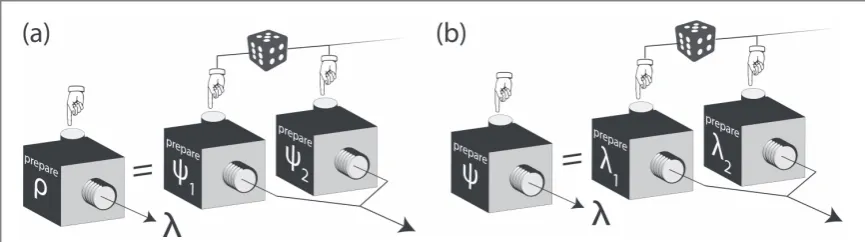
measure(or POVM)is a set of positive operators that sum to the identity operator. It constitutes the most general description of a quantum measurement. Likewise, a mixed state(being an Hermitian, trace-one operator)is the most general description of a quantum state. If we interpret a mixed state as a proper mixture of other states, then the corresponding preparation in the ontological model is the random selection of one of a number of preparations, each itself a random selection ofλ. Seefigure1.
The following generalisations of the quantum overlap and the Born rule
w (∣cñ,∣yñ ) w r r( , y)= -1 1∣∣r -r∣∣* ( )
2 , 9
Q i Q c i c i
y r
á ñ
∣ ijk∣ c ∣2 trace(Eijk c) (10)
share an important property:they conserve their meaningsas twice the minimum error discrimination probability [21], and prepare-measure probability(respectively).∣∣ ∣∣• *is the nuclear norm(or sum of singular values). Derivative notions such as antidistinguishabilityijtherefore also inherit their meaning correspondingly. With
å
å
r r r
r r
r r
+ + + + + +
-
-+ + =
=
´
> ( )
∣∣ ∣∣
( ) ( )
*
E E E
E E E
E
minimize
1 trace
1
subject to
0 0
trace 1. 11
i j ij i ij j ij c ij ij ij
j c j
ij ij ij
ijk
i
i
1 2 3 1 2 3
1 2
1 2 3
HereM0denotes thatMis a positive semidefinite matrix.ijkare small error parameters to be discussed
shortly—the reader may temporarily assume these to be zero. Recall that a function f( )x is convex iff
l + -l l + -l ( ( ) ) ( ) ( ) ( )
f x1 1 x2 f x1 1 f x2, and that a setis convex iff
l l
Î +( - ) Î
x x1, 2 x1 1 x2 forlÎ[0, 1]. Call a problemconvexif it involves minimising a convex function over a convex set. Such problems exhibit many convenient features: if a local optimum exists, it is also a global optimum. Efficient algorithms exist to solve convex problems. Although(11)is not a convex problem, notice that the objective function is linear(hence convex)in the set of measurements when the states arefixed. Furthemore, when the measurements arefixed, the objective is convex–concave fractional in the states: then the global optimum can be found by solving a series of parametric(convex)subproblems[30]. Note further that
, are convex sets. Thus, we proceed in a manner inspired by‘biconvex’problems[31](which have a very similar structure). The approach put forward here is to begin with a feasible point in, and then proceed to alternately optimise overand thenagain, and so on(keeping the other setfixed)until the optimal values of the two subproblems converge. This is known as alternate convex search[31], and while it does not guarantee
global optimality, it does tend to provide good results which are guaranteedpartially optimal: that is to say, no change inor inalone could provide a better solution. In order to solve the fractional subproblem of the form mina/b(whenfixing the measurements and searching for states), one may use Dinkelbach’s technique [32], which involves solving a series of parameterised problems mina-qkb: see appendixA.
5. Numerical results
There exist many software packages for solving the convex problems that arise during my algorithm. Because the algorithm will not always settle on the same solution if seeded with different starting points, I ran the algorithm several times, using theCVXpackage[33]for each subproblem: the best numerical results forijk=0,
= ¼
d 3, , 8andn=3,¼, 20are shown infigure2(a). The algorithm was seeded with random pure states. CorrespondingMATLABfiles with the states and measurements are available in the supplementary material, as is the code needed tofind partially optimal solutions for anyn d, . The results show that an experiment showing
k0 50%is possible with current technology such as linear optics[4]or ion traps[15]. The performance of the algorithm is discussed in appendixC.
[image:6.595.119.552.62.183.2]Some comments about the choice of reference state are in order. Because our objective function is invariant under a simultaneous unitary transformation of all states and measurements, the reference state may be chosen arbitrarilyup to the choice of eigenvalues, which determine(for example)the puritytrace( )rc2. Because of the linearity of the subsearch over, the algorithm will return projective(i.e. extremal)POVMs: our generalisation to positive matrices can thus always be thought of as a purely mathematical trick, since the measurements will
Figure 1.In the ontological models framework, preparations may be thought of as‘black boxes’that simply produce aλaccording to the distributionm ly( ).(a)A mixed stater= åi ip∣y yiñá i∣can be thought of as the net preparation when several pure preparations
are wired together with a probabilistic switch. The resulting probability density over ontic states is the convex combination of the component distributions:m lr( )= åi ipmyi( )l.(b)In much the same way, each component preparation labelled by a pure stateyi
can be thought of itself as a compound preparation, where a probabilistic switch selects from a number of deterministic preparations ofλ, so that the net preparation is described bym ly( ). For the purposes of illustration, hereλis represented as a discrete space, although it is often thought of as a continuous space, as in equation(1).
5
always correspond to a projective measurement(and it is very important that the measurement has only 3 outcomes[34]). Importantly, no such property guarantees that the search overwill return pure states. The results so far correspond to a pure reference state, which caused the solution statesrito also all be pure. However, one can in fact include the reference state into the search space{rc,{ } }ri i , thereby leaving the purity as a free parameter to be optimised over. While this should only lead to better results(in principle), in practice it can mean the algorithm is more likely to get stuck in local optima. However, in the appendix I present
mixedstates and measurements which lead to an=d=3bound ofk01.2018 1.5003»0.8011, a marked
improvement over known bounds with only pure states.
5.1. Noise
Inspectingfigure2(a), it seems that increasingnis an easy way to improve an experiment—but as long as the errorsijk¹0(which captures the realistic situation where the QT predictions are not precisely reflected in the
experiment)they will accumulate and spoil the trend. Let¯ = å2 i j>[ij1+ij2+ij3] (3n2-3n)be the
average error. Note that the objective function in(11)is monotonically increasing in¯. Note also that my algorithm can adjust the tradeoff between the numerator and denominator to achieve states which are in general less optimal for the noise-free case, but more robust to error than the noise-free optima. For numerical results relating to¯ =0.15%, seefigure2(b).
Let a bound onk0be given by the ratioA/B, whereAis the(noiseless)numerator of(11), andBthe denominator. Then, the maximum tolerable error is¯MAX=2(B-A) (3n2-3n). Surprisingly, the mixed
state bound I found by including the reference state in the search is extremely robust to noise, tolerating
> ¯
[image:7.595.121.552.62.380.2]MAX 0.033, while the previous bestn=d =3(pure state)solution[28]could tolerate¯MAX=0.0006. This constitutes, a>50-fold improvement in robustness for the same experimental resources, contradicting the widely held feeling that extremely high precision experiments are necessary to show the reality of the quantum state.
Figure 2.(a)Upper bounds onk0achievable by preparingn+1quantum states each of dimensiond, generated using an alternating search which solves convex subproblems. Increasingdfrom 3 to 4 and to 5 provide significant gains, but thereafter only diminishing returns. Open circles follow
(
1+1n n( -1 3) ¯)
n5.2. Lower bounds
A loose lower bound on the global optimum of(11) (i.e. the best possible BCLM experiment)can be obtained through convex relaxation. Replace the bilinear terms in the numerator with zero: then the problem is convex
(by virtue of the objective function then being the reciprocal of a positive, concave function)and actually solvable analytically by puttingri=rc "i. The BCLM argument therefore cannot hope tofind a bound onk0 any lower than
(
1+ 1n n( -1 3) ¯)
n2 . Tighter convex relaxations would be very useful if found.
6. Conclusions and directions
The technique forfinding BCLM experiments presented here is veryflexible. Besides the results showcased above—the improved zero-error bounds and improvedfinite-error bounds for lownandd—there are additional applications of the method. An experimentalist, armed with an estimate of the typical precision available in her laboratory setup, can use my algorithm with this quantity as input—and therefore extract the optimumnand appropriate sets , .
It is atfirst quite surprising that non-extremal states can be a better choice in arguing for the reality of the quantum state. It is counter intuitive because(i)for many quantum information processing applications, mixed states will perform strictly worse than pure states, and(ii)since mixing states together introduces‘artificial’ ignorance into the problem one would then expect the states to become more epistemic. But since we are interested in the ratio of quantum to classical overlaps, we are not interested in the absolute measure of epistemicness, but rather the upper limit on how close the epistemicness of the ontological model can come to explaining the overlap at the quantum, or operational level. Intuitively, increasing the mixedness of states can make them less distinguishable: increasing their overlapwQand therefore decreasing our objective function
(11). Fundamentally, a mixed stateρin quantum mechanics will still have to correspond to some distributionmr in an ontological model(seefigure1). Such preparations also exhibit the property that(except in special cases) one cannot distinguish them with a single shot measurement. The epistemic interpretation is therefore just as compelling for mixed states as for pure states. One difference is that even within quantum mechanics there is an ‘ignorance’interpretation of a mixed state as a(non-unique)convex combination of pure states. But since our goal is to show that there is an ever widening explanatory gap that the epistemic interpretation fails to breach, this is by no means a get out clause to the argument. Needless to say that the often-cited belief that‘there are no pure states in the laboratory’should causeρ-epistemicism to be taken just as seriously, nay,more seriouslythan
ψ-epistemicism.
Each of the mathematical elements of an ontological model(ie. the preparations, transformations and measurements)should, in principle, carry labels that allow for contextuality[35,36]. This is because multiple,
physically distinct preparations(transformations, or measurements)may be identified in QT, but one is generally not warranted in identifying their representation in the ontological model. Doing so amounts to making an additional(and spurious[35,36])assumption of non-contextuality. It is therefore paramount in any experimental test relating to ontological models(such as those proposed by PBR and BCLM)that the very same physical procedure be used at any point where a definite preparation or measurement is repeatedly called for. The temptation to use distinct procedures which would be equivalent in QT is perhaps greater for objects with multiple convex decompositions, such as mixed states: but it should be resisted all the same, because it would introduce a contextuality loophole.
Further, it is simple to apply additional constraints which will not spoil the properties of(11). For example; the expression∣∣rc-rj∣∣*can be upper bounded, ortrace(r rc j)can be bounded from above(and/or below if choosingrcto befixed, and not part of). These constraints might help provide further theoretical insight into the nature of ontological models for QT. Similar constraints might help experimentalists search for those certain states and measurements that are easy to prepare with highfidelity. It is also possible to seed the algorithm a more structured and informed initial feasible point from which to search from—rather than the random feasible points I chose. My algorithm will return a solution at least as good as its input, and can therefore be used to ‘polish’any solution found by other means.
It is possible in future that deterministic global optimisation techniques[37]can be applied to this problem, and provide a certificate ofglobaloptimality(rather than just partial optimality)forand. Such a certificate would be a akin to a‘Tsirelson’s bound’[38]—and would provide some much-desired certainty in the search for
optimal BCLM experiments.
7
Acknowledgments
I would like to thank Owen Maroney and Andrew Briggs for helpful discussions, and Ronnie Hermens and Cyril Branciard for feedback on an earlier version of this manuscript. This publication was made possible through the support of a grant from Templeton Religion Trust. The opinions expressed in this publication are those of the author and do not necessarily reflect the views of Templeton Religion Trust. This work was supported by the Royal Commission for the Exhibition of 1851.
Appendix A. Dinkelbach
’
s technique
Dinkelbach’s technique is an iterative method of solving a convex–concave fractional problem: here I follow Jeflea’s description[32]—the interested reader should consult this reference for more details. Consider the
problem
Î ( )
( ) ( )
a x
b x x X
minimize : , A.1
wherea(x)andb(x)are(respectively)convex and positive, concave functions andXis a compact convex set. Dinkelbach developed the following algorithm which he proved to converge on the globally optimal solution to this problem[39]:
(i) Initialisex1ÎX. Letk=1.
(ii) Letqk=a x( )k b x( )k . Find the solutionxk+1to the convex problemminX{ ( )a x -qkb x( )}.
(iii) Ifa x( k+1)-qkb x( k+1)=0, stop andxkis optimal. Otherwisek= +k 1and go to previous step.
The subproblem of my alternating search approach that involvesfixing the measurements and searching for states is of the form(A.1): it may therefore be solved with Dinkelbach’s method.
Appendix B. Mixed states solution
With pure states in then=d =3case, my algorithm never returned a bound better thanko0.9964¼after
many trials. One therefore has the suspicion that this is in fact the global optimum of the problem when the reference state is set to a pure state. Inserting the reference state into the search space removes unnecessary constraints, for example that it must have a certain purity. The algorithm found:
r r r r = - + - - - - -+ - + = + - - + -- + -= - - - + - ++ - - -= - - - - -- + + = - +- -- -- - - -- - - - -= -- -+ - -- - - -- - - -= -- +- - +- - - -- - + - -( ) ⎛ ⎝ ⎜ ⎜ ⎞ ⎠ ⎟ ⎟ ⎛ ⎝ ⎜ ⎜ ⎞ ⎠ ⎟ ⎟ ⎛ ⎝ ⎜ ⎜ ⎞ ⎠ ⎟ ⎟ ⎛ ⎝ ⎜ ⎜ ⎞ ⎠ ⎟ ⎟ ⎛ ⎝ ⎜ ⎜ ⎞ ⎠ ⎟ ⎟ ⎛ ⎝ ⎜ ⎜ ⎞ ⎠ ⎟ ⎟ ⎛ ⎝ ⎜ ⎜ ⎞ ⎠ ⎟ ⎟ i i i i i i i i i i i i i i i i i i i i i i i i U
i i i
i i i
i i i
U
i i i
i i i
i i i
U
i i i
i i i
i i i
0.36238 0.05820 0.19604 0.04384 0.07843
0.05820 0.19604 0.19657 0.09383 0.09519
0.04384 0.07843 0.09383 0.09519 0.44104
0.46135 0.05756 0.01170 0.08267 0.03289
0.05756 0.01170 0.43220 0.17263 0.06280
0.08267 0.03289 0.17263 0.06280 0.10645
0.31986 0.04357 0.08822 0.07957 0.21626
0.04357 0.08822 0.42252 0.07043 0.09595
0.07957 0.21626 0.07043 0.09595 0.25762
0.16537 0.09443 0.20002 0.04010 0.04801
0.09443 0.20002 0.34712 0.06583 0.02614
0.04010 0.04801 0.06583 0.02614 0.48752
0.21308 0.34918 0.73262 0.03220 0.28060 0.46494
0.41066 0.24840 0.04936 0.42176 0.50882 0.57485
0.72704 0.27156 0.23588 0.47568 0.34016 0.00688
0.09331 0.10812 0.82454 0.21487 0.20553 0.45970
0.23642 0.21660 0.25851 0.45038 0.59552 0.52237
0.17509 0.91986 0.03121 0.05766 0.34483 0.00239
0.45263 0.11154 0.69730 0.14663 0.45256 0.26488
0.27154 0.06431 0.21650 0.52185 0.19325 0.75206
0.02490 0.83917 0.20971 0.35931 0.30627 0.16823
which givesk01.2018 1.5003»0.8011. Note that here a measurement is represented by a unitary matrix Uij, where each column is a pure state∣ijkñcorresponding to the projector∣ijk ijkñá ∣=Eijk.
Appendix C. Performance of the algorithm
To gain an idea of the runtime of the algorithm, and the topology of the optimisation landscape, observe
figureC1. For the purposes of making thisfigure, the algorithm was run ind=3, a total of 1000 times for each value ofn=3, 4, 5, 6, 7on a 3.6 GHz Intel Core i7-4790 running openSUSE linux, Matlab R2016a andCVX. The results suggest that the mean runtime scales linearly withn, although generally the algorithm willfind one of many distinct local optima depending on the initial random seed.
References
[1]Harrigan N and Spekkens R 2010Found. Phys.40125
[2]Spekkens R W 2007Phys. Rev.A75032110
[3]Leifer M 2014Quanta367–155
[4]Ringbauer Met al2015Nat. Phys.11249
[5]Bell J 1966Rev. Mod. Phys.38447
[6]Bell J S 1964Physics1195
[7]Clauser J F, Horne M A, Shimony A and Holt R A 1969Phys. Rev. Lett.23880
[8]Hensen Bet al2015Nature526682
[9]Giustina Met al2015Phys. Rev. Lett.115250401
[10]Shalm L Ket al2015Phys. Rev. Lett.115250402
[11]Pusey M F, Barrett J and Rudolph T 2012Nat. Phys.8475
[12]Kochen S and Specker E 1967J. Math. Mech.1759
[13]Lewis P G, Jennings D, Barrett J and Rudolph T 2012Phys. Rev. Lett.109150404
[14]Aaronson S, Bouland A, Chua L and Lowther G 2013Phys. Rev.A88032111
[15]Nigg Det al2016New J. Phys.18013007
[16]Patra M K, Pironio S and Massar S 2013Phys. Rev. Lett.111090402
[17]Colbeck R and Renner R 2012Phys. Rev. Lett.108150402
[18]Hardy L 2013Int. J. Mod. Phys.B271345012
[19]Maroney O J E 2012 arXiv:1207.6906v2
[20]Barrett J, Cavalcanti E G, Lal R and Maroney O J E 2014Phys. Rev. Lett.112250403
[21]Fuchs C A 1996 Distinguishability and accessible information in quantum theoryPhD ThesisUniversity of New Mexico arXiv: quant-ph/9601020v1
[22]Nielsen M and Chuang I 2004Quantum Computation and Quantum Information (Cambridge Series on Information and the Natural Sciences)1st ed(Cambridge: Cambridge University Press) (https://doi.org/10.1080/00107514.2011.587535)
[23]Harrigan N and Rudolph T 2007 arXiv:0709.4266v1
[24]Ballentine L 2014 arXiv:1402.5689v1
[25]Bandyopadhyay S, Jain R, Oppenheim J and Perry C 2014Phys. Rev.A89022336
[26]Caves C M, Fuchs C A and Schack R 2002Phys. Rev.A66062111
[image:10.595.122.552.63.262.2][27]Leifer M S 2014Phys. Rev. Lett.112160404
Figure C1.Histograms of the distribution of(a)output objective function value and(b)running time for 1000 trials on a single CPU implementation of the algorithm. When the algorithm is seeded randomly, it takes a variable amount of time tofinish, and settles on distinct(generally non-globally optimal)solutions. The inset of(b)shows the same data with the black line tracing the mean value, which is linear ford4.
9
[28]Branciard C 2014Phys. Rev. Lett.113020409
[29]Hedemann S R 2013 arXiv:1303.5904v1
[30]Enkhbat R, Bazarsad Y and Enkhbayar J 2011Int. J. Pure Appl. Math.7393 [31]Gorski J, Pfeuffer F and Klamroth K 2007Math. Methods Oper. Res.66373
[32]Jeflea A 2003An. St. Univ. Ovidius Constanta1187(https://eudml.org/doc/125842)
[33]Grant M and Boyd S 2014 CVX: Matlab software for disciplined convex programming, version 2.1(http://cvxr.com/cvx)
October 2016
[34]Dutta A, Pawłowski M andŻukowski M 2015Phys. Rev.A91042125
[35]Spekkens R W 2005Phys. Rev.A71052108
[36]Leifer M S and Maroney O J E 2013Phys. Rev. Lett.110120401
[37]Floudas C 2013Deterministic Global Optimization: Theory, Methods and Applications(Nonconvex Optimization and Its Applications)
(New York: Springer) (https://doi.org/10.1007/978-1-4757-4949-6)
[38]Cirel’son B S 1980Lett. Math. Phys.493
![Figure 2.=4 (with¯~0.0015) [4], generated using an alternating(11, which is a lower bound to the optimum experimentAllowing observed statistics to deviate on average bysearch which solves convex subproblems](https://thumb-us.123doks.com/thumbv2/123dok_us/9437662.451102/7.595.121.552.62.380/figure-generated-alternating-experimentallowing-observed-statistics-bysearch-subproblems.webp)