© 2019, IRJET | Impact Factor value: 7.211 | ISO 9001:2008 Certified Journal | Page 4328
Multipurpose Agricultural Robot
Gowtham kumar S N
1, Anand G Warrier
2, Chirag B Shetty
3,Gerard Elston Shawn D’souza
41,2,3,4,
Students, B.E, Mechanical Engineering, Alva’s Institute of Engineering & Technology, Mangalore,
Karnataka.
---***---Abstract
The paper presents about the multiple agricultural tasks done by the single robot. To develop the efficiency of the agricultural tasks we have to find the new ways. This project deals with a novel approach for cultivating lands in very efficient way. The distinctiveness of this agriculture robot system is it is multitasking abilities which can drill, pick and place, seeding, pumping water & fertilizers, weather monitoring to work in both agriculture, afforestation and gardening platform. The project aim is design, development and the fabrication of the robot which can dig soil, put seeds, roller to close the mud and sprayer to spray water, this whole system of robot works with the help of battery and solar power. More than 40% of the population in the world chooses agriculture as the primary occupation, in recent years the development of the autonomous vehicles in the agriculture has experienced increased interest
Key word : -ploughing, seeding, pick and place, Sprayer, Toggle switch, Battery, Solar panel.
1.INTRODUCTION
Agriculture is the backbone of India. The history of Agriculture in India dates back to Indus Valley Civilization Era and even before that in some parts of Southern India. Today, India ranks second worldwide in farm output. The special vehicles play a major role in various fields such as industrial, medical, military applications etc., [1] The special vehicle field are gradually increasing its productivity in agriculture field. Some of the major problems in the Indian agricultural are rising of input costs, availability of skilled labors, lack of water resources and crop monitoring. To overcome these problems, the automation technologies were used in agriculture.
The agricultural census gives vital information on the distribution of land holdings in our country. According to the census majority of the farmers are having the land less than 1 hectare [2]. This is one of the major drawbacks for the mechanization in agricultural sector in India.
The vehicles are being developed for the processes for ploughing, seed sowing, leveling, water spraying. All of these functions have not yet performed using a single vehicle. In this the robots are developed to concentrate in an efficient manner and also it is expected to perform the operations autonomously. The proposed idea implements the vehicle to perform the functions such as ploughing, seed sowing, mud
leveling, water spraying.[3] These functions can be integrated into a single vehicle and then performed.
Fig-1
: Multipurpose agricultural robot
2. REASON FOR SELECTING THE PROBLEM
This project objective is to fabricate a robot vehicle which can dig the soil, put the seeds, and close the mud and to spray water, these whole systems of the robot works with the battery and the solar power. To reduce human effort in the agricultural field with
the use of small robot.
To perform all 4 operations at single time, hence increases production and saves time.
To complete large amount of work in less time. Farmer can operate this robot through remote by
sitting at one side and he can operate easily.
The usage of solar can be utilized for Battery charging. As the Robot works in the field, the rays of the sun can be used for solar power generation.
To increase the efficiency, the solar power is used and the Power output can be increased.
3. LITERATURE SURVEY
© 2019, IRJET | Impact Factor value: 7.211 | ISO 9001:2008 Certified Journal | Page 4329
and also to take appropriate actions even in the absence ofthe farmers. It can be induced with human interaction and also learning from experience, given by Blackmore, S. (2007). “A systems view of agricultural robotics”.[4]. Central to this idea was the proposal of the implementation of the PFDS and PADS, and their strong interaction. The PFDS is primarily used for relaying spatial accuracy information for machinery navigation, while the PADS are used to communicate the agronomy information about, and requirements of, the crop, given by R. Eaton, R. Eaton, J. Katupitiya, S D Pathirana (2008), “Autonomous farming: Modeling and control of agricultural machinery in a unified framework”,[5].
4. PHYSICAL PARAMETERS
There are so many physical parameters considering while designing of multipurpose agricultural robot they are listed below.
4.1. FACTORS DETERMINING THE CHOICE OF
MATERIALS.
The various factors which determine the choice of
material are discussed below;
4.1.1.PROPERTIES
The
material selected must contain the necessary properties for the proposed application. The following four types of principle properties of materials decisively affect their selection; Physical Mechanical
From manufacturing point of view Chemical
The various physical properties concerned are melting point, Thermal Conductivity, Specific heat, coefficient of thermal expansion, specific gravity, electrical Conductivity, Magnetic purposes etc. The various Mechanical parameters considered are strength in tensile, compressive shear, bending, torsional and buckling load, fatigue resistance, impact resistance, elastic limit, endurance limit, and modulus of elasticity, hardness, wear resistance and sliding properties. The various properties concerned from the manufacturing point of view are,
Cast ability weld ability Brazability Forgability merchantability surface properties shrinkage
4.1.2.
MANUFACTURING COST:
Sometimes the demand for lowest possible manufacturing cost or surface qualities obtainable by the application of suitable coating substances may demand the use of special materials.
4.1.3. QUALITY REQUIRED
:This generally affects the manufacturing process and ultimately the material. For example, it would never be desirable to go for casting of a less number of components which can be fabricated much more economically by welding or hand forging the steel.
4.1.4. AVAILABILITY OF MATERIAL
:Some materials may be scarce or in short supply. It then becomes obligatory for the designer to use some other material which though may not be a perfect substitute for the material designed. The delivery of materials and the delivery date of product should also be kept in mind.
4.1.5. SPACE CONSIDERATION:
Sometimes high strength materials have to be selected because the forces involved are high and the space limitations are there. There are also some restrictions to what we can utilize in the mechanism.
4.1.6. COST:
As in any other problem, in selection of material the cost of material plays an important part and should not be ignored. Sometimes factors like scrap utilization, appearance, and non-maintenance of the designed part are involved in the selection of proper materials.
5. DESIGN OF BODY
Base Frame: 18 X 20”
Solar Panel: 5W (power), 15 X 7” (dimension) Ground Clearance: 6”
PVC Wheel: 6”
Lead screw: 2mm pitch, 18mm diameter (For ploughing)
M.S square pipe for base: 1”, 18 gauge M.S flat plate: 1”, 3mm thickness Seeder funnel: 2
© 2019, IRJET | Impact Factor value: 7.211 | ISO 9001:2008 Certified Journal | Page 4330
Fig. 2: Block diagram of Multipurpose Agricultural Robot6. OPERATIONS
Our robot can perform the various operation like, Steering operation, ploughing operation, cultivating operation, spraying operation
.
6.1. STEERING OPERATION
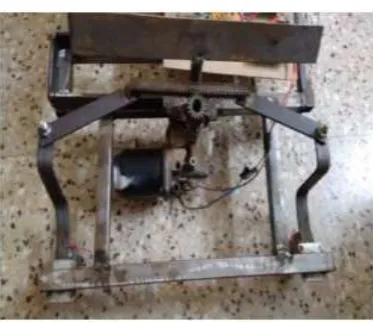
Fig-3: Steering Operation
• Rack and pinion Mechanism for steering operation. • The pinion is coupled with the DC Motor.
• The power for motor is regulated by Relay switch. • The direction of motor rotation can be controlled by remote controller for steering the vehicle to either left or right side direction.
[image:3.595.337.532.122.277.2]6.2. CULTIVATING OPERATION
Fig-4: Cultivating opertion
A DC Motor coupled with the screw rod is used. The power for motor is regulated by relay switch. The screw rod rotates and the nut welded to the cultivator slides between the screws of the screw rod.
As the cultivator is lowered down, soil is digged up to 1.5 inches.
The direction of motor rotation can be controlled by remote controller for up and down movement of the cultivator
6.3. SEED SOWING OPERATION
Fig-5: Seed sowing operation
• A sheet metal hopper box is used for Seed storage. • We have provided 3 holes to the main wheel shaft,
where the Storage box is placed above it.
• The main wheels are powered by DC motor which is regulated by a Relay switch and is controlled by a remote controller.
[image:3.595.68.255.422.583.2] [image:3.595.321.521.465.621.2]© 2019, IRJET | Impact Factor value: 7.211 | ISO 9001:2008 Certified Journal | Page 4331
6.4. MUD CLOSING AND LEVELING OPERATION
Fig-6: Mud Closing and Leveling Operation
• A Sheet metal Plate is used as mud closer and leveler.
• The sliding mechanism is used for leveler up & down movement.
• The Leveler is powered by a DC motor which is regulated by Relay switch and controlled by a remote controller.
• As the leveling plate moves downward to the ground level, the mud is closed in the sowed soil
6.5. WATER SPRAYING OPERATION
Fig-7: Water spraying Opertion
• A water container is used for water storage. • A water pump is used for pumping water to the
water sprayer.
• The water flows to the sprayer through pipe. • The power for pump is regulated by a toggle switch
7. CONCLUSIONS
The multipurpose agricultural robot gives an advance method to sow, plow and cut the crops with minimum man power and labor making it an efficient vehicle. The machine will cultivate the farm by considering particular rows and specific column at fixed distance depending on crop.Robots can improve the quality of our
lives and enhance opportunities for future mankind to create an upgraded model for the betterment of farmers. In agriculture, the opportunities for robot-enhanced productivity are immense and the robots are appearing on farms in various guises and in increasing numbers. The other problems associated with autonomous farm equipment can probably be overcome with technology.This equipment may be in our future, but there are important reasons for thinking that it may not be just replacing the human driver with a computer. It may mean a rethinking of how crop production is done. Crop production may be done better and cheaper with a swarm of small machines than with a few large ones. One of the advantages of the smaller machines is that they may be more acceptable to the non-farm community. The jobs in agriculture are a drag, dangerous, require intelligence and quick, though highly repetitive decisions hence robots can be rightly substituted with human operator. The machine requires less man power and less time compared to traditional methods, so if we manufacture it on a large scale its cost gets significantly reduce and we hope this will satisfy the partial thrust of Indian agriculture. So in this way we can overcome the labor problem that is the need of today’s farming in India.
8. REFERENCES
1. Simon Blackmore, Bill Stout, Maohua Wang, Boris Runov (2005), Robotic agriculture – The future of agriculture mechanism, Agro Technology, the royal veterinary and agriculture University.
2. Agricultural Census: All India report on number and area of operational holdings. Agricultural census division, Department of agriculture and co-oeration, Ministry of Agricluture, Government of India 2014. 3. R. Eaton, R. Eaton, J. Katupitiya, S.D. Pathirana (2008), Autonomous farming: Modeling and control of agricultural machinery in a unified framework,15th international conference on mechatronicsand machine vision in practice, NewZealand.
4. Simon Blackmore, Bill Stout, MaohuaWang, Boris Runov (2005), “A systems view of agricultural robotics”, Agro Technology, the royal veterinary and agriculture University.
5. R. Eaton, R. Eaton, J. Katupitiya, S D Pathirana (2008), “Autonomous farming: Modeling and control of agricultural machinery in a unified framework
6. Akhila Gollakota, "A Multipurpose Agricultural Robot ", Birla Institute of Technology and Science, Hyderabad Campus
© 2019, IRJET | Impact Factor value: 7.211 | ISO 9001:2008 Certified Journal | Page 4332
8. Ms. Sushma Bijapur, Ms. Suprita Kulkarni, Ms.Sahana Shivangi, Ms. Sanchayan Roy (2011), B.V.Bhoomaraddi College of Engg & Tech, Hubli. 9. Shree Harsha B T, Saketh Chellur, Aparna Latha A,
Sandeep Kumar Y H M (2017), “Multi-Purpose Agricultural Vehicle”, Imperial Journal of Interdisciplinary Research (IJIR), Vol-3, Issue-6, 2017 ISSN: 2454-1362.
10. Suraj Chavan, Anilkumar Dongare, Pooja Arabale, Usha suryanwanshi, Sheetal Nirve, “Agriculture Based Robot (AGRIBOT)”, Vol-3 Issue-1 2017 IJARIIE-ISSN(O)-2395-4396, www.ijariie.com 11. D. Kornack and P. Rakic, “Cell Proliferation without
Neurogenesis in Adult Primate Neocortex,” Science, vol. 294, Dec. 2001, pp. 2127-2130, doi:10.1126/science.1065467.
12. M. Young, The Technical Writer’s Handbook. Mill Valley, CA: University Science, 1989.
13. R. Nicole, “Title of paper with only first word capitalized,” J. Name Stand. Abbrev., in press.
BIOGRAPHIES
Gowtham Kumar S N student
4TH year Mechanical Department Alva’s Institute of Engineering and Technology, Mangalore, 574225
Anand G Warrier student
4TH year Mechanical Department Alva’s Institute of Engineering and Technology, Mangalore, 574225
Chirag B Shetty student
4TH year Mechanical Department Alva’s Institute of Engineering and Technology, Mangalore, 574225
Gerard Elston Shawn D’souza student