Manuscript version: Author’s Accepted Manuscript
The version presented in WRAP is the author’s accepted manuscript and may differ from the published version or Version of Record.
Persistent WRAP URL:
http://wrap.warwick.ac.uk/109422
How to cite:
Please refer to published version for the most recent bibliographic citation information. If a published version is known of, the repository item page linked to above, will contain details on accessing it.
Copyright and reuse:
The Warwick Research Archive Portal (WRAP) makes this work by researchers of the University of Warwick available open access under the following conditions.
Copyright © and all moral rights to the version of the paper presented here belong to the individual author(s) and/or other copyright owners. To the extent reasonable and
practicable the material made available in WRAP has been checked for eligibility before being made available.
Copies of full items can be used for personal research or study, educational, or not-for-profit purposes without prior permission or charge. Provided that the authors, title and full
bibliographic details are credited, a hyperlink and/or URL is given for the original metadata page and the content is not changed in any way.
Publisher’s statement:
Please refer to the repository item page, publisher’s statement section, for further information.
Crafting Workspaces by Entangling Physical
and Digital Environments
Completed Research Paper
Kamaran Sheikh
Warwick Business School
The University of Warwick
[email protected]
João Baptista
Warwick Business School
The University of Warwick
[email protected]
João Porto de Albuquerque
Centre for Interdisciplinary Methodologies
The University of Warwick
[email protected]
Abstract
Digital working is often seen to be replacing office-based work practices. This study captures the opposite, the entanglement of features of both physical and digital by software development teams in a multinational IT company. We observed how these software development teams crafted three types of entangled workspaces, characterised by different modulations of digital and physical features of their environment. We take an ontogenetic view of space that sees space as performative and constantly in the making to study the crafting of these entangled workspaces which transcend both physical and digital environments. This sociospatial view provides a novel conceptual basis to study the role of space in digital working.
Keywords: physical space, digital work, entangled workspace, code/spaces, sociospatial, spatiality, work practices
Introduction
The ubiquity of mobile digital media drive constant connectivity (Wajcman and Rose 2011; Kolb et al. 2012) and the emancipation of people from physical locations and physical presence with others (Bjerrum et al. 2003; MacCormick et al. 2012; Mazmanian et al. 2013). This movement towards digital working has meant that many organisations have had to rethink the role of the physical office space in response to these new emergent patterns of work (Waber et al. 2014; Bjerrum et al. 2003). Despite using digital media to enable more flexible working practices, many modern organisations have made significant investments to upgrade and rethink their office buildings to bring employees back to the office for collocated working practices (Metiu 2006). Modern work in these organisations is characterised by integrated flow of activities across physical and digital environments (Weeks and Fayard 2011). Work therefore is not performed within physical or digital spaces but instead as a combination of both (Davis et al. 2011; Orlikowski 2007) giving rise to new blended spaces of work. We thus contend that the workplaces of today’s organisations consist of entangled digital-physical spaces, in which physical spaces, digital technologies and collaborative work practices are reciprocally defined and constitutively intertwined.
ways of working across combined physical and digital spaces (Flecker 2016). One important departure from previous literature is the view of physical space as a passive container for work activities. Instead physical space should be seen as capable of shaping and performing (de Vaujany and Vaast 2013; Kornberger and Clegg 2004).
The importance of physical space for collaborative practices has been acknowledged since the 1990s by researchers in the field of computer supported collaboration in the so-called “workplace studies” (Heath and Luff 1992) and, more recently, has entered in the agenda of organisational studies (Dale and Burrell 2008). However, today’s scenarios of entangled physical-digital spaces pose new challenges for theorising the relationship between physical spaces, digital technologies and work practices. This resonates with recent scholarship on the role of materiality for social practice. However research in organisation studies and IS research has been predominately focused on the materiality of technology in general (Orlikowski and Scott 2008; Leonardi 2011) and specific digital artefacts (Leonardi 2013; De Albuquerque and Christ 2015). In contrast, the constitutive role of the physical environment and its interplay with digital technologies for shaping social practice has been a marginal topic in the organisational studies and in the IS field so far (de Vaujany and Mitev 2013).
This study addresses this gap by seeking to better understand and conceptualise this entangled nature of physical-digital spaces of work. This view of workspace as a combination of digital and physical features and properties is already recognised in practice in organisations and increasingly relevant as a topic for research, but not yet fully theorised in academic research. We introduce here a novel analytical framework centred around the concept of entangled workspaces as emerging from the performance of socio-technical assemblages. We draw on theories on the relationship between space, technology and social practice which adopt a performative view of space based on the work of the philosopher de Certeau (1984) and on scholarship on human geography by Kitchin and Dodge (2014). This enables us to differentiate between the
place where the organisation is located (typically an office building) and the space that emerge from practices that appropriate features of both physical and digital environments to support the performing of work within organisations.
In particular, we seek to conceptualise the flow of activities and interactions between physical and digital environments of software development teams and the emergence of integrated workspaces inscribed across digital platforms and physical work environments. Unique affordances emerge when individuals observe and combine properties of both the physical environment and the digital tools used to support their individual and team work activities. So, for example, if there are attractive physical rooms for team collaboration, employees will adjust their online collaborative practices to include activities in these rooms. Entanglement therefore occurs when teams appropriate the properties and features of both digital and physical environments in their routine work practices. This study responds to increasing calls for research that combines these two fields (Fayard 2012; Fayard and Weeks 2011) and contributes with a novel conceptualisation of modern work spaces. The study is driven by the following research question: what is the role of physical environment and digital tools in the constitution of workspaces in modern organisations?
To address this question, we conduct an in-depth interpretive case study set within a recently purpose-built software design studio in a large multinational IT company in London, UK. We focus on software development teams, as an extreme example of intense collaboration within an agile software development environment. The case captures the practices of these teams as they perform work activities in both digital platforms and within the rooms of the purpose-built office of this IT company. This case is potentially extreme because these teams of software developers are naturally digital savvy and work in a physical environment dedicated to agile work, which means that both environments have been created to support their needs. However, this type of work is not unique and by studying these teams we are able to foresee developments in the crafting of workspaces in other sectors and types of organisations too.
study is thus able to make a twofold contribution: first, we provide a novel conceptual approach that is able to theorise the role of digital tools and physical environment in modern workspaces. Second, we provide empirical evidence that this reconceptualisation of workspace enables us to better understand the role of space in the use and appropriation of digital technologies in the workplace.
In the remainder of this paper, we first present a literature review summarising existing research on the relationships between space, organisations and technology. We then elaborate on our conceptual and theoretical underpinnings, in particular to develop the concept of entangled workspaces and further expand on the ontogenetic perspective of space. This is followed by a discussion of the research methods employed, specifically explaining our approach to capture the crafting of workspaces by employees using time lapse video recording and other ethnographic research work. The findings of our case study are then presented and discussed, organised around three types of workspaces that emerged from distinct digital-physical assemblages crafted by the software development teams. Finally, the paper closes by capturing the main contribution from this study in the conclusion.
Literature Review
To achieve a deeper understanding of how today’s workspaces emerge from the interplay of digital technologies, physical environments and organisational practices, we start by exploring evolving conceptualisations on the ontology of space in social research. The “genealogy of space” as traced by the human geographersKitchin and Dodge (2014) identifies three dominant ways of thinking about space in social theory research.
The first conceptualisation regards space as a static and inert background where social life unfolds, a notion which was articulated in the 1950s and 60s in geography as “spatial science”. In this view, space had an absolute ontology, “defined and understood primarily through a Euclidean geometry” (Kitchin and Dodge 2014). This absolute notion of space as a fixed “container” to social life was criticised from the 1970s onwards especially following from the work of the Marxist human geographer Henri Lefebvre, who put forward a relational concept of space in his work “the production of space” (Lefebvre 1991). From this viewpoint, space is not neutral or an absolute geometric grid, but it is instead constitutive of social relationships. This relational perspective of space has been used also to analyse organisational space as constituted through social practice (Taylor and Spicer 2007; Clegg and Kornberger 2006).
In the past few years, a third stream of theoretical work emerged that challenges both absolute and relational conceptualisations of space and proposes a performative view: “space achieves its form, function,
and meaning through practice; space emerges as a process of ontogenesis” (Kitchin and Dodge 2014). This “ontogenetic” conceptualisation of space is thus able to capture the fact that space is continuously remodelled, reaffirmed or changed by sociospatial practices. For instance, a workplace is only brought into being as a space for performing work through a series of coordinated practices and material exchanges, e.g. daily some people come in and leave at certain times, tables and other furniture are arranged (and rearranged), people swap places, a chair breaks down and is replaced, rooms are cleaned, rubbish bins are filled up and emptied later etc.
This ontogenetic view of space, which reflects a view that space is constantly in the making and established through practice, implies a different way of thinking about the relation between place and space. The philosopher de Certeau (1984, p.117) defines place (lieu) as “an instantaneous configuration of positions”, which implies an indication of stability. In this way, when we refer to a place (e.g. a room, an office, a city), we usually think of a set of relatively positioned elements, or a snapshot of dynamic relations. In contrast,
“space is composed of intersections of mobile elements (…) In short, space is a practiced place” (Certeau
1984). This conceptualisation of space is therefore performative and changes “the central question of
inquiry from ‘what space is’ to ‘how space becomes’” (Kitchin and Dodge 2014).
space is still conceptualised as “a fairly stable construction that provides limits for social interaction”
(Hiikkinen and Kivinen 2013). Therefore, they fall short of the ontogenetic perspective as recently developed by human geographers. Furthermore, the literature analysing digital technologies in the workplace (Mazmanian 2013) and the effectiveness of virtual work (Townsend et al. 1998) has framed physical space as alternative or complementary to face-to-face interaction (Dixon and Panteli 2010; Gaver 1992; Leonardi et al. 2013; Vaast and Kaganer 2013; Leonardi 2011), missing the important exploration of the mutual constitution of physical interactions and information technology in the workplace.
We contend that this marginalisation of the role of space prevents information systems studies to provide a full account of the co-constitutive, generative role of the materialities of workspaces and information technology within organisational practice. In particular, it imposes a serious constraint for investigating work practices in today’s software development organisations, many of which are currently emphasising the importance of flexible workspaces within co-location arrangements as previously discussed.
Theoretical Underpinnings
We therefore propose a new perspective that understands today’s workspace - i.e. the spaces where work happens - as always in the making and as an evolving continuum that cuts across physical and digital elements. Workspaces emerge from the interactions between people, technology, tasks, objects and the physical environment. In order to capture the constitution process of these modern workspaces, we follow
the theorisations of space that we identified before as “ontogenetic”, drawing particularly on the work of de
Certeau (1984) and Kitchin and Dodge (2014). For them, “space gains its form, function, and meaning in
practice. Space emerges through a process of ontogenesis” (Dodge and Kitchin 2005, p.172). This
perspective allows us to shed light into the emergence of space from organisational practices that articulate physical and digital elements, which is particularly useful in the context of modern workplace activity as discussed previously.
Kitchin and Dodge’s contribution to ontogenetic perspectives of space comes from a specific consideration on the implications of digital technologies (which they refer to as “code”) to the processes of space formation. They do so by drawing on scholarship on social and cultural studies of technology by Mackenzie (2003). Mackenzie relied upon the philosopher Gilbert Simondon to conceptualise the emergence of spacing and, as cited in Kitchin and Dodge (2014), explains that “through transduction, a domain
structures itself as a partial, always incomplete solution to a relational problem” (Mackenzie 2003, p.10).
Kitchin and Dodge use this concept to theorise about the role of code in structuring space: by “acting as a catalyst for transductions to occur(…) code changes the conditions through which everyday life occurs because it modulates how other technologies function” (Dodge and Kitchin 2005, p.171). This idea is used by Kitchin and Dodge (2014) to theorise the effects of software and code in the constitution of space in various contexts, including modern airports and homes.
Two connected concepts are introduced by Kitchin and Dodge to describe how assemblages of objects, infrastructures, processes and people transduce space, that means, how these assemblages bring space into
being or as they refer to “beckon new spatial formations and spatiality into existence” (Dodge and Kitchin
2005, p.172). First, coded spaces are spaces organised and modulated by the use of software but code is not essential for the space to be brought into being, e.g. postcodes are calculated with software and used to organise the urban space. The postcodes augment and enhance the spatialities that emerge from this modulation but they are not required to generate these spatialities, just an improvement to them. So coded spaces are mediated by code but their relationship is not dyadic or mutually constituted. However, the second concept that Kitchin and Dodge propose, ‘code/spaces’, differs precisely on this point, in that code/spaces are intrinsically co-constituted through software. They emerge from spatial practices that are indissociably from software, e.g. airports only work (as “proper” airports) when software is working, otherwise they are only waiting rooms.
The work of Kitchin and Dodge is useful because it brings ontogenetic views of space closer to our everyday modern lives where many of our activity is mediated by technology. Their concept of code/space is particularly interesting because it helps us capture the mutual constitution between space and information technology (which Kitchin and Dodge refer to as software or code). They say that “code/space is quite
literally constituted through software-mediated practices, wherein code is essential to the form, function,
concept applies and is useful in organisational settings to study workplace practices, which is an area absent from their work.
To understand the relationship between technology, space and organisational practice, we build upon the
notion of “code/space” to propose the concept of entangled workspaces. We see these spaces emerge as an
outcome of spatial practices that intertwine features of physical environments (e.g. rooms, walls, furniture) and digital technology (e.g. instant messaging software, project management tools, collaborative digital environments). It is worth noting that this concept of entangled workspaces captures space in organisational setting as dynamic and brought into being through practice, it is therefore ontogenetic and corresponds to what de Certeau calls “experienced spaces”.
Drawing on the aforementioned differentiation between space and place made by de Certeau (1984), we shall refer to workplace as the static configuration of positional relationships between elements of the physical and digital environment in organisations. We then refer to entangled workspaces as the ongoing accomplishments of spatial practices, which transform workplaces into spaces by weaving together sociomaterial assemblages of people, mobile phones, laptops, chat rooms, instant messages, project management software, chairs, tables, rooms, office buildings, and other elements of the physical and digital environments. Following de Certeau’s proposition that spaces are “practised places”, we thus theorise
entangled workspaces as practised workplaces that prominently include digital elements alongside physical elements of the work environment.
However, beyond the fact that our concept of entangled workspaces is specifically useful to capture dynamics within organisations, there are three additional and important ways in which this concept differs and extends the concept of code/space by Kitchin and Dodge.
First, Kitchin and Dodge refer to “software” or “code” as a reified and fixed element from which the fabric of space is woven by spatial practices together with other elements such as streets, people, cars, traffic lights etc. However, information systems used in collaborative software development today are much more plastic and malleable: they can be configured, combined, tweaked, extended by other pieces of software. Equally importantly, these systems can also be deactivated, hacked, bypassed and ignored in organisational practice. Collaborative media in the workplace is inherently reconfigurable and mouldable (Newell et al. 2001) and therefore it is not taken by users as fixed (“code”) as presented by Kitchin and Dodge. Research in information systems has shown that collaborative software interplays and becomes embedded in organisations (Baptista 2009) and takes shape in practice, in a process that may result into divergent
“technologies in practice” (Orlikowski 2000). This represents sociomaterial assemblages (Introna 2013).
Whilst the concept of code/space assumes “code”/“software” as a fixed entity to investigate and describe the emergence of space, we would like to capture the processes by which space and information technology co-evolve, and are mutually constituted, and come into being as sociomaterial assemblages that result from what de Certeau (1984) calls “spatial practices”.
Second, current offices, sites and organisational settings are becoming more modular, multi-purpose and configurable in terms of how physical objects, people and rooms are spatially arranged. As we have seen before, organisations are purposefully providing different types of office rooms, as well as enabling workers to use and adapt their environments in the way they feel could best support their needs for collaborative and individual work. However, at the same time that human actors configure, adapt and appropriate information systems and physical environments, the materialities of physical arrangements and technological artefacts configure new spatialities by modulating and sometimes controlling how people interact with each other, e.g. by establishing classification codes and software procedures that approximate/repel people, by creating physical arrangements that facilitate/obstruct communication between individuals, or yet by constraining/enabling access to physical and digital objects.
Third, as a result of the more flexible nature of digital media use in the workplace and the modularity of the physical features in organisations today, it is not just code that modulates space. Significant is the way physical environments modulate code, therefore space is a result of mutual shaping rather than as presented by Kitchin and Dodge as space being primarily modulated by code. This is particularly important for the types of dynamics in the organisations we are focusing our study and adds a new dimension to
Kitchin and Dodge’s theorisation since their focus was to capture the role of code in more large-scale
One significant nuance in our concept of entangled workspaces is bringing to the foreground the role of space as integral to social practices, particularly in the context of organisational work. This reflects the view that “spatial usage creates the determining conditions of social life” (Certeau 1984), and follows the spatial movement in social theory (Massey et al. 1999; Massey 2005; Crang and Thrift 2000) and more specifically in organisational theory (Kornberger and Clegg 2004; Taylor and Spicer 2007; Dale and Burrell 2008; Hernes 2004). Following from this movement, we argue that although agencies associated with the materialities of digital tools and physical environments may differ to those of humans (Pickering, 1995; Leonardi, 2013a) they nonetheless exert a crucial role onto the constitution of workspaces, a role to which our theorisation would like to elucidate.
This marks a shift from privileging and focusing on either the features of the digital tools or the features of physical places as determinants of the activities performed in the workplace (Zhang and Venkatesh 2013). Physical aspects of the work environment tend to be covered within the organisational studies literature, whilst digital practices in the workplace are generally studied in information systems research. We draw on both streams to conceptualise the integrated experience of work across digital and physical environments of work in a modern technology organisation. We conceptualise how the combination of fluid and mutually constitutive relationship between physical and digital environments becomes entangled, a term from quantum physics employed in the context of sociomaterial research (Barad 2003; Orlikowski and Scott 2008) but that we feel is also appropriate in the context of physical environments becoming entangled in digital work through organisational practice.
We propose that this conceptualisation enables an understanding of how these entangled workspaces emerge in organisations, thus shaping both physical and digital environments and defining topological relationships between people and things (i.e. digital and non-digital objects), whilst at the same time being shaped by them. This conceptualisation is thus particularly useful for shedding light in the role played by the physical environment and digital technologies in the constitution of the workspaces of software development in our empirical case study, which is examined in the following sections.
Research Methods
To capture the mutual constitution across digital and physical spaces of work we conducted a qualitative in-depth case study. This approach builds on previous studies of technology use in the workplace (Leonardi 2015; Wajcman and Rose 2011) which also employ qualitative methods for richness and depth of data (Easterby-Smith et al. 2012). The research process was reflexive (Hammersley and Atkinson 2007) and based upon an interpretive and qualitative research approach (Weber 2004) utilising multiple data collection methods for data triangulation (Yin 2009). This reduces the risk of systematic biases or limitations of a specific method, whilst providing assessment of the validity and generality of the developed explanations (Maxwell 2009). As our unit of analysis, we focused on tracing work activities known as agile
‘stories’ through interactions in teams that operate across digital and co-located physical environments.
The empirical setting is the IBM Studio, London which opened in 2015 as part of a $100M global investment into modernising IBM workspaces (IBM 2014). This setting provides a unique view of the phenomena given that the space hosts the development of software development teams which IBM sees as the example of future ways of working using Agile project methods and modern software development technologies which requires individuals and teams with constant interaction. The studio is also a nascent initiative by IBM to encourage a shift toward co-located team working practices to improve collaboration and accelerate work activities (Simons 2017). Hence, physical and digital space are both necessary and of particular emphasis within this empirical setting.
1. Participant observation of work in action within teams: this direct technique permitted observations from the inside (Saunders et al. 2008; Alvesson 2017) allowing for extreme detail
to follow and trace the ‘crafting’ and assemblage of physical and digitally entangled workspaces.
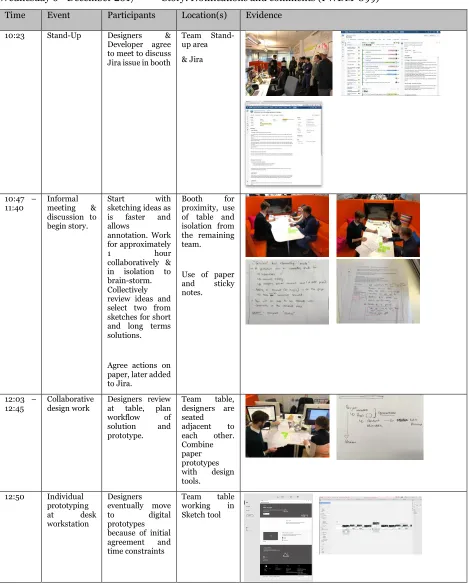
Through the continuous capturing of real-time data with added context and insight (Coghlan and Brannick 2014) for probing events which were supported through ongoing cycles of data collection and analysis. The work activities were captured as vignettes using a crafted research instrument (see Appendix A. Example of data collection instrument). This created discrete units of analysis for tracing digital-physical interactions with due consideration of their temporal nature.
2. Semi-structured interviews: one of the most important sources of case study data as they provide essential sources of information which enable focus directly on the case study topic (Yin 2009). A draft interview guide driven by the research question, theoretical framework and underlying philosophy was developed using the seven stages framework (Kvale 1996) and suitable interview preparation guidelines (Collis and Hussey 2009; Robson 1993). Interviews with over 40 participants from project teams lasted between 30 minutes to 1 hour, considered valuable enough to capture the required data and optimise the numbers of persons willing to participate in interviews without placing unreasonable demands on busy interviewees and leading to participation bias (Robson 1993). All interviews were recorded with permission and subsequently transcribed for data analysis.
3. Time-lapse video recording: we used a mobile phone to capture the use of offices over a long period of time using a function in modern smartphones that grabs an image on a regular timed basis and then collates all the images as an animation. The typical duration was 60 minutes. This allowed us to capture practices over time. This innovative approach to data collection provided unique insights for this study around the usage of digital-physical space. Although it is not feasible to display the results of this method within this paper, the analysis of the footage was instrumental in identifying the entangled nature of physical and digital features, which we hadn’t been able to capture as clearly through written or static methods.
A laptop computer, smartphone and notepad were used to record details of the activities (notes, sounds, pictures, video) of participants. Data collected include the nature, location and duration of activities. This method provided a rich and detailed thick description of events within a natural and meaningful context (Fetterman 2010). The data analysis was based on axial coding, to explore inherent connections between primary codes. We coded for features, properties, behaviours, practices, perceptions and the implied and expressed creation of spaces for the various work activities studied.
Findings
Physical environment
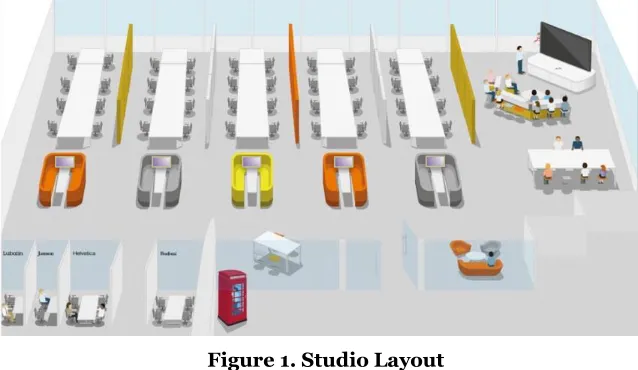
The IBM Studio as illustrated by Figure 1 was designed and presented within IBM as a new office model with distinct features to attract and support new working practices within IBM. The layout and features intended to attract employees back to the office and support increased collaboration and social interaction using Agile methods of team working (Rigby et al. 2016). The layout was split into five team-based areas, each based around a large team desk for 8-12 members responsible for software development of web-based technologies. Each team area was separated with moveable whiteboards which visibly and acoustically segregated teams as represented in Figure 1. These whiteboards were typically used by each team for writing or status tracking with hand drawing or an arrangement of sticky notes.
Figure 1. Studio Layout
Each team sat co-located at their respective shared desk with no physical barriers between the respective team members. Each individual team members workplace typically comprised a laptop and secondary display. Due to the proximity and employee density at each desk, team members often use noise-cancelling headphones for concentration during individual work. Each team had access to a booth located at the end of their team desk which comprised a digital display and seating for 4-6 team members with some physical separation and sound proofing from other team members. The studio also included a wide range of communal spaces including four closed-glass meeting rooms designed for increased privacy or meetings. In addition, there were also four break-out areas for sharing of ideas and group-based discussion. Two of these designed for small groups, the first with an arrangement of sofas and the second with a high-top table and chairs. For larger groups, there was a large standing desk (so-called Titanic table) or an auditorium style seating area (Mediascape) which could accommodate approximately 20 people facing a large display.
Digital environment
Teams were also able to select from a wide range of team collaboration and software development tools including IBM products, open source and licensed software. The use of specific digital tools was also not prescribed by the company, rather employees were given autonomy to appropriate tools based on their needs and preferences as explained by an IT executive:
“We did not perform thorough analysis to select the early tools…. a lot of it was initially just talking to people who we thought were better than us in terms of their practices and their
outcomes and finding ways that we could copy and adopt those practices.”
Although the physical and digital environments were created with potential use cases in-mind, the appropriation of the elements of these environments remained flexible with a high degree of adaptability. One common theme was the adoption of a suite of digitally integrated collaboration tools to support work within and across teams. These included the project management platform Jira, the software version control service GitHub and the messaging platform Slack. The similarity between physical and digital environments was evident and reflects the level of integration between the two environments. This is captured in this quote from a business analyst:
“I see where I work as both physical and digital space.…I think that has changed due to a large
move toward co-location, so it will be lots of teams working digitally together in close physical
proximity.”
Mirroring of physical and digital
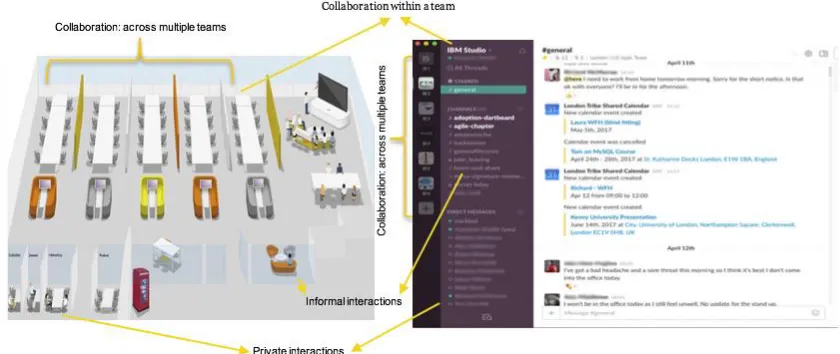
When observing the use of physical environment and digital tools, it was apparent how the properties and features of the digital tools mirror the configurations of the physical environment within the studio. For example, similarly to the physical studio layout, Slack enables interaction to take place within dedicated
‘team spaces’ which can then be regrouped into more focused interactions within channels. While the digital
of the office layout. Informal one-to-one and private interactions within Slack are also available as an enhancement or extension of the physical breakout areas and meeting rooms as supported by the following quote from a designer (add specific reference):
“The digital tools tie together the physical spaces because you have more opportunities to interact, you have the physical and the digital, so if two people need to communicate they’ve got a host of ways of doing it.”
The mirroring of emergent physical and digital structure is illustrated in Figure 2. It is however worth noting that in particular, the digital structures, labels and arrangements were not enforced or imposed, but instead constantly negotiated and established by the teams in the environment.
[image:10.612.80.500.223.400.2]
Figure 2. Mirroring of Physical and Digital Spaces
In the next section we draw on the key concepts presented earlier from an ontogenetic perspective to conceptualise the emergence of three types of entangled workspaces within this team at IBM Studio. It is important to note that each of these workspaces, as we will show, developed distinct attributes that reflects unique modulations of software and physical features of the work environment.
Entangled workspaces
Our data showed that the IBM Studio team structured three types of entangled workspaces, which similarly to the concept of ‘code/spaces’, tightly integrate features of the physical and digital environments of work, in a way that are intemperate. In other words, the functioning of these workspaces constitutively depends on features of both physical and digital environments, engendering unique types of modulation. The workspaces result of unique assemblages of features appropriated by the IBM Studio teams in response to these modulations, and, as the empirical evidence shows, the teams performed and crafted these assemblages daily as part of their routines of work. This extends the concept of ‘code/space’ from Kitchin and Dodge since we find an active process of modification of the physical-digital assemblages as a result from different types of modulations in entangled workspaces. Below we describe these three workspaces in some detail and then discuss and analyse these findings more theoretically in the following section.
Workspace 1: for permanent and ongoing interactions
There were daily routines part of agile practices and ceremonies that would involve teams to congregate around the same area, typically standing around the “wall of work” (see Figure 3). This would involve teams
to initiate their ‘stand-up meeting’ each morning at around 9:45am. The meeting was typically preceded by
prompt in the office room, a message in the digital platform was the announcement medium to call the meeting. This message would prompt locally based team members to stand and congregate around the team table, whilst remote team members working from other offices or home would join via video conference as shown in Figure 3. Here the team would provide status updates with references to Jira items, the project tracking platform where task status is logged and tracked.
In this example, the Slack channel, video conference session and team stand-up area (including the “wall of work”), modulate the performance of a workspace that emerges from the assemblage of physical artefacts and digital features. Team members navigate seamlessly between interactions in the digital platform and in the physical office areas. Both physical and digital environments are indispensable to perform the resulting spatialities with associated effects of visibility and proximity of the activities of the team members, regardless if they are physically present or “digitally close” through the technological artefacts of the digital environment.
Workspace 2: for immediate and focused interactions
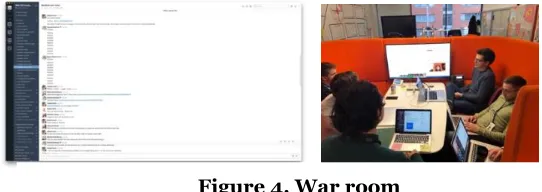
At the other extreme, when the team were faced with an unexpected high-priority problem, including an outage or major defect, they would form and adopt a ‘war room’ as the space for coordinating and mediating work to address it. This was enacted to force relevant team members to abandon their regular planned activities to come together and focus on resolving the problem. The war room would involve physical congregation at the booth at the end of the desk space (see Figure 4), for team discussions which allowed the team to be around a shared visual display to show and share visuals and information. Whilst seated in close proximity, team members would track activity over time using a dedicated channel in Slack called “#war-room” and a Jira ticket as shown in Figure 4. The issue was collectively triaged using GitHub and software development and performance monitoring tools. Within the entangled “war room” space, communication seamlessly flowed across face-to-face and digital interactions with no visible conscious effort to consider these transitions.
[image:11.612.153.424.230.342.2]This type of entangled workspace displayed a different type of modulation between physical and digital, it was brought to being by the need for immediacy and fast response. The digital features such as the hashtag ‘#war-room’ and Slack channel signalled this, and these triggered action within the team space. Frequent Slack activity informed discussions within the team and recorded new actions. The physical proximity of the team meant that some of the digital interactions were limited to formal or auditable interaction, whilst the physical environment modulated the pace of interactions across digital and physical environments.
Figure 3. Agile stand-up
[image:11.612.163.434.521.617.2]Workspace 3: for project-based interactions
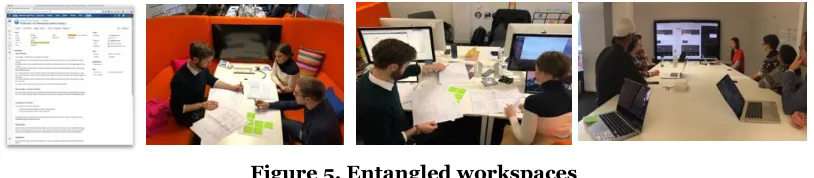
The third type of entangled workspace involved routine work activities of a more longitudinal but focused nature. The agile ‘stories’ would begin with task assignment in Jira, which would result in automated email and Slack notifications being sent to these team members. To address the task, these notified team members would come together for face-to-face interaction in communal collaborative physical spaces such as the booth and surrounding breakout areas. Here team members often preferred to manipulate physical objects
such as “post it” notes and visual diagrams during brain-storming sessions for rapid feedback and revision.
The outputs from these interactions would then be transferred back into Jira, the project tracking platform. As the task progressed through implementation, the emergent spaces of interaction extended increasingly into digital tools which were configured to prompt team members to discuss and review the software artefacts by meeting around desks as shown in Figure 5.
This type of workspace displayed deep entanglement between physical and digital, the use of the digital tools was highly dependent on the activities that happened in the office, for example the card sorting reflected on Jira. This is what Kitching and Dodge refer to a code/space, but both the code modulated the use of space and the space modulated the code.
Discussion
Our findings show the emergence of three types of entangled workspaces characterised by unique assemblages of features of digital tools and features of the physical environment part of the IBM studio. These emergent assemblages resulted from ongoing adjustments and shared understanding of the properties of the various aspects of the team’s environment. It was also noticeable the degree of freedom and sense of empowerment displayed by the ability of the teams to repurpose the environment to their needs. We observed the same “places” of work became different “spaces” when appropriated by the teams in different ways. The ontogenetic perspective of the entangled workspaces revealed different modulations by physical and digital features. This coincides with the characteristics of code/space as indicated by Kitchin
and Dodge: “code/space is not consistently produced, not always manufactured and experienced
identically. Instead, code/space is constantly in a state of becoming, produced through individual performance and social interactions that are mediated, consciously or unconsciously, in relation to the
mutual constitution of code/space” (Kitchin and Dodge 2014, p.74).
Nevertheless, in our conceptualisation of entangled workspaces, which was confirmed by empirical evidence, is not just digital (code) that modulates the usage of physical environments, as theorised by Kitchin and Dodge, but also features of the physical environment and face-to-face interactions modulate the use, configuration and adoption of digital tools by the teams. The ongoing practices of software development teams enacted new types of spaces that responded to their individual needs, creating workspaces that depend on assemblages of physical and digital environments to come into being, whilst also transcending both.
These orderings or assemblages engendered spatialities that supported activities and interactions across physical and digital environments. They were purposefully created in response to the needs of the team to
support the flow of interactions. The teams “crafted” new workspaces that served their needs by
[image:12.612.108.515.218.307.2]appropriating useful features of both physical and digital environments into various assemblages. Each assemblage in turn modulates in a particular way the entangled workspaces where different work activities unfold. They transcend the physical and digital environments and are seen as performative by the teams.
From this perspective, we say that these workspaces transcend the physical and digital environments where the teams operate, but only become instantiated by the appropriation of features of both environments. This ongoing crafting of workspaces was in part a result of the flexible nature of both physical and digital environments in our case and the relatively non-prescriptive management style surrounding the teams. Our data revealed the importance and role of physical environment in the activities and practices of the teams. Physical interactions were integral to their practices and deeply entangled with digital interactions and activities. The relationship between both environments was however very symbiotic. The crafting of these workspaces reflected ideals or potential “templates” that became references for the types of assemblages we then captured in our data collection.
We suggest that this perspective of entangled space in organisations provides a novel conceptualisation of how current workspaces emerge from physical environments and digital tools. This conceptual lens allowed us to discern types of workspaces where particular kinds of modulations engender specific spatialities. Thus, this study provides a conceptual basis to study space in information systems and provides the background to developing a notion of sociospaciality in information systems research.
Conclusion
This study explores the role of space and digital technology on modern organisations, this topic is somehow void in information systems research. We contribute with an exploration and conceptualisation of the role of space in digital work. We specifically conceptualise the emergence of entangled workspaces that transcend divisions between digital and physical environments. We capture the process by which these spaces are purposefully crafted by software development teams at the IBM Studio. We draw on the concept of code/space by Kitchin and Dodge to explain how code and software modulates the use of physical environment, but extend this notion with the concept of entangled workspaces that also capture situations where physical features and interactions modulate the spatial usage, configuration and appropriation of digital tools.
This conceptual basis enables us to reveal unique characteristics within organisations where teams appropriate features from both types of environment in response to ongoing needs. We suggest that these
entangled workspaces are “crafted” by the appropriation of these features. The study provides new
conceptualisation of workspace but also new and useful vocabulary to explain the evolving nature of workspaces in modern organisations. The underlying ontogenetic nature of space is particularly significant and we believe an important and valuable contribution to the information systems field.
The empirical setting of software development teams at the IBM Studio may reflect extreme conditions because teams are highly capable in configuring digital tools, and the type of routines and of practices are structured around software development. However, the work performed essentially consists of collaboration and coordination tasks that are likely relevant in other organisational environments. The process of assembling physical and digital tools may therefore be amplified in this case but it is not unique to it and offers a glimpse at similar dynamics emerging in other sectors and types of collocated team work in different organisations.
References
De Albuquerque, J.P. and Christ, M. 2015. The tension between business process modelling and flexibility: Revealing multiple dimensions with a sociomaterial approach. Journal of Strategic Information Systems, 24(3), pp.189–202.
Alvesson, M. 2017. Methodology for Close up Studies : Struggling with Closeness and Closure. Higher Education, 46(2), pp.167–193.
Baptista, J. 2009. Institutionalisation as a process of interplay between technology and its organisational context of use. Journal of Information Technology, 24(4), pp.305–319.
Barad, K. 2003. Posthumanist Performativity: Toward an Understanding of How Matter Comes to Matter.
Signs: Journal of Women in Culture and Society, 28(3), pp.801–831.
Bjerrum, E.Bjerrum, E.Bødker, S.and Bødker, S. 2003. Learning and living in the “new office.” Proceedings of the eighth conference on European Conference on Computer Supported Cooperative Work, (September), pp.199–218.
Certeau, M. de 1984. The Practice of Everyday Life, Berkeley, CA: The University of California Press. Clegg, S. and Kornberger, M. 2006. Space, organizations and management theory, Copenhagen Business
School Press.
Coghlan, D. and Brannick, T. 2014. Doing Action Research in Your Own Organization, Sage Publications Ltd.
Collis, J. and Hussey, R. 2009. Business Research: A practical guide for undergraduate and postgraduate students., London: Palgrave.
Crang, M. and Thrift, N. 2000. Thinking space, London: Routledge.
Dale, K. and Burrell, G. 2008. The spaces of organisation and the organisation of space: power, identity and materiality at work, Palgrave.
Davis, M.C.Leach, D.J.and Clegg, C.W. 2011. The Physical Environment of the Office: Contemporary and Emerging Issues. In International Review of Industrial and Organizational Psychology 2011. pp. 193–237.
Dixon, K.R. and Panteli, N. 2010. From virtual teams to virtuality in teams. Human Relations, 63(8), pp.1177–1197.
Dodge, M. and Kitchin, R. 2005. Code and the Transduction of Space. Annals of the Association of American geographers, 95(1), pp.162–180.
Easterby-Smith, M.Thorpe, R.and Jackson, P. 2012. Management Research, Sage.
Fayard, A. 2012. A Sense of Place: The Production of Virtual and Physical Spaces. In P. M. Leonardi, B. Nardi, & J. Kallinikos, eds. Materiality and Organizing: Social Interaction in a Technological World. Oxford: Oxford University Press.
Fayard, A. and Weeks, J. 2007. Photocopiers and Water-coolers: The Affordances of Informal Interaction.
Organization Studies, 28(5), pp.605–634.
Fayard, A. and Weeks, J. 2011. Who moved my cube? Harvard Business Review, 89. Fetterman, D.M. 2010. Ethnography Step By Step 3rd ed., Sage Publications, Inc. Flecker, J. 2016. Space, Place and Global Digital Work, Palgrave Macmillan.
Fulk, J. and DeSanctis, G. 1995. Electronic communication and changing organizational forms.
Organization Science, 6(4), pp.337–349.
Gaver, W.W. 1992. The Affordances of Media Spaces for Collaboration. Cscw 92, 92(November), pp.17–24. Hammersley, M. and Atkinson, P. 2007. Ethnography: principles in practice 3rd ed., Sage Publications,
Inc.
Heath, C. and Luff, P. 1992. Collaboration and control: Crisis management and multimedia technology in London Underground control rooms. Computer Supported Cooperative Work, 1(1990), pp.69–94. Hernes, T. 2004. The spatial construction of organization, John Benjamins Publishing Company.
Hiikkinen, L. and Kivinen, N. 2013. Writing Spaces — Performativity in Media Work. In Materiality and Space. Technology, Work and Globalization. London: Palgrave Macmillan.
IBM 2014. IBM News room - 2014-03-27 IBM Commits $100 Million to Globally Expand Unique Consulting Model That Fuses Strategy, Data and Design - United States.
Introna, L.D. 2013. Epilogue: Performativity and the becoming of sociomaterial assemblages1. In
Materiality and Space: Organizations, Artefacts and Practices,. London: Palgrave Macmillan, pp. 330–342.
(2014), pp.65–80.
Kolb, D.G.Caza, a.and Collins, P.D. 2012. States of Connectivity: New Questions and New Directions.
Organization Studies, 33(2), pp.267–273.
Kornberger, M. and Clegg, S.R. 2004. Bringing Space Back in: Organizing the Generative Building.
Organization Studies, 25(7), pp.1095–1114.
Kvale, S. 1996. InterViews: An Introduction to Qualitative Research Interviewing, Sage Publications, Inc. Latour, B. 1986. The powers of association. In Power, Action and Belief. London: Routledge, pp. 264–280. Lefebvre, H. 1991. The Production of Space, Oxford: Blackwell.
Leonardi, P.M. 2015. Studying Work Practices in Organizations: Theoretical Considerations and Empirical Guidelines. Annals of the International Communication Association, 39, pp.235–273.
Leonardi, P.M. 2013. Theoretical foundations for the study of sociomateriality. Information and Organization, 23(2), pp.59–76.
Leonardi, P.M. 2011. When Flexible Routines Meet Flexible Technologies: Affordance, Constraint, and the Imbrication of Human and Material Agencies. MIS Quarterly, 35(1), pp.147–168.
Leonardi, P.M.Huysman, M.and Steinfield, C. 2013. Enterprise social media: Definition, history, and prospects for the study of social technologies in organizations. Journal of Computer-Mediated Communication, 19(1), pp.1–19.
MacCormick, J.S.Dery, K.and Kolb, D.G. 2012. Engaged or just connected? Smartphones and employee engagement. Organizational Dynamics, 41(3), pp.194–201.
Mackenzie, A. 2003. Transduction: invention, innovation and collective life. Massey, D. 2005. For Space, London: Sage Publications Ltd.
Massey, D.Sarre, P.and Allen, J. 1999. Human geography today, Cambridge: Polity Press.
Maxwell, J. 2009. Designing a Qualitative Study. The SAGE Handbook of Applied Social Research Methods, pp.214–253.
Mazmanian, M. 2013. Avoiding the trap of constant connectivity: When congruent frames allow for heterogeneous practices. Academy of Management Journal, 56(5), pp.1225–1250.
Mazmanian, M.Orlikowski, W.J.and Yates, J. 2013. The Autonomy Paradox: The Implications of Mobile Email Devices for Knowledge Professionals. Organization Science, 24(5), pp.1337–1357.
Metiu, A. 2006. Owning the Code: Status Closure in Distributed Groups. Organization Science, 17(4), pp.418–435.
Newell, S.Scarbrough, H.and Swan, J. 2001. From global knowledge management to internal electronic fences: Contradictory outcomes of intranet development. British Journal of Management, 12, pp.97– 111.
Orlikowski, W.J. 2007. Sociomaterial Practices: Exploring Technology at Work. Organization Studies, 28(9), pp.1435–1448.
Orlikowski, W.J. 2000. Using Technology and Constituting Structures: A Practice Lens for Studying Technology in Organizations. Organization Science, 11(4), pp.404–428.
Orlikowski, W.J. and Scott, S. V. 2008. Sociomateriality: challenging the separation of technology, work and organization. Academy of Management Annals, 2(1), pp.433–474.
Patton, M.P. 1990. Qualitative evaluation and research methods 2nd ed., Newbury Park, CA: Sage. Pickering, A. 1995. The Mangle of Practice: Time, Agency, and Science, University of Chicago Press. Rigby, D.K.Sutherland, J.and Takeuchi, H. 2016. Embracing agile. Harvard Business Review, (May),
pp.41–50.
Robson, C. 1993. Real World Research A Resource for Social Scientists and Practitioner-Researchers, John Wiley & Sons.
Saunders, M.Lewis, P.and Thornhill, A. 2008. Research Methods for Business Students,
Simons, J. 2017. IBM, a Pioneer of Remote Work, Calls Workers Back to the Office - WSJ. The Wall Street Journal. Available at: https://www.wsj.com/articles/ibm-a-pioneer-of-remote-work-calls-workers-back-to-the-office-1495108802 [Accessed May 28, 2017].
Taylor, S. and Spicer, A. 2007. Time for space: A narrative review of research on organizational spaces.
International Journal of Management Reviews, 9(4), pp.325–346.
Townsend, A.M.DeMarie, S.M.and Hendrickson, A.R. 1998. Virtual teams: Technology and the workplace of the future. Academy of Management Perspectives, 12(3), pp.17–29.
Vaast, E. and Kaganer, E. 2013. Social media affordances and governance in the workplace: An examination of organizational policies. Journal of Computer-Mediated Communication, 19(1), pp.78–101. de Vaujany, F.-X. and Mitev, N. 2013. Materiality and Space: Organizations, Artefacts and Practices. In
de Vaujany, F.-X. and Vaast, E. 2013. If These Walls Could Talk: The Mutual Construction of Organizational Space and Legitimacy. Organization Science, 25(3), pp.713–731.
Waber, B.Magnolfi, J.and Lindsay, G. 2014. Workspaces that move people. Harvard business review, 92(10), pp.121–77.
Wajcman, J. and Rose, E. 2011. Constant connectivity: rethinking interruptions at work. Organization Studies, 32(7), pp.941–961.
Weber, R. 2004. The Rhetoric of Positivism Versus Interpretivism: A Personal View. MIS Quarterly, 28(1), pp.iii–xii.
Weeks, J. and Fayard, A. 2011. Blurring Face-to-Face and Virtual Encounters. Harvard Business Review. Available at: https://hbr.org/2011/07/blurring-face-to-face-and-virt [Accessed April 3, 2017]. Yin, R.K. 2009. Case Study Research: Design and Methods, California: SAGE Publications, Inc.
Zammuto, R.F.Griffith, T.L.Majchrzak, A.Dougherty, D.J.and Faraj, S. 2007. Information Technology and the Changing Fabric of Organization. Organization Science, 18(5), pp.749–762.
Appendix A. Example of data collection instrument
Wednesday 6th December 2017 Story: Notifications and comments (PWDM-899)
Time Event Participants Location(s) Evidence
10:23 Stand-Up Designers & Developer agree to meet to discuss Jira issue in booth
Team Stand-up area & Jira
10:47 –
11:40 Informal meeting & discussion to begin story.
Start with sketching ideas as is faster and allows
annotation. Work for approximately 1 hour collaboratively & in isolation to brain-storm. Collectively review ideas and select two from sketches for short and long terms solutions.
Agree actions on paper, later added to Jira.
Booth for proximity, use of table and isolation from the remaining team.
Use of paper and sticky notes.
12:03 –
12:45 Collaborative design work Designers review at table, plan workflow of solution and prototype.
Team table, designers are seated adjacent to each other. Combine paper prototypes with design tools. 12:50 Individual
prototyping at desk workstation
Designers eventually move to digital prototypes because of initial agreement and time constraints
[image:17.612.73.542.105.690.2]