Original citation:
Fetzer, Thiemo, Vanden Eynde, Oliver and Wright, Austin L. (2018) Security transitions. Working Paper. Coventry: University of Warwick. Department of Economics. Warwick economics research papers series (WERPS) (1171). (Unpublished)
Permanent WRAP URL:
http://wrap.warwick.ac.uk/106391
Copyright and reuse:
The Warwick Research Archive Portal (WRAP) makes this work by researchers of the University of Warwick available open access under the following conditions. Copyright © and all moral rights to the version of the paper presented here belong to the individual author(s) and/or other copyright owners. To the extent reasonable and practicable the material made available in WRAP has been checked for eligibility before being made available.
Copies of full items can be used for personal research or study, educational, or not-for-profit purposes without prior permission or charge. Provided that the authors, title and full bibliographic details are credited, a hyperlink and/or URL is given for the original metadata page and the content is not changed in any way.
A note on versions:
The version presented here is a working paper or pre-print that may be later published elsewhere. If a published version is known of, the above WRAP URL will contain details on finding it.
Warwick Economics Research Papers
ISSN 2059-4283 (online)
Security Transitions
Thiemo Fetzer, Oliver Vanden Eynde & Austin L. Wright
(This paper also appears as CAGE discussion paper 383)
Security Transitions
∗
Thiemo Fetzer
†Oliver Vanden Eynde
‡Austin L. Wright
§July 18, 2018
Abstract
How do foreign powers disengage from a conflict? We study the recent large-scale security transition from international troops to local forces in the context of the ongoing civil conflict in Afghanistan. We construct a new dataset that com-bines information on this transition process with declassified conflict outcomes and previously unreleased quarterly survey data. Our empirical design leverages the staggered roll-out of the transition onset, together with a novel instrumental variables approach to estimate the impact of the two-phase security transition. We find that the initial security transfer to Afghan forces is marked by a significant, sharp and timely decline in insurgent violence. This effect reverses with the ac-tual physical withdrawal of foreign troops. We argue that this pattern is consistent with a signaling model, in which the insurgents reduce violence strategically to facilitate the foreign military withdrawal. Our findings clarify the destabilizing consequences of withdrawal in one of the costliest conflicts in modern history and yield potentially actionable insights for designing future security transitions.
Keywords: Counterinsurgency, CivilConflict, PublicGoodsProvision
JEL Classification: D72, D74, L23
∗We thank Ethan Bueno de Mesquita, Wioletta Dziuda, Anthony Fowler, Hannes Mueller,
Christo-pher Price, Jacob Shapiro, and audiences at the Chicago Harris Political Economy, ESOC Annual Con-ference, University of Warwick, IAE Barcelona Workshop on Prediction for Prevention, HiCN confer-ence, CREST Political Economy Workshop, and Labex OSE Aussois Days. Manh Duc Nguyen provided excellent research assistance. Support from the Pearson Institute for the Study and Resolution of Con-flicts is gratefully acknowledged. We thank Phil Eles, ANQAR technical lead at NATO, for granting access to the platform and providing technical feedback. Any errors remain our own.
†Department of Economics, University of Warwick. Email:[email protected]. ‡Paris School of Economics and CNRS. Email:
1
Introduction
Foreign military occupations typically end with a security transition, in which
inter-national forces transfer military and police powers to local allies. Such foreign-to-local
security transitions are difficult to manage (Lake, 2016). This is due to the likely
sur-vival, in one form or another, of anti-government elements that triggered the foreign
military intervention to begin with. Therefore, a successful security transition is
cru-cial for the economic and political development of the local state that emerges in
the wake of military interventions. Yet surprisingly little is known about the conflict
dynamics of countries experiencing a foreign-to-local security transition. Our paper
relies on rich microlevel data to study the impact of the large-scale security
transi-tion that marked the end of Operatransi-tion Enduring Freedom in Afghanistan—NATO’s
long-running military campaign.
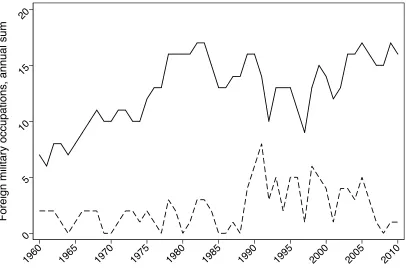
Since 1960, at least 115 foreign military occupations have ended (Collard-Wexler,
2013) (see Figure 1). A substantial percentage of these interventions involved the
withdrawal of troops and redeployment of weaponry to local allies. As Figure1
re-veals, security transitions remain an important economic and policy issue as a large
number of military occupations remain active globally. Even though the historical
record is riddled with security transitions, nearly all microlevel empirical research on
counterinsurgency focuses on understanding the economic and political drivers that
explain how military interventions begin and how conflict strategies and
warfight-ing tactics evolve within anongoing campaign. How foreign campaigns endhas been
mostly ignored in this literature (Berman and Matanock,2015). Empirical work on this
topic is naturally constrained by the lack of consistent conflict data during the
transi-tion period, in particular for unsuccessful transitransi-tions. Our paper relies on unique data
sources that were collected continuously during the transition process, which enables
us to address the knowledge gap around exit strategies after foreign interventions.
Conflict patterns during and after security transitions—which mark the end of a
foreign intervention or occupation—are theoretically ambiguous. A security
transi-tion may shift provision of policing and formal military operatransi-tions from well trained
and equipped foreign fighters to unseasoned local forces using unfamiliar or
unintended harm to civilians, or deliberately discriminate against ethnic rivals,
un-dermining economic welfare and damaging public confidence in the quality and
sta-bility of host nation institutions. Local forces might also transfer weaponry and other
warfighting capital to unregulated paramilitary groups (Dube and Naidu, 2015).
Un-der these conditions, insurgent operations are likely to increase, and their control over
previously contested territory may consolidate. On the other hand, local forces might
actually be more capable of integrating with communities within their operational
zone and extracting information from non-combatants about insurgent operations
(Lyall et al.,2015). Insurgents might also find it more difficult to mobilize support for
attacks on host nation forces as opposed to foreign soldiers. Knowledge of the
hu-man terrain and difficulties motivating violence against conationals or coethnics could
translate to reduced insurgent activity and increased counterinsurgent effectiveness.
Furthermore, insurgents may directly and strategically respond to plans of foreign
forces to withdraw troops by changing their underlying tactics and targets (Bueno de
Mesquita, 2013; Wright, 2016; Vanden Eynde, 2018). Lastly, security transitions may
be poorly coordinated between foreign and local forces, leading to political and
tac-tical disorder and further enhancing tensions and conflict. Importantly, there is no
existing empirical evidence on the relative significance of these different mechanisms
in the context of security transitions.
To study how security transitions from foreign to local forces influence insurgent
activity and counterinsurgent effectiveness, we examine the large-scale transfer of
policing and military power from the International Security Assistance Force (ISAF)
to host nation forces in Afghanistan at the end of Operation Enduring Freedom.
Char-acteristic of other foreign military interventions, the occupation of ISAF displaced the
incumbent regime and assisted in the installation of an ostensibly democratic
govern-ment in 2001. During the occupation, foreign forces coordinated under the auspices
of NATO helped train and equip local police and military forces. Planning for the
transition of security provision from ISAF to Afghan forces began as early as 2010,
and was formally announced in 2011. The transition was staggered, and coordinated
around administrative districts. Over three years, and five transition tranches, all of
We estimate the impact of the security transition on conflict dynamics using
ex-ceptionally granular data. Data limitations may be a central reason for why there
have been no prior quantitative studies on the impact of security transitions. We are
uniquely positioned to overcome this obstacle. Since the start of major ISAF
opera-tions, a system to collect comprehensive conflict data from ISAF and host nation forces
was set up to track significant activities, referred to as SIGACTS. These event data are
geotagged and timestamped, and document dozens of different types of insurgent
and security force operations. Access to this database was secured through formal
declassification channels and represents the most complete catalog of conflict activity
during Operation Enduring Freedom currently available (Shaver and Wright, 2016).
We combine this observational data with microlevel survey data collected by NATO
(using local contractors) through the Afghanistan National Quarterly Assessment
Re-search (ANQAR) platform. The primary aim of the survey was to provide and collect
data on perceptions of the security situation from Afghan citizens across the country
in a systematic manner. We have obtained restricted access to the complete survey
records of around 370,000 individual respondents across dozens of quarterly waves
from 2008 to 2016. These surveys include multiple questions measuring respondent’s
perceptions of security conditions, the extent of local security provision and
percep-tions of territorial control. These measures will allow us to validate our findings based
on conflict measures, and to distinguish between potential mechanisms.1
Our empirical analysis sheds light on the two main phases of the security
transi-tion. The first phase is the onset of the transition marked by a sequence of public
an-nouncements providing lists of districts where security responsibility is to be handed
over to local forces from a given date onwards. The second phase is the actual physical
withdrawal and closure of military bases hosting NATO troops. To estimate the effect
of the onset of the security transition, we use a difference-in-difference approach. We
exploit the staggered schedule of transition announcements that occurred across five
tranches. This allows us to pool five difference-in-difference estimators to study the
effect of the onset of the security transition on conflict outcomes, comparing localities
where the Afghan National Security Forces (ANSF) took over security to those where
1Existing work rarely combines observational and survey data on conflicts. Exceptions areGould
ISAF is still in charge, before and after the security transfer. The geographic precision
of our conflict data enables us to employ a high resolution spatial matching design as
an alternative to our district-level analysis. Our results show that the local
announce-ment of the security transition schedule led to a short-term decline in local violence.
This pattern holds both for conflict measures drawn from the SIGACTS database as
well as ANQAR survey instruments measuring security perceptions of the local
pop-ulation. This improvement in security outcomes appears to have gone hand-in-hand
with a substantial upward shift in civilian perceptions of the efficacy of local security
forces.
Our second empirical exercise focuses on the physical withdrawal of NATO troops.
Using a newly constructed data set of individual base closures and handovers, we
employ an novel instrumental variables strategy exploiting operational and logistical
constraints to the organization of the troop withdrawal. This approach helps us to
address concerns about the endogeneity of the decision to close bases in one area
earlier compared to others. Our IV strategy relies on cross-sectional variation in the
travel distance between individual districts and ten major logistical hubs. These ten
hubs were central to the withdrawal as they had military grade airports that could
physically accommodate the heavy cargo airplanes that were used to transport arms
and troops out of the country. Our findings suggest that following the second phase
of the transition—the physical withdrawal of troops and closure of military bases—
violence significantly surged and perceptions of security worsened substantially. We
address potential violations of the exclusion restriction directly by accounting for
the correlation between logistical constraints and other measures of population and
market proximity. While our empirical design allows us to fully control for the direct
effect that the first phase of the security transition had on conflict, we also combine the
analysis from both phases in a single framework. Overall, the pattern that emerges
suggests that the transition onset announcement is associated with an improvement
in the security situation, while the physical withdrawal of NATO troops is marked by
a dramatic worsening of security.
We argue that these two pieces of evidence are consistent with insurgents
raised the cost of local re-intervention. We develop a simple model that rationalizes
this logic and treats the initial reduction in violence as a costly signal sent by the
Tal-iban to ISAF. As ISAF cannot directly observe the local capacity of the TalTal-iban relative
to the ANSF, it bases its decision to stick to a fixed withdrawal timeline on observed
levels of violence during the transition period. A high-capacity Taliban can then
de-cides to ‘lie low’ as part of a pooling equilibrium, which facilitates ISAF’s withdrawal,
and increases the ability of the Taliban to inflict violence when the transition is
com-pleted. Official documents of the US Department of Defense interpreted the initial
phases of the transition as a success, which is consistent with the idea that the
Tal-iban effectively understated their true capacity. Public opposition to the war in most
Western troop sending countries may have incentivized insurgents to make the
tran-sition appear successful until it became excessively costly for political and military
leaders to revert back. As such, ISAF’s public commitment to a timeline for a troop
withdrawal—an often criticized tactical decision—may have undermined the success
of the security transition.
Even if we lack a direct test of the ‘lying low’ strategy described above, the most
plausible alternative interpretation of our violence patterns can be investigated
di-rectly. In principle, the reduction in violence during the transfer phase and its rise
after the withdrawal of foreign troops could have been driven by complementarities
between ISAF and the ANSF. Relying on a range of empirical tests, we find no
evi-dence of such complementarities between ISAF and the ANSF. We can also rule out
other plausible alternative explanations.
We contribute to several strands of literature in economics and political science.
Prior work on the economics of civil war has largely focused on factors that cause
insurgencies to emerge (Fearon and Laitin, 2003; Collier and Hoeffler, 2004; Miguel
et al., 2004; Bazzi and Blattman, 2014; Berman et al., 2015), rather than how
insur-gents strategically respond to shifts in military power as occupations draw to a close.
In most countries, state capacity is central to these dynamics (Besley and Persson,
2009,2010; Powell, 2013; Gennaioli and Voth, 2015; Esteban et al., 2015;Sanchez de la
Sierra, 2017).2 In Afghanistan, recent work byCondra et al.(2018) shows that the
move-iban have disrupted core democratic institutions (elections), which undermines the
government’s state building efforts. Our study emphasizes another key component of
Afghanistan’s state building process—the gradual transfer of security to local forces.
And, our findings are in line withCondra et al.(2018) because we also document how
the strategic use of violence by the Taliban may have had an impact on the subsequent
consolidation of political control by government forces. More broadly, our paper fills
an important gap in the literature on interventions in civil wars, by examining the
conflict dynamics of a foreign-to-local security transfer.
A growing number of recent papers study security and development interventions
that occur within conflicts. These studies have produced mixed results. On the one
hand, development projects have been found to reduce conflict in Iraq (Berman et al.,
2011), India (Fetzer, 2014), and Afghanistan (Beath et al., 2013), which could be
be-cause they allow counter-insurgency forces to win “hearts and minds” or bebe-cause they
raise the opportunity cost of participating in conflict. But, evidence from the
Philip-pines (Crost et al., 2014) and contested areas in Afghanistan (Sexton, 2016) suggests
that development projects could also increase violence, possibly because the
insur-gents try to disrupt these programs. Nunn and Qian(2014) argue that food aid could
even extend the duration of conflicts by funding its participants indirectly. Violence
within conflicts may also respond to warfighting tactics. Dell and Querubin (2016)
show that US bombing runs in Vietnam increased operations of Viet Cong forces, in
line with earlier work by Kocher et al. (2011). A tactical choice in civil wars that is
particularly relevant for our paper is whether to rely on coethnic fighting units. Lyall
(2009) finds that coethnic forces in Chechnya were more effective than entirely foreign
(Russian) forces. However, the deployment of foreign and coethnic forces in
Chech-nya occurred throughout the conflict, and was not linked to an exit strategy. None
of these papers on economic or security interventions in conflict zones examine what
happens when foreign powers try to leave a war.
In parallel to the literature on interventions in ongoing conflicts, a growing
num-ber of papers study post-conflict societies. Existing work has found that development
aid and reconciliation programs can improve social cohesion after war (Fearon et al.,
ment, even if real world conflicts involve complex alliances between many actors in a networkK ¨onig
2009;Cilliers et al.,2016). Voigtlander and Voth(2012) find that denazification policies
implemented by occupying forces in Germany after the World War II had long-run
effects on anti-Semitic attitudes. Related work has shown that the experience of war
veterans can profoundly shape the societies they return to (Jha and Wilkinson, 2012;
Vanden Eynde, 2015), and that individual exposure to war violence could increase
prosocial behavior (Bellows and Miguel,2006;Blattman,2009;Bauer et al.,2016). This
literature has produced rich insights in the legacies of conflict, but it tends focus on
settings in which the conflict has clearly ended. This could be the case if there is a
credible peace agreement. As highlighted by Fearon (2004), commitment problems
preclude durable peace agreements in many civil wars. Our paper tries to
under-stand these complex environments, in which severe security threats may outlive
for-eign interventions and successful exit strategies are crucial for whether countries can
transition to “post-conflict” status.
Our study also yields potentially actionable insights regarding one of the
costli-est conflicts in modern history. Since 2001, the United States alone has invcostli-ested 1.07
trillion dollars in combat operations, economic assistance, and soldier healthcare
di-rectly related to the war in Afghanistan. The Pentagon estimates that continuing
annual costs of US operations after the security transition are roughly 45 billion
dol-lars; roughly six times Afghanistan’s yearly national budget. The human toll of the
war has also been substantial. As of April 2018, ISAF had lost 3,547 soldiers in
com-bat operations. In addition to these troop fatalities, more than 31,000 civilian deaths
have been documented during the conflict. The security transition marked a turning
point in the conflict, and it has been the subject of fierce political debates at all its
stages: when it was first announced, when it was implemented, and after it had been
completed. The evidence we present demonstrates how the withdrawal of foreign
forces influenced the stability of local political actors and institutions and how future
transitions might be managed more effectively, addressing a significant gap in our
understanding of a topic of immense economic and policy significance.
The paper proceeds as follows. First, we provide background on the security
transition in Afghanistan. Second, we introduce and describe the data used in this
four, we present the main results. Section five discusses the mechanisms that could
drive our findings, providing a simple conceptual framework as well as discussing
the external validity. Section six concludes.
2
Context and Data
2.1
Timing of the security transition
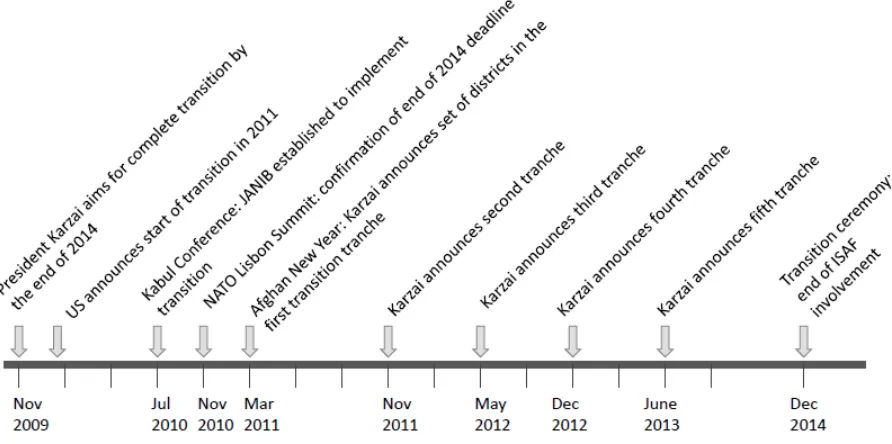
The ongoing war in Afghanistan, which started in 2001, saw a large number of NATO
countries participate in ground operations, under the umbrella of International
Secu-rity Assistance Force (ISAF). ISAF’s role, according to UN SecuSecu-rity Council Resolution
1386, was explicitly to assist the Afghan Interim Authority in rebuilding government
institutions and providing security. From its inception, the mission was conceived as a
temporary intervention, and the first steps towards a security transition were taken in
November 2009, when then-President Karzai announced the desire to see a complete
transition by the end of 2014. The US subsequently announced that the transition
pro-cess would begin in 2011. In July 2010, the Joint Afghan-NATO Inteqal Board (JANIB)
was established to implement the transition process. JANIB selected a first tranche
of districts for which the ANSF took over security, and President Karzai announced
these districts in March 2011. The process was completed in five tranches, with an
official transition ceremony to mark the completion of the transfers at the end of 2014.
These events are depicted on a timeline in Figure 2. The official transfer of security
responsibilitycould be considered as the first phase of the broader transition process,
with ISAF base closures and the ultimate physical withdrawal of ISAF troops as the
second phase. The next subsections discuss these two transition phases in detail.
2.2
Security transfer: assignment to transition tranches
In November 2010, the Joint Afghan NATO Inteqal Board (JANIB) convened for the
first time.3 Under the leadership of Dr. Ashraf Ghani (appointed by President Karzai
as the Chairman of the Afghan Transition Coordination Commission) and co-chaired
by ISAF Commander General Petraeus and NATO representatives, the JANIB
con-firmed the 2011-2014 transition timeline. It emphasized stability and self-sufficiency
as goals of transition. In February 2011, JANIB recommended the geographic areas
assessed as prepared to begin the transition process. Authorization to proceed from
Stabilization into Transition was decided by JANIB based on the following factors:4
1. The capability of the ANSF to shoulder additional security tasks with less
assis-tance from ISAF;
2. The level of security in the area and the degree to which the local populace was
able to pursue routine daily activities;
3. The development of local governance structures, so that security would not be
undermined as ISAF assistance diminished;
4. Whether the force level and posture of ISAF forces could be readjusted as the
ANSF expanded its capabilities and as threats to security were reduced.
Although these criteria suggest a rules-based approach, the actual assessments
and recommendations of the JANIB board were not made public and remain
classi-fied.5 The final decision on the assignment to transition tranches was taken by the
Afghan cabinet, where political considerations played an important role too,
imply-ing divergence from the intention of followimply-ing a rules-based approach. For example,
President Karzai is reported to have aimed at an ethnically- and regionally-balanced
first tranche, resulting in the inclusion of districts in the first tranche that were not
recommended.6 It was noted in 2012, that while NATO provided thorough security
assessments “ultimately, the transfer decision lies with President Hamid Karzai and
his principal advisor for transition, Ashraf Ghani. Complex political considerations,
4UK Parliament, Defence Committee, “Written Evidence from the Ministry of Defence”, session
2012-2013. See alsohttps://tinyurl.com/ya58xbzv.
5In principle, a condition-based tranche assignment could have relied on a quantitative assessment.
Any subsequent ranking could be leveraged in a regression discontinuity approach. However, we have been able to confirm neither the use of a ranking system nor the algorithm that could have been used in a quantitative assessment. Perhaps most importantly, the final tranche sequence was assigned by the Afghan government, not JANIB, and deviated from the board’s assessments in notable cases.
including ethnic balancing, at times influence the transfer decisions, despite ISAF’s
advice.”7 Concerns over whether the JANIB board stuck to the initial aspiration set
out in the Lisbon NATO summit of a conditions-based, not calendar-driven process is
highly questionable. As the process continued, the assignment of districts to different
transition tranches became more and more opaque.8
While the allocation of districts to transition tranches was subject to discretion,
NATO’s commitment to five tranches between 2011 and 2014 imposed severe
con-straints on the timing of the security transfers. The districts and their assignments
to the ultimate transition tranches are presented in Panel B of Figure3. Our various
difference-in-difference strategies will exploit the temporal variation generated by the
transition process, which we will discuss in detail in section3.
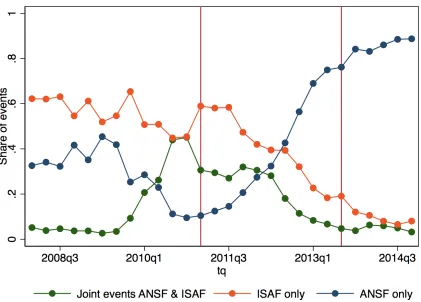
It is important to highlight that the security transfers marked a real shift in
respon-sibility, but did not represent a complete break. While ISAF troops were transferred
out of lead combat roles, the coalition maintained a supporting and advisory role even
after the transition. These trends are evident in Figure 4. This figure plots the share
of recorded events in the SIGACTS conflict dataset we describe in the next section
that involved coalition and/or Afghan security forces together. Prior to the transition
onset, as ISAF is preparing Afghan forces for the handover of security responsibility,
joint operations increase. This increase captures the fact that Afghan Forces are
de-ployed to the field. Towards the end of the transition, Afghan forces absorbed the vast
majority of all operations on their own. The transition announcement thus marks the
gradual handover of security responsibility to local forces, which typically took
be-tween 3-12 months to complete, during which which NATO gradually shifted into an
oversight and supporting role. The date of the announcement of a tranche and which
districts would participate in each wave was public information. We consider these
security transfers the first phase of the transition process. The second phase of the
transition was the formal withdrawal of troops and the closure of ISAF installation,
which we describe in the next subsection.
7Vanda Felbab-Brown, Brookings Institution, ”Afghanistan Field Trip Report VII: The Overall
Tran-sition in Afghanistan”,https://tinyurl.com/y9fzwkba.
8Afghan Analyst Network, “Opaque and Dilemma-Ridden: A look back at transition”, https:
2.3
Base closures
Over the course of ISAF’s engagement, up to 140,000 NATO troops operated out of an
estimated 825 physical bases scattered across Afghanistan. The withdrawal of most
NATO forces saw the closure, demolition, or handing over to Afghan Security Forces
of nearly 800 of these bases. The vast majority of these bases were small tactical
positions, such as Observation Posts, or Check points, that were hosting—at most—
small troop consignments (SIGAR, 2016). Only a handful of bases still remain in
NATO operation under ISAF’s small scale Resolute Support follow up mission that
currently involves around 15,000 troops and started officially on January 1st, 2015.
Collecting data on base-level deployments from more than 51 troop sending
coun-tries proved a major challenge. In the course of NATO’s engagement many small-scale
ad-hoc bases were set up and intermittently used as part of the military campaign
against the Taliban. Nevertheless, we identified a robust method for measuring and
coding base closures by focusing on a set of military facilities that regularly were
mentioned in the Department of Defense’s Periodic Occupational and Environmental
Monitoring Summary (POEMS). The POEMS provide information about the physical
environment and environmental hazards of main bases along with a list of names of
smaller bases out of which NATO troops operated. We restrict ourselves to the likely
set of larger bases such as Forward Operating Bases (FOBs), Camps, Combat Outposts
(COPs), and bases hosting the Provincial Reconstruction Teams (PRTs). While no clear
size ranking exists, Camps tend to be bigger than FOBs, which in turn are larger than
COPs. The PRTs are particularly important as most were operated by multinational
forces. Unfortunately, the POEMS does not provide exact location information or
ex-act data when bases ceased to be used for operations.9 However, we use the list of
338 main base locations extracted from POEMS and we conduct a systematic search
of sources and references for each base. In particular, we searched video and image
hosting platforms for timestamped video and image footage as many soldiers on
de-9Currently, the best available deployment data is the Order of Battle (ORBAT) platform. This data
ployment shared material on social media; we further conducted systematic searches
of main news sources using the LexisNexis and Factiva news databases, along with
standard search engine queries. For most bases we have several name variations as
bases were sometimes named after fallen soldiers and our list also includes a
substan-tial number of bases that were not exclusively under US command.
For a subset of 170 bases out of 338 main bases we were able to identify the district
in which they are located as well as confirming when the base was either Closed,
Handed over to the Afghan Security Forces, or Retrograded/Demolished using the
aforementioned secondary sources. We cannot confirm whether an individual base
that was handed over to the ANSF saw a subsequent deployment of Afghan forces. It
is also likely that our sample is biased towards including bases that were physically
not demolished but handed-over. Given the lack of spatial accuracy and the potential
measurement error, we aggregate the information to the district level, computing the
date in which the last base was either retrograded or handed over in a district. Lastly,
we also obtained data on the public handover ceremonies that were usually held at
the end of the formal withdrawal process in the provincial capitals. Since our base
closure data does not provide us with a date for all districts in a province, we infer
the physical withdrawal date based on these handover ceremonies, which formally
mark the end of the transition process.
Base transitions and withdrawals tend to happen after the formal transfer of
secu-rity responsibility (i.e. the first phase of the transition). Panel A of Figure5 presents
the timing of the transition tranche announcement relative to the recorded transition
ceremony or base closure in months. The pattern that emerges is quite evident: base
closures and handovers were happening earliest (lighter shades)—relative to the
tran-sition onset date—in remote areas relative to a few geographic centers. We will argue
and document a host of compelling anecdotal evidence that this pattern is a
conse-quence of the logistic organization of the withdrawal process and not a coincidence
2.4
Exploiting logistic constraints to construct an instrument for the
sequencing of base closures
The physical withdrawal of ISAF troops and material was a significant logistical
chal-lenge, which was impeded by several factors that we exploit to inform the
construc-tion of an instrumental variable to isolate as-if random variaconstruc-tion in the sequencing of
the physical closure of ISAF bases. First, being landlocked, the closest accessible sea
port was Karachi, Pakistan. From Afghanistan, Karachi can be reached by crossing
the Khyber Pass in the east, or via the Chaman border crossing in the south. Early
into the transition, Pakistan closed the borders for in- and out-bound NATO supplies
for seven months in 2011 and 2012, following an American air strike that accidentally
killed 24 Pakistani troops near the ill-defined border between the two countries in
November 2011. Unreliable access to Pakistan continued and the challenge to
navi-gate the treacherous south as well as the Khyber Pass limited the ability to transport
equipment via the most economical route to Karachi.10
Second, the only alternative land-based route was also constrained. In principle,
the so-called “Northern Distribution Network” gives access to Uzbekistan through
the northern border crossing of Hairatan (Sanderson and Petersen,2010). From there,
the Soviet-era rail system could be utilized to eventually reach the Black Sea and
Eu-rope. But land transports on this route need to traverse the 3,900-meter-high Salang
Pass, which is vulnerable to avalanches and landslides.11 Further, as a US General
William Fraser highlighted in a Senate hearing, the “existing agreements with
Tajik-istan, Kyrgyzstan, and Kazakhstan allowed equipment that is now in Afghanistan to
pass through their territory as the war draws down—but not any weapons.”12 This
implied that only light armored vehicles with the weapon systems removed could
be transported via the Northern route. This proved a severe problem as the
con-voys needed to be armed to defend themselves against attacks. Further, bureaucratic
hurdles at the border crossing implied significant delays and backlogs, which vastly
10Equipment crawls through Afghanistan to Pakistan, The Tribune Pakistan, https://tinyurl.
com/yaw7cpef.
11The Big Retrograde, The Economist,https://tinyurl.com/yapfzsor.
12U.S. General Says Closure Of Pakistan Supply Routes Complicates Afghan Pullout, Radio Free
limited the use of this route (see e.g. Felbab-Brown, 2012).
Third, transport of equipment, material and personnel for long distances within
Afghanistan is challenging due to the exposure of the convoys to attacks and due to
limitations on the road infrastructure. While being only slightly smaller than Texas—
which has around 501,000 kilometers of roads—Afghanistan has a road network of
only 42,150 kilometers out of which only 12,350 kilometers are paved.13
Fourth, the scale of the logistical task was enormous by any standard. It is
es-timated that the US alone had USD 36 billion worth of equipment in the country.
Roughly 3% of ISAF bases would subsequently remain under NATO control under
the small scale Resolute Support follow up mission.14 The remaining bases needed to
be handed over to the ANSF or be retrograded, which in many cases meant that they
were physically destroyed. For this, heavy machinery like fork-lifts and caterpillar
tractors were needed. Throughout this process, the ongoing security challenge was a
constant concern, resulting in the adoption of special measures to ensure that
equip-ment remaining in Afghanistan could not be turned into weapons.15 It was estimated
that the US needed to move an estimated 90,000 twenty foot shipping container’s of
equipment together with 50,000 vehicles. Overall, the dozens of troop-sending
coun-tries participating in ISAF are thought to have moved at least 70,000 vehicles and
120,000 containers (Loven, 2013).
The scale of the withdrawal operations along with the significant logistical
chal-lenges faced by ISAF forces implied that a small set of nodal bases with airfields suited
for heavy duty cargo machines played a crucial role. These nodal bases informed both
the timing and geographic sequencing of the pullout. The key nodes that were used
were Bagram Airfield near Kabul, along with Kandahar Airfield in the south and
Camp John Pratt near Mazar-i-Sharif in the north. These bases served as significant
Retrograde Sort Yards to consolidate the materials. Seven smaller Forward Retrograde
Elements were established to handle smaller cargo planes and to consolidate
mate-rials and equipment from bases within the vicinity.16 The consolidation of materials
13Seehttps://tinyurl.com/ybozco6kandhttps://tinyurl.com/yrkmrh.
14A salute for Afghanistan retrograde efforts, Army Times,https://tinyurl.com/yarnd86s. 15Getting Out Of Afghanistan, Fast Company,https://tinyurl.com/y9dxz3au.
16These were located at bases near Kabul, Jalalabad Airport, Shindand Airbase in the West, Camp
around main airhubs was necessary as the transport constraints by land implied that
only heavy duty long-haul transport planes, such as the Boeing C-17 Globemaster,
could economically transport military gear out of Afghanistan. A dedicated route
with up to seven trips a day was established between Kuwait and Afghanistan. From
Bagram Airfield alone, the 455th Expeditionary Aerial Port Squadron lifted out 84,000
tons of cargo (or 1,083 fully loaded Boeing C-17 carrying each 77.5 tons) between
Jan-uary and August 2014, as well as 134,000 passengers.17
As indicated, smaller or remote bases were handed over first with materials being
consolidated around larger bases. This is best illustrated using an example. Forward
Operating Base (FOB) Torkham in Momand Dara district of Nangarhar province was
formally handed over to the ANSF on December 18th, 2013. The base was located
right on the border with Pakistan; despite the relative proximity of a transit point to
leave Afghanistan, most of the equipment from FOB Torkham was sent 73 km inland
to Jalalabad Airfield by road and using sling-loaded CH-53 helicopters. From there,
materials were transferred an additional 185 kilometers to the Bagram Airfield north
of Kabul. There, the equipment was finally loaded on to heavy duty C-17 Globemaster
military cargo airplanes flying to Kuwait.18
The above discussion suggests that access to a small subset of NATO air-ready
bases was crucial up until the last stages of the military pullout. As a consequence,
bases were closed from the outside in, consecutively starting with the outlying bases
with difficult or limited access to these central transport hubs. We use this
informa-tion, together with information on the available road network, to construct a variable
capturing the travel distance on the least cost path to one of the ten logistical hubs.
The resulting instrument is presented in Panel B of Figure5. We will show that our
results are robust to controlling for a host of other distance measures, most
impor-tantly distance to the nearest airport of any type (i.e. including airfields not suited for
military planes or heavy cargo).
17NATO’s Afghan Drawdown Poses Logistics Challenges, Aviation Week, https://tinyurl.com/
ybyaq8gb.
2.5
Measuring Conflict Activity and Perceptions
In order to study the evolution of conflict around the transition, we rely on two
novel microlevel datasources that will allow us to combine results from institutionally
tracked conflict data with detailed survey data.
2.5.1 Significant Activities Event Data
Afghanistan provides a rich environment for investigating security transitions, and
as we describe below, our study overcomes several critical obstacles that usually limit
the ability to draw meaningful and robust inferences. We rely on newly declassified
microdata collected by ISAF and local national security partners. Throughout the
ongoing conflict, these security forces have tracked insurgent attacks by documenting
the approximate time and precise location of attacks perpetrated against them or
reported to them. This dataset includes more than 200,000 individual observations of
insurgent attacks between 2008 and 2014, each of which is identified by attack type
(e.g., direct fire attack, improvised explosive device). These data were secured by
Shaver and Wright(2016).
Afghan insurgents undertook several primary types of attacks throughout the war
involving direct fire and IEDs as well as other combat activity. Direct fire includes
attacks perpetrated at close range (direct line-of-sight encounters). Individual
insur-gents (often acting in groups) carry out these attacks in a variety of ways. IEDs tend to
be directed against moving targets (e.g., vehicle patrols and convoys) and are typically
placed on or immediately around roadways. Our data also tracks indirect fire combat
events. Indirect fire refers to attacks that include mortars and rockets, which can be
launched from much greater distances, but tend to be far less accurate. Nevertheless,
even when mortars and rockets fail to strike their intended target, they often create
loud explosions that can be heard over relatively large distances.
2.5.2 Afghanistan Nationwide Quarterly Assessment Research Survey Data
Our survey evidence relies on the Afghanistan Nationwide Quarterly Assessment
anti-government entities, and coalition partners. Survey responses are collected on
a quarterly basis. The firm contracted to design and implement most of the surveys
was ACSOR (an Afghan subsidiary of D3). This firm administered ANQAR Waves 1
through 10 and 16 through 38 (present). EUREKA conducted waves 11 to 15. Local (to
survey region) enumerators were selected by ACSOR and trained in proper household
and respondent selection, recording of questions, appropriate interview techniques,
and secure use of contact sheets. The administrative district is the primary sampling
unit (PSU) and are selected via probability proportional to size (PPS) systematic
sam-pling. Among sampled districts, secondary sampling units (villages/settlements) are
randomly selected. A random walk method is used to identify select households and
a Kish grid is use to randomize the target respondent within each selected household.
Before administering a survey wave, ACSOR contacts local elders to secure
permis-sion for enumerators to enter sample villages.19 When enumerators could not access
sampled villages, intercept interviews were used to collected information from
resi-dents traveling in neighboring areas (Child, 2016). Questions vary by survey wave,
but the questions most relevant to our investigation are consistently included.
Al-though early waves have higher non-response rates than later waves, these rates are
consistently lower (5-10%) than comparable nation surveys in the United States and
Europe. We have restricted access to data from 2008 to 2016, covering roughly 370,000
respondents, through a data-sharing agreement with NATO.
2.5.3 Other data sources used
We rely on digital placemats from ISAF archives to link districts to Regional
Com-mands, and we classify districts using a standardized administrative map compiled
by the Empirical Studies of Conflict (ESOC) research group. All events and survey
19Blair et al. (2014) note that ANQAR Wave 13 had high refusal and non-contact rates in several
waves are rectified to match this map. We incorporate information from Afghan
Com-mander’s Emergency Response Program (CERP), which is a military-led scheme for
small-scale development projects. These data were obtained through formal
chan-nels.20 In addition, our empirical analysis will include detailed land cover data, grid
cell population data, as well as measures of elevation and terrain features that we
exploit in our empirical designs.
3
Empirical strategy
Our paper studies the impact of the two main phases of the security transition: (1) the
transfer of control from ISAF to the ANSF and (2) the physical withdrawal of ISAF
troops. We rely on different strategies to estimate these effects, which we detail in this
section.
3.1
Security transfer to ANSF
Our baseline empirical strategy is a difference-in-difference approach, comparing
dis-tricts in which the security transition has been implemented to non-treated disdis-tricts,
before and after the transition.
yd,r,t =αd+βr,t+γ×ANSFd,t+ηd×t+ed,t (1)
In the equation above, dindicates the district, r the Regional Command (RC) and
t the quarter. ANSFd,t switches on when ANSF takes over from ISAF. At the district
and quarter level our outcome measuresyd,r,t come from both, the SIGACTS incident
and ANQAR survey data. While the SIGACTS data contains finer timestamps, the
ANQAR survey data are collected quarterly. In order to maintain consistency, we use
the quarterly frequency for the district-level analysis. We allow each district to follow
a specific linear trend ηd×t, and we allow for regional command specific non-linear
time effects (βr,t). The RC, indexed by r, served as most important organizational
units in ISAF and it is possible that reporting practices differed by regional command,
hence the choice of the time fixed effects.
Our preferred outcome for the SIGACTS data at the district level is the logarithm
of incidents (plus one). This specification allows us to capture changes on the
exten-sive and intenexten-sive margin, but is not sensitive to vertical outliers.21 Our estimate of
the coefficient γ captures the causal impact of the security transition as long as
con-flict in districts in different transition tranches where following common trends. As
discussed in the background section, the selection into different transition tranches
was based on a variety of factors, which were not clearly linked totrendsin violence.
To validate our estimates, we provide important evidence in support of the common
trends assumption based on event studies around the transition dates and based on
the estimation of pre-treatment effects. We introduce these tests later. As a baseline,
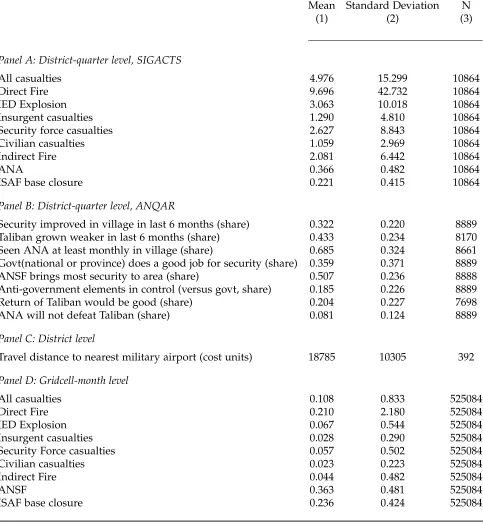
consider TableA1, which shows that several baseline characteristics were not balanced
at the district level. However, more violent districts are not systematically allocated
to later tranches. There are few significant differences between violence levels when
we compare tranches 1 to 2, 3 to 4, and 4 to 5. Only tranche 3 appears to have been
significantly more violent compared to its previous tranche.22 Our basic district-level
panel includes district specific linear time trends to alleviate the concerns associated
with these baseline differences.
In an attempt to relax the identification assumption that underlies our main
dis-trict level difference-in-difference approach, we change the unit of analysis to 10×10
km gridcells.23 This is only possible for the SIGACTs data, as the ANQAR survey data
is reported at the district level. In the resulting high-resolution dataset, we construct
pairs of matched gridcells. We rely on purely geographical characteristics of gridcells
measured at baseline, such as: grid level population (as of 2008), elevation, terrain
features, distance to nearest asphalt road, distance to nearest road, and distance to
the nearest airport. In addition we use land cover data and construct the share of grid
cells covered by different land cover type across sixteen land cover classes using the
21Our results are robust to using alternative transformations of the dependent variable. In particular,
for our subsequent grid cell level results will rely on binary violence outcomes.
22As a robustness check, we present treatment effects by tranche (in tableA7and we confirm that
our results are not driven by tranches 1 to 2, or 3 to 5.
23The choice of 10 x 10 km gridcells is appealing as this resolution is the basis of the geocoordinate
detailed 500m pixel resolution MODIS product (Channan et al., 2014). We proceed
by constructing these matched pairs sequentially sampling without replacement: we
first find matches for grid cells in the first transition waves by sampling from cells in
later waves, only retaining matched pairs that are sufficiently similar with a
propen-sity score difference of less than 0.01.24 Our main estimating sample is chosen such
that matched pairs are at least 200 km apart (we call these distant matched pairs).
This strategy allows us to rule out displacement effects, which could affect estimates
relying on close matched pairs.
The estimating specification for the distant matched panel difference-in-differences
is as follows:
yi,p,d,t =αi+βp,t+γ×ANSFd,t+ηd×t+ei,d,t (2)
As before, the level of analysis is gridcelli, that is part of a matched pair plocated
in district d, and month t. We include matched-pair specific time fixed effects βp,t.
These are very demanding, as for every matched pair, we allow conflict to be on a
dif-ferent trajectory common only to the cells that form the matched pair. This zooms in
to any time-varying changes that are specific to the matched-pair and accounts for any
non-linear trends specific to the propensity score. As in earlier specifications, ANSFd,t
switches on when ANSF takes over from ISAF. Since the distant matched pair panel
is very granular (both in terms of time and geography), we use dummy variables as
outcomes capturing the incidence of a conflict event within a given gridcell-month as
a more meaningful measure of conflict activity. The crucial identifying assumption
remains that there are common trends in conflict levels across observationally similar
distant matched grid cells in the different transition phases. TableA2 shows that we
achieve much better balance on conflict characteristics compared to the district level
when resorting to the distant matched pair analysis, yet, some important baseline
differences still exist. Importantly, as with the district-level difference-in-difference
strategy, relying on event studies around the transition dates, we will provide strong
evidence in support of the common trends assumption, necessary to enable us to
24This approach could result in a decay in match quality for later transition rounds, as the set of
interpret any estimated effects as causal.
3.2
ISAF troop withdrawal
At the end of the transition process, the vast majority of ISAF troops physically left
Afghanistan. While the troop withdrawal was made possible by the transfer of control
to the ANSF, its timing was not mechanically linked to the formal security transfers.
Unlike the transfer process, which was constrained by a fixed schedule in 5 tranches,
the decision to close or hand over individual bases was highly discretionary. Hence,
the identification of the effect of the withdrawal is particularly challenging. We try
to overcome these identification concerns by exploiting the importance of logistical
constraints for the withdrawal process. As described in section2.4, a small number of
military grade airports acted as crucial logistical hubs during the withdrawal process.
We hypothesize that bases that were furthest removed from these airports saw their
ISAF troops leave first once the transition process started (i.e., after 2011). We use a
a least cost path algorithm (illustrated in Figure 5) to calculate distances from every
district to the nearest military airport, and we use the interaction of this distance
measure with a dummy for the post-2011 period as an instrument for the ISAF troop
withdrawal. The corresponding first stage is:
wd,t =αd+γ×ANSFd,t+λ×Distance to Hubd×Postt+βt×Xd+ηd×t+ed,t (3)
wd,t is a dummy indicator that switches to 1 when the last military base has closed in
the district according to our dataset. This outcome is defined at the district level, and
its construction is described in detail in section2. We keep the security transfer in this
specification, as it typically precedes the withdrawal. To isolate the effect of distance
to military airports, our main specifications will control for time-varying effects of the
distance to the nearest airport (of any type) as well as distance to the province border
(i.e., these distance measures enter Xd). A more demanding specification includes
tranche-specific time effects, which fully absorb any level effect of the transition
cap-tured by the variable ANSFd,t, thus relying only on the within-tranche variation to
In the second stage, we model violence outcomes yd,t with the following
specifica-tion:
yd,t =αd+γ×ANSFd,t+κ×wˆd,t+βt×Xd+ηd×t+ed,t (4)
For the exclusion restriction to hold, the differential effect of the distance to
mil-itary grade airports after 2011 on conflict outcomes can only operate through the
withdrawal of ISAF troops. This assumption could be violated if our distance
mea-sure proxies for, as an example, market integration. The inclusion of time-varying
effects of other market-oriented distances like distance to any type of airport in our
vector of covariates Xd addresses this concern. We also control for time-varying
ef-fects of additional baseline characteristics as a further robustness check, which do not
affect our results. As the base closure measure is defined at the district level, this is
the most natural unit for us to examine. However, the distant matched pair (grid)
specification can easily be augmented with the (instrumented) base closure measure
wd,t, which we consider as a robustness check (see Figure8).
4
Main Results
The discussion first focuses on the effect of the security transfer to ANSF, and then
estimates the separate impact of the ISAF troop withdrawal, along the lines discussed
in our empirical strategy.
4.1
Phase I: Security transfer to ANSF
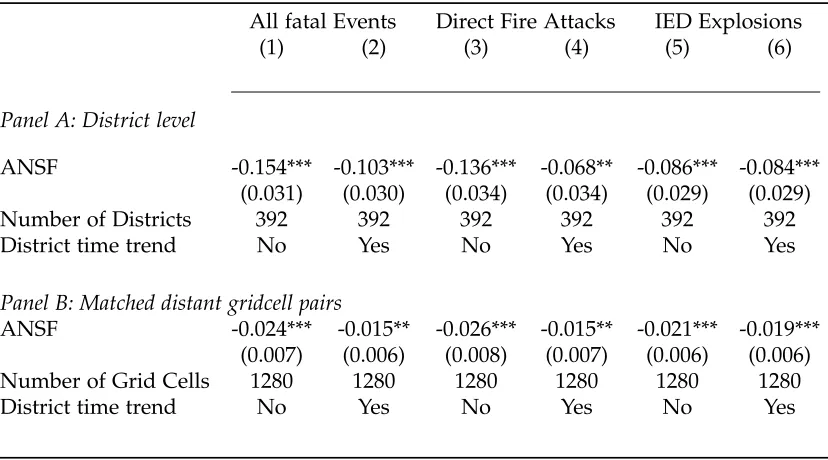
Table 2 shows the effects of the security transition for important conflict outcomes
captured in our military records—fatal events, direct fire attacks, and IED explosions.
Our baseline difference-in-difference specification at the district level shows that the
intensity of violence dropped sharply when the ANSF became responsible for security
provision. The estimated decline is around 10% for all outcomes. While the inclusion
of district-specific trends and RC × time fixed effects weakens the results slightly,
speci-fication. The gridcell-level outcomes see similar reductions in violence. The implied
reductions in violence are even larger—up to 30%, although it should be kept in mind
that this is at the extensive margin and for the subsample of matched gridcells. To
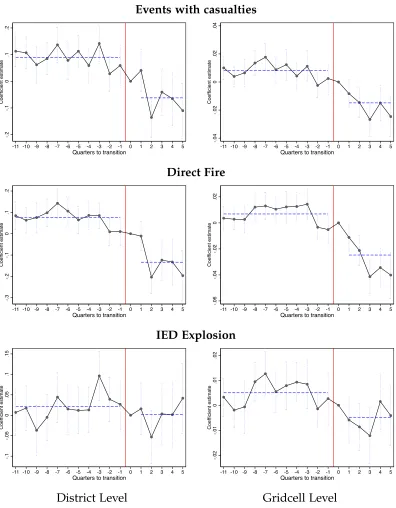
validate our estimates, we introduce a number of event studies, which are presented
in Figure 6. They provide compelling evidence of the common trends assumption
that underlies our difference-in-difference estimates. We see very flat trends prior to
the security transition and marked drops, once security responsibility had been
for-mally handed over to ANSF, which is indicated by the vertical line in the subfigures.
In Figure 7, we present coefficient estimates from our main specification for a wider
set of violence outcomes (both at the district in the left panel and the gridcell level
in the right panel). These additional outcomes include fatal events involving security
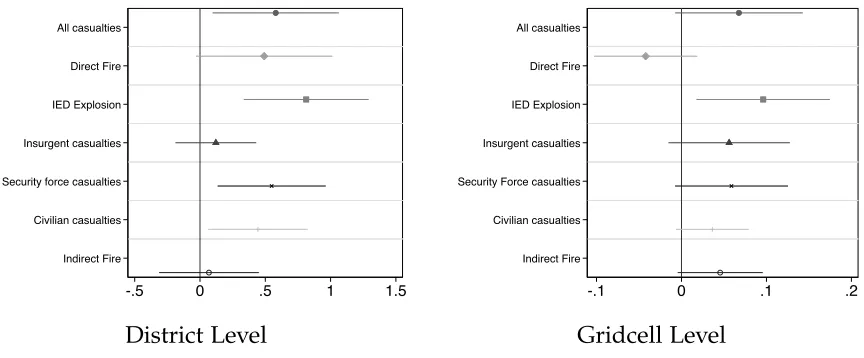
forces, civilians, and insurgents, as well as indirect fire attacks. Across this broader
set of violence measures, we observe consistent drops in conflict measures after the
responsibility for security provision has been transferred to ANSF.
Table 3 shows results for ANQAR survey responses. The ANQAR data are only
available at the district level and, for consistency, we report results for the most
de-manding specifications at this level. Table3includes measures that are systematically
collected across the multitude of different ANQAR survey waves independently from
the SIGACTS data. These results suggest that the shift in security perceptions matches
the changes we observed in the tactical reports. An increased share of respondents
reported security improved in the last 6 months after the ANSF took over security
(column 1) and they perceive that the Taliban had grown weaker since the transition
(column 2). Moreover, respondents were more likely to have seen the Afghan National
Army (ANA, i.e. the most important component of the ANSF) in their village at least
once a month (column 3), and they were more likely to respond that the Afghan forces
bring security to their area (column 5). This suggests that the formal transfer of
se-curity responsibility during the transition process is clearly perceived as such. The
consistency of our results across data types (military records and individual survey
evidence), together with our demanding empirical designs, gives us confidence in
the robustness of this core finding.25 Yet, as becomes evident studying the results in
columns 6 through 9 of Table3, the security transfer does not appear to have affected
the perceptions of the local population about who is actually in control of their area.
Similarly, it did not reduce reported sympathy for the Taliban. This suggests that the
security transfer, while being associated with improvements in the perceived security
situation, seems to have failed at shifting the underlying fundamentals of the
con-flict. This result foreshadows our findings regarding the second phase of the security
transition.
4.2
Phase II: Withdrawal of ISAF troops
The initial transfer of security to the ANSF was followed by the gradual closure of
ISAF bases. As discussed in section 2.3, the logistical challenges of organizing the
troop withdrawal imposed a certain structure on the military pullout. We instrument
the sequence of base closure with the interaction of the distance to the closest military
airport hub and a dummy for the post-2011 period (see equations 3 and 4). Table 4
presents the first stage results and confirms that our interacted distance measure does
a good job predicting the timing of base closures in a district. This remains true when
we control for time-varying effects of the transition tranche in column (2), as well as
distance to the closest airport of any type (i.e. including non-military airports) and
province borders in column (3).
We take the instrumental variable strategy and contrast our IV estimates with the
naive OLS results in Table 5. The OLS results are presented in Panel A and suggest
that base closures are not associated with any significant changes in conflict outcomes.
As we argued earlier, the OLS estimates could suffer from endogeneity problems, as
the decision to close a base is highly discretionary. In particular, if bases are closed
earlier in districts where violence is decreasing, the OLS coefficient would suffer from
a downward bias, masking any violence-enhancing effect of troop withdrawal. Panel
B of table5presents our IV results. When we use our instrument for the base closure,
using our measure of travel distance to the nearest military airport interacted with a
post-2011 dummy, we find positive effects of the base closure dummy on our main
conflict outcomes in columns (1) through (6). In fact, as we highlight by contrasting
the direct effect of the transfer in the previous section with the effect of the base
closures in columns (1), (3), and (5), the increase in violence due to the base closures
completely offsets the reductions in violence due to the security transfer.
This finding is robust to using exclusively within tranche variation, by including
a set of tranche × time fixed effects (in columns 2, 4, and 6). Hence, the uptick in
violence cannot be explained by a general time pattern that is specific to districts
be-longing to an individual tranche. Rather, the increased violence appears to reflect an
effect that is specific to the physical withdrawal of Western troops—after and
indepen-dent from the transfer announcementwe studied in the previous section. In Figure8we
confirm these findings by studying a broader set of conflict outcomes at the district
level in the left panel, while the right side panel of the figure shows that we obtain
very similar results—yet estimated with slightly less precision—when estimating our
IV specification using the distant matched pair sample from the previous section. To
what extent do these distinct effects on conflict outcomes map into changes in the
perceived security situation? In Table 6, we present results studying ANQAR survey
response data. In panel A, we estimate both the effect of the security transition
on-set, as well as the effect of the (instrumented) physical base closure. The picture that
emerges is consistent with our findings from the SIGACTS conflict data: while the
transition onset is associated with a marked improvement in the perceived security
situation, the physical withdrawal and base closure is associated with a reported
wors-ening of the security situation. In particular, perceptions of the Taliban having grown
weaker strongly reverses, suggesting that the Taliban have, indeed, become stronger
since bases were closed. In Panel B, we study the same outcomes, yet, only
exploit-ing within tranche variation. This precludes the estimation of the security transfer
to ANSF, as this variable is perfectly collinear with the tranche by time fixed effects.
Our results remain robust, suggesting that the closure of bases is indeed associated
with a significant worsening of the security situation. Before turning to a discussion
of the underlying mechanism, we highlight the additional robustness checks that we
4.3
Robustness
In the online appendix, we introduce a range of robustness checks. First, we study
whether the the security transfer to ANSF has effects prior to the treatment
announce-ment for the broader set of of outcomes in Figures A3 and A4. Similar to the event
studies already presented, the vast majority of these pretreatment effects are
insignif-icant and small compared to the actual treatment effects.26 Second, we confirm the
statistical precision of our results for the security transfer to ANSF using a
random-ization inference exercise. For this, we reshuffle the assignments of districts to the
tranche to estimate the treatment relative to counterfactual tranche assignments. The
results are presented in Figure A1 and confirm that the effect estimated under the
actual tranche assignments stands out relative to the permuted assignments. Third,
we add time-varying effects of additional district-level baseline controls to our main
specifications. These results are reported in Table A5 for SIGACTS measures, and
Table A6 for the ANQAR survey outcomes. The main coefficients of interest remain
stable (even if they lose precision in some cases) in these demanding specifications.
Finally, we look at heterogeneous effects by tranche in TablesA7 and A8, which
con-firm that the effects are not driven by a single tranche. Even if the magnitudes differ
across tranches, the signs are consistent and significant for key outcomes in multiple
tranches. We next turn to the discussion of the underlying mechanisms, presenting a
conceptual framework that captures the effects we observe.
5
Mechanisms
Afghanistan’s security transition could affect violence outcomes through a large set
of mechanisms, but the evidence presented so far allows us to rule out a number of
plausible mechanisms.
26One exception is the pre-treatment effect for ”Having seen ANA at least monthly” in FigureA4.
5.1
Withdrawal of foreign targets
In principle, the transfer of security to the ANSF could reduce violence because the
ability of the Taliban to mobilize was weakened by the ISAF withdrawal. However,
this explanation cannot account for the increase in violence we observe after the base
closures. Another interpretation of the reduction in local violence following the
secu-rity transfer, is that the ANSF are more effective, for example because it monopolizes
violence better than the multinational ISAF forces,27 or because it coordinates more
effectively with the local population. However, these mechanisms are in themselves
not consistent with the violence-increasing effect of base closures.
5.2
Complementarities during the transition period
Our main results are consistent with the idea that complementarities between ISAF
and the ANSF generate improved security outcomes, to the extent that ISAF base
closures wipe out the gains in security outcomes that accompany the security transfer.
These complementarities could arise because ISAF monitors the ANSF and provides
military support. It could also be that NATO countries targeted aid to smoothen the
transition process. We look for evidence of such complementarities through a variety
of tests.
In Table7we look at survey responses that could reflect complementarities as well
as the construction of small-scale development projects. In column (1), we confirm
that the transition process did not affect reported misbehavior by ANA (as measured
in the ANQAR survey), which is an outcome for which monitoring should have been
particularly important. There are also no changes in the perceived importance of
com-plementarities between ISAF and the ANSF (column 2, based on ANQAR). Similarly,
27Security provision in large international coalitions can be thought of as the interaction between
a principal and many agents, as in the canonical “Moral Hazard in Teams” framework (Holmstrom,
there is no evidence that aid, in the context of the US Army’s Commander’s
Emer-gency Response Program (CERP), was targeted to coincide with the transition process
(column 4). In Table8, we zoom in on tactical support activities. We hypothesize that
improved complementarities between ANSF and ISAF should change how support
activities respond to the violent events that trigger these interventions. In columns (1)
and (2), we see that close air support and medical evacuations are highly correlated
with contemporaneous direct and indirect fire attacks as well as IED explosions. But,
there is no evidence that the security transfer increased the responsiveness to these
“trigger events”. Similarly, there is no consistent evidence that ISAF base closures
reduced these support activities. Column (3) shows that the relationship between IED
explosions and IED neutralization activities also did not change during the transition.
In all these tests, there is no evidence of changes in war-fighting tactics or behavior
af-ter the security transfer to Afghan forces. Therefore, the reduction in violence that we
observe during the transition period is unlikely to have been the result of improved
tactical and logistical support.
It is still possible that an unobserved shock to state capacity occurred just after
each local transition announcement and reversed after foreign withdrawal. One such
shock might be a large shift in the stock of weapons available to Afghan forces, which
were depleted by the time coalition forces exit. Another shock might be coordinated
crackdowns during the transition period. Shocks of this type would have observable
implications for the levels and composition of insurgent attacks. Theoretical accounts,
most importantly Powell (2007) and Bueno de Mesquita (2013), suggest insurgents
should substitute conventional, labor-intensive combat (e.g., direct fire engagements)
for guerrilla style attacks (e.g., IEDs) when faced with capacity shocks. Empirical
findings from a variety of contexts yield evidence consistent with such a tactical shift
(in the Colombian context see Wright (2016), for the Naxalite conflict in India, refer
toVanden Eynde(2018); Hanson et al.(2009) provides evidence for Iraq, whileWood
(2014) studies similar mechanisms in African conflicts). In our setting, we would
expect a shock to the Taliban’s capacity to induce a downward shift in direct fire and
an increase in roadside bomb deployment. We find no evidence of such a composition