warwick.ac.uk/lib-publications
Manuscript version: Submitted Version
The version presented here is the submitted version that may later be published elsewhere.
Persistent WRAP URL:
http://wrap.warwick.ac.uk/116102
How to cite:
Please refer to the repository item page, detailed above, for the most recent bibliographic citation information. If a published version is known of, the repository item page linked to above, will contain details on accessing it.
Copyright and reuse:
The Warwick Research Archive Portal (WRAP) makes this work by researchers of the University of Warwick available open access under the following conditions.
Copyright © and all moral rights to the version of the paper presented here belong to the individual author(s) and/or other copyright owners. To the extent reasonable and
practicable the material made available in WRAP has been checked for eligibility before being made available.
Copies of full items can be used for personal research or study, educational, or not-for-profit purposes without prior permission or charge. Provided that the authors, title and full
bibliographic details are credited, a hyperlink and/or URL is given for the original metadata page and the content is not changed in any way.
Publisher’s statement:
Please refer to the repository item page, publisher’s statement section, for further information.
Evaluation of the University of Warwick’s
outreach programme, UniTracks: The Warwick
Young Achievers' Programme:
Report 9: Impact.
Stephen M. Cullen.
DRAFT
14 November, 2018.
1
Contents
Executive summary ... 3
This report ... 3
Overall findings ... 3
1. Introduction ... 5
1.1. UniTracks core offers and evaluation, 2015-2018 ... 5
1.2 UniTracks, and its evaluation, 2015-2018 ... 7
1.3 This evaluation report ... 8
1.4 The structure of this report ... 13
2 The adult view of the impact of UniTracks’ membership on young people ... 14
2.1. Parent views on impact ... 14
2.1.1 Building confidence ... 15
2.2 School teachers’ views on impact ... 15
2.2.1 Building confidence ... 16
2.2.2 Acquiring skills ... 17
2.2.3 Understanding university ... 18
2.2.4 Building aspirations ... 19
2.3 Mentors’ views on impact... 19
2.3.1 Building confidence ... 19
2.3.2 Acquiring skills ... 20
2.3.3 Understanding university ... 20
2
2.4 The Brightside Trust data ... 22
3. The participating young people’s views of impact ... 25
3.1 The data ... 25
3.2 Building confidence ... 26
3.3 Acquiring skills... 26
3.4 Understanding university ... 27
3
Executive summary
This report
This report draws together impact data relating to UniTracks from November 2015 – June
2018. The data are drawn from eight evaluation reports covering UniTracks’ Launch Day; the
Big Deal competition; Shooting the Past; GCSE Bootcamp; and E-mentoring.
The impact data have been presented under four key headings which relate to the stated
aims of the UniTracks programme; that is: building confidence, acquiring skill,
understanding university, and building aspirations.
Limitations on the evaluation processes (i.e., that the use of control groups is not possible)
mean that the data relating to impact is of OFFA Level 2, Standards of Evaluation Practice1,
with both quantitative and qualitative evidence of impact being available. The complete
range of stakeholders in UniTracks have participated in the evaluations – participating young
people; mentors; undergraduates; parents, school staff; the Brightside Trust; and university
staff.
Overall findings
Impact has been demonstrated across the four key areas, albeit to different degrees. The
most notable impact, as evidenced across the stakeholder groups, has been in terms of
understanding university, and acquiring skills. Skills acquisition appeared to be most notable
in terms of the Big Deal, and both business-related skills, along with more genera skills, for
example, deadline keeping, and public speaking. In relation to understanding university, the
1 Crawford, C, Dytham, S., Naylor, R. (2017), The Evaluation of the Impact of Outreach; proposed standards of
evaluation; practice and associated guidance (The Sutton Trust, University of Warwick, OFFA, Department for
4
aspects of UniTracks’ membership which enhanced this key element were the impact of
visiting the university, taking part in learning experiences at the university, being mentored
by university undergraduates, attending short residential events at the university, and being
5
1. Introduction
1.1. UniTracks core offers and evaluation, 2015-2018
UniTracks forms part of the University of Warwick’s widening participation programme. It
engages between 440-520 school students from Years 10 – 13 (ages 14 – 18 years) in a
programme of outreach and widening participation events aimed at talented/highly able
school students (top 10-5% nationally) from 23 partner schools. The participating school
students all meet strict eligibility requirements relating, for example, to no parental history
of higher education, residents of low participation neighbourhoods, and residents of areas
of significant socio-economic deprivation. The overriding aim of UniTracks is to support
school student members to successfully apply to the UK’s most competitive, research
intensive universities.
Each of the UniTracks’ cohorts are offered differing interventions, events and support for
each year of their membership. The Year 10 members have been offered three events in
their first year as UniTracks members. These were: the Launch Day at the University of
Warwick, the Big Deal Enterprise Challenge (Big Deal), and the ‘Shooting the Past’
Competition. The Big Deal competition is an established part of UniTracks, and earlier
University of Warwick outreach work, and gives young people the chance to take part in a
business and enterprise focused project. This well-established scheme has proved itself as a
popular and effective programme, and, in its current incarnation, was evaluated by the
Centre for Educational Development, Appraisal and Research (CEDAR) in 2016, 2017, and
20182. In addition, the same cohort has been offered, since 2016, an alternative, history
and film-focused, project, ‘Shooting the Past’. In its first presentation, various difficulties led
2 Cullen, Stephen M., (July 2016) Evaluation of the University of Warwick’s outreach programme, UniTracks:
The Warwick Young Achievers’ Programme: Report 2: The Big Deal Enterprise Challenge, 2016, CEDAR,
University of Warwick. Cullen, Stephen M., & Thomas, Ruth (July 2017), Evaluation of the University of
6
to its cancellation3, but the following two years saw successful presentations of the
programme4.
For Year 12 members of UniTracks, the academic year 2016-2017 saw the first offering of an
e-mentoring scheme. The scheme, operated in partnership with the Brightside Trust5, was
evaluated by CEDAR6, and was a successful offering for the Year 12 members. The
2017-2018 offer was delayed, with little mentoring being undertaken until the summer term of
that school year, as a result, the evaluation of the programme was limited7.
Year 11 and Year 13 members of UniTracks are offered support during the period of their
public examinations – GCSE and A level. In 2017, CEDAR evaluated the Year 11 offer, which
is a ‘GCSE Bootcamp’. The ‘Bootcamp’ is a residential GCSE revision course in one of four
subjects, mathematics, English language, chemistry or physics. It involves a two night stay at
the University of Warwick, and two and a half days of revision teaching and learning. The
CEDAR evaluation showed that the 2017 presentation was a successful one for the
UniTracks members8.
3 Cullen, Stephen M, (July 2016), Evaluation of the University of Warwick’s outreach programme, UniTracks:
The Warwick Young Achievers’ Programme: Report 3: ‘Shooting the Past’, 2016, CEDAR, University of Warwick.
4 Cullen, Stephen M., & Thomas, Ruth, (August 2017), Evaluation of the University of Warwick’s outreach
programme, UniTracks: The Warwick Young Achievers’ Programme: Report 6: ‘Shooting the Past’, 2017,
CEDAR, University of Warwick. Cullen, Stephen M, (September 2018), Evaluation of the University of
Warwick’s outreach programme, UniTracks: The Warwick Young Achievers’ Programme: Report 8: UniTracks’ Big Deal, Shooting the Past, and Mentoring, 2018, CEDAR, University of Warwick.
5http://www.thebrightsidetrust.org/
6 Cullen, Stephen M, & Thomas, Ruth (September 2017), Evaluation of the University of Warwick’s outreach
programme, UniTracks: The Warwick Young Achievers’ Programme: Report 7: E-mentoring, 2016-2017, CEDAR,
University of Warwick.
7 Cullen, Stephen M, (September 2018), Evaluation of the University of Warwick’s outreach programme,
UniTracks: The Warwick Young Achievers’ Programme: Report 8: UniTracks’ Big Deal, Shooting the Past, and Mentoring, 2018, CEDAR, University of Warwick.
8 Thomas, Ruth, (May 2017), Evaluation of the University of Warwick’s outreach programme, UniTracks: The
7 1.2 UniTracks, and its evaluation, 2015-2018
CEDAR was asked by Warwick’s Widening Participation and Outreach department to
undertake a longitudinal evaluation of UniTracks from over the school years 2015-2019. The
evaluation was intended to be both a formative and summative evaluation. The evaluation
is concerned with the process of the delivery of the various UniTracks’ offers, and in
establishing the impact of those offers on participating young people who are members of
Unitracks.
The eight evaluation reports produced so far have covered both process and impact
elements. The reports have focused on particular UniTracks offers and experiences:
UniTracks Year 10s Launch Event, November 2015. The Big Deal Enterprise Challenge, 2016.
Shooting the Past, 2016. GCSE Bootcamp, 2017.
The Big Deal Enterprise Challenge, 2017. Shooting the Past, 2017.
E-mentoring, 2016-2017.
The Big Deal Enterprise Challenge, 2018. Shooting the Past, 2018.
Mentoring, 2018.
Each report covered the running of the programme or event in question, and gathered data
from participating young people, school and university staff, business mentors, university
undergraduate mentors, and the Brightside Trust (the main provider of web-based
8
researcher observations, engagement data (from the Brightside Trust), focus groups, and
semi-structured interviews carried out both face-to-face and by telephone. The evaluation
methods are presented in each report. Data gathering was focused on generating
information about the experience of each event or offer and on trying to the impact – both
in terms of the event or offer itself, and in terms of the wider experience of UniTracks.
1.3 This evaluation report
The aim of this evaluation report is to consolidate the impact data gathered so far in the
evaluation process. It is hoped that the findings presented here will enable an overall
assessment of the impact of UniTracks during the period November 2015 – July 2018, and
provide indicators for the evaluation during the school year 2018-2019.
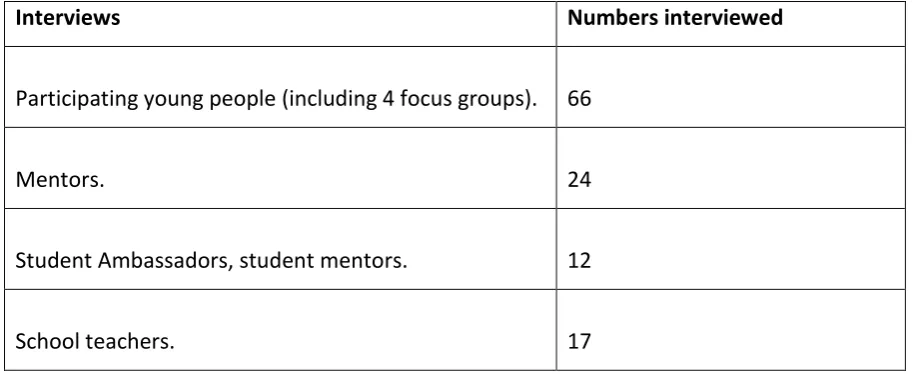
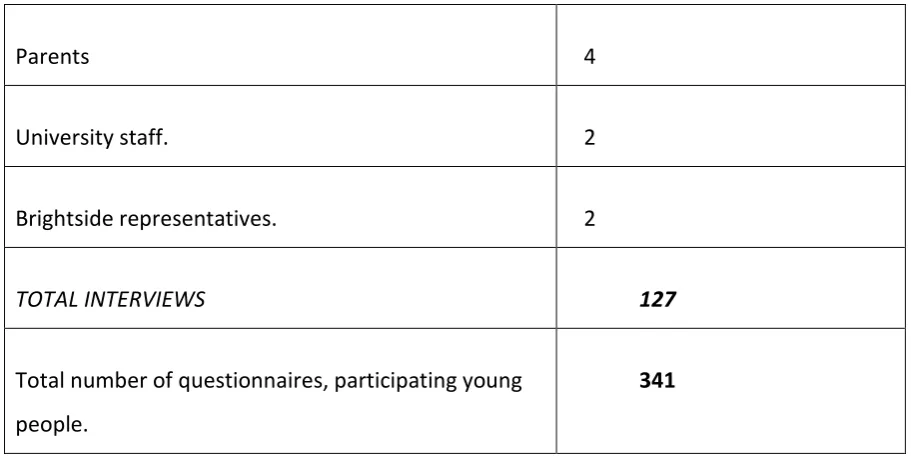
Taking all the evaluation data gathered so far provides a data pool of some 127 interviews,
and 341 questionnaires. The total data gathered are presented in Table 1, while the
[image:11.595.70.527.559.746.2]breakdown of data gathered by event and offer is presented in Table 2.
Table 1 Total data collection, UniTracks evaluation, November 2015 - July 2018.
Interviews Numbers interviewed
Participating young people (including 4 focus groups). 66
Mentors. 24
Student Ambassadors, student mentors. 12
9
Parents 4
University staff. 2
Brightside representatives. 2
TOTAL INTERVIEWS 127
Total number of questionnaires, participating young
people.
[image:12.595.70.526.70.299.2]341
Table 2 Data collection by event and offer, UniTracks evaluation, November 2015 - July 2018
Programme/event Year Data type & source Number
UniTracks Launch
Event for Y10s
2015 Semi-structured interviews.
Parents.
4
Semi-structured interviews.
School teachers.
2
Pre-launch event questionnaire
for participating young people
81
Post-launch event questionnaire
for participating young people
57
Big Deal 2016 Semi-structured interviews.
Business mentors
10
Semi-structured interviews.
School teachers
3
Semi-structured interviews.
Student mentors.
3
Semi-structured interviews.
Brightside staff.
1
Questionnaires, participating
young people
20
GCSE ‘Boot Camp’ 2016 4 x Focus groups (41 Young
People in total)
41 Young People in
total in the focus
groups.
Post-event questionnaire,
participating young people.
41
Big Deal 2017 Semi-structured interviews.
Participating young people.
5
Semi-structured interviews.
Business mentors.
7
Semi-structured interviews.
School teachers.
3
Semi-structured interviews.
Brightside staff.
11
Pre-Big Deal questionnaire for
participating young people.
46
Post-Big Deal questionnaire for
participating young people.
24
Brightside Big Deal blogs
engagement data.
N/A
Shooting the Past 2017 Semi-structured interviews.
University staff. 2 Semi-structured interviews. Student Ambassadors. 4 Semi-structured interviews. School teachers. 3 Semi-structured interviews.
Participating Young People.
6
Pre-Shooting the Past
questionnaires for participating
young people.
16
Post-Shooting the Past
questionnaires for participating
young people. 16 E-mentoring (Year 12) 2016-2017 Semi-structured interviews.
Participating Young People.
12
Semi-structured interviews.
Undergraduate mentors.
5
Big Deal 2018 Semi-structured interviews.
School teachers.
3
Semi-structured interviews.
Participating young people.
3
Semi-structured interviews.
Mentors.
2
Pre-Big Deal questionnaire for
participating young people.
16
Post-Big Deal questionnaire for
participating young people
10
Shooting the Past 2018 Semi-structured interviews.
School teachers.
3
Semi-structured interviews.
Participating young people.
6
Semi-structured interviews.
Mentors.
6
Pre-Shooting the Past
questionnaire for participating
young people
13
Post-Shooting the Past
questionnaire for participating
young people
4
1.4 The structure of this report
This report is built on the UniTracks mission statement which stated that young people who
join the UniTracks programme will learn:
‘about university life [and] the benefits of pursuing university studies, and how to
make an application to the best universities in the country. UniTracks members are
supported in this work through events and workshops designed to build their skills,
confidence, and academic attainment. […] Our aim is that, by the end of their
four-year commitment to the programme, UniTracks participants will be in a position to
make informed choices about their future and have the necessary qualifications,
skills, and attributes to achieve the next step in their journey.’9 [Our stress]
UniTracks is collecting its own data on qualifications and UniTracks membership, along with
post-school destinations of members. In relation to the impact of UniTracks membership,
the CEDAR evaluation focuses on those elements of the UniTracks experiences and offers
that fall under the headings of the acquisition of ‘skills, confidence, and academic
attainment’ and the elements of UniTracks which enable the young people to make
‘informed choices’.
14
This report brings together data derived from all sources (Table 2), and presents findings
relating to impact as seen by the differing groups of stake holders – parents, teachers, and
mentors10. Their views of impact on the young people are presented under the following
headings:
Building confidence. Acquiring skills.
Understanding university. Building aspirations.
The views of the young people are presented separately (Section 3 below).
2 The adult view of the impact of UniTracks’ membership on young
people
2.1. Parent views on impact
Only a very small number of parents have been interviewed as part of the evaluation so far.
At the UniTracks launch for Year 10 members on 14th November, 2015, four mothers, who
had accompanied their children to the event, were interviewed, face-to-face. The interviews
were conducted using a semi-structured interview schedule, were recorded (with informed
consent) and fully transcribed for analysis11. The mothers’ UniTracks’ children were three
daughters and a son, who attended three different schools in two different English regions.
In terms of the impact of joining UniTracks, and the hopes and expectations of the new
UniTracks members, the interviewees gave accounts that focused on the self-confidence of
10 The two academic staff from Warwick who were interviewed as part of the evaluation of Shooting the Past,
2017 were only interviewed about the processes of running the scheme.
11 For details, see Cullen, Stephen, & Lindsay, Geoff (2015) Evaluation of the University of Warwick’s outreach
15
their children. The interviewees themselves hoped that their children would benefit from
being members of UniTracks in terms of increased self-confidence, support, and making
new friendships. These hoped-for benefits were seen by the parents as important, enabling
factors that would help their children achieve their post-school goals.
2.1.1 Building confidence
The interviewees hoped that UniTracks’ membership would boost their children’s
self-confidence at school and in relation to attending university. Although the young people had
only just joined UniTracks, the parents were able to give examples of the impact on their
children of being chosen for the scheme. One mother explained that her son was very quiet,
and had been affected by deaths in his family in the past year. The prospect of being able to
join UniTracks had already enthused him; he had said, for instance, ‘I need to get this’, and
his mother believed that his successful application had already brought about change, as he
had ‘all of a sudden […] taken it upon himself to start finding out about things’. In a similar
fashion, another interviewee explained how her daughter had been excited and pleased by
being accepted for UniTracks, and that she had woke up early on the Launch Day and said to
her mother – ‘just let me go there!’.
2.2 School teachers’ views on impact
Seventeen school teachers with responsibility for all or part of the UniTracks’ offer in their
schools have been interviewed. The teachers were interviewed for all elements reported on
by the evaluation with the exception of the GCSE Bootcamp, and E-mentoring. Two of the
interviews were conducted face-to-face, the remainder by telephone. The interviews were
all conducted using semi-structured interview schedules, recorded (with informed consent),
and fully transcribed for analysis. For each event or project, the teachers were asked what
their perception of the impact of event or project was on their school pupils. In addition, the
teachers were asked about their view of the impact of the entire UniTracks offer on the
16
2.2.1 Building confidence
Teachers gave examples of cases in which young people who lacked confidence benefited
from taking part in UniTracks’ events and projects. This was most noticeable in a few pupils
who had exhibited low levels of confidence in school settings, and seemed to benefit from
UniTracks work. An appreciation of this potential impact underpinned, for example, one
school’s decision to pick a particular pupil to take part in the Big Deal competition:
‘We chose one boy this year, just as an example, who doesn’t speak. And I was
reluctant to choose him, but the head of Year 10 said that she interviewed him,
because we do an interview for them, that he really wanted to try and improve how
he was in front of people, to improve his skills. So we gave him a chance, and said,
OK, you know you’ve got to stand up in front of a whole room of people and give a
presentation. So we’ve used that to try and improve their confidence. So, I think
that’s one of the main skills, outcomes, really. […] We specifically chose him because
he made a point of saying to us, “I really want to try and improve how I am as a
person” – we thought that was lovely, so we chose him.’
Some teachers also talked about building confidence among parents who had not
themselves been to university. The view was that the young people’s reports of good
UniTracks’ experiences helped build the confidence of their parents in the scheme and in
university. An example was:
‘We live in an area where they don’t actually leave this area. They don’t travel, they
don’t like to go out of the area. I just think it shows them that they can do it, they
17
parents is important because it just gives them more confidence, that the launch day
and everything I think really shows them how well it’s organised and that the kids
are safe and inspires them. I’ve had quite a few parents come up to me afterwards
and say “oh my God, it made me want to go”. So it is inspiring definitely for the
parents as well.’
2.2.2 Acquiring skills
The interviewed teachers stressed the role of UniTracks in helping their pupils acquire skills,
particularly those skills they termed ‘soft skills’ – social skills, communication skills,
team-working skills, and organisational skills. This impact, along with increasing pupils’ knowledge
and understanding of university, was the most frequently mentioned by the teachers. For
example, one interviewee said that ‘the skills these kids pick up during these challenges [Big
Deal] are absolutely priceless I think, not just the social aspect, but also the organisation, the
communication between each other’. Another example of the stress on skills acquisition
was:
‘I think its benefits are in terms of their soft skills and their cultural capital because
some of the students […]. In terms of the actual skills that they learn on the
challenge are they applicable, probably the independent work skills and having to
complete something without somebody on your back, because our school like quite
a lot of others, is quite hands-on making deadlines met and things like that.’
There was also evidence that the Big Deal competition had a direct impact on
subject-related skills acquisition for those young people who were studying business studies at
school, with one responsible teacher commenting that the competition ‘is inspiring, and it’s
18
GCSE Bootcamp, and Shooting the Past enhanced subject-specific skills and knowledge, as
well as the more generally applicable skills. For example, one teacher said of Shooting the
Past that skills acquisition was the most important impact – ‘the skills are really
organisation, planning, teamwork, communication – I think that all these things they
absolutely had to employ’.
2.2.3 Understanding university
The teachers were uniformly positive about the impact UniTracks had on their pupils in
relation to finding out about, and understanding university. Of the four impact themes, this
was the theme most frequently mentioned by school staff. Impact was identified in relation
to the school students seeing and experiencing a university campus, meeting
undergraduates, finding out about university courses and life, as well as about finance and
funding. All of these were regarded, by the school staff, as being important for the young
people in terms of enhancing the likelihood of them attending university.
The interviewees stressed the importance of the young people visiting, seeing and staying
on the Warwick campus. A typical view of the impact of visiting the university was that it
‘helps them to realise what life would be like at university […] I think the first thing is that
they actually went to the university itself, and they could see what a lecture theatre looks
like, people milling about, the students themselves, and I think they got a little bit of a
taster.’. In a similar vein, another teacher explained that young people from her school who
had not been keen to attend university were impacted by their residential stay for Shooting
the Past:
‘We’re trying to get one of the girls to go to university because she is a very, very
19
of the others have anyone in their family that has been to university. So I think it has
made them realise, especially going to the campus and spending the two days there,
made them realise it could be something they would want to do’.
A final example is provided by a teacher who overheard their school pupils talking after
visiting the university – ‘they were taking about the university, they were having
conversations, they are 14 and 15 and they were having conversation about where they
would like to go, whether they’d like to go to a campus university or not; so it [the
UniTracks’ visit] was very inspiring’.
2.2.4 Building aspirations
Typically, school staff said that their school pupils already had high aspirations in relation to
examination success, attendance at university and career choices. In these cases, it was
argued that their involvement in UniTracks enhanced pre-existing, and high, levels of
aspiration. Nonetheless, examples were provided of the positive impact of participation in
UniTracks on the aspirations of some of the pupils who had been unsure about their futures.
This was the case in relation to pupils who had little experience of life outside their home
and school, whether that was young people living in an inner city, or in a rural town – ‘they
liked the campus […] they’ve never been to a university […] this is quite a small community,
and it’s quite isolated from other towns and cities. I think widening their eyes for them to
think there is more to it’.
2.3 Mentors’ views on impact
2.3.1 Building confidence
Mentors provided little in the way of direct evidence of confidence-building as a discrete
20
the acquisition of new skills, finding out about university, and taking part in the various
UniTracks’ offers had the combined effect of boosting confidence.
2.3.2 Acquiring skills
The mentors gave accounts of the positive impact in relation to skills acquisition that were
very positive, particularly in relation to the Big Deal. Accounts of participation in the Big Deal
stressed the acquisition of business-related skills, such as budgeting, market research, cash
flows, and costs, along with more generic skills, such as team-working, working to deadlines,
presentation skills, and public speaking. The mentors were clear that, with the right
attitude, the school pupils were able to benefit strongly from taking part in the Big Deal. An
example was given by one of the business mentors, who noted the range of skills involved in
the Big Deal work on the launch day, the engagement of young people, and the need for
them to develop new skills when faced with difficulties:
‘We were introducing a whole number of business concepts and jargon and
challenges, and that was good, I think they [the pupils] really engaged with that and
took a lot of things on board. And then the structure of the business plan kind of
enabled them to think about the business, and some of the disciplines and rigours of
what you need to do in business. I definitely do think that they have had some
difficulty in terms of team working, and that’s been a good thing because it’s actually
made them think about how they got together, and they have learnt from one
another.’
2.3.3 Understanding university
The mentors for the Big Deal reported that although they were aware of the UniTracks’
21
were, as expected, more focused on the immediate challenges of the competition itself.
Nonetheless, mentors took opportunities to talk about university, and to answer questions
on universities when they arose; for example: ‘I talked to the about university and when
they apply, and what to think about, and just realy shared my experiences of what it was
like for me applying’.
The mentors from the 2016-17 e-mentoring scheme for Year 12 UniTracks’ members were
all undergraduates, and the scheme enabled a direct focus on university choices for the
school pupils. Of the five undergraduate mentors interviewed from the 2016-17
e-mentoring offer, four stressed the reassurance that the participating pupils received about
choosing, applying for, and attending university. All of the mentors said that they thought
the mentees were benefiting from having a source of trusted, up-to-date, reliable
information about university and university life. Most of the mentors were matched with
UniTracks’ members who had similar academic and subject interests, and there were,
therefore, opportunities for subject-specific advice and knowledge to be gained by the
school pupils. One of the mentors explained what they saw as the value and impact of the
scheme:
‘I think the first [benefit] is that they [the pupils] are making an informed decision,
because I think a lot of young people, particularly myself at that age, because none
of my family went to university or anything like that [and] I was completely making
the decision on a whim, scraping information together, not knowing if the
information was right or anything like that, but just happy to trust it. It’s quite good
for them to make an informed decision, and they’re going to university knowing “I
want to go to campus or non-campus, I want to go to this university, and study this
22
The e-mentoring scheme was seen by the mentors to have provided an effective platform
that enabled good communication between undergraduates and UniTracks’ members – ‘it’s
nice for them [pupils] to have an extra resource, someone that you know has legitimate
answers and not just someone random on a forum’; and, as another undergraduate
explained, ‘she [pupil] told me when I met her that I’m the only person she knows that goes
to university’.
2.3.4 Building aspirations
As with confidence-building, there was little evidence provided by the mentors in relation to
building aspirations.
2.4 The Brightside Trust data
The Brightside Trust12 has been one of UniTracks’ partner in the delivery of some of
UniTracks’ programmes, most notably, the Big Deal and e-mentoring. Part of Brightside’s
package was, for the Big Deal, 2016 and 2017, the provision a ‘skills tracker’, and site
engagement record. Data regarding site engagement - that is with the 11 weekly tasks and
contact with the business mentor for each team. In addition, the school pupils were able to
track their own, self-assessed, skills development over the course of the Big Deal
competition using the Brightside skills tracker.
The skills tracker related to the Big Deal and building confidence, communication skills,
creativity, motivation and presentation skills. The data for the 2016 Big Deal competition is
presented in tables 3 and 4 below.
23
Table 3: Big Deal 2016: Self-assessed skills tracking by young people (14 teams, c.42 pupils)
Skill Average
initial value
Average target
value
Average final
value
(immediately
prior to
competition day)
Confidence 6.4 8.6 8
Communication skills 6.3 8.7 7.6
Creativity 6.2 8.3 7.6
Motivation 7.2 9 7.8
Presentation skills 5.9 8.1 7.1
The average skills acquisition show that in no category was the average final value reached.
However, the figures presented in Table 4, below, show that in each category, a majority of
the participating young people did see an improvement in their key skills.
Table 4: Big Deal 2016: Skills tracker data relating to percentage of young people
(immediately prior to competition day) who improved key skills.
Skill % of participants who improved skill
Confidence 88%
Communication skills 74%
Creativity 73%
Motivation 54%
[image:26.595.71.526.541.681.2]24
Low levels of skills improvement in relation to motivation and presentation skills may,
possibly, be related to the group already possessing high levels of these skills prior to the Big
Deal.
For the 2017 presentation of the Big Deal, the participating teams had fewer (nine as
opposed to 11) weekly tasks, but, per task, engagement (measured by team) was slightly
higher than in 2016. In terms of skills acquisition, the data presented in Table 5 show
improvements in averages of key skills, but a more mixed picture in terms of final average
values and target values. Overall, however, it is possible to say that average target values
[image:27.595.71.528.406.566.2]were reached.
Table 5: Big Deal 2017: Self-assessed skills tracking by young people (n = 27)
Skill Average initial
value
Average target
value
Average final value
Confidence 6.9 7.9 7.9
Communication skills 6.7 8.0 8.1
Creativity 6.2 7.5 7.4
Motivation 7.2 8.3 8.2
Presentation skills 6.7 7.6 7.7
As in 2016, the majority of 2017 Big Deal participants recorded tskills improvements; Table
25
Table 6: Big Deal 2017: Skills tracker data relating to percentage of young people (n = 27)
who improved key skills
Skill % of young people who improved their
skills
Confidence 61%
Communication skills 65%
Creativity 69%
Motivation 58%
Presentation skills 62%
As with the data provided by the skills tracker in 2016, it is difficult to interpret this basic
data from Brightside, but it is reasonable to assume that where there are comparatively low
percentages in term of the young people who recorded improved skills, then that is a
reflection of pre-existing high rates of motivation, or confidence. Nonetheless, in all
categories, the majority of participants recorded improved skills.
3. The participating young people’s views of impact
3.1 The data
In total, the evaluation has gathered data from 66 young people in focus groups (four, all
from the GCSE Bootcamp, 2016), and interviews (with young people participating in the Big
Deal, 2016, 2017 and 2018; Shooting the Past, 2017 and 2018; and e-mentoring, 2017). In
addition, 341 questionnaires have been completed by young people taking part in the
various UniTracks programmes covered by the evaluation. The various interviews,
questionnaires and focus groups were designed to generate data about the individual
UniTracks projects, and the impact of participation on the young people involved. The data
about the process of the projects has been presented in the relevant reports; what is
26
themes: confidence, skills, university and aspirations. Of the four themes, the most
frequently occurring in the data related to finding out about university and subject choices,
and university life. Impact in term of enhanced aspirations did not appear as a discrete
theme, but, rather, could be inferred from comments regarding enthusiasm for university
attendance.
3.2 Building confidence
The young people typically spoke about UniTracks’ programmes boosting confidence in
relation to skills and knowledge. Increased confidence in deploying skills acquired through
taking part in the Big Deal, or Shooting the Past were most frequently mentioned. There
was, however, some evidence provided by the young people relating to improved
confidence in a wider sense, arising out of participation in UniTracks; for example, one Big
Deal competitor said: ‘I have become a lot more confident in all aspects and have seen
myself become a lot more professional’.
The GCSE Bootcamp, 2017, offered 41 young people a residential revision course at the
university in maths, English language, chemistry, or physics. This was a popular and very
successful offer, and participating students gave accounts of the impact of attending the
residential course that stressed improved confidence and motivation – the two most
frequently mentioned outcomes of attendance.
3.3 Acquiring skills
There was general agreement among Big Deal and Shooting the Past participants that taking
part in these UniTracks’ offers helped build their skills. Team-working, negotiating, research,
and public speaking skills were all enhanced by participation in the two schemes. In
27
the Big Deal, were acquired or enhanced. For example, the Big Deal 2018 data provided
examples of skills acquisition and associated improvements in confidence:
‘I think it [the Big Deal] just helps me to have a bit more confidence in myself. I’m
quite a confident person, but in the things I do [in the Big Deal] it’s helped me
become more confident, and coming up with ideas, I was, like, “we need you to do
this”. I was more confident. It helps you to prepare to react as a team because we all
had completely different experience, and obviously, when you are older you’re not
going to be working with people exactly like you, and it just helps you to learn
different ways of working with people.’
In addition, business-related skills, and public speaking skills were mentioned by young
people, with one interviewee, for instance, saying, ‘I mentioned the public speaking thing,
which I thought was really good, and a lot about the spreadsheets, and how you do
budgeting, and things like that. I thought that was all useful’.
3.4 Understanding university
Of the four key areas relating to the aims of UniTracks, it was the fourth – understanding
university – which was most frequently noted by the young people as being a result of
taking part in UniTracks’ events and programmes. From the data collected, and presented in
the previous eight evaluation reports, the impact of visiting the university, taking part in
learning experiences at the university, being mentored by university undergraduates,
attending short residential events at the university, and being part of the university’s
UniTracks scheme, have the most salient impact on the schools pupils. Their understanding
of what a university is; what a campus university like Warwick looks like; the variety of
28
undergraduate; issues relating to finance, entry requirements and possible future careers,
were all enhanced by participation in UniTracks.
One example of the impact of UniTracks in terms of understanding university was given by a
participant in the 2017 Big Deal competition:
‘It’s opened my eyes to the university world, I think, because I didn’t really know just
how many different options there were at university before I did this, because on the
first day [Launch Day] we got a tour round the campus. Some students at the
university showed us round and we got a chance to chat to them, which was really
good.’
Another participant from the same presentation of the Big Deal explained how visiting, and
working at the university, as well as doing the Big Deal, had impacted on their view of
university, degree choice and future career:
‘I think it [the Big Deal] was really effective in showing me personally what
university, especially the business side of things, was going to be like because I’ve
never really been exposed to something like this before, and I was always strict
about what I wanted to do, something with maths and physics, but it has made me
consider possibly not being so strict to those things, and looking elsewhere at what
else I could do, because I really did enjoy working up this business with other people,
and I didn’t think it was something that I was very good at, and I thought that I’d not
be as effective as I could be, but it turned out that I did play quite a big part with the
29
There were numerous, similar examples of commentary and reflection by the school pupils
relating to impact in terms of understanding university. From the data provided by these
young people, it appears that contact and interaction with current university
undergraduates had the potential for being particularly useful. Two examples, taken from
the E-mentoring 2016-17 scheme illustrate this:
‘I think it has [made a difference] because I always thought that university was, like,
you go there and you study hard. [But] it’s not going to be that bad, and it will be
more fun if you really enjoy your degree. It’s helping me decide, do I actually want to
do pharmacy, or do I want to do something, not cooler, but different.’
While another young person explained:
‘She [the mentor] was asking if I’d gone to open days, and she was saying, especially
if I want to do medicine, because the deadline is earlier, I should look into starting to
go to some before the summer. That was really helpful because I’ve [now] started
looking at when some of the open days are that I’d like to go to.’
Conclusion
This report draws together impact data relating to UniTracks from November 2015 – June
2018. The data are drawn from eight evaluation reports covering UniTracks’ Launch Day; the
Big Deal competition; Shooting the Past; GCSE Bootcamp; and E-mentoring. The impact data
30
UniTracks programme; that is: building confidence, acquiring skill, understanding university,
and building aspirations. Limitations on the evaluation processes (i.e., that the use of control
groups is not possible) mean that the data relating to impact is of OFFA Level 2, Standards of
Evaluation Practice13, with both quantitative and qualitative evidence of impact being
available. The complete range of stakeholders in UniTracks have participated in the
evaluations – participating young people; mentors; undergraduates; parents; school staff;
the Brightside Trust; and university staff.
Impact has been demonstrated across the four key areas, albeit to different degrees. The
most notable impact, as evidenced across the stakeholder groups, has been in terms of
understanding university, and acquiring skills. Skills acquisition appeared to be most notable
in terms of the Big Deal, and both business-related skills, along with more genera skills, for
example, deadline keeping, and public speaking. In relation to understanding university, the
aspects of UniTracks’ membership which enhanced this key element were the impact of
visiting the university, taking part in learning experiences at the university, being mentored
by university undergraduates, attending short residential events at the university, and being
part of the university’s UniTracks scheme. All these were highly valued.
13 Crawford, C, Dytham, S., Naylor, R. (2017), The Evaluation of the Impact of Outreach; proposed standards of
evaluation; practice and associated guidance (The Sutton Trust, University of Warwick, OFFA, Department for