When you choose DATUM mag tape
or disc systems You get performance ...
but We get system responsibility!
Choose a DATUM peripheral-device-controller system knowing that you will be free of any problems when the system is installed! No matter what the problem, or where, DATUM will get you up and running ... because DATUM assumes system responsi-bility in every system installation.
Only DATUM has designed, built and installed over 6000 controllers and systems for so many different minicomputers to interface with so many different peripheral devices. And, of all device-controller manufacturers, only DATUM/Peripheral Products Division has the advantages and
Series 4091 Disk Controller expertise given by cooperating
in-house divisions that design and build custom data acquisition systems and sophisticated micro-programmed minicomputers.
Check these features! • Triple-Density NRZI For-matting • Dual-Density PE/NRZI Formatting • 200 IPS for all Exist-ing Interfaces • SExist-ing Ie-Source Responsibility for all Major Tape-Drive Manufacturers
Off-the-shelf controllers for these computers:
Computer Automation Alpha LSI • Data General Nova and Eclipse. DCC 112, 116. DEC
PDP-8, -8e, -8i, -81, -9, -91, 11, 12, 15 • Harris Communications Slash
4, Slash 7 (Data craft) • HP 21MX, 2100, 21M, 2116 • Honeywell 316,416,516 • IBM 1130 • Interdata 716, 832 • Lockheed SUE • Micro Systems 810 • Rolm 1602, 1603 • Varian 620i,6201,620f, V73, V74, V75, V76.
DATUM Tape Controllers are available with the following Formatters:
NRZ, 9-track,800 BPI and 7-track, 800, 556, 200 BPI • PEl 9-track, 1600 BPI • QUAD, 9 track 1600,800 BPI and 7-track 800, 556,200 BPI.
Each formatter controls as many as four drives with indi-vidually-driven ports for each tape unit. All drives with industry-compatible interfaces can be accommodated.
CIRCLE 1 ON READER CARD
DATUM formatters provide all timing for IBM-compatible inter-block gaps and correct head-positioning between records.
Advanced MSIjLSI hybrid technology gives optimum cost / performance ratio • Systems and controllers are compatible with your computer software • Com-ponents plug together and into the computer for uncomplicated installation • Complete with con-trols, power supply, all necessary cables, diagnostic software and instruction manual.
Write for specifications and prices and for a copy of, "How To Buy Computer Peripherals:'
DATUM also manufactures modular data acquisition systems, microprogrammable minicomputers, cassette and rotating memories and timing instrumentation.
Peripheral Products Division
1363 S. State College Blvd., Anaheim, CA 92806· 714/533-6333. EUROPE: Datum House, Cranford Lane, Horlington, Middlesex, UK • 01-897-0456
~
Datum Inc
I
U~ue! ~(lj)
MSDDD
't
"J
~ ~(lJ)
ffi
IITfi}M U1l
D©el
~G)
Sodoall our
KeyProcessin~rSystems
~
... @It
[JI':
,I
I
~·
.••.••~.V.~.;.·
..•. "".·.· •..•. ' .•.. '.' .•. : •.. '.· •. •.· .•.•...lUll '
1111\\
~
"
. - - - - ---.--
._._--Talk to us,
Signaling a new era
in data entry communications, CMC's TeleBatchTM option does it all - remote data entry, remote job entry, and remote printing':"" all concurrent with a full complement of active keystations.
The KeyProcessing Family
-offers the widest range of data entry systems available today. With features and options that will serve you tomorrow too. Like TeleBatch, and the industry's most comprehensive array of manage-ment control reports.
TeleBatch
proVides decentralized ,data entry with-out sacrificing centralized control over quality and procedures. TeleBatch is fast, with speeds up to 19,200 bps. And it's simple
to
operate - with unique Communications Control Batches auto-matically performing all operator and remote batch terminal functions.Our customers say
- that CMC'~Management Control Reportsare outstanding. The TeleBatch Log, forexample, improves the effec-tiveness of communications by provid--ing an audit trail of important com- ,
munications statistics.
CMC KeyProcessing Systems
are installed and communicating throughout the world.
you'll be pleased you did. Call or write today for more information.
KeyProcessing and TeleBatch are trademarks of
[ tij
1
~ a division of:=
n
A
~
=
PBlTEC CDAPOARTIOn
IN FINANCIAL PACKAGING,
.THERE IS ONLY ONE ALTERNATIVE
TO ITEL.
And that's no exaggeration, either.
It's something we can back up with fad after fact.
Take our Packaged Lease, for example. We not only supply you with a total computer system (com-parable to the best of IBM), but we
supply it all at the lowest possible prices.
The savings are enormous. Moreover, if you want, you can sublease everything at attractive rates-making our Packaged Lease a virtual no risk proposition.
It's this kind of all out creative effort that has put us right up there with IBM. Not only in financial pack-aging. But in field engineering. In computer peripherals. In systems and ·software. In total computer capability.
CIRCLE 55 ON READER CARD
When it comes to experience and reputation, it's either IBM. Or Itel.
When you get to price/perform-ance, however, there is no alternative.
There is only Itel.
ITEL
CORPORATION
Data Products Group
VOLUME 22 NUMBER 7 FEATURES
This issue 121,866 copies JULY 1976
Electronic Banking
In spite of their stodgy, conservative images, banks are now showing the way for transaction oriented dp appli-cations. Different styles still lead U.S. banks to distribute processing while the Europeans continue to centralize, but similar basic needs are bringing both sides together in global networks -replacing labor, paper, and mechan-ics with electronmechan-ics.
54 DISTRIBUTIVE PROCESSING FOR BANKING John D. Foster. The world's largest bank turns to mini-computers.
57 EUROPE CLAIMS THE LEAD IN BANKING Nancy Foy and William Helgason. Transaction processing and networked dp on a scale not often seen in the U.S. 60 CENTRALIZATION OR DECENTRALIZATION
IN BANKING?
Flemming J. Jensen. After trying both, the international NEWS IN PERSPECTIVE
98 CONFERENCES
Everyone in a buying mood at the largest NCC. 0 NCe box score. 0 Theodore J. Williams new Afips president.
o
Teletype could market 40/4. 0 Compounded mar-ket expansion predicted. 0 Packet protocol criticized. 110 ANTITRUSTThe West Coast cases will be lively affairs tried by juries.
o
Photographer seeking $20 million from IBM. 112 USER GROUPSRising from the ashes? 115 COMMUNICATIONS
MCI's Execunet is still alive. 0 MCI seeks federal inves-tigation of Bell's political action.
DEPARTMENTS 7 LETTERS
Historical accuracy, relational data bases; APL booster, a primer on software clarity, and more.
13 PEOPLE
Dr. Dttis Rechard: one more professional move; Janis Miller: a believer in certification; Ron Murr: spreading his wings.
17 LOOK AH EAD 22 CALENDAR
A preview of COMPCON Fall, plus others fore and aft. 27 SOURCE DATA
"Data Processing in 1980-1985" (the' SILT report), "Crime by Computer," and "Recursive Programming Techniques" reviewed; plus other books, reports, vendor literature, courses.
July, 1976
banking community is finding that the terms are relative. 65 FITTING IN THAT EXTRA WORKLOAD
Joe M. Wiley. A few tricks of the trade, some queuing theory, and "accidental" good fortune.
71 GREAT MOMENTS IN THE HISTORY OF COMPUTING: DECEMBER 12, 1777
Jackson Granholm. Diligent research has uncovered the role played by the revolutionary computer.
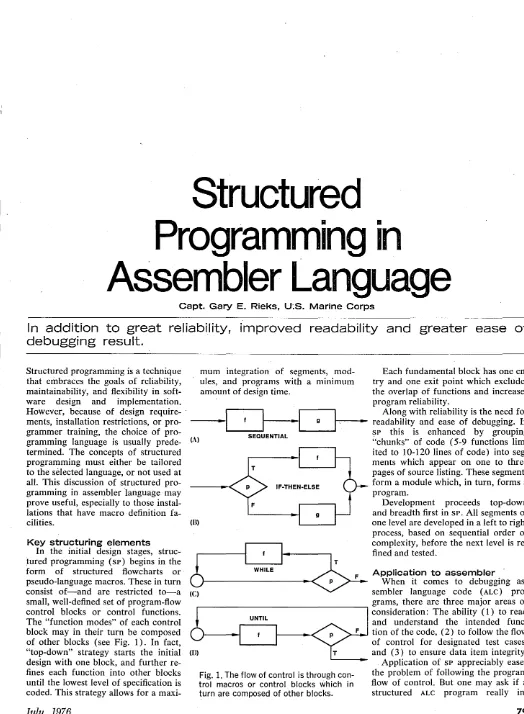
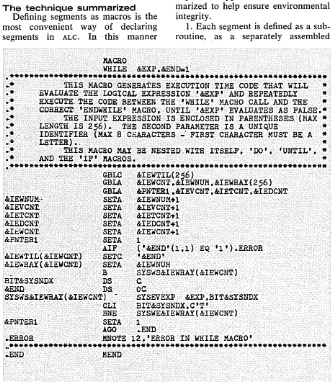
STRUCTURED PROGRAMMING IN ASSEMBLER LANGUAGE
Capt. Gary E. Rieks. Greater flexibility, maintainability-and 99% reliability-are claimed.
INSIGHT AND CREATIVITY
Thomas R. Gildersleeve. Brainstorming, transformation, elaboration, or solution by analogy.:..all's fair in data processing.
155 THE FORUM
Stephen R. Levine, III. To save the NSF $300,000, here are the next research study results in advance.
John M. Triance. COBOL is twice as big as most users realize.
117 LEGISLATION
Hartke promises early hearing on Bell bill. 117 SATELLITES
Justice Dept. asks for study of SBS proposal. 121 INTERNATIONAL
The pains and payoffs of going abroad. 126 BENCHMARKS
Micro in an attache case; Opel on IBM; Amdahl going public; NCR selling subsidiary; Interdata at Citibank; 1,000th Eclipse delivered; More changes at General Automation; Back on top; Big again; Ripe for EDP; Analytical instruments.
51 EDITOR'S READOUT
Reflections on the IBM vs. Justice antitrust trial. 130 HARDWARE
Featured is a communications diagnostic system. Also, a $99 computer kit, & Teletype Corp.'s 132-column printer. 142 SOFTWARE & SERVICES
A user-developed program to interface process control to standard manufacturing programs is featured.
149 MAR KETPLACE 153 ADVERTISERS' INDEX
ABOUT TH E COVER
We borrowed Uncle Sam from nostalgia and plugged him into banking. It's his year! Design and photography by Barbara Benson.
4
"Our DAC printer is
so good, we ordered
another one ... "
"and we saved
$4~OOO."
Minicomputer users allover the country are saying it. "Digital Associates Printer Systems Perform!" I f you need better cost/perfor-mance, look at our high-throughput/low-cost printer systems from 100 to 1 ,000
LPIV1, compatible with most minicomputers. For better performance, and lower cost, call today.
East, (203) 327-9210 Midwest, (612) 890-8988 West Coast, (714) 549-8555
Digital
Associates
Corporation
Printer Systems
1039 East Main St .. Stamford. CT 06902
CIRCLE 99 ON READER CARD
CRTRMRTICNoo
EDITORIAL STAFF Editor
Articles Editor International Editor European Editor Communications Editor Industry Editor Products Editor Source Data Editor Calendar Editor News Editor Bureau Managers
San Francisco Los Angeles New York New England Correspondents Minneapolis Southwest Australia Editorial Advisor Technical Advisor Contributing Editors
EDITORIAL OFFICES
John L. Kirkley Richard A. McLaughlin Angeline Pantages Nancy Foy Phil Hirsch W. David Gardner Michael Cashman Daniel P. Schlosky Gloria Tidstrand Tom McCusker Edward K. Yasakl Edith D. Myers Angeline Pantages W. David Gardner James K. Johnson Robert F. Alexander Ken McGregor Robert L. Patrick Lowell Amdahl Paul Armer, Howard Bromberg, Philip H. Dorn, Louis B. Marienthal, Carl Reynolds F. G. Withington
Headquarters: 1801 S. La Cienega Blvd., Los An-geles, CA 90035. Phone (213) 559-5111, Eastern: 35 Mason SI., Greenwich, CT 06830, (203) 661-5400. 134 MI. Auburn St., Cambridge, Mass. 02138, (617) 354-2125; 9805 Singleton Dr., Bethesda, MD 20034, (301) 530-7271. Southwestern: 2711 Cedar Spri ngs, Dallas, TX 75201. (214) 744-0161.
Weit-ern: 2680 Bayshore Frontage Rd., Suite 401, Moun-tain View, CA 94043, (415) 965-8222. Foreign: 8 Pellerin Rd., London N. 16; (01) 249-1177; 74 Staf-ford Road, Artarmon, Sydney, NSW 2064, Australia. 41-5748.
GRAPHIC DESIGN & PRODUCTION Art & Production
Director Advertising Production Manager Production Assistant CIRCULATION
Cleve Marie Boutell Marilee Pitman Alberta R. Martin 3fj·Mason Street, Greenwich, CT 06830 Circulation Manager
Marketing Research Manager
Publisher Assistant Publisher Circulation audited
Suzanne A. Ryan Deborah Dwelley James M. Morris F. Douglas De Carlo by Business Publications
Audit
-American Member ~ Business
NABP
Press, Inc.DATAMATION Is
pub-1-1 ___ 1
lished monthly on orII.f!1 about the first day of every month by Tech-nical Publishing Company, 1301 South Grove Ave., Barrington, Illinois 60010; Arthur L. Rice, Jr., Chairman of the Board; James B. Tafel, President; Gardner F. Landon, Executive Vice President. Executive, Circulation and Advertising offices, 35 Mason Street, Greenwich, CT 06830, (203) 661-5400. Editorial offices, 1801 S. La Cienega Blvd., Los Angeles, .CA 90035. Published at Chicago, III. DATAMATION is circulated without charge by name and title to certain qualified individuals resident in U.S.A. or Canada who are employed by companies involved with automatic information handling equipment. Available to others resident in U.S.A. or Canada by subscription at the rate of $24 (airmail $40) annually. Reduced rate for quali-fied students, $14. Agent for all SUBSCRIPTIONS OUTSIDE U.S.A. and CANADA is J.B. TratsartLtd. 154A, Greenford Road, Harrow, Middlesex HA1 30T England. Rate is £20 6r $40 or the "equivalent in local currency. No subscription. agency is authorized by us to solicit or take orders for sub-scriptions. Controlled circulations paid at Colum-bu·s, OH and Form 3579 to be sent to Technical Publishing Company, P.O. Box 2000, Greenwich, CT 06830. © Copyright 1976 Technical Publishing Company. ® "Datamation" registered trademark of Technical Publishing Company. Microfilm copies of DATAMATION may be obtained from University Microfilm·s, A Xerox Company, 300 NO.Zeeb R.oad, Ann Arbor, Michigan 48106. Printed by Beslow Associates, Inc.
IMSA18080: THE COMPLETE COMPUTER SYSTEM
• Computer with 16K bytes of memor
8-/evel interrupt and interval I k Y' • Programmer's front panel
• .2 floppy disk drives with intellf ~~t • and so~tware
mterface/controller g $ All peripherals interfaced
• 300 LPM printer 10.493 UNIT PRICE"
• 24-line by 80-column CRT with -Quantity discounts auailable.
keyboard .
I
/
~-"'-"---
\"
"\- OPMEN~SYS~EM
OMPLE~E
DEVEL rogrammer's.IMSA\ 8080:
~HE
. 16K bytes C 0 f me mory. power , hont paneSUPf~~~
ICE'" software• Computer wtth t and \nterva\ c\ock t $5 856 UNl~ PR Q ntity discounts'
8 \ene\ \nterrup - v d- k dr\ves u,·tth \ntemgen vv 'Unasse 'rnbled $4.444. ua
• 2 HopPy tS troller available, \nteriace/ co~S 232 or TTY ports
What's new In printers! AskCentronlcs.
just because you need
a faster
printer doesn't
mean you have to leave
thefamil)\
Our speeds are way up. But our prices aren't. And when you select products from the Centronics family, you get the extra advantages of proven reliability, printer compatibility, and
commonality of parts.
Our new Model 104 printer delivers 200 lines per minute. Which is more full 132-column lines per minute for the money than any other printer
in our family. .
The low price includes a quiet, fully-enclosed design. Clean, consistent high quality printing. A choice of over 20 foreign language character sets. Special character sets. Boldface characters on com-mand. Automatic on-off motor control. Exclusive off-line self-test switch .. LSI electronics. Optional upper/lower case printing. And much, much more. All this - plus the best warranty in the business.
For reliability proven in tens of thousands of instal-lations, and for optimum price/performance, look to Centronics. You'll find the biggest selection of printers anywhere. With a broad range of computer interfaces and communications adapters. Plus features and options available nowhere else.
High-volume production assures prompt delivery. Service and parts always available through a net- _ work of field service offices. Call our nearest office for full information. Centronics Data Computer Corp., Hudson, New Hampshire 03051.
I: E nTRO nil:
s®
PRinTERS
r---~
Centronics - Marketing Services Dept. 104Hudson, N.H. 03051
o
Send catalog and specification sheets.o
Have a sales representative call.o
I am particularly interested in a printer for:(describe application)
Name ______________________________________ ___ Position
Company ____________________________________ __ Company Address ______________________________ _ L ________________ • _______________________ ~
Centronics Data Computer Corp., Hudson, N.H. 03051, Tel. (603) 883-0111, Twx. 710-228-6505, Tlx. 94-3404; Eastern Region: (617) 272-8545 (MA); Central Region:
6
(513) 294-0070, Twx. 810-459-1784 (OH); Western Region: (714) 979-6650, Twx. 910-595-1925 (CA); Centronics Data Computer (Canada) Ltd., Ontario, Tel. (603) 883-0111, Twx.
710-228-6505; Centronics Data Computer (UK) Ltd., Cheam, Surrey, England, Tel. 643 0821-4, Tlx. 851 945756; Centronics Data Computer, GmbH, 6 Frankfurt/Main., West Germany, Tel. 678041, Tlx. 841413224; Centronics of Puerto Rico,Dorado, Puerto Rico, Tel. (809) 796-1881, Tlx. 3859349
letters
Older than you think
Dick Heiser's article on the first World Altair Computer Convention ("Hobbyists off on a Weekend," May, p. 201) referred to a certain book as having been "printed in August 1974 for the computer hobbyist, a breed that didn't even exist then .... " It did exist, and much further back than 1974.
This August marks the- tenth anni-versary of the Amateur Computer
So-ciety Newsletter, which seems to be the
oldest computer-hobby pUblication in the world. Also, back in the Sixties, the Tesla Research Foundation offered analog and digital computer kits; their DI-TR5 digital computer cost $365 in kit form, $440 assembled, used germanium-transistor NAND logic and diode OR gates, had two registers and 15 instructions. I/O was via switches and lamps. The company didn't last long, and has vanished without a trace. The British Wireless World maga-zine carried a five-part construction ar-ticle on building a small computer, in late 1967.
Microcomputer kits were first avail-able in early 1974, the Scelbi 8H in March and Radio-Electronics Mark 8 in June. The January 1975 Popular
Electronics introduced the MITS Altair
8800, the best-known and most widely sold hobby computer.
By August 1974 there were three microcomputer kits (third was the RGS 008A), and several dozen built-from-scratch amateur computers had been in operation for some years.
However, Dick has the year right as far as the hobby microcomputer explo-sion goes; 1974 marks the beginning of what now amounts to over 30 comput-er kits and at least seventy computcomput-er clubs.
STEPHEN B. GRAY
Amateur Computer Society Darien, Connecticut
"If memory serves me r:,ight . . . " Much as I appreciate DATAMATION'S new interest in historical articles I am constantly irked by the apparent in-attention, to the rudiments of the histo-rian's craft. Inaccurate information from second and third-hand sources, once printed in DATAMATION, takes on an authority which tends to erase more precise pictures of our short past.
The most recent case occurs in the otherwise fine article by David N. Freeman, "IBM and MUltiprocessing" (March, p. 92). In an
authoritative-July, 1976
looking table, Freeman lists "IBM M ul-tiprocessors prior to System/360." The s,econd entry lists SABRE as a 1958 tem, without saying whether the sys-tem was operational or simply publi-cized then. According to my recollec-tion, no 7090s existed in the world in 1958, and the SABRE system was cer-tainly not operational in any effective sense until several years later. If mem-ory serves me right, the first 7090s went to BMEWS (which also had some sort of multiprocessing), and the next ones went to Project Mercury.
The Mercury Project never got the publicity of systems such as SABRE, partly because IBM had been stung on SABRE-making promises in public that couldn't be fulfilled (on time, any-way), and partly because of fear that something might happen to the astro-naut that could be blamed on IBM.
But the Mercury system, designed in 1958 and up and running in 1960 with loosely coupled multiprocessing and full multiprogramming, was a great success. Not only did it serve its mis-sion, but its operating system was used Is ADABAS relational?
I read and appreciated two fine data base texts recently, C. J. Date's An
Introduction to Database Systems
[re-viewed July 1975, p. 27] and James Martin's Computer Data Base
Con-cepts [reviewed January 1976, p. 27].
Then along came Date's article, "Rela-tional Data Base Concepts" (April p. 50) .. "
Relational data bases, they say, are the wave of the future. Yet the exis-tence of a nearly relational and opera-tionally efficient DBMS, ADABAS, re-mains unnoticed by these authors. Ei-ther ADABAS literature has been cun-ningly shielded from them, particularly from Date, or other reasons prevail for
SILICON VALLE.Y
CHAPEL
as the core of many other 7090 sys-tems working on-line. People trained on Mercury went in several directions. Some went to bail out SABRE, some went to Houston to found the Gemini and later Apollo missions, and others went, ultimately, to the os/360 proj-ect.
All in all, the people of Project ~er cury had a tremendous influence on operating system developments, both mUltiprocessing and whatever. Perhaps some of the others will write you giving more of the story, but I felt it was about time somebody gave a little his-torical recognition to those· forgotten heroes of Project Mercury.
GERALD M. WEINBERG
President Ethnotech, Inc. Lincoln, Nebraska
A spokesman from IBM Data Process-ing Division informs us that the first customer for the SABRE system was American Airlines, and the year was 1962. The first 7090s were shipped to Sylvania Corp. in November 1959 and to the Army Materiel Command at Redstone Arsenal in May 1960. their refusal to acknowledge, in their texts or in the article, that ADABAS to-day is a close kin to a relational data base system.
To be sure, ADABAS does not demand flat files, but the reason is that recog-nized operating efficiencies permit this compromise. Nevertheless, applying Date's test of properties that define a relational data base, ADABAS comes closest to the relational structure than any other widely-used and operational DBMS. Not even an honorable mention by these authors ....
Robert M. Curtice's article, also in the April issue (p. 46), says that we must wait until 1983-1985 for the real-ization of an economically viable
rela-"Gosh, that's not rice. They're ICs."
letters
tional data base. While no claim is made for an academically pure imple-mentation of the relational data base in ADABAS, I know. that current ADA BAS users are not waiting for the Second Coming.
LEON GAINEN
pirector and Senior Consultant Management Database Systems San Pedro, California
ADABAS and other commercially available data bases can be used, we are told, to build a relational system, but are not in themselves relational systems.
Data base correction
I wish to correct an error in Mr. Chvalovsky's arti"le "Anything New in Database Technology?" (April, p. 54). Near the end of the article Mr. Chvalovsky refers to IDMS as an alter-native to CODASYL data base manage-ment systems. In actuality, IDMS is a CODASYL system, and as such is the only DBMS of its kind running on IBM hardware.
HARVEY DUHON
Systems Analyst • Clemson University Clemson, South Carolina
APL vs. COBOL
I read with extreme amusement the article by Bill Inmon, "An Example of Structured Design" (March, p. 82). Inadvertently, this article provided en-tertainment for thousands of pro-grammers around the country, those who know APL and wouldn't write a program in COBOL if their professional careers depended on it-which fortu-nately, is not the case. (Grace Hopper, please take note.) !!
I admire the quoted yield of 11 lines of code per hour. That's quite an achievement in COBOL. I wonder if the author realizes that in APL an average programmer can probably produce five times that yield, and that each line is probably five times as powerful in ad-dition. Furthermore, 31,000 lines of COBOL coding would be between 1,500 and 6,000 lines in APL; the median module size would probably be half a page; and using APL would have saved probably 50% of the total
develop-ment cost!
Keep those amusing articles coming! WILLIAM B. LURIE
Tamarac, Florida
An encryption moral
This regards the discussion of encryp-tion standards and techniques and, in particular, Professor Hellman's reply
8
to Robert Decker in the Letters de-partment, May 76, page 8.
Professor Hellman's proposed tech-nique for breaking the crypto system depends on
a
known, plain text block. It should come as no news that it is strictly bad form to make available any plain text in such a way that it can be associated with the encrypted text. Is this the moral: If you have informa-tion deserving of protecinforma-tion by encryp-tion, look well to all your security pre-cautions lest some error in procedure make your safeguards vulnerable to at-tack; especially, if your information is worth 12 hours of time on a Megachip machine?LLOYD D. UMBAUGH
LTC, USA Director, Office of Data Systems Defense Supply Agency Mechanicsburg, Pemisylvania
Software is also writing
There is one aspect of software de-velopment that is not sufficiently re-garded. Everyone working in the area of software design spends virtually all his time on some aspect of expository writing. He is thinking about writing to be done, or is writing or rewriting a paper. At other times he is trying to understand papers others have written. An unrecognized problem then is poor expository writing or poor methods used in expository writing.
Everyone agrees that communica-tion is difficult. However, p~oject man-agement seldom attacks tire problem with a true do or die attitude. In large projects, it may actually be true that survival is involved; and a mere pre-tense of attacking the enemy is not good enough.
Management could start with a few cardinal rules as listed pelow. I also suggest that if management does not modify or add to this list, there has not been a sufficient effort.
1. Don't start a project without pub-lishing a set of regulations about expos-itory writing.
2. Don't tolerate bad writing. Do whatever is necessary to judge papers; , and have bad papers improved by the author or by someone else.
3. Tryout the rule that the abstract of a paper consists of the dozen most
important statements that can be made
about the subject. This gives a valuable overview to the readers.
4. Instruct writers to list important points at appropriate places in their papers. Information given in this forthright way is often more clear than the same information scattered throughout paragraphs of discussion. 5. Maintain a library of short, defin-itive, approved papers on various as-pects of software. This library can pre-vent costly reinpre-vention in the software
field, in the same way that hardware records prevent reinvention of hard-ware components.
6. Don't concentrate entirely on pa-per efforts that serve only the interests of managers. Try to find means that help the rank and file, including any-thing that can be done to reduce the amount of writing.
CHARLES R. WILLIS
Jenkintown, Pennsylvania
Calculator in transit
There definitely is a limit to how far the fantastic pocket ca:lculators can go: right up to the Soviet border, but not beyond!
I sent a low cost model to a doctor friend in the USSR, thinking it would be a generous and useful gift. Two months later a battered and clumsily retied package came back to my home with two words: "Forbidden. Re-fused." A Soviet post office seal showed where the package had been opened, the calculator inspected (and presumably played with), and the package resealed.
Presumably the gift was a too im-pressive witness to the American way of life! Well, I am lucky to get it back at all. The price was ,cut in half on that model while it was in transit.
JAMES E. OBERG
Dickinson, Texas
"I can hardly wait"
HIPO, Structured Programming, Top-Down Programming! My, my, my! What "new" technique will be "dis-covered" next? The rapidity with which these fundamental approaches are being "invented" literally astounds me, but then I am easily impressed.
Top-Down Programming and HIPO have been in use for at least 15 years that I know of. One of the more popu-lar names in use when I entered the field was the "black box approach." Starting at the top and "functional-izing" is definitely not a "new" tech-nique. The best programmers have used this style of programming for years because that's what constitutes "good programming technique." It is also the only logical avenue to use in the development of any system.
I suspect that the next gigantic step forward in the evolution of data pro-cessing development will be the "dis-covery" that you can design a success-ful "user-oriented" system by actually including the' ideas, needs and desires of the user! Gentlemen, I can hardly wait!
JOE KING
Chief, Systems and Programming The Alaska Railroad Anchorage, Alaska
:fl:
NO MORESH
KS.PERIODI
"
~"7.~~
Cranberry Red Jungle Gree~
*'
Aztec Gold BrownstoneCrown's
9&a&Qap
mats
and matting.
Now, someone has finally come up with a true
anti-static mat and matting product Proven in test
after test to reduce the level of static charges below
the 3000-volt level ... the shock cut-off point for
most people. The first carpet-top, vinyl-back,
anti-static mats and matting ever offered. And
they're made only by Crown. Stat-Zap mats and
matting. No more shocks. No more sparks. No
more equipment malfunctions caused by
electro-static build-up. Fulfilling a real need in
many applications. Wide. choice, too: 8 mat sizes,
, 3 rolled matting widths, 4 decorator colors ...
all with a full 5-year limited wear warranty. Send
for more information. And learn how you can
stop static shocks.
~---~---I
I
Please send me more information about' your Stat-ZapI
mats and matting.I
I
NAME _________________________________ ____I
I
TITLE COMPANY-I
I
ADDRESS PHONE ----~~I
I
CITY STATE ZIP _ _I
A DIVISION OFI
CPOIUO Indu6lipje6
"!/fl/'ilj,;,;
I
1615 Croghan Street. Fremont, Ohio 43420 CORPORATION~76-~ _ _ _ _ _ _ _ _ _ _ _ _ _ _ _ _ _ _ ~
July, 1976 CIRCLE 21 ON READER CARD 9
Weve just made the HP
9830
all-purpose computing system
abetterbu~
For three years and more, the HP 9830 has been the back-bone of very versatile, low-cost computing systems-systems you could use wherever there was a variety and multiplicity of computing jobs to be done. Now we've just made the sys-tem even more useful to even more people. Now: more memory for your money.
Announcing the improved 9830B-and a price reduc-tion of about 30%* for the 9830A. By using the new memory technology, the 9830B offers twice the mem-ory of the largest 9830A for , about the largest 9830A cost
before its price reduction. That's like getting 16k bytes free. Then we built addi-tional function in to the 9830B -matrix manipulation and alphanumeric text and label-ing capabilities. Choose either the 9830B or the 9830A and you'll get a lot more comput-ing power for the price.
You'll get a lot of system versatility, too. Choose from an array of optional peripher-als, storage devices, software, ROM s and interfacing cards for either 9830. And the sys-tem can switch from one appli-cation to another in no time at all. Just plug in the devices you need, load your program and go-all without help from computer experts. For small companies: a total computing system. A 9830 computing system could be all the computing power a small company needs -for research, design, pro-duction, marketing, account-ing-you name it. Using the 9830's optional mass mem-ory, random-access data bases can be created, includ-ing a management infor-mation system built with HP-supplied programs for
accounts receivable, accounts payable, payroll, general ledger, inventory, order pro-cessing and financial report-ing. Couple this with HP pro-grams for engineering, math and for data acquisition and control, and the ease with which programs can be writ-ten by non-computer people, and you can appreciate why we call the 9830 "The all-purpose system."
For departments in larger organizations: computing independence.
Within your department there are all types of computing applications-applications as varied as quadratic equations and budget preparation; sta-tistical analysis and report generation. With a 9830 com-puting system, members of your group have immediate access to computing power. No waiting for programmers
or computer time. They can easily and quickly write their own programs using the 9830's English-like BASIC language, and run them whenever the need arises.
The 9830 can also com-municate with your compa- . ny's central computer for re-mote batch, time-share and satellite operations, when not performing stand-alone applications.
Learn more about our all-purpose system. Because you need qUick so-lutions to all kinds of prob-lems, we can deliver your system from any of 172 HP offices around the world. Get more 9830 facts from the one nearest you; and the facts about the 80 HP application program packages, the variety of peripherals, the many other options to help you increase productivity. Or use this publi-cation's reader service card to get literature about the all-purpose 9830.
*Calculated on Domestic U.S. price only.
HP
Desktop Computing, Systems put the power where the problems are.
Ju~y, 1976
HEWLETT~PACKARD
Sales and service from 172 offices in 65 countries.
p,o, Box 301, Loveland, Colorado 80537 For assistance call Washington (301) 948·6370, Chicago (312) 677·0400 Atlanta (404) 434-4000, Los Angeles (213) 877-1282, Toronto (416) 678-9430
CIRCLE 70 ON READER CARD
406/12
~---.--.-,.-,-.,-},.---j
r:
I
I
I
\
\
Informatics __ . the word is synonymous throughout the world with the ultimate in modern data processing. In the United States and many other countries it means tile people, products and services of Informatics Inc. Just one of Informatics' many products ... MAR~< IV
~\(ctorn tho irnnlornont-:ltil"'\n C'\lC'torn f,...,r Cl f, III ... "'nnr,
' - ' ] V I I . V I I I • • • 1.1' ... 1 1 1 1 , . . . . · ' \ . . I I I I V l l l U l I V I I v J v , " v l l l I V I U l U l l IUII~v
of business applications. One-tenth the programming tirne of COBOL. One thousand installations in 42 coun-tries throughout the world. MARK IV" ... another way Informatics'" fulfills the computer's promise.
I
,r§," ,
,',--
~~)
SOFTWARE PRODUCTS PROFESSIONAL SmVICES INFOHMATION PROCESSING SEHVICES
o
n
8 Co ~. • 0
l
'I Und'Oulnr~atj]CS ~~lC()
r=';
~ LJ
Corporate Offices/21 031 Ventura Boulevard/Woodland Hills, California 91364/ (213) 887 .. 9040/Telex 69-8473
j1i InformJtlcs ilrlcJ MARK IV ilr8 U S. re'Ji~',kred service lr1arks cwd llc1dl~IJldrk::, uf 11,fl!r:JIc1t:l~ IIIL
I
I
J
.,
1
I
-j
1
l
\
!
people
One More
Professional
Move
"I had one more professional move left and this was the time to make it," says Dr. Ottis Rechard who left Washing-ton State Vniv. in midwinter to be~
come director of computing services and professor of mathematics at the Vniv. of Denver. He had been at Washington State for 20 years; for the past seven as Chairman of the Com-puter Science Dept. And while he says
DR. OTTIS RECHARD
Looks longingly at state tax base "I wanted new challenges," associates at Washington State said he simply was tired of an increasingly fruitless. search for funding.
"When he first came, here, funding was quite good," says an associate. "Gradually it became worse and worse. I think he felt a new person coming in could exert a little more, leverage with the administration. He used to be able to hire and transfer people in the com-puting department. Now it's primarily civil service .. and there are no salary iricreases on the basis of merit."
Says Dr.' Rechard, who was the first director of the computer science pro-gram at the National·Science Founda-tion and remains an NSF consultant, "I
July, 1976
think universities are always looking for new money. But the money hasn't really grown over the years as the level of interest has increased. It hasn't been good for students who want support for their work."
Dr. Rechard came to Washington State in 1956 at a time when IRM was providing generous educational grants. The university had an IBM 650 which it replaced with a 709 and in 1966 it acquired a 360/67, which was supple-mented with a 360/65 last March. In those 20 years, he developed comput-ing from a campus unit to one servcomput-ing other educational institutions and the Washington state government.
He received his B.A. in mathematics from the Vniv. of Wyoming, and his M.A. and Ph.D. from the Vniv. of Wisconsin. He taught at Wisconsin and the Vniv. of Ohio before going in 1951 to the Los Alamos Scientific Lab-oratory for five years where he still is a consultant. "In those days," says the 52-year-old professor, "you either started at the AEC or in the aerospace industry. I was an AEC monster."
He's been active in the American
Mathematical Society, Mathematical Assn. of America, Society for Industri-al and Applied Mathematics and the Assn. for Computing Machinery. "He's the original Christian, seeing no evil in anybody, tells a joke well and is an excellent poker player," says former Washington State associate Bill Walden. He's also a very persuasive person who once called Walden at 11: 30 p.m. to talk him out of leaving the university.
At the Vniv. of Denver, a privately-run school of about 8,000 students, Dr. Rechard will try to integrate the computing and academic programs and, bring a more up-to-date systems approach to administration. "It's the place I now want to be," says Rechard who was born in Laramie, Wyo.
He says one of his reasons for leav-ing Washleav-ington State was that "public higher education has been subjected in recent years to stultifying controls at various levels of state government." Nevertheless, at the Burroughs B 6700-based Vniv. of Denver, "I find myself looking longingly at the state tax base."
:fI:
A Believer In Certification
The newest member of the Certifica-tion Council for the Certificate in Data Processing (CDP), testing arm of the Institute for Certification of Computer Professionals (JccP), is a strong be-liever in certification of data process-ing professionals.
"It (certification) establishes stan-dards, creates a stable environment, and helps keep garbage out of the field," says Janis Miller, 29, second vice president in charge of data pro-cessing for Standard Security Life In-surance Co. of New York.
Miller sat for the CDP exam herself last year. "I think of myself as doing a good job-meaning that I certainly measure up to, and I hope exceed, the standard for acceptable performance of others performing the same func-tions elsewhere. If I feel thi!! way, then I want to measure myself against a recognized, credible standard," she ex-plained.
She describes her dutt'es at Standard Security Life as "running the gamut from dp management to technical backup, structuring the shop, liaison with top management and setting up systems." Hers, she says, is a "medium sized shop" with 20 people, using IBM
360/30s, 360/65s on a time-shared basis and some minis.
Although she feels her main exper-tise is in data processing management, Miller currently is working on the hardware section of the five. part CDP
exam. "Much of it," she said, "is out-dated." She's revamping it and adding
things. She estimates her work on be-half of the council takes about two hours a week, inclu~ing time spent reading "to keep up-to-date." She said the five members of the council are in "constant communication" with each other.
JANIS MILLER
"not just a dp person" Miller said the management part of the exam has been revamped over the past couple of years to reflect the fact that "the data processing manager is not just a dp person. He's first a man-ager. We've put the emphasis in proper perspective. "
people
She also feels strongly that any data processing person "has got to know the applications side; has got to know the business he's in." The council, she said, is "thinking about" ways to measure this knowledge either through the COP exam or the registered programmer exam.
Miller feels she knows her business -insurance. "But if anyone involved in insurance tells you it's interesting, he's lying." She's quick to add that she likes her job because it offers the chance to attack a wide variety of data processing applications.
A native of Chicago, .Miller got into data processing while still a senior in high school. The city had a special program whereby gifted high school seniors could enroll in college in one of three programs-chemistry, advanced mathematics, or data processing. She chose data processing because "I was lured by the mystique of computers." She received a special certificate in computer science from the Illinois
In-stitute of Technology, then went on to major in mathematics at the Univ. of Illinois.
After college she worked at CNA In-surance in Chicago in a "user capacity. I was a stat clerk. I compiled reports and related them to systems analysts." Her move to New York in 1966 she describes as "a move of the heart, not a career move. There was this guy who worked for GE Computers who was transferred to New Jersey. After nine months without him, and many, many phone calls, I moved East and got mar-ried." The "guy," her husband Rock Miller, is now an accomplished mu-ralist.
Miller commutes by train from her home in East Orange, N.J., to her job in Manhattan. Besides her job and her work for the certification council, she is interested in ecology, history, danc-ing, theater, cookdanc-ing, good conversa-tion and her young daughter who, at the age of eight, already is a member of a professional dance troupe. Miller intends to "expose" her daughter to 'computers but she doesn't see her ever going into data processing so its unlike-ly she'll ever sit for the cOP exam. :Jt:
From Computer to Computer to ...
"I wanted to spread my wings," said Ron Murr when asked about his new company, ROM Systems, in West-minster, Calif.
Murr left Datum Inc., Anaheim, to start his new venture. He had been director-engineering of the Computer Products Div. and principal designer of the company's Enhancer (April 1975, p. 17) minicomputer line. He had been with Datum five years.
His new company, Murr said, will put together mini-based systems on a customer basis. They will be micropro-grammable and will emulate other computers, particularly older cpu's that are hard to get.
ROM won't do any manufacturing, Murr said. They'll use Manufacturing Inc., which is right next door, for things like printed circuit boards and another, nearby firm, Concept Devel-opment Corp., for memory. "We'll just put ~he systems together and get them out the back door." He said he already has "several contracts in negotiation." In some cases, he said, customers "will be able to pick up manufacturing rights to our systems later on."
His firm is three people strong right now and he doesn't want to get any bigger than seven.
Murr, 41, is a native of Los Angeles. He attended Sherry Griswald Founda-tion in Inglewood, Calif., and did a stint in the navy as an electrician be-fore getting into the computer
indus-14
try, as so many others aid, via IBM. At IBM he worked on the 632 computer which he describes as "one of the first small business computers."
From IBM, he went to Beckman In-struments' Systems division where he
RON~LD O. MURR He .Iikes his name
workea on the 420, a computer he said was much like Scientific Data Systems' 900 series which was introduced just shortly before the Beckman machine. "We were just a little too late."
Murr's next job was with Raytheon Computer where he designed a
com-puter for the Times Mirror Press, a photocomposition computer which he says is still being used to produce all of the phone books in Los Angeles.
Then came Microdata where he de-signed the first microprogrammable minicomputer and next, California Data Processors which produced mini-computers which emulate the pop-II, was sued by Digital Equipment Corp. (the suit has been settled), was ac-quired by Data 100, and has since been moved to Minneapolis.
Murr's next move was to Peripherals Interface CO. (PICO) which was ac-quired by Datum in December of
1973.
An avid scuba diver and the father of five, M urr must like both his name and his industry for the name of his new company' reflects both. "ROM has a meaning in the industry-read-only-memory-and it also stands for
Ron-ald Owen M urr." ~
In New Posts
H. L. (TED ) BAYNES, senior vice president of United Virginia Bank-shares, Inc., was elected president of the National Automated Clearing
House Assn. . CLARK M.
LAMBERT resigned as a data pro-cessing executive with The Miami Herald and Knight-Ridder News-papers, Inc. to form his own company, CIRC, Inc. to develop minicomputer-based circulation systems for small to medium newspapers . . . EARL KENDLE was elected vice president-information systems for the Eaton Corp., Cleveland . . . BARBARA AMBROSE joined Holiday Universal, Inc., Towson, Md., as director of infor-mation systems . . . ROBERT B. SILLECK was appointed senior vice president of Bradford Computer & Systems, Inc., New York City . . . JACK I. EPSTEIN was promoted to principal in the Information Systems Division of Booz, Allen & Hamilton ... J. J. BURKE was named vice president of Sperry Univac west-ern operations . . . WILLIAM V. SCHELLINGER is the new president of Program Products ~nc., Montvale, N.J., a subsidiary of Information Sci-ence Inc . . . . MICHAEL M.GOR-MAN joined Psi-Tran Corp., Arling-ton, Va., as a data base management systems expert . . . RICHARD J. CONLAN, in charge of Metropolitan Life Insurance Co.'s electronic installa-tions, was named a senior vice presi-dent of the company ... ROBERT J. BOHRER was .appointed director of systems development for Digital Sci-entific Corp., San Diego. ARTHUR B. LEVIN was elected vice-president, product development, Decision Data Computer Corp., Horsham, Pa. ~~~
"Okay, Whitlow,
you've marketed
1,000
SyncSorts.
Now would you like
to try for
2,000?"
(Sure. If IBM keeps making
hardware, how can we miss?)
Call (201) 568-9700
If the question
is sorting,
the answer
is SyncSort.
OVERSEAS
REPRESENTATIVES-London. Paris. Dusseldorf. Brussels - (Gemini Computer Systems). Rijswijk (ZH) - (PANDATA). Madrid - (Entel/lbermatica). Vienna-(Ratio). Sao Paulo - (Deltacom Do Brasil). Melbourne - (The Shell Company of Australia. Limited).
WHITLOW
1/ 0 ACTIVITY
SMI·5734 1100.0 SMI·5740
I
91.8 SYNCSORT 1 59.8ELAPSED TIME
SMI·5734 1100.0 SMI·5740
T
90.3 SYNCSORTI
61.7Sometimes we almost feel like Archimedes. It's as though we've discovered a natural law of our own.
Even the Ph.D.'s around our place regard our discovery with a certain amount of awe. They refer to it, in hushed tones, as the "SyncSort Factor."
It's a progression that goes something like this: 1. IBMwili continue to make and market computers.
(That seems like a safe $2 bet.)
2. The busy people who use these computers will naturally require the best sort package they can obtain. (Sorting is the most frequent job on any commercial computer.)
3. These people being intelligent men and women -will sooner or later find their way to SyncSort III-and-a-half. (It's the best sort package on the market.) 4. None of the foregOing will harm our business. (We will
continue to update our package so that it will always stay ahead of the competition.)
5. This will lead to more sales and more improvements. (Maybe we should call our discovery the "Law of Perpetual Sorting Improvement!")
If you'd like a graphic representation of the "SyncSort Factor" take a look at the picture below. These graphs depict what happens when you match SyncSort III-and-a half against other sorts on the market today:
TRUE CPU TIME
D
PROBLEM STATE CPU TIME
, ..• ' ...•.•. ' •. / .•. ; ..•.•...•.•... '.' .. ; ... ' ... ' •.. '.'.' :;)::::::;::::/::::::::~. ... ··.·.··.·.·.·.··1
SUPERVISOR STATE CPU TIME
Performance is, of course, the bottom line in sorting. But it's not the only thing you should consider in choosing a sort package. Is the sort versatile, for example? Will it support 3350 devices in their native mode without having to sysgen a new system? SyncSort Ill-and-a-half will. And how's the sort support? Will anybody help you phase the package in when you start using it? If you call the other supplier with a tricky little question, will there b'8 anybody there willing to take the time and effort to give you a reasonable answer?
We will. In fact, we like receiving questions from users. It's a hangover'from the days when we were pioneering all those developments that opened up the sorting industry. Once an explorer, always an explorer! The foregOing are some reasons why SyncSort has been so successful in penetrating its market. (In fact, we think we may have obtained a bigger slice of our market than any other software product.)
So we don't see 2,000 users as an impossible goal. Not unless nature repeals the "SF." Or IBM goes out of business.
COMPUTER SYSTEMS Inc.
560 Sylvan Ave., Englewood Cliffs, N.J. 07632Announcing the first time big computer
COBOL
has ever been carried by a small computer.
Sqme
small computers have a little COBOL.
Data General's ECLIPSE C/300 is the first to have
a big one: a COBOL that not only meets the ANSI '74
standards (ANSI-X3-23-1974) for the most commonly
used modules, but is also implemented at the
highest levels.
And since.we didn't take any shortcuts, this
COBOL gives you the full power of the language. So
there's no need to retrain your programmers.
In fact, this COBOL has things no other COBOL
has. Our extensive data management facility called
. INFOS, for example. It makes for easy manipulation
of data bases, ranging from simple ISAM files to
com-plex data structures.
This COBOLalso interfaces to our
Communi-cations Access Manager software. So you can handle
multiple terminals in simple data entry/inquiry
appli-cations directly from a COBOL program.
And because the ECLIPSE C/300 COBOL is
a
complete language system, it has extensive
develop-ment aids you can't get on any other small computer.
An interactive debugger with COBOL-like verbs such
as COMPUTE and DISPLAY, for example. And free
format input of source programs from any terminal.
. All of which helps you get your programs up and
running sooner.
And this COBOL takes advantage of the C/300's
instruction set that's tailor-made for commercial
appli-cations .. Which keeps both your programmer.s and your
programs efficient.
.
And the ECLIPSE C/300 COBOL runs under
our mature Real-time Disc Operating System. So you
can concentrate on your software instead of ours.
W rite for more information.
You may be surprised to learn how much COBOL
a small computer can carry.
DataGeneral
ECLIPSE is a registered trademark 01 the Data General Corpo~ation. INFOS is a trademark 01 the Data General Corporation.
t.
Data General. Route 9, Southboro, Mass. 01772 (617) 485-9100. Data General (Canada) Ltd., Ontario.
Data General Europe, 15 Rue
Le
Sueur, Paris 75116, France. Data General Australia, Melbourne (03) 82-1361
- - - --- - - - ---- - -
---~---Microdata makes it all. So
get single-source
support and
~""-"H·"Our systems utilize
programming and stack
~"r1,,..ac'''t .... a· to give you superfast response time
and improved overall system efficiency.
Together they make up the
most powerful OEM computer
systems on the market.
Completely integrated systems.
With our high-level systems programming language you can cut coding, debugging and
software development costs by more than half. If you're looking for an OEM system
that does everthing but wash your dishes, contact us today. Microdata Corporation,
17481 Red Hill Avenue, Irvine, CA 92714, P.O. Box 19501, Irvine, CA 92713,
Telephone: (714) 540-6730, TWX: 910-595-1764.
'
Microdata
I ,
Announcing the biggest
breakthrough ever in core storage.
Four MEMORY+ devices give this MODCOMP com-puter an external core storage capacity ot 16 megabytes, operating at main memory speeds.
June, 1976
MEMORY+. Its an entirely new
Think of it
as a shared
.dimension in bulk memory
memory in multi-processor
for minicomputers. An
systems. Two MODCOMP
add-on memory system
computers can be
used with MODCOMP
processing the same
computers to give you a
data at memory
whopping 4,000,000 bytes
The MODCOMP 256K-byte memory modulespeeds, without tying
of directly accessible core
that made it all possible.Up main memory:
storage. At far less cost than any other
Think of it
as an operating system
core memory you could ever buy.
auxiliary memory. Boosting system
Until now.
throughput by providing fast access to
It opens up vast new possibilities for
often-used operating system files.
.
storing those programs and data you
Think of it
as a direct data path to
can't accommodate in main memory;
main memory for external data, used
but frequently need to get at -super fast.
as a high-speed buffer.
Because now you have the best of two
Any way you look at it, MEMORY+ is
worlds. The capacity of disc.With the high
one giant step forward in real-time
speed and reliability of main memory:
bulk storage.
At an amazingly economical price.
And because of its modular design,
The big breakthrough came when
you buy only the capacity you need
we found a way to slash the cost-per-bit
now.
As
you need more, add more
of core by condensing a massive 256K
plug-in modules.
bytes of memory into a single memory
It's simple. It works. And it's available.
plane. In a single MEMORY+ device,
Now.
anyWhere from one to sixteen of these
Call your nearest MODCOMP sales
memory modules go together for a
office for full details. Or write for a
total capacity of 4 megabytes.
comprehensive 20-page brochure that
Consider what MEMORY+ can
explains the whole MEMORY+ story.
mean to you.
Modular Computer Systems, 1650
Think of it
as a giant extension
West McNab Road,
Ft.
Lauderdale,
to main memory. It's both
FL 33309. Phone (305) 974-1380.
word and block address-
European Headquarters: Export
able, and it swaps data so
House, Woking, Surrey, England
fast it appears to be apart
Phone (04862) 71471
of main memory itself.
Think of it
as a way to
MODCOMP
beat the sluggish speed of
fixed head disc. With its core
memory access time, and
transfer rates as high as five
megabytes per second,
MODCOMP SALES OFFICES: ALBUQUERQUE. NM/ATLANTA. GAl
BOSTON. MA/CHICAGO. ILiCINCINNATI. OH!DALLAS.TX/DENVER. CO DETROIT. MIIHOUSTON.TX/HUNTSVILLE. AL!INDIANAPOLIS. IN I
KANSAS CITY KS/LOSANGELES. CA/MONTREAL. CN/NEWYORK. NY. ORLANDO. FL 'PHILADELPHIA. PA/PITTSBURGH. PAiROCHESTER. NY! SAN JOSE. CA'SEATTLE.WAIWASHINGTON. DC/INTERNATIONAL OFFICES OR REPRESENTATIVES IN ENGLANDIFRANCEiBENELUXIWEST GERMANY NORWAY'SWEDEN JAPAN
calendar
AUGUST
Distributed Data ,Processing, Aug. 3·6, San Francisco. This conference is desIgned fo'r executives and professionals con-cernedwith current and potential applications of distributed da'ta processing from either the dp or user point of view. Discussions will include classifications, trends, software and' hardware developments; concepts of star and ring networks, and segmented systems; and a presentation on dp manage-ment problems involved in a "distributed" environmanage-ment. Fees: $395; teams, $295. Contact: Dept. CL, AilE Seminars, P.O. Box 25116, Los Angeles, Calif. 90025, (213) 826-7572.
1976 ACM Symposium on Symbolic and Algebraic Com· putation, Aug. 10·12, Yorktown Heights, N.Y. Five invited papers, 51 contributed papers, and a panel discussion will cover design and analysis of algorithms, complexity aspects, languages; data structures and· systems for symbolic com-putation; combined use of numeric and symbolic methods, and applications. The conference is sponsored by the ACM Special Interest Group on Symbolic and Algebraic Manipu-lation. Fees: $50, member; $60, nonmember. Contact: James H. Griesmer, IBM Thomas J. Watson Research Cen-ter, P.O. Box 218, Yorktown Heights, N.Y. 10598, (914) 945-1582.
11th Int'l. Logistics Symposium, Aug. 17-19, Valley Forge, Pa. The Society of Logistics Engineers will sponsor this meeting on "Logistics 76, Heritage to Horizon." Fees: full registration includes luncheons and banquet, $75, member; $85, nonmember; one day registration is $30 and $40, respectively. Contact: Sam Hahn, 9720 Redd Rambler Dr., Philadelphia, Pa. 19115, (215) 464-4442.
SPIE's 20th Anniversary Technical Symposium, Aug. 23-27, San Diego. The Society of Photo-Optical Instrumenta-tion Engineers has arranged an in-depth program on optics, electro-optics, photographic, and laser technology. There , will be over 325 technical presentations plus about 140 instrument displays. Fee: $100, members; $130, nonmem-bers. Contact: SPIE, 338 Tejon Place, P.O. Box 1146, Palos Verdes Estates, Calif. 90274, (213) 378-1216.
Technology, Management, and Economics of Information Centers and' Services, Aug. 29·Sept. 3, Easton, Md. The Engineering Foundation sponsors this conference to im-prove the "planning and management functions in the de-livery of information services." The $200 pre-registration fee includes the conference, meals, and double occupancy rooms. Contact: Engineering Foundation Conferences, 345 E. 47th St., New York, N.Y. 10017, (212) 644-7835.
SEPTEMBER
COMPCON Fall '76, Sept. 8.10, Washington, D.C. "Com-pu·ters by the Millions for the Millions" is the theme of this conference sponsored by the IEEE Computer Society. Topics will include computer applications, microprocessor develop-ment and applications, distributed processiIlg, software
de-22
velopment, system technology, real-time systems, compo-nent technology, and memories. Pre-conference tutorials will be held Sept. 7; they are # 1, Structured Programming, and #2, Designing with Microprocessors, a hands-on ses-sion. Fees: tutorial #1: $50, member; $65, nonmember; tutorial '#2, $60, member; $75, nonmember; conference: $50, member; $65, nonmember. Registrations after August 27 will require an additional $10. Contact: COMPCON Fall '76, P.O. Box 639, Silver Spring, Md. 20901, (301) 439-7007.
Advanced Summer Institute on Computer Architecture, Sept. 12.24, St. Raphael, France. The NATO Scientific Af-fairs Division is sponsoring this in-depth program. Topics will include principles of computing systems, fundamentals of computer architecture, problem and/ or language ori-ented machines, hardware components (including micro-processors), and computer networks and communications. Major speakers from the U.S., U.K., and France will con-duct the lectures. Contact: Prof. Douglas Lewin, BruneI Univ., Dept. of Electrical Engrg. and Electronics, Uxbridge, Middlesex uB8 3PH, England.
Western Electronic Show and Convention (WESCON), Sept. 14~17, Los Angeles. More than 400 exhibitors
will
display electronics equipment and components at this show sponsored by chapters of IEEE and the Electronic Represen-tatives Assn. The registration fee (under $10) covers at-tendance at all technical sessions and exhibits. Contact: William C. Weber, Jr., WESCON, 999 N. Sepulveda Blvd., EI Segundo, Calif. 90245, (213) 772-2965. '9th Annual Workshop on Microprogramming (MICRO·9), Sept. 27-29, New Orleans. This IEEE Computer Society workshop for industry, government, and academia will con-sist of short informal presentations, discussion groups, and case study tutorials. Topics include performance measure-ment and evaluation, system architecture, fault diagnosis and recovery, and microprogramming applications. Fees: $60, member; $80, nonmember; $20, student; after Sept. 13 fees are $70, $85, and $30, respectively. Contact: MICRO-9, Univ. of Southwestern Louisiana, Box 4-4330, Lafayette, La. 70504, (318) 233-3850, Ext. 538.
CALL FOR PAPERS
ACM Computer Science Conference and SIGCSE Tech· nical Symposium, Jan. 31-Feb. 3, 1977, Atlanta. November 15 is the deadline for papers to be submitted for either or both of these meetings. Abstracts of research reports for the fifth amiual ACM conference should be submitted to Prof. Vladimir Slamecka, Director, School of Information and Computer Science, Georgia Institute of Technology, At-lanta, Ga. 30332. Papers for the special interest group on Computer Science Education should be sent to Prof. John
Goda at the same address. ~
Conference information submitted to Calendar should include registration, fees, phone number and name· of contact. Items for consideration should be received by DATAMATION three months prior to the event.
Introducing the
ne~
BTl
- - -
-titnesharing systen1s.
one
big
tninus.
Our new 4000-Plus minicomputer-based timesharing systems offer a number
of plusses over the highly successful 4000 series:
String arithmetic, logical operators and many other language features
now microcoded for faster and more efficient operation.
Magnetic tape software back-up and entry, using a new tape pack for
easy handling and mailing.
Storage capacity in our smallest system is tripled-to 7.5 megabytes.
And memory expansion (in 7.5 megabyte increments) is about one-third the
previous cost.
Optional "polling
ports~'
giving other computers direct access.
A revolutionary self-stacking structure eliminates the conventional
system cabinet. All major system components are contained in stackable,
interlocking cages. Cosmetic covers and top simply snap on. This radically
new approach makes for the easiest system expansion, component
replacement, and portability.
And while the new 4000-Plus systems give you these ease-of-use
improvements, they still offer the advantages that made the earlier 4000
such a good timesharing system. Like hierarchal access, on-line software
mobility, and a wealth of system management features. Like BASIC-X, the
user language with the simplicity of BASIC and the sophistication
necessary for demanding business and scientific applications. Modular
expandability-in port capacity and mass storage. And 24 hours,
seven-day-a-week on-line support.
The 4000-Plus series: a lot of plusses.
The one big minus? The Model 4000/15 timesharing system costs
$35,950-representing a $20,000 reduction over the previous lowest-cost
4000. The bigger 4000/25 system is
available at similar savings.
The new BTl
4000-Plus-a lot more com pu ter, 'for 4000-Plus-a lot less money.
Write or call for complete information, today .
•
Basic Timesharing Inc.
Timesharing systems built by the company with timeshare experience.
Home office: 650 North Mary Avenue, Sunnyvale, California 94086. Sales offices: East: Cherry Hill, New Jersey (609) 795-2334; Southeast: Atlanta, Georgia (404) 433-0900; Midwest: Minneapolis, Minnesota (612) 854-1122; West: Sunnyvale, California (408) 733-1122