Analysis of the variability of auditory brainstem response
components through linear regression
Kheline F. P. Naves1*, Adriano A. Pereira1, Slawomir J. Nasuto2, Ieda P. C. Russo3#, Adriano O. Andrade1
1Laboratory of Biomedical Engineering, Faculty of Electrical Engineering, Federal University of Uberlândia, Uberlândia, Brazil 2Cybernetic Intelligence Research Group, School of Systems Engineering, University of Reading, Reading, UK
3Catholic University of São Paulo, São Paulo, Brazil Email: *[email protected]
Received 8 June 2012; revised 5 July 2012; accepted 18 July 2012
ABSTRACT
The analysis of the Auditory Brainstem Response (ABR) is of fundamental importance to the investiga- tion of the auditory system behavior, though its in- terpretation has a subjective nature because of the manual process employed in its study and the clinical experience required for its analysis. When analyzing the ABR, clinicians are often interested in the identi- fication of ABR signal components referred to as Jewett waves. In particular, the detection and study of the time when these waves occur (i.e., the wave la- tency) is a practical tool for the diagnosis of disorders affecting the auditory system. In this context, the aim of this research is to compare ABR manual/visual analysis provided by different examiners. Methods: The ABR data were collected from 10 normal-hearing subjects (5 men and 5 women, from 20 to 52 years). A total of 160 data samples were analyzed and a pair- wise comparison between four distinct examiners was executed. We carried out a statistical study aiming to identify significant differences between assessments provided by the examiners. For this, we used Linear Regression in conjunction with Bootstrap, as a me- thod for evaluating the relation between the responses given by the examiners. Results: The analysis sug- gests agreement among examiners however reveals differences between assessments of the variability of the waves. We quantified the magnitude of the ob- tained wave latency differences and 18% of the inves- tigated waves presented substantial differences (large and moderate) and of these 3.79% were considered not acceptable for the clinical practice. Conclusions: Our results characterize the variability of the manual analysis of ABR data and the necessity of establishing unified standards and protocols for the analysis of these data. These results may also contribute to the
validation and development of automatic systems that are employed in the early diagnosis of hearing loss.
Keywords:Auditory Brainstem Response; Hearing Loss;
Linear Regression
1. INTRODUCTION
The study of the Auditory Brainstem Response (ABR) is an important tool for the evaluation of the auditory ca- pacity and plasticity, as well as for the investigation of the integrity of the structures involved in the transmission of electrical impulses through the auditory system [1-3]. The classical process of analysis of the ABR consists in the identification of relevant temporal and morphological fea- tures of the Jewett waves. The waves I, III and V are characterized by presenting the most evident positive peaks in the whole signal, and they are usually employed for the evaluation of the integrity of the auditory pathway [4-6]. When the objective of the ABR exam is the inves- tigation of electro-physiological thresholds, the wave V is the most relevant, as it remains more evident in the signal even under low power intensity (e.g., 20 dB) [1]. Cur- rently, ABR analysis can be employed in distinct contexts. For instance, it can be used for the determination of electro- physiological thresholds in children, diagnosis of neural dysfunctions [2,7], intra-operative monitoring [8], and cardiac surgery, staging of coma, detection of degenera- tive diseases that produce hearing impairment, and in the diagnosis of disorders that cannot be identified by tonal audiometry (e.g., in some motor deficiencies) [9]. The most common use of ABR analysis in clinical practice is the diagnosis of early hearing loss, particularly in new- borns and children. According to the World Health Or- ganization (WHO), 1.4 million of children worldwide suffer from hearing problems. Olusanya and et al. [10] recently estimate that 855 babies are born every day in developing countries with hearing loss with little expec- tation of being diagnosed. A late diagnosis may hamper *Corresponding author.
the cognitive development of patients, language skills, consequently resulting in delay of the learning and emo- tional processes [11,12]. Another relevant application of ABR analysis is in the identification of diseases in the auditory nerve, such as tumor (schwannoma), neuropathy, dys-synchrony and degenerative diseases affecting the brainstem.
In most clinical situations, the ABR waves are identi- fied through a manual/visual assessment. The process of identification of the ABR components is dependent upon many variables, such as the employed experimental pro- tocol, the clinical conditions of the subject and more im- portantly, on the previous experience of the examiner. The visual analysis of the ABR yields inconsistency in the results obtained by distinct examiners [13-15]. This makes the process of identification of the Jewett waves prone to error and can contribute to the erroneous diag- nosis of some diseases. The consequences of a non-pre- cise diagnosis are numerous, for instance, leading to in- adequate treatment, or even delaying discovery of a se- rious illness. In this context, given the importance of the ABR analysis and the subjective nature of its interpreta- tion, the main objective of this study is to compare the results of the visual analysis of the ABR obtained by distinct examiners. The examiners focused their analysis on classical features (i.e., temporal and morphological) manually extracted from the signal, as it is practiced in the clinical routine. The results of this study quantify the variability found in the responses given by the examiners. Such results can be useful for highlighting the necessity of continuing training and standardization of procedures used for the interpretation of the ABR in the clinical practice. In the future, they can also be employed in the development of more accurate intelligent algorithms used for the automatic detection of the ABR waves.
2. METHODS
In total, ten subjects (five men and five women), with mean age of 36 years (minimum = 20 and maximum = 52), participated in the experiments. Subjects were selected based on their performance in standard exams that verify the integrity of the auditory system. The following exams were applied: otoscopy, pure tone audiometry and speech audiometry (WRS—Word Recognition Score and SRT- Speech Recognition Threshold) for the confirmation of the hearing thresholds. The audiometer model AC40 (Interacoustics, USA), duly calibrated according to re- cent international technical norms was employed. Pure tone thresholds were considered as normal from 0 to 25 dB HL (Hearing Level), in the frequencies of 250 Hz, 500 Hz, 1 kHz, 2 kHz, 3 kHz, 4 kHz, 6 kHz and 8 kHz. Prior to data collection, the subjects signed a Consent Form ap- proved by the Ethical Committee of the Federal Univer- sity of Uberlândia (Project number: 160/06). Four exam-
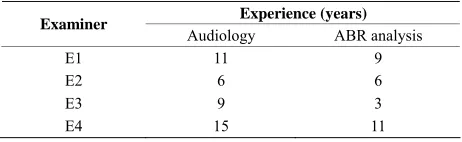
iners (E1, E2, E3 and E4) with experience in audiology participated in this study. All of them have theoretical and practical experience in the detection and analysis of ABR as shown in Table 1.
2.1. Data Collection
ABR data were collected by means of the commercial amplifier Bio-logic’s Evoked Potential System (EP), from Bio-Logic, USA. Prior to the positioning of electrodes on the scalp of the subject, the skin was properly cleansed and abraded. The electrodes were positioned according to the International 10 - 20 System proposed by Jasper in 1958 [16]. Four electrodes were placed, M1 (mastoid right) and M2 (mastoid left), Cz (active) and Fz (ground) [28]. And two channels of information were recorded. Channel 1(M1-Cz), representing information detected from the right ear and Channel 2 (M2-Cz) from the left ear. The signals were collected at a sample rate of 37,101 Hz, meaning that the time interval between two consecutive samples was of 0.027 ms. Each signal, resulting from an auditory stimulus, lasted 13.824 ms (or 512 samples). In this study we work with the averaged ABR, which is obtained by averaging 2000 ABR samples. This process can be seen as a filter that reduces background activity and highlights the signal of interest. The auditory stimuli (clicks) were used for the 80, 60, 40 and 20 dBHL power intensities for each ear. The stimulus rate was set to 21 cycles/s, as commonly use in clinical practice. The data were analyzed later in MatLab (Mathworks). The exam- iners evaluated a total of 160 ABR samples. The data were collected from 10 subjects. For each subject we collected ABR samples by stimulating both the left and right ears with auditory stimuli of 80, 60, 40 and 20 dBHL (hearing level). This procedure was repeated twice for each ear. The examiners following their individual criteria and professional experience, and the analysis consisted in the visual identification of the waves I, II, III, IV and V. All pairs of the results obtained by distinct examiners were statistically compared.
2.2. Data Analysis
2.2.1. Descriptive Statistics
[image:2.595.308.539.666.737.2]With the aim of understanding the obtained differences between responses of the examiners, we analyzed the dis- crepancies found for the latency of each Jewett wave (I, II,
Table 1. Experience in years for each examiner.
Experience (years) Examiner
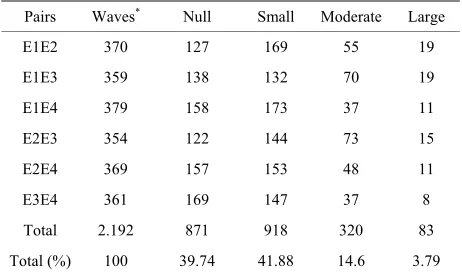
III, IV and V). The discrepancies were categorized into four groups: null (no difference at all), small (<0.1 ms), moderate (between 0.1 ms and 0.2 ms) and large (>0.2 ms). The frequency (number of occurrences) was esti-mated for each category.
estimated by the regression. Note that the data here is a set of bi-dimensional data points of the form ( ),
where (
, , ,
w s w s
k z
tE tE
, w s k
tE w s, z
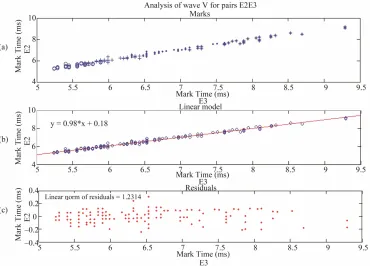
tE ) is the manually detected occurrence time in milliseconds by examiner k(z), for wave w and stimulus intensity s. In this study w = 1, …, V; k = z = 1, …, 4; s = 80, 60, 40, 20 dBHL. Figure 1(a) illustrates the data points (Y) for the results of wave V when com-paring the detection time of examiners 2 and 3, for all stimulus intensity and all subjects that participated in the research. The estimated linear model (Z) for these data is shown in Figure 1(b), whereas the residue R is shown in Figure 1(c).
2.2.2. Model-Based Analysis
When studying the relationship between results of pair of examiners, it is expected that a linear regression provide a good fit if there is complete agreement in the analyses, as showed in the Figure 1 that depicts the relation between
examiners E2E3. With this hypothesis in mind we studied the variability of the parameters of a linear model (y = ß0+
ß1·x) using Bootstrap [17,18]. The dependent variable y
represents the data obtained from an examiner for a par- ticular Jewett wave and the independent variable x re- presents the data from another examiner for the same wave. Ideally, if the examiners fully agree in their re- sponses then ß0 = 0 and ß1 = 1. In practice both ß0 and ß1
varies, and one of the aims of this research was to estimate this variability and its implications for the practical in- terpretation of ABR. In order to estimate the coefficients
ß0 and ß1 of a relationship between examiners, linear regression was employed.
2) At this stage, the residuals R (see example in Figure 1(c)) are re-sampled, with replacement, by means of
Bootstrap. A total of N = 800 new samples of R, so-called, i
R, i = 1, …, N, are generated. Each i is then added to
Z generating therefore new samples from which it is possible, through linear regression ( i
R
i
Y
Z), to estimate the coefficients *
0i
ß and * 1i
ß . The histogram of each of the set of parameters represents the empirical probability distribution function of ß0 and ß1. From it, it is possible to obtain information about the variability (e.g., standard deviation) of the parameters of the linear model.
The application of the algorithm, based on the Boot- strap, to calculate the confidence interval for the mean is given in the following example [19]:
The following sequence of steps was employed for the estimate of the variability of the coefficients ß0 and ß1:
1) The residuals (R) of the model fitted to the data were obtained as R = Y –Z where Y is the data and Z the value
[image:3.595.114.484.432.698.2]1) Experiment: Conduct the experiment. Assuming that the sample is X = (
–
2.41, 4.86, 6.06, 9.11, 10.20, 12.81,Figure 1. Linear Regression for examiners E2E3 for the wave V. (a) is the mark of the wave for the following intensity: “○” is the mark for 80 dBHL, “+” for 60 dBHL, “” for 40 dBHL and “*” for the 20
13.17, 14.10, 15.77, 15.79) of size 10, with mean µ = 9.946.
2) Re-sampling: Using a pseudo-random number gene- rator, select a sample, with replacement, from the 10 values of X. Thus we estimate the bootstrap sample X* =
(9.11, 9.11, 6.06, 13.17, 10.20,
–
2.41, 4.86, 12.81, –2.41, 4.86). Note that some of the original sample values appear more than once, while others do not appear at all.3) Estimate the average of X*: the mean for all 10 values
of X* is calculated (µ*= 6.54).
4) Repetition: Repeat step 2, N times, to obtain the total of N means, µ1*, ..., µN*. For example, N = 1000.
5) Estimate the approximate distribution of µ*: Sort, in
ascending order, them mean values estimated in step 4 to obtain: µ(1)* µ(2)* ... µ(1000)*, where µ(k) is the k-th smallest value of µ1*, ..., µN*.
6) Confidence Interval: the confidence interval desired, (1 – α) 100%, is given by: [µ(q1)*, µ(q2)*], where q1 is
the integer part of (Nα/2) and q2 = N – q1 + 1. For α = 0.05 and N = 1000, q1 = 25 and q2 = 976.
3. RESULTS
3.1. Data Consistency Analysis
[image:4.595.121.477.442.701.2]The first step in signal analysis is the visual inspection of the collected data. This can help the detection of outliers, patterns and possible inconsistencies in the data set.
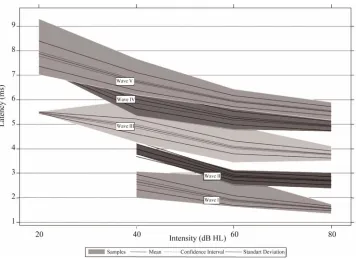
Figure 2 shows a graph of the intensity (in dBHL) versus
the latency (in ms) provided by the four examiners, for all
subjects, and for waves I, II, III, IV and V. The results include the analysis of 160 ABR samples. In the graph the shaded areas represent the area limited by the minimum and maximum latency values obtained for the analysis of each wave and each intensity. In addition, the standard deviation of the samples is presented together with a central tendency (i.e., the mean) and its confidence in-terval estimated through the Bootstrap [17]. The visual inspection of the graph reveals that the latency increases as the intensity decreases. This behavior is in accordance with findings reported in the literature, discussing the differences in the ABR patterns as function of the inten- sity [2,20-22]. Another relevant observation is that at the 80 dBHL intensity, the ABR signal has a relatively high signal-to-noise ratio, which allows for a more precise evaluation of the waves, as they are more evident. For this reason, at the high intensity the latency is an important discriminatory feature of the Jewett waves. Note in the graph that at this intensity there is no overlap between the shaded areas and the central tendencies of the waves. However, as we decrease the intensity, the visual detec- tion of some waves is impaired. For instance, the exam- iners could not visually detect the presence of the waves I and II at the 20 dBHL intensity. The wave III is more evident in the intensities of 80, 60 and 40 dBHL. In the 20 dBHL intensity the number of detections was signifi- cantly smaller. The waves IV and V remain evident for all intensities, but they tend to overlap at the 20 dBHL, as the detection of the waves IV and V gets more complex (be-
Figure 2. Latency values obtained for each Jewett wave as function of the intensity (dB HL). The
cause the signal amplitude for this intensity tends to de- crease). The number of detections is significantly lower at low intensity. This happens because of the way the neu- rons are activated by low intensity. In general waves I, II and III are less evident at lower intensity, different from waves IV and V, which are evident even at low intensity, being therefore employed in auditory threshold detection studies. As a consequence of this we have less manual detections, mainly for waves I, II and III and this could interfere on the confidence intervals estimated for the parameter of the linear model.
The experimental results illustrated in Figure 2 are in
accordance with those found in the literature [2,21,23,24], showing, therefore, the consistency of our data set and the visual detection of the Jewett waves executed by the ex- aminers.
3.2. Descriptive Statistics
Following the consistency verification of the data pro- vided by the examiners we carried out a data discrepancy analysis in order to verify, by means of descriptive statis-tics, the discrepancies in the visual detection of the Jewett waves. The main difficulty in this analysis was to set thresholds for the latency, which would allow for the data categorization into distinct groups (i.e. null, small, mod-erate and large). For this, we employed the patterns of reproducibility of ABR data suggested by Hood [1,2], Vannier [24] and Burkard and Don [25]. These authors consider variations in the latency values between 0.1 and 0.2 ms as acceptable for subjects with normal hearing and without neurological impairment. Based on this we cate- gorized the data as described in Table 2 shows the fre-
quency found for each category. This analysis revealed that, if we consider the null and small categories as an acceptable standard for ABR analysis we have 81.62% of agreement between the examiners. This number can in- crease to 96.21% if we also consider the moderate cate- gory. Differences larger than 0.2 ms, which are not ac- ceptable at all, represent 3.79% of the total samples.
3.3. Data Variability Analysis
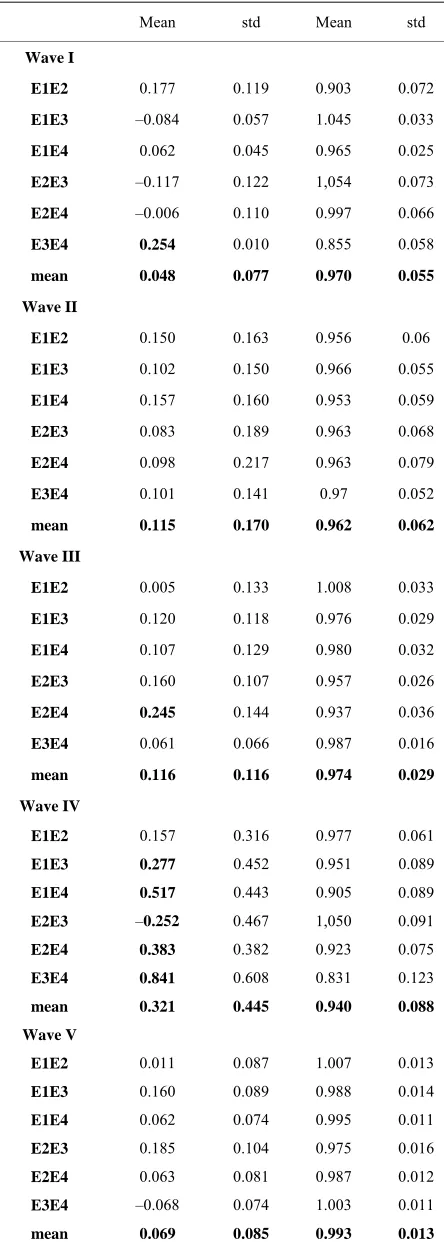
In order to assess the variability of the visual analysis of examiners we applied the model-based approach de- scribed in Section 2.2.2. Table 3 and Figure 3 depict the
obtained results. In the linear model, the parameter ß0 is the intercept and has the same unit as the input signal (ms). The dimensionless parameter ß1, the slope, is responsible for modulating the independent variable of the model. If
ß0 = 0 and ß1 = 1 then there is complete agreement be- tween the analysis of pair of examiners. Small values for
[image:5.595.308.539.154.291.2]ß1 could indicate a disagreement between the classifica-tions of a particular wave. For instance, E1 could classify a given wave as I whereas E2 could classify it as II. Large
Table 2. Analysis of the categorized discrepancy between
re-sults provided by examiners. The number of occurrences is pre- sented for each category. The discrepancies were categorized into four groups and the number of occurrences (frequency) es- timated for each category: null (no difference at all), small (<0.1 ms), moderate (between 0.1 ms and 0.2 ms), large (>0.2 ms).
Pairs Waves* Null Small Moderate Large
E1E2 370 127 169 55 19
E1E3 359 138 132 70 19
E1E4 379 158 173 37 11
E2E3 354 122 144 73 15
E2E4 369 157 153 48 11
E3E4 361 169 147 37 8
Total 2.192 871 918 320 83
Total (%) 100 39.74 41.88 14.6 3.79
*The total number of waves refers to those waves that were detected by both
examiners considering the analysis of signals obtained from all investigated intensities.
values of ß0 (e.g., >0.2 ms) represent significant system- atic discrepancies in the analysis of a particular wave. The results shown in Table 3 suggest that there was no dis-
agreement between wave classifications for all cases, be- cause the values of ß1 are close to 1.0 with a small stan- dard deviation, indicating little variability of this para- meter. Based on the analysis of the mean and standard deviation of our data we found the worst results for the wave IV (ß1 = 0.94 ± 0.088) and the best for the wave V (ß1 = 0.99 ± 0.013). In contrast, some large values and variability were found for the parameter ß0 in the analysis of waves I, III and IV. For the cases of waves I and III, there were significant differences between a pair of ex- aminers, whereas for the wave IV there was a general disagreement, showing therefore the difficulty in the visual detection of this wave. The probability distribu- tions for ß0 and of ß1 highlights the discrepancies found for wave IV. As expected, ß0 and ß1 are closer to the ideal values in the analysis of wave V, which is the less affected by the changes in the intensity.
4. DISCUSSION AND CONCLUSION
Table 3. Mean and standard deviation of the coefficients of the
linear model.
Mean std Mean std
WaveI
E1E2 0.177 0.119 0.903 0.072
E1E3 –0.084 0.057 1.045 0.033
E1E4 0.062 0.045 0.965 0.025
E2E3 –0.117 0.122 1,054 0.073
E2E4 –0.006 0.110 0.997 0.066
E3E4 0.254 0.010 0.855 0.058
mean 0.048 0.077 0.970 0.055
WaveII
E1E2 0.150 0.163 0.956 0.06
E1E3 0.102 0.150 0.966 0.055
E1E4 0.157 0.160 0.953 0.059
E2E3 0.083 0.189 0.963 0.068
E2E4 0.098 0.217 0.963 0.079
E3E4 0.101 0.141 0.97 0.052
mean 0.115 0.170 0.962 0.062
WaveIII
E1E2 0.005 0.133 1.008 0.033
E1E3 0.120 0.118 0.976 0.029
E1E4 0.107 0.129 0.980 0.032
E2E3 0.160 0.107 0.957 0.026
E2E4 0.245 0.144 0.937 0.036
E3E4 0.061 0.066 0.987 0.016
mean 0.116 0.116 0.974 0.029
WaveIV
E1E2 0.157 0.316 0.977 0.061
E1E3 0.277 0.452 0.951 0.089
E1E4 0.517 0.443 0.905 0.089
E2E3 –0.252 0.467 1,050 0.091
E2E4 0.383 0.382 0.923 0.075
E3E4 0.841 0.608 0.831 0.123
mean 0.321 0.445 0.940 0.088
WaveV
E1E2 0.011 0.087 1.007 0.013
E1E3 0.160 0.089 0.988 0.014
E1E4 0.062 0.074 0.995 0.011
E2E3 0.185 0.104 0.975 0.016
E2E4 0.063 0.081 0.987 0.012
E3E4 –0.068 0.074 1.003 0.011
mean 0.069 0.085 0.993 0.013
The first stage of our analysis was to verify whether the latency values obtained by the examiners were compatible with those reported in the literature. The results presented in Figure 2 depict all information provided by the ex-
aminers. They are consistent with patterns described in other studies. For the intensity of 80 dBHL we obtained the following mean values for the Jewett waves: 1.56 ms (wave I), 3.77 ms (wave III) and 5.53 ms (wave V). An- tonelli [23] reported that the normal average values of latency in the 100 dB SPL (Sound Pressure level) inten- sity for the waves I, III and V, are respectively equal to 1.54 ms, 3.73 ms and 5.52 ms. Hernandez [21] evaluated the behavior of waves generated at different power in- tensities. In the intensities of 90, 70, 50, 30, 10 dBHL the wave V was always found, and the average latency values were 1.49 ms, 3.73 ms and 5.53 ms, for the waves I, III and V, respectively. These results indicate the coherence in the visual analysis provided by the examiners in this research. Another problem we had to face in our analysis was in the establishment of acceptable threshold levels for the variation of the latency of Jewett waves. There is some disagreement in the literature, as some authors report a variation of 0.1 ms as acceptable, whereas others report 0.2 ms [2,5,15,24,26]. In addition, some studies con- cerning the development of automatic systems for the detection of Jewett waves have considered values of la- tency between 0.1 ms and 0.2 ms as acceptable for the validation of these systems [27-30]. Therefore, we em- ployed simple descriptive statistics for categorization of the discrepancies between results provided by the exam- iners. The discrepancies were categorized into four groups and the number of occurrences (frequency) estimated for each category: null (no difference at all), small (<0.1 ms), moderate (between 0.1 ms and 0.2 ms), large (>0.2 ms). This analysis showed that discrepancies larger than 0.2 ms, which are not acceptable, accounted for 3.79% of the total samples. Moderate differences accounted for 14.6%, which means that more than 18% of the investigated samples presented variations larger than 0.1 ms. The figures high- light the necessity of standardization in the process of analysis of ABR, as in some cases moderate and large discrepancies can interfere with the accurate diagnosis of some neurological disorders.
Figure 3. Probability distribution of the parameters ß0 (left) and ß1 (right) for the wave I for distinct pair of
ex-aminers. The parameter ß1 suggests that all examiners are in agreement regarding the analysis of the wave I, and the parameter ß0 indicates that the discrepancy is less than 0.112 ms (mean value) for all pairs. Note that only the pair E3E4 shows a significant discrepancy 0.254 ms.
the best of our knowledge, this type of analysis has not been employed for the characterization of the relationship between results obtained from distinct examiners and for different Jewett waves (I, II, III, IV and V).
A simple way to avoid such a problem would be to sig- nificantly increase the number of examiners involved in the research. Although pairwise analysis such as the one employed in this study is often found in literature, it has some limitations: the order of the comparison my influ- ence upon the final results; there is an assumption that each paired comparison is independent; generally, dif- ferent pairs may have different total number of compare- sons. The probability distribution functions (PDFs) shown in Figure 3 were obtained from data analyzed by only
four examiners. Possibly the increase of the number of examiners would result in more accurate PDFs that could better represent the data. This is an important limitation of our study that should be addressed in future investiga- tions.
An important and innovative aspect of this research was the investigation of the variability of the discrepan- cies of the analyses of the examiners through the pa- rameters (ß0 and ß1) of a linear model using Bootstrap. We concluded that the parameter ß1 can be employed for checking the agreement between classifications of a par- ticular Jewett wave. If the value of ß1 is either small or large it can indicate that two examiners classified the wave differently. The parameter ß0 can be interpreted as the accuracy of the latency value. Ideally, it should be null, however in this study it should take into account the ac- ceptable limits of variation found for the latency of each wave with its standard deviations. This study shows that the variability of results obtained among the examiners is not the same for all waves. For instance, for the waves I, II and III the mean difference was 0.11 ms, for the wave V of 0.08 ms, and for the wave IV of 0.40 ms. The number of examiners that participated in this study is small, al- though it is in accordance to other similar investigations (e.g. Hunt 1986, [31]) the authors recruited three exam- iners for participation in practical experiments. This may affect our results, for instance the Regression to the mean effect can interfere with the estimated values for ß0 and ß1.
The results can be seen as practical scales that can be used in the assessment of automatic systems that detect Jewett waves, and also as practical tools to ease the in- terpretation and visual analysis provided by examiners. Another important aspect of our results is that they ac- count for the ABR data collected from stimulus signals with intensities ranging from 20 dB HL to 80 dB HL and for all waves that could be detected at these intensities. The contribution of this study in the Evoked Potentials Analysis is supported by our strategy for data analysis that can:
ß1) of the linear model. These two parameters can give us complementary information. In our study ß0 gives us an estimate of the accuracy of the agreement between ex- aminers, whereas the analysis of its variability, estimated by means of the Bootstrap, is a measure of the precision of such agreement. The closer ß0 is to zero the smaller are the differences between examiners when visually detecting the time when the Jewett waves occurs. ß1, the angular coefficient, gives us information on the agreement of the type of Jewett wave (I, II, III, IV and V) labeled by ex- aminers. A value of ß1 close to one is an indicative that the examiners agreed in the labeling of a specific Jewett wave.
2) Provide a model representing the relationship be- tween the agreements of distinct examiners. The model parameters together with their variability can be used in generative models, for generating new data sets which takes into account the underlying differences between ex- aminers. Such differences may be due to subjective va- riables such as the effect of the duration of the data ana- lysis on the concentration of the examiner, clinical expe- rience, the visual detection method selected by the ex- aminer. Variables which are inherent to the process of data collection, such as noise, may also contribute to in- creasing the differences of results obtained by examiners.
Generative models like this can be used for generating known data, with different features controlled by the variability of the original data set, which can be employed for assessing systems developed for the automatic detec- tion of Jewett waves. Descriptive statistics methods could have been used in the data analysis. However, these methods might not highlight any potentially interesting structure in the data to the extent that the linear regression could if the regression reveals that the linear dependence is only an approximation. In other words, if the data (or residuals) follow the Gaussian distribution then most likely the descriptive statistics such as Intraclass Correla- tion Coefficients (ICC) and Bland-Altman plots would convey the same information as the regression. However, if the linear regression assumptions are violated the re- gression plots can reveal it, the descriptive stats may not. In this study we don’t know the pattern of the response expected since it is not described in literature and the linear model was adequate.
5. ACKNOWLEDGEMENTS
The authors would like to thank the Brazilian government, which through the Foundation for Research Support of the Minas Gerais State (FAPEMIG), has provided financial support for this research (Project FAPEMIG— TEC APQ-2481- 6.01/07). Text for this section.
REFERENCES
[1] Eggermont, J.J. (2007) Electric and magnetic fields of syn-
chronous neural activity. In: Burkard, R.F., Eggermont, J.J. and Don, M., Eds., Auditory evoked potentials: Basic
principles and clinical application. Lippincott Williams
& Wilkins, Baltimore, 2-21.
[2] Hood, L.J. (1998) Clinical applications of the auditory brainstem response. Singular Publishing Group Inc., San Diego.
[3] Nodarse, E.M., Abalo, M.C.P. and López, G.S. (2006) Métodos de pesquisaje de las pérdidas auditivas a edades tempranas. Revista Electrónica de Audiologia, 3, 9-18.
[4] Hall, J.W. (2006) New handbook of auditory evoked re- sponses. Pearson Edication Inc., Boston.
[5] Misulis, K.E. (2003) Potencial evocado de spehlmann. 2nd Edition, Revinter Ltda, Rio de Janeiro.
[6] Schwanke, D. (2000) Exame de potenciais evocados au- ditivos utilizando processador digital de sinais—DSPEA. Dissertação de Mestrado, Instituto de Informática, Univer- sidade Federal do Rio Grande do Sul, Rio Grande do Sul. [7] Sininger, Y.S. (2007) Source analysis of auditory evoked
potentials and fields. In: Burkard, R.F., Eggermont, J.J. and Don, M., Eds., The use of auditory brainstem response in screening for hearing loss and audiometric threshold
pre-diction. Lippincott Williams & Wilkins, Baltimore, 254-
274.
[8] Martin, W.H. and Shi, B.Y.B. (2007) Intraoperative mon- itoring. In: Burkard, R.F., Eggermont, J.J. and Don, M., Eds.,
Auditory evoked potentials: Basic principles and clinical
application. Lippincott Williams & Wilkins, Philadelphia,
355-384.
[9] Katz, J. (1989) Audiologia clínica. 3rd Edition, Manole, New York.
[10] de Garcia, B.G., Gaffney, C., Chacon, S., et al. (2011) Overview of newborn hearing screening activities in Latin America. Revista Panamericana de Salud Pública,
29, 145-152.
[11] Chomsky, N. (2005) Three factors in language design.
Linguistic Inquiry, 36, 1-22.
doi:10.1162/0024389052993655
[12] Fitcha, W.T., Hauserb, M.D. and Chomsky, N. (2005) The evolution of the language faculty: Clarifications and im- plications. Cognition, 97, 179-210.
[13] Junqueira, C.A.O. and Colafêmina, J.F. (2002) Investiga- ção da estabilidade inter e intra-examinador na identify- cação do P300 auditivo: Análise de erros. Revista Brasil-
eira de Otorrinolaringologia, 68, 468-478.
[14] Pediatrics, A.A.O. (1999) Newborn and infant hearing loss: Detection and Intervention. Pediatricis, 103, 527-530. doi:10.1542/peds.103.2.527
[15] Vidler, M. and Parker, D. (2004) Auditory brainstem re- sponse threshold estimation: Subjective threshold estima- tion by experienced clinicians in a computer simulation of the clinical test. International Journal of Audiology, 43,
417-429. doi:10.1080/14992020400050053
[16] Böcker, K.B.E., van Avermaete, J.A.G. and Van den Berg- Lenssen, M.M.C. (2005) The international 10-20 system revisited: Cartesian and spherical co-ordinates. Brain To-
[17] Efron, B. and Tibshirani, R.J. (1998) An introduction to the bootstrap, Chapman & Hall/CRC, Boca Raton. [18] Johnson, R.W. (2001) An introduction to the bootstrap.
Journal of Royal Statistical Society: Series D, 23, 49-54.
[19] Andrade, A.O. (2005) Decomposition and analysis of elec- tromyographic signals. Ph.D Thesis, School of Systems Engineering, Department of Cybernetics, The University of Reading, Reading.
[20] Don, M., Ponton, C.W., Eggermont, J.J., et al. (1998) The effects of sensory hearing loss on cochlear filter times es- timated from auditory brainstem response latencies. Acous-
tical Society of America, 104, 2280-2289.
doi:10.1121/1.423741
[21] Hernández, J.D., Castro, F.Z. and Prat, J.J.B. (2003) Nor- malización de los potenciales evocados auditivos del tronco cerebral I: Resultados en una muestra de adultos normoyentes. Revista Electrónica de Audiologia, 2, 13-18. [22] De Montes, C., Manjón, M., vinuales, M. et al. (2002) Es-
túdio morfológico de los potenciales evocados auditivos de tronco del encéfalo. Influência de la posición del ele- trodo de referência. Revista de Neurologia, 34, 84-88.
[23] Antonelli, A.R., Bellotto, R. and Grandori, F. (1987) Au- diologic diagnosis of central versus eighth nerve and co- chlear auditory impairment. Audiology, 4, 209-226. doi:10.3109/00206098709081550
[24] Vannier, E., Adam, O. and Motsch, J.-F. (2002) Objec- tive detection of brainstem auditory evoked potentials with a priori information from higher presentation levels.
Artificial Intelligence in Medicine, 25, 283-301.
doi:10.1016/S0933-3657(02)00029-5
[25] Burkard, R.F. and Don, M. (2007) The auditory brain-stem response.In: Burkard, R.F. Don, M. and Eggermont, J.J., Eds., Auditory evoked potencials: Basic principles
and clinical applications. Lippincott Williams & Wilkins,
Baltimore, 229-253.
[26] Don, M. (1989) Quantitative approaches for defining the quality and threshold of auditory brainstem responses.
IEEE Engineering in Medicine & Biology Society, 2, 761-
762.
[27] Acyra, N., Ozdamarb, O. and Guzelis, C. (2006) Auto- matic classification of auditory brainstem responses using SVM-based feature selection algorithm for threshold de- tection. Engineering Applications of Artificial Intelligence,
19, 209-218.
[28] Boston, J.R. (1989) Automated Interpretation of brain-stem auditory evoked potentials: A prototype sybrain-stem.
IEEE Transactions on Biomedical Engineering, 36, 528-
532. doi:10.1109/10.24254
[29] Bradley, A.P. and Wilson, W.J. (2004) On wavelet analy- sis of auditory evoked potentials. Clinical Neurophysiol- ogy, 115, 1114-1128. doi:10.1016/j.clinph.2003.11.016
[30] Jacquin, A., Causevic, E., John, E.R., et al. (2006) Optimal denoising of brainstem auditory evoked response (BAER) for Automatic peak identification and brainstem assess- ment. Proceedings of the 28th IEEE EMBS Annual Inter-
national Conference, New York, 30 August-3 September
2006, 1723-1726.
[31] Hunt, R.J. (1986) Percent agreement, Pearson’s correla- tion, and kappa as measures of inter-examiner reliability.