Supple: Multiagent Communication Protocols with Causal Types
Engineering Multiagent Systems Track
Paper # 187
ABSTRACT
A (communication) protocol captures how agents interoperate by specifying the messages they exchange. In particular, since the information content of messages characterizes the interactions a protocol specifies, message types can improve interoperation by strengthening the specification of what each agent may legitimately expect from another agent. In addition, in implementations, typing information can enable improved verification of agents.
We introduce Supple, a protocol specification language that ex-presses message schemas with typed parameters. Supple enables definition ofcausal typesfor parameters that constrain how other parameters are computed in a protocol enactment. We give the formal semantics of Supple; characterize the liveness and safety of Supple specifications; and provide decision procedures for them.
KEYWORDS
Communication protocols; Agent communication
1
INTRODUCTION
The MAS Setting Our setting is a decentralized multiagent system (MAS) of autonomous and heterogeneous agents communicating via asynchronous messaging. Each agent acts on behalf of some real-world principal. An agent would be independently implemented or configured by its principal—without necessarily knowing the details of the other agents. Successful interoperation in such a setting requires precise specification of each agent’s expectations— so the agents can comply with them.
In a decentralized MAS, aprotocolenables interoperation be-tween agents by specifying their mutual expectations separately from their internal decision making. That is, a protocol yields de-sign requirements on how the agents exchange information. Major applications in finance and healthcare specify protocols. For ex-ample, the international healthcare standard, HL7 [12], specifies protocols to support interactions among healthcare stakeholders. Financial protocols as well, e.g., for syndicated loans [14], involve complex interactions and information models.
Problem For simplicity, we adopt an insurance auditing scenario as our running example. Auditing protocols are essential in many real world applications. In healthcare, HIPAA (US) and NHS (UK) specify auditing protocols involving several stakeholders. In our scenario, the agents involved are a subscriber S, insurer I, and auditor A. S buys policies from I which it uses to make claims. A requests reports from an insurer for auditing, which list the claims that were paid out but for less than the initial claimed amount.
Proc. of the 18th International Conference on Autonomous Agents and Multiagent Systems (AAMAS 2019), N. Agmon, M. E. Taylor, E. Elkind, M. Veloso (eds.), May 2019, Montreal, Canada
© 2019 International Foundation for Autonomous Agents and Multiagent Systems (www.ifaamas.org). All rights reserved.
https://doi.org/doi
A protocol language must deal with the following interoperation failures. One, liveness failure: the insurer may lack the information needed to compute a report because it may have only a partial view of all the information communicated. Two, integrity failure: if I can compute the report, it should contain all and only the correct results. Three, safety failure: agents must not face a race situation where each attempts to produce authoritative results, e.g., if both I and S are enabled to produce results of the same request.
Ourproblemis how can a protocol language support statically
verifying avoidance of the above failures? And, how can we re-late the structure of communication in a MAS to the structure of information exchanged between agents.
Approach Our proposed language, Supple, adopts a declarative framework to ensure that protocols can be flexibly enacted in a decentralized and asynchronous manner [22]. An underlying intu-ition is that communication both produces and is constrained by information. Supple’s main idea is to use typed parameters as first-class language elements for dynamically specifying types of the information to be exchanged at run time. In particular, it introduces
causal typesfor parameters that constrain how other parameters
are computed in a protocol enactment.
A causal type specifies the type of information on which a com-putation is performed, and the type of information the comcom-putation yields. For example, a causal type may specify a computation that can be applied to the claimed and paid amounts of an insurance policy to compute the total payable amount of the policy. The au-ditor may send a request for a report including a function of the above causal type to express the selection criteria for the claims to be considered in the report and the type of information to be reported for those claims.
Supple yields three main benefits. First, agents may enact the same protocol instantiated with different functions to produce dif-ferent report types. Second, agents can be verified against those types. Third, protocols can be verified taking parameter types into account. For example, if a protocol enables the auditor to send a function of the above causal type to the insurer, it must enable the insurer to acquire the necessary information to apply the function during the enactment. Otherwise, the protocol is incorrect. Parame-ter types enable static checking of protocols to prevent such errors even though a function may be formulated at run time.
LiteratureExisting protocol specification approaches inadequately specify what information may be exchanged through a protocol, leading to ad hoc methods to ensure correctness. Several approaches capture control flow: UML sequence diagrams [4], session types [18], WS-CDL [25], RASA [16]) and 2CL [3], but none captures information flow. FIPA [10] adds ontology annotations to messages but doesn’t relate information across messages. Gunay et al. [11], assign meanings to messages but don’t specify the message con-tent precisely upon which the meanings rely. Information flow approaches, [22, 24] model content weakly, as uninterpreted values.
Chopra et al.’s [6] Splee incorporates queries into protocols, e.g., to specify that the winner in an English auction protocol is the highest bidder, but considers them only as untyped descriptive annotations, which are not part of Splee’s formalization. Supple shares some motivations with business artifacts and data-centric models [9, 19], which combine information abstractions with process. Montali et al. [17] address verification of commitment-based MAS with queries. However these works typically do not address decentralization, treating a multiagent system as a single machine.
Baldoni et al. [2] formalize agent types to check them for compat-ibility with commitment protocols. Damiani et al. [8] formalize type soundness of MAS in terms of agents and artifacts. Kakas et al. [13] support agent reasoning for communication. Supple focuses on the complementary concern of specifying a protocol independent of agent reasoning as a way to guide the development of interoperable agents. In decentralized MAS, a protocol must handle loosely cou-pled, asynchronous communication whereas the above approaches require synchronous communication via a shared infrastructure.
Contributions Supple provides (1) a language for enriched pro-tocol specification; (2) a novel definition of safe and live proto-cols; and (3) associated verification algorithms. Supple’s novelty lies in introducing type abstractions for information in interaction whereas existing work does not consider information modeling of interactions. Supple’s significance lies in advancing interaction-orientation: by specifying interactions in more detail, we can verify protocols and agents without relying upon internal details. Expos-ing implementations is anathema to engineerExpos-ing practice in any setting and especially inapplicable in decentralized MAS.
2
BACKGROUND
We introduce information-based protocols by example. BSPL [20] specifies protocols declaratively, constraining message via causality and integrity, and omitting control structures (e.g., sequencing, branching, iteration). Listing 1 shows a BSPL protocol,CreatePolicy, to create an insurance policy between an insurer (I) and a subscriber (S). It declares three public parameters,pID(the protocol’s key),
premium, anddate. Every complete enactment of the protocol must
produce bindings for all of these parameters. The⌜out⌝adornment signifies that the bindings are produced by this protocol.
Listing 1: A protocol to create an insurance policy. C r e a t e P o l i c y {
r o l e I , S
p a r a m e t e r o u t pID key , o u t premium , o u t d a t e I 7→ S : o f f e r [o u t pID , o u t premium ]
S 7→ I : a c c e p t [i n pID , i n premium , o u t a g r e e d ] S 7→ I : r e j e c t [i n pID , i n premium , o u t d a t e ]
I 7→ S : c r e a t e [i n pID , i n premium , i n a g r e e d , o u t d a t e ] }
CreatePolicydeclares four message schemas. The ordering of
message schemas in a protocol listing is irrelevant to their oper-ational ordering in an enactment. The messageofferis directed from the insurer to the subscriber to offer a new policy. Its two parameters are adorned⌜out⌝, meaning that their bindings must be produced by the insurer when emitting anoffermessage. Inaccept, the parameterspIDandpremiumare adorned⌜in⌝, meaning that the subscriber must know the bindings of these parameters from
prior messages (e.g.,offer) to emitaccept. Each protocol and mes-sage must have a key. The key parameters of a protocol are also key parameters of its messages. Bindings of all parameters are unique for each binding of the key parameters. Note thatdateis adorned
⌜out⌝inrejectandcreate. Hence, in any enactment ofCreatePolicy,
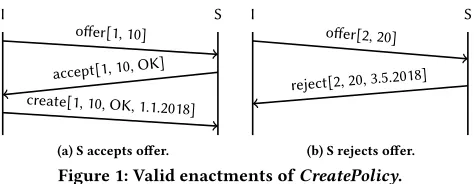
either onlyrejector onlycreatecan be emitted to ensure integrity. Figure 1 shows two valid enactments ofCreatePolicywith bind-ings of the message parameters. In Figure 1a, the subscriber accepts the insurer’s offer and in Figure 1b, the subscriber rejects the offer.
I S
offer[1, 10]
accept[1, 10,OK]
create[1, 10, OK, 1.1.2018]
(a) S accepts offer.
I S
offer[2, 20]
reject[2, 20, 3.5.2018]
[image:2.612.323.560.197.289.2](b) S rejects offer.
Figure 1: Valid enactments ofCreatePolicy.
Listing 2 illustrates protocol composition.ReportPolicy refer-encesCreatePolicyvia its public parameters, and adds two messages. Here,rIDidentifies report instances, and forms a composite key withpIDto associate multiple policies with a report. The auditor’s request for a report is captured asrequest, whereamountindicates the minimum premium amount the insurer should report. BSPL enforces no constraints besides integrity on parameter bindings. Hence, althoughamountis meant as a criterion to filter the reported policies,ReportPolicydoes not represent this intuition. Hence,
Re-portPolicy’s enactments may include areportfor any knownpID.
Listing 2: Reporting insurance policies to an auditor. R e p o r t P o l i c y {
r o l e I , A
p a r a m e t e r o u t r I D key , o u t pID key , o u t amount , o u t i n f o
C r e a t e P o l i c y ( I , S , o u t pID key , o u t premium , o u t d a t e ) A7→ I : r e q u e s t [o u t rID , o u t amount ]
I 7→ A : r e p o r t [i n rID , i n pID , i n amount , i n premium , o u t i n f o ]
}
3
TYPES IN SUPPLE
What we need is a protocol language that not only tackles decentral-ized MAS but provides language support for information dependen-cies. Specifically, BSPL supports⌜out⌝–⌜in⌝causal dependencies but ignores⌜in⌝–⌜out⌝dependencies needed to correctly link the requested minimum premium amount inrequestwith the reported information inreportas we illustrate in Listing 2.
3.1
Atomic and Composite Causal Types
In Supple, each parameter with its adornment constitutes a distinct
causal typeand may have a binding conforming to its type. For
example, in Listing 1, we interpretout pID andin pID, andout
premiumandin premiumas distinct causal types.
Whereas a data type in traditional languages defines how a value may be interpreted by an application (e.g.,premiumis money in Euros), a type in Supple defines the flow of information in a protocol.
We disregard data types since they are well-known (assume they are strings throughout) and reserve the term “type” for causal types. In Supple, the possible bindings of a type, for which the adorn-ment component is⌜out⌝, include any possible binding (i.e., any string). For instance, the parameterpremiumcan be bound to any string by the insurer when emittingoffer, since the type of the parameter isout premium. On the other hand, the possible bindings of a type, for which the adornment component is⌜in⌝, depend on the existing bindings of the types, which share the same parameter component, in all enactments. For instance, the possible bindings of parameterpremiuminacceptdepend on the existing bindings of
thepremiumparameters in all messages.
A type isatomicwhen it consists of a single pair of adornment and parameter components. A type may be acompositeof multiple atomic types. Protocols (and messages) have composite types over their parameters’ types. For example,offer’s type in Listing 1 is the composite type (out pID,out premium) with respect to the types of its parameters (i.e.,pIDandpremium). Note that an atomic type is a special case of a composite type. That isout premiumand
(out premium)correspond to the same type. However, we drop
the parentheses from the notation of a composite type when it is defined over a single atomic type.
3.2
Causal Type of a Computation
Our main focus is the notion of the causal type of a computation, which we denote asT :I → O, whereT is a name, andIandO
are composite types.Idefines the type of information on which the computation is performed andOdefines the type of information the computation yields. For instance, a computation whose type
isc : (in pID, in premium)→(out c.pID, out c.premium, out c.info)is
performed on the information, whose type is(in pID, in premium), yielding to the information, whose type is(out c.pID, out c.premium,
out c.info). Note thatin pIDandout c.pID(and similarlyin premium
andout c.premium) are different types.
The causal type of a computation enforces certain constraints on the type of information the computation yields with respect to the type of information on which the computation is applied.
Constraint 1:All the atomic types that form the composite type
Imust have⌜in⌝as their adornment component. The reason is,
Idefines the type of information on which the the computation is performed. Hence, this type of information must be known to the agent when the computation is performed, which is signified by the⌜in⌝adornment.
Constraint 2:If there is an atomic typetinI, whose parameter component isp(e.g.,pID), and there is an atomic typet′inO, whose parameter component includespprefixed withT (e.g.,c.pID), then (1)t′must have an⌜out⌝adornment, and (2) the bindings oft′ to which the computation yields, must be a subset of the existing bindings oftwhen the computation is performed. That ist′is a dependent type ont. This is an⌜in⌝-⌜out⌝dependency, which cannot be captured in BSPL. This kind of dependency enables us to specify the causal type of computations that perform information filtering, which we explore in Section 3.3.
Constraint 3:If there is an atomic typet′inO, whose parameter component ispwithout the prefixT (e.g.,infowithout the prefix c.), but there is no atomic typetinI, whose parameter component
isp, thent′must have an⌜out⌝, which can have any binding. This kind of types enable us to specify production of new information as the result of a computation, which may be used to create mappings or aggregations, which we explore in Section 3.3.
These constraints allow only certain adornments of atomic types inIandO, which we can infer from the names of the atomic types. Hence, we simplify the notation of causal types as follows. Using Constraint1, we drop⌜in⌝adornments from the atomic types in
I. Using Constraint 2, we drop⌜out⌝adornments and use ofT as a prefix of atomic types inO. Using Constraint 3 we drop⌜out⌝ adornments of atomic types inO. As a result in the rest of the paper, instead ofc : (in pID, in premium)→(out c.pID, out c.premium, out
c.info)we writec : (pID, premium)→(pID, premium, info).
Listing 3 shows a Supple protocol that uses the causal typec
: (pID, premium)→(pID, premium, info)for a computation in our
scenario. The parameterc, whose type isc : (pID, premium)→(pID,
premium, info)with the adornment component⌜out⌝is used in the
messagerequestto indicate the type of computation that the auditor requests. When emittingrequest, the auditor can bind the parameter cto any computation conforming to its type. The adornment ofcin
reportis⌜in⌝, meaning that the insurer must know the computation
that is bound tocin order to send an instance of areport. Supple is indifferent to the meaning of parameter bindings. Hence, the binding ofccan be anything (i.e., a query, constraint, etc.) that agents can interpret as a computation. Type conformance verifica-tion methods are out of our scope but program analysis techniques or run-time verifiers [21] can support verification.
Listing 3: Capturing causal types of computations. R e p o r t P o l i c i e s V i a C o n s t r a i n t {
r o l e I , A
p a r a m e t e r o u t r I D key , o u t ⟦c⟧
t y p e c : ( pID , premium )→( pID , premium , i n f o )
C r e a t e P o l i c y ( I , S , o u t pID key , o u t premium , o u t d a t e ) A7→ I : r e q u e s t [o u t rID , o u t c ]
I 7→ A : r e p o r t [i n rID , i n c , o u t ⟦c⟧] }
Supple introduces⟦⟧notation to refer the yielding composite
type (i.e.,OinT : I → O) of a computation. For example, in Listing 3,reportincludes⟦c⟧which corresponds to the composite
type(out c.pID, out c.premium, out c.info).
3.3
Causal Computation Patterns
We introduce major patterns that occur in a variety of applications.
3.3.1 Filter.Filter selects a subset of a parameter’s known bind-ings according to the criteria defined in a computation. For example, the auditor may request the insurer to report only the policies that satisfy some premium criteria (e.g., below of amount). Listing 4 showsReportPremium, in which the parametercis used to define computations to represent such criteria. Listing 5 shows such a computation specified as a (simplified SQL), which can be assigned tocby the auditor for requesting only the policies with premium between 50 and 100.
Listing 4: Reporting premiums of selected policies. ReportPremium {
r o l e I , A
p a r a m e t e r o u t r I D key , o u t ⟦c⟧
t y p e c : ( pID , premium )→( pID , premium )
C r e a t e P o l i c y ( I , S , o u t pID key , o u t premium , o u t d a t e ) A 7→ I : r e q u e s t [o u t rID , o u t c ]
I 7→ A : r e p o r t [i n rID , i n c , o u t ⟦c⟧] }
In Filter, the computation yields to a dependent type of its input. LetKandPbe the types of key and non-key parameters, respec-tively. Filter is represented by the following type definition:
(K,P)→(K,P)
Listing 5: Example query in SQL to filter policies. SELECT C r e a t e P o l i c y . pID AS pID
C r e a t e P o l i c y . premium AS premium WHERE 50 < C r e a t e P o l i c y . premium < 1 0 0
3.3.2 Map.Map transforms bindings of a tuple of parameters yielding to new bindings for other tuple of parameters. For instance, the auditor may request the insurer to report its debt for each claim, which is the difference between the claimed and paid amounts. Listing 6 definesReportClaimDebtreferring toMakeClaim, which makes a claim for an existing policy (identified bypID), and pro-duces bindings ofcID(claim’s key),claimed, andpaidamounts. In
ReportClaimDebt, the insurer’s debt for each claim (i.e.,cDebt) is
computed usingclaimedandpaidaccording to the computation that is bound toc(i.e., the claimed and paid amounts of each claim in each policy are mapped to the debt for the corresponding claim). Note that the outcome ofcincludespID, which is needed to asso-ciate the computed debt for a claim with the corresponding policy.
Listing 6: Reporting insurer’s debt per claim. R e p o r t C l a i m D e b t {
r o l e I , A
p a r a m e t e r o u t r I D key , o u t ⟦c⟧
t y p e c : ( pID , cID , c l a i m e d , p a i d )→( pID , cID , c D e b t ) C r e a t e P o l i c y ( I , S , o u t pID key , o u t premium , o u t d a t e ) MakeClaim ( S , I , i n pID key , o u t cID key , o u t c l a i m e d ,
o u t p a i d )
A 7→ I : r e q u e s t [o u t rID , o u t c ] I 7→ A : r e p o r t [i n rID , i n c , o u t ⟦c⟧] }
LetKbe a the type of key parameters, andPandRbe the types of non-key parameters. Map corresponds to the type:
(K,P)→(K,R)
3.3.3 Reduce. Reduce yields bindings for a parameter by aggre-gating another parameter’s bindings. For instance, the auditor may want to know the total debt of an insurer for each policy, a solution to which Listing 7 illustrates. InReportPolicyDebt, the insurer’s debt per policy is computed using the computation bound toc, which assigns the insurer’s debt per policy topDebtaccording tocDebt re-ferring toReportClaimDebt. Here, the keycIDis not involved in the yielding type ofc, since the reduced debt information is associated only with policies (and reports).
Listing 7: Reporting insurer’s debt per policy. R e p o r t P o l i c y D e b t {
r o l e I , A
p a r a m e t e r i n aID key , i n q , i n c , o u t ⟦c⟧
t y p e c : ( rID , pID , cID , c D e b t )→( rID , pID , pDebt ) R e p o r t C l a i m D e b t ( I , A , o u t r I D key , o u t pID key , o u t
cID key , o u t c D e b t )
I 7→ A : a g g r e g a t e [i n aID , i n c , o u t ⟦c⟧] }
LetK1andK2be the types of key parameters, andPandRbe the types of non-key parameters. Reduce corresponds to:
(K1,K2,P)→(K2,R)
3.4
A Comprehensive Example
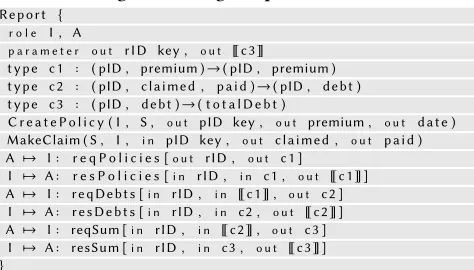
Listing 8 gives a comprehensive example, where the results of one computation are used in another: the auditor requests from the insurer reports on (1) its policies, using filter viac1; (2) its debts for those policies, using map viac2; and, (3) its total debt over those debts using reduce viac3.
Listing 8: Chaining computation results. R e p o r t {
r o l e I , A
p a r a m e t e r o u t r I D key , o u t ⟦c 3⟧
t y p e c 1 : ( pID , premium )→( pID , premium ) t y p e c 2 : ( pID , c l a i m e d , p a i d )→( pID , d e b t ) t y p e c 3 : ( pID , d e b t )→( t o t a l D e b t )
C r e a t e P o l i c y ( I , S , o u t pID key , o u t premium , o u t d a t e ) MakeClaim ( S , I , i n pID key , o u t c l a i m e d , o u t p a i d ) A7→ I : r e q P o l i c i e s [o u t rID , o u t c 1 ]
I 7→ A : r e s P o l i c i e s [i n rID , i n c1 , o u t ⟦c 1⟧] A7→ I : r e q D e b t s [i n rID , i n ⟦c 1⟧, o u t c 2 ] I 7→ A : r e s D e b t s [i n rID , i n c2 , o u t ⟦c 2⟧] A7→ I : reqSum [i n rID , i n ⟦c 2⟧, o u t c 3 ] I 7→ A : resSum [i n rID , i n c3 , o u t ⟦c 3⟧] }
4
FORMAL MODEL AND VERIFICATION
Supple’s syntax enhances BSPL with causal types which can be used to define the type of computations that determine bindings of parameters. The requisite computations may be specified in any lan-guage that the concerned agents can interpret. Computations may be specified at design time to accommodate restricted situations such as in contracts or regulations.
[image:4.612.321.558.215.350.2]Below, superscripts∗and+denote zero or more, and one or more repetitions, respectively. Delimiters⌊and⌋identify optional expressions. Cardinality constraints are left informal for readability.
Table 1: Supple’s syntax.
Protocol −→Name{roleRole+parameter⌊Parameter⌊key⌋ ⌋+ ⌊Type∗⌋Reference+}
Reference −→Name(Role+Parameter+)|
Role 7→Role:Name[Parameter+]⌊::Attachment⌋ Type −→typeName:(Parameter+)→(Parameter+)
Attachment−→(Parameter+)→(Parameter+){ComputationSpec} Parameter −→Adornment(Name|⟦Name⟧⌊.Name⌋) Adornment −→in|out|nil
A protocol declaration involves a name, two or more roles, one or more parameters, zero or more type definitions, and one or more protocol and message references. A protocol reference consists of a name, one or more roles, and one or more parameters of the referred protocol. Alternatively, a message reference consists of a name, exactly two roles, one or more parameters, and an optional computation attachment. A type definition consists of a parameter name, and two tuples of parameters. A computation attachment consists of two tuples of parameters and a computation specification. A parameter consists of an adornment and a name. Alternatively, the parameter name can be enclosed in double brackets to refer the
outcome of a bound computation, from which individual parameters can be accessed using the⌜·⌝notation. An adornment is either⌜in⌝, ⌜out⌝, or⌜nil⌝.
4.1
Semantics
Supple’s semantics enhances BSPL’s semantics [22]. The main con-tribution of Supple pertains to the specification of causal types. As a result, message instances in Supple must satisfy the type of their schema, meaning that each binding matches to the type of the bound parameter. Below,σ⃗denotes a finite list, which can be treated in places as a set, andσ⃗↓⃗γ denotes projection of⃗σon to the elements ofγ⃗.
Definition 4.1. AprotocolPis a tuple⟨n,⃗x,p,⃗⃗k,⃗q,F,T⟩, where
nis the protocol’s name and⃗x,p,⃗⃗k,q⃗are lists of roles, public pa-rameters, key papa-rameters, and private papa-rameters, respectively, such that⃗k ⊆ ⃗p.F is a finite set of references, such that∀f ∈ F: f =⟨nf,⃗xf,⃗pf,⃗kf⟩is a public projection of a protocolPf =
⟨nf,⃗xf,p⃗f,⃗kf,q⃗f,Ff,T⟩satisfying⃗xf ⊆⃗x,⃗pf ⊆⃗p∪⃗q, and⃗kf = ⃗
pf ∩⃗k.T is a finite set of causal types, such that∀t ∈ T:t =
⟨pt,u⃗t,w⃗t⟩satisfyingpt ∈p⃗∪⃗q,u⃗t ⊆p⃗∪q⃗, andw⃗t ⊆⃗p∪⃗q.
Tformalizes the causal types of the formT :I → Othat we introduce in Section 3.2. Specifically, in a type⟨pt,u⃗t,w⃗t⟩ ∈T,pt, ⃗
ut, andw⃗tcorrespond toT,I, andO, respectively. For convenience, we treat causal types as global constructs shared by all references of a protocol.
Definition 4.2. Amessage schema⌜s7→r:mp⃗(⃗k)⌝is an atomic protocol⟨m,{s,r},⃗p,k,⃗ ∅,∅,∅⟩with rolessandr, and no references.
Definition 4.3. Amessage instancem[s,r,p,⃗v⃗] associates a mes-sage schema⌜s7→r:mp⃗(k⃗)⌝with a list of values, where|v⃗|=|p⃗|.
Definition 4.4. Auniverse of discourse(UoD) is a pair⟨R,M⟩
whereRis a set of roles, andMis a set of message names, each with its parameters, and sender and receiver roles fromR.
Definition 4.5. Thehistoryof a rolex, denoted byHx, is a
se-quence of message instancesm1,m2, . . ., such that eachmiis either emitted or received byx.
A role’s history captures the local view of the role with respect to the message instances that are sent and received by the role.
Definition 4.6 captures when a messagemis viable in the history of rolex. Below we usep⃗I andp⃗O for the lists of⌜in⌝and⌜out⌝ adorned parameters, respectively, andp⃗⟦⟧is the list of causal type parameters, which are enclosed in⟦⟧(i.e., the computation that is
bound to the causal type parameter is performed to yield bindings of parameters in the outcome of its type definition). Intuitively, (1) ensures thatmis either sent or received byx; (2) ensures thatm does not violate uniqueness of parameter bindings; (3) ensures that
xknows the bindings of all⌜in⌝adorned parameters and does not know the bindings of any⌜out⌝or⌜nil⌝adorned parameter; (4) ensures that a causal type parameter is bound to a computation before the computation yields to bindings; (5) ensures that, ifpis a causal type parameter that is bound to a computation,xknows the bindings of every parameter inu⃗, before emitting the message with the outcome of the computation that is bound top—which satisfies
Constraint 1 in Section 3.2; and (6) ensures that for every parameter
pinw⃗, if there is a parameteruinu⃗whose base name is equal top, then the bindings ofpmust be a subset of the known bindings of
u—which satisfies Constraint 2 in Section 3.2. In (6)basereturns the base name of a parameter (i.e.,base(p)=p, andbase(p.q)=q). Note that Definition 4.6 satisfies Constraint 3 from Section 3.2 implicitly via (2) and (3), which ensure that⌜out⌝adorned parameters are bound preserving integrity.
Definition 4.6. A message instancem[s,r,p,⃗v⃗] with key
param-eters⃗k ⊆p⃗isviableat rolex’s historyHxif and only if all the following conditions hold:
(1) r=x (reception) or s=x(emission)
(2) ∀mi[si,ri,⃗pi,v⃗i] ∈ Hx : if⃗k ⊆p⃗i andv⃗i ↓⃗k=v⃗ ↓⃗k then
⃗
vi ↓p⃗∩⃗pi=v⃗↓p⃗∩⃗pi(messages respect keys)
(3) ∀p ∈p⃗:p∈⃗pI if and only if(∃mi[si,ri,⃗pi,v⃗i]∈Hx and
p∈⃗pi and⃗k⊆⃗pi)
(4) ∀p∈p⃗: ifp∈(⃗pO∩⃗p⟦⟧)then∃mi[si,ri,p⃗i,v⃗i]∈Hx and p∈p⃗i and⃗k⊆p⃗i.
(5) ∀p ∈ p⃗ : ifp ∈ p⃗⟦⟧ and⟨p,u,⃗w⃗⟩ ∈ T then∀ui ∈ u⃗ :
∃mi[si,ri,p⃗i,v⃗i]∈Hxandui ∈p⃗iand⃗k⊆p⃗i
(6) ∀p∈p⃗: if⟨q,⃗u,w⃗⟩ ∈T andp∈w⃗andu∈u⃗andbase(p)=
base(u)then∃mi[si,ri,p⃗i,v⃗i]∈Hxand⃗k⊆p⃗iandv⃗i ↓⃗k=
⃗ v↓⃗
kandv⃗i ↓u=v⃗↓p
An enactment of a protocol is a vector of its roles’ histories.
Definition 4.7. Let⟨R,M⟩be a UoD. Ahistory vectorover⟨R,M⟩
is [H1, . . . ,H| R |, such that∀s,r: 1≤s,r ≤ |R | ⇒Hsis a history and(∀m[s,r,p,⃗v⃗]∈Hr:m∈ Mandm[s,r,p,⃗v⃗]∈Hs).
Definition 4.8. A history vector isviableif and only if each of its
histories is empty or it arises from the addition of the emission or reception of a viable message by any role to a viable history vector.
Definition 4.9. Let⟨R,M⟩be a UoD. Theuniverse of enactments
UR,Mfor⟨R,M⟩is the set of viable history vectors with exactly
|R |dimensions over the instances of messages inM.
Definition 4.10. Theintensionof a message schema⌜s7→r:m
⃗
p(⃗k)⌝for the UoD⟨R,M⟩is([s 7→ r:mp⃗(⃗k)])R,M = {H|H ∈ UR,Mand∃v,⃗i,j:His =m[s,r,p,⃗v⃗] andHjr =m[s,r,p,⃗v⃗].
Definition 4.11. LetP = ⟨n,⃗x,p,⃗⃗k,q,⃗F,T⟩be a protocol. The
intensionof Pfor the UoD⟨R,M⟩is ([P])R,M = (∪cover(P,G)
(∩G
i∈G([Gi])R,M)) ↓⃗x, where cover(P,G) ≡ G ⊆ F such that
∀p∈p⃗:(∃Gi ∈G:Gi =⟨ni,xi,pi⟩andp∈p⃗i).
Definition 4.12. LetP = ⟨n,⃗x,p,⃗⃗k,q,⃗F,T⟩be a protocol. The universe of discourseofPis UoD(P)=⟨roles(P),msgs(P)⟩, where
roles(P)=x⃗∪(∪iroles(Fi))andmsgs(P)=∪iFi.
4.2
Liveness and Safety
Liveness and safety are two key properties of Supple protocols. A protocol is live if every enactment of the protocol can be completed by producing bindings of all public parameters.
Definition 4.13. A protocolPisliveif and only if each history
vector in the protocol’s universe of enactments UoD(P) can be
extended through finitely many message emissions and receptions to a history vector in UoD(P) that is complete.
A protocol is safe if no key constraint is violated despite local decisions on messages emitted by each role.
Definition 4.14. A protocolPissafeif and only if each history
vector in its([P])UoD(P)is safe. A history vector is safe if and only if all key uniqueness constraints apply across all histories in it.
Liveness and safety in Supple go beyond those of BSPL. In Supple, liveness requires, if there is causal type parameter that is bound to a computation, the role, who performs the computation, must know the bindings of the parameters on which the computation is performed. For instance, considerLivenessFailurein Listing 9, which is a variant ofReportClaimDebtin Listing 6.
Listing 9: Liveness fails for variant of ReportClaimDebt. L i v e n e s s F a i l u r e {
r o l e I , A , S
p a r a m e t e r o u t r I D key , o u t ⟦c 2⟧
t y p e c 1 : ( pID , cID , c l a i m e d , p a i d )→( pID , cID , c D e b t ) t y p e c 2 : ( pID , cID , c o m p l a i n t )→( pID , cID , c D e b t ) / / C r e a t e P o l i c y and MakeClaim a s b e f o r e
A 7→ I : a u d i t R e p o r t R e q u e s t [o u t rID , o u t c 1 ] I 7→ A : a u d i t R e p o r t [i n rID , i n c1 , o u t ⟦c 1⟧] S 7→ A : c o m p l a i n t S u b m i s s i o n [o u t rID , o u t c o m p l a i n t ] A 7→ I : c o m p l a i n t R e p o r t R e q u e s t [i n rID , o u t c 2 ]
I 7→ A : c o m p l a i n t R e p o r t [i n rID , i n c2 , o u t ⟦c 2⟧] }
LivenessFailureincludes an additional causal typec2and new
messagescomplaintSubmission,complaintReportRequest, and
com-plaintReportto capture the scenario where a subscriber makes a
complaint about a policy to the auditor, and the auditor requests a report from the insurer about the policy that is subject to the com-plaint. The type definition ofc2requirescomplaintto be available to the insurer. However,complaintappears only in
complaintSub-mission, which is sent from the subscriber to the auditor. Thus, the
insurer can never send acomplaintReportin any enactment where it receives acomplaintReportRequestmessage. Note that some enact-ments ofLivenessFailurecan be completed, e.g., enactments where the auditor sends aauditReportRequest, which does not refer toc2. This protocol would be live ifcomplaintwas included as an⌜in⌝ parameter incomplaintReportRequest.
Safety of a protocol means that each of its enactments ensures integrity of information exchanged. Safety may be violated if two or more roles (1) as in BSPL, may bind the same parameter; or (2) as added by Supple, concurrently perform the computation that is bound to a causal type parameter. For instance,SafetyFailurein Listing 10, where the auditor requests the total claimed amount for a policy from both insurer and subscriber, is unsafe.
Listing 10: Safety failure. S a f e t y F a i l u r e {
r o l e I , A , S
p a r a m e t e r o u t r I D key , o u t ⟦c⟧
t y p e c : ( pID , cID , c C l a i m )→( pID , pClaim ) / / C r e a t e P o l i c y and MakeClaim a s b e f o r e A 7→ I : r e q T o t a l C a l i m I [o u t rID , o u t c ] A 7→ S : r e q T o t a l C l a i m S [i n rID , i n c ]
I 7→ A : r e p T o t a l C l a i m I [i n rID , i n c , o u t ⟦c⟧] S 7→ A : r e p T o t a l C l a i m S [i n rID , i n c , o u t ⟦c⟧] }
BothrepTotalClaimIandrepTotalClaimSuse the same
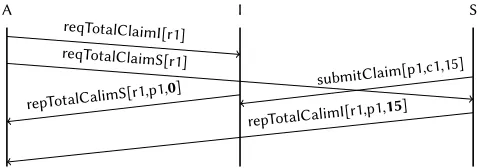
computa-tion bound tocto determine the total claims for a policy. However, because of asynchrony, the same information is not available to all parties and applying the same computation may produce different results, thus violating integrity. For example, in Figure 2, which shows a possible enactment omitting the binding ofcfor readability, the auditor sendsreqTotalClaimIandreqTotalClaimSto the insurer and subscriber, respectively. The insurer computes the total claim amount for the policy, wherepIDis equal top1, before receiving the
submitClaimmessage of the subscriber. Hence, the insurer sends
repTotalClaimIwithpClaimof 0 to the auditor. In the meantime,
the subscriber submits a claim for 15 to the insurer and, therefore, responds to the auditor’s request by sendingrepTotalClaimSwith
pClaimof 15. As a result, the auditor receives inconsistent bindings
ofpClaim, which violates integrity for the bindingp1 of keypID.
A I S
reqTotalClaimI[r1] reqTotalClaimS[r1]
submitClaim[p1,c1,15] repTotalCalimS[r1,p1,
0]
[image:6.612.320.559.255.339.2]repTotalCalimI[r1,p1, 15]
Figure 2: Integrity ofpClaimis violated in unsafe protocol.
4.3
Verification of Supple Protocols
To verify correctness, we derive the following propositional logic expressions from a Supple protocol (1)C: its causal structure, indi-cating how information flows via its messages; (2)S: its unsafety, i.e., that two messages that produce bindings for the same parameter both occur; and (3)L: its liveness failure, i.e., some parameters re-main unbound even tough every agent sends every viable message, and the infrastructure delivers all messages. Safety and liveness hold whenC ∧ SandC ∧ L, respectively, are unsatisfiable.
Algorithm 1 defines the algorithm to create the causal struc-ture of a protocol as a propositional logic expression. Algorithm 1 creates the expression step by step by as a conjunction of subex-pression. For readability, we define the subexpressions separately in Definitions 4.15–4.19.
Algorithm 1:Generation of the causal structure of a protocol
Pas a proposition logic expression.
input :P=⟨n,⃗x,⃗p,⃗k,q,⃗F,T⟩
output :CP// expression ofP’s causal structure
CP←message-reception-exp// Definition 4.15
CP← CP∧information-transmission-exp// Definition 4.16
CP← CP∧information-reception-exp// Definition 4.17
CP← CP∧information-minimality-exp// Definition 4.18
CP← CP∧message-ordering-exp// Definition 4.19
returnCP
Given a protocolP =⟨n,⃗x,p,⃗⃗k,q,⃗F,T⟩, Algorithm 1 uses the following sets of propositional symbols. (1) A finite setPofpx symbols for each parameterp ∈ p⃗∪q⃗and for each rolex ∈ ⃗x,
which model observation ofpbyx. (2) A finite setMofmxsymbols for each messagem ∈ F and for each rolex ∈ ⃗x, which model observation ofmbyx. (3) A finite set ofbei,ej symbols for every (ei,ej)pair inP∪M, which model observation ofei beforeej. For readability, we writebei,ejin predicate form asbefore(ei,ej). (4) A finite set oftei,ejsymbols for every(ei,ej)pair inP∪M, which model observation ofeitogether withej. For readability, we write
tei,ej in predicate form astogether(ei,ej).
Definitions 4.15–4.19 define the subexpressions in Algorithm 1. We provide examples for Report protocol in Listing 8.
Definition 4.15. (Message Reception)A message is received only
if it is emitted earlier: ^
m∈F
(¬mr∨before(ms,mr))
For messagereqDebts, Definition 4.15 yields to the expression
¬reqDebtsI∨before(reqDebtsA,reqDebtsI).
Definition 4.16. (Information Transmission)For every message
schema⌜s7→r:m⃗p(⃗k)⌝∈F,seither does not emitm, or:
•sobserves all⌜in⌝parameters in⃗pthat are not bound to a computation, before the emission ofm:
exp1= ^ p∈⃗pI\⃗p⟦⟧
before(ps,ms)
•and,sobserves all⌜in⌝parameters in the outcome of all causal type parameters in⃗pbefore the emission ofm:
exp2= ^
⟨q,⃗u,w⃗⟩∈⃗pI∩⃗p⟦⟧
(^
p∈w⃗
before(ps,ms))
•and,sobserves all the requisite parameters of all ⌜out⌝ causal type parameters in⃗pbefore the emission ofm:
exp3= ^
⟨q,⃗u,w⃗⟩∈p⃗O∩⃗p⟦⟧
(^
p∈⃗u
before(ps,ms))
•and,sobserves all⌜out⌝parameters in⃗pthat are not bound to a computation together with the emission ofm:
exp4= ^ p∈p⃗O\⃗p⟦⟧
together(ps,ms)
•and,sobserves all the outcome parameters of all⌜out⌝causal type parameters inp⃗together with the emission ofm:
exp5= ^
⟨q,⃗u,w⃗⟩∈p⃗O∩⃗p⟦⟧
(^
p∈w⃗
together(ps,ms))
Hence, we generate: ^
m∈F
(¬ms∨(exp1∧exp2∧exp3∧exp4∧exp5))
For example, for⌜A7→I: reqDebts[in rID, in⟦c1⟧, out c2]⌝and
c1of type(pID, premium)→(pID, premium), Definition 4.16 yields to
¬reqDebtsA∨(before(rIDA,reqDebtsA)∧before(pIDA,reqDebtsA)∧ before(premiumA,reqDebtsA)∧together(c2A,reqDebtsA)).
Definition 4.17. (Information Reception)For every message schema
⌜s7→r:mp⃗(⃗k)⌝∈F,reither does not observem, orrobserves all parameters ofmeither before or together with the reception ofm:
^
m∈F
(¬mr∨( ^
p∈⃗p
(before(pr,mr)∨together(pr,mr))))
For example, considering onlypremiumfor brevity, for message
⌜I7→A: resPolicies[in rID, in c1, out⟦c1⟧]⌝ andc1of type(pID,
premium)→(pID, premium)Definition 4.17 yields¬resPoliciesA∨
(before(premiumA,resPoliciesA)∨(together(premiumA,resPoliciesA))):
Definition 4.18. (Information Minimality)For every rolex in⃗x
and parameterpinp⃗,pis either not observed orpis observed together with a messageminF(for readability, assume thatF′⊆F
such that⌜s 7→r : m⃗pm(⃗km)⌝ ∈ F and (x =s orx =r, and
p∈p⃗m)):
^
x∈⃗xandp∈⃗p (¬px∨
_
m∈F′
together(px,mx))
Definition 4.19. (Ordering)For every pair of messagesmi and
mj inF that are emitted byxin⃗x,xmay observe them in some order, but not together (for readability, assume thatF′⊆Fsuch that⌜s7→r:m⃗pm(⃗km)⌝∈F, andx =s):
^
mi,mj∈F′
(¬mis∨ ¬mjs∨before(mis,mjs)∨before(mjs,mis))
4.3.1 Correctness of Causal Structure Generation.LetPbe a protocol for which Algorithm 1 generates the causal structureCP.
Theorem 4.20. (Correspondence)For every viable history vector
ofP, there is a model ofCP, and vice versa.
Proof Sketch. We use induction in the forward direction. An emptyHcorresponds to an emptyCPwithout any propositions. Inductively, for every viable messagemthat extendsH, we can extendCPform’s emission using the above information transmis-sion clauses, and form’s reception using the reception clause. Con-versely, givenCP, we can constructH, simply appending messages instances that correspond to the message emission and reception propositions to the histories of the corresponding roles. □
Theorem 4.21. (Termination)Algorithm 1 always terminates.
Proof Sketch. The lists of roles, messages, and parameters of a protocol are finite, and the rules in Definitions 4.15–4.19, when applied to finite lists, generate finite expressions. Algorithm 1 uses
each rule once and terminates. □
4.3.2 Safety.A protocol’s safety requires that, if any parameter is adorned⌜out⌝in two or more messages, only one of these mes-sages is emitted. Hence, integrity of parameter bindings cannot be violated. This means that for any pair of messagesmiandmjin a protocol (and with corresponding⌜out⌝adorned parameterspOi andpOj , respectively) wherepOi ∩pj
O ,∅, we must not infer the clausemi
si ∧m j
sj from the causal structure of a protocol.
Definition 4.22. Given a protocol’s list of messagesF, letf⃗be
the list of every message pair(mi,mj)for whichpiOandpOj are the respective⌜out⌝adorned parameters andpOi ∩pj
O ,∅.Unsafety
expressionof the protocol is:
_
(mi,mj)∈⃗f
(mis∧msj)
LetPbe a protocol,CPbe the causal structure ofP, andSP
be the unsafety expression ofPas in Definition 4.22. We decide on
P’s safety by checking unsatisfiability ofCP∧ SP.
Theorem 4.23. A protocolPis safe if and only ifCP∧ SPis not satisfiable.
Proof Sketch. IfCP∧ SP is satisfiable, by Theorem 4.20, we can construct a history vector that contains at least two mes-sages that bind the same⌜out⌝adorned parameter. Conversely, ifCP∧ SPis not satisfiable, by Theorem 4.20, we cannot construct a history vector that contains more than one message to bind the
same⌜out⌝adorned parameter. □
4.3.3 Liveness. A protocol’s is live if every enactment of the protocol can be completed (i.e., every public parameter are bound). To verify liveness of a protocol, we represent its incompleteness as follows. First, we consider lack of a public parameter’s observation. That is, for each public parameterp, we create a conjunction that is composed of negatedpxsymbols for each rolexwho observesp in a message, and compose these clauses into a disjunction.
Definition 4.24. (Lack of Public Parameter Observation)Letp⃗be
the list of a protocol’s public parameters andXpbe the set of roles in the protocol who are either sender or receiver of at least one message in the protocol which includespas a parameter.
expa= _
p∈⃗p
( ^
x∈Xp
¬px)
Second, to avoid situations in which an agent intentionally de-cides not to emit any of the currently viable messages, we should have an expression to ensure that if a sender of a message observes its⌜in⌝adorned parameters but does not observe its⌜out⌝adorned parameters, then the sender observes the message.
Definition 4.25. (Emission Enforcement of Viable Messages)Letm
be a message,p⃗m
I andp⃗mO be the list of⌜in⌝and⌜out⌝adorned parameters ofm, andsbe the sender ofm.
expb= ^
m∈F (ms∨
_
pi∈⃗pmI
¬pi∨ _
po∈p⃗Om )
Third, to avoid situations where a lossy communication channel drops some of the emitted messages, we should have an expression to ensure that every emitted message is received
Definition 4.26. (Nonlossy Channel)Letmbe a message with
sender rolesand receiver roler.
expc = ^
m∈F
(¬ms∨mr)
Let,LPbeexpa∧expb∧expc, whereexpa,expb, andexpcare the corresponding expressions in Definitions 4.24, 4.25, and 4.26, respectively, for protocolP. We decide on the liveness ofPby checking unsatisfiability ofCP∧ LP.
Theorem 4.27. A protocolPis live if and only ifCP∧ LPis not satisfiable.
Proof Sketch. IfCP∧ LPis satisfiable, by Theorem 4.20, we can construct a viable history vector that cannot be extended via message emission (maximality) or reception (lossless transmission),
and yet is incomplete. Conversely, ifPis live, we know that each history vector ofPis either complete or can be finitely extended to a complete history vector. Hence,CP∧ LPis not satisfiable. □
5
DISCUSSION
Supple introduces a new abstraction of types in protocols, on which there is little work, and supporting checking of important properties. These contributions coincide with the growing interest in richer data-aware specifications. As noted in Section 1, existing work when it applies types does so only for static purposes (ontology annotations on fields). It doesn’t consider information modeling of
interactions, let alone the advanced typing techniques we introduce.
Our overarching contribution lies in elucidating an important aspect of information-based protocols via causal types. Supple ex-tends information-based protocol specification approaches with causal types for constraining the information that is communicated in a protocol. Supple treats causal type parameters as first-class information parameters, which enables the agents (1) to define com-putations during enactment of a protocol, and (2) to communicate them and their results as they communicate any other information. Supple formalizes causal types and incorporates them into verifi-cation of a protocol’s safety and liveness. At the technical level, Supple provides a flexible and formal method to define constraints on the exchanged information in a protocol.
Aspects of data have begun to receive more attention in protocol specification. HAPN [24] complements state machine-based repre-sentation of protocols with guards and effects. A major conceptual difference is that HAPN supportssystemparameters, whose bind-ings are produced exogenously to the interaction, indicating shared state between agents and incorporation of internal decision-making in the specification of public interactions. In Supple, by contrast, interaction state as captured by parameter bindings is neither global nor includes any agent’s internal state. SPY [18] adds assertions to session types to constrain communicated values. However, neither HAPN nor SPY support causal types as in Supple.
Winikoff and Cranefield [23] study the testability of BDI agent programs and identify challenges in scalability. Supple could fa-cilitate helping manage those challenges in a MAS setting in two ways. First, the decoupling of agents through interactions would reduce the verification problem to each agent separately. Second, the existence of a strong type discipline can reduce the burden on testing by eliminating certain kinds of interaction errors early.
At the conceptual level, Supple’s contribution is in line with the challenge of connecting operational and meaning-based protocol specifications [15]. In fact, most previous formalizations of commit-ments and norms, in general, are in terms of computations [1, 5, 7], and could thus benefit from Supple’s enhancements.
An interesting future direction is whether norm-related compu-tations can be mapped at least partially to Supple compucompu-tations with the aim of regimenting some interactions. Splee gives the ex-ample of auctions: the auctioneer’s commitment to seller to declare the highest bidder as winner yields a query attachment (i.e., a com-putation in Supple) that aggregates over all bids receives to produce a binding for winner. Security is an interesting direction: norms could be used to generate information protocols with computations that serve as policies, e.g., for privacy.
REFERENCES
[1] Alexander Artikis, Marek J. Sergot, and Jeremy V. Pitt. 2009. Specifying Norm-Governed Computational Societies.ACM Transactions on Computational Logic 10, 1 (Jan. 2009), 1:1–1:42.
[2] Matteo Baldoni, Cristina Baroglio, Federico Capuzzimati, and Roberto Micalizio. 2018. Type checking for protocol role enactments via commitments.Autonomous Agents and Multi-Agent Systems32, 3 (2018), 349–386.
[3] Matteo Baldoni, Cristina Baroglio, Elisa Marengo, Viviana Patti, and Federico Capuzzimati. 2014. Engineering Commitment-Based Business Protocols with the 2CL Methodology.Journal of Autonomous Agents and Multi-Agent Systems (JAAMAS)28, 4 (July 2014), 519–557.
[4] Bernhard Bauer and James Odell. 2005. UML 2.0 and Agents: How to Build Agent-Based Systems with the New UML Standard.Engineering Applications of Artificial Intelligence18, 2 (March 2005), 141–157.
[5] Federico Chesani, Paola Mello, Marco Montali, and Paolo Torroni. 2013. Repre-senting and Monitoring Social Commitments using the Event Calculus.Journal of Autonomous Agents and Multi-Agent Systems (JAAMAS)27, 1 (2013), 85–130. [6] Amit K. Chopra, Samuel H. Christie V, and Munindar P. Singh. 2017. Splee: A
Declarative Information-Based Language for Multiagent Interaction Protocols. InProceedings of the 16th International Conference on Autonomous Agents and MultiAgent Systems (AAMAS). IFAAMAS, São Paulo, 1054–1063.
[7] Amit K. Chopra and Munindar P. Singh. 2016. Custard: Computing Norm States over Information Stores. InProceedings of the 15th International Conference on Autonomous Agents and MultiAgent Systems (AAMAS). IFAAMAS, Singapore, 1096–1105.
[8] Ferruccio Damiani, Paola Giannini, Alessandro Ricci, and Mirko Viroli. 2012. Standard Type Soundness for Agents and Artifacts.Scientific Annals of Computer Science22, 2 (2012), 267–326.
[9] Riccardo De Masellis, Chiara Di Francescomarino, Chiara Ghidini, Marco Montali, and Sergio Tessaris. 2017. Add Data into Business Process Verification: Bridging the Gap between Theory and Practice. InProceedings of the Thirty-First AAAI Conference on Artificial Intelligence. 1091–1099.
[10] FIPA. 2003. FIPA Interaction Protocol Specifications. (2003). FIPA: The Foundation for Intelligent Physical Agents, http://www.fipa.org/repository/ips.html. [11] Akın Günay, Michael Winikoff, and Pınar Yolum. 2015. Dynamically Generated
Commitment Protocols in Open Systems.Journal of Autonomous Agents and Multi-Agent Systems (JAAMAS)29, 2 (2015), 192–229.
[12] HL7. 2007. Health Level Seven. (2007). http://www.hl7.org.
[13] Antonis C. Kakas, Nicolas Maudet, and Pavlos Moraitis. 2005. Modular Represen-tation of Agent Interaction Rules through ArgumenRepresen-tation.Autonomous Agents and Multi-Agent Systems11, 2 (2005), 189–206.
[14] Bhavik Katira. 2015.Syndicated Loan FpML Requirements: Business Requirements Document Version 2.0. TR. The LSTA Agent Bank Communications Working Group, International Swaps and Derivatives Association.
[15] Thomas Christopher King, Akın Günay, Amit K. Chopra, and Munindar P. Singh. 2017. Tosca: Operationalizing Commitments over Information Protocols. In Proceedings of the 26th International Joint Conference on Artificial Intelligence (IJCAI). IJCAI, Melbourne, 256–264.
[16] Tim Miller and Jarred McGinnis. 2008. Amongst First-Class Protocols. In Proceed-ings of the 8th International Workshop on Engineering Societies in the Agents World (ESAW 2007) (Lecture Notes in Computer Science), Vol. 4995. Springer, Athens, 208–223.
[17] Marco Montali, Diego Calvanese, and Giuseppe De Giacomo. 2014. Verification of data-aware commitment-based multiagent system. InProceedings of the 13th In-ternational Conference on Autonomous Agents and Multiagent Systems. IFAAMAS, Paris, 157–164.
[18] Rumyana Neykova, Nobuko Yoshida, and Raymond Hu. 2013. SPY: Local Ver-ification of Global Protocols. InProceedings of the International Conference on Runtime Verification (LNCS), Vol. 8174. Springer, 358âĂŞ363.
[19] Michael Rovatsos, Dimitrios I. Diochnos, and Matei Craciun. 2015. Agent Pro-tocols for Social Computation. InAdvances in Social Computing and Multiagent Systems - 6th International Workshop on Collaborative Agents Research and Devel-opment, CARE 2015 and 2nd International Workshop on Multiagent Foundations of Social Computing, MFSC (Communications in Computer and Information Science), Vol. 541. Springer, Istanbul, 94–111.
[20] Munindar P. Singh. 2011. Information-Driven Interaction-Oriented Program-ming: BSPL, the Blindingly Simple Protocol Language. InProceedings of the 10th International Conference on Autonomous Agents and MultiAgent Systems (AAMAS). IFAAMAS, Taipei, 491–498.
[21] Munindar P. Singh. 2011. LoST: Local State Transfer—An Architectural Style for the Distributed Enactment of Business Protocols. InProceedings of the 9th IEEE International Conference on Web Services (ICWS). IEEE Computer Society, Washington, DC, 57–64.
[22] Munindar P. Singh. 2012. Semantics and Verification of Information-Based Protocols. InProceedings of the 11th International Conference on Autonomous Agents and MultiAgent Systems (AAMAS). IFAAMAS, Valencia, Spain, 1149–1156.
[23] Michael Winikoff and Stephen Cranefield. 2014. On the Testability of BDI Agent Systems.Journal of Artificial Intelligence Research (JAIR)51 (Sept. 2014), 71–131. [24] Michael Winikoff, Nitin Yadav, and Lin Padgham. 2018. A New Hierarchical
Agent Protocol Notation.Journal of Autonomous Agents and Multi-Agent Systems (JAAMAS)32, 1 (Jan. 2018), 59–133.
[25] WS-CDL. 2005. Web Services Choreography Description Language Version 1.0. (Nov. 2005). www.w3.org/TR/ws-cdl-10/.