“The study on Evaluation of Cost Escalation in Infrastructure Projects &
It’s Provisions”
Sourabh Muleyl
1, Purushottam Dange
21
M.E. Student, Department of Civil Engineering, D.Y Patil Institute of Technology, Pimpri, Pune–411018, India
2Associate Professor, Department of Civil Engineering D.Y Patil Institute of Technology, Pimpri,
Pune–411018, India
---***---Abstract - In present scenario many of Infrastructure projects are delayed due to various reasons because of that escalation
in cost affects the proposed budget of the project. Cost overrun in any type of construction projects is a critical challenge for both owners and contractors. Managing budget for cost escalation is a very important in the planning stage of these projects. In this study different methods are used to calculate an escalation in cost with the time. The systematic approach through mean of obtained results of these calculations is considered for minimizing errors in each individual method. The methods selected for this study is Regression Modeling (RM),). This calculation assures cost estimators that the actual value of the escalation factor will not exceed more than the estimated one within a reasonable bound. Planners and cost estimators can use this systematic approach for budgeting and calculating the escalation factor and risk premiums in a more conservative way. The contractors will use various techniques to control overhead cost for better budge management. The system can be used by planners and cost estimators for budgeting the effect of cost escalation in infrastructure projects with multiyear schedules.
Keywords: Infrastructure, Escalation, Regression Modeling, Systematic approach
1. INTRODUCTION:
The construction industry has a major role in the development of the Indian economy. Construction industry dominate 40% to 50% of the national five year plan outlay and share 20% of gross domestic product.In infrastructural project it takes serval years to complete as it has many of factors are depending such as labour, material and most important part is planning of activity. This is a related to the approach of inflation and deflation except that increase is specific to an aspect or class of items, it is often not elementary urged by changes in the money supply,
and it tends to be less sustained. While escalation will affect the increase in project cost overrun which will influence various parties in project, For example, there is large impact on escalation of project in Maharashtra are due to implementation of RERA act and government policies such as application of GST and demonetization. In particular, this has been a major problem to the construction industry. In order to find out the percentage rise in cost of construction, a survey and analysis has been done in this study a more realistic way to assess cost escalation is to consider the uncertainty in the value of escalation factor. This uncertainty is major contributor to the overall cost uncertainty and can be modeled using appropriate probabilistic models. In this report, we first review various methods of forecasting escalation factors and then introduce a system for modeling the escalation uncertainty in large multiyear construction projects. The system uses a value at risk approach and considers variability of project component prolongation and the unpredictability of escalation factor during the project period and calculates the distribution for the cost. Cost escalation in construction, as used in the context of this paper, is the increase in the cost of any construction aspect of the initial contract or base cost of a project due to passage of time. Escalation is caused by many factors such as lack of proper panning, contractor’s response, interest rate, and taxes. Escalation is a risk that can account for a substantial part of construction cost, especially in long term projects where the fluctuation and unpredictability is greater. In multiproject programs, the effect of escalation can be the prime concern.
2. OBJECTIVE
To find out various factors that influences increase in the cost of construction.
To forecast the percentage increase in cost of construction for the next three years 2019, 2020 and 2021.
To study various procedures and techniques used for forecasting the escalation in prices.
3. METHODOLOGY
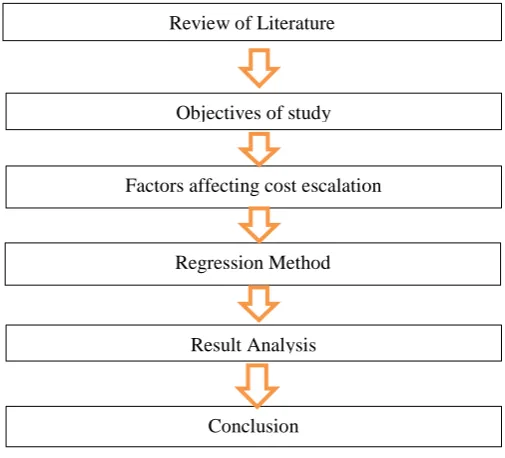
Figure No.1. Representing the statgy of work followed in the project.
Figure No.1 scheme of project 1. Literature Reviews
1. Seokyon Hwang
Accurate prediction of construction costs in the market is essential to effectively estimate costs for construction projects. In the construction industry, cost indexes that are reported in series are often used to explain the change of construction costs. By tracking the trend of such quantitative contemporaneous cost index and making frequent and regular forecasts of the future values of the index, one can develop a deeper understanding of prices of resources used for construction. Incorporating such an understanding and prediction into estimating will help practitioners manage construction costs. This paper proposes two dynamic regression models for the prediction of construction cost index. Comparison of the proposed models with the existing methods proves that the new models provide several advantages and improvements.
2. Nilesh D Patil, B.A.Konnur
The construction industry іs a vital sector іn any economy and sіgnіfіcantly contributes to the socіo-economіc growth of a country. Cost escalation іs one of the consequential іdentіfіed risks faced by construction industry. So the objective of the study іs to intend new and modified theories so that the subject area іnclіnes towards precision and perfection under the case study of building construction project. The study proposes new approaches and method such as Market Rate Method (MRM) that can be implemented іn the field of cost escalation, so that different errors, complexities in the stіll used techniques could be removed. The result of study denotes that this new approach yields better results than the traditional method which are more widely utilized.
3. M.S.Ramabodu, JJP VerPurpose
The primary objective of this study is to attempt to identify the major cost overrun factors in the construction sector of the Free State Province of South Africa, which can serve as the way forward for future projects in dealing with these cost overruns. The study is based on a literature review investigating factors which have a significant influence on cost overruns and also a survey, consisting of a questionnaire and personal interviews, was conducted among professionals of the construction industry. The survey investigated factors that have significant influence in construction cost overruns of public sector projects. This includes misinterpretation of the client’s brief, incomplete design at tender stage, procurement strategies and contractual claims such as contract instructions. The results were analyzed and compared against the literature review. Results indicated that indicated that the factors that have an influence in cost overruns of construction projects can be grouped into three categories i.e. very critical factors, moderately critical factors and less critical factors. It
Review of Literature
Objectives of study
Factors affecting cost escalation
Regression Method
Result Analysis
is important to note that major attention still need to be given to all these factors collectively as they all contribute to cost overruns of construction projects.
[image:3.595.28.558.166.806.2]2. Details of Factors affecting on Cost escalation
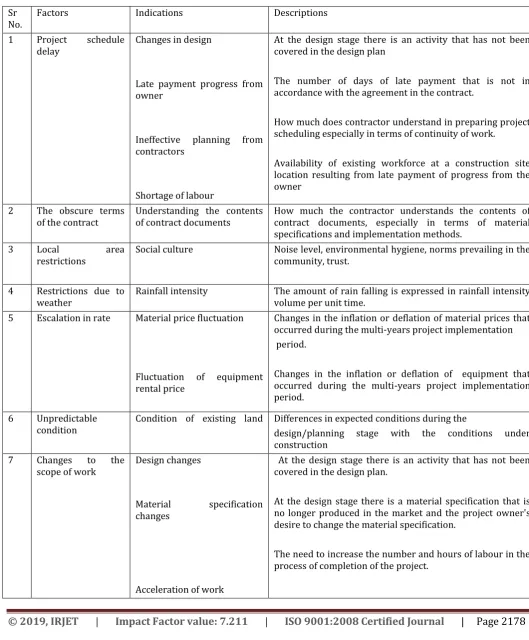
Table No.1 factors affecting on cost escalation
Sr
No. Factors Indications Descriptions
1 Project schedule
delay Changes in design
Late payment progress from owner
Ineffective planning from contractors
Shortage of labour
At the design stage there is an activity that has not been covered in the design plan
The number of days of late payment that is not in accordance with the agreement in the contract.
How much does contractor understand in preparing project scheduling especially in terms of continuity of work.
Availability of existing workforce at a construction site location resulting from late payment of progress from the owner
2 The obscure terms
of the contract Understanding the contents of contract documents How much the contractor understands the contents of contract documents, especially in terms of material specifications and implementation methods.
3 Local area
restrictions Social culture Noise level, environmental hygiene, norms prevailing in the community, trust.
4 Restrictions due to
weather Rainfall intensity The amount of rain falling is expressed in rainfall intensity volume per unit time. 5 Escalation in rate Material price fluctuation
Fluctuation of equipment rental price
Changes in the inflation or deflation of material prices that occurred during the multi-years project implementation period.
Changes in the inflation or deflation of equipment that occurred during the multi-years project implementation period.
6 Unpredictable
condition Condition of existing land Differences in expected conditions during the design/planning stage with the conditions under construction
7 Changes to the
scope of work Design changes
Material specification changes
Acceleration of work
At the design stage there is an activity that has not been covered in the design plan.
At the design stage there is a material specification that is no longer produced in the market and the project owner's desire to change the material specification.
3. Regression Method
A regression model describes relationships between a response variable and one or more predictor variables by the generalization of a straight line. Let us assume a vector of random variable X. A linear regression model can be represented in matrix terms as Eq. (1), where
Y = [y1, ... ,yn]T, e=[e1,...,en]T,þ=[þ0,...,þn]T
Y = Xþ+e
If the model is appropriate, then the observed value yican be determined from the value of xithrough Eq (1), except for ei, the unknown random quantity of statistical error for the ith case that represents the failure of the model to determine the fitted value. The model assumes that errors are normally and independently distributed with zero mean and common variance s2. Using the observed responses and predictors, the unknown parameters þ are estimated. A model that
minimizes the residual sum of squares of errors is selected. The strength of the established relationship is represented by the coefficient of determination R2, which represents the proportion of variability of response explained by regression on
predictors. By using computer software we will get following results. In these algorithms we are referring data obtained from previous method. In this modelling we are using MS Excel software and in that we are giving inputs with the help of data which we are got from previous method which is value at risk.
Table No.5 Regression summary
SUMMARY OUTPUT
Regression Statistics Multiple R 0.996616
R Square 0.993243 Adjusted R
Square 0.986486 Standard
Error 0.408248 Observations 3
ANOVA
df SS MS F Significance F
Regression 1 24.5 24.5 147 0.052389
Residual 1 0.166667 0.166667
Total 2 24.66667
Coefficients Standard Error t Stat P-value Lower 95% Upper 95% Lower 95.0% 95.0% Upper Intercept 81.66667 0.62361 130.958 0.004861 73.74296 89.59038 73.74296 89.59038
month 0.291667 0.024056 12.12436 0.052389 -0.014 0.59733 -0.014 0.59733
y= constant+B1*X1
Table No.6 Results forecasted by regression
Year Months Forecasted Cost
2020 12 81.66667
2021 24 85.16667
2022 36 92.16667
Discussion
By using regression method with using MS Excel software we are getting above results and we are crosschecking it with correlation method of value at risk and the results are matches. Hence regression modelling is very practical in use.
4. CONCLUSION
The above study will help to investors in infrastructure project to forecast the escalated cost if project delays due to various reasons as project schedule, contracting terms, social barriers, inflation rate, unpredicted situation, changes in design. And with the help of parameters used in value at risk which are confidence level, volatility. We also predict escalated cost for next serval years. As the results indicates the increased cost of project with the base value of 75cr is increased in next three years are 13%, 18%, 26%. We will control the escalation of project by working on factors which affects escalation. This study may use effectively by planning department, estimation department and purchase department to keep close watch on cost.
Escalation and most important the investors may get more profit.
REFERENCES:
[1]. Abhishek Bhargava; Panagiotis Ch. Anastasopoulos. Journak of Construction Engineering and Management, Vol. 136, No. II. (Nov2010), ‘ Three- stage Least Squares Analysis of Time and Cost Overruns in Construction Contracts’,Pg no.20-25
[2]. Adnan Amin Alvanchi; SangHyun Lee, A.M.ASCE Vol. 138. No.1. (2012), ‘Dynamics of working hours in construction’,
[3]. Bee Hua Goh, Volume 40, (2005), Issue 2. ‘The dynamic effects of the Asian financial crisis on construction demand and tender price levels in Singapore’ Pg no. 23-26.
[4]. Brad W.Wambeke, ‘Causes of Variation in Construction project task starting times and Duration’ ASCE Vol 1(Sep 2011).
[5]. Byung Cheol Kim, A.M. Combination of Project cost Forecasts in Earned Value Management’ ‘, ASCE Vol.2, (Nov 2011) and No.2.
[6]. ChangTaek Hyun, TaeHoon Hong, SoungMin, JunHyeok Yu, and SooBae, ‘The Development of Probabilistic Time and Cost Data: Focus on
[7] Seokyon Hwang ‘Dynamic Regression Models for Prediction of Construction Costs’