DYNAMIC ANALYSIS OF TALL TUBULAR STEEL STRUCTURES OF
HEXAGON CONFIGURATION BY INCORPORATING ADDITIONAL
STRUCTURAL SYSTEM
Manoj Kumar S R
1, Ramya B V
2, Sowmya R H
31
Post Graduate in Structural Engineering, BIET College, Davanagere-577004, India
2Asst, Professor, M. Tech Structural Engineering, BIET College, Davanagere, India
3Asst, Professor, M.Tech Structural Engineering, BIET College, Davanagere, India
---***---
Abstract - In structural engineering, The structural framesare the load resisting systems. The analysis and design of structures particularly tall structures needs appropriate analysis methods, precise design concepts along with preliminary designs aided with optimisation, in order to resist the gravity as well as lateral load, so that structure remains safe thought its life span. In extremely tall buildings stiffness plays a very important role in controlling the global displacements. Hence new structural systems are developed by combining the previous structural systems in order to resist effectively the lateral loads due to earthquake and wind and to limit global displacements, drifts and accelerations under control. The tube structural concept had become more popular structural systems particularly for high rise steel structures. The basic structural form consist of vertical columns positioned about 1 to 2 m centre to centre, which are connected by deep spandrels, To understand the behaviour of the tall tubular steel structures for geometric configurations like hexagonal shapes in plan, in comparison with the steel beam column rigid frame system, were analysed using ETABS 2016. The effect of geometric configurations on behaviour of tall tubular steel structures are summarised using the obtained results, by concluding the optimum geometric configuration for tall tubular steel structures.
Key Words: Tube structure, Diagonal bracings, Earthquake zones, wind load, Base shear, Story drift, Story displacement and ETABS.
1.
INTRODUCTIONThe load resisting sub-system of structure is considered as structural systems or frame in structural engineering. Appropriate 0analysis methods are used for the analysis and design of structures especially for high rise structures, vertical load like gravity load seismic load wind load are acting on tall structures, structure should be able to withstand all these vertical and horizontal load throughout its life span. The most important factor in structural engineering is strength serviceability and stability of the structures, stability is explained by factor of safety against P-delta effect and buckling, strength is explained by limit stress and serviceability by lateral drift Most necessarily the human comforts are influenced by
accelerations of the structures due to dynamic loads. The main objective of a structural engineer is to fulfil all these circumstances and lastly to develop a proper structural schemes, geometric configurations to understand the behaviour of structural systems before implementation in real time scenarios.
1.1. Function and importance of structural systems
Now a days tall structures in the city is more common and due to migration of people in urban areas
which in turns getting higher requirement of tallstructure
not only tall structures safety of the structure plays major role. Because of deficiency of land in extremely urbanized areas it requires a new innovation in structures to words to build high rise or skyline structures to fulfil all the requirements.
Tall structures are cantilevered perpendicular to the ground. Nowadays, the advancements in structural systems, increase in building height and slenderness, use of high strength materials, reduction of building weight etc., has necessitated the consideration of lateral loads such as wind and earthquake in the design process. Lateral forces resulting from wind and seismic activities are now dominant in design considerations. Lateral displacement of such buildings must be strictly controlled, not only for occupants comfort and safety, but also to control secondary structural effects. In this wild growing generation there is a need for tall, particularly super tall structures, where its height may be in range of 300m to 500m. In order to reach structural reliability as whole and structural soundness between the components of the super high rise structure, different structural systems are established.
1.2 Categorization of structural systems
Mainly the Structural Systems are categorised into 4 types.
Type 1 – Shear Frames
Type 2 – Interacting frames
Type 3 – Partial Tubular frames
© 2019, IRJET | Impact Factor value: 7.211 | ISO 9001:2008 Certified Journal | Page 1284
1.3 Classification of Tube structuresBasic forms of tubular systems are
Framed tube
Braced tube
Bundled tube
Tube-in-tube
Tubed mega frame
1.4 Objectives studies
1. To know the performance of the tall tubular steel structures for hexagon geometric configuration in plan, in comparison with the reference model of steel beam column rigid frame system.
2. Earth quake0Analysis is carried out in ETABS 2016
using response spectrum analysis for different
seismic zones using IS 1893-2002. Also
wind0analysis is carried out to recognise the
performance under the wind loads.
3. Efficiency of tall tubular steel structures with respect the base shear, story and peak displacement, drift and time period are recorded.
4. To reducing the displacements and story drifts,
bracings can be incorporated to hexagonal tubular structure as an additional structural systems and analysis is carried out by response spectrum method.
5. From the analysis the results obtained for moment resisting frame, hexagonal tube structure and hexagonal tube with bracings structure are comparing.
6. Using the obtained results the outcome of hexagon geometric configuration on performance of tall tubular steel structures are summarised.
2. DATA FOR DEVELOPING THE MODEL
Using ETAB 2016 Structural modelling of steel framed tall tubular structure is made for hexagon shape geometric configuration, with a regular steel moment resisting frame section. All the models having equal number of stories which is 88 numbers and constant floor area constant diaphragm to take lateral loads and transmits to beams are provided for all the models to obtain the consistent results for lighting, ventilation and service criteria a central core is permitted.
2.1
Building DataType of Structure- Steel Moment Resisting Framed tube square in plan
Plan Configurations - Hexagon and Hexagon with diagonal bracings
Story details - G+87 (88 Storied)
Height between the floors- 3.6 m
Total building height - 316.8 m
Floor Area - 3550 m2
Building type - Office Building
2.2
Material Properties
Structural Steel Grade - 345 Grade Concrete Grade - M30 (Deck Slab)
2.3
Section Properties
Column Sections - Built up (ISWB 600)
Beam Sections - ISMB 600
Deck Section - 200mm thick
Bracings Section - ISHB 150
2.4
Loads consideration
a) Gravity load:
Live load - 4.00kN/m2
Floors finish - 1.50kN/m2
Exterior Glazing - 2.00kN/m
b) Earth quake data based on IS1893 (Part0I):2002 Location of Building - All intensity zones Soil type - Type II (Medium) Importance factor - 1.0
Response reduction factor - 5.0
Fundamental Natural Period - 6.382 seconds
c) Wind load pattern – Indian IS875:1987
Exposure and pressure coefficients: Exposure from Extents of Diaphragms is considered and following in puts are given.
Wind Speed Vb - 33 m/s Terrain Category - 4 Structure Class - C Risk Co-efficient - 1 Topography Factor - 1
2.5
Geometric Configurations of Framed Tube
Structuresa) Model 1 : Steel Moment Resisting frame : Square in Plan
Fig – 1: Steel Moment Resisting Frame: Square in Plan
b) Model 2 : Framed tube structure : Hexagonal in Plan
Fig – 2: Framed Tube Structure: Hexagonal in Plan
[image:3.596.311.558.237.407.2]c)Model 3: Framed Tube Structure with bracings: Hexagonal in Plan
Fig – 3: Framed Tube Structure with bracings: Hexagonal in Plan
3. RESULTS AND DISCUSSIONS
3.1 Modal Analysis
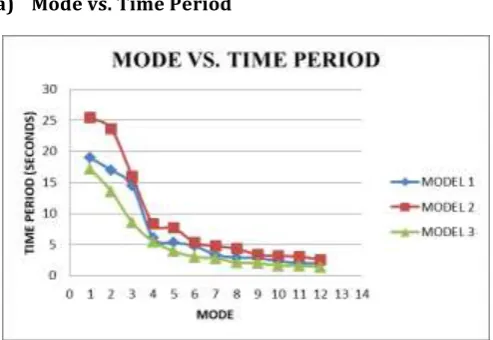
Hexagonal tube structure having maximum time period which is 25.408 seconds and which is 34% more than that of steel reference structure. Time period for hexagonal bracing tube structure is 9.31% lesser than that of steel moment resisting frame. From the frequency values highest value is for model 3 i.e., for hexagonal tube with bracing structure which is 0.058 cycles/sec
a) Mode vs. Time Period
Chart -1: Mode V/s Mode (time) period for different models
b) Mode vs. Frequency
[image:3.596.43.296.339.502.2]© 2019, IRJET | Impact Factor value: 7.211 | ISO 9001:2008 Certified Journal | Page 1286
3.2 Earth Quake Analysis results: Response SpectrumMethod
a) Low Seismic Intensity: Zone II
Chart – 3: Maximum ase shear for Zone II
Chart -4: Story Displacements for Zone II
Chart -5: Story Drifts for Zone II
b)Moderate Seismic Intensity: Zone III
Chart – 6: Maximum base shear for Zone III
Chart -7: Story Displacements for Zone II
Chart -8: Story Drifts for Zone III
c) Severe Seismic Intensity: Zone IV
Chart -10: Story Displacements for Zone IV
Chart -11: Story Drifts for Zone IV
d) Very severe Seismic Intensity: Zone V
Chart – 12: Maximum base shear for Zone V
Chart -13: Story Displacements for Zone V
Chart -14: Story Drifts for Zone V
3.3 Results of Wind Analysis
Chart -15: Story Displacements for Wind Analysis
Chart – 16: Story Drifts – Wind Analysis
4. Conclusions
i. Form the modal analysis results, it can be concluded that more time period value i.e., 25.410seconds is obtained in the first mode of vibration for hexagonal tube structure which is 34% more than the reference structure and also this hexagonal tube structure having low frequency 0.0390cycles per second. Hence from the point of assessment of frequency and time period this structure can be considered as stable.
© 2019, IRJET | Impact Factor value: 7.211 | ISO 9001:2008 Certified Journal | Page 1288
iii. From the earthquake analysis, it can be establishedthat in all seismic zones the hexagonal tall tubular steel structure having a displacement of 1.86 times and story drift 2 times higher than the steel moment resisting structure.
iv. From the wind analysis results, comparing to steel
moment resisting frame the hexagonal tube structure having a story displacement of 2.66 times and story drift of 3.05times higher.
v. Therefore in order to reduce displacement and story drift of hexagonal tube structure and also for increasing the strength of structure by incorporating additional structural system like bracings, Provision of bracings was found0to be effective in increasing the overall seismic response and characteristics of the structure,
vi. Comparing to hexagonal structure the hexagonal tube
with bracing structure shows lesser displacement and story drift and which is almost equal to the reference structure in all the intensity zones of earthquake analysis and also for wind analysis.
vii. From the analysis results and consideration it can be decided that dynamic analysis is more desirable to identify the accurate response of the tall structural system.
viii. Form the complete results and examination it can be concluded that hexagonal plan tubular structure is more suitable for tall structures than the proper beam column moment resisting steel frame system.
REFERENCS
[1] Arvind, J.S. and Helen Santhi, M. (2015) “Effect of Column Shortening on the Behaviour of Tubular Structures.” Indian Journal of Science and Technology, Vol 8(36).
[2] Dileep, N., and Renjith, R. (2015) “Analytical
investigation on the performance of tube-in-tube structures subjected to lateral loads.” International Journal of Technical Research and Applications. Vol. 3, (4), 284-288.
[3] Han, R.P.S.(1989) “Analysis of framed tube
structures of arbitrary sections”. Applied
Mathematical Modelling, Vol. 13.
[4] Hong, F., Li, Q.S., Tuan, A.Y. and Xu, L. (2009) “Seismic analysis of the world’s tallest building.” Journal of Constructional Steel Research, 65 1206– 1215.
[5] Li, Q.S., Zhang, Y.H., Wu, J.R. and Lin, J.H. (2004) “Seismic random vibration analysis of tall buildings.”
Engineering Structure, 26, 1767–1778.
[6] Lu, X.L. and Jiang, H.J. (2011) “Research and Practice
of Response Control for Tall Buildings in Mainland China.” Procedia Engineering, 14, 73–83.
[7] Nishant, R., and Siddhant, R. (2014) “Structural
Forms Systems for Tall Building Structures.”SSRG International Journal of Civil Engineering, (SSRG-IJCE). Vol. 1, (4).
[8] Patil, S. and Kalwane U. (2015) “Shear lag in tube
structures.” International Journal of Innovative
Science, Engineering & Technology. Vol. 2 (3).
[9] Pekau, Lin, L. and Zielinski, Z.A. (1996) “Static and dynamic analysis of tall tube-in-tube structures by finite story method.” Engineering Structures, Vol. 18, (7), 515-527.
[10] Richard, A. Ellis and David P. Billington (2003) “Construction history of the composite framed tube
BIOGRAPHIES
MANOJ KUMAR S R Post Graduate Student Dept. of
Civil Engineering BIET
College, Davanagere.
RAMYA B V
Asst. Professor Dept. of Civil
Engineering BIET College,
Davanagere.
SOWMYA R H
Asst. Professor Dept. of Civil
Engineering BIET College,