ISSN Online: 2327-5227 ISSN Print: 2327-5219
DOI: 10.4236/jcc.2018.66003 Jun. 21, 2018 31 Journal of Computer and Communications
A New Digital Image Encryption Algorithm
Based on Improved Logistic Mapping and
Josephus Circle
Zhiben Zhuang, Jing Wang, Jingyi Liu, Dingding Yang, Shiqiang Chen
* School of Science, Hubei University for Nationalities, Enshi, ChinaAbstract
Digital image encryption based on Joseph circle and Chaotic system has be-come a hot spot in the research of image encryption. An encryption algorithm based on improved Josephus loop and logistic mapping is proposed to scram-bling blocks in this paper. At first, the original image is scrambled by using logistic mapping to obtain the encrypted image, and then the encrypted image is divided into many blocks. Finally, the position of the blocked image is scrambled by using the improved Josephus ring to get the encrypted image. According to the experiments, the information entropy of the encrypted im-age reaches 7.99 and the adjacent correlations in three directions are within ±0.1. The experimental results show that the proposed algorithm has advan-tages of large key space, high key sensitivity and can effectively resist the at-tacks of statistical analysis and gray value analysis. It has good encryption ef-fect on digital image encryption.
Keywords
Digital Image Encryption, Image Block Scrambling, Josephus Loop, Logistic Mapping, Pixel Scrambling
1. Introduction
With the rapid development of the application of multimedia technology on the Internet, more and more images are transmitted in the network, such as mali-cious serial image information, interception and so on, which brings conveni-ence to users and causes a series of potential safety problems. Therefore, it is very important to ensure the security of image information in the process of network transmission. Among the technologies of guarantee image security [1], image encryption [1] is a more intuitive method and the essence of image en-cryption is pixel scrambling [2].
How to cite this paper: Zhuang, Z.B., Wang, J., Liu, J.Y., Yang, D.D. and Chen, S.Q. (2018) A New Digital Image Encryp-tion Algorithm Based on Improved Logistic Mapping and Josephus Circle. Journal of Computer and Communications, 6, 31-44.
https://doi.org/10.4236/jcc.2018.66003
Received: March 12, 2018 Accepted: June 18, 2018 Published: June 21, 2018
Copyright © 2018 by authors and Scientific Research Publishing Inc. This work is licensed under the Creative Commons Attribution International License (CC BY 4.0).
DOI: 10.4236/jcc.2018.66003 32 Journal of Computer and Communications In 1998, Fridrich proposed an image encryption algorithm based on permuta-tion and confusion structure in [1]. [2][3] discussed the use of Arnold mapping for pixel replacement, in which [3] also incorporates discrete Chen mapping of pixel values for permutation confusion; [4][5][6] [7] used the randomness of one-dimensional chaotic sequence to scramble the pixel position of the image to realize encryption; [8] proposed an image bit encryption algorithm based on Jo-seph’s ergodic and generalized Henon mapping. The security image to be en-crypted Hash Algorithm 1 (SHA-1) summary and user-selected encryption pa-rameters are combined as the key to drive Generalized Henon Mapping to ran-domly disturb the starting position, the reported number of intervals and the reported direction of the improved Josephus traversal map, so that different en-crypted images and encryption parameters correspond substantially to different site replacement processes and added a site obfuscation process to improve the security of site replacement. [9] proposed an image pixels scrambling by Tent chaotic mapping and then using S-box permutation of color image encryption algorithm at the bit; [8]-[14] introduced a bit-based encryption algorithm; [15]
proposed improved the Logistic map by using scale transformation, constructing robust system and composite mapping respectively. [16] proposed an image en-cryption with chaotically coupled chaotic maps. [17] proposed an image encryp-tion algorithm based on Brownian moencryp-tion and image, and introduced a new one-dimensional chaotic system. [18] analyzed the security of image encryption algorithm based on the incorrect fractional-order chaotic system. In [19], a data invariant encryption algorithm based on improved Logistic mapping is proposed. The image encryption performance is analyzed and studied and some indexes of encryption performance evaluation are also given in the [3][20].
The above works used some pixel value replacement methods in the process of encryption, such as compute of encryption pixels and adjacent elements [4], op-erations of encryption pixel gray value and key [9] [10] [11] [13] and so on. None of these algorithms involve encrypting the original image first, followed by blocking the entire encrypted image and then scrambling the block. Therefore, this paper presents a digital image encryption algorithm based on improved Jo-sephus loop and improved logistic mapping to scramble block. The images se-lected by this algorithm are all gray-scale image. The simulation experiments are carried out by Matlab, and the experimental results are evaluated by the evalua-tion indexes of informaevalua-tion entropy, histogram, fixed point ratio and adjacent pixel correlation. The experimental results show that the proposed algorithm has advantages of large key space, high key sensitivity and can effectively resist the attacks of statistical analysis and gray value analysis. It has good encryption ef-fect on digital image encryption.
2. The Preparatory Work
2.1. Improved Joseph’s Traversal Mappings
DOI: 10.4236/jcc.2018.66003 33 Journal of Computer and Communications According to the Joseph problem, we can uniquely identify an arrangement of n elements in the order of elimination. Given n and m, we can uniquely obtain a permutation constructed by (1,2, , n). Write fysf
(
n m,)
. For example,( )
4,3ysf
f , which corresponds to the element sequence of 3, 2, 4, 1, so the elements of the order can be 1, 2, 3, 4 by mapping fysf
( )
4,3 to replace it with 3, 2, 4, 1.In order to increase the permutation variables generated by Joseph’s traversal mappings, the application of Josephus rings is now augmented by an interval q constraint, which results in the randomness of the resulting permutations and increases their key space during the image’s encryption. After increasing the in-terval q, the corresponding Joseph-ergodic mapping becomes 1
(
, ,)
ysf
f n q m .
2.2. Improved Logistic Mapping
In 1976, American ecological mathematician May proposed a logistic mapping model used to simulate the growth behavior of biological populations. It is very simple in mathematical form, but its dynamic behavior is complicated by its nonlinear chaotic system. In the process of image encryption has a wide range of applications. The equation is:
(
)
1 1 ,
n n n
x+ =ux −x (1)
where n and u are system parameters. When n=1,2, and 3.75≤ ≤u 4, the
system is chaotic. In order to expand the encryption key of digital image, many researchers have improved the logistic mapping equation. For example, the im-proved logistic mapping equation is [14]:
(
)
(
)
(
(
)
)
1 1 2k 1 2 ,k , 8.
n n n n n
x ux x floor ux x k Z k+
+ = − × − − × ∈ ≥ (2)
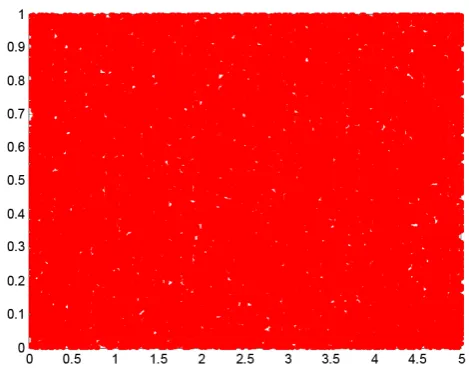
Its chaotic map is shown in Figure 1. In order to make the encrypted image more secure, the Equation (2) is made the following improvements. The equa-tion is:
( )
(
)
(
)
(
( )
(
)
)
1 1log 1 6k 1log 1 6 ,5k 15.
n n n n n n n
x+ = u x ×x −x × − floor u x ×x −x × ≤ ≤k
(3) When 5≤ ≤k 15 and u1∈
[ ]
0,4 , the system is chaotic. Its chaotic map isshown in Figure 2. Compared with the sequence generated by the chaotic map-ping in (2), the sequence in (3) is more chaotic and transformable. At the same time, the value range of k is increased so that the key space of the encryption al-gorithm also increases.
After the above improvement, 2.1 effectively increases the substitution varia-ble generated by Joseph’s ergodic mapping, and 2.2 effectively enhances the chaos state, transformativeness and the range of k of the logistic mapping se-quence.
3. Algorithm Description
3.1. Encryption Algorithm Description
DOI: 10.4236/jcc.2018.66003 34 Journal of Computer and Communications Figure 1. The chaotic map of Equation (2).
Figure 2. The chaotic map of Equation (3).
the position of the blocked image is scrambled by using the improved Josephus ring to get the encrypted image.
Given a M × N grayscale image, the encryption steps are described as follow-ing:
Step 1: Enter the encrypted grayscale image Q, the size of the image is M × N, let L = M × N.
Step 2: Enter the keys u x k l1, , ,0 , where u1 is the control parameter of the logistic chaotic map, x0 is the initial value of the logistic chaotic map, and
( )
0 0,1
x ∈ , k is the control index of the equation, l is the range of the chaotic se-quence converted to an integer and 100< <l L. This article take l=256.
Step 3: Generate a L-long chaotic sequence T =
[
x x1, 2,xL]
by using the formula (3), and then modifies each component xi of T to obtain the keyvec-tor of the sequence 1 1 1 1 1, , ,2 L
T = x x x and the vector T1 as the image en-cryption.
[image:4.595.254.489.283.469.2]vec-DOI: 10.4236/jcc.2018.66003 35 Journal of Computer and Communications tor 2 2 2
1, , ,2 L
B= x x x .
Step 5: Exclusive-OR the T1 and B to obtain another one-dimensional vector 3 3 3
1, , ,2 L
C= x x x , and then convert C to an M × N matrix to obtain the image 1
E encrypted with the improved logistic map.
Step 6: Input m n1, 1, where m1 is the pixel of each line after the block, n1 is the column pixel of each block after the block; and the values of A and B are re-spectively the factors of M and N. The values of A and B may be the same or dif-ferent.
Step 7: Partition the encrypted image E1 to obtain m n1× 1 matrix of
(
M m1) (
× N n1)
blocks.Step 8: Enter m, q, where m is the number of the first few to come up with this one, q is the number of intervals.
Step 9: Write n=
(
M m1) (
× N n1)
, C=(
1,2, , n)
, where 1,2, ,(
N n1)
are the numbering from left to right of m n1× 1 array in the first row,(
N n1+1 , ,2)
×(
N n1)
are the numbering of the m n1× 1 array in the second row from left to right and go on in order .Then all the elements in C are scram-bled by the improved Josephian traversal mapping 1(
, ,)
ysf
f n p m to get a se-quence C1.
Step 10: The elements in C1 (that is, the numbering in step 9) are arranged in a matrix of
(
M m1) (
× N n1)
from left to right in the order of positions in1
C (Write X =
(
M m1) (
× N n1)
, where X is(
M m1) (
× N n1)
matrix), and then these m n1× 1matrix of corresponding number are got into the X to get a disorganized block image.Step 11: The block image in the tenth step is restored to M×N image, which is the final encrypted image E.
3.2. Decryption Algorithm Description
Step 1: Input the final encrypted image E in step 11 above. Step 2: Enter the correct m n1, 1 to block the encrypted image E.
Step 3: Enter the correct m, q for scrambling the restoration of the block to be restored encrypted image.
Step 4: restoring the restored encrypted block image to an M × N encrypted image again.
Step 5: Enter the correct key u x k l1, , ,0 , and perform the exclusive-OR opera-tion on the M × N encrypted image to obtain the decrypted image.
4. Experimental Results and Analysis
4.1. Experimental Platform
PC configuration: Intel (R) Celeron (R) CPU N3450 @ 1.10 GHz 1.10 GHz, memory 4 GB, win 10 64 bit operating system. Through the Matlab R2014a pro-gramming to achieve the above encryption algorithm.
4.2. Experimental Results
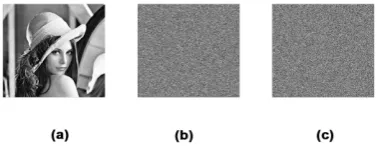
DOI: 10.4236/jcc.2018.66003 36 Journal of Computer and Communications in which the pixel value of the first image was 1024 × 1024 and the pixel values of the remaining images were both 512 × 512. The algorithm of this paper is used to test the selected four images. Figure 3 shows the comparison of plaintext, ciphertext and decrypted images. It can be seen from Figure 3 that the encrypted image has become cluttered and visually distinct from the plaintext image, showing that the algorithm has a good encrypted visual effect and the decrypted image is completely correct, indicating that the algorithm in this paper can cor-rectly implement the role of image encryption and decryption.
4.3. Key Space and Key Sensitivity Analysis
Image encryption algorithm should have enough key space and the sensitivity of key changes, so as to effectively defend against attacks. The key of this algorithm consists of 8 parameters of 1 1
1, , , , , , ,0
u x k l m n m p, where u1∈
( )
0,4 , x0∈( )
0,1 and k∈(
5,15)
are all decimal digits, plus the range of l m n m, , ,1 1 and p, the key space of this algorithm is more than 1037 (calculated with a computer preci-sion of 10−15) and has a good ability to resist attacks. The comparison results with other algorithms are shown in Table 1. [image:6.595.225.515.376.650.2]The sensitivity of the key can be divided into the sensitivity of the encryption and the sensitivity of the decryption. In the encryption process, the sensitivity
DOI: 10.4236/jcc.2018.66003 37 Journal of Computer and Communications Table 1. Key space comparison results with other methods.
Methods Ours Ref. [9] Ref. [16]
Key space 1037 2106 1.2 × 1024
can be reflected by the slight transformation of the key. We use to calculate the rate of change of ciphertext image to reflect the key encryption sensitivity, which is calculated as:
(
)
1
,
100%
L
i i i Dif E E
CRC
L
=
′
=
∑
× (4)where Ei is a ciphertext image encrypted by the initial key, Ei′ is a ciphertext
image encrypted with a small change of the key, and Dif E E
(
i, i′)
is the number of elements with different pixel values in Ei and Ei′. The following were lena,baboon, boat image as an example.
Figure 4 test the sensitivity of key u1, Figure 4(a) is the original image of le-na, Figure 4(b) is the ciphertext image E encrypted by the keys u1=3.7,
0 0.5
x = , k=9.8, l=256, m1=64, n1=128, m=3 and p=2, Figure 4(c) is the encrypted image E′ whose key u1 is changed to 3.70000000000001. By formula (4) calculated the rate of change between the two images was 99.61%.
Figure 4(d) is the decrypted image obtained by decrypting E′ with the key 1 3.7
u = , and Figure 4(e) is the decrypted image obtained by decrypting E′ with the key u1=3.70000000000001.
Figure 5 test the sensitivity of key x0. Figure 5(a) is the original picture of baboon, Figure 5(b) is the ciphertext image E encrypted with the key u1=3.7,
0 0.5
x = , k=9.8, l=256, m1=32, n1=64, m=3 and p=2. Figure 5(c) is the encrypted image E′ whose key x0 is changed to 0.50000000000001. Through the formula (4) calculated the rate of change between the two images was 99.59%. Figure 5(d) is the decrypted image obtained by decrypting E with the key x0=0.50000000000001, and Figure 5(e) is the decrypted image obtained by decrypting E with the key x0=0.5.
Figure 6 test the sensitivity of key k. Figure 6(a) is the original picture of the boat, Figure 6(b) is the ciphertext image E encrypted with the key u1=3.7,
0 0.5
x = , k=9.8, l=256, m1=32, n1=64, m=3 and p=2. Figure 6(c) is the encrypted image E′ whose key k is changed to 9.80000000000001. By formula (4) calculated the rate of change between the two images was 99.61%.
Figure 6(d) is the decrypted image obtained by decrypting E with the key
9.80000000000001
k= , and Figure 6(e) is the decrypted image obtained by de-crypting E with the key k=9.8.
DOI: 10.4236/jcc.2018.66003 38 Journal of Computer and Communications Figure 4. The sensitivity of the key u1 experimental analysis. (a) Original lena image; (b)
Encrypted image E; (c) Encrypted image E′; (d) The wrong key is decrypted; (e) The
correct key is decrypted.
Figure 5. The sensitivity of the key x0 experimental analysis. (a) Original baboon image.
(b) Encrypted image E; (c) Encrypted image E′; (d) The wrong key is decrypted; (e) The correct key is decrypted.
Figure 6. The sensitivity of the key k experimental analysis. (a) Original boat image. (b) Encrypted image E; (c) Encrypted image E′; (d) The wrong key is decrypted; (e) The
correct key is decrypted.
Figure 7 test the influences of key m1 on the decryption process. Figure 7(a) is the original picture of the lena, Figure 7(b) is the ciphertext image encrypted with the key u1=3.7, x0 =0.5, k=9.8, l=256, m1=64, n1=64, m=3 and p=2, Figure 7(c) is the decrypted image with m1 changed to 128.
Figure 8 test the influences of key p on the decryption process. Figure 8(a) is the original image of the lena, Figure 8(b) is the ciphertext image encrypted by the key u1=3.7, x0 =0.5, k=9.8, l=256, m1=64, n1=64, m=3 and
2
p= , and Figure 8(c) is the decrypted image with p changed to 3.
The experimental results from Figures 4-6 show that the ciphertext changes rate is above 99% even though the key changes slightly in the encryption process. In the process of decryption, even if the key changes slightly, it can not get the correct decryption image. The experimental results from Figure 7, Figure 8
DOI: 10.4236/jcc.2018.66003 39 Journal of Computer and Communications Figure 7. Key m1 on the decryption process
anal-ysis. (a) Original lena image; (b) Encrypted image; (c) m1 wrongly decrypted image.
Figure 8. key p on the decryption process analysis. (a) Original lena image; (b) Encrypted image; (c) p wrongly decrypted image.
4.4. Histogram Analysis
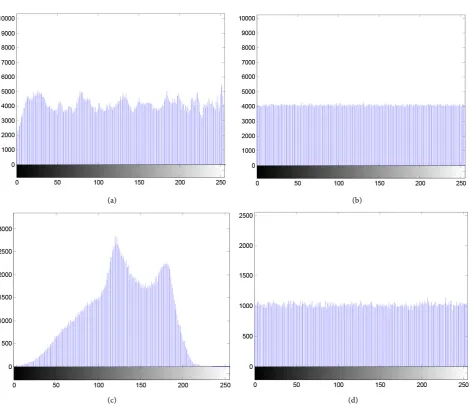
Histograms can well reflect the distribution of image pixel values. The smoother the histogram is, the more uniform the pixel values are. Figure 9 shows the his-tograms of the original image and the encrypted image of the lena and baboon images, respectively.
4.5. Image Encryption Fixed Point Ratio Analysis
According to the literature [3][20], the fixed point refers to the pixel whose gray value does not change before and after the image is encrypted. The fixed point ratio is the percentage of the fixed point of the image and all pixels, which is calculated as follows:
(
,)
1 1( )
, 100%M N
i j f i j
BD G C
MN
= =
=
∑∑
× (5)where
( )
, 1, 0,ij ij
ij ij
g c
f i j
g c
=
= ≠
.
From the formula (5) to calculate the fixed point of the encryption algorithm as shown in Table 2.
4.6 Average Gray Value Change Analysis
[image:9.595.279.468.202.275.2]DOI: 10.4236/jcc.2018.66003 40 Journal of Computer and Communications (a) (b)
(c) (d)
Figure 9. Histogram comparison of plaintext image and ciphertext image. Histogram of plaintext lena; (b) Histogram of en-crypted lena; (c) Histogram of plaintext baboon; (d) Histogram of enen-crypted baboon.
Table 2. Encrypted image fixed point ratio analysis table.
Image All pixels Fixed point Fixed point ratio
lena 1,048,576 4014 0.39%
baboon 262,144 1075 0.41%
boat 262,144 1021 0.39%
couple 262,144 974 0.37%
(
,)
1 1M N ij ij i j c g
GAVE C G
MN
= =
−
=
∑∑
(6) [image:10.595.64.537.60.464.2]DOI: 10.4236/jcc.2018.66003 41 Journal of Computer and Communications Table 3. Average gray value change analysis table.
image lena baboon boat couple
Average changed value of gray 84.92 71.26 75.05 70.53
4.7. Information Entropy Analysis
Information entropy reflects the distribution of image gray values. The more uniform the gray value of images is, the larger the information entropy of images is. On the contrary, the entropy of information is smaller [20]. Information en-tropy is calculated as follows:
( )
( )
2( )
1 log
L
i i
i
H G p x x
=
= −
∑
(7)The information entropy of the original image and the ciphertext image cal-culated according to formula (7) are shown in Table 4.
4.8. Neighborhood Pixel Correlation Analysis
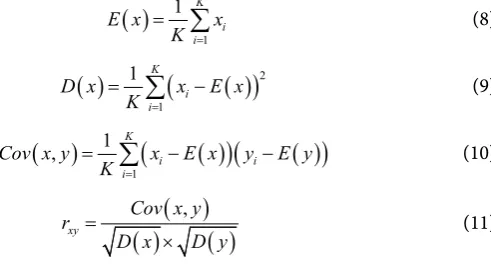
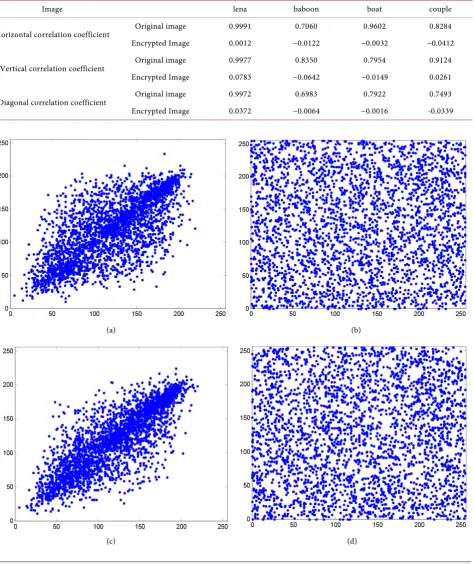
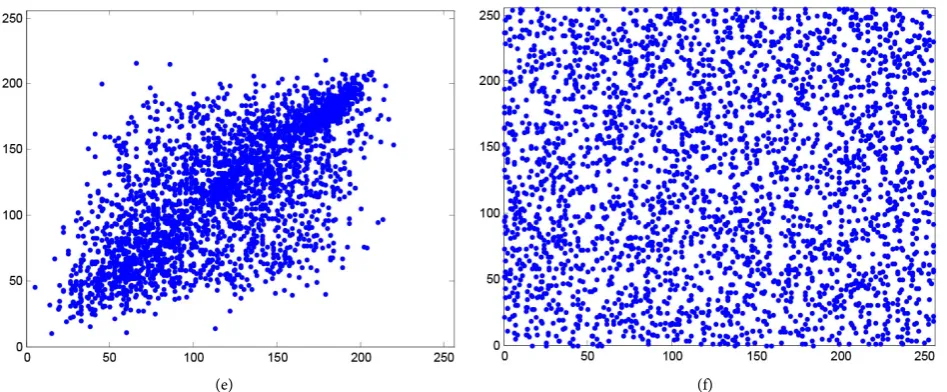
The correlation of adjacent pixels is used to evaluate the effect of image encryp-tion algorithms in eliminating the correlaencryp-tion of adjacent pixels in a plaintext image. In this paper, 3000 adjacent pixels are randomly selected in the original images and ciphertext images of 4 images. The correlation coefficients of adja-cent pixels of the original image and the ciphertext image in the horizontal di-rection, the correlation coefficients of the adjacent pixels of the original image and the ciphertext image in the vertical direction and the correlation coefficients of adjacent pixels of the original image and the ciphertext image in the diagonal direction are calculated according to the formulas (8) - (11). Table 5 is a com-parison table of correlation coefficients between the original image and the en-crypted image. In Figure 10, the correlation between the original baboon image and the encrypted image in the horizontal, vertical and diagonal directions is compared.
( )
1 1 K i iE x x
K =
=
∑
(8)( )
(
( )
)
2 11 K
i i
D x x E x
K =
=
∑
− (9)(
)
(
( )
)
(
( )
)
11
, K i i
i
Cov x y x E x y E y
K =
=
∑
− − (10)( )
( )
( )
,
xy
Cov x y r
D x D y
=
× (11)
5. Conclusion
DOI: 10.4236/jcc.2018.66003 42 Journal of Computer and Communications Table 4. Table of information entropy analysis of original and encrypted images.
image lena baboon boat couple
The original image 7.9790 7.3713 7.1267 7.2369
Ciphertext image 7.9999 7.9992 7.9991 7.9990
Table 5. Comparison table of correlation coefficient between original image and encrypted image.
Image lena baboon boat couple
Horizontal correlation coefficient Original image 0.9991 0.7060 0.9602 0.8284
Encrypted Image 0.0012 −0.0122 −0.0032 −0.0412
Vertical correlation coefficient Original image 0.9977 0.8350 0.7954 0.9124
Encrypted Image 0.0783 −0.0642 −0.0149 0.0261
Diagonal correlation coefficient Original image 0.9972 0.6983 0.7922 0.7493
Encrypted Image 0.0372 −0.0064 −0.0016 -0.0339
(a) (b)
[image:12.595.65.540.175.741.2]DOI: 10.4236/jcc.2018.66003 43 Journal of Computer and Communications (e) (f)
Figure 10. Comparison of the correlation between original baboon image and encrypted baboon image in horizontal, vertical and diagonal directions; (a) Baboon original image horizontal correlation; (b) Horizontal correlation of baboon after encryption; (c) Baboon originalimage vertical correlation; (d) Vertical correlation of baboon after encryption; (e) Baboon original image diagonal correlation; (f) Diagonal correlation of baboon after encryption.
encryption algorithm based on improved Josephus loop and improved logistic mapping to scrambling block. At first, we use logistic mapping to scramble the original image to obtain the encrypted image and then the encrypted image is divided into blocks. Finally, an improved Josephus ring is used to perform the position of the blocked image to get the encrypted image in this paper. By Mat-lab simulation experiments and the safety of experimental results are analyzed, the results show that the algorithm has the advantages of large key space, high key sensitivity, and can effectively resist the statistical analysis and gray value analysis attacks. So, it has good encryption effect on digital image encryption.
References
[1] Fridrich, J. (1998) Symmetric Ciphers Based on Two-Dimensional Chaotic Maps. Intemational Journal of Bifurcation and Chaos, 8, 1259-1284.
https://doi.org/10.1142/S021812749800098X
[2] Xu, J.F. and Yang, Y. (2006) Analysis of Scrambling Performance of Encrypted Im-age. Neural Computation, 33, 110-113.
[3] Guan, Z.H., Huang, F.J. and Guan, W.J. (2005) Chaos-Based Image Encryption Al-gorithm. Physics Letters A, 346, 153-157.
[4] Xu, B. and Yuan, L. (2014) Research on Image Encryption Algorithm Logistic Chaotic Based on an Improved Digital Mapping. Computer Measurement & Con-trol, 22, 2157-2159.
[5] Li, C.H., Luo, G.C., Qin, K. and Li, C.B. (2016) An Image Encryption Scheme Based on Chaotic Tent Map. Nonlinear Dynamics, 1-7.
[6] Li, X., Zhang, G.J. and Zhang, X.Y. (2015) Image Encryption Algorithm with Com-pound Chaotic Maps. Journal of Ambient Intelligence & Humanized Computing, 6, 563-570. https://doi.org/10.1007/s12652-013-0217-4
DOI: 10.4236/jcc.2018.66003 44 Journal of Computer and Communications Chaotic Sequences. Journal of Computer-Aided Design & Computer Graphics, 12, 672-676.
[8] Gou, Y., Shao, L.P. and Yang, L. (2015) Bit-Level Image Encryption Algorithm Based on Josephus and Henon Chaotic Map. Application Research of Computers, 32, 1-7.
[9] Hussain, I. and Gondal, M.A. (2014) An Extended Image Encryption Using Chaotic Coupled Map and S-Box Transformation. Nonlinear Dynamics, 76, 1355-1363. https://doi.org/10.1007/s11071-013-1214-z
[10] El-Latif, A.A.A., Li, L., Zhang, T.J., Wang, N., Song, X.H. and Niu, X.M. (2012) Dig-ital Image Encryption Scheme Based on Multiple Chaotic Systems. Sensing and Imaging, 13, 67-88. https://doi.org/10.1007/s11220-012-0071-z
[11] Khanzadi, H., Eshghi, M. and Borujeni, S.E. (2014) Image Encryption Using Ran-dom Bit Sequence Based on Chaotic Maps. Arabian Journal Forence & Engineering, 39, 1039-1047. https://doi.org/10.1007/s13369-013-0713-z
[12] Seyedzadeh, S.M., Norouzi, B., Mosavi, M.R. and Mirzakuchaki, S. (2015) A Novel Color Image Encryption Algorithm Based on Spatial Permutation and Quantum Chaotic Map. Nonlinear Dynamics, 81, 1-19.
https://doi.org/10.1007/s11071-015-2008-2
[13] Zhu, H.G., Lu, X.J., Zhang, X.D. and Tang, Q.S. (2014) A Novel Image Encryption Scheme with 2D-Logistic Map and Quadratic Residue. Journal of Northeastern University (Natural Science), 35, 20-23.
[14] Liu, R. (2015) New Algorithm for Color Image Encryption Using Improved 1D Lo-gistic. Open Cybernetics & Systemics Journal, 9, 210-215.
https://doi.org/10.2174/1874110X01509010210
[15] Elgendy, F., Sarhan, A.M., Eltobely, T.E., El-Zoghdy, S.F., El-Sayed, H.S. and Fara-gallah, O.S. (2015) Chaos-Based Model for Encryption and Decryption of Digital Images. Multimedia Tools & Applications, 1-25.
[16] Pisarchik, A. and Zanin, M. (2008) Image Encryption with Chaotically Coupled Chaotic Maps. Journal of Physics D, 237, 2638-2648.
https://doi.org/10.1016/j.physd.2008.03.049
[17] Chai, X. (2017) An Image Encryption Algorithm Based on Bit Level Brownian Mo-tion and New Chaotic Systems. Multimedia Tools and Applications, 76, 1159-1175.
https://doi.org/10.1007/s11042-015-3088-1
[18] Norouzi, B. and Mirzakuchaki, S. (2017) Breaking a Novel Image Encryption Scheme Based on an Improper Fractional Order Chaotic System. Multimedia Tools and Applications, 76, 1817-1826.https://doi.org/10.1007/s11042-015-3085-4 [19] Yang, D., Wang, J. and Chen, S. (2017) An Encryption Algorithm Keeping Data
Length Unchanged Based on Modified Logistic Map. Computer Applications and Software, 34, 293-298.