SOLUBILIZATION OF DI-AND POLY
*
El-Shamy, O.
Egyptian Petroleum Research Institute
ARTICLE INFO ABSTRACT
The effect of three selected concentrations of the nonionic surfactant, polyoxyethylenated (23) monolaurate (I) and polyoxyethylenated (23) monostearate (II) on an
used to detect the critical micelle concentration (CMC). The hydrophobic calculated and the wetting Power was determined for the prepared surfactants. Gas Chro
used to detect the most effective surfactant as a dispersing agent; also, the pristine/phytane ratio was determined before and after treatment. The di
respectively using t
II, can successfully be used as a dispersing agent especially at and above its critical micelle concentrations (CMC) with efficiency more than surfactant I,
low concentration range (i.e. below the CMC).
INTRODUCTION
Marine oil spills have become more common as offshore oil production and transport increased over the last few decades
[Li et al., 2007; Anderson and LaBelle 2000]. The volume of crude oil
being spilled into the environment has increased significantly especially now where that oil seems to have taken the center stage as the major source of energy to mankind. Spilled oil on the surface of water bodies limits gaseous exchange, entangles, and kills surface organisms, and coats the gills of fish [Otitoloju 2005]
spilled into the sea, it suffers some natural processes like spreading, evaporation, and dissolution. Also, wind and waves influence the rate of spill spreading. All these factors lead to the spread of the oil spilled in the sea water and the formation of water-in-oil emulsion and/or dispersion which will pollute the marine environment and cause damage for the aquatic organisms. The first priority in
stop the source of leakage and the second is to contain the spill so that further environment damage does not occur. For this reason, most researches were designed to study the possibility of cleaning
in marine water [Shalaby and El-Shamy 2006]. It is generally accepted that no single technique will be capable of dealing with every oil spill. The spillage of crude oil into the environment and its far-reaching negative effects on the environment demands the development of various control strategies such as containment and recovery using booms [Wong and Stewart 2003], skimmers or pumps [Lambton 2002], sorbents, burning [Garo et al., 2004]
[Anderson et al., 2009]. The volume of oil spilled, the sensitivity of the receiving environment, the topography of the area, etc. will always dictate the type of control strategies deployed. Dispersants are usually introduced when there is need to urgently eliminate the floating mass of the oil slick, especially when the spillage is close to shorelines [Otitoloju 2005].Dispersantsare specific type of surfactants. Their molecules possess amphiphilic characters as they consist of hydrophilic moieties together with hydrophobic moieties. The use of dispersants to remedy and site is being examined in research laboratories [Mourrel and Schechter 1998]. Dispersants alter the
*Corresponding author:El-Shamy, O. A. A.
Egyptian Petroleum Research Institute (EPRI), Nasr city 11727, Cairo, Egypt
ISSN: 0975-833X
International Journal of Current Research Vol.
Article History:
Received 16th
October, 2010 Received in revised form 19th
November, 2010 Accepted 10th
December, 2010 Published online 31st
March, 2011
Key words:
Dispersion, Oil spill, Marine pollution, Gas Chromatography.
RESEARCH ARTICLE
AND POLY-AROMATICS USING NONIONIC SURFACTANTS
Shamy, O. A. A. and Shalaby, M. N.
Egyptian Petroleum Research Institute (EPRI), Nasr city 11727, Cairo, Egypt
ABSTRACT
The effect of three selected concentrations of the nonionic surfactant, polyoxyethylenated (23) monolaurate (I) and polyoxyethylenated (23) monostearate (II) on an artificial oil spill was studied. Surface tension measurements were used to detect the critical micelle concentration (CMC). The hydrophobic-Lypophilic balance, HLB, was calculated and the wetting Power was determined for the prepared surfactants. Gas Chro
used to detect the most effective surfactant as a dispersing agent; also, the pristine/phytane ratio was determined before and after treatment. The di- and poly-aromatic compounds were detected at 228 nm and 256 nm, respectively using the Ultra Violet technique (UV). The obtained results pointed out that the nonionic surfactant, can successfully be used as a dispersing agent especially at and above its critical micelle concentrations (CMC) with efficiency more than surfactant I, which is less effective at these concentrations but it shows a good result at low concentration range (i.e. below the CMC).
Copyright, IJCR, 2013, Academic Journals
Marine oil spills have become more common as offshore oil
production and transport increased over the last few decades . The volume of crude oil
being spilled into the environment has increased significantly especially now where that oil seems to have taken the center stage as the major source of energy to mankind. Spilled oil on the surface of exchange, entangles, and kills surface [Otitoloju 2005]. Once the oil spilled into the sea, it suffers some natural processes like spreading, evaporation, and dissolution. Also, wind and waves influence the rate ill spreading. All these factors lead to the spread of the oil spilled oil emulsion and/or dispersion which will pollute the marine environment and cause damage for the aquatic organisms. The first priority in any spill is to stop the source of leakage and the second is to contain the spill so that further environment damage does not occur. For this reason, most researches were designed to study the possibility of cleaning-up the oil . It is generally accepted that no single technique will be capable of dealing with every oil spill. The spillage of crude oil into the environment and its reaching negative effects on the environment demands the control strategies such as containment and , skimmers or pumps 2004], and dispersants . The volume of oil spilled, the sensitivity of eiving environment, the topography of the area, etc. will always dictate the type of control strategies deployed. Dispersants are usually introduced when there is need to urgently eliminate the floating mass s close to shorelines are specific type of surfactants. Their molecules possess amphiphilic characters as they consist of hydrophilic moieties together with hydrophobic moieties. The use of eing examined in research
. Dispersants alter the
Egyptian Petroleum Research Institute (EPRI), Nasr city 11727, Cairo, Egypt
balance between natural dispersion and
balance strongly towards dispersion and away from emulsification. The formation of droplets increases the exposure of the oil to bacteria and oxygen, favoring biodegradation. However, the distribution of oil into the water column is increased. This study is designed to examine how the type of the surfactant head can affect its performance as dispersing agents for oil spill. To achieve this goal, the two surfactants I and II were used. These surfactants have similar ethylene oxide and different hydrophobic chain.
EXPERAIMENTAL
Materials
Ethoxylated nonionic surfactants were prepared in the laboratory according to the method recorded elsewhere
Feky et al., 2009]. Oil polluted sea water sample was
by the addition of crude oil that obtained from east desert to unpolluted sea water. Different concentrations of the tested surfactants were added to the oil polluted sea water and shake well for 6 h. After settled, the sample was poured in a separating funnel to separate the surface oil layer from the water layer [El-Shamy 2003]
Measurements
Surface tension
The surface tension of the tested surfactant samples were measured using Krüss Tensiometer K100, Krüss GmbH at room temperature.
Sinking time
The sinking time (wetting power) of the surface active agents under investigation was determined by measuring the sinking time in second of gray cotton skein in the surfactant solution using Daves and Clarkson method [Lissant 1974].
Gas Chromatography
The gas chromatography (GC) is selected as a good tool to detect the intensity of pollution before and after treatment with dispersant and to
ternational Journal of Current Research Vol. 3, Issue, 3, pp.252-256, March, 2011
INTERNATIONAL
OF CURRENT RESEARCH
AROMATICS USING NONIONIC SURFACTANTS
11727, Cairo, Egypt
The effect of three selected concentrations of the nonionic surfactant, polyoxyethylenated (23) monolaurate (I) and artificial oil spill was studied. Surface tension measurements were Lypophilic balance, HLB, was calculated and the wetting Power was determined for the prepared surfactants. Gas Chromatography (GC) was used to detect the most effective surfactant as a dispersing agent; also, the pristine/phytane ratio was determined aromatic compounds were detected at 228 nm and 256 nm, he Ultra Violet technique (UV). The obtained results pointed out that the nonionic surfactant, can successfully be used as a dispersing agent especially at and above its critical micelle concentrations (CMC) is less effective at these concentrations but it shows a good result at
, Academic Journals. All rights reserved.
dispersion and emulsification, pushing the balance strongly towards dispersion and away from emulsification. The formation of droplets increases the exposure of the oil to bacteria and oxygen, favoring biodegradation. However, the distribution of oil This study is designed to examine how the type of the surfactant head can affect its performance as dispersing agents for oil spill. To achieve this goal, the two surfactants I and II were used. These surfactants have similar ethylene oxide units
Ethoxylated nonionic surfactants were prepared in the laboratory according to the method recorded elsewhere [Wrigley et al., 1957;
El-. Oil polluted sea water sample was prepared in lab by the addition of crude oil that obtained from east desert to Different concentrations of the tested surfactants were added to the oil polluted sea water and shake well for 6 h. After a separating funnel to separate the
Shamy 2003].
The surface tension of the tested surfactant samples were measured using Krüss Tensiometer K100, Krüss GmbH at room temperature.
The sinking time (wetting power) of the surface active agents under investigation was determined by measuring the sinking time in second of gray cotton skein in the surfactant solution using Daves and
clarify the efficiency of each dispersant at the different concentrations under investigation. The gas chromatograms of the crude surface samples before and after treatment with surfactants were recorded on GC-17A Gas chromatograph, Shimadzu-(Japan) with methyl sillicon column. The column temperature was 70 oC (for 2 min.) and
increased 7 oC/min until it reached 270 oC (for 10 min.). The detector and injector temperatures were 300 oC.
Ultra Violet spectroscopy
The Ultra Violet (UV) absorption for the subsurface water sample using Unicam UV2-100 UV/Visible spectrometer is used to detect the solubilization of di- and poly-aromatic compounds due to the presence of surfactant at wave length 228 nm and 256 nm, respectively.
RESULTS AND DISCUSION
Chemical Structure
Elemental Analysis
The carbon and hydrogen content of the used surfactant has been determined using CHN Elemental Analyzer Elementer Vario – EL (Germany). The matching between the measured and the theoretical percentage indicates the purity of the compound to be used as show in Table 1.
Table 1. Elemental analyses for nonionic surfactant (I)
Sample Element
%C %H
Found Calculated Found Calculated
I 57.9 58.0 9.7 9.6
II 66.9 67.0 10.6 10.6
FTIR
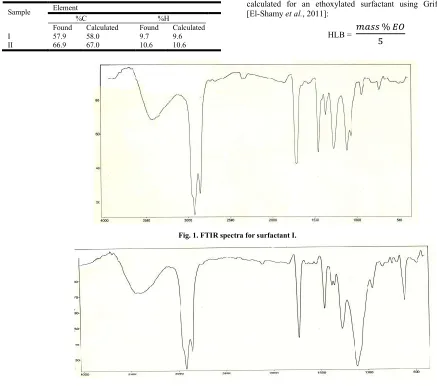
The chemical structure of the prepared ethoxylated nonionic surfactants was confirmed by the FTIR which are shown the following absorption bands at 2886.92 cm-1(CH
2str.), 1468.53 cm-1 (CH2 bend.),
1111.76 cm-1 (C-O str.) and 1731.76 cm-1 (C=O). The FTIR spectra confirmed the expected function groups in the synthesized ethoxylated surfactants (Fig. 1 and 2).
Critical Micelle Concentration
The critical micelle concentrations (CMC) of the investigated surfactants were determined from the intercept point of the two linear
portions given by the semi logarithmic plot of surface tension, γ (mNm-1) versus log concentration, log C (mol dm-3). A break is
observed where the surface tension doesn’t change further with concentration; this break represents the critical micelle concentration as observed in Figures (3 and 4) for the tested nonionic and anionic surfactants, respectively. The cmc values of the used surfactants are 2.51 x 10⁻⁴ mol dm-3 for (II) and 2.31 x 10⁻⁴ mol dm-3 for (I). It is clear from the data of CMC that it decrease with increasing the
hydrophobic chain which is agreed with many authors [El-Feky et al., 2010].
Hydrophilic-Lipopholic Balance (HLB)
The HLB number of a surfactant is one of the most widely used indicators of its suitability for a given application.It is a measure of a surfactant partitioning tendency between oil and water and it calculated for an ethoxylated surfactant using Griffin's equation [El-Shamy et al., 2011]:
[image:2.612.67.504.334.720.2]HLB =
%
Fig. 1. FTIR spectra for surfactant I.
Fig. 3. Variation of surface tension with log concentration for I.
Fig. 4. Variation of surface tension with log concentration for II.
Where, mass % EO is the percentage of EO in the surfactant on the mass scale. From the calculated values and according to the HLB scales [El-Shamy 2003], it was found that the two surfactants can be considered not only as dispersing agents but also as good solubilizer (HLB = 16.6), in addition, both of them are considered as strong wetting agents. The HLB data revealed the good suitability of the selected surfactants in this application.
Sinking time
The sinking time logarithm were plotted versus log concentration. Fig. 5 declined that the logarithm of the sinking time is a linear function of the log of the bulk phase concentration and decreased sharply as the surfactant concentration increases. This means that the tested surfactants possess wetting power confirmed the HLB results.
Variation of log sinking time with log surfactant concentration: I (□) and II (▲)
Gas Chromatography measurements (GC)
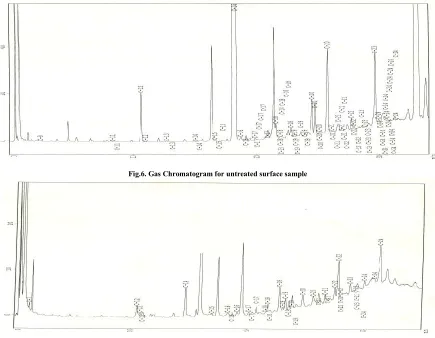
The GC profile of the untreated polluted sea water in Fig. 6 shows that the chromatogram has a homologous series of n-alkanes distributed with regularly spaced of gradually changed size. Also, the two majored acyclic isoprenoids pristane (C17) and phytane (C18) are
[image:3.612.63.300.185.265.2]present. All arranged over a large unresolved complex mixture (UCM), which is the general feature of the used petroleum crude oil [El-Shamy 2003]. The GC profile of the original sample (i.e. untreated oil polluted sea water) shows the absence of low molecular weight hydrocarbons ranged from (C1-C10) where they were easily
Fig.6. Gas Chromatogram for untreated surface sample
[image:3.612.90.525.368.706.2]vaporized. The GC-profile of the polluted surface that was treated with different concentrations of the tested nonionic surfactant II is defined
and given in Figure (7, 8 and 9). At low surfactant concentration (i.e. below the cmc), there is no great effectobserved (Figure 7) while
a good dispersion efficiency is observed with concentrations at and above the critical micelle concentration [Figure 8 and 9]. This behavior reflects the solubilization of the oil droplets into the hydrophobic core of the micelle of this surfactant which contain long hydrocarbon chain. This result is in line with the feature discussed before [Deshpande et al., 2000] as the author decided that the surfactant monomers aggregate to form micelles with the hydrophobic portion of the molecules in the center and the hydrophilic portions at the micelle. The hydrophilic exterior of the micelles makes them highly stable in water while the contaminants partitioning into the hydrophobic micelle interior increases their apparent solubilization. Surfactant I has similar trend as surfactant II but with less efficiency (GC-Profile not include). Because the aromatic components are polar in nature, it would be expected that they favor to solubilize in the palisade region of the micelles. This behavior gives the reason for the high treating of polluted water by investigated surfactants at and above its critical micelle concentration [Shalaby and El-Shamy 2006]. The two isoprenoids, pristine and phytane (C17 and C18, ratio of the
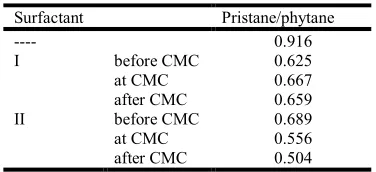
respectively) and their ratio was calculated before and after the addition of surfactants and the obtained data are tabulated in Table (2). The decrease in the value of these ratios with the increase in the surfactant concentrations confirms the effect of the used surfactant on the resistant isoprenoid compounds [Shimy et al., 1995]. A different feature than in cse of La(EO)14 has been shown in Figure (5 a,b,c) for
the GC profile of the surface oil pollutant treated with the anionic
[image:4.612.123.494.47.218.2]surfactant SDS at concentrations: below, at, and higher than cmc, respectively. At low concentration, i.e. below cmc, the chromatogram shows markedly decrease in the concentration of all the hydrocarbons series compared with the GC chromatogram before treatment as presented in Figure (5a). The efficiency of SDS is greater not only on the lower hydrocarbons but its effect reaches also the higher hydrocarbon series. Despite of the resistance of isopernoides pristane and phytane to different weathering conditions [Pastor et al., 2001], the chromatogram declares that there is a significant decrease in their concentrations and hence their ratio as represented in Table 2.
Table 2. The pristine / phytane ratio for surface oil sample with and without surfactants
Surfactant Pristane/phytane
---- 0.916
I before CMC 0.625 at CMC 0.667 after CMC 0.659 II before CMC 0.689 at CMC 0.556 after CMC 0.504
The pristane / phytane ratio with both surfactant concentrations at and above the cmc are slightly affected, which confirmed the efficiency of them as dispersing agent for oil polluted sea water. Ultra violet spectroscopy is a sensitive tool for qualitative determination of aromatic hydrocarbons and various heterocyclic compounds [Shimy
[image:4.612.112.506.246.413.2]et al., 1995]. Saturated hydrocarbons such as paraffins do not respond
Fig.8. Gas Chromatogram for treated surface sample with II at CMC
[image:4.612.339.527.569.655.2]to this technique. The UV absorption spectra is used to detect the solubilization of di- (at 228 nm) and poly-aromatics (at 256 nm) due to the presence of the tested surfactants. The spectrogram of the water sample that was treated by each surfactants especially at low concentration shows a peak at 228 nm while another with higher surfactant concentration (at cmc) another peak at 256 nm appears. This indicates that surfactant under investigation possess a great efficiency to solubilize di-aromatic compounds of the oil surface presents in water column and hence great facility for the biodegradation of these compounds. Above the cmc, the efficiency of the solubilization of both di- and poly- aromatics increases (Figure not include). The results of UV with those obtained from GC are matched and confirm each other.
Conclusion
Surface tension measurements were used to determine the CMC for the investigated surfactants.
The sinking time measurements were declared the strong wetting power of the investigated surfactants.
HLB values were declared that the investigated surfactants considered as solubilizig agents.
Surfactant II exhibits higher dispersion and solubilization for both di- and poly- aromatics as confirmed by both GC and UV comparing with surfactant I.
Acknowledgement
Prof. Dr. Shimy, Th.M. for here kindly support and fruitful help.
REFERENCES
Anderson, B. S.; Arenella-Parkerson, D.; Phillips,B. M.; Tjeerdema, R.S. and Crane, D. (2009): "Preliminary investigation of the effects of dispersed prudhoe bay crude oil on developing top smelt embryos, atherinops offinis", Environmental Pollution, 157:1058-1061.
Anderson, C.M. and LaBelle, R.P. (2000): "Update of Comparative occurance rates for offshore oil spills", Spill Science & Technology Bulletin, 6: 5-6.
Deshpande, S.; Wesson, L.; Wade, D.; Sabtini, D.A. and Harwell, J.H. (2000): "DOWFAX surfactant components for enhancing contaminant solubilization", Water research, 34.
El-Feky, A. A. Shalaby, M. N. El-Shamy, O. A. A. and Selim, S. A. 2010. Adsorption of Some Surfactants onto Polyvinyl Alcohol as Hydrophobic Polymer Surface J. Disp. Sci. and Technol. 31:1091-1099.
El-Feky, A.A.; Shalaby, M.N. and El-Shamy, O.A.A. 2009. Polymers
as Hydrophobic Adsorbent Surface for Some Surfactants. J. Disp. Sci. and Technol. 30:445-450.
El-Shamy O.A.; Khidr T.T. and Doheim, M.M., Effect of Ethoxlate Chain Length on the Pour Point Depressant of Middle Distillate Fuel Oil. Journal of Dispersion Science and Technology 2011; 32: 654-658.
El-Shamy, O.A.A. (2003): M.Sci. Thesis, "A Study on The Effect of Some Surfactants on Petroleum Oil-Spilled in Marine Water", Mansoura University, Cairo, Egypt.
Garo, J.P.; Vantelon, J.P.; Souil, J.M. and Breillat, C. (2004): "Burning of weathering and emulsified oil spills", Experimental Thermal and Fluid Science, 28.
Lambton, J.W. (2002): "Summary of field equipments for responding to revering oil spills in ice", Spill Science & Technology Bulletin, 7.
Li, Z., Kepkay, P., Lee, K., King, T.; Boufadel, M.D. and Venosa, A.D. (2007): "Effects of chemical dispersants and mineral fines on crude oil dispersion in a wave tank under breaking waves", Marine Pollution Bulletin, 54.
Lissant, K.J. 1974. Surfactant Series, Emulsions and Emulsion Technology. Part 1 Marcel Dekker, IVC, New York.
Mourrel, M. and Schechter, R.S. (1998): "Microemulsion and Related System", Surfactant science Series, New York.
Otitolju, A.A. (2005): "Crude oil plus dispersant: always a boon or a bane?", Ecotoxicology and Environmental Safety, 60.
Pastor, D.; Sanchez, J.; Porte, C. and Albaiges, J. (2001): "The Aegean sea oil in the Galicia Coast (NW Spain).I. Distribution and fate of the crude oil and combustion products in subtaidal sediments". Marine Pollution Bulletin, 42.
Shalaby, M.N. and Elshamy, O.A.A. (2006): "Treatment of Marine Water Against Petroleum Oil Pollution Using Some Surfactants", Egyptian Journal of Petroleum, 15: 2.
Shimy, Th.M.; Mostafa, Y.M. and Roushdy, M.I. (1995): "Suez Canal Environment and Oil Pollution Studies", TESCE, 21(2) (1995). Wong, K.F.V. and tewart, H.O. (2003): "Oil spill contaminant by
flexible boom system", Spill Science & Technology Bulletin, 8: 543-548.